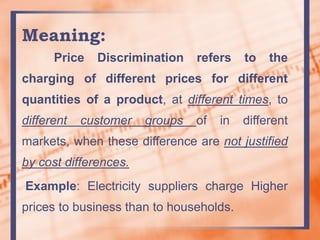
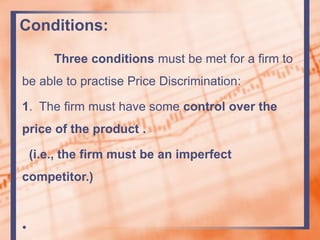
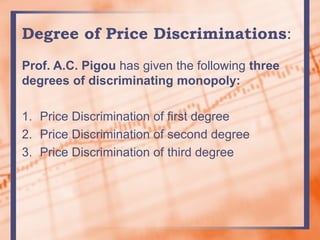
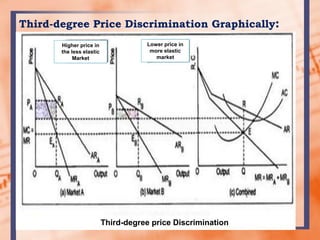
This document discusses different types of price discrimination. It defines price discrimination as charging different prices for the same product when costs are equal. There are three degrees of price discrimination: first, second, and third. First degree involves charging each customer the maximum they are willing to pay. Second degree sets uniform prices in blocks that get lower at higher quantities. Third degree discriminates across different markets that have different price elasticities of demand. To practice discrimination, a firm needs monopoly power and the ability to segment markets.












![Eco 6th Lecture[1]](https://cdn.slidesharecdn.com/ss_thumbnails/eco6thlecture1-1253256517118-phpapp03-thumbnail.jpg?width=640&height=640&fit=bounds)


