MANUEL M. MATHEW
II MA ECONOMICS
UNIVERSITY COLLEGE
TRIVANDRUM
relates business cycles to the internal
workings of the economy, showing how
changes in investment and output reinforce
each other; the central ingredients of the
model are the multiplier and accelerator.
Samuelson’s Model of Business Cycles:
Interaction between Multiplier and Accelerator
Multiplier is the factor by which a change
in a component of agg.dd,like C or I or G is
multiplied to lead to a larger change in
equilibrium national output. The multiplier
principle is so named because relatively small
autonomous changes generate relatively
larger, or multiple, induced changes in
agg.production.This principle is commonly
represented by a multiplier, which is a specific
number with a value greater than 1.
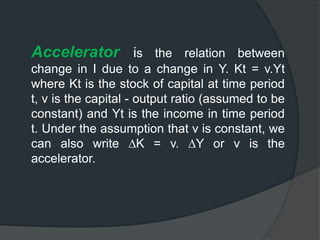
Accelerator is the relation between
change in I due to a change in Y. Kt = v.Yt
where Kt is the stock of capital at time period
t, v is the capital - output ratio (assumed to be
constant) and Yt is the income in time period
t. Under the assumption that v is constant, we
can also write ∆K = v. ∆Y or v is the
accelerator.
 An autonomous increase in the level of
investment raises income by a
magnified amount depending upon the
value of the multiplier.
 This increase in income further induces
the increase in investment through the
acceleration effect.
Combining Accelerator with
Keynesian Multiplier
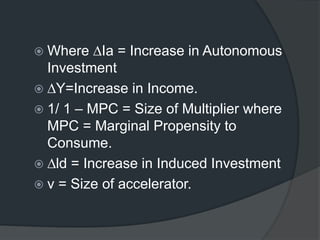
 Where ∆Ia = Increase in Autonomous
Investment
 ∆Y=Increase in Income.
 1/ 1 – MPC = Size of Multiplier where
MPC = Marginal Propensity to
Consume.
 ∆ld = Increase in Induced Investment
 v = Size of accelerator.
Mathematical
Representation
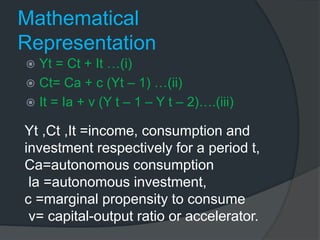
 Yt = Ct + It …(i)
 Ct= Ca + c (Yt – 1) …(ii)
 It = Ia + v (Y t – 1 – Y t – 2)….(iii)
Yt ,Ct ,It =income, consumption and
investment respectively for a period t,
Ca=autonomous consumption
la =autonomous investment,
c =marginal propensity to consume
v= capital-output ratio or accelerator.
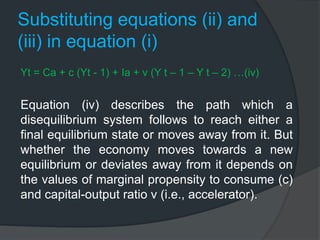
Substituting equations (ii) and
(iii) in equation (i)
Yt = Ca + c (Yt - 1) + Ia + v (Y t – 1 – Y t – 2) …(iv)
Equation (iv) describes the path which a
disequilibrium system follows to reach either a
final equilibrium state or moves away from it. But
whether the economy moves towards a new
equilibrium or deviates away from it depends on
the values of marginal propensity to consume (c)
and capital-output ratio v (i.e., accelerator).
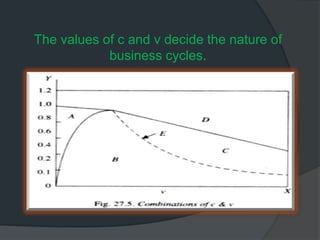
The values of c and v decide the nature of
business cycles.
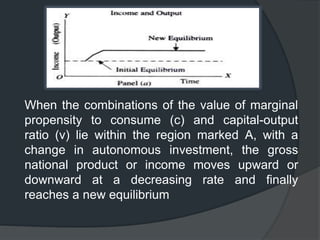
When the combinations of the value of marginal
propensity to consume (c) and capital-output
ratio (v) lie within the region marked A, with a
change in autonomous investment, the gross
national product or income moves upward or
downward at a decreasing rate and finally
reaches a new equilibrium
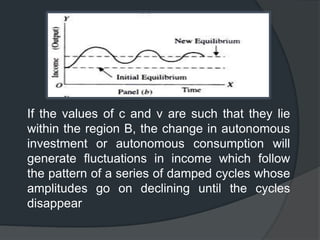
If the values of c and v are such that they lie
within the region B, the change in autonomous
investment or autonomous consumption will
generate fluctuations in income which follow
the pattern of a series of damped cycles whose
amplitudes go on declining until the cycles
disappear
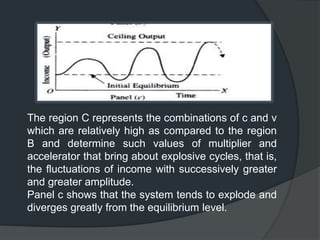
The region C represents the combinations of c and v
which are relatively high as compared to the region
B and determine such values of multiplier and
accelerator that bring about explosive cycles, that is,
the fluctuations of income with successively greater
and greater amplitude.
Panel c shows that the system tends to explode and
diverges greatly from the equilibrium level.
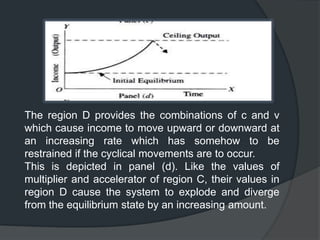
The region D provides the combinations of c and v
which cause income to move upward or downward at
an increasing rate which has somehow to be
restrained if the cyclical movements are to occur.
This is depicted in panel (d). Like the values of
multiplier and accelerator of region C, their values in
region D cause the system to explode and diverge
from the equilibrium state by an increasing amount.
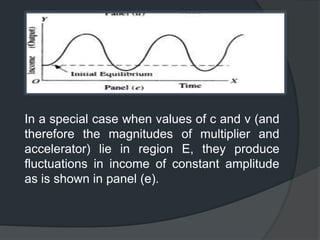
In a special case when values of c and v (and
therefore the magnitudes of multiplier and
accelerator) lie in region E, they produce
fluctuations in income of constant amplitude
as is shown in panel (e).
 Only combinations B, C and E produce
business cycles. The upper limit is the
buffer imposed by real life constraints
beyond which cycles can't explode.
 One of the famous theories of business
cycles based on the interaction of
multiplier and accelerator was put forward
by the English economist J.R. Hicks.
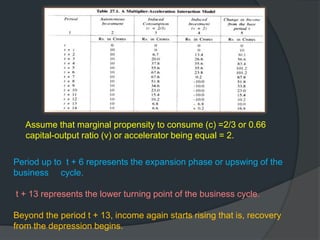
Assume that marginal propensity to consume (c) =2/3 or 0.66
capital-output ratio (v) or accelerator being equal = 2.
Period up to t + 6 represents the expansion phase or upswing of the
business cycle.
t + 13 represents the lower turning point of the business cycle.
Beyond the period t + 13, income again starts rising that is, recovery
from the depression begins.
Limitations
THANK YOU……

Multiplier-Accelerator Interaction

  • 1.
    MANUEL M. MATHEW IIMA ECONOMICS UNIVERSITY COLLEGE TRIVANDRUM
  • 2.
    relates business cyclesto the internal workings of the economy, showing how changes in investment and output reinforce each other; the central ingredients of the model are the multiplier and accelerator. Samuelson’s Model of Business Cycles: Interaction between Multiplier and Accelerator
  • 3.
    Multiplier is thefactor by which a change in a component of agg.dd,like C or I or G is multiplied to lead to a larger change in equilibrium national output. The multiplier principle is so named because relatively small autonomous changes generate relatively larger, or multiple, induced changes in agg.production.This principle is commonly represented by a multiplier, which is a specific number with a value greater than 1.
  • 4.
    Accelerator is therelation between change in I due to a change in Y. Kt = v.Yt where Kt is the stock of capital at time period t, v is the capital - output ratio (assumed to be constant) and Yt is the income in time period t. Under the assumption that v is constant, we can also write ∆K = v. ∆Y or v is the accelerator.
  • 5.
     An autonomousincrease in the level of investment raises income by a magnified amount depending upon the value of the multiplier.  This increase in income further induces the increase in investment through the acceleration effect.
  • 6.
  • 7.
     Where ∆Ia= Increase in Autonomous Investment  ∆Y=Increase in Income.  1/ 1 – MPC = Size of Multiplier where MPC = Marginal Propensity to Consume.  ∆ld = Increase in Induced Investment  v = Size of accelerator.
  • 8.
    Mathematical Representation  Yt =Ct + It …(i)  Ct= Ca + c (Yt – 1) …(ii)  It = Ia + v (Y t – 1 – Y t – 2)….(iii) Yt ,Ct ,It =income, consumption and investment respectively for a period t, Ca=autonomous consumption la =autonomous investment, c =marginal propensity to consume v= capital-output ratio or accelerator.
  • 9.
    Substituting equations (ii)and (iii) in equation (i) Yt = Ca + c (Yt - 1) + Ia + v (Y t – 1 – Y t – 2) …(iv) Equation (iv) describes the path which a disequilibrium system follows to reach either a final equilibrium state or moves away from it. But whether the economy moves towards a new equilibrium or deviates away from it depends on the values of marginal propensity to consume (c) and capital-output ratio v (i.e., accelerator).
  • 10.
    The values ofc and v decide the nature of business cycles.
  • 11.
    When the combinationsof the value of marginal propensity to consume (c) and capital-output ratio (v) lie within the region marked A, with a change in autonomous investment, the gross national product or income moves upward or downward at a decreasing rate and finally reaches a new equilibrium
  • 12.
    If the valuesof c and v are such that they lie within the region B, the change in autonomous investment or autonomous consumption will generate fluctuations in income which follow the pattern of a series of damped cycles whose amplitudes go on declining until the cycles disappear
  • 13.
    The region Crepresents the combinations of c and v which are relatively high as compared to the region B and determine such values of multiplier and accelerator that bring about explosive cycles, that is, the fluctuations of income with successively greater and greater amplitude. Panel c shows that the system tends to explode and diverges greatly from the equilibrium level.
  • 14.
    The region Dprovides the combinations of c and v which cause income to move upward or downward at an increasing rate which has somehow to be restrained if the cyclical movements are to occur. This is depicted in panel (d). Like the values of multiplier and accelerator of region C, their values in region D cause the system to explode and diverge from the equilibrium state by an increasing amount.
  • 15.
    In a specialcase when values of c and v (and therefore the magnitudes of multiplier and accelerator) lie in region E, they produce fluctuations in income of constant amplitude as is shown in panel (e).
  • 16.
     Only combinationsB, C and E produce business cycles. The upper limit is the buffer imposed by real life constraints beyond which cycles can't explode.  One of the famous theories of business cycles based on the interaction of multiplier and accelerator was put forward by the English economist J.R. Hicks.
  • 17.
    Assume that marginalpropensity to consume (c) =2/3 or 0.66 capital-output ratio (v) or accelerator being equal = 2. Period up to t + 6 represents the expansion phase or upswing of the business cycle. t + 13 represents the lower turning point of the business cycle. Beyond the period t + 13, income again starts rising that is, recovery from the depression begins.
  • 18.
  • 19.

Editor's Notes