Naveen Adhikari
Central Department of Economics,
Tribhuvan University, Kirtipur
Mode of Presentation
 Oligopolistic Competition
 Price Discrimination
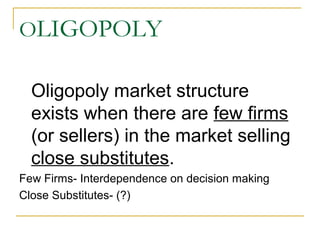
OLIGOPOLY
Oligopoly market structure
exists when there are few firms
(or sellers) in the market selling
close substitutes.
Few Firms- Interdependence on decision making
Close Substitutes- (?)
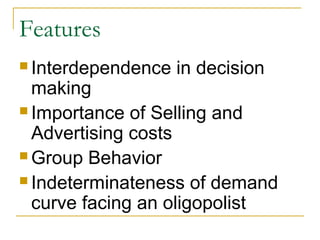
Features
 Interdependence in decision
making
 Importance of Selling and
Advertising costs
 Group Behavior
 Indeterminateness of demand
curve facing an oligopolist
Determination of Price and
Output
Collusive
Non-Collusive
Collusive Oligopoly
 Practice of setting price ( and
output) jointly through an
agreement or understanding
among the firms
 Two Practices:
Cartel and Price Leadership
Cartel
Joint Profit Maximization
Market Sharing
Market Sharing by Quotas
Price Leadership
 Price Leadership of low cost
firm
 Leadership by dominant firm
 Barometric Leadership
 Aggressive Price Leadership
Non-Collusive Oligopoly
Practice of maximizing the
benefits independently (with out
agreement) given the reaction
(strategies) of others
Price Discrimination
Price discrimination is a practice
of charging different price for the
same product
Degrees of Price Discrimination
 The degree (extent) that a monopolist can
charge the different price
First Degree
Second Degree
Third Degree
First Degree: Perfect Price Discrimination
 First degree price discrimination exits when
the sell is able to sell each unit of the output
separately at a different price, price being
maximum willingness to pay of consumer
 It implies selling every unit at the maximum
the consumer is willing to pay leaving no
consumer surplus
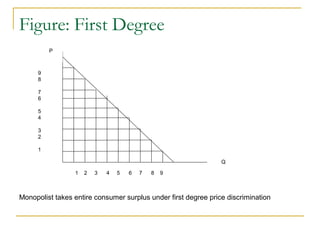
Figure: First Degree
Monopolist takes entire consumer surplus under first degree price discrimination
Q
P
9
8
7
6
5
4
3
2
1
1 2 3 4 5 6 7 8 9
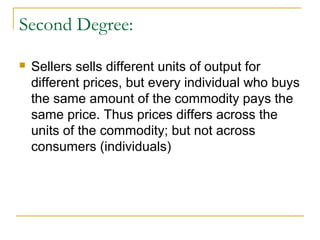
Second Degree:
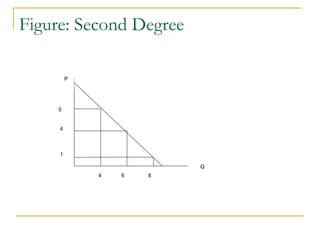
 Sellers sells different units of output for
different prices, but every individual who buys
the same amount of the commodity pays the
same price. Thus prices differs across the
units of the commodity; but not across
consumers (individuals)
Figure: Second Degree
Q
P
5
4
1
4 6 8
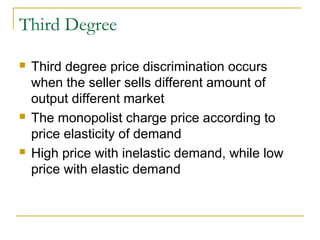
Third Degree
 Third degree price discrimination occurs
when the seller sells different amount of
output different market
 The monopolist charge price according to
price elasticity of demand
 High price with inelastic demand, while low
price with elastic demand
Figure: Third Degree
??
Domo Aarigato!!
 Any Question?

Kcm presentation