Priapism 
Background
• Priapism is defined as an abnormal
persistent erection of the penis. It is an
involuntary prolonged erection unrelated
to sexual stimulation and unrelieved by
ejaculation. As with many medical
emergencies, the saying "time is tissue"
holds true for priapism. This condition is a
true urologic emergency, and early
intervention allows the best chance for
functional recovery.[1]
Pathophysiology
• The penis is composed of 3 corporeal
bodies: 2 corpora cavernosa and 1 corpus
spongiosum. Erection is the result of
smooth-muscle relaxation and increased
arterial flow into the corpora cavernosa,
causing engorgement and rigidity (see
image below).
• Priapism. Corporeal relaxation causes
external pressure on the emissary veins
exiting the tunica albuginea, trapping
blood in the penis and causing erection.
• Engorgement of the corpora cavernosa
compresses the venous outflow tracts (ie,
subtunical venules), trapping blood within
the corpora cavernosa. The major
neurotransmitter that controls erection is
nitric oxide, which is secreted by the
endothelium that lines the corpora
cavernosa (see image below).
• These events occur in both normal and
pathologic erections. The pathophysiology
of priapism involves failure of
detumescence and is the result of the
underregulation of arterial inflow (ie, high
flow) or, more commonly, the failure of
venous outflow (ie, low flow). Priapism
typically involves engorgement of corpora
cavernosa. The corpus spongiosum is
typically not engorged.
• Priapism must be defined as either a low-
flow (ischemic) or a high-flow
(nonischemic) type because the causes
and treatments for these 2 types are
different. Low-flow priapism, which is by
far the most common type, is a failure of
the detumescence mechanism due to (1)
an excessive release of neurotransmitters,
• 2) blockage of draining venules (eg,
mechanical interference in sickle cell
crisis, leukemia, or excessive use of
intravenous parenteral lipids), (3) paralysis
of the intrinsic detumescence mechanism,
or (4) prolonged relaxation of the
intracavernous smooth muscles (most
often caused by the use of exogenous
smooth-muscle relaxants such as
injectable intracavernosal prostaglandin
E1).
• Prolonged low-flow priapism leads to a
painful ischemic state, which can cause
fibrosis of the corporeal smooth muscle
and cavernosal artery thrombosis. The
degree of ischemia is a function of the
number of emissary veins and the
duration of occlusion. Light-microscopy
studies conducted early on demonstrated
that corporeal tissue becomes thickened,
edematous, and fibrotic after days of
priapism.
Epidemiology
• Frequency
The frequency of priapism depends on
the population being considered. The
combination of intracavernosal agents and
other drugs is the cause of approximately
21-80% of all adult priapism. Agents used
to treat erectile dysfunction are common
causes of adult priapism in the Western
world. The overall rate of priapism in
persons using these agents ranges from
0.05-6%.
• At other centers, sickle cell disease (SCD)
and sickle cell trait predominate as the
cause of adult priapism. The rate of
priapism in adults with SCD is as high as
89%. Approximately two thirds of all
pediatric patients who have priapism also
have SCD. The rate of priapism among
children with SCD is as high as 27%.
• Mortality/Morbidity
• Priapism is painful at onset. Corporeal
fibrosis due to persistent priapism can
result in deep-tissue infections of the
penis.
• The major chronic morbidity associated
with all types of priapism is persistent
erectile dysfunction and impotence.
• The duration of symptoms is the most
important factor affecting outcome. A
recent Scandinavian study reported that
92% of patients with priapism for less than
• Race
• Priapism is common in African Americans
with SCD.
• Sex
• Priapism occurs exclusively in males.
• Age
• Priapism can occur in males of any age
group, with peaks at age 5-10 years and
20-50 years.
• Among patients with SCD, the prevalence
is higher in men aged 19-21 years.
• History
• Patients with priapism report a persistent
erection. The symptoms depend on the
type of priapism and the duration of
engorgement.
• Low-flow, ischemic-type priapism is
generally painful, although the pain may
disappear with prolonged priapism.
• High-flow, nonischemic priapism is
generally not painful. This type of priapism
is associated with blunt or penetrating
injury to the perineum. It may manifest in
– Erection: Duration of longer than 4 hours is
consistent with priapism.
– Duration of pain
– Similar prior episodes
– Genitourinary (GU) trauma
– Medical history (eg, sickle cell disease [SCD]):
Onset occurs during sleep, when relative
oxygenation decreases.
– Medication and/or recreational drug use,
especially the antidepressant trazodone,
intracavernosal injections of prostaglandin E1
used to treat impotence, and illicit cocaine
injection into the penis
– History of malignancy (prostate cancer)
– Penile prosthesis: The permanent erection
that occurs with some penile prostheses may
mimic priapism.
– Recent urologic surgery
• Aspects of history in high-flow priapism
are as follows:
– Not painful
– May be sexually active
– Straddle injury usually the initiating event
– Chronic recurrent presentation
– Generally not caused by medication
• Aspects of history in high-flow priapism
are as follows:
– Not painful
– May be sexually active
– Straddle injury usually the initiating event
– Chronic recurrent presentation
– Generally not caused by medication
• Aspects of history of low-flow priapism are
as follows:
– Painful
– Inactive sexually and without desire
– No history of trauma
– Usually presents to emergency department
(ED) within hours
– Associated with substance abuse or
vasoactive penile injections
– Rarely caused by leukemia, fat embolism,
acute spinal cord injury, or (extremely rare)
cancer metastases to the corporeal bodies
• Physical
• Obvious erection is the key physical
finding in any case of priapism. Penile
priapism generally involves only the paired
corpora cavernosa, with the glans and
corpora spongiosum remaining flaccid or
softly distended without rigidity.
• Careful physical examination may reveal
specific causal factors. Remember that no
single pathology excludes all others;
therefore, a thorough history and physical
examination should address the patient as
a whole.
• Aspects of the physical examination are
as follows:
– Penile color, rigidity, and sensation (soft glans
vs firm glans)
– Penile discharge, lesions, or both
– Evidence of local trauma
– Presence of prosthetic devices: Hardware
malfunction may cause pseudopriapism.
– Regional lymphadenopathy (ie, metastatic
disease)
• Aspects of the physical examination
consistent with high-flow priapism are as
follows:
– Adequate arterial flow
– Well-oxygenated corpora
– Evidence of trauma
• Aspects of the physical examination
consistent with low-flow priapism are as
follows:
– Rigid erection
– Ischemic corpora as indicated by dark blood
upon corporeal aspiration
– No evidence of trauma
Causes
• Priapism can result from idiopathic or
secondary causes. In the United States,
the most common cause of priapism in the
adult population involves agents used to
treat erectile dysfunction. The most
common cause of priapism in the pediatric
population is SCD. Internationally, the
most common cause is idiopathic.
• Uncommonly, both low- and high-flow
priapism are idiopathic in nature.
• Secondary causes of low-flow priapism
are as follows:
– Thromboembolic/hypercoagulable states
• Sickle cell anemia (SCD) - Polycythemia: A recent
study found that, in unscreened children with SCD,
priapism was the first presentation in 0.5% of
cases.[3]
• Thalassemia
• Total parenteral nutrition
• Fabry disease
• Dialysis
• Vasculitis
• Fat embolism (after multiple long-bone fractures or
after iatrogenic intravenous lipids as part of total
parenteral nutrition)
– Neurogenic disease
• Spinal cord stenosis (ie, trauma to the medulla)
• Autonomic neuropathy and cauda equina
compression
– Neoplastic disease (metastatic to the penis or
obstructive to venous outflow)
• Prostate cancer and GU (highest risk) bladder
cancer
• Hematological (leukemia)
• Renal carcinoma
• Melanoma
– Pharmacologic causes
• Intracavernosal agents - Papaverine,
phentolamine, prostaglandin E1
• Intraurethral pellets (ie, medicated urethral system
for erection with intracavernosal prostaglandin E1)
• Antihypertensives - Ganglion-blocking agents (eg,
guanethidine), arterial vasodilators (eg,
hydralazine), alpha-antagonists (eg, prazosin),
calcium channel blockers
• Psychotropics - Phenothiazine, butyrophenones,
hypnotics (eg, mesoridazine, perphenazine),
trazodone, selective serotonin reuptake inhibitors
(eg, fluoxetine, sertraline)[4]
• Anticoagulants - Heparin, warfarin
• Recreational drugs - Cocaine, marijuana, ethanol
• Hormones - Gonadotropin-releasing hormone
(GnRH), tamoxifen, testosterone
• Herbal medicine - Ginkgo biloba with concurrent
use of antipsychotic agents[5]
• Miscellaneous medications - Metoclopramide,
omeprazole, penile injection of cocaine, epidural
infusion of morphine and bupivacaine[6]
• Secondary causes of high-flow priapism
are as follows:
– GU trauma
• Straddle injury
• Intracavernous injections with direct cavernosal
• Other causes of priapism (rare) are as
follows:
– Amyloidosis (massive amyloid infiltration)
– Gout (one case report)
– Carbon monoxide poisoning
– Malaria
– Black widow spider venom
– Asplenia
Laboratory Studies
• Complete blood cell count: This is
performed to determine if the patient has
anemia, leukocytosis, or thrombocytosis.
• Plasma thromboplastin or activated partial
thromboplastin time: Priapism may require
surgical intervention if medical treatment
fails.
• Blood type and hold: Exchange
transfusion may be necessary to treat
underlying sickle cell disease (SCD).
• PBG measurement
– Test results allow differentiation between
high- and low-flow priapism.
– Low-flow PBG findings may include a pH of
less than 7.0, a PCO2 of greater than 60 mm
Hg, and a PO2 of less than 30 mm Hg.
Variation depends on duration.
– High-flow PBG findings should reflect normal
arterial values.
Imaging Studies
• Perform penile duplex Doppler
ultrasonography to help identify and locate
a fistula in patients with high-flow
priapism.
• Perform pelvic angiography to help
confirm the fistula location, followed by
embolization in patients with high-flow
priapism.
• Perform chest radiography or CT scanning
if the history is consistent with a malignant
or metastatic condition.
• Other Tests
• Perform an ECG if the patient is older than
55 years, has a history of cardiac disease,
or is a possible surgical candidate.
Treatment
Medical Care
• All cases of priapism require prompt
consultation with a GU medicine
specialist. When treating priapism in the
ED, physicians must first differentiate
between the high- and low-flow varieties.
With appropriate training and protocols,
ED personnel may begin treatment with
saline irrigation and injection of alpha-
agonist drugs such as phenylephrine.
Surgical Care
• A transglanular to corpus cavernosal
scalpel or needle-core biopsy (Ebbehoj or
Winter technique) is the first reasonable
approach for refractory cases (see image
below). A unilateral shunt is often
effective. Bilateral shunts are used only if
necessary (usually apparent after 10 min).
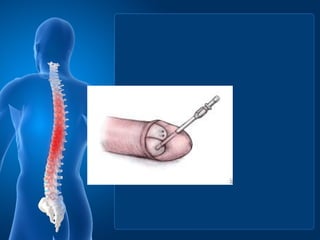
Priapism. Winter shunt placed by biopsy
needle, usually under local anesthetic.
• The El-Ghorab procedure is a more
aggressive open surgical cavernosal
shunt and is indicated if the Winter shunt
fails.
• Quackel shunts are cavernosal-
spongiosum shunts (unilateral or bilateral)
and are performed via a perineal
approach (see image below). Such shunts
are rarely effective if a more distal shunt
has already failed (eg, El-Ghorab
procedure) because thrombosis of the
• already esent.[11]
Priapism. Proximal
cavernosal-spongiosum shunt (Quackel
shunt) surgically connects the proximal
corpora cavernosa to the corpora
spongiosum
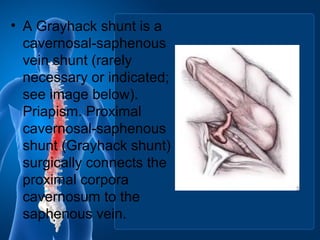
• A Grayhack shunt is a
cavernosal-saphenous
vein shunt (rarely
necessary or indicated;
see image below).
Priapism. Proximal
cavernosal-saphenous
shunt (Grayhack shunt)
surgically connects the
proximal corpora
cavernosum to the
saphenous vein.
• Consultations
• Urologist
• Cardiologist (for patients with cardiac
disease or hypertension)
• Hematologist (priapism as a complication
of SCD)
•
Thank you

Priapism

  • 1.
  • 2.
    Background • Priapism isdefined as an abnormal persistent erection of the penis. It is an involuntary prolonged erection unrelated to sexual stimulation and unrelieved by ejaculation. As with many medical emergencies, the saying "time is tissue" holds true for priapism. This condition is a true urologic emergency, and early intervention allows the best chance for functional recovery.[1]
  • 3.
    Pathophysiology • The penisis composed of 3 corporeal bodies: 2 corpora cavernosa and 1 corpus spongiosum. Erection is the result of smooth-muscle relaxation and increased arterial flow into the corpora cavernosa, causing engorgement and rigidity (see image below). • Priapism. Corporeal relaxation causes external pressure on the emissary veins exiting the tunica albuginea, trapping blood in the penis and causing erection.
  • 5.
    • Engorgement ofthe corpora cavernosa compresses the venous outflow tracts (ie, subtunical venules), trapping blood within the corpora cavernosa. The major neurotransmitter that controls erection is nitric oxide, which is secreted by the endothelium that lines the corpora cavernosa (see image below).
  • 6.
    • These eventsoccur in both normal and pathologic erections. The pathophysiology of priapism involves failure of detumescence and is the result of the underregulation of arterial inflow (ie, high flow) or, more commonly, the failure of venous outflow (ie, low flow). Priapism typically involves engorgement of corpora cavernosa. The corpus spongiosum is typically not engorged.
  • 7.
    • Priapism mustbe defined as either a low- flow (ischemic) or a high-flow (nonischemic) type because the causes and treatments for these 2 types are different. Low-flow priapism, which is by far the most common type, is a failure of the detumescence mechanism due to (1) an excessive release of neurotransmitters,
  • 8.
    • 2) blockageof draining venules (eg, mechanical interference in sickle cell crisis, leukemia, or excessive use of intravenous parenteral lipids), (3) paralysis of the intrinsic detumescence mechanism, or (4) prolonged relaxation of the intracavernous smooth muscles (most often caused by the use of exogenous smooth-muscle relaxants such as injectable intracavernosal prostaglandin E1).
  • 9.
    • Prolonged low-flowpriapism leads to a painful ischemic state, which can cause fibrosis of the corporeal smooth muscle and cavernosal artery thrombosis. The degree of ischemia is a function of the number of emissary veins and the duration of occlusion. Light-microscopy studies conducted early on demonstrated that corporeal tissue becomes thickened, edematous, and fibrotic after days of priapism.
  • 10.
    Epidemiology • Frequency The frequencyof priapism depends on the population being considered. The combination of intracavernosal agents and other drugs is the cause of approximately 21-80% of all adult priapism. Agents used to treat erectile dysfunction are common causes of adult priapism in the Western world. The overall rate of priapism in persons using these agents ranges from 0.05-6%.
  • 11.
    • At othercenters, sickle cell disease (SCD) and sickle cell trait predominate as the cause of adult priapism. The rate of priapism in adults with SCD is as high as 89%. Approximately two thirds of all pediatric patients who have priapism also have SCD. The rate of priapism among children with SCD is as high as 27%.
  • 12.
    • Mortality/Morbidity • Priapismis painful at onset. Corporeal fibrosis due to persistent priapism can result in deep-tissue infections of the penis. • The major chronic morbidity associated with all types of priapism is persistent erectile dysfunction and impotence. • The duration of symptoms is the most important factor affecting outcome. A recent Scandinavian study reported that 92% of patients with priapism for less than
  • 13.
    • Race • Priapismis common in African Americans with SCD. • Sex • Priapism occurs exclusively in males. • Age • Priapism can occur in males of any age group, with peaks at age 5-10 years and 20-50 years. • Among patients with SCD, the prevalence is higher in men aged 19-21 years.
  • 14.
    • History • Patientswith priapism report a persistent erection. The symptoms depend on the type of priapism and the duration of engorgement. • Low-flow, ischemic-type priapism is generally painful, although the pain may disappear with prolonged priapism. • High-flow, nonischemic priapism is generally not painful. This type of priapism is associated with blunt or penetrating injury to the perineum. It may manifest in
  • 15.
    – Erection: Durationof longer than 4 hours is consistent with priapism. – Duration of pain – Similar prior episodes – Genitourinary (GU) trauma – Medical history (eg, sickle cell disease [SCD]): Onset occurs during sleep, when relative oxygenation decreases.
  • 16.
    – Medication and/orrecreational drug use, especially the antidepressant trazodone, intracavernosal injections of prostaglandin E1 used to treat impotence, and illicit cocaine injection into the penis – History of malignancy (prostate cancer) – Penile prosthesis: The permanent erection that occurs with some penile prostheses may mimic priapism. – Recent urologic surgery
  • 17.
    • Aspects ofhistory in high-flow priapism are as follows: – Not painful – May be sexually active – Straddle injury usually the initiating event – Chronic recurrent presentation – Generally not caused by medication
  • 18.
    • Aspects ofhistory in high-flow priapism are as follows: – Not painful – May be sexually active – Straddle injury usually the initiating event – Chronic recurrent presentation – Generally not caused by medication
  • 19.
    • Aspects ofhistory of low-flow priapism are as follows: – Painful – Inactive sexually and without desire – No history of trauma – Usually presents to emergency department (ED) within hours – Associated with substance abuse or vasoactive penile injections – Rarely caused by leukemia, fat embolism, acute spinal cord injury, or (extremely rare) cancer metastases to the corporeal bodies
  • 20.
    • Physical • Obviouserection is the key physical finding in any case of priapism. Penile priapism generally involves only the paired corpora cavernosa, with the glans and corpora spongiosum remaining flaccid or softly distended without rigidity.
  • 21.
    • Careful physicalexamination may reveal specific causal factors. Remember that no single pathology excludes all others; therefore, a thorough history and physical examination should address the patient as a whole.
  • 22.
    • Aspects ofthe physical examination are as follows: – Penile color, rigidity, and sensation (soft glans vs firm glans) – Penile discharge, lesions, or both – Evidence of local trauma – Presence of prosthetic devices: Hardware malfunction may cause pseudopriapism. – Regional lymphadenopathy (ie, metastatic disease)
  • 23.
    • Aspects ofthe physical examination consistent with high-flow priapism are as follows: – Adequate arterial flow – Well-oxygenated corpora – Evidence of trauma
  • 24.
    • Aspects ofthe physical examination consistent with low-flow priapism are as follows: – Rigid erection – Ischemic corpora as indicated by dark blood upon corporeal aspiration – No evidence of trauma
  • 25.
    Causes • Priapism canresult from idiopathic or secondary causes. In the United States, the most common cause of priapism in the adult population involves agents used to treat erectile dysfunction. The most common cause of priapism in the pediatric population is SCD. Internationally, the most common cause is idiopathic.
  • 26.
    • Uncommonly, bothlow- and high-flow priapism are idiopathic in nature. • Secondary causes of low-flow priapism are as follows: – Thromboembolic/hypercoagulable states • Sickle cell anemia (SCD) - Polycythemia: A recent study found that, in unscreened children with SCD, priapism was the first presentation in 0.5% of cases.[3]
  • 27.
    • Thalassemia • Totalparenteral nutrition • Fabry disease • Dialysis • Vasculitis • Fat embolism (after multiple long-bone fractures or after iatrogenic intravenous lipids as part of total parenteral nutrition)
  • 28.
    – Neurogenic disease •Spinal cord stenosis (ie, trauma to the medulla) • Autonomic neuropathy and cauda equina compression – Neoplastic disease (metastatic to the penis or obstructive to venous outflow) • Prostate cancer and GU (highest risk) bladder cancer • Hematological (leukemia) • Renal carcinoma • Melanoma
  • 29.
    – Pharmacologic causes •Intracavernosal agents - Papaverine, phentolamine, prostaglandin E1 • Intraurethral pellets (ie, medicated urethral system for erection with intracavernosal prostaglandin E1) • Antihypertensives - Ganglion-blocking agents (eg, guanethidine), arterial vasodilators (eg, hydralazine), alpha-antagonists (eg, prazosin), calcium channel blockers
  • 30.
    • Psychotropics -Phenothiazine, butyrophenones, hypnotics (eg, mesoridazine, perphenazine), trazodone, selective serotonin reuptake inhibitors (eg, fluoxetine, sertraline)[4] • Anticoagulants - Heparin, warfarin • Recreational drugs - Cocaine, marijuana, ethanol • Hormones - Gonadotropin-releasing hormone (GnRH), tamoxifen, testosterone
  • 31.
    • Herbal medicine- Ginkgo biloba with concurrent use of antipsychotic agents[5] • Miscellaneous medications - Metoclopramide, omeprazole, penile injection of cocaine, epidural infusion of morphine and bupivacaine[6] • Secondary causes of high-flow priapism are as follows: – GU trauma • Straddle injury • Intracavernous injections with direct cavernosal
  • 32.
    • Other causesof priapism (rare) are as follows: – Amyloidosis (massive amyloid infiltration) – Gout (one case report) – Carbon monoxide poisoning – Malaria – Black widow spider venom – Asplenia
  • 33.
    Laboratory Studies • Completeblood cell count: This is performed to determine if the patient has anemia, leukocytosis, or thrombocytosis. • Plasma thromboplastin or activated partial thromboplastin time: Priapism may require surgical intervention if medical treatment fails.
  • 34.
    • Blood typeand hold: Exchange transfusion may be necessary to treat underlying sickle cell disease (SCD). • PBG measurement – Test results allow differentiation between high- and low-flow priapism. – Low-flow PBG findings may include a pH of less than 7.0, a PCO2 of greater than 60 mm Hg, and a PO2 of less than 30 mm Hg. Variation depends on duration. – High-flow PBG findings should reflect normal arterial values.
  • 35.
    Imaging Studies • Performpenile duplex Doppler ultrasonography to help identify and locate a fistula in patients with high-flow priapism. • Perform pelvic angiography to help confirm the fistula location, followed by embolization in patients with high-flow priapism.
  • 36.
    • Perform chestradiography or CT scanning if the history is consistent with a malignant or metastatic condition. • Other Tests • Perform an ECG if the patient is older than 55 years, has a history of cardiac disease, or is a possible surgical candidate.
  • 37.
    Treatment Medical Care • Allcases of priapism require prompt consultation with a GU medicine specialist. When treating priapism in the ED, physicians must first differentiate between the high- and low-flow varieties. With appropriate training and protocols, ED personnel may begin treatment with saline irrigation and injection of alpha- agonist drugs such as phenylephrine.
  • 38.
    Surgical Care • Atransglanular to corpus cavernosal scalpel or needle-core biopsy (Ebbehoj or Winter technique) is the first reasonable approach for refractory cases (see image below). A unilateral shunt is often effective. Bilateral shunts are used only if necessary (usually apparent after 10 min). Priapism. Winter shunt placed by biopsy needle, usually under local anesthetic.
  • 40.
    • The El-Ghorabprocedure is a more aggressive open surgical cavernosal shunt and is indicated if the Winter shunt fails. • Quackel shunts are cavernosal- spongiosum shunts (unilateral or bilateral) and are performed via a perineal approach (see image below). Such shunts are rarely effective if a more distal shunt has already failed (eg, El-Ghorab procedure) because thrombosis of the
  • 42.
    • already esent.[11] Priapism.Proximal cavernosal-spongiosum shunt (Quackel shunt) surgically connects the proximal corpora cavernosa to the corpora spongiosum
  • 43.
    • A Grayhackshunt is a cavernosal-saphenous vein shunt (rarely necessary or indicated; see image below). Priapism. Proximal cavernosal-saphenous shunt (Grayhack shunt) surgically connects the proximal corpora cavernosum to the saphenous vein.
  • 44.
    • Consultations • Urologist •Cardiologist (for patients with cardiac disease or hypertension) • Hematologist (priapism as a complication of SCD) •
  • 45.