

Malignant PriapismMalignant Priapism
A Quick Overview
Shady Nafie
Senior Clinical Fellow Urology
Lister Hospital
Priapism
๏ Priapism is a persistent, prolonged (more than 6
hours) and painful erection not associated with
sexual stimulation.
๏ First described in 1824.
๏ Named after greek god of fertility, Priapus.
๏ Idiopathic.
๏ Haematological (Sickle cell, Leukaemia,
Lymphoma).
๏ Neurological (Spinal cord injury).
๏ Traumatic (Genital, Perineal)
๏ Iatrogenic (Intra-cavernous injections).
๏ Infection (Malaria, Rabies, Scorpion sting).
๏ Penile Metastasis of Malignant Tumours.
Priapism
Aetiology
Penile Metastasis.
๏ Uncommon condition.
๏ First described by Eberth in 1870.
๏ 460 cases are reported since.
๏ Manifestations include: indurated nodules,
penile mass, diffuse penile swelling,
ulceration and priapism (in 40% of cases
and is referred to as “Malignant Priapism”).
๏ Metastatic tumours of the penis represent
evidence of a more widespread malignant
disease with a poor prognosis, and the
majority of patients die within 1 year.
Penile Metastasis.
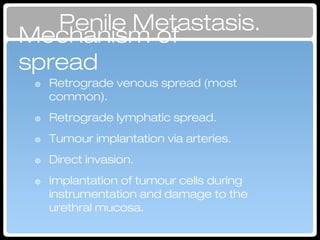
Mechanism of spread
๏ Retrograde venous spread (most
common).
๏ Retrograde lymphatic spread.
๏ Tumour implantation via arteries.
๏ Direct invasion.
๏ Implantation of tumour cells during
instrumentation and damage to the
urethral mucosa.
Penile Metastasis.
Malignant Priapism
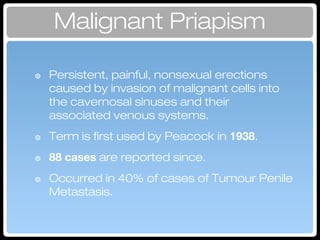
๏ Persistent, painful, nonsexual erections
caused by invasion of malignant cells into
the cavernosal sinuses and their
associated venous systems.
๏ Term is first used by Peacock in 1938.
๏ 88 cases are reported since.
๏ Occurred in 40% of cases of Tumour Penile
Metastasis.
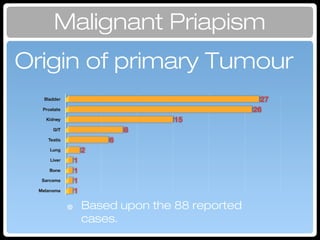
Origin of primary Tumour
Malignant Priapism
๏ Based upon the 88 reported
cases.
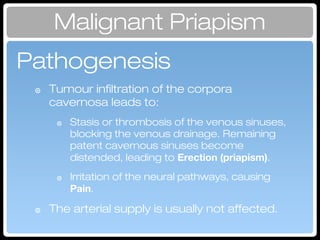
๏ Tumour infiltration of the corpora
cavernosa leads to:
๏ Stasis or thrombosis of the venous sinuses,
blocking the venous drainage. Remaining
patent cavernous sinuses become
distended, leading to Erection (priapism).
๏ Irritation of the neural pathways, causing
Pain.
๏ The arterial supply is usually not affected.
Malignant Priapism
Pathogenesis
๏ Core-Needle biopsy (confirms diagnosis).
๏ Corporeal aspiration (confirms diagnosis).
๏ MRI (reliable alternative for confirming the
diagnosis and assessing the extension of the
disease).
๏ Doppler ultrasound (differentiate between High
flow and Low flow priapism).
Malignant Priapism
Investigations
Management
๏ Tailored according to the case, it includes:
๏ Conservative (have a short life expectancy,
conservative treatment can be a reasonable
choice).
๏ Excision of corpora cavernosa (effective in treating
pain).
๏ Total penectomy.
๏ Radiotherapy.
๏ Chemotherapy.
Malignant Priapism
Case Report
๏ 64 years old male.
๏ Presented with:
๏ Weight loss (3 stones), lethargy, generalised bone
pains (for 3 months).
๏ Constipation (for 1 week)
๏ Painful erection (for 1 month).
Presentation
Case Report
๏ Passing urine.
๏ No haematuria.
๏ DRE showed benign feeling prostate.
๏ PSA was 1.4
๏ Had a painful erection for 1 month with soft
glans penis.
Presentation
Case Report
๏ CT Chest/Abdo/Pelvis, showed:
๏ Enlarged Hilar, Mediastinal, Para-aortic Lymph Nodes.
๏ Enlarged necrotic inguinal Lymph Nodes.
๏ Large left adrenal mass.
๏ L3 vertebral body collapse.
Investigation
Case Report
๏ Biopsy from inguinal lymph nodes, showed
poorly differentiated squamous cell carcinoma.
๏ Patient refused any further investigations or
treatment and died in 2 weeks.
Investigation
Thank You.

Malignant Priapism: A Quick Overview

  • 1.
    Malignant PriapismMalignant Priapism AQuick Overview Shady Nafie Senior Clinical Fellow Urology Lister Hospital
  • 2.
    Priapism ๏ Priapism isa persistent, prolonged (more than 6 hours) and painful erection not associated with sexual stimulation. ๏ First described in 1824. ๏ Named after greek god of fertility, Priapus.
  • 3.
    ๏ Idiopathic. ๏ Haematological(Sickle cell, Leukaemia, Lymphoma). ๏ Neurological (Spinal cord injury). ๏ Traumatic (Genital, Perineal) ๏ Iatrogenic (Intra-cavernous injections). ๏ Infection (Malaria, Rabies, Scorpion sting). ๏ Penile Metastasis of Malignant Tumours. Priapism Aetiology
  • 4.
    Penile Metastasis. ๏ Uncommoncondition. ๏ First described by Eberth in 1870. ๏ 460 cases are reported since. ๏ Manifestations include: indurated nodules, penile mass, diffuse penile swelling, ulceration and priapism (in 40% of cases and is referred to as “Malignant Priapism”).
  • 5.
    ๏ Metastatic tumoursof the penis represent evidence of a more widespread malignant disease with a poor prognosis, and the majority of patients die within 1 year. Penile Metastasis.
  • 6.
    Mechanism of spread ๏Retrograde venous spread (most common). ๏ Retrograde lymphatic spread. ๏ Tumour implantation via arteries. ๏ Direct invasion. ๏ Implantation of tumour cells during instrumentation and damage to the urethral mucosa. Penile Metastasis.
  • 7.
    Malignant Priapism ๏ Persistent,painful, nonsexual erections caused by invasion of malignant cells into the cavernosal sinuses and their associated venous systems. ๏ Term is first used by Peacock in 1938. ๏ 88 cases are reported since. ๏ Occurred in 40% of cases of Tumour Penile Metastasis.
  • 8.
    Origin of primaryTumour Malignant Priapism ๏ Based upon the 88 reported cases.
  • 9.
    ๏ Tumour infiltrationof the corpora cavernosa leads to: ๏ Stasis or thrombosis of the venous sinuses, blocking the venous drainage. Remaining patent cavernous sinuses become distended, leading to Erection (priapism). ๏ Irritation of the neural pathways, causing Pain. ๏ The arterial supply is usually not affected. Malignant Priapism Pathogenesis
  • 10.
    ๏ Core-Needle biopsy(confirms diagnosis). ๏ Corporeal aspiration (confirms diagnosis). ๏ MRI (reliable alternative for confirming the diagnosis and assessing the extension of the disease). ๏ Doppler ultrasound (differentiate between High flow and Low flow priapism). Malignant Priapism Investigations
  • 11.
    Management ๏ Tailored accordingto the case, it includes: ๏ Conservative (have a short life expectancy, conservative treatment can be a reasonable choice). ๏ Excision of corpora cavernosa (effective in treating pain). ๏ Total penectomy. ๏ Radiotherapy. ๏ Chemotherapy. Malignant Priapism
  • 12.
    Case Report ๏ 64years old male. ๏ Presented with: ๏ Weight loss (3 stones), lethargy, generalised bone pains (for 3 months). ๏ Constipation (for 1 week) ๏ Painful erection (for 1 month). Presentation
  • 13.
    Case Report ๏ Passingurine. ๏ No haematuria. ๏ DRE showed benign feeling prostate. ๏ PSA was 1.4 ๏ Had a painful erection for 1 month with soft glans penis. Presentation
  • 14.
    Case Report ๏ CTChest/Abdo/Pelvis, showed: ๏ Enlarged Hilar, Mediastinal, Para-aortic Lymph Nodes. ๏ Enlarged necrotic inguinal Lymph Nodes. ๏ Large left adrenal mass. ๏ L3 vertebral body collapse. Investigation
  • 15.
    Case Report ๏ Biopsyfrom inguinal lymph nodes, showed poorly differentiated squamous cell carcinoma. ๏ Patient refused any further investigations or treatment and died in 2 weeks. Investigation
  • 16.