Penile doppler – A practical approach


35 yr male patient with h/o
depression
And Erectile dysfunction.
Grey scale / color doppler
assessment was done
to assess vasogenic / other
etiology of the erectile
dysfunction.


                               Dr Ritesh Mahajan
                                Free lance radiology
                              Approach towards basic imaging
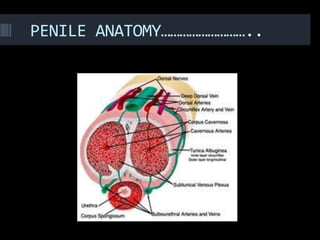
PENILE ANATOMY………………………..
Penile vascular anatomy……….
 Internal pedundle artery
  through bulbar artery supplies  Venous drainage is through
  base of the penis . Penile         efferent venules – emisssary
  artery divides into two            veins - dorsal veins . Base of
  cavernosal arteries and            the penis through crural
  continues as dorsal artery .       veins drains into the
  There are helicine arteries that   periprostatic venous plexus
  run through the substance of       in to the internal iliac veins .
  the corpora .
                                    The glans region has it’s
 Cavernosal arteries are            drainage into the external
  paramedian in location.            iliac venous system.
 Cavernosal and dorsal
                                    Penile venous system is
  arteries show more
  variability than venous            more constant than the
  drainage of the penis .            arterial anatomy.
Basis of normal erection……….
                                   Flaccid state : Intracavernosal arterial
 After neural impulse              resistance is high . Cavernosal arterial flow
                                    has low systolic, dampened diastolic flow .
 Vasodilatation                   After giving vasoactive agent : Increased
 Increased blood supply            dilatation of the cavernosal arterial tree is
                                    there with increased systolic and diastolic
 Increased intracavernosal         component of the flow and velocities.
  pressure                         There is sinusoidal expansion of the arterial
 Efferent venous channel are       flow with obstructed venous egress
  obstructed by taut tunica        Further rise in cavernosal pressure leads to
                                    systolic dampening and loss of diastolic
  albuginea.                        component .
 On doppler study                 With rigid erection – there is near total loss
  predictable spectral              of diastolic flow and at times reversal .
  waveform corrborates with        As far as venous flow is concerned : flaccid
  changes in the intra              state has sluggish flow. With vasoactive
  cavernosal pressure .             agent there is increase in the dorsal venous
                                    flow and with rigid erection the venous
                                    flow can stop . Retrograde venous flow is
                                    also appreciated in normal individuals.
Basis of normal erection……
Phases of erection ………….    After neural impulse there is
                             rise in the intracavernosal
                             presssure –There is cavernosal
 Flaccid                    arterial dilatation and rise in
                             the systolic and diastolic flow
 Latent                     . The dorsal venous flow also
                             rises initially . With rise in the
 Tumescent                  cavernosal pressure –
                             distended sinusoids abut the
 Rigid                      tunica albuginea and this
 Detumescence               leads to cessation of the
                             venous egress and leads to
                             rigid erection. With rigid
                             erection ,this diastolic
                             component of the cavernosal
                             arterial flow is lost and at
                             times reverses also .
Penile imaging ………………………..
                 ERECTILE DYSFUNCTION
                       ETIOLOGY

 Psychogenic
 Endocrine
 Pharmacological
 Neurological
 Vascular
Organic etiology – Vasogenic
  etiology is important and
  penile Doppler assessment
  can be of use to ascertain
  the same .
Penile imaging …………………………….

Diagnostic work up for erectile
dysfunction                       Penile anatomy
 Medical / drug history .         Three distensible corpora
                                     chambers -
 Routine / endocrine blood       1. Corpora spongiosum enveloping
  analysis.                           the urethera. This does not play
                                      significant role in erection.
 Non invasive testing            2. Corpora cavernosa – dorsal in
                                      position –paired .
 Brachial – penile indices        Mid line septum separates the
 Nocturnal penile                    two corpora cavernosa . Thick
                                      fascia (tunica albugenia) encircles
  tumescence.                         the corpora cavernosa and bucks
                                      fascia covers corpora cavernosa
                                      and spongiosa .
Basic methodology of penile doppler


 Linear transducer parallel     Grey scale assessment
  to skin surface is used .       involves assessment of
  Both ventral and dorsal         echogenic tunica
  transducer position             albuginea. Midlevel echoes
  approaches can be used.         of the corpora cavernosa .
 Slow flow detection             Assess mid line septum .
  settings are to be used.       Cavernosal arteries are
 Longitudinal and                assessed by echogenic
  parasagitttal image             walls and with paramedian
  acquisition is to be done .     location.
Brief about doppler examination…….

 Complete discussion of         Velocity measurements are
    the examination with the      done along the base of the penis
                                  . Angle of assessment <60
    patient is to be done .       degree.
   Assessment of the privacy    PSV, EDV, RI , PI is done for
                                  cavernosal arteries on either side
    is to be done .               .
   Quiet examination setting    Look for cavernosal artery
                                  stenosis , occlusion, retrograde
    is necessary .                arterial flow , dampened spectral
                                  flow.
   Pharmacological agents :
                                 Cavernosal artery dilatation
    papaverine, phentolamine,     <75% of the base arterial
     prostaglandin E              diametre is indirect e/o
                                  vasogenic etiology of erectile
   Eye technique : visual        dysfunction.
    inspection is important .
Grey scale            sonography…..
Grey scale sonography
Good for assessment of

 Peyronie’s disease.
 Penile trauma
 Penile neoplasm
venous insufficiency………

Variations …………………..            Venous insufficiency
                                 Most common form of
 Absence of the penile             impotence
  artery : +_ cause of the         EDV > 5cm/sec suggests venous
  impotence .                       incompetence .
                                   PSV > 30 cm/sec helps to rule
 Corpora cavernosa -               out arterial etiology and search
  corpora spongiosum                for venous etiology has to be
                                    sorted out .
  collaterals , dorsal venous      EDV > 2 to 6cm/sec supports
  and corpora collaterals           venous insufficiency .
  should also be assessed.         Instead of measuring EDV : RI (
                                    <.8) , PI (<4) also support
                                    venous insufficiency as etiology
                                    of erectile dysfunction.
Grey scale and basic
        doppler assessment
                            BASIC COLOR DOPPLER ASSESMENT –
GREY SCALE                  DONE AT BASE OF THE PENIS

 PLAQUE / CALCIFICATION.    Imaging especially for
                                 doppler is done along the
 MID LEVEL ECHOES OF
                                 base of the penis .
  CORPORA CAVERNOSA
                                The sequence of the
 TUNICA ALBUGENIA               imaging is as following :
  /BUCKS FASCIA             1.    Flaccid state
                            2.    Papaverine injection
                            3.    Post injection imaging is
                                  done at 5 , 10,15,20,25
                                  minutes .
PARAMETRES TO BE ASSESED IN
     THE FLACCID STATE
         Dorsal vein diameter
         Cavernosal artery ( both left
          and left artery )
          1.   Diametre
          2.   PSV
          3.   EDV
          4.   PI
          5.   Dorsal cavernosal collaterals
          6.   Cavernosal spongiosal collaterals
PARAMETRES TO BE ASSESED POST
              PAPAVERINE INJECTION

 Post papaverine
                     Dorsal vein diameter
    injection
                     Cavernosal artery ( both left
   5minutes
   10minutes         and left artery )
   15 minutes        1.   Diametre
   20 minutes        2.   PSV
   25 minutes        3.   EDV
                      4.   PI
INTERPRETATION
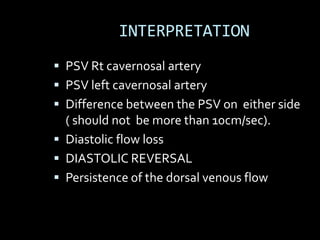
 PSV Rt cavernosal artery
 PSV left cavernosal artery
 Difference between the PSV on either side
  ( should not be more than 10cm/sec).
 Diastolic flow loss
 DIASTOLIC REVERSAL
 Persistence of the dorsal venous flow
NORMAL VALUES

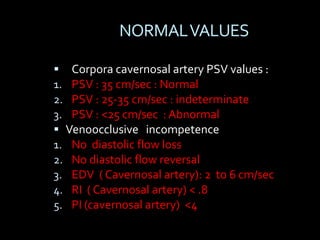
 Corpora cavernosal artery PSV values :
1. PSV : 35 cm/sec : Normal
2. PSV : 25-35 cm/sec : indeterminate
3. PSV : <25 cm/sec : Abnormal
 Venoocclusive incompetence
1. No diastolic flow loss
2. No diastolic flow reversal
3. EDV ( Cavernosal artery): 2 to 6 cm/sec
4. RI ( Cavernosal artery) < .8
5. PI (cavernosal artery) <4
PRECAUTIONS

 Inject papaverine only once
 Keep region of injection pressed
 Use insulin syringe
 Alcohol swab to clean
 Keep watch for priapism ( urologist
  /anesthetist support ) .
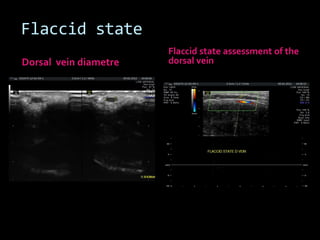
Flaccid state
                       Flaccid state assessment of the
Dorsal vein diametre   dorsal vein
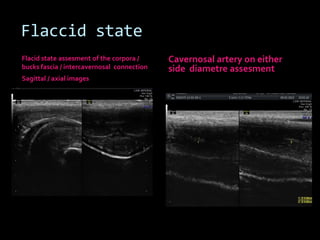
Flaccid state
Flacid state assesment of the corpora /     Cavernosal artery on either
bucks fascia / intercavernosal connection   side diametre assesment
Sagittal / axial images
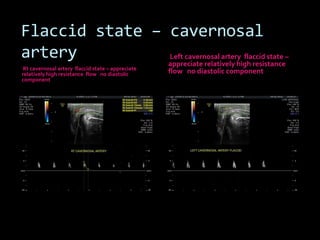
Flaccid state – cavernosal
artery          Left cavernosal artery flaccid state –
                appreciate relatively high resistance
 Rt cavernosal artery flaccid state – appreciate
relatively high resistance flow no diastolic       flow no diastolic component
component
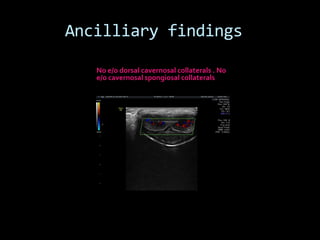
Ancilliary findings

   No e/o dorsal cavernosal collaterals . No
   e/o cavernosal spongiosal collaterals
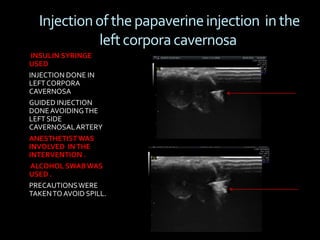
Injection of the papaverine injection in the
             left corpora cavernosa
 INSULIN SYRINGE
USED
INJECTION DONE IN
LEFT CORPORA
CAVERNOSA
GUIDED INJECTION
DONE AVOIDING THE
LEFT SIDE
CAVERNOSAL ARTERY
ANESTHETIST WAS
INVOLVED IN THE
INTERVENTION .
 ALCOHOL SWAB WAS
USED .
PRECAUTIONS WERE
TAKEN TO AVOID SPILL.
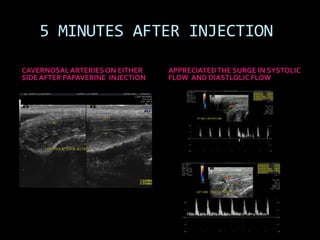
5 MINUTES AFTER INJECTION

CAVERNOSAL ARTERIES ON EITHER     APPRECIATED THE SURGE IN SYSTOLIC
SIDE AFTER PAPAVERINE INJECTION   FLOW AND DIASTLOLIC FLOW
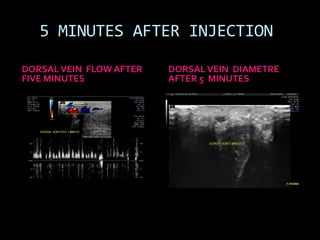
5 MINUTES AFTER INJECTION

DORSAL VEIN FLOW AFTER   DORSAL VEIN DIAMETRE
FIVE MINUTES             AFTER 5 MINUTES
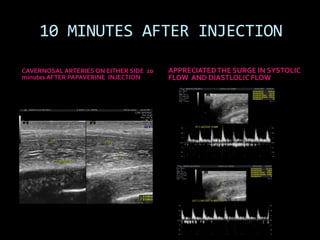
10 MINUTES AFTER INJECTION

CAVERNOSAL ARTERIES ON EITHER SIDE 10   APPRECIATED THE SURGE IN SYSTOLIC
minutes AFTER PAPAVERINE INJECTION      FLOW AND DIASTLOLIC FLOW
10 MINUTES AFTER INJECTION

DORSAL VEIN FLOW AFTER   DORSAL VEIN DIAMETRE
TEN MINUTES              AFTER 10 MINUTES
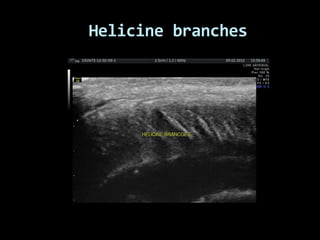
Helicine branches
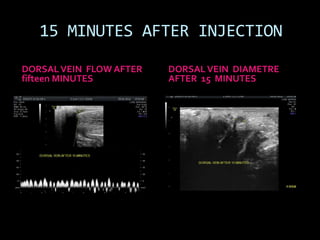
15 MINUTES AFTER INJECTION

DORSAL VEIN FLOW AFTER   DORSAL VEIN DIAMETRE
fifteen MINUTES          AFTER 15 MINUTES
15 MINUTES AFTER INJECTION
CAVERNOSAL ARTERIES ON EITHER SIDE AFTER 15
                                              APPRECIATE THE SURGE IN SYSTOLIC
minutes of PAPAVERINE INJECTION               FLOW AND DIASTLOLIC FLOW
20 MINUTES AFTER INJECTION

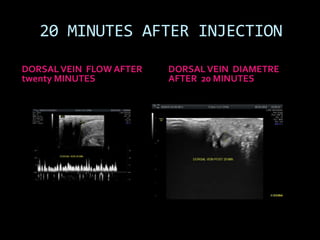
DORSAL VEIN FLOW AFTER   DORSAL VEIN DIAMETRE
twenty MINUTES           AFTER 20 MINUTES
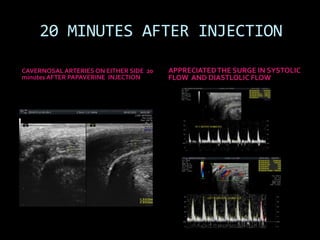
20 MINUTES AFTER INJECTION

CAVERNOSAL ARTERIES ON EITHER SIDE 20   APPRECIATED THE SURGE IN SYSTOLIC
minutes AFTER PAPAVERINE INJECTION      FLOW AND DIASTLOLIC FLOW
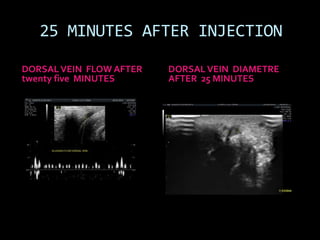
25 MINUTES AFTER INJECTION

DORSAL VEIN FLOW AFTER   DORSAL VEIN DIAMETRE
twenty five MINUTES      AFTER 25 MINUTES
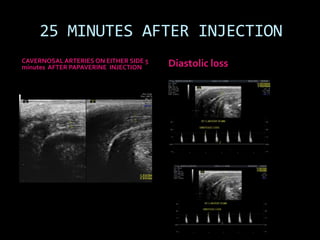
25 MINUTES AFTER INJECTION
CAVERNOSAL ARTERIES ON EITHER SIDE 5
minutes AFTER PAPAVERINE INJECTION     Diastolic loss
30 MINUTES AFTER INJECTION

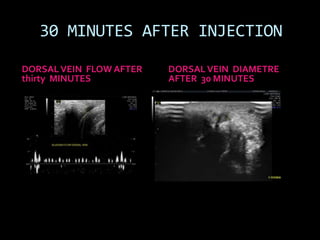
DORSAL VEIN FLOW AFTER   DORSAL VEIN DIAMETRE
thirty MINUTES           AFTER 30 MINUTES
30 MINUTES AFTER INJECTION

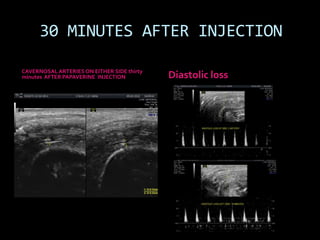
CAVERNOSAL ARTERIES ON EITHER SIDE thirty
minutes AFTER PAPAVERINE INJECTION          Diastolic loss

Penile doppler a review

  • 1.
    Penile doppler –A practical approach 35 yr male patient with h/o depression And Erectile dysfunction. Grey scale / color doppler assessment was done to assess vasogenic / other etiology of the erectile dysfunction.  Dr Ritesh Mahajan Free lance radiology Approach towards basic imaging
  • 2.
  • 3.
    Penile vascular anatomy………. Internal pedundle artery through bulbar artery supplies  Venous drainage is through base of the penis . Penile efferent venules – emisssary artery divides into two veins - dorsal veins . Base of cavernosal arteries and the penis through crural continues as dorsal artery . veins drains into the There are helicine arteries that periprostatic venous plexus run through the substance of in to the internal iliac veins . the corpora .  The glans region has it’s  Cavernosal arteries are drainage into the external paramedian in location. iliac venous system.  Cavernosal and dorsal  Penile venous system is arteries show more variability than venous more constant than the drainage of the penis . arterial anatomy.
  • 4.
    Basis of normalerection……….  Flaccid state : Intracavernosal arterial  After neural impulse resistance is high . Cavernosal arterial flow has low systolic, dampened diastolic flow .  Vasodilatation  After giving vasoactive agent : Increased  Increased blood supply dilatation of the cavernosal arterial tree is there with increased systolic and diastolic  Increased intracavernosal component of the flow and velocities. pressure  There is sinusoidal expansion of the arterial  Efferent venous channel are flow with obstructed venous egress obstructed by taut tunica  Further rise in cavernosal pressure leads to systolic dampening and loss of diastolic albuginea. component .  On doppler study  With rigid erection – there is near total loss predictable spectral of diastolic flow and at times reversal . waveform corrborates with  As far as venous flow is concerned : flaccid changes in the intra state has sluggish flow. With vasoactive cavernosal pressure . agent there is increase in the dorsal venous flow and with rigid erection the venous flow can stop . Retrograde venous flow is also appreciated in normal individuals.
  • 5.
    Basis of normalerection…… Phases of erection ………….  After neural impulse there is rise in the intracavernosal presssure –There is cavernosal  Flaccid arterial dilatation and rise in the systolic and diastolic flow  Latent . The dorsal venous flow also rises initially . With rise in the  Tumescent cavernosal pressure – distended sinusoids abut the  Rigid tunica albuginea and this  Detumescence leads to cessation of the venous egress and leads to rigid erection. With rigid erection ,this diastolic component of the cavernosal arterial flow is lost and at times reverses also .
  • 6.
    Penile imaging ……………………….. ERECTILE DYSFUNCTION ETIOLOGY  Psychogenic  Endocrine  Pharmacological  Neurological  Vascular Organic etiology – Vasogenic etiology is important and penile Doppler assessment can be of use to ascertain the same .
  • 7.
    Penile imaging ……………………………. Diagnosticwork up for erectile dysfunction Penile anatomy  Medical / drug history .  Three distensible corpora chambers -  Routine / endocrine blood 1. Corpora spongiosum enveloping analysis. the urethera. This does not play significant role in erection.  Non invasive testing 2. Corpora cavernosa – dorsal in position –paired .  Brachial – penile indices  Mid line septum separates the  Nocturnal penile two corpora cavernosa . Thick fascia (tunica albugenia) encircles tumescence. the corpora cavernosa and bucks fascia covers corpora cavernosa and spongiosa .
  • 8.
    Basic methodology ofpenile doppler  Linear transducer parallel  Grey scale assessment to skin surface is used . involves assessment of Both ventral and dorsal echogenic tunica transducer position albuginea. Midlevel echoes approaches can be used. of the corpora cavernosa .  Slow flow detection Assess mid line septum . settings are to be used.  Cavernosal arteries are  Longitudinal and assessed by echogenic parasagitttal image walls and with paramedian acquisition is to be done . location.
  • 9.
    Brief about dopplerexamination…….  Complete discussion of  Velocity measurements are the examination with the done along the base of the penis . Angle of assessment <60 patient is to be done . degree.  Assessment of the privacy  PSV, EDV, RI , PI is done for cavernosal arteries on either side is to be done . .  Quiet examination setting  Look for cavernosal artery stenosis , occlusion, retrograde is necessary . arterial flow , dampened spectral flow.  Pharmacological agents :  Cavernosal artery dilatation papaverine, phentolamine, <75% of the base arterial prostaglandin E diametre is indirect e/o vasogenic etiology of erectile  Eye technique : visual dysfunction. inspection is important .
  • 10.
    Grey scale sonography….. Grey scale sonography Good for assessment of  Peyronie’s disease.  Penile trauma  Penile neoplasm
  • 11.
    venous insufficiency……… Variations ………………….. Venous insufficiency  Most common form of  Absence of the penile impotence artery : +_ cause of the  EDV > 5cm/sec suggests venous impotence . incompetence .  PSV > 30 cm/sec helps to rule  Corpora cavernosa - out arterial etiology and search corpora spongiosum for venous etiology has to be sorted out . collaterals , dorsal venous  EDV > 2 to 6cm/sec supports and corpora collaterals venous insufficiency . should also be assessed.  Instead of measuring EDV : RI ( <.8) , PI (<4) also support venous insufficiency as etiology of erectile dysfunction.
  • 12.
    Grey scale andbasic doppler assessment BASIC COLOR DOPPLER ASSESMENT – GREY SCALE DONE AT BASE OF THE PENIS  PLAQUE / CALCIFICATION.  Imaging especially for doppler is done along the  MID LEVEL ECHOES OF base of the penis . CORPORA CAVERNOSA  The sequence of the  TUNICA ALBUGENIA imaging is as following : /BUCKS FASCIA 1. Flaccid state 2. Papaverine injection 3. Post injection imaging is done at 5 , 10,15,20,25 minutes .
  • 13.
    PARAMETRES TO BEASSESED IN THE FLACCID STATE  Dorsal vein diameter  Cavernosal artery ( both left and left artery ) 1. Diametre 2. PSV 3. EDV 4. PI 5. Dorsal cavernosal collaterals 6. Cavernosal spongiosal collaterals
  • 14.
    PARAMETRES TO BEASSESED POST PAPAVERINE INJECTION  Post papaverine  Dorsal vein diameter injection  Cavernosal artery ( both left  5minutes  10minutes and left artery )  15 minutes 1. Diametre  20 minutes 2. PSV  25 minutes 3. EDV 4. PI
  • 15.
    INTERPRETATION  PSV Rtcavernosal artery  PSV left cavernosal artery  Difference between the PSV on either side ( should not be more than 10cm/sec).  Diastolic flow loss  DIASTOLIC REVERSAL  Persistence of the dorsal venous flow
  • 16.
    NORMAL VALUES  Corporacavernosal artery PSV values : 1. PSV : 35 cm/sec : Normal 2. PSV : 25-35 cm/sec : indeterminate 3. PSV : <25 cm/sec : Abnormal  Venoocclusive incompetence 1. No diastolic flow loss 2. No diastolic flow reversal 3. EDV ( Cavernosal artery): 2 to 6 cm/sec 4. RI ( Cavernosal artery) < .8 5. PI (cavernosal artery) <4
  • 17.
    PRECAUTIONS  Inject papaverineonly once  Keep region of injection pressed  Use insulin syringe  Alcohol swab to clean  Keep watch for priapism ( urologist /anesthetist support ) .
  • 18.
    Flaccid state Flaccid state assessment of the Dorsal vein diametre dorsal vein
  • 19.
    Flaccid state Flacid stateassesment of the corpora / Cavernosal artery on either bucks fascia / intercavernosal connection side diametre assesment Sagittal / axial images
  • 20.
    Flaccid state –cavernosal artery Left cavernosal artery flaccid state – appreciate relatively high resistance Rt cavernosal artery flaccid state – appreciate relatively high resistance flow no diastolic flow no diastolic component component
  • 21.
    Ancilliary findings No e/o dorsal cavernosal collaterals . No e/o cavernosal spongiosal collaterals
  • 22.
    Injection of thepapaverine injection in the left corpora cavernosa INSULIN SYRINGE USED INJECTION DONE IN LEFT CORPORA CAVERNOSA GUIDED INJECTION DONE AVOIDING THE LEFT SIDE CAVERNOSAL ARTERY ANESTHETIST WAS INVOLVED IN THE INTERVENTION . ALCOHOL SWAB WAS USED . PRECAUTIONS WERE TAKEN TO AVOID SPILL.
  • 23.
    5 MINUTES AFTERINJECTION CAVERNOSAL ARTERIES ON EITHER APPRECIATED THE SURGE IN SYSTOLIC SIDE AFTER PAPAVERINE INJECTION FLOW AND DIASTLOLIC FLOW
  • 24.
    5 MINUTES AFTERINJECTION DORSAL VEIN FLOW AFTER DORSAL VEIN DIAMETRE FIVE MINUTES AFTER 5 MINUTES
  • 25.
    10 MINUTES AFTERINJECTION CAVERNOSAL ARTERIES ON EITHER SIDE 10 APPRECIATED THE SURGE IN SYSTOLIC minutes AFTER PAPAVERINE INJECTION FLOW AND DIASTLOLIC FLOW
  • 26.
    10 MINUTES AFTERINJECTION DORSAL VEIN FLOW AFTER DORSAL VEIN DIAMETRE TEN MINUTES AFTER 10 MINUTES
  • 27.
  • 28.
    15 MINUTES AFTERINJECTION DORSAL VEIN FLOW AFTER DORSAL VEIN DIAMETRE fifteen MINUTES AFTER 15 MINUTES
  • 29.
    15 MINUTES AFTERINJECTION CAVERNOSAL ARTERIES ON EITHER SIDE AFTER 15 APPRECIATE THE SURGE IN SYSTOLIC minutes of PAPAVERINE INJECTION FLOW AND DIASTLOLIC FLOW
  • 30.
    20 MINUTES AFTERINJECTION DORSAL VEIN FLOW AFTER DORSAL VEIN DIAMETRE twenty MINUTES AFTER 20 MINUTES
  • 31.
    20 MINUTES AFTERINJECTION CAVERNOSAL ARTERIES ON EITHER SIDE 20 APPRECIATED THE SURGE IN SYSTOLIC minutes AFTER PAPAVERINE INJECTION FLOW AND DIASTLOLIC FLOW
  • 32.
    25 MINUTES AFTERINJECTION DORSAL VEIN FLOW AFTER DORSAL VEIN DIAMETRE twenty five MINUTES AFTER 25 MINUTES
  • 33.
    25 MINUTES AFTERINJECTION CAVERNOSAL ARTERIES ON EITHER SIDE 5 minutes AFTER PAPAVERINE INJECTION Diastolic loss
  • 34.
    30 MINUTES AFTERINJECTION DORSAL VEIN FLOW AFTER DORSAL VEIN DIAMETRE thirty MINUTES AFTER 30 MINUTES
  • 35.
    30 MINUTES AFTERINJECTION CAVERNOSAL ARTERIES ON EITHER SIDE thirty minutes AFTER PAPAVERINE INJECTION Diastolic loss