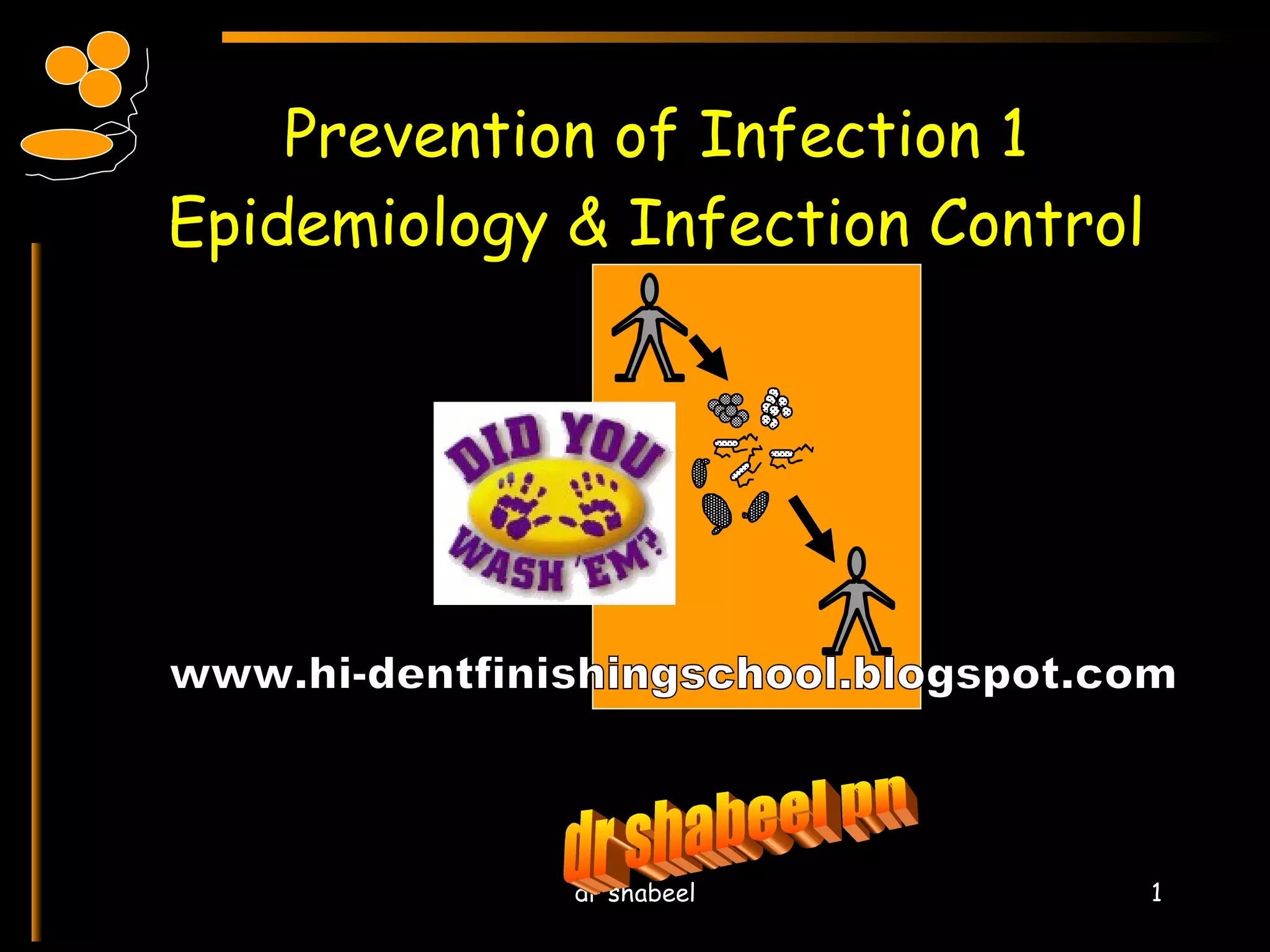
Prevention of Infection 1 Epidemiology & Infection Control dr shabeel pn www.hi-dentfinishingschool.blogspot.com
Overview Sources of infection Transmission of Infection Patterns of Infection Outbreaks & Epidemiological typing Infection Control General Principles: Hospital & Community Who’s who Hospital-acquired infection Syndromes Rogues’ gallery Control of Cross-Infection Risks from Hospital Staff Final words
Sources of infection Where do patients get their infections from...? …in the community food salmonellosis,  campylobacter Humans Animals (zoonoses) Environment clinical case e.g. measles tuberculosis ,  convalscent carrier e.g. typhoid diphtheria  hepatitis B symptomless  carrier  e.g. typhoid,  hepatitis auto-infection e.g. UTI candidiasis clinical case e.g. rabies psittacosis carrier e.g. salmonella  leptospirosis vector-borne e.g. malaria  Lyme disease  plague soil e.g. tetanus water cryptosporidiosis,  giardia, cholera airborne e.g. legionellosis
Sources of infection Where do patients get their infections from...? …in the hospital food salmonellosis Humans Cross -infection Environment clinical case e.g. chickenpox streptococcal pharyngitis wound infection symptomless carrier e.g. MRSA gent-resistant GNRs auto-infection e.g.  some  Staph aureus  wound infections IVI e.g.  Staph aureus, diphtheroids,  staph epidermidis ventilator  e.g. Pseudomonas air/dust Staph aureus ,  legionella disinfectants, solutions etc eg.  Pseudomonas endoscopes e.g. mycobacteria H. pylori Humans
Transmission of Infection Definitions of terms by example Salmonella  gastro-enteritis  Reservoir more commonly animal gut flora less commonly human cases & carriers Source or Vehicle food from affected animals contaminated food
Transmission of Infection Definitions of terms by example S. aureus  wound infection Reservoir Human nose & skin Source or Vehicle Hands of health care workers insert here
Patterns of Infection Definitions Sporadic   rare infections, occurring now and then, without any particular pattern  e.g. gas gangrene, or  Strep.  pyogenes  wound infections Epidemic   A sudden unexpected rise in number of infections caused by a particular pathogen Can range from the small scale e.g. a few individuals up to nationwide,  e.g. the BSE epidemic in UK
Patterns of Infection Definitions Outbreak   commonly used to mean a limited epidemic, e.g. in a hospital ward Pandemic   a world-wide epidemic e.g. HIV or influenza Endemic  implies a constant significant number of infections indefinitely  e.g. methicillin-resistant  S. aureus  is endemic to many hospitals
e.g. an outbreak of salmonella gastro-enteritis  No. of  new  cases Day Epidemic   infection  or outbreak Introduction of pathogen   followed by  point source outbreak  with abrupt start outbreak sputters on due  to limited human-to- human spread Patterns of Infection Examples Days
Patterns of Infection Examples e.g.  S. aureus  wound  infections in a hospital Endemic  infection continuous level of infection  predominantly due to human-to-human spread (cross-infection)
Outbreaks & Epidemiological typing Why type organisms? do you have an outbreak or just an increase in endemic or sporadic infection??  e.g.  S. aureus  infections in surgical unit identification of the source or extent of outbreak may have legal importance, e.g. close down restaurant identification of more virulent strains, Typing methods show whether isolates same or different Biochemistry, Antibiogram, Phage typing, Serotyping, Molecular methods
Infection Control General Principles   Remove reservoir or source of infection Interrupt transmission of infection Increase host resistance to infection
Infection Control  in the community Remove reservoirs & sources Human-to-human Case finding & treatment e.g. TB Contact tracing STDs, diphtheria, TB, meningitis Animals Culling of infected animals E.g. TB,  Brucella Environment Clean water, good housing
Infection Control  in the community Interrupt transmission Human-to-human avoid overcrowding changes in behaviour (e.g. safe sex) isolation of infectious cases (e.g. from school, work) Animals & Environment Food hygiene, vector control, animal vaccination & treatment, “poop-scooping”
Infection Control  in the community Increase host resistance Improved diet Vaccination Chemoprophylaxis Meningitis, diphtheria, TB
Hospital-acquired Infection why worry? 10-15% of patients will get infected during a stay in hospital Costs >£1 billion per year in UK A single large outbreak can cost 10-100K Effects of nosocomial infection Increased mortality & morbidity Prolonged hospital stay Increased drugs bill Increased staffing costs Demoralising for staff & patients Decreased public confidence in hospitals & doctors
Why is hospital-acquired infection different from community-acquired infection? Many patients have impaired immunity After anti-cancer chemotherapy After transplants Extremes of age Many patients have impaired normal physiological defences Breaches in skin Implanted foreign bodies (biofilms) Impaired phsyiology (Peristalsis, mucociliary escalator) Many vulnerable patients in close proximity to each other for prolonged periods of time
Why is hospital-acquired infection different from community-acquired infection? There is a distinct hospital flora "ordinary" pathogens e.g pnemococci,  E. coli, S. aureus , can all cause disease both inside and outside hospital opportunists only cause infection in patients with impaired immunity e.g  Serratia marsecens, Xanthomonas maltophilia, S. epidermidis, Corynebacterium jeikeium multi-resistant bacteria overlap with previous groups selected for in a darwinian fashion by antibiotic usage in hospitals include opportunists which are inherently multi-resistant  (e.g.  Xanthomonas maltophilia ) and multi-resistant varieties of common organisms, e.g. MRSA, gent-resistant E. coli
Infection Control  in hospital Remove reservoirs & sources Human-to-human Discharge infectious patients, e.g. with MRSA Treat & decontaminate patients Environment Control of  Legionella Ward hygiene & cleaning Hospital design
Infection Control  in hospital Interrupt transmission Human-to-human Hand washing Ward routine (e.g. wet mopping) Aseptic technique Sterilisation & disinfection Isolation procedures Environment Food hygiene, pest control, theatre design
Infection Control  in hospital Increase host resistance Good nutrition (e.g. TPN in ITU) Restore normal physiology as quickly as possible Remove lines, catheters etc Vaccinate (e.g. hepatitis B) Correct underlying defects E.g control diabetes Stimulate immunity (e.g. GM-CSF)
Infection Control  who’s who   in hospital Infection Control Doctor Infection Control Nurses Infection Control Committee Formulate policies waste disposal, theatre design, food hygiene etc Surveillance of infection Management of outbreaks Staff education Power to close wards and even whole hospitals
Hospital-acquired Infection Syndromes Nosocomial UTI ~30% of hospital infections Usually catheter associated Asymptomatic colonisation common Treatment of clinical infection often requires catheter removal  BUT only under antibiotic cover!
Hospital-acquired Infection Syndromes Chest infection  ~20% of nosocomial infections Gram-negative pneumonia Problem in critically ill & immunocompromised patients Legionellosis Vigilance is necessary for early detection of outbreaks Control by raising the hot water temp regular cleaning & inspection of water & air-cooling systems
Hospital-acquired Infection Syndromes Wound Infections  ~20% of nosocomial infections Rates vary depending on whether “clean” or “dirty” surgery Blood-stream Infections ~30% of nosocomial infections Especially device-associated infection Treatment: remove the foreign body
Hospital-acquired Infection Rogues gallery Methcillin-resistant  Staphylococcus aureus MRSA Infection Requires vancomycin treatment Colonisation requires isolation, decontamination with mupirocin and betadine Vancomycin-resistant enterococci VRE, includes E, faecalis and E. faecium Low grade pathogens If also multi-drug resistant treatment can be difficult  E. faecium  but not  E. faecalis  treatable with quinupristin & dalfopristin (Synercid)
Hospital-acquired Infection Rogues’ gallery Clostridium difficile Causes Antibiotic-associated colitis Can cause outbreaks in hospitals Patients should be isolated Gentamicin-resistant GNRs Require treatment with expensive drugs such as amikacin and imipenem Patients should be isolated Can cause outbreaks e.g. on oncology wards or in ITU Fungal infection Aspergillus fumigatus  and  Candida albicans  can cause nosocomial outbreaks
Control of Cross-Infection  Handwashing is paramount! even for Consultants! wash your hands before & after examining patients, especially if you look at undressed wounds Alcoholic hand rubs may provide a convenient alternative to soap and water, especially where sinks are in short supply or during an outbreak
Control of Cross-Infection  Isolation of infectious patients whenever you admit or assess a patient think: does this patient need to be isolated? general precautions Side-room isolation (or cohort nursing or isolation ward) Hand-washing on entry & exit Use of aprons and gloves consult  microbiologist or infection control nurse for advice infection control manual for isolation protocols contains advice on meningitis, D&V, open TB, MRSA, hepatitis, HIV, and lots more besides - everything from Lassa to lice!! Prophylaxis e.g. of contacts of chickenpox, diphtheria, meningitis
Risks from Hospital Staff Take Care Of Yourself! Your first responsibility is to your patients not your colleagues Do not work  if you have diarrhoea, or a flu-like illness, a sore throat, or if you may be incubating a viral illness such as measles, rubella, chickenpox! Be Considerate To Lab Staff! Don't send specimens to the lab without proper packing,  leaking and / or blood-stained specimens are not acceptable!!! Label hazardous specimens • •
Summary Sources of infection Transmission of Infection Patterns of Infection Outbreaks & Epidemiological typing Infection Control General Principles: Hospital & Community Who’s who Hospital-acquired infection Syndromes Rogues’ gallery Control of Cross-Infection Risks from Hospital Staff Final words….
...and some final words on  Hospital Infection Control... An extract from the work book of Dr Fester, aged 24 and  a  half, newly qualified house officer... 50 lines as punishment for poor hand hygiene I promise to wash my hands between patients  I promise to wash my hands between patients  I promise to wash my hands between patients  I promise to wash my hands between patients  I promise to wash my hands between patients  I promise to wash my hands between patients I promise to wash my hands between patients  I promise to wash my hands between patients  I promise to wash my hands between patients  I promise to wash my hands between patients  I promise to wash my hands between patients  I promise to wash my hands between patients I promise to wash my hands between patients  I promise to wash my hands between patients  I promise to wash my hands between patients  I promise to wash my hands between patients  I promise to wash my hands between patients...
 

Prevention of Infection

  • 1.
    Prevention of Infection1 Epidemiology & Infection Control dr shabeel pn www.hi-dentfinishingschool.blogspot.com
  • 2.
    Overview Sources ofinfection Transmission of Infection Patterns of Infection Outbreaks & Epidemiological typing Infection Control General Principles: Hospital & Community Who’s who Hospital-acquired infection Syndromes Rogues’ gallery Control of Cross-Infection Risks from Hospital Staff Final words
  • 3.
    Sources of infectionWhere do patients get their infections from...? …in the community food salmonellosis, campylobacter Humans Animals (zoonoses) Environment clinical case e.g. measles tuberculosis , convalscent carrier e.g. typhoid diphtheria hepatitis B symptomless carrier e.g. typhoid, hepatitis auto-infection e.g. UTI candidiasis clinical case e.g. rabies psittacosis carrier e.g. salmonella leptospirosis vector-borne e.g. malaria Lyme disease plague soil e.g. tetanus water cryptosporidiosis, giardia, cholera airborne e.g. legionellosis
  • 4.
    Sources of infectionWhere do patients get their infections from...? …in the hospital food salmonellosis Humans Cross -infection Environment clinical case e.g. chickenpox streptococcal pharyngitis wound infection symptomless carrier e.g. MRSA gent-resistant GNRs auto-infection e.g. some Staph aureus wound infections IVI e.g. Staph aureus, diphtheroids, staph epidermidis ventilator e.g. Pseudomonas air/dust Staph aureus , legionella disinfectants, solutions etc eg. Pseudomonas endoscopes e.g. mycobacteria H. pylori Humans
  • 5.
    Transmission of InfectionDefinitions of terms by example Salmonella gastro-enteritis Reservoir more commonly animal gut flora less commonly human cases & carriers Source or Vehicle food from affected animals contaminated food
  • 6.
    Transmission of InfectionDefinitions of terms by example S. aureus wound infection Reservoir Human nose & skin Source or Vehicle Hands of health care workers insert here
  • 7.
    Patterns of InfectionDefinitions Sporadic rare infections, occurring now and then, without any particular pattern e.g. gas gangrene, or Strep. pyogenes wound infections Epidemic A sudden unexpected rise in number of infections caused by a particular pathogen Can range from the small scale e.g. a few individuals up to nationwide, e.g. the BSE epidemic in UK
  • 8.
    Patterns of InfectionDefinitions Outbreak commonly used to mean a limited epidemic, e.g. in a hospital ward Pandemic a world-wide epidemic e.g. HIV or influenza Endemic implies a constant significant number of infections indefinitely e.g. methicillin-resistant S. aureus is endemic to many hospitals
  • 9.
    e.g. an outbreakof salmonella gastro-enteritis No. of new cases Day Epidemic infection or outbreak Introduction of pathogen followed by point source outbreak with abrupt start outbreak sputters on due to limited human-to- human spread Patterns of Infection Examples Days
  • 10.
    Patterns of InfectionExamples e.g. S. aureus wound infections in a hospital Endemic infection continuous level of infection predominantly due to human-to-human spread (cross-infection)
  • 11.
    Outbreaks & Epidemiologicaltyping Why type organisms? do you have an outbreak or just an increase in endemic or sporadic infection?? e.g. S. aureus infections in surgical unit identification of the source or extent of outbreak may have legal importance, e.g. close down restaurant identification of more virulent strains, Typing methods show whether isolates same or different Biochemistry, Antibiogram, Phage typing, Serotyping, Molecular methods
  • 12.
    Infection Control GeneralPrinciples Remove reservoir or source of infection Interrupt transmission of infection Increase host resistance to infection
  • 13.
    Infection Control in the community Remove reservoirs & sources Human-to-human Case finding & treatment e.g. TB Contact tracing STDs, diphtheria, TB, meningitis Animals Culling of infected animals E.g. TB, Brucella Environment Clean water, good housing
  • 14.
    Infection Control in the community Interrupt transmission Human-to-human avoid overcrowding changes in behaviour (e.g. safe sex) isolation of infectious cases (e.g. from school, work) Animals & Environment Food hygiene, vector control, animal vaccination & treatment, “poop-scooping”
  • 15.
    Infection Control in the community Increase host resistance Improved diet Vaccination Chemoprophylaxis Meningitis, diphtheria, TB
  • 16.
    Hospital-acquired Infection whyworry? 10-15% of patients will get infected during a stay in hospital Costs >£1 billion per year in UK A single large outbreak can cost 10-100K Effects of nosocomial infection Increased mortality & morbidity Prolonged hospital stay Increased drugs bill Increased staffing costs Demoralising for staff & patients Decreased public confidence in hospitals & doctors
  • 17.
    Why is hospital-acquiredinfection different from community-acquired infection? Many patients have impaired immunity After anti-cancer chemotherapy After transplants Extremes of age Many patients have impaired normal physiological defences Breaches in skin Implanted foreign bodies (biofilms) Impaired phsyiology (Peristalsis, mucociliary escalator) Many vulnerable patients in close proximity to each other for prolonged periods of time
  • 18.
    Why is hospital-acquiredinfection different from community-acquired infection? There is a distinct hospital flora "ordinary" pathogens e.g pnemococci, E. coli, S. aureus , can all cause disease both inside and outside hospital opportunists only cause infection in patients with impaired immunity e.g Serratia marsecens, Xanthomonas maltophilia, S. epidermidis, Corynebacterium jeikeium multi-resistant bacteria overlap with previous groups selected for in a darwinian fashion by antibiotic usage in hospitals include opportunists which are inherently multi-resistant (e.g. Xanthomonas maltophilia ) and multi-resistant varieties of common organisms, e.g. MRSA, gent-resistant E. coli
  • 19.
    Infection Control in hospital Remove reservoirs & sources Human-to-human Discharge infectious patients, e.g. with MRSA Treat & decontaminate patients Environment Control of Legionella Ward hygiene & cleaning Hospital design
  • 20.
    Infection Control in hospital Interrupt transmission Human-to-human Hand washing Ward routine (e.g. wet mopping) Aseptic technique Sterilisation & disinfection Isolation procedures Environment Food hygiene, pest control, theatre design
  • 21.
    Infection Control in hospital Increase host resistance Good nutrition (e.g. TPN in ITU) Restore normal physiology as quickly as possible Remove lines, catheters etc Vaccinate (e.g. hepatitis B) Correct underlying defects E.g control diabetes Stimulate immunity (e.g. GM-CSF)
  • 22.
    Infection Control who’s who in hospital Infection Control Doctor Infection Control Nurses Infection Control Committee Formulate policies waste disposal, theatre design, food hygiene etc Surveillance of infection Management of outbreaks Staff education Power to close wards and even whole hospitals
  • 23.
    Hospital-acquired Infection SyndromesNosocomial UTI ~30% of hospital infections Usually catheter associated Asymptomatic colonisation common Treatment of clinical infection often requires catheter removal BUT only under antibiotic cover!
  • 24.
    Hospital-acquired Infection SyndromesChest infection ~20% of nosocomial infections Gram-negative pneumonia Problem in critically ill & immunocompromised patients Legionellosis Vigilance is necessary for early detection of outbreaks Control by raising the hot water temp regular cleaning & inspection of water & air-cooling systems
  • 25.
    Hospital-acquired Infection SyndromesWound Infections ~20% of nosocomial infections Rates vary depending on whether “clean” or “dirty” surgery Blood-stream Infections ~30% of nosocomial infections Especially device-associated infection Treatment: remove the foreign body
  • 26.
    Hospital-acquired Infection Roguesgallery Methcillin-resistant Staphylococcus aureus MRSA Infection Requires vancomycin treatment Colonisation requires isolation, decontamination with mupirocin and betadine Vancomycin-resistant enterococci VRE, includes E, faecalis and E. faecium Low grade pathogens If also multi-drug resistant treatment can be difficult E. faecium but not E. faecalis treatable with quinupristin & dalfopristin (Synercid)
  • 27.
    Hospital-acquired Infection Rogues’gallery Clostridium difficile Causes Antibiotic-associated colitis Can cause outbreaks in hospitals Patients should be isolated Gentamicin-resistant GNRs Require treatment with expensive drugs such as amikacin and imipenem Patients should be isolated Can cause outbreaks e.g. on oncology wards or in ITU Fungal infection Aspergillus fumigatus and Candida albicans can cause nosocomial outbreaks
  • 28.
    Control of Cross-Infection Handwashing is paramount! even for Consultants! wash your hands before & after examining patients, especially if you look at undressed wounds Alcoholic hand rubs may provide a convenient alternative to soap and water, especially where sinks are in short supply or during an outbreak
  • 29.
    Control of Cross-Infection Isolation of infectious patients whenever you admit or assess a patient think: does this patient need to be isolated? general precautions Side-room isolation (or cohort nursing or isolation ward) Hand-washing on entry & exit Use of aprons and gloves consult microbiologist or infection control nurse for advice infection control manual for isolation protocols contains advice on meningitis, D&V, open TB, MRSA, hepatitis, HIV, and lots more besides - everything from Lassa to lice!! Prophylaxis e.g. of contacts of chickenpox, diphtheria, meningitis
  • 30.
    Risks from HospitalStaff Take Care Of Yourself! Your first responsibility is to your patients not your colleagues Do not work if you have diarrhoea, or a flu-like illness, a sore throat, or if you may be incubating a viral illness such as measles, rubella, chickenpox! Be Considerate To Lab Staff! Don't send specimens to the lab without proper packing, leaking and / or blood-stained specimens are not acceptable!!! Label hazardous specimens • •
  • 31.
    Summary Sources ofinfection Transmission of Infection Patterns of Infection Outbreaks & Epidemiological typing Infection Control General Principles: Hospital & Community Who’s who Hospital-acquired infection Syndromes Rogues’ gallery Control of Cross-Infection Risks from Hospital Staff Final words….
  • 32.
    ...and some finalwords on Hospital Infection Control... An extract from the work book of Dr Fester, aged 24 and a half, newly qualified house officer... 50 lines as punishment for poor hand hygiene I promise to wash my hands between patients I promise to wash my hands between patients I promise to wash my hands between patients I promise to wash my hands between patients I promise to wash my hands between patients I promise to wash my hands between patients I promise to wash my hands between patients I promise to wash my hands between patients I promise to wash my hands between patients I promise to wash my hands between patients I promise to wash my hands between patients I promise to wash my hands between patients I promise to wash my hands between patients I promise to wash my hands between patients I promise to wash my hands between patients I promise to wash my hands between patients I promise to wash my hands between patients...
  • 33.