
Water
Purification
Mr. Kuldeep Vyas
Community Health Nursing
Mr. Kuldeep Vyas M.Sc. (N)
PURIFICATION OF WATER
 LARGE SCALE
Storage Filtration
SMALL SCALE (DOMESTIC)
Disinfection

A. Household purification
–Boiling
–Chemical disinfection :
Bleaching powder, Chlorine solution , High test hypochlorite(HTH),
Chlorine tablets , Iodine, Potassium permagnate
–Household filtration : Ceramic filters
•Disinfection of well
• By adding bleaching powder
• Double pot method
Mr. Kuldeep Vyas M.Sc. (N)
STORAGE
 In Natural / Artificial Reservoirs
 Effects of storage:
• Physical: Gravity – 90%suspended impurities settle down in one
day
Oxidizing action•Chemical: Organic matter Nitrates, Free Ammonia
Aerobic bacteria, dissolved O2
•Biological: Only 10% bacteria
remains at the end of 1 week
Optimum period of
storage: 2 weeksMr. Kuldeep Vyas M.Sc. (N)
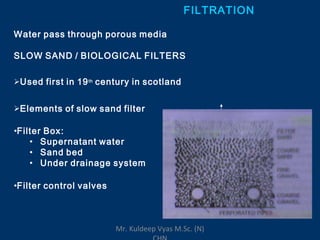
FILTRATION
Water pass through porous media
SLOW SAND / BIOLOGICAL FILTERS
Used first in 19th century in scotland
Elements of slow sand filter
•Filter Box:
• Supernatant water
• Sand bed
• Under drainage system
•Filter control valves
Mr. Kuldeep Vyas M.Sc. (N)
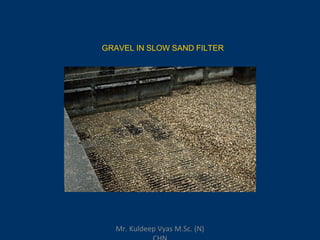
GRAVEL IN SLOW SAND FILTER
Mr. Kuldeep Vyas M.Sc. (N)
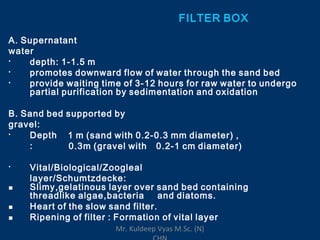
FILTER BOX
A. Supernatant
water
•
•
•
depth: 1-1.5 m
promotes downward flow of water through the sand bed
provide waiting time of 3-12 hours for raw water to undergo
partial purification by sedimentation and oxidation
B. Sand bed supported by
gravel:
• Depth
:
1 m (sand with 0.2-0.3 mm diameter) ,
0.3m (gravel with 0.2-1 cm diameter)
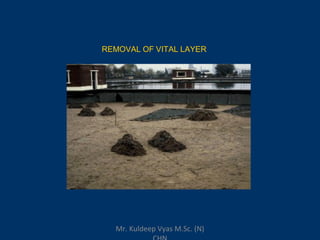
• Vital/Biological/Zoogleal
layer/Schumtzdecke:
 Slimy,gelatinous layer over sand bed containing
threadlike algae,bacteria and diatoms.
Heart of the slow sand filter.
Ripening of filter : Formation of vital layer


Mr. Kuldeep Vyas M.Sc. (N)
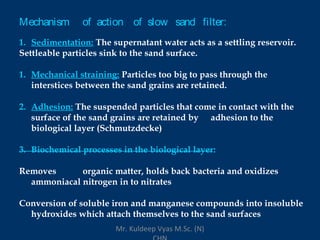
Mechanism of action of slow sand filter:
1. Sedimentation: The supernatant water acts as a settling reservoir.
Settleable particles sink to the sand surface.
1. Mechanical straining: Particles too big to pass through the
interstices between the sand grains are retained.
2. Adhesion: The suspended particles that come in contact with the
surface of the sand grains are retained by adhesion to the
biological layer (Schmutzdecke)
3. Biochemical processes in the biological layer:
Removes organic matter, holds back bacteria and oxidizes
ammoniacal nitrogen in to nitrates
Conversion of soluble iron and manganese compounds into insoluble
hydroxides which attach themselves to the sand surfaces
Mr. Kuldeep Vyas M.Sc. (N)
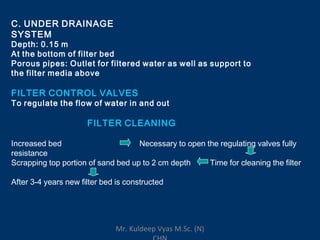
C. UNDER DRAINAGE
SYSTEM
Depth: 0.15 m
At the bottom of filter bed
Porous pipes: Outlet for filtered water as well as support to
the filter media above
FILTER CONTROL VALVES
To regulate the flow of water in and out
FILTER CLEANING
Increased bed
resistance
Necessary to open the regulating valves fully
Scrapping top portion of sand bed up to 2 cm depth Time for cleaning the filter
After 3-4 years new filter bed is constructed
Mr. Kuldeep Vyas M.Sc. (N)
REMOVAL OF VITAL LAYER
Mr. Kuldeep Vyas M.Sc. (N)
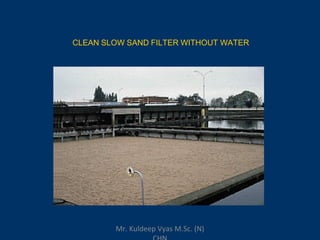
CLEAN SLOW SAND FILTER WITHOUT WATER
Mr. Kuldeep Vyas M.Sc. (N)
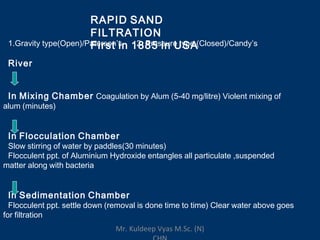
RAPID SAND
FILTRATION
First in 1885 in USA1.Gravity type(Open)/Paterson’s 2. Pressure type (Closed)/Candy’s
River
In Mixing Chamber Coagulation by Alum (5-40 mg/litre) Violent mixing of
alum (minutes)
In Flocculation Chamber
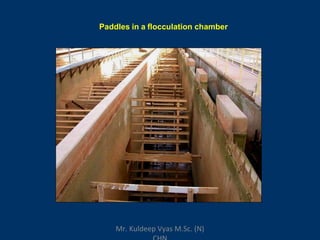
Slow stirring of water by paddles(30 minutes)
Flocculent ppt. of Aluminium Hydroxide entangles all particulate ,suspended
matter along with bacteria
In Sedimentation Chamber
Flocculent ppt. settle down (removal is done time to time) Clear water above goes
for filtration
Mr. Kuldeep Vyas M.Sc. (N)
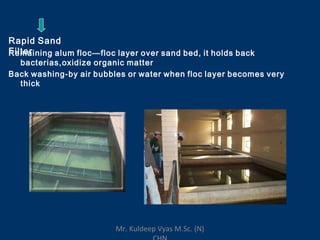
Rapid Sand
FilterRemaining alum floc—floc layer over sand bed, it holds back
bacterias,oxidize organic matter
Back washing-by air bubbles or water when floc layer becomes very
thick
Mr. Kuldeep Vyas M.Sc. (N)
Paddles in a flocculation chamber
Mr. Kuldeep Vyas M.Sc. (N)
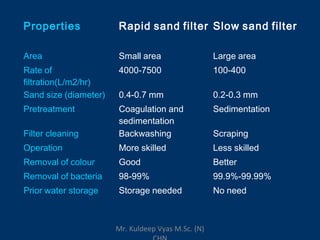
Properties Rapid sand filter Slow sand filter
Area Small area Large area
Rate of
filtration(L/m2/hr)
4000-7500 100-400
Sand size (diameter) 0.4-0.7 mm 0.2-0.3 mm
Pretreatment Coagulation and
sedimentation
Sedimentation
Filter cleaning Backwashing Scraping
Operation More skilled Less skilled
Removal of colour Good Better
Removal of bacteria 98-99% 99.9%-99.99%
Prior water storage Storage needed No need
Mr. Kuldeep Vyas M.Sc. (N)
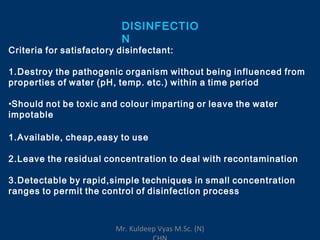
DISINFECTIO
N
Criteria for satisfactory disinfectant:
1.Destroy the pathogenic organism without being influenced from
properties of water (pH, temp. etc.) within a time period
•Should not be toxic and colour imparting or leave the water
impotable
1.Available, cheap,easy to use
2.Leave the residual concentration to deal with recontamination
3.Detectable by rapid,simple techniques in small concentration
ranges to permit the control of disinfection process
Mr. Kuldeep Vyas M.Sc. (N)
Chlorination
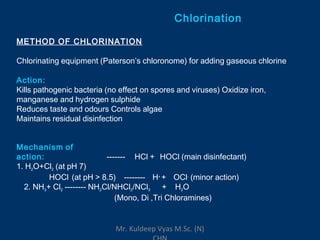
METHOD OF CHLORINATION
Chlorinating equipment (Paterson’s chloronome) for adding gaseous chlorine
Action:
Kills pathogenic bacteria (no effect on spores and viruses) Oxidize iron,
manganese and hydrogen sulphide
Reduces taste and odours Controls algae
Maintains residual disinfection
Mechanism of
action:
1. H2O+Cl2 (at pH 7)
------- HCl + HOCl (main disinfectant)
HOCl (at pH > 8.5) -------- H+ + OCl- (minor action)
2. NH3+ Cl2 -------- NH2Cl/NHCl2/NCl3 + H2O
(Mono, Di ,Tri Chloramines)
Mr. Kuldeep Vyas M.Sc. (N)
PRINCIPLES OF
CHLORINATION
1.Water should be clear,free from turbidity
2.Chlorine demand :
Chlorine needed to destroy bacteria, to oxidize organic matter and
to neutralize the ammonia in water
1.Free residual chlorine for a contact period of 1 hour is essential
2.Breakpoint : Point when chlorine demand of water is met and
free residual chlorine appears
3.Breakpoint chlorination: Chlorination beyond the breakpoint . The
principle of break point chlorination is to add sufficient chlorine so
that 0.5 mg/L free residual chlorine is present in the water after one
hour of contact time
4. Dose of Chlorine = Chlorine demand + Free residual chlorine
Mr. Kuldeep Vyas M.Sc. (N)
Tests to measure Residual
Chlorine
 OT Test- Yellow colour
( In 10 seconds-free chlorine,
In 15 min-both free and combined chlorine)
 Ortho Tolidine Arsenite (OTA) Test-Yellow
colour
Tests both free and combined chlorine separately (Yellow
colour due to nitrites,iron,mangenese
are overcome by OTA test)
Mr. Kuldeep Vyas M.Sc. (N)
Super
chlorination

method of choice for highly polluted waters high
dose of chlorine is added
after 20 minutes of contact, dechlorination
is done with sodium sulphate / sodium thiosulphate
to reduce the taste of excess chlorine


Mr. Kuldeep Vyas M.Sc. (N)
OTHER DISINFECTANTS
OZONE
•Used in Europe and Canada
•Strong oxidizing agent
•Strong Virucidal
•No residual effect
•Should be used with chlorination
UV RAYS
•Used in UK
•Water should be clear
•No residual effect
•Expensive
CHLORAMINE
•Chlorine + Ammonia — Chloramine
•Less effective than chlorine
Mr. Kuldeep Vyas M.Sc. (N)
PURIFICATION OF WATER ON SMALL SCALE
A . HOUSEHOLD PURIFICATION:
1.BOILING
Rolling boil for 10 min.
Kills all bacteria,spores,cysts,ova,remives temporary hardness No residual
protection
2.CHEMICAL DISINFECTION
•Bleaching powder: White powder,pungent smell
33% available chlorine
Unstable
Storage in dark,cool,dry place in a closed container Prepared by passing chlorine
gas over lime (CaO) Chlorinated lime(CaOCl2)-another name
Stabilized bleach-Bleaching powder mixed with excess of lime
Chlorine solution:
200 gm bleaching powder (25% available chlorine) + 1 litre water = 5% solution 1
drop of this solution---For disinfection of 1 L water
Mr. Kuldeep Vyas M.Sc. (N)
b. HTH/Perchloron:
High strength Ca Hypochlorite
70% available chlorine
1 gm/L of water
c. Chlorine tablets:
NEERI developed cheaper good tablets 1 tab(0.5g) for 20 L water
d. Iodine :
2 drops (2% solution in alcohol) for 1 L water Contact time 30 minutes
Used only in emergency situation
•Potassium permangnate: Expensive,unreliable,not recommended
•Alum : For turbidity reduction: 0.4-1.6 g/20 L water
Mr. Kuldeep Vyas M.Sc. (N)
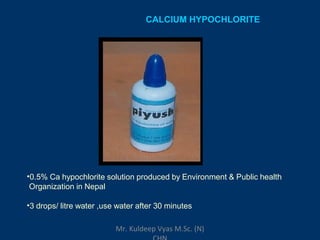
CALCIUM HYPOCHLORITE
•0.5% Ca hypochlorite solution produced by Environment & Public health
Organization in Nepal
•3 drops/ litre water ,use water after 30 minutes
Mr. Kuldeep Vyas M.Sc. (N)
3. FILTRATION AT HOUSEHOLD LEVEL
1. FOUR GHARA METHOD: Top: Muddy water, II: Sand,III: Charcoal,
(MSCE) IV: Empty ghara to collect filtered water
2. CERAMIC FILTERS
Water pass through micro-pores of candle placed inside the water
container. Bacteria: Unable to pass through the pores,
Virus: Can pass through the pores
1. PASTEUR CHAMBERLAND FILTER:
porcelain candles, used in labs & dispensaries.
1. BERKEFELD FILTER:
infusorial earth (keiselgurh) candles, less reliable
Mr. Kuldeep Vyas M.Sc. (N)
KATADYN
FILTER:
•katadyn: activated form of silver
•filter coated with silver catalyst (oligodynamic action)
•oligodynamic action: certain metals in very small doses act as
powerful germicide
Cleaning of filter:
•candles scrubbing with a hard brush - every 3 days,
•boiling of candles-once in a week
Mr. Kuldeep Vyas M.Sc. (N)
DISINFECTION OF WELL
1. By adding bleaching powder:
Find volume of water in well (V in Litres) = 3.14 x h x d2 x 1000
4
Find the amount of bleaching powder needed by Horrock’s apparatus
Bleaching powder (max.100 g) mixed with water in a bucket
(water up to 3/4th of bucket)
Allow 10 minutes sedimentation
Transfer supernatant chlorine solution to another bucket Deliver
chlorine solution in to the well
Allow 1 hour contact
Do OTA test to measure free residual chlorine If free residual chlorine <
0.5 mg/L
Add more bleaching powder
Mr. Kuldeep Vyas M.Sc. (N)
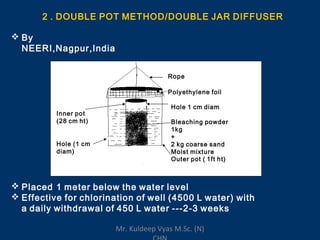
2 . DOUBLE POT METHOD/DOUBLE JAR DIFFUSER
 By
NEERI,Nagpur,India
 Placed 1 meter below the water level
 Effective for chlorination of well (4500 L water) with
a daily withdrawal of 450 L water ---2-3 weeks
Inner pot
(28 cm ht)
Hole (1 cm
diam)
Bleaching powder
1kg
+
2 kg coarse sand
Moist mixture
Outer pot ( 1ft ht)
Rope
Polyethylene foil
Hole 1 cm diam
Mr. Kuldeep Vyas M.Sc. (N)
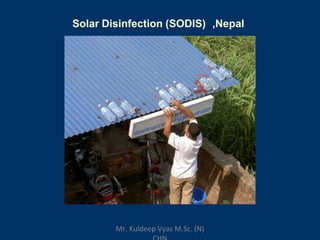
Solar Disinfection (SODIS) ,Nepal
Mr. Kuldeep Vyas M.Sc. (N)
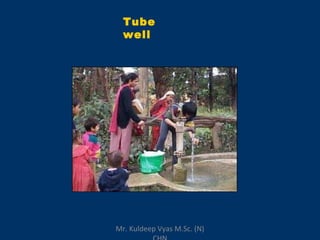
Tube
well
Mr. Kuldeep Vyas M.Sc. (N)

Water purification

  • 1.
    Water Purification Mr. Kuldeep Vyas CommunityHealth Nursing Mr. Kuldeep Vyas M.Sc. (N)
  • 2.
    PURIFICATION OF WATER LARGE SCALE Storage Filtration SMALL SCALE (DOMESTIC) Disinfection  A. Household purification –Boiling –Chemical disinfection : Bleaching powder, Chlorine solution , High test hypochlorite(HTH), Chlorine tablets , Iodine, Potassium permagnate –Household filtration : Ceramic filters •Disinfection of well • By adding bleaching powder • Double pot method Mr. Kuldeep Vyas M.Sc. (N)
  • 3.
    STORAGE  In Natural/ Artificial Reservoirs  Effects of storage: • Physical: Gravity – 90%suspended impurities settle down in one day Oxidizing action•Chemical: Organic matter Nitrates, Free Ammonia Aerobic bacteria, dissolved O2 •Biological: Only 10% bacteria remains at the end of 1 week Optimum period of storage: 2 weeksMr. Kuldeep Vyas M.Sc. (N)
  • 4.
    FILTRATION Water pass throughporous media SLOW SAND / BIOLOGICAL FILTERS Used first in 19th century in scotland Elements of slow sand filter •Filter Box: • Supernatant water • Sand bed • Under drainage system •Filter control valves Mr. Kuldeep Vyas M.Sc. (N)
  • 5.
    GRAVEL IN SLOWSAND FILTER Mr. Kuldeep Vyas M.Sc. (N)
  • 6.
    FILTER BOX A. Supernatant water • • • depth:1-1.5 m promotes downward flow of water through the sand bed provide waiting time of 3-12 hours for raw water to undergo partial purification by sedimentation and oxidation B. Sand bed supported by gravel: • Depth : 1 m (sand with 0.2-0.3 mm diameter) , 0.3m (gravel with 0.2-1 cm diameter) • Vital/Biological/Zoogleal layer/Schumtzdecke:  Slimy,gelatinous layer over sand bed containing threadlike algae,bacteria and diatoms. Heart of the slow sand filter. Ripening of filter : Formation of vital layer   Mr. Kuldeep Vyas M.Sc. (N)
  • 7.
    Mechanism of actionof slow sand filter: 1. Sedimentation: The supernatant water acts as a settling reservoir. Settleable particles sink to the sand surface. 1. Mechanical straining: Particles too big to pass through the interstices between the sand grains are retained. 2. Adhesion: The suspended particles that come in contact with the surface of the sand grains are retained by adhesion to the biological layer (Schmutzdecke) 3. Biochemical processes in the biological layer: Removes organic matter, holds back bacteria and oxidizes ammoniacal nitrogen in to nitrates Conversion of soluble iron and manganese compounds into insoluble hydroxides which attach themselves to the sand surfaces Mr. Kuldeep Vyas M.Sc. (N)
  • 8.
    C. UNDER DRAINAGE SYSTEM Depth:0.15 m At the bottom of filter bed Porous pipes: Outlet for filtered water as well as support to the filter media above FILTER CONTROL VALVES To regulate the flow of water in and out FILTER CLEANING Increased bed resistance Necessary to open the regulating valves fully Scrapping top portion of sand bed up to 2 cm depth Time for cleaning the filter After 3-4 years new filter bed is constructed Mr. Kuldeep Vyas M.Sc. (N)
  • 9.
    REMOVAL OF VITALLAYER Mr. Kuldeep Vyas M.Sc. (N)
  • 10.
    CLEAN SLOW SANDFILTER WITHOUT WATER Mr. Kuldeep Vyas M.Sc. (N)
  • 11.
    RAPID SAND FILTRATION First in1885 in USA1.Gravity type(Open)/Paterson’s 2. Pressure type (Closed)/Candy’s River In Mixing Chamber Coagulation by Alum (5-40 mg/litre) Violent mixing of alum (minutes) In Flocculation Chamber Slow stirring of water by paddles(30 minutes) Flocculent ppt. of Aluminium Hydroxide entangles all particulate ,suspended matter along with bacteria In Sedimentation Chamber Flocculent ppt. settle down (removal is done time to time) Clear water above goes for filtration Mr. Kuldeep Vyas M.Sc. (N)
  • 12.
    Rapid Sand FilterRemaining alumfloc—floc layer over sand bed, it holds back bacterias,oxidize organic matter Back washing-by air bubbles or water when floc layer becomes very thick Mr. Kuldeep Vyas M.Sc. (N)
  • 13.
    Paddles in aflocculation chamber Mr. Kuldeep Vyas M.Sc. (N)
  • 14.
    Properties Rapid sandfilter Slow sand filter Area Small area Large area Rate of filtration(L/m2/hr) 4000-7500 100-400 Sand size (diameter) 0.4-0.7 mm 0.2-0.3 mm Pretreatment Coagulation and sedimentation Sedimentation Filter cleaning Backwashing Scraping Operation More skilled Less skilled Removal of colour Good Better Removal of bacteria 98-99% 99.9%-99.99% Prior water storage Storage needed No need Mr. Kuldeep Vyas M.Sc. (N)
  • 15.
    DISINFECTIO N Criteria for satisfactorydisinfectant: 1.Destroy the pathogenic organism without being influenced from properties of water (pH, temp. etc.) within a time period •Should not be toxic and colour imparting or leave the water impotable 1.Available, cheap,easy to use 2.Leave the residual concentration to deal with recontamination 3.Detectable by rapid,simple techniques in small concentration ranges to permit the control of disinfection process Mr. Kuldeep Vyas M.Sc. (N)
  • 16.
    Chlorination METHOD OF CHLORINATION Chlorinatingequipment (Paterson’s chloronome) for adding gaseous chlorine Action: Kills pathogenic bacteria (no effect on spores and viruses) Oxidize iron, manganese and hydrogen sulphide Reduces taste and odours Controls algae Maintains residual disinfection Mechanism of action: 1. H2O+Cl2 (at pH 7) ------- HCl + HOCl (main disinfectant) HOCl (at pH > 8.5) -------- H+ + OCl- (minor action) 2. NH3+ Cl2 -------- NH2Cl/NHCl2/NCl3 + H2O (Mono, Di ,Tri Chloramines) Mr. Kuldeep Vyas M.Sc. (N)
  • 17.
    PRINCIPLES OF CHLORINATION 1.Water shouldbe clear,free from turbidity 2.Chlorine demand : Chlorine needed to destroy bacteria, to oxidize organic matter and to neutralize the ammonia in water 1.Free residual chlorine for a contact period of 1 hour is essential 2.Breakpoint : Point when chlorine demand of water is met and free residual chlorine appears 3.Breakpoint chlorination: Chlorination beyond the breakpoint . The principle of break point chlorination is to add sufficient chlorine so that 0.5 mg/L free residual chlorine is present in the water after one hour of contact time 4. Dose of Chlorine = Chlorine demand + Free residual chlorine Mr. Kuldeep Vyas M.Sc. (N)
  • 18.
    Tests to measureResidual Chlorine  OT Test- Yellow colour ( In 10 seconds-free chlorine, In 15 min-both free and combined chlorine)  Ortho Tolidine Arsenite (OTA) Test-Yellow colour Tests both free and combined chlorine separately (Yellow colour due to nitrites,iron,mangenese are overcome by OTA test) Mr. Kuldeep Vyas M.Sc. (N)
  • 19.
    Super chlorination  method of choicefor highly polluted waters high dose of chlorine is added after 20 minutes of contact, dechlorination is done with sodium sulphate / sodium thiosulphate to reduce the taste of excess chlorine   Mr. Kuldeep Vyas M.Sc. (N)
  • 20.
    OTHER DISINFECTANTS OZONE •Used inEurope and Canada •Strong oxidizing agent •Strong Virucidal •No residual effect •Should be used with chlorination UV RAYS •Used in UK •Water should be clear •No residual effect •Expensive CHLORAMINE •Chlorine + Ammonia — Chloramine •Less effective than chlorine Mr. Kuldeep Vyas M.Sc. (N)
  • 21.
    PURIFICATION OF WATERON SMALL SCALE A . HOUSEHOLD PURIFICATION: 1.BOILING Rolling boil for 10 min. Kills all bacteria,spores,cysts,ova,remives temporary hardness No residual protection 2.CHEMICAL DISINFECTION •Bleaching powder: White powder,pungent smell 33% available chlorine Unstable Storage in dark,cool,dry place in a closed container Prepared by passing chlorine gas over lime (CaO) Chlorinated lime(CaOCl2)-another name Stabilized bleach-Bleaching powder mixed with excess of lime Chlorine solution: 200 gm bleaching powder (25% available chlorine) + 1 litre water = 5% solution 1 drop of this solution---For disinfection of 1 L water Mr. Kuldeep Vyas M.Sc. (N)
  • 22.
    b. HTH/Perchloron: High strengthCa Hypochlorite 70% available chlorine 1 gm/L of water c. Chlorine tablets: NEERI developed cheaper good tablets 1 tab(0.5g) for 20 L water d. Iodine : 2 drops (2% solution in alcohol) for 1 L water Contact time 30 minutes Used only in emergency situation •Potassium permangnate: Expensive,unreliable,not recommended •Alum : For turbidity reduction: 0.4-1.6 g/20 L water Mr. Kuldeep Vyas M.Sc. (N)
  • 23.
    CALCIUM HYPOCHLORITE •0.5% Cahypochlorite solution produced by Environment & Public health Organization in Nepal •3 drops/ litre water ,use water after 30 minutes Mr. Kuldeep Vyas M.Sc. (N)
  • 24.
    3. FILTRATION ATHOUSEHOLD LEVEL 1. FOUR GHARA METHOD: Top: Muddy water, II: Sand,III: Charcoal, (MSCE) IV: Empty ghara to collect filtered water 2. CERAMIC FILTERS Water pass through micro-pores of candle placed inside the water container. Bacteria: Unable to pass through the pores, Virus: Can pass through the pores 1. PASTEUR CHAMBERLAND FILTER: porcelain candles, used in labs & dispensaries. 1. BERKEFELD FILTER: infusorial earth (keiselgurh) candles, less reliable Mr. Kuldeep Vyas M.Sc. (N)
  • 25.
    KATADYN FILTER: •katadyn: activated formof silver •filter coated with silver catalyst (oligodynamic action) •oligodynamic action: certain metals in very small doses act as powerful germicide Cleaning of filter: •candles scrubbing with a hard brush - every 3 days, •boiling of candles-once in a week Mr. Kuldeep Vyas M.Sc. (N)
  • 26.
    DISINFECTION OF WELL 1.By adding bleaching powder: Find volume of water in well (V in Litres) = 3.14 x h x d2 x 1000 4 Find the amount of bleaching powder needed by Horrock’s apparatus Bleaching powder (max.100 g) mixed with water in a bucket (water up to 3/4th of bucket) Allow 10 minutes sedimentation Transfer supernatant chlorine solution to another bucket Deliver chlorine solution in to the well Allow 1 hour contact Do OTA test to measure free residual chlorine If free residual chlorine < 0.5 mg/L Add more bleaching powder Mr. Kuldeep Vyas M.Sc. (N)
  • 27.
    2 . DOUBLEPOT METHOD/DOUBLE JAR DIFFUSER  By NEERI,Nagpur,India  Placed 1 meter below the water level  Effective for chlorination of well (4500 L water) with a daily withdrawal of 450 L water ---2-3 weeks Inner pot (28 cm ht) Hole (1 cm diam) Bleaching powder 1kg + 2 kg coarse sand Moist mixture Outer pot ( 1ft ht) Rope Polyethylene foil Hole 1 cm diam Mr. Kuldeep Vyas M.Sc. (N)
  • 28.
    Solar Disinfection (SODIS),Nepal Mr. Kuldeep Vyas M.Sc. (N)
  • 29.
  • 30.