PREVENTING INFECTION
We can all help prevent the spread of infections.
Chapter 5
*Information is primarily based from Hartman’s Nursing Assistant Care/Long term
Care textbook, 4th edition.
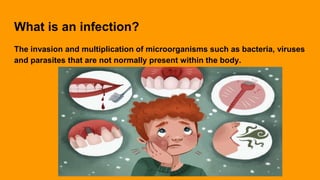
What is an infection?
The invasion and multiplication of microorganisms such as bacteria, viruses
and parasites that are not normally present within the body.
What causes infections?
Harmful microorganisms or bacteria, which are called PATHOGENS (germs).
Microorganisms need special conditions to thrive
DARK, WARM, MOIST environments
Not all microorganisms are spread in the same manner.
Where can we find Pathogens?
Communicable Disease
Communicable diseases are highly contagious and can spread easily.
Influenza
Tuberculosis
Ebola
Legionella
MRSA
Meningitis
Natural or Normal Flora
Microorganisms or bacteria that are naturally occuring on our body surface and in
our bodies. There are approximately one hundred trillion bacteria that form the
natural flora of our bodies. They can be found in the respiratory tract, urinary
tract, digestive tract and on the skin.
When the natural balance is thrown off or if the bacteria is relocated to another
area that will cause an problem.
How Do We Fight Infections?
The body’s IMMUNE SYSTEM attacks pathogens and fight infection (briefly touch
on chapter 9).
Why are the Elderly more at risk for Infection?
● Weakened immune system
● Decreased circulation and poor wound healing
● Malnutrition and dehydration
Types of infection
● Localized infection - the infection only affects one part of the body or
organ, symptoms are only observed in one area.
● Systemic infection - the infection is spread through multiple systems of
the body by the bloodstream. The symptoms will be observed
throughout the body.
● Healthcare-associated infection (HAI) - is an infection acquired in a
healthcare setting during the delivery of medical care.
Signs & Symptoms of Infection
● Local infection - pain, redness, swelling, pus,
drainage, heat.
● Systemic infection - fever, body aches, chills, nausea, vomiting,
weakness, headache, change in mentation, drop in persons baseline
BP.
HANDWASHING!!!!!
Use soap and water and at least 20 seconds of friction.
Wash all areas of your hand and wrists
Don’t forget between your fingers
Standard Precautions
Standard Precautions means treating blood, body fluids, non-intact skin (like
abrasions, pimples, or open sores), and mucous membranes (linings of mouth,
nose, eyes, rectum and genitals) as if they were infected. Body fluids include
saliva, sputum (mucus coughed up), urine, feces, semen, vaginal secretions, pus
and other wound drainage and vomit. They do not include sweat.
STANDARD PRECAUTIONS MUST BE USED WITH EVERY PATIENT!!!
Personal Protective Equipment (PPE)
● Gown
● Mask
● Gloves
Don
Doff
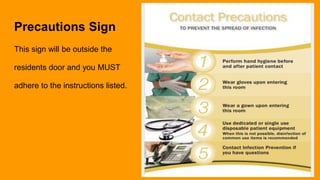
Precautions Sign
This sign will be outside the
residents door and you MUST
adhere to the instructions listed.
Occupational Safety & Health Administration (OSHA)
● Federal government agency that makes rules to protect workers from hazards
on the job. It was established in 1970. The agency has deals with health and
safety complaints, you can also report a death or severe injury that happened
on the job.
Center for Disease Control
● CDC is a government agency within the HHS
● It issues health information to protect individuals and communities
● It promotes public health, as well as disease, injury, and disability prevention
and control through education.
● The CDC recommends new infection control regulation to reduce the
prevalence of infectious disease in the healthcare settings.
Transmission Based Precautions
This is s level of precautions beyond Standard Prec.
Transmission based precautions means the person has a condition that can be
passed on or transferred.
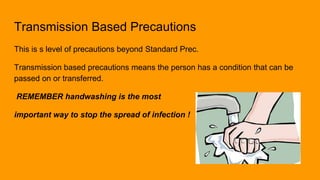
REMEMBER handwashing is the most
important way to stop the spread of infection !
Airborne Precautions
Tiny germs or pathogens are expelled from the host and travel through the air.
● Tuberculosis
● Measles
● Chickenpox
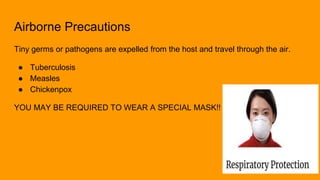
YOU MAY BE REQUIRED TO WEAR A SPECIAL MASK!!
Tuberculosis is Airborne
Tuberculosis is a serious infectious bacterial disease that mainly
affects the lungs.
It can be spread when the infected person coughs
or sneezes.
Droplet Precautions
Droplet precautions are used for diseases or germs that are spread in droplets, in
the air caused by coughing and sneezing.
● Pneumonia, Influenza, mumps
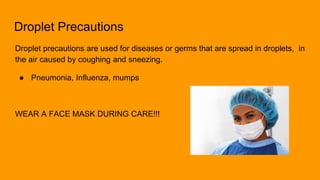
WEAR A FACE MASK DURING CARE!!!
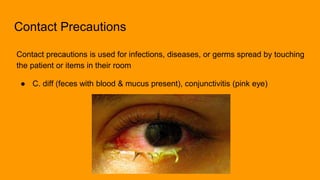
Contact Precautions
Contact precautions is used for infections, diseases, or germs spread by touching
the patient or items in their room
● C. diff (feces with blood & mucus present), conjunctivitis (pink eye)
Protective Isolation Precautions
Most Precautions are to protect the staff from infection or disease, however
Isolation Precautions are designed to protect residents with decreased immune
function.
● Cancer pts
● Aids pts
● Organ transplant pts
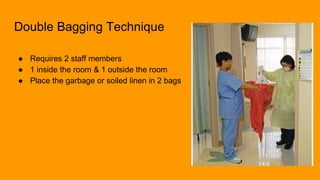
Double Bagging Technique
● Requires 2 staff members
● 1 inside the room & 1 outside the room
● Place the garbage or soiled linen in 2 bags
Bloodborne Pathogens
Are found in blood, bodily fluids, draining wounds and mucous membranes.
Examples
● AIDS
● HIV
● Hepatitis B (HBV) can spread through sexual activity
● Hepatitis C (HCV) can lead to cirrhosis of the liver and liver cancer
Human Immunodeficiency Virus (HIV)
A major bloodborne disease is HIV. Over time HIV severely weakens the immune
system so that the body can not effectively fight infections. The final stage of HIV
disease is AIDS.
Hepatitis
Hepatitis is a major bloodborne disease. Hepatitis is inflammation of the liver
caused by certain viruses and other factors, such as alcohol abuse, certain meds,
and trauma. Liver function can be permanently damaged.
Liver function
● Filters blood
● Secrete bile (digest fats)
● Makes proteins needed for blood clotting
Multidrug-resistant organisms (MDROs)pg 71
***MRSA (methicillin-resistant Staphylococcus aureus): an infection caused by
specific bacteria that have become resistant to many bacteria.
***VRE (Vancomycin-resistant enterococcus): bacteria that have developed
resistance to antibiotics as a result of of being exposed to vancomycin.
***C. difficile (Clostridium difficile): bacterial illness that can cause diarrhea &
colitis; spread by spores in feces that are difficult to kill.
Terminology (pages 69 & 70)
Clean
Dirty
Disinfect
Sterilization
Asepsis
Medical asepsis is used in all healthcare settings to reduce and prevent the
spread of infection. Medical asepsis means free from pathogens, clean.
Surgical asepsis is the state of being free from ALL microorganisms, not just
pathogens. Surgical asepsis means STERILE.
Conclusion
1. Wash your hands
2. Follow standard precautions
3. Follow your facility policies

Preventing infection

  • 1.
    PREVENTING INFECTION We canall help prevent the spread of infections. Chapter 5 *Information is primarily based from Hartman’s Nursing Assistant Care/Long term Care textbook, 4th edition.
  • 2.
    What is aninfection? The invasion and multiplication of microorganisms such as bacteria, viruses and parasites that are not normally present within the body.
  • 3.
    What causes infections? Harmfulmicroorganisms or bacteria, which are called PATHOGENS (germs). Microorganisms need special conditions to thrive DARK, WARM, MOIST environments Not all microorganisms are spread in the same manner.
  • 4.
    Where can wefind Pathogens?
  • 5.
    Communicable Disease Communicable diseasesare highly contagious and can spread easily. Influenza Tuberculosis Ebola Legionella MRSA Meningitis
  • 6.
    Natural or NormalFlora Microorganisms or bacteria that are naturally occuring on our body surface and in our bodies. There are approximately one hundred trillion bacteria that form the natural flora of our bodies. They can be found in the respiratory tract, urinary tract, digestive tract and on the skin. When the natural balance is thrown off or if the bacteria is relocated to another area that will cause an problem.
  • 7.
    How Do WeFight Infections? The body’s IMMUNE SYSTEM attacks pathogens and fight infection (briefly touch on chapter 9).
  • 8.
    Why are theElderly more at risk for Infection? ● Weakened immune system ● Decreased circulation and poor wound healing ● Malnutrition and dehydration
  • 9.
    Types of infection ●Localized infection - the infection only affects one part of the body or organ, symptoms are only observed in one area. ● Systemic infection - the infection is spread through multiple systems of the body by the bloodstream. The symptoms will be observed throughout the body. ● Healthcare-associated infection (HAI) - is an infection acquired in a healthcare setting during the delivery of medical care.
  • 10.
    Signs & Symptomsof Infection ● Local infection - pain, redness, swelling, pus, drainage, heat. ● Systemic infection - fever, body aches, chills, nausea, vomiting, weakness, headache, change in mentation, drop in persons baseline BP.
  • 12.
    HANDWASHING!!!!! Use soap andwater and at least 20 seconds of friction. Wash all areas of your hand and wrists Don’t forget between your fingers
  • 13.
    Standard Precautions Standard Precautionsmeans treating blood, body fluids, non-intact skin (like abrasions, pimples, or open sores), and mucous membranes (linings of mouth, nose, eyes, rectum and genitals) as if they were infected. Body fluids include saliva, sputum (mucus coughed up), urine, feces, semen, vaginal secretions, pus and other wound drainage and vomit. They do not include sweat. STANDARD PRECAUTIONS MUST BE USED WITH EVERY PATIENT!!!
  • 14.
    Personal Protective Equipment(PPE) ● Gown ● Mask ● Gloves Don Doff
  • 15.
    Precautions Sign This signwill be outside the residents door and you MUST adhere to the instructions listed.
  • 16.
    Occupational Safety &Health Administration (OSHA) ● Federal government agency that makes rules to protect workers from hazards on the job. It was established in 1970. The agency has deals with health and safety complaints, you can also report a death or severe injury that happened on the job.
  • 17.
    Center for DiseaseControl ● CDC is a government agency within the HHS ● It issues health information to protect individuals and communities ● It promotes public health, as well as disease, injury, and disability prevention and control through education. ● The CDC recommends new infection control regulation to reduce the prevalence of infectious disease in the healthcare settings.
  • 18.
    Transmission Based Precautions Thisis s level of precautions beyond Standard Prec. Transmission based precautions means the person has a condition that can be passed on or transferred. REMEMBER handwashing is the most important way to stop the spread of infection !
  • 19.
    Airborne Precautions Tiny germsor pathogens are expelled from the host and travel through the air. ● Tuberculosis ● Measles ● Chickenpox YOU MAY BE REQUIRED TO WEAR A SPECIAL MASK!!
  • 20.
    Tuberculosis is Airborne Tuberculosisis a serious infectious bacterial disease that mainly affects the lungs. It can be spread when the infected person coughs or sneezes.
  • 21.
    Droplet Precautions Droplet precautionsare used for diseases or germs that are spread in droplets, in the air caused by coughing and sneezing. ● Pneumonia, Influenza, mumps WEAR A FACE MASK DURING CARE!!!
  • 22.
    Contact Precautions Contact precautionsis used for infections, diseases, or germs spread by touching the patient or items in their room ● C. diff (feces with blood & mucus present), conjunctivitis (pink eye)
  • 23.
    Protective Isolation Precautions MostPrecautions are to protect the staff from infection or disease, however Isolation Precautions are designed to protect residents with decreased immune function. ● Cancer pts ● Aids pts ● Organ transplant pts
  • 24.
    Double Bagging Technique ●Requires 2 staff members ● 1 inside the room & 1 outside the room ● Place the garbage or soiled linen in 2 bags
  • 25.
    Bloodborne Pathogens Are foundin blood, bodily fluids, draining wounds and mucous membranes. Examples ● AIDS ● HIV ● Hepatitis B (HBV) can spread through sexual activity ● Hepatitis C (HCV) can lead to cirrhosis of the liver and liver cancer
  • 26.
    Human Immunodeficiency Virus(HIV) A major bloodborne disease is HIV. Over time HIV severely weakens the immune system so that the body can not effectively fight infections. The final stage of HIV disease is AIDS.
  • 27.
    Hepatitis Hepatitis is amajor bloodborne disease. Hepatitis is inflammation of the liver caused by certain viruses and other factors, such as alcohol abuse, certain meds, and trauma. Liver function can be permanently damaged. Liver function ● Filters blood ● Secrete bile (digest fats) ● Makes proteins needed for blood clotting
  • 28.
    Multidrug-resistant organisms (MDROs)pg71 ***MRSA (methicillin-resistant Staphylococcus aureus): an infection caused by specific bacteria that have become resistant to many bacteria. ***VRE (Vancomycin-resistant enterococcus): bacteria that have developed resistance to antibiotics as a result of of being exposed to vancomycin. ***C. difficile (Clostridium difficile): bacterial illness that can cause diarrhea & colitis; spread by spores in feces that are difficult to kill.
  • 29.
    Terminology (pages 69& 70) Clean Dirty Disinfect Sterilization
  • 30.
    Asepsis Medical asepsis isused in all healthcare settings to reduce and prevent the spread of infection. Medical asepsis means free from pathogens, clean. Surgical asepsis is the state of being free from ALL microorganisms, not just pathogens. Surgical asepsis means STERILE.
  • 31.
    Conclusion 1. Wash yourhands 2. Follow standard precautions 3. Follow your facility policies