Understanding Infection NUR 154 Spring 2010
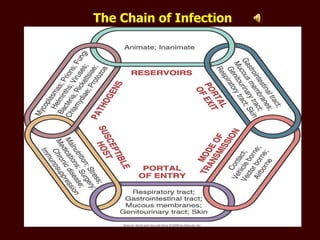
The Chain of Infection
Key Terms Pathogen (agent) Communicable Pathogenicity Virulence Normal Flora Colonization Carrier Reservoirs Toxins Exotoxins Endotoxins Susceptibility Host Incubation Period
Primary Infection Secondary Infection Focal Infection Endemic Panendemic Epidemic Key Terms
Pathogens Organisms that can cause illness/disease Bacteria, viruses Fungi; intracellular organisms Multicellular animals Cause disease in two ways Divide rapidly to overcome body defenses Disrupt normal cell function Secrete toxins Disrupt normal cell function
Infectious Process Prodromal syndrome - preclinical or nondescript, nonspecific manifestations of a beginning infection.  As the infection progresses, symptoms become more specific or severe.
Factors That Influence Susceptibility Natural Immunity Age Normal Flora Environmental Hormonal Factors Phagocytosis Nutrition Skin/MM Integrity Medical Interventions
Portals of Entry Sites Respiratory tract Gastrointestinal tract Genitourinary tract Skin/mucous membranes Bloodstream
Mode of Transmission Contact transmission by direct, indirect contact or fecal-oral transmission. Droplet transmission such as in influenza Airborne transmission such as in tuberculosis Vector-borne transmission involving insect or animal carriers, such as in Lyme disease
Physiologic Defenses Against Infection Body tissues Phagocytosis Inflammation Specific defenses Antibody-mediated immune system Cell-mediated immunity
Infection Control in Inpatient Health Care Agencies Nosocomial or health care–associated infections are infections acquired in the inpatient health care setting which were not present or incubating at admission. Bacteremia NYS reportable event Endogenous infection is from a client’s flora. Exogenous infection is from outside the client, often from the hands of health care workers.
Nosocomial Infections Infections that develop after the person has been admitted to the hospital.  Occur in about 2 million of the 30 million patients admitted to a hospital each year Common in very young, very old and persons w/chronic, debilitating diseases. Two contributing factors: Concentration of virulent forms of different organisms w/in hospitals. Presence of patients w/anatomic or physiologic defects in their immune defenses
Methods of Infection Control Practice hand hygiene and proper hand washing. No Artificial fingernails. Gloves should be worn. The CDC provides guidelines for disinfection and sterilization, outlining standard precautions for all modes of transmission.
What are the CDC hand hygiene guidelines?
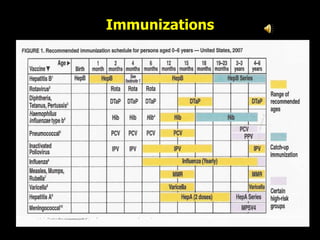
Immunizations
Multiple Drug–Resistant Infections Multiple drug–resistant infections are no more transmissible than their drug-sensitive counterparts,  S. aureus  and  Enterococcus  organisms. To control antimicrobial resistance in health care settings, see the CDC program.
Problems from Inadequate Antimicrobial Therapy Noncompliance or nonadherence Legal sanctions that compel a client to complete treatment, such as in the instance of tuberculosis Septicemia Septic shock
Collaborative Management History Physical assessment & clinical manifestations Psychosocial assessment Laboratory assessment including: Culture and antibiotic sensitivity testing Complete blood count Erythrocyte sedimentation rate Serologic testing Radiographic and other assessment
Nursing Diagnosis Hyperthermia Risk for Social Isolation
Nursing Interventions Prevent the spread of infections. GOOD HANDWASHING Prevent complications. Treat symptoms of infection Monitor for secondary symptoms of infection
Hyperthermia Interventions Eliminate the underlying cause of hyperthermia and destroy the causative microorganism. Manage fever by: Drug therapy: antimicrobial, antipyretic therapy External cooling, fluid administration
Health Teaching Education on these topics is vital to client’s understanding of transmission prevention precautions: Infection control Drug therapy Psychosocial support Health care resources
Methods of Describing Bacteria Basic Shapes Bacilli—rod shape Cocci—spherical shape Spirilla—spiral shape
Methods of Describing Bacteria Ability to use Oxygen Aerobic—with O 2 Anaerobic—without O 2 Staining Characteristics Gram positive Gram negative
Anti-infective Drugs Known as antibacterial, antimicrobial, antibiotic Classified by  Chemical structures  (e.g., aminoglycoside, fluoroquinolone) Mechanism of action (e.g., cell-wall inhibitor, folic-acid inhibitor)
Actions of Anti-infective Drugs Affect target organism’s structure, metabolism, or life cycle Goal is to eliminate pathogen Bactericidal—kill bacteria Bacteriostatic—slow growth of bacteria
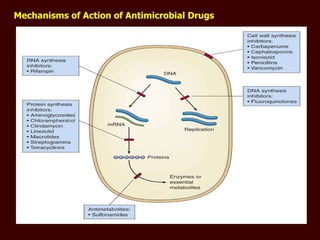
Mechanisms of Action of Antimicrobial Drugs
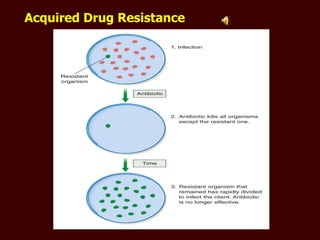
Widespread Use of Antibiotics Resistance not caused by but is worsened by over prescription of antibiotics Results in loss of antibiotic effectiveness Only prescribe when necessary Long-time use increases resistant strains
Widespread Use of Antibiotics  (continued) Nosocomial infections often resistant Prophylactic use sometimes appropriate Nurse should instruct client to take full dose
Acquired Drug Resistance
What Can Nurses do to Prevent Infection in our Patients?
Role of the Nurse Obtain specimens for culture and sensitivity prior to start of therapy Monitor for indications of response to therapy Reduced fever Normal white blood count Improved appetite Absence of symptoms such as cough
Role of the Nurse (continued) After parenteral administration, observe closely for possible allergic reactions  Monitor for superinfections Replace natural colon flora with probiotic supplements or cultured dairy products
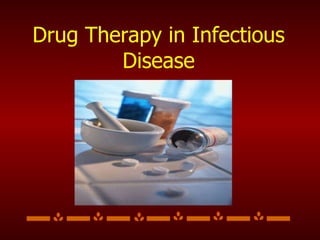
Drug Therapy in Infectious Disease
Penicillin Tx applications: pneumonia, meningitis, skin, bone, joint infections, stomach, blood & valve infections, gas gangrene, tetanus, anthrax, sickle-cell in infants. One of the safest class of drugs around for > 60 years
Cephlasporin Tx applications: serious infections of lower respiratory tract, CNS, Genitourinary, bone & joint.  Avoid in patient with history of SEVERE penicillin reaction Primarily used for ampicillin-resistance hemophilus influenza and staphylococci which are penicillin resistant. Duricef, Kefzol, Keflex, Ceclor, Cefotan, Mefoxin, Rocephin, Lorabid
Tetracycline Tx applications: Lyme disease, cholera, typhus, rocky mountain spotted fever,  Helicobacter pylori,  chlamydial infections. Contraindicated in pregnant or lactating clients  Effect on linear skeletal growth of fetus and child Contraindicated in children less than 8 yrs Permanent mottling and discoloration of teeth
Macrolide Therapy Safe alternative to penicillin Tx applications: whooping cough, Legionnaires’ disease,  H. influenza, Mycoplasma pneumoniae  (infections caused by  streptococcus )   E-mycin, Erythromycin, Biaxin, Zithromax  Almost no serious side effects, mild GI upset, diarrhea & abdominal pain most common.  Drug to drug interaction with Coumadin
Aminoglycosides Reserved for serious systemic infections caused by aerobic gram-negative organisms Streptomycin is usually restricted to tx of TB Amikin, Gentamicin, Kantrex May cause nephro and ototoxicity even at normal doses.
Fluoroquinolones Tx applications: infections of Respiratory, GI, GU, Skin and Soft tissue. Postexposure prophylaxix for Anthrax Dosing advantage PO as effective as IV, dosing is 1-2 times a day Cipro, Floxin, Levaquin, Avelox
Sulfonamide Therapy Tx applications: Pneumocystis carnii pneumonia, shigella infections, UTI, RA, Ulcerative colitis Cetamide, Gantrisin, Bactrim, Septra Classified by their treatment applications systemic or topical Higher incidence of allergies due to sulfer content Interacts with anticoagulants
Antituberculosis Therapy Contraindicated for clients with history of alcohol abuse, AIDS, liver disease, or kidney disease Isoniazid (INH) Pyrazinamide(PZA) Ethambutol, rifampin, streptomycin Use caution for certain clients Those with renal dysfunction Those who are pregnant or lactating Those with history of convulsive disorders
Other Drugs Clindamycin (Cleocin): for oral infections caused by bacteroides Metronidazole (Flagyl): used to treat  H. pylori  infections of stomach Vancomycin (Vancocin): effective for MRSA infections Adverse effects :  ototoxicity, nephrotoxicity,  red man  syndrome
Selection of an Antibiotic Careful selection of correct antibiotic essential Use of culture and sensitivity testing For effective pharmacotherapy; to limit adverse effects Broad-spectrum antibiotics  Effective for wide variety of bacteria Narrow-spectrum antibiotics Effective for narrow group of bacteria
Multidrug Therapy Affected by antagonism—combining two drugs may decrease efficacy of each Use of multiple antibiotics increases risk of resistance. Multidrug therapy can be used When multi-organisms cause infection For treatment of tuberculosis For treatment of HIV
Superinfections Occur when too many host flora are killed by an antibiotic Pathogenic microorganisms have chance to multiply Opportunistic—take advantage of suppressed immune system Signs and symptoms include diarrhea, bladder pain, painful urination, or abnormal vaginal discharge
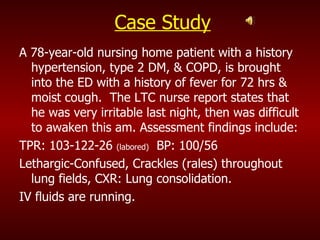
Case Study A 78-year-old nursing home patient with a history hypertension, type 2 DM, & COPD, is brought into the ED with a history of fever for 72 hrs & moist cough.  The LTC nurse report states that he was very irritable last night, then was difficult to awaken this am. Assessment findings include: TPR: 103-122-26  (labored)   BP: 100/56 Lethargic-Confused, Crackles (rales) throughout lung fields, CXR: Lung consolidation. IV fluids are running.
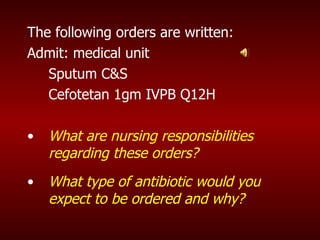
The following orders are written: Admit: medical unit  Sputum C&S  Cefotetan 1gm IVPB Q12H What are nursing responsibilities regarding these orders? What type of antibiotic would you expect to be ordered and why?
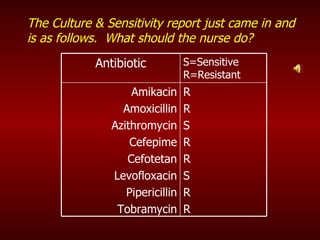
The Culture & Sensitivity report just came in and is as follows.  What should the nurse do? Antibiotic S=Sensitive R=Resistant Amikacin Amoxicillin Azithromycin Cefepime Cefotetan Levofloxacin Pipericillin Tobramycin R R S R R S R R
References Adams, MP; Josephson, DL & Holland, LN (2008). Pharmacology for Nurses a Pathophysiologic Approach (2 nd  ed). Upper Saddle River, NJ: Prentice Hall  Center for Disease Control (CDC – 2007).  Recommended   Immunization Schedules for Persons Aged 0-18 Years . Retrieved on January 21, 2007 from  http://www.cdc.gov/nip/acip   Ignatavicius, DD & Workman, ML (2006) Medical Surgical Nursing critical Thinking for Collaborative Care 5 th  Ed.  St Louis, MO: Elsevier/Saunders Hockenberry & Wilson (2007)  Wong’s Nursing Care of   Infants & Children 8 th  Ed.  St. Louis, MO: Mosby-Elsevier

Understanding Infection

  • 1.
  • 2.
    The Chain ofInfection
  • 3.
    Key Terms Pathogen(agent) Communicable Pathogenicity Virulence Normal Flora Colonization Carrier Reservoirs Toxins Exotoxins Endotoxins Susceptibility Host Incubation Period
  • 4.
    Primary Infection SecondaryInfection Focal Infection Endemic Panendemic Epidemic Key Terms
  • 5.
    Pathogens Organisms thatcan cause illness/disease Bacteria, viruses Fungi; intracellular organisms Multicellular animals Cause disease in two ways Divide rapidly to overcome body defenses Disrupt normal cell function Secrete toxins Disrupt normal cell function
  • 6.
    Infectious Process Prodromalsyndrome - preclinical or nondescript, nonspecific manifestations of a beginning infection. As the infection progresses, symptoms become more specific or severe.
  • 7.
    Factors That InfluenceSusceptibility Natural Immunity Age Normal Flora Environmental Hormonal Factors Phagocytosis Nutrition Skin/MM Integrity Medical Interventions
  • 8.
    Portals of EntrySites Respiratory tract Gastrointestinal tract Genitourinary tract Skin/mucous membranes Bloodstream
  • 9.
    Mode of TransmissionContact transmission by direct, indirect contact or fecal-oral transmission. Droplet transmission such as in influenza Airborne transmission such as in tuberculosis Vector-borne transmission involving insect or animal carriers, such as in Lyme disease
  • 10.
    Physiologic Defenses AgainstInfection Body tissues Phagocytosis Inflammation Specific defenses Antibody-mediated immune system Cell-mediated immunity
  • 11.
    Infection Control inInpatient Health Care Agencies Nosocomial or health care–associated infections are infections acquired in the inpatient health care setting which were not present or incubating at admission. Bacteremia NYS reportable event Endogenous infection is from a client’s flora. Exogenous infection is from outside the client, often from the hands of health care workers.
  • 12.
    Nosocomial Infections Infectionsthat develop after the person has been admitted to the hospital. Occur in about 2 million of the 30 million patients admitted to a hospital each year Common in very young, very old and persons w/chronic, debilitating diseases. Two contributing factors: Concentration of virulent forms of different organisms w/in hospitals. Presence of patients w/anatomic or physiologic defects in their immune defenses
  • 13.
    Methods of InfectionControl Practice hand hygiene and proper hand washing. No Artificial fingernails. Gloves should be worn. The CDC provides guidelines for disinfection and sterilization, outlining standard precautions for all modes of transmission.
  • 14.
    What are theCDC hand hygiene guidelines?
  • 15.
  • 16.
    Multiple Drug–Resistant InfectionsMultiple drug–resistant infections are no more transmissible than their drug-sensitive counterparts, S. aureus and Enterococcus organisms. To control antimicrobial resistance in health care settings, see the CDC program.
  • 17.
    Problems from InadequateAntimicrobial Therapy Noncompliance or nonadherence Legal sanctions that compel a client to complete treatment, such as in the instance of tuberculosis Septicemia Septic shock
  • 18.
    Collaborative Management HistoryPhysical assessment & clinical manifestations Psychosocial assessment Laboratory assessment including: Culture and antibiotic sensitivity testing Complete blood count Erythrocyte sedimentation rate Serologic testing Radiographic and other assessment
  • 19.
    Nursing Diagnosis HyperthermiaRisk for Social Isolation
  • 20.
    Nursing Interventions Preventthe spread of infections. GOOD HANDWASHING Prevent complications. Treat symptoms of infection Monitor for secondary symptoms of infection
  • 21.
    Hyperthermia Interventions Eliminatethe underlying cause of hyperthermia and destroy the causative microorganism. Manage fever by: Drug therapy: antimicrobial, antipyretic therapy External cooling, fluid administration
  • 22.
    Health Teaching Educationon these topics is vital to client’s understanding of transmission prevention precautions: Infection control Drug therapy Psychosocial support Health care resources
  • 23.
    Methods of DescribingBacteria Basic Shapes Bacilli—rod shape Cocci—spherical shape Spirilla—spiral shape
  • 24.
    Methods of DescribingBacteria Ability to use Oxygen Aerobic—with O 2 Anaerobic—without O 2 Staining Characteristics Gram positive Gram negative
  • 25.
    Anti-infective Drugs Knownas antibacterial, antimicrobial, antibiotic Classified by Chemical structures (e.g., aminoglycoside, fluoroquinolone) Mechanism of action (e.g., cell-wall inhibitor, folic-acid inhibitor)
  • 26.
    Actions of Anti-infectiveDrugs Affect target organism’s structure, metabolism, or life cycle Goal is to eliminate pathogen Bactericidal—kill bacteria Bacteriostatic—slow growth of bacteria
  • 27.
    Mechanisms of Actionof Antimicrobial Drugs
  • 28.
    Widespread Use ofAntibiotics Resistance not caused by but is worsened by over prescription of antibiotics Results in loss of antibiotic effectiveness Only prescribe when necessary Long-time use increases resistant strains
  • 29.
    Widespread Use ofAntibiotics (continued) Nosocomial infections often resistant Prophylactic use sometimes appropriate Nurse should instruct client to take full dose
  • 30.
  • 31.
    What Can Nursesdo to Prevent Infection in our Patients?
  • 32.
    Role of theNurse Obtain specimens for culture and sensitivity prior to start of therapy Monitor for indications of response to therapy Reduced fever Normal white blood count Improved appetite Absence of symptoms such as cough
  • 33.
    Role of theNurse (continued) After parenteral administration, observe closely for possible allergic reactions Monitor for superinfections Replace natural colon flora with probiotic supplements or cultured dairy products
  • 34.
    Drug Therapy inInfectious Disease
  • 35.
    Penicillin Tx applications:pneumonia, meningitis, skin, bone, joint infections, stomach, blood & valve infections, gas gangrene, tetanus, anthrax, sickle-cell in infants. One of the safest class of drugs around for > 60 years
  • 36.
    Cephlasporin Tx applications:serious infections of lower respiratory tract, CNS, Genitourinary, bone & joint. Avoid in patient with history of SEVERE penicillin reaction Primarily used for ampicillin-resistance hemophilus influenza and staphylococci which are penicillin resistant. Duricef, Kefzol, Keflex, Ceclor, Cefotan, Mefoxin, Rocephin, Lorabid
  • 37.
    Tetracycline Tx applications:Lyme disease, cholera, typhus, rocky mountain spotted fever, Helicobacter pylori, chlamydial infections. Contraindicated in pregnant or lactating clients Effect on linear skeletal growth of fetus and child Contraindicated in children less than 8 yrs Permanent mottling and discoloration of teeth
  • 38.
    Macrolide Therapy Safealternative to penicillin Tx applications: whooping cough, Legionnaires’ disease, H. influenza, Mycoplasma pneumoniae (infections caused by streptococcus ) E-mycin, Erythromycin, Biaxin, Zithromax Almost no serious side effects, mild GI upset, diarrhea & abdominal pain most common. Drug to drug interaction with Coumadin
  • 39.
    Aminoglycosides Reserved forserious systemic infections caused by aerobic gram-negative organisms Streptomycin is usually restricted to tx of TB Amikin, Gentamicin, Kantrex May cause nephro and ototoxicity even at normal doses.
  • 40.
    Fluoroquinolones Tx applications:infections of Respiratory, GI, GU, Skin and Soft tissue. Postexposure prophylaxix for Anthrax Dosing advantage PO as effective as IV, dosing is 1-2 times a day Cipro, Floxin, Levaquin, Avelox
  • 41.
    Sulfonamide Therapy Txapplications: Pneumocystis carnii pneumonia, shigella infections, UTI, RA, Ulcerative colitis Cetamide, Gantrisin, Bactrim, Septra Classified by their treatment applications systemic or topical Higher incidence of allergies due to sulfer content Interacts with anticoagulants
  • 42.
    Antituberculosis Therapy Contraindicatedfor clients with history of alcohol abuse, AIDS, liver disease, or kidney disease Isoniazid (INH) Pyrazinamide(PZA) Ethambutol, rifampin, streptomycin Use caution for certain clients Those with renal dysfunction Those who are pregnant or lactating Those with history of convulsive disorders
  • 43.
    Other Drugs Clindamycin(Cleocin): for oral infections caused by bacteroides Metronidazole (Flagyl): used to treat H. pylori infections of stomach Vancomycin (Vancocin): effective for MRSA infections Adverse effects : ototoxicity, nephrotoxicity, red man syndrome
  • 44.
    Selection of anAntibiotic Careful selection of correct antibiotic essential Use of culture and sensitivity testing For effective pharmacotherapy; to limit adverse effects Broad-spectrum antibiotics Effective for wide variety of bacteria Narrow-spectrum antibiotics Effective for narrow group of bacteria
  • 45.
    Multidrug Therapy Affectedby antagonism—combining two drugs may decrease efficacy of each Use of multiple antibiotics increases risk of resistance. Multidrug therapy can be used When multi-organisms cause infection For treatment of tuberculosis For treatment of HIV
  • 46.
    Superinfections Occur whentoo many host flora are killed by an antibiotic Pathogenic microorganisms have chance to multiply Opportunistic—take advantage of suppressed immune system Signs and symptoms include diarrhea, bladder pain, painful urination, or abnormal vaginal discharge
  • 47.
    Case Study A78-year-old nursing home patient with a history hypertension, type 2 DM, & COPD, is brought into the ED with a history of fever for 72 hrs & moist cough. The LTC nurse report states that he was very irritable last night, then was difficult to awaken this am. Assessment findings include: TPR: 103-122-26 (labored) BP: 100/56 Lethargic-Confused, Crackles (rales) throughout lung fields, CXR: Lung consolidation. IV fluids are running.
  • 48.
    The following ordersare written: Admit: medical unit Sputum C&S Cefotetan 1gm IVPB Q12H What are nursing responsibilities regarding these orders? What type of antibiotic would you expect to be ordered and why?
  • 49.
    The Culture &Sensitivity report just came in and is as follows. What should the nurse do? Antibiotic S=Sensitive R=Resistant Amikacin Amoxicillin Azithromycin Cefepime Cefotetan Levofloxacin Pipericillin Tobramycin R R S R R S R R
  • 50.
    References Adams, MP;Josephson, DL & Holland, LN (2008). Pharmacology for Nurses a Pathophysiologic Approach (2 nd ed). Upper Saddle River, NJ: Prentice Hall Center for Disease Control (CDC – 2007). Recommended Immunization Schedules for Persons Aged 0-18 Years . Retrieved on January 21, 2007 from http://www.cdc.gov/nip/acip Ignatavicius, DD & Workman, ML (2006) Medical Surgical Nursing critical Thinking for Collaborative Care 5 th Ed. St Louis, MO: Elsevier/Saunders Hockenberry & Wilson (2007) Wong’s Nursing Care of Infants & Children 8 th Ed. St. Louis, MO: Mosby-Elsevier