Environmental Hygiene:
Introduction
Plan of the lecture
• Concepts and etymology of Hygiene
• Hygiene as a science. Its place among medical sciences. Classification
• Main objectives of Hygiene
• Terms and Definitions: Environment, Health, Safety, Disease, and Risk
• Environmental Factors
• Importance of the Environmental Health studies
• Routes of Exposure of Environmental Factors
• Prevention
• Sanitary
Etymology of Hygiene
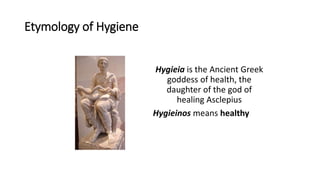
Hygieia is the Ancient Greek
goddess of health, the
daughter of the god of
healing Asclepius
Hygieinos means healthy
Hygiene
an area of medicine for studying the effect of living and working
conditions on human health and developing measures (sanitary norms,
rules, etc.) to prevent their adverse effects, to ensure optimum living
conditions and to promote health and prolong life
Medical Sciences (hygienistics), which study the influence of
environmental factors on human health, its performance and life
expectancy, develop the standards, requirements and sanitary
measures aimed at improving the settlements, living conditions and
human activities - Environmental Health
Environmental Health Science
The study of those factors in the environment that affect human health
• Factors (“pollutants” or “toxicants”) in air, water, soil, or food
• Transferred to humans by inhalation, ingestion, or absorption
• Production of adverse health effects
WHO Definition of Environmental Health
Environmental Health comprises those aspects of human health,
including quality of life, that are determined by physical, biological,
social, and psychosocial factors in the environment. It also refers to the
theory and practice of assessing, correcting, controlling, and preventing
those factors in the environment that can potentially affect adversely
the health of present and future generations
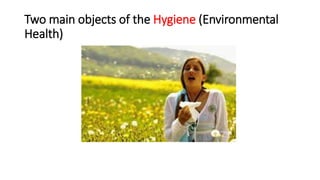
Two main objects of the Hygiene (Environmental
Health)
Definitions: Environment
The circumstances, objects, or conditions by which one is surrounded
or
The complex of climatic, edaphic (soil-based), and biotic factors that act
upon an organism or an ecologic community
Public Health Definition of “The Environment”
All that which is external to the individual host. [It] can be divided into
physical, biological, social, and cultural factors, any or all of which can
influence health status in populations.
−Last, J. M. (Ed.). (1995). A Dictionary of Epidemiology(3rd ed.). New York: Oxford
University Press.
Definitions: Health
The condition of being sound in body, mind, or spirit
A flourishing condition or well-being—not just the absence of disease
or
A state of complete physical, mental, and social well-being and not
merely the absence of disease or infirmity
WHO, 1948
Definitions: Disease
Trouble or a condition of the living animal or plant body or one of its
parts that impairs the performance of a vital function
Definitions: Safe
Free from harm or risk
Secure from threat of danger, harm, or loss
Zero risk
Definitions: Risk
Possibility of loss or injury, peril
The chance of loss; the degree of probability of such loss
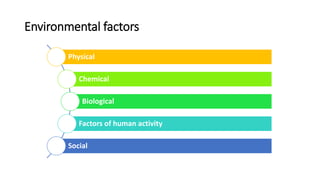
Environmental factors
Physical
Chemical
Biological
Factors of human activity
Social
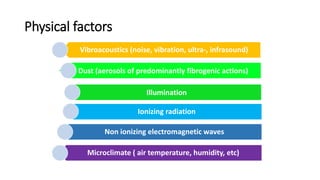
Physical factors
Vibroacoustics (noise, vibration, ultra-, infrasound)
Dust (aerosols of predominantly fibrogenic actions)
Illumination
Ionizing radiation
Non ionizing electromagnetic waves
Microclimate ( air temperature, humidity, etc)
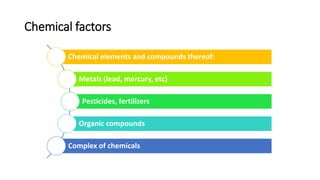
Chemical factors
Chemical elements and compounds thereof:
Metals (lead, mercury, etc)
Pesticides, fertilizers
Organic compounds
Complex of chemicals
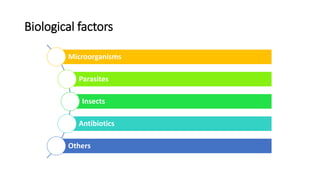
Biological factors
Microorganisms
Parasites
Insects
Antibiotics
Others
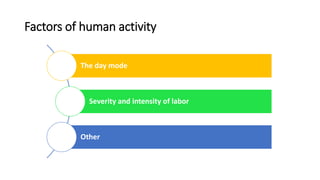
Factors of human activity
The day mode
Severity and intensity of labor
Other
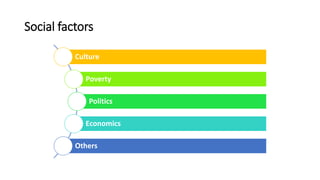
Social factors
Culture
Poverty
Politics
Economics
Others
Do you think that Environmental Health issues are
among the top three Public Health issues in the
country?
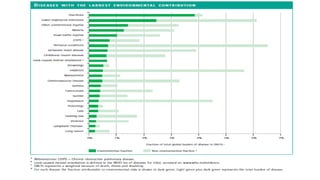
Contribution of Environmental Factors to Morbidity
Globally, an estimated 24% of the disease burden
(healthy life years lost) and an estimated 23% of
all deaths (premature mortality) was
attributable to environmental factors
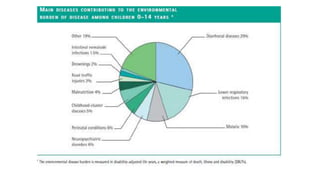
Among children 0–14 years of age, the
proportion of deaths attributed to the
environment was as high as 36%
The Lancet Commission (2017)
Diseases caused by pollution were responsible for an estimated 9
million premature deaths in 2015—16% of all deaths worldwide —
three times more deaths than from AIDS, tuberculosis, and malaria
combined and 15 times more than from all wars and other forms of
violence. In the most severely affected countries, pollution-related
disease is responsible for more than one death in four
Should You Care about Environmental Health
Safety?
Acute environmental catastrophes (high-level exposures)
Chronic (low-level) exposures
Indirect effects of global environmental changes
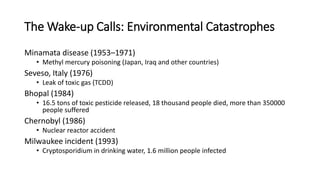
The Wake-up Calls: Environmental Catastrophes
Minamata disease (1953–1971)
• Methyl mercury poisoning (Japan, Iraq and other countries)
Seveso, Italy (1976)
• Leak of toxic gas (TCDD)
Bhopal (1984)
• 16.5 tons of toxic pesticide released, 18 thousand people died, more than 350000
people suffered
Chernobyl (1986)
• Nuclear reactor accident
Milwaukee incident (1993)
• Cryptosporidium in drinking water, 1.6 million people infected
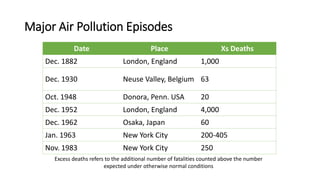
Major Air Pollution Episodes
Date Place Xs Deaths
Dec. 1882 London, England 1,000
Dec. 1930 Neuse Valley, Belgium 63
Oct. 1948 Donora, Penn. USA 20
Dec. 1952 London, England 4,000
Dec. 1962 Osaka, Japan 60
Jan. 1963 New York City 200-405
Nov. 1983 New York City 250
Excess deaths refers to the additional number of fatalities counted above the number
expected under otherwise normal conditions
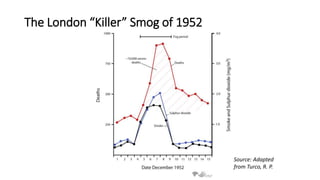
The London “Killer” Smog of 1952
Source: Adapted
from Turco, R. P.
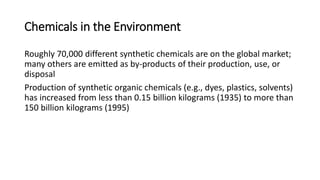
Chemicals in the Environment
Roughly 70,000 different synthetic chemicals are on the global market;
many others are emitted as by-products of their production, use, or
disposal
Production of synthetic organic chemicals (e.g., dyes, plastics, solvents)
has increased from less than 0.15 billion kilograms (1935) to more than
150 billion kilograms (1995)
Why Don’t We Know More about These Chemicals?
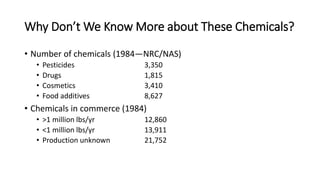
• Number of chemicals (1984—NRC/NAS)
• Pesticides 3,350
• Drugs 1,815
• Cosmetics 3,410
• Food additives 8,627
• Chemicals in commerce (1984)
• >1 million lbs/yr 12,860
• <1 million lbs/yr 13,911
• Production unknown 21,752
Why Don’t We Know More about These Chemicals?
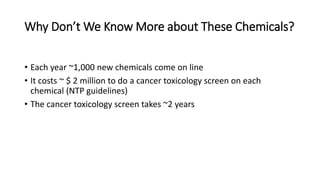
• Each year ~1,000 new chemicals come on line
• It costs ~ $ 2 million to do a cancer toxicology screen on each
chemical (NTP guidelines)
• The cancer toxicology screen takes ~2 years
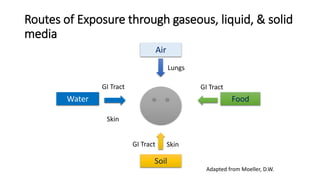
Routes of Exposure through gaseous, liquid, & solid
media
Air
Water Food
Soil
GI TractGI Tract
Skin
SkinGI Tract
Lungs
Adapted from Moeller, D.W.
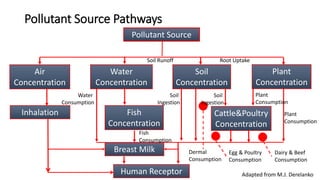
Pollutant Source Pathways
Pollutant Source
Inhalation Fish
Concentration
Breast Milk
Human Receptor
Plant
Concentration
Soil
Concentration
Water
Concentration
Air
Concentration
Cattle&Poultry
Concentration
Soil Runoff Root Uptake
Water
Consumption
Soil
Ingestion
Soil
Ingestion
Plant
Consumption
Plant
Consumption
Fish
Consumption
Dermal
Consumption
Egg & Poultry
Consumption
Dairy & Beef
Consumption
Adapted from M.J. Derelanko
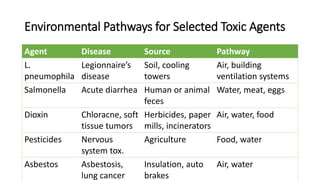
Environmental Pathways for Selected Toxic Agents
Agent Disease Source Pathway
L.
pneumophila
Legionnaire’s
disease
Soil, cooling
towers
Air, building
ventilation systems
Salmonella Acute diarrhea Human or animal
feces
Water, meat, eggs
Dioxin Chloracne, soft
tissue tumors
Herbicides, paper
mills, incinerators
Air, water, food
Pesticides Nervous
system tox.
Agriculture Food, water
Asbestos Asbestosis,
lung cancer
Insulation, auto
brakes
Air, water
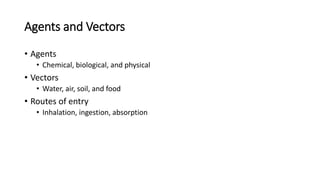
Agents and Vectors
• Agents
• Chemical, biological, and physical
• Vectors
• Water, air, soil, and food
• Routes of entry
• Inhalation, ingestion, absorption
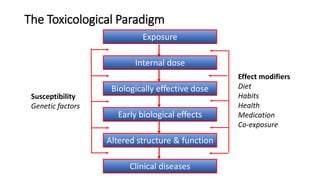
The Toxicological Paradigm
Exposure
Altered structure & function
Internal dose
Biologically effective dose
Early biological effects
Clinical diseases
Susceptibility
Genetic factors
Effect modifiers
Diet
Habits
Health
Medication
Co-exposure
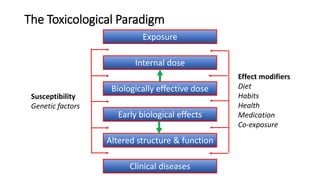
The Toxicological Paradigm
Exposure
Altered structure & function
Internal dose
Biologically effective dose
Early biological effects
Clinical diseases
Susceptibility
Genetic factors
Effect modifiers
Diet
Habits
Health
Medication
Co-exposure
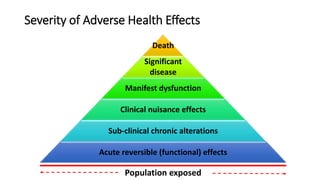
Severity of Adverse Health Effects
Death
Significant
disease
Manifest dysfunction
Clinical nuisance effects
Sub-clinical chronic alterations
Acute reversible (functional) effects
Population exposed
Health Effects
• Adverse vs. beneficial
• Acute vs. delayed onset
• Clinical vs. subclinical manifestations
• Transient (reversible) vs. chronic (irreversible)
Examples of Manifestations
• Lung disease
• Reproductive effects
• Teratogenic effects
• Neurologic effects
• Immunosuppression and hypersensitivity
• Cancer
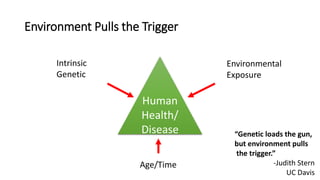
Environment Pulls the Trigger
Human
Health/
Disease
Intrinsic
Genetic
Environmental
Exposure
Age/Time
“Genetic loads the gun,
but environment pulls
the trigger.”
-Judith Stern
UC Davis
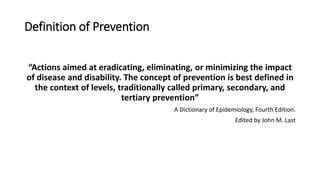
Definition of Prevention
“Actions aimed at eradicating, eliminating, or minimizing the impact
of disease and disability. The concept of prevention is best defined in
the context of levels, traditionally called primary, secondary, and
tertiary prevention”
A Dictionary of Epidemiology, Fourth Edition.
Edited by John M. Last
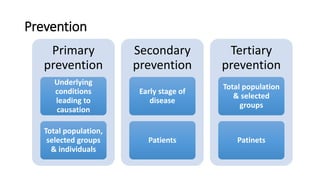
Prevention
Primary
prevention
Underlying
conditions
leading to
causation
Total population,
selected groups
& individuals
Secondary
prevention
Early stage of
disease
Patients
Tertiary
prevention
Total population
& selected
groups
Patinets
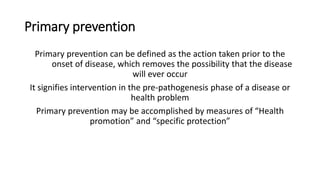
Primary prevention
Primary prevention can be defined as the action taken prior to the
onset of disease, which removes the possibility that the disease
will ever occur
It signifies intervention in the pre-pathogenesis phase of a disease or
health problem
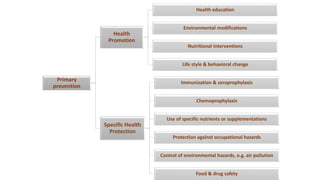
Primary prevention may be accomplished by measures of “Health
promotion” and “specific protection”
Primary
prevention
Health
Promotion
Health education
Environmental modifications
Nutritional interventions
Life style & behavioral change
Specific Health
Protection
Immunization & seroprophylaxis
Chemoprophylaxis
Use of specific nutrients or supplementations
Protection against occupational hazards
Control of environmental hazards, e.g. air pollution
Food & drug safety
Approaches for Primary Prevention
The WHO has recommended the following approaches for the primary
prevention of chronic diseases where the risk factors are established:
• Population (mass) strategy
• High‐risk strategy
Population (mass) strategy
“Population strategy" is directed at the whole population irrespective
of individual risk levels.
For example, studies have shown that even a small reduction in the
average blood pressure or serum cholesterol of a population would
produce a large reduction in the incidence of cardiovascular disease
The population approach is directed towards socio‐economic,
behavioral and lifestyle changes
High‐risk strategy
The high‐risk strategy aims to bring preventive care to individuals at
special risk
This requires detection of individuals at high risk by the optimum use of
clinical methods
Prevention Paradox
”A preventive measure which brings much benefit to the population
often offers little to each participating individual”
Rose, 1985
Secondary prevention
It is defined as “action which halts the progress of a disease at its
incipient stage and prevents complications”
The specific interventions are: early diagnosis (e.g. screening tests, and
case finding programs) and adequate treatment
Secondary prevention (cont.)
Secondary prevention attempts to arrest the disease process, restore
health by seeking out unrecognized disease and treating it before
irreversible pathological changes take place, and reverse
communicability of infectious diseases
It thus protects others from in the community from acquiring the
infection and thus provide at once secondary prevention for the
infected ones and primary prevention for their potential contacts
Early diagnosis and treatment
WHO Expert Committee in 1973 defined early detection of health
disorders as “ the detection of disturbances of homoeostatic and
compensatory mechanism while biochemical, morphological and
functional changes are still reversible.”
The earlier the disease is diagnosed, and treated the better it is for
prognosis of the case and for the prevention of the occurrence of other
secondary cases
Tertiary prevention
It is used when the disease process has advanced beyond its early
stages
It is defined as “all the measures available to reduce or limit
impairments and disabilities, and to promote the patients’ adjustment
to irremediable conditions.”
Intervention that should be accomplished in the stage of tertiary
prevention are disability limitation, and rehabilitation
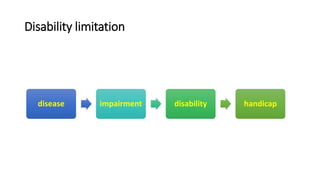
Disability limitation
disease impairment disability handicap
Impairment
Impairment is “any loss or abnormality of psychological, physiological
or anatomical structure or function”
Disability
Disability is “any restriction or lack of ability to perform an activity in
the manner or within the range considered normal for the human
being.”
Handicap
Handicap is termed as “a disadvantage for a given individual, resulting
from an impairment or disability, that limits or prevents the
fulfillment of a role in the community that is normal (depending on
age, sex, and social and cultural factors) for that individual”
Rehabilitation
Rehabilitation is “ the combined and coordinated use of medical, social,
educational, and vocational measures for training and retraining the
individual to the highest possible level of functional ability.”
Concept of control
The term “disease control” describes ongoing operations aimed at
reducing:
• The incidence of disease
• The duration of disease and consequently the risk of transmission
• The effects of disease, including both the physical and psychosocial
complications
• The financial burden to the community
Sanitary
Practical implementation of hygienic measures
In simple words:
Making our environment healthier and safer

Environmental Hygiene

  • 1.
  • 2.
    Plan of thelecture • Concepts and etymology of Hygiene • Hygiene as a science. Its place among medical sciences. Classification • Main objectives of Hygiene • Terms and Definitions: Environment, Health, Safety, Disease, and Risk • Environmental Factors • Importance of the Environmental Health studies • Routes of Exposure of Environmental Factors • Prevention • Sanitary
  • 3.
    Etymology of Hygiene Hygieiais the Ancient Greek goddess of health, the daughter of the god of healing Asclepius Hygieinos means healthy
  • 4.
    Hygiene an area ofmedicine for studying the effect of living and working conditions on human health and developing measures (sanitary norms, rules, etc.) to prevent their adverse effects, to ensure optimum living conditions and to promote health and prolong life
  • 5.
    Medical Sciences (hygienistics),which study the influence of environmental factors on human health, its performance and life expectancy, develop the standards, requirements and sanitary measures aimed at improving the settlements, living conditions and human activities - Environmental Health
  • 6.
    Environmental Health Science Thestudy of those factors in the environment that affect human health • Factors (“pollutants” or “toxicants”) in air, water, soil, or food • Transferred to humans by inhalation, ingestion, or absorption • Production of adverse health effects
  • 7.
    WHO Definition ofEnvironmental Health Environmental Health comprises those aspects of human health, including quality of life, that are determined by physical, biological, social, and psychosocial factors in the environment. It also refers to the theory and practice of assessing, correcting, controlling, and preventing those factors in the environment that can potentially affect adversely the health of present and future generations
  • 8.
    Two main objectsof the Hygiene (Environmental Health)
  • 9.
    Definitions: Environment The circumstances,objects, or conditions by which one is surrounded or The complex of climatic, edaphic (soil-based), and biotic factors that act upon an organism or an ecologic community
  • 10.
    Public Health Definitionof “The Environment” All that which is external to the individual host. [It] can be divided into physical, biological, social, and cultural factors, any or all of which can influence health status in populations. −Last, J. M. (Ed.). (1995). A Dictionary of Epidemiology(3rd ed.). New York: Oxford University Press.
  • 11.
    Definitions: Health The conditionof being sound in body, mind, or spirit A flourishing condition or well-being—not just the absence of disease or A state of complete physical, mental, and social well-being and not merely the absence of disease or infirmity WHO, 1948
  • 12.
    Definitions: Disease Trouble ora condition of the living animal or plant body or one of its parts that impairs the performance of a vital function
  • 13.
    Definitions: Safe Free fromharm or risk Secure from threat of danger, harm, or loss Zero risk
  • 14.
    Definitions: Risk Possibility ofloss or injury, peril The chance of loss; the degree of probability of such loss
  • 15.
  • 16.
    Physical factors Vibroacoustics (noise,vibration, ultra-, infrasound) Dust (aerosols of predominantly fibrogenic actions) Illumination Ionizing radiation Non ionizing electromagnetic waves Microclimate ( air temperature, humidity, etc)
  • 17.
    Chemical factors Chemical elementsand compounds thereof: Metals (lead, mercury, etc) Pesticides, fertilizers Organic compounds Complex of chemicals
  • 18.
  • 19.
    Factors of humanactivity The day mode Severity and intensity of labor Other
  • 20.
  • 21.
    Do you thinkthat Environmental Health issues are among the top three Public Health issues in the country?
  • 22.
    Contribution of EnvironmentalFactors to Morbidity Globally, an estimated 24% of the disease burden (healthy life years lost) and an estimated 23% of all deaths (premature mortality) was attributable to environmental factors Among children 0–14 years of age, the proportion of deaths attributed to the environment was as high as 36%
  • 23.
    The Lancet Commission(2017) Diseases caused by pollution were responsible for an estimated 9 million premature deaths in 2015—16% of all deaths worldwide — three times more deaths than from AIDS, tuberculosis, and malaria combined and 15 times more than from all wars and other forms of violence. In the most severely affected countries, pollution-related disease is responsible for more than one death in four
  • 26.
    Should You Careabout Environmental Health Safety? Acute environmental catastrophes (high-level exposures) Chronic (low-level) exposures Indirect effects of global environmental changes
  • 27.
    The Wake-up Calls:Environmental Catastrophes Minamata disease (1953–1971) • Methyl mercury poisoning (Japan, Iraq and other countries) Seveso, Italy (1976) • Leak of toxic gas (TCDD) Bhopal (1984) • 16.5 tons of toxic pesticide released, 18 thousand people died, more than 350000 people suffered Chernobyl (1986) • Nuclear reactor accident Milwaukee incident (1993) • Cryptosporidium in drinking water, 1.6 million people infected
  • 28.
    Major Air PollutionEpisodes Date Place Xs Deaths Dec. 1882 London, England 1,000 Dec. 1930 Neuse Valley, Belgium 63 Oct. 1948 Donora, Penn. USA 20 Dec. 1952 London, England 4,000 Dec. 1962 Osaka, Japan 60 Jan. 1963 New York City 200-405 Nov. 1983 New York City 250 Excess deaths refers to the additional number of fatalities counted above the number expected under otherwise normal conditions
  • 29.
    The London “Killer”Smog of 1952 Source: Adapted from Turco, R. P.
  • 30.
    Chemicals in theEnvironment Roughly 70,000 different synthetic chemicals are on the global market; many others are emitted as by-products of their production, use, or disposal Production of synthetic organic chemicals (e.g., dyes, plastics, solvents) has increased from less than 0.15 billion kilograms (1935) to more than 150 billion kilograms (1995)
  • 31.
    Why Don’t WeKnow More about These Chemicals? • Number of chemicals (1984—NRC/NAS) • Pesticides 3,350 • Drugs 1,815 • Cosmetics 3,410 • Food additives 8,627 • Chemicals in commerce (1984) • >1 million lbs/yr 12,860 • <1 million lbs/yr 13,911 • Production unknown 21,752
  • 32.
    Why Don’t WeKnow More about These Chemicals? • Each year ~1,000 new chemicals come on line • It costs ~ $ 2 million to do a cancer toxicology screen on each chemical (NTP guidelines) • The cancer toxicology screen takes ~2 years
  • 33.
    Routes of Exposurethrough gaseous, liquid, & solid media Air Water Food Soil GI TractGI Tract Skin SkinGI Tract Lungs Adapted from Moeller, D.W.
  • 34.
    Pollutant Source Pathways PollutantSource Inhalation Fish Concentration Breast Milk Human Receptor Plant Concentration Soil Concentration Water Concentration Air Concentration Cattle&Poultry Concentration Soil Runoff Root Uptake Water Consumption Soil Ingestion Soil Ingestion Plant Consumption Plant Consumption Fish Consumption Dermal Consumption Egg & Poultry Consumption Dairy & Beef Consumption Adapted from M.J. Derelanko
  • 35.
    Environmental Pathways forSelected Toxic Agents Agent Disease Source Pathway L. pneumophila Legionnaire’s disease Soil, cooling towers Air, building ventilation systems Salmonella Acute diarrhea Human or animal feces Water, meat, eggs Dioxin Chloracne, soft tissue tumors Herbicides, paper mills, incinerators Air, water, food Pesticides Nervous system tox. Agriculture Food, water Asbestos Asbestosis, lung cancer Insulation, auto brakes Air, water
  • 36.
    Agents and Vectors •Agents • Chemical, biological, and physical • Vectors • Water, air, soil, and food • Routes of entry • Inhalation, ingestion, absorption
  • 37.
    The Toxicological Paradigm Exposure Alteredstructure & function Internal dose Biologically effective dose Early biological effects Clinical diseases Susceptibility Genetic factors Effect modifiers Diet Habits Health Medication Co-exposure
  • 38.
    The Toxicological Paradigm Exposure Alteredstructure & function Internal dose Biologically effective dose Early biological effects Clinical diseases Susceptibility Genetic factors Effect modifiers Diet Habits Health Medication Co-exposure
  • 39.
    Severity of AdverseHealth Effects Death Significant disease Manifest dysfunction Clinical nuisance effects Sub-clinical chronic alterations Acute reversible (functional) effects Population exposed
  • 40.
    Health Effects • Adversevs. beneficial • Acute vs. delayed onset • Clinical vs. subclinical manifestations • Transient (reversible) vs. chronic (irreversible)
  • 41.
    Examples of Manifestations •Lung disease • Reproductive effects • Teratogenic effects • Neurologic effects • Immunosuppression and hypersensitivity • Cancer
  • 42.
    Environment Pulls theTrigger Human Health/ Disease Intrinsic Genetic Environmental Exposure Age/Time “Genetic loads the gun, but environment pulls the trigger.” -Judith Stern UC Davis
  • 43.
    Definition of Prevention “Actionsaimed at eradicating, eliminating, or minimizing the impact of disease and disability. The concept of prevention is best defined in the context of levels, traditionally called primary, secondary, and tertiary prevention” A Dictionary of Epidemiology, Fourth Edition. Edited by John M. Last
  • 44.
    Prevention Primary prevention Underlying conditions leading to causation Total population, selectedgroups & individuals Secondary prevention Early stage of disease Patients Tertiary prevention Total population & selected groups Patinets
  • 45.
    Primary prevention Primary preventioncan be defined as the action taken prior to the onset of disease, which removes the possibility that the disease will ever occur It signifies intervention in the pre-pathogenesis phase of a disease or health problem Primary prevention may be accomplished by measures of “Health promotion” and “specific protection”
  • 46.
    Primary prevention Health Promotion Health education Environmental modifications Nutritionalinterventions Life style & behavioral change Specific Health Protection Immunization & seroprophylaxis Chemoprophylaxis Use of specific nutrients or supplementations Protection against occupational hazards Control of environmental hazards, e.g. air pollution Food & drug safety
  • 47.
    Approaches for PrimaryPrevention The WHO has recommended the following approaches for the primary prevention of chronic diseases where the risk factors are established: • Population (mass) strategy • High‐risk strategy
  • 48.
    Population (mass) strategy “Populationstrategy" is directed at the whole population irrespective of individual risk levels. For example, studies have shown that even a small reduction in the average blood pressure or serum cholesterol of a population would produce a large reduction in the incidence of cardiovascular disease The population approach is directed towards socio‐economic, behavioral and lifestyle changes
  • 49.
    High‐risk strategy The high‐riskstrategy aims to bring preventive care to individuals at special risk This requires detection of individuals at high risk by the optimum use of clinical methods
  • 50.
    Prevention Paradox ”A preventivemeasure which brings much benefit to the population often offers little to each participating individual” Rose, 1985
  • 51.
    Secondary prevention It isdefined as “action which halts the progress of a disease at its incipient stage and prevents complications” The specific interventions are: early diagnosis (e.g. screening tests, and case finding programs) and adequate treatment
  • 52.
    Secondary prevention (cont.) Secondaryprevention attempts to arrest the disease process, restore health by seeking out unrecognized disease and treating it before irreversible pathological changes take place, and reverse communicability of infectious diseases It thus protects others from in the community from acquiring the infection and thus provide at once secondary prevention for the infected ones and primary prevention for their potential contacts
  • 53.
    Early diagnosis andtreatment WHO Expert Committee in 1973 defined early detection of health disorders as “ the detection of disturbances of homoeostatic and compensatory mechanism while biochemical, morphological and functional changes are still reversible.” The earlier the disease is diagnosed, and treated the better it is for prognosis of the case and for the prevention of the occurrence of other secondary cases
  • 54.
    Tertiary prevention It isused when the disease process has advanced beyond its early stages It is defined as “all the measures available to reduce or limit impairments and disabilities, and to promote the patients’ adjustment to irremediable conditions.” Intervention that should be accomplished in the stage of tertiary prevention are disability limitation, and rehabilitation
  • 55.
  • 56.
    Impairment Impairment is “anyloss or abnormality of psychological, physiological or anatomical structure or function”
  • 57.
    Disability Disability is “anyrestriction or lack of ability to perform an activity in the manner or within the range considered normal for the human being.”
  • 58.
    Handicap Handicap is termedas “a disadvantage for a given individual, resulting from an impairment or disability, that limits or prevents the fulfillment of a role in the community that is normal (depending on age, sex, and social and cultural factors) for that individual”
  • 59.
    Rehabilitation Rehabilitation is “the combined and coordinated use of medical, social, educational, and vocational measures for training and retraining the individual to the highest possible level of functional ability.”
  • 60.
    Concept of control Theterm “disease control” describes ongoing operations aimed at reducing: • The incidence of disease • The duration of disease and consequently the risk of transmission • The effects of disease, including both the physical and psychosocial complications • The financial burden to the community
  • 61.
    Sanitary Practical implementation ofhygienic measures In simple words: Making our environment healthier and safer

Editor's Notes

  • #9 As a result, hygiene has two objects of the study - the environmental factors and the reaction of the body to their impact.
  • #18 More than 140 000 new chemicals and pesticides have been synthesized since 1950. Of these materials, the 5000 that are produced in greatest volume have become widely dispersed in the environment and are responsible for nearly universal human exposure. Fewer than half of these high-production volume chemicals have undergone any testing for safety or toxicity, and rigorous pre-market evaluation of new chemicals has become mandatory in only the past decade and in only a few high income countries. The result is that chemicals and pesticides whose effects on human health and the environment were never examined have repeatedly been responsible for episodes of disease, death, and environmental degradation. Historical examples include lead, asbestos, dichlorodiphenyltrichloroethane (DDT), polychlorinated biphenyls (PCBs), and the ozone destroying chlorofluorocarbons.
  • #34 Lets talk about routes we are exposed on. Here on the picture you see only four main natural environmental factors: air, water, soil and food. But we have more factors such as cloths we wear, noise we make and so on.