CS8792
CRYPTOGRAPHY
&
NETWORK SECURITY
Mr.A.Rameshbabu
Ramco Institute of Technology
Cryptography
Cryptography is the study of secure
communications techniques that allow
only the sender and intended recipient of
a message to view its contents.
The term is derived from the Greek word
kryptos, which means hidden.
Cryptography is about constructing and
analyzing protocols that prevent third
parties or the public from reading
private messages
Course Outcomes
After completion of the course, it is expected that:
The students will be able to
1.Describe the fundamentals of networks security,
security architecture, threats and vulnerabilities.
2.Apply the different cryptographic operations of
symmetric cryptographic algorithms.
3.Explain the different cryptographic operations of
public key cryptography.
4.Apply the various Authentication schemes to
simulate different applications.
5.Discuss the various Security practices and
System security standards.
Syllabus
UNIT I : Introduction
UNIT II : Symmetric Cryptography
UNIT III: Public Key Cryptography
UNIT IV: Message Authentication And
Integrity
UNIT V : Security Practice And System
Security
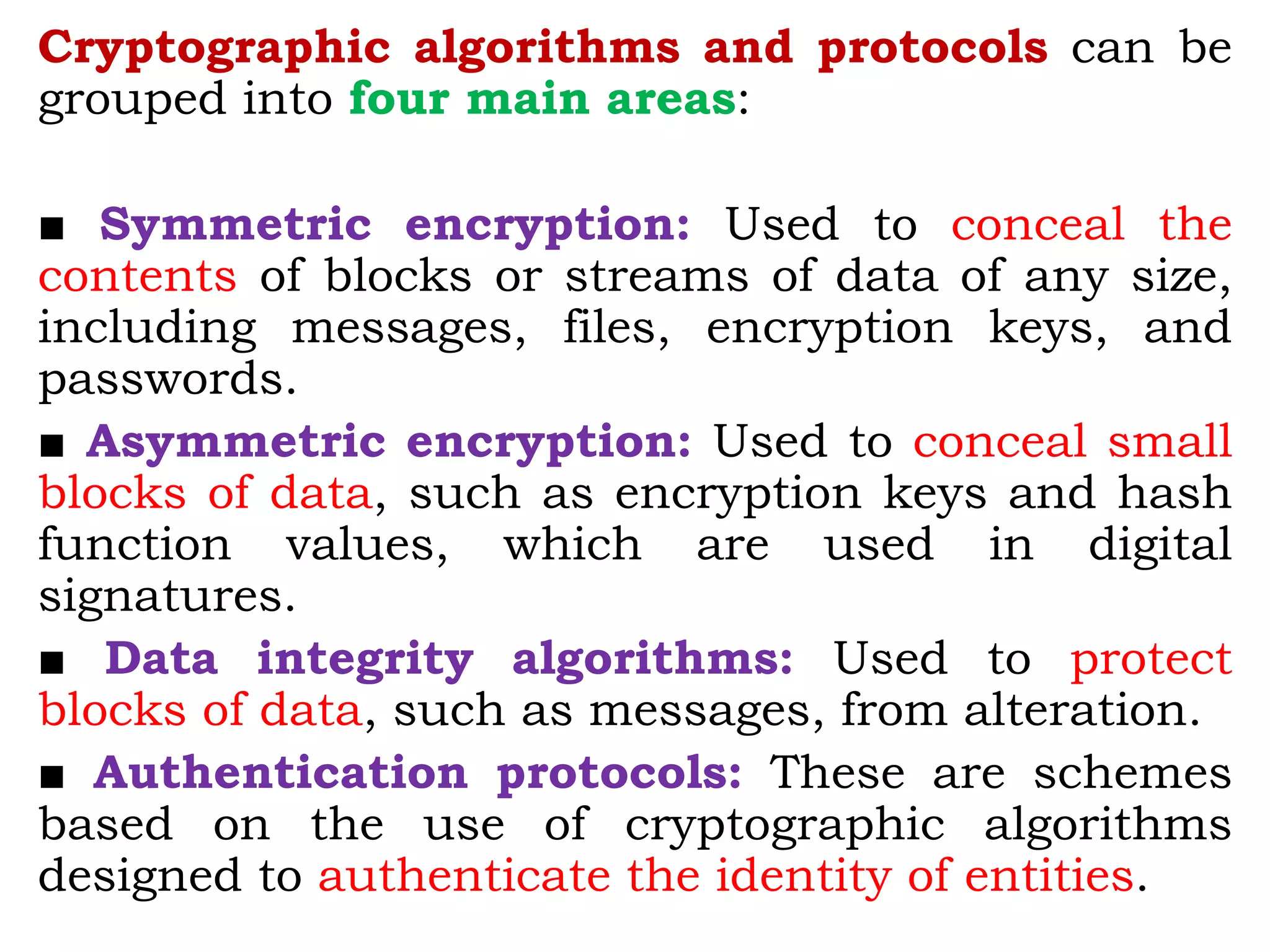
Cryptographic algorithms and protocols can be
grouped into four main areas:
■ Symmetric encryption: Used to conceal the
contents of blocks or streams of data of any size,
including messages, files, encryption keys, and
passwords.
■ Asymmetric encryption: Used to conceal small
blocks of data, such as encryption keys and hash
function values, which are used in digital
signatures.
■ Data integrity algorithms: Used to protect
blocks of data, such as messages, from alteration.
■ Authentication protocols: These are schemes
based on the use of cryptographic algorithms
designed to authenticate the identity of entities.
Essential Network and
Computer Security
Requirements
 Confidentiality: Preserving authorized restrictions
on information access and disclosure, including
means for protecting personal privacy and
proprietary information.
 Integrity: Guarding against improper information
modification or destruction, including ensuring
information nonrepudiation and authenticity.
 Availability: Ensuring timely and reliable access to
and use of information.
 Authenticity: The property of being genuine and
being able to be verified and trusted confidence in
the validity of a transmission, a message, or message
originator.
 Accountability: The security goal that generates
the requirement for actions of an entity to be
traced uniquely to that entity.
Legal, Ethical and
Professional Aspects of
Security
Cybercrime And Computer Crime:
 Computer crime, or cybercrime, is a
term used broadly to describe criminal
activity in which computers or computer
networks are a tool, a target, or a place
of criminal activity.
 The term cybercrime has a connotation
of the use of networks specifically,
whereas computer crime may or may
not involve networks.
The U.S. Department of Justice [DOJ]
categorizes computer crime based on
the role that the computer plays in the
criminal activity, as follows:
Computers as targets
Computers as storage devices
Computers as communications tools
Privacy Law and Regulation
A number of international organizations and
national governments have introduced laws
and regulations intended to protect individual
privacy.
Notice
Consent
Consistency
Access
Security
Onward transfer
Enforcement
Law and Ethics in
Information Security
Laws:
 Rules that mandate or prohibit certain behavior
 Drawn from ethics
Ethics:
 Define socially acceptable behaviors
Key difference:
 Laws carry the authority of a governing body
 Ethics do not carry the authority of a governing
body
 Based on cultural mores
 Fixed moral attitudes or customs
 Some ethics standards are universal
Policy Versus law
Policies:
 Guidelines that describe acceptable and
unacceptable employee behaviors
 Functions as organizational laws
 Has penalties, judicial practices, and sanctions
Difference between policy and law:
 Ignorance of policy is acceptable
 Ignorance of law is unacceptable
Keys for a policy to be enforceable:
 Dissemination
 Review
 Comprehension
 Compliance
 Uniform enforcement
Types of Law
 Civil – govern a nation or state
 Criminal – addresses activities and
conduct harmful to public
 Private – encompasses family,
commercial, labor, and regulates the
relationship between individuals and
organizations
 Public – regulates the structure and
administration of government agencies
and their relationships with citizens,
employees, and other governments
United States Privacy Initiatives:
Banking and financial records
Credit reports
Medical and health insurance records
Children’s privacy
Electronic communications
Ethical issues arise as the result of the roles of
computers, such as the following:
 Repositories and processors of information:
Unauthorized use of otherwise unused computer
services or of information stored in computers raises
questions of appropriateness or fairness.
 Producers of new forms and types of assets: For
example, computer programs are entirely new types
of assets, possibly not subject to the same concepts
of ownership as other assets.
 Instruments of acts: To what degree must
computer services and users of computers, data,
and programs be responsible for the integrity and
appropriateness of computer output?
 Symbols of intimidation and deception: The
images of computers as thinking machines, absolute
truth producers, infallible, subject to blame, and as
anthropomorphic replacements of humans who err
should be carefully considered.
Need for Security at Multiple
levels
 The field of Network and Internet
security consists of measures to deter,
prevent, detect, and correct security
violations that involve the transmission of
information
 Following are some examples for security
violation
User A transmits a file to user B. The file
contains sensitive information that is to be
protected from disclosure. User C, who is not
authorized to read the file, is able to monitor
the transmission and capture a copy of the
file during its transmission
Need for Security at Multiple
levels
 A network manager, D, transmits a message to a
computer, E, under its management. The message
instructs computer E to update an authorization
file to include the identities of a number of new
users who are to be given access to that computer.
User F intercepts the message, alters its contents
to add or delete entries, and then forwards the
message to computer E, which accepts the
message as coming from manager D and updates
its authorization file accordingly
 Rather than intercept a message, user F
constructs its own message with the desired
entries and transmits that message to computer E
as if it had come from manager D. Computer E
accepts the message as coming from manager D
and updates its authorization file accordingly
Security Policy
P.1.  A policy on cryptographic controls
will be developed with procedures to
provide appropriate levels of protection to
sensitive information while ensuring
compliance with statutory, regulatory and
contractual requirements.
P.2.  Classified information shall only be
taken for use away from the organization
in an encrypted form unless its
confidentiality can otherwise be assured.
Security Policy
P.3.  Procedures shall be established to
ensure that authorized staff may gain
access, when needed, to any important
business information being held in
encrypted form.
P.4. The confidentiality of information
being transferred on portable media or
across networks, must be protected by use
of appropriate encryption techniques.
Security Policy
P.5. Encryption shall be used whenever
appropriate on all remote access
connections to the organization's network
and resources.
P.6. A procedure for the management of
electronic keys, to control both the
encryption and decryption of sensitive
documents or digital signatures, must be
established to ensure the adoption of best
practice guidelines and compliance with
both legal and contractual requirements.
OSI Security Architecture
 It is a systematic way of defining the
requirements for the security
 It characterize the approaches to
satisfy the various security products
and polices
 X.800 security architecture of OSI
defines such a systematic approach
 OSI security architecture is useful for
organizing the task of providing
security
OSI Security Architecture
 Since this architecture was developed
as an international standard,
Computer and Communications
vendors have developed security
features for their products and
services that relate to this
structured definition of services
and mechanisms
OSI Security Architecture
The OSI security architecture focuses
on
Security Attacks
Security Mechanism
Security Services
Security Attacks
Security Attacks:
 Any action that compromises the
security of information owned by an
organization
Classifications:
Passive attacks
Active attacks
Passive Attacks
Passive attacks are in the nature of
eavesdropping on, or monitoring of,
transmissions.
Passive Attacks
The goal of the opponent is to obtain
information that is being
transmitted.
Two types of passive attacks are
Release of message contents
Traffic analysis.
Passive Attacks
• Release of message contents
– capture and read the content.
– A telephone conversation, an electronic mail
message, and a transferred file may contain
sensitive or confidential information.
• Traffic analysis
– Can’t read the information, But observe the
pattern
– Determine the location and identity of
communicating parties
– Observe frequency and length of
communication
Active Attacks
 Active attacks involve some
modification of the data stream or the
creation of a false stream
Active Attacks
It can be subdivided into four
categories:
 Masquerade
 Replay
 Modification of messages
 Denial of service
Active Attacks
 Masquerade
 A masquerade takes place when one
entity pretends to be a different entity
 Masquerade is a type of attack where the
attacker pretends to be an authorized
user of a system in order to gain access
to it or to gain greater privileges than
they are authorized for.
Active Attacks
 Replay
 A replay attack also known as
playback attack.
 Replay involves the passive capture of a
data unit and its subsequent
retransmission to produce an
unauthorized effect.
Active Attacks
 Modification of messages
 It simply means that some portion of a
legitimate message is altered, or that
messages are delayed or reordered, to
produce an unauthorized effect
 Denial of service
 A denial-of-service (DoS) is any type of
attack where the attackers (hackers)
attempt to prevent legitimate users from
accessing the service
Security Mechanisms
 Security mechanism:
A process that is designed to detect, prevent,
or recover from a security attack
 The following are some security
mechanisms defined in X.800
• Encipherment
• Access Control
• Digital Signature
• Data Integrity
• Authentication Exchange
• Traffic Padding
• Routing Control
• Notarization
Security Mechanisms
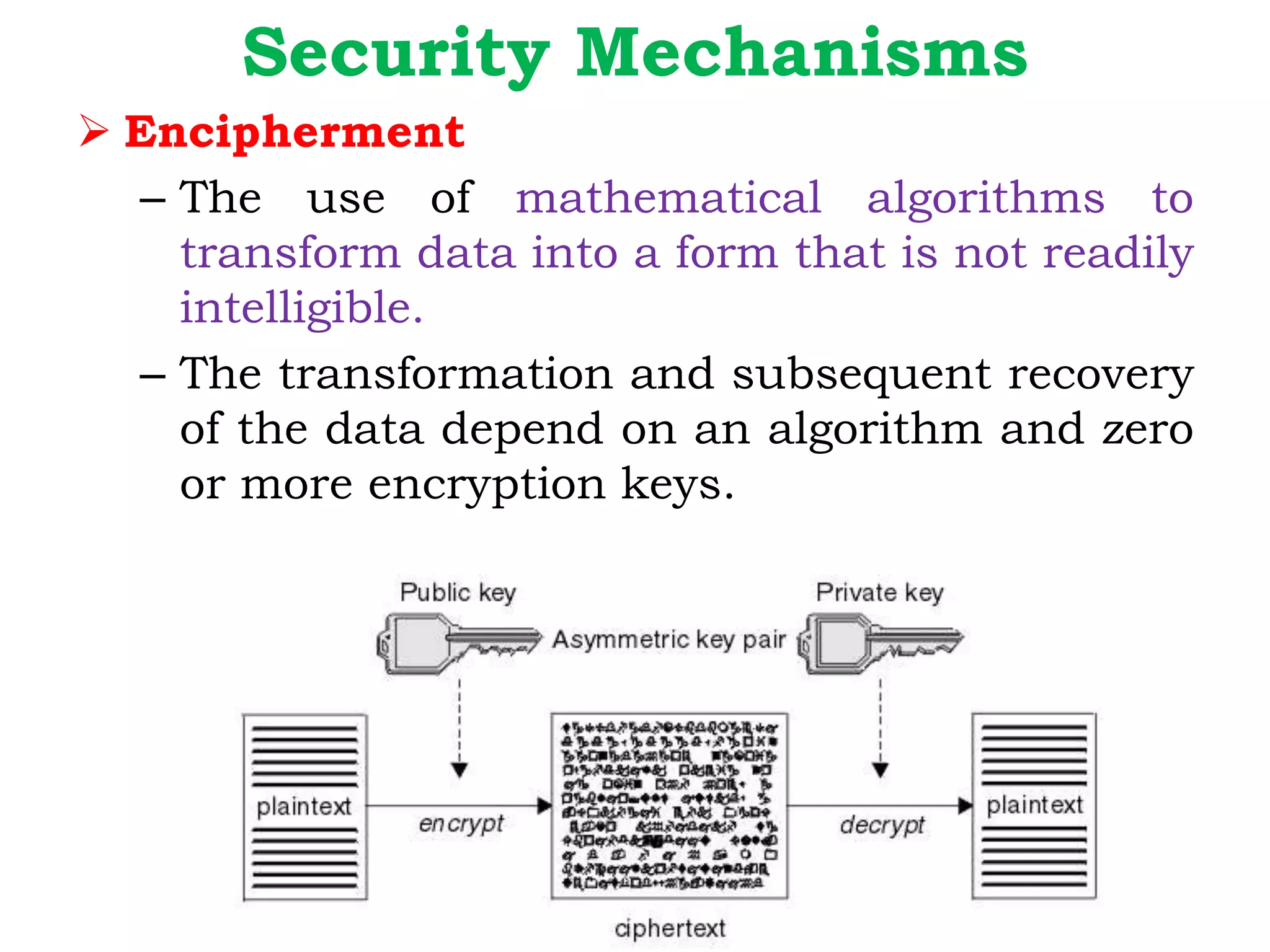
 Encipherment
– The use of mathematical algorithms to
transform data into a form that is not readily
intelligible.
– The transformation and subsequent recovery
of the data depend on an algorithm and zero
or more encryption keys.
Security Mechanisms
Access Control
– A variety of mechanisms that enforce
access rights to resources.
Security Mechanisms
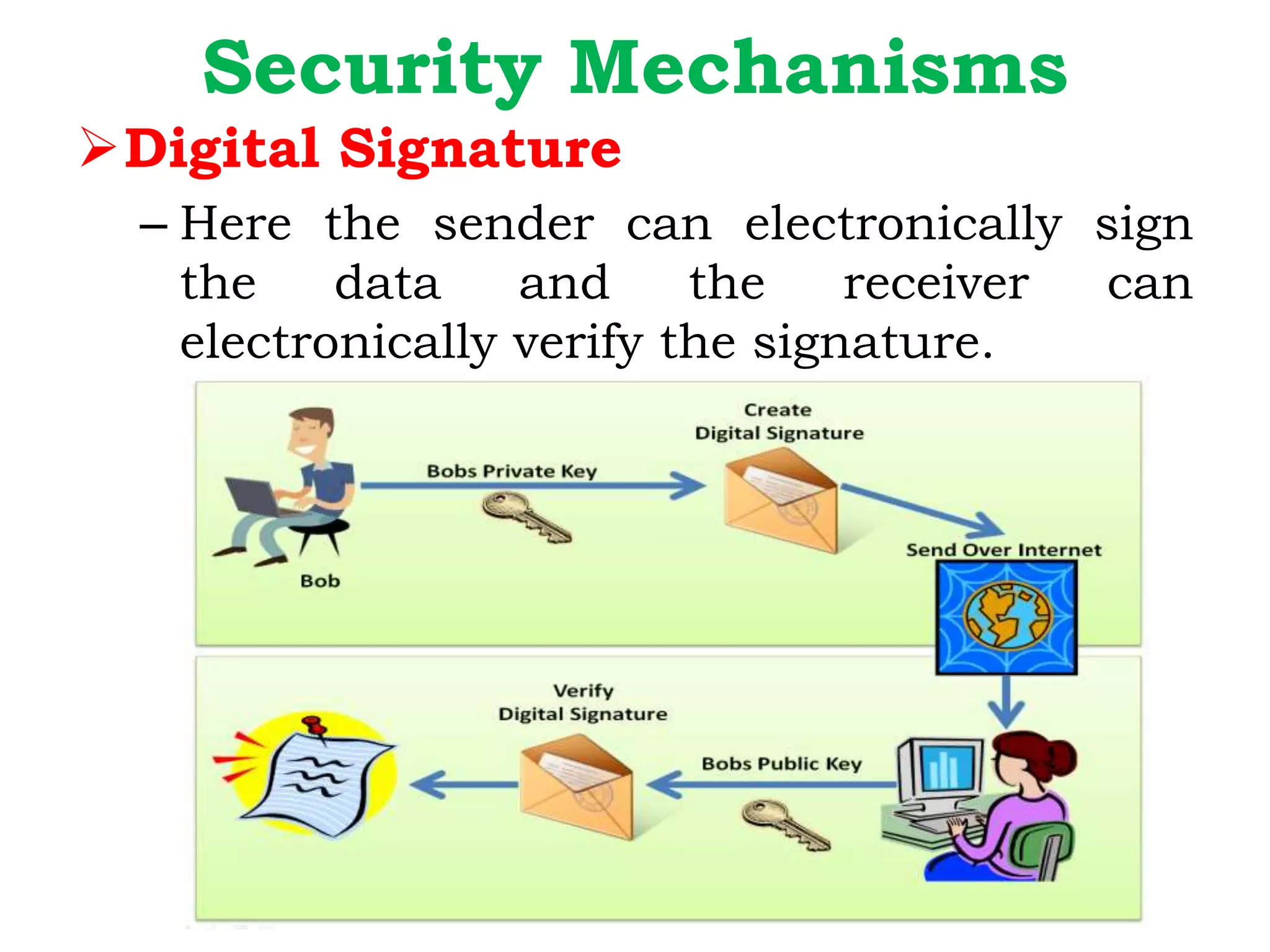
Digital Signature
– Here the sender can electronically sign
the data and the receiver can
electronically verify the signature.
Security Mechanisms
 Data Integrity
– The assurance that the data has not been
altered in an unauthorised manner since the
time that the data was last created,
transmitted, or stored by an authorised user.
– A variety of mechanisms used to assure the
integrity of a data unit or stream of data units.
Security Mechanisms
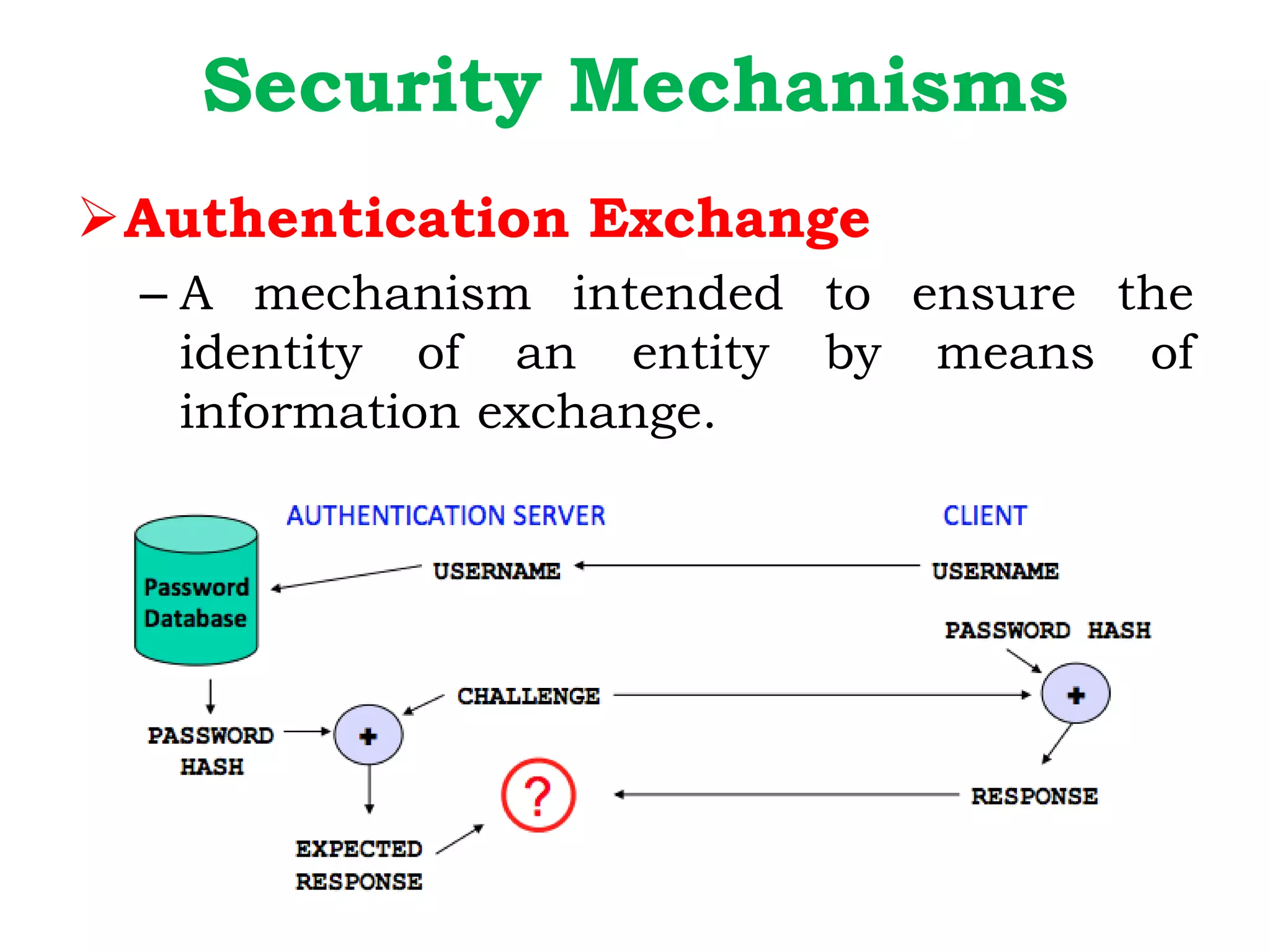
Authentication Exchange
– A mechanism intended to ensure the
identity of an entity by means of
information exchange.
Security Mechanisms
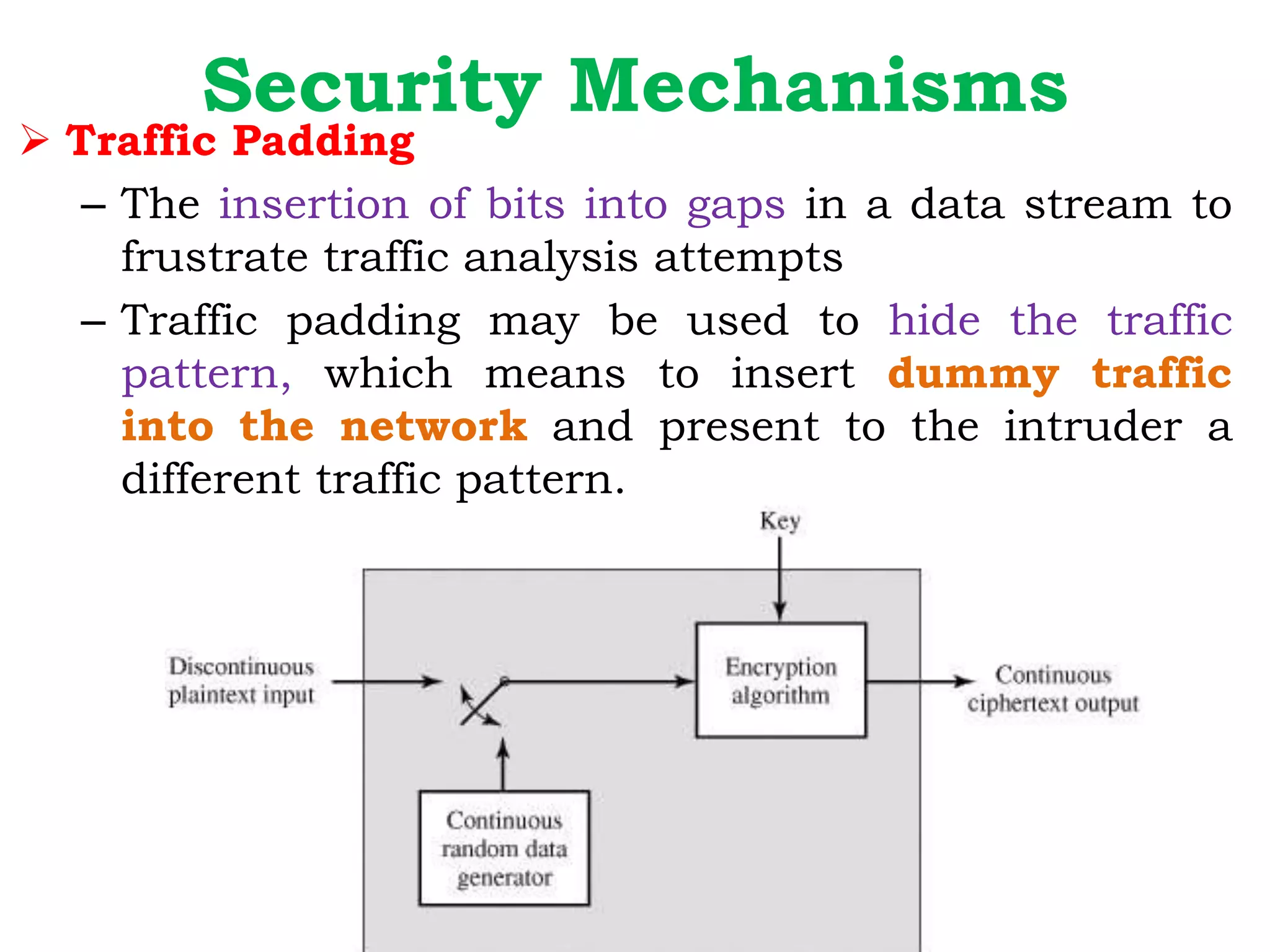
 Traffic Padding
– The insertion of bits into gaps in a data stream to
frustrate traffic analysis attempts
– Traffic padding may be used to hide the traffic
pattern, which means to insert dummy traffic
into the network and present to the intruder a
different traffic pattern.
Security Mechanisms
Routing Control
– Enables selection of particular physically
secure routes for certain data and allows
routing changes, especially when a
breach of security is suspected.
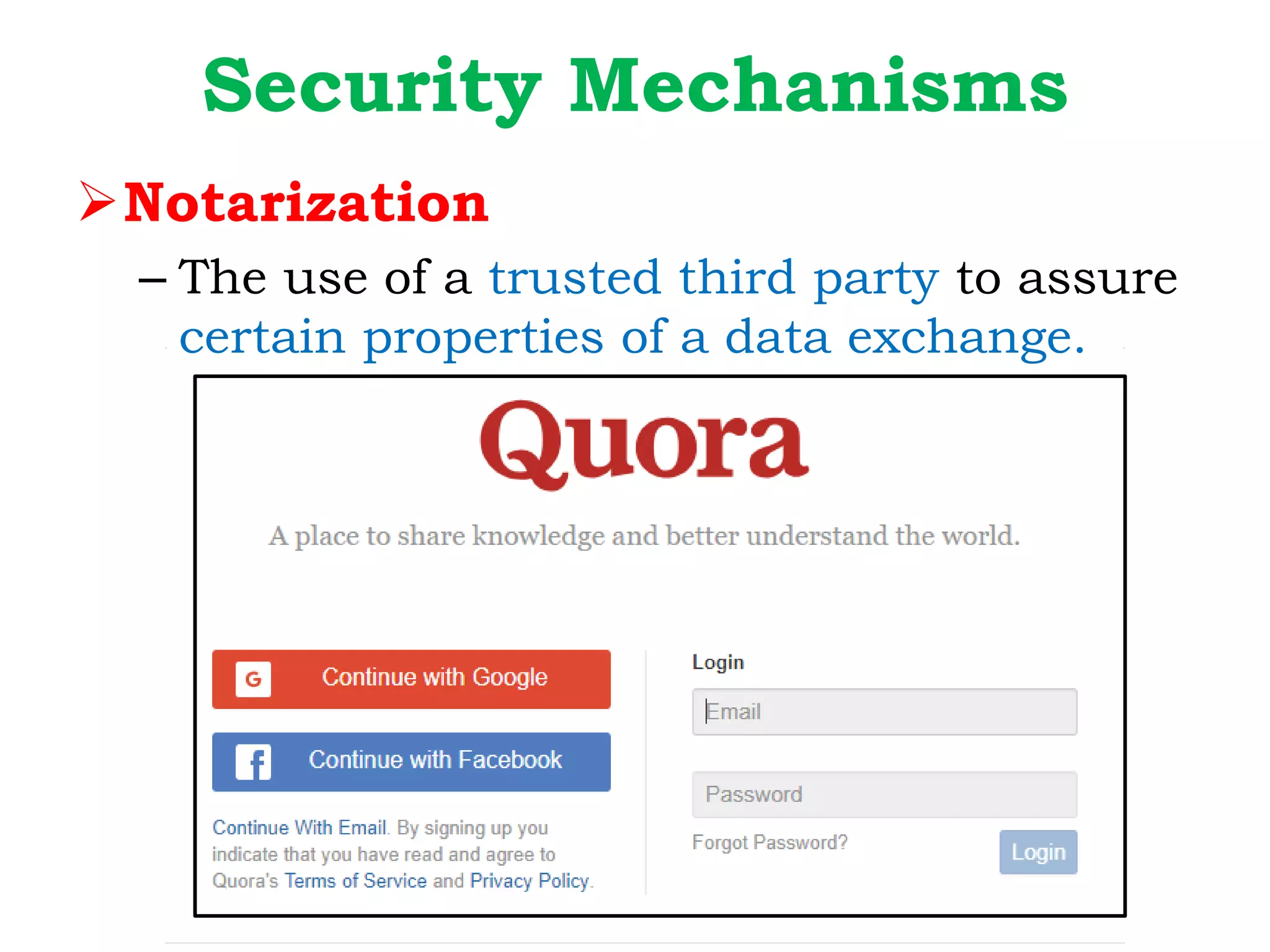
Notarization
– The use of a trusted third party to assure
certain properties of a data exchange.
Security Mechanisms
Notarization
– The use of a trusted third party to assure
certain properties of a data exchange.
Security Services
 It is a processing or communication
service that is provided by a system to
give a specific kind of protection to
system resources.
 Security services implement security
policies and are implemented by
security mechanisms.
 X.800 divides these services into five
categories and fourteen specific
services
Security Services
The five categories are
• Authentication
• Access Control
• Data Confidentiality
• Data Integrity
• Nonrepudiation
Authentication
 The authentication service is
concerned with assuring that a
communication is authentic
 Two specific authentication services
are defined in X.800:
Peer entity authentication
Data origin authentication
Authentication
 Peer entity authentication
– Used in association with a logical
connection to provide confidence in the
identity of the entities connected.
 Data origin authentication
– In a connectionless transfer, provides
assurance that the source of received
data is as claimed
Access Control
 The prevention of unauthorized use
of a resource.
(i.e., this service controls who can have
access to a resource, under what
conditions access can occur, and what
those accessing the resource are
allowed to do)
Data Confidentiality
 Confidentiality is the protection of
transmitted data from passive attacks
Connection Confidentiality
Connectionless Confidentiality
Selective-Field Confidentiality
Traffic-Flow Confidentiality
Data Confidentiality
• Connection Confidentiality
– The protection of all user data on a
connection
• Connectionless Confidentiality
– The protection of all user data in a single
data block
• Selective-Field Confidentiality
– The confidentiality of selected fields within
the user data on a connection or in a
single data block.
• Traffic-Flow Confidentiality
– The protection of the information that might
be derived from observation of traffic
flows
Data Integrity
 The assurance that data received are
exactly as sent by an authorized
entity (i.e., contain no modification,
insertion, deletion, or replay).
 Connection Integrity with Recovery
 Connection Integrity without Recovery
 Selective-Field Connection Integrity
 Connectionless Integrity
 Selective-Field Connectionless Integrity
Data Integrity
• Connection Integrity with Recovery
– Provides for the integrity of all user data
on a connection and detects any
modification, insertion, deletion, or replay of
any data within an entire data sequence,
with recovery attempted.
• Connection Integrity without Recovery
– As above, but provides only detection
without recovery
• Selective-Field Connection Integrity
– Provides for the integrity of selected fields
within the user data of a data block
transferred over a connection and takes
the form of determination of whether the
selected fields have been modified, inserted,
deleted, or replayed.
Data Integrity
• Connectionless Integrity
– Provides for the integrity of a single
connectionless data block and may
take the form of detection of data
modification.
– Additionally, a limited form of replay
detection may be provided.
• Selective-Field Connectionless Integrity
– Provides for the integrity of selected
fields within a single connectionless
data block; takes the form of
determination of whether the selected
fields have been modified
Nonrepudiation
 Provides protection against denial by one
of the entities involved in a communication
of having participated in all or part of the
communication
 Nonrepudiation Origin
Proof that the message was sent by the
specified party.
 Nonrepudiation, Destination
Proof that the message was received by
the specified party.
Relationship Between Security
Services and Mechanisms

CRYPTOGRAPHY & NETWORK SECURITY - unit 1

  • 1.
  • 2.
    Cryptography Cryptography is thestudy of secure communications techniques that allow only the sender and intended recipient of a message to view its contents. The term is derived from the Greek word kryptos, which means hidden. Cryptography is about constructing and analyzing protocols that prevent third parties or the public from reading private messages
  • 3.
    Course Outcomes After completionof the course, it is expected that: The students will be able to 1.Describe the fundamentals of networks security, security architecture, threats and vulnerabilities. 2.Apply the different cryptographic operations of symmetric cryptographic algorithms. 3.Explain the different cryptographic operations of public key cryptography. 4.Apply the various Authentication schemes to simulate different applications. 5.Discuss the various Security practices and System security standards.
  • 4.
    Syllabus UNIT I :Introduction UNIT II : Symmetric Cryptography UNIT III: Public Key Cryptography UNIT IV: Message Authentication And Integrity UNIT V : Security Practice And System Security
  • 5.
    Cryptographic algorithms andprotocols can be grouped into four main areas: ■ Symmetric encryption: Used to conceal the contents of blocks or streams of data of any size, including messages, files, encryption keys, and passwords. ■ Asymmetric encryption: Used to conceal small blocks of data, such as encryption keys and hash function values, which are used in digital signatures. ■ Data integrity algorithms: Used to protect blocks of data, such as messages, from alteration. ■ Authentication protocols: These are schemes based on the use of cryptographic algorithms designed to authenticate the identity of entities.
  • 6.
    Essential Network and ComputerSecurity Requirements
  • 7.
     Confidentiality: Preservingauthorized restrictions on information access and disclosure, including means for protecting personal privacy and proprietary information.  Integrity: Guarding against improper information modification or destruction, including ensuring information nonrepudiation and authenticity.  Availability: Ensuring timely and reliable access to and use of information.  Authenticity: The property of being genuine and being able to be verified and trusted confidence in the validity of a transmission, a message, or message originator.  Accountability: The security goal that generates the requirement for actions of an entity to be traced uniquely to that entity.
  • 8.
    Legal, Ethical and ProfessionalAspects of Security Cybercrime And Computer Crime:  Computer crime, or cybercrime, is a term used broadly to describe criminal activity in which computers or computer networks are a tool, a target, or a place of criminal activity.  The term cybercrime has a connotation of the use of networks specifically, whereas computer crime may or may not involve networks.
  • 9.
    The U.S. Departmentof Justice [DOJ] categorizes computer crime based on the role that the computer plays in the criminal activity, as follows: Computers as targets Computers as storage devices Computers as communications tools
  • 10.
    Privacy Law andRegulation A number of international organizations and national governments have introduced laws and regulations intended to protect individual privacy. Notice Consent Consistency Access Security Onward transfer Enforcement
  • 11.
    Law and Ethicsin Information Security Laws:  Rules that mandate or prohibit certain behavior  Drawn from ethics Ethics:  Define socially acceptable behaviors Key difference:  Laws carry the authority of a governing body  Ethics do not carry the authority of a governing body  Based on cultural mores  Fixed moral attitudes or customs  Some ethics standards are universal
  • 12.
    Policy Versus law Policies: Guidelines that describe acceptable and unacceptable employee behaviors  Functions as organizational laws  Has penalties, judicial practices, and sanctions Difference between policy and law:  Ignorance of policy is acceptable  Ignorance of law is unacceptable Keys for a policy to be enforceable:  Dissemination  Review  Comprehension  Compliance  Uniform enforcement
  • 13.
    Types of Law Civil – govern a nation or state  Criminal – addresses activities and conduct harmful to public  Private – encompasses family, commercial, labor, and regulates the relationship between individuals and organizations  Public – regulates the structure and administration of government agencies and their relationships with citizens, employees, and other governments
  • 14.
    United States PrivacyInitiatives: Banking and financial records Credit reports Medical and health insurance records Children’s privacy Electronic communications
  • 15.
    Ethical issues ariseas the result of the roles of computers, such as the following:  Repositories and processors of information: Unauthorized use of otherwise unused computer services or of information stored in computers raises questions of appropriateness or fairness.  Producers of new forms and types of assets: For example, computer programs are entirely new types of assets, possibly not subject to the same concepts of ownership as other assets.  Instruments of acts: To what degree must computer services and users of computers, data, and programs be responsible for the integrity and appropriateness of computer output?  Symbols of intimidation and deception: The images of computers as thinking machines, absolute truth producers, infallible, subject to blame, and as anthropomorphic replacements of humans who err should be carefully considered.
  • 16.
    Need for Securityat Multiple levels  The field of Network and Internet security consists of measures to deter, prevent, detect, and correct security violations that involve the transmission of information  Following are some examples for security violation User A transmits a file to user B. The file contains sensitive information that is to be protected from disclosure. User C, who is not authorized to read the file, is able to monitor the transmission and capture a copy of the file during its transmission
  • 17.
    Need for Securityat Multiple levels  A network manager, D, transmits a message to a computer, E, under its management. The message instructs computer E to update an authorization file to include the identities of a number of new users who are to be given access to that computer. User F intercepts the message, alters its contents to add or delete entries, and then forwards the message to computer E, which accepts the message as coming from manager D and updates its authorization file accordingly  Rather than intercept a message, user F constructs its own message with the desired entries and transmits that message to computer E as if it had come from manager D. Computer E accepts the message as coming from manager D and updates its authorization file accordingly
  • 18.
    Security Policy P.1. A policy on cryptographic controls will be developed with procedures to provide appropriate levels of protection to sensitive information while ensuring compliance with statutory, regulatory and contractual requirements. P.2.  Classified information shall only be taken for use away from the organization in an encrypted form unless its confidentiality can otherwise be assured.
  • 19.
    Security Policy P.3. Procedures shall be established to ensure that authorized staff may gain access, when needed, to any important business information being held in encrypted form. P.4. The confidentiality of information being transferred on portable media or across networks, must be protected by use of appropriate encryption techniques.
  • 20.
    Security Policy P.5. Encryptionshall be used whenever appropriate on all remote access connections to the organization's network and resources. P.6. A procedure for the management of electronic keys, to control both the encryption and decryption of sensitive documents or digital signatures, must be established to ensure the adoption of best practice guidelines and compliance with both legal and contractual requirements.
  • 21.
    OSI Security Architecture It is a systematic way of defining the requirements for the security  It characterize the approaches to satisfy the various security products and polices  X.800 security architecture of OSI defines such a systematic approach  OSI security architecture is useful for organizing the task of providing security
  • 22.
    OSI Security Architecture Since this architecture was developed as an international standard, Computer and Communications vendors have developed security features for their products and services that relate to this structured definition of services and mechanisms
  • 23.
    OSI Security Architecture TheOSI security architecture focuses on Security Attacks Security Mechanism Security Services
  • 24.
    Security Attacks Security Attacks: Any action that compromises the security of information owned by an organization Classifications: Passive attacks Active attacks
  • 25.
    Passive Attacks Passive attacksare in the nature of eavesdropping on, or monitoring of, transmissions.
  • 26.
    Passive Attacks The goalof the opponent is to obtain information that is being transmitted. Two types of passive attacks are Release of message contents Traffic analysis.
  • 27.
    Passive Attacks • Releaseof message contents – capture and read the content. – A telephone conversation, an electronic mail message, and a transferred file may contain sensitive or confidential information. • Traffic analysis – Can’t read the information, But observe the pattern – Determine the location and identity of communicating parties – Observe frequency and length of communication
  • 28.
    Active Attacks  Activeattacks involve some modification of the data stream or the creation of a false stream
  • 29.
    Active Attacks It canbe subdivided into four categories:  Masquerade  Replay  Modification of messages  Denial of service
  • 30.
    Active Attacks  Masquerade A masquerade takes place when one entity pretends to be a different entity  Masquerade is a type of attack where the attacker pretends to be an authorized user of a system in order to gain access to it or to gain greater privileges than they are authorized for.
  • 31.
    Active Attacks  Replay A replay attack also known as playback attack.  Replay involves the passive capture of a data unit and its subsequent retransmission to produce an unauthorized effect.
  • 32.
    Active Attacks  Modificationof messages  It simply means that some portion of a legitimate message is altered, or that messages are delayed or reordered, to produce an unauthorized effect  Denial of service  A denial-of-service (DoS) is any type of attack where the attackers (hackers) attempt to prevent legitimate users from accessing the service
  • 33.
    Security Mechanisms  Securitymechanism: A process that is designed to detect, prevent, or recover from a security attack  The following are some security mechanisms defined in X.800 • Encipherment • Access Control • Digital Signature • Data Integrity • Authentication Exchange • Traffic Padding • Routing Control • Notarization
  • 34.
    Security Mechanisms  Encipherment –The use of mathematical algorithms to transform data into a form that is not readily intelligible. – The transformation and subsequent recovery of the data depend on an algorithm and zero or more encryption keys.
  • 35.
    Security Mechanisms Access Control –A variety of mechanisms that enforce access rights to resources.
  • 36.
    Security Mechanisms Digital Signature –Here the sender can electronically sign the data and the receiver can electronically verify the signature.
  • 37.
    Security Mechanisms  DataIntegrity – The assurance that the data has not been altered in an unauthorised manner since the time that the data was last created, transmitted, or stored by an authorised user. – A variety of mechanisms used to assure the integrity of a data unit or stream of data units.
  • 38.
    Security Mechanisms Authentication Exchange –A mechanism intended to ensure the identity of an entity by means of information exchange.
  • 39.
    Security Mechanisms  TrafficPadding – The insertion of bits into gaps in a data stream to frustrate traffic analysis attempts – Traffic padding may be used to hide the traffic pattern, which means to insert dummy traffic into the network and present to the intruder a different traffic pattern.
  • 40.
    Security Mechanisms Routing Control –Enables selection of particular physically secure routes for certain data and allows routing changes, especially when a breach of security is suspected. Notarization – The use of a trusted third party to assure certain properties of a data exchange.
  • 41.
    Security Mechanisms Notarization – Theuse of a trusted third party to assure certain properties of a data exchange.
  • 42.
    Security Services  Itis a processing or communication service that is provided by a system to give a specific kind of protection to system resources.  Security services implement security policies and are implemented by security mechanisms.  X.800 divides these services into five categories and fourteen specific services
  • 43.
    Security Services The fivecategories are • Authentication • Access Control • Data Confidentiality • Data Integrity • Nonrepudiation
  • 44.
    Authentication  The authenticationservice is concerned with assuring that a communication is authentic  Two specific authentication services are defined in X.800: Peer entity authentication Data origin authentication
  • 45.
    Authentication  Peer entityauthentication – Used in association with a logical connection to provide confidence in the identity of the entities connected.  Data origin authentication – In a connectionless transfer, provides assurance that the source of received data is as claimed
  • 46.
    Access Control  Theprevention of unauthorized use of a resource. (i.e., this service controls who can have access to a resource, under what conditions access can occur, and what those accessing the resource are allowed to do)
  • 47.
    Data Confidentiality  Confidentialityis the protection of transmitted data from passive attacks Connection Confidentiality Connectionless Confidentiality Selective-Field Confidentiality Traffic-Flow Confidentiality
  • 48.
    Data Confidentiality • ConnectionConfidentiality – The protection of all user data on a connection • Connectionless Confidentiality – The protection of all user data in a single data block • Selective-Field Confidentiality – The confidentiality of selected fields within the user data on a connection or in a single data block. • Traffic-Flow Confidentiality – The protection of the information that might be derived from observation of traffic flows
  • 49.
    Data Integrity  Theassurance that data received are exactly as sent by an authorized entity (i.e., contain no modification, insertion, deletion, or replay).  Connection Integrity with Recovery  Connection Integrity without Recovery  Selective-Field Connection Integrity  Connectionless Integrity  Selective-Field Connectionless Integrity
  • 50.
    Data Integrity • ConnectionIntegrity with Recovery – Provides for the integrity of all user data on a connection and detects any modification, insertion, deletion, or replay of any data within an entire data sequence, with recovery attempted. • Connection Integrity without Recovery – As above, but provides only detection without recovery • Selective-Field Connection Integrity – Provides for the integrity of selected fields within the user data of a data block transferred over a connection and takes the form of determination of whether the selected fields have been modified, inserted, deleted, or replayed.
  • 51.
    Data Integrity • ConnectionlessIntegrity – Provides for the integrity of a single connectionless data block and may take the form of detection of data modification. – Additionally, a limited form of replay detection may be provided. • Selective-Field Connectionless Integrity – Provides for the integrity of selected fields within a single connectionless data block; takes the form of determination of whether the selected fields have been modified
  • 52.
    Nonrepudiation  Provides protectionagainst denial by one of the entities involved in a communication of having participated in all or part of the communication  Nonrepudiation Origin Proof that the message was sent by the specified party.  Nonrepudiation, Destination Proof that the message was received by the specified party.
  • 53.