1
Mini Project #02
(Fluid Mechanics)
Project Title: Pressure measuring Devices
SUBMITTED BY:MOHAMMED MUTAHAR
SUBMITTED TO ASST.PROF.DR.MUJAHD KHAN
University of Engineering and Technology,
Peshawar
2
Different types of Pressure measuring Devices:
 Many techniques have been developed for the measurement of pressure.
Instruments used to measure pressure are called pressure gauges.
 We use a column of liquid to measure the Pressure, which is referred to as
a “Manometer”.
 There are two types of pressure:
o Absolute Pressure Pabs: Pressure measured relative to vacuum.
o Gauge Pressure PO: Pressure measured to local atmospheric Pressure.
Pabs = Po+ Patm
 Instruments used to measure Pressure:
• Barometer
• U-tube Manometer
• Piezometer
• Differential manometer
• Bourdon gauge
Barometer:
 An instrument for measuring local atmospheric Pressure.
 The barometer, is calibrated to read zero when there is a complete
vacuum; the pressure indicated by the instrument is therefore called
absolute pressure.
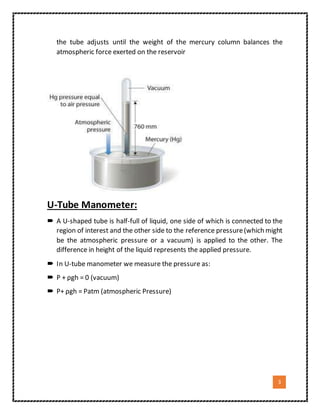
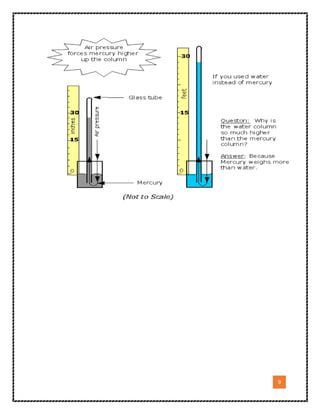
 A mercury barometer has a glass tube with a height of at least 84 cm,
closed at one end, with an open mercury-filled reservoir at the base. The
weight of the mercury creates a vacuum in the top of the tube. Mercury in
3
the tube adjusts until the weight of the mercury column balances the
atmospheric force exerted on the reservoir
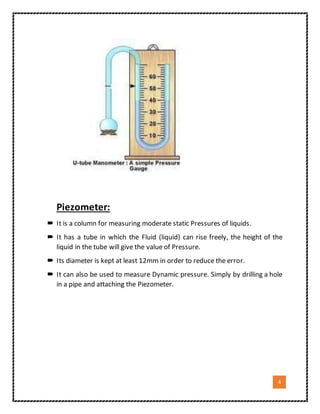
U-Tube Manometer:
 A U-shaped tube is half-full of liquid, one side of which is connected to the
region of interest and the other side to the reference pressure(which might
be the atmospheric pressure or a vacuum) is applied to the other. The
difference in height of the liquid represents the applied pressure.
 In U-tube manometer we measure the pressure as:
 P + ρgh = 0 (vacuum)
 P+ ρgh = Patm (atmospheric Pressure)
4
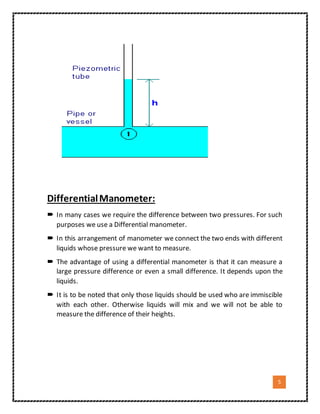
Piezometer:
 It is a column for measuring moderate static Pressures of liquids.
 It has a tube in which the Fluid (liquid) can rise freely, the height of the
liquid in the tube will give the value of Pressure.
 Its diameter is kept at least 12mm in order to reduce the error.
 It can also be used to measure Dynamic pressure. Simply by drilling a hole
in a pipe and attaching the Piezometer.
5
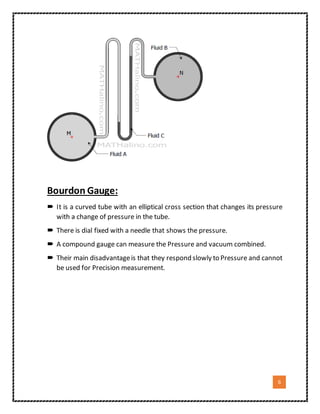
DifferentialManometer:
 In many cases we require the difference between two pressures. For such
purposes we use a Differential manometer.
 In this arrangement of manometer we connect the two ends with different
liquids whose pressure we want to measure.
 The advantage of using a differential manometer is that it can measure a
large pressure difference or even a small difference. It depends upon the
liquids.
 It is to be noted that only those liquids should be used who are immiscible
with each other. Otherwise liquids will mix and we will not be able to
measure the difference of their heights.
6
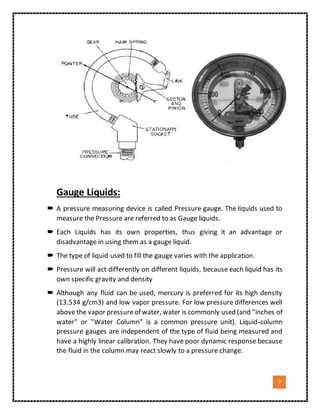
Bourdon Gauge:
 It is a curved tube with an elliptical cross section that changes its pressure
with a change of pressure in the tube.
 There is dial fixed with a needle that shows the pressure.
 A compound gauge can measure the Pressure and vacuum combined.
 Their main disadvantageis that they respond slowly to Pressure and cannot
be used for Precision measurement.
7
Gauge Liquids:
 A pressure measuring device is called Pressure gauge. The liquids used to
measure the Pressure are referred to as Gauge liquids.
 Each Liquids has its own properties, thus giving it an advantage or
disadvantage in using them as a gauge liquid.
 The type of liquid used to fill the gauge varies with the application.
 Pressure will act differently on different liquids, because each liquid has its
own specific gravity and density
 Although any fluid can be used, mercury is preferred for its high density
(13.534 g/cm3) and low vapor pressure. For low pressure differences well
above the vapor pressureof water, water is commonly used (and "inches of
water" or "Water Column" is a common pressure unit). Liquid-column
pressure gauges are independent of the type of fluid being measured and
have a highly linear calibration. They have poor dynamic response because
the fluid in the column may react slowly to a pressure change.
8
Why use different gauge liquids:
The question is why we use different kind of gauge liquids, why not use
water for all our pressure measuring experiments.
 The reason is simple, water has a very low specific weight or we can say
mercury is much heavier than water. ( approximately 13.55 times)
 Let water be used instead of mercury to find atmospheric Pressure:
Than:
Patm = ρmgh
“Ρm” and “g” are known & from experiments h = 0.76m (mercury)
Putting values
Patm = 13594 kg/m3 *9.81m/s2 * 0.76m
Patm = 101325 N/m2 or 101.32 KPa
Now use the same equation for water:
Patm = ρwgh
h = Patm/ ρwg
h = 101.32*1000N/m3 / 1000 kg/m3 *9.81m/s2
h = 10.35m
So if we usewater we would require a glass tube of approximately “11
meters” which is quite difficult, compared to an 84 cm glass tube (which we
use in barometer). If wechange our Gaugeliquid to mercury.
 This proves that in measuring PressureGaugeliquid is very important, and
we should select our gauge liquid carefully.
9

Pressure measuring Devices

  • 1.
    1 Mini Project #02 (FluidMechanics) Project Title: Pressure measuring Devices SUBMITTED BY:MOHAMMED MUTAHAR SUBMITTED TO ASST.PROF.DR.MUJAHD KHAN University of Engineering and Technology, Peshawar
  • 2.
    2 Different types ofPressure measuring Devices:  Many techniques have been developed for the measurement of pressure. Instruments used to measure pressure are called pressure gauges.  We use a column of liquid to measure the Pressure, which is referred to as a “Manometer”.  There are two types of pressure: o Absolute Pressure Pabs: Pressure measured relative to vacuum. o Gauge Pressure PO: Pressure measured to local atmospheric Pressure. Pabs = Po+ Patm  Instruments used to measure Pressure: • Barometer • U-tube Manometer • Piezometer • Differential manometer • Bourdon gauge Barometer:  An instrument for measuring local atmospheric Pressure.  The barometer, is calibrated to read zero when there is a complete vacuum; the pressure indicated by the instrument is therefore called absolute pressure.  A mercury barometer has a glass tube with a height of at least 84 cm, closed at one end, with an open mercury-filled reservoir at the base. The weight of the mercury creates a vacuum in the top of the tube. Mercury in
  • 3.
    3 the tube adjustsuntil the weight of the mercury column balances the atmospheric force exerted on the reservoir U-Tube Manometer:  A U-shaped tube is half-full of liquid, one side of which is connected to the region of interest and the other side to the reference pressure(which might be the atmospheric pressure or a vacuum) is applied to the other. The difference in height of the liquid represents the applied pressure.  In U-tube manometer we measure the pressure as:  P + ρgh = 0 (vacuum)  P+ ρgh = Patm (atmospheric Pressure)
  • 4.
    4 Piezometer:  It isa column for measuring moderate static Pressures of liquids.  It has a tube in which the Fluid (liquid) can rise freely, the height of the liquid in the tube will give the value of Pressure.  Its diameter is kept at least 12mm in order to reduce the error.  It can also be used to measure Dynamic pressure. Simply by drilling a hole in a pipe and attaching the Piezometer.
  • 5.
    5 DifferentialManometer:  In manycases we require the difference between two pressures. For such purposes we use a Differential manometer.  In this arrangement of manometer we connect the two ends with different liquids whose pressure we want to measure.  The advantage of using a differential manometer is that it can measure a large pressure difference or even a small difference. It depends upon the liquids.  It is to be noted that only those liquids should be used who are immiscible with each other. Otherwise liquids will mix and we will not be able to measure the difference of their heights.
  • 6.
    6 Bourdon Gauge:  Itis a curved tube with an elliptical cross section that changes its pressure with a change of pressure in the tube.  There is dial fixed with a needle that shows the pressure.  A compound gauge can measure the Pressure and vacuum combined.  Their main disadvantageis that they respond slowly to Pressure and cannot be used for Precision measurement.
  • 7.
    7 Gauge Liquids:  Apressure measuring device is called Pressure gauge. The liquids used to measure the Pressure are referred to as Gauge liquids.  Each Liquids has its own properties, thus giving it an advantage or disadvantage in using them as a gauge liquid.  The type of liquid used to fill the gauge varies with the application.  Pressure will act differently on different liquids, because each liquid has its own specific gravity and density  Although any fluid can be used, mercury is preferred for its high density (13.534 g/cm3) and low vapor pressure. For low pressure differences well above the vapor pressureof water, water is commonly used (and "inches of water" or "Water Column" is a common pressure unit). Liquid-column pressure gauges are independent of the type of fluid being measured and have a highly linear calibration. They have poor dynamic response because the fluid in the column may react slowly to a pressure change.
  • 8.
    8 Why use differentgauge liquids: The question is why we use different kind of gauge liquids, why not use water for all our pressure measuring experiments.  The reason is simple, water has a very low specific weight or we can say mercury is much heavier than water. ( approximately 13.55 times)  Let water be used instead of mercury to find atmospheric Pressure: Than: Patm = ρmgh “Ρm” and “g” are known & from experiments h = 0.76m (mercury) Putting values Patm = 13594 kg/m3 *9.81m/s2 * 0.76m Patm = 101325 N/m2 or 101.32 KPa Now use the same equation for water: Patm = ρwgh h = Patm/ ρwg h = 101.32*1000N/m3 / 1000 kg/m3 *9.81m/s2 h = 10.35m So if we usewater we would require a glass tube of approximately “11 meters” which is quite difficult, compared to an 84 cm glass tube (which we use in barometer). If wechange our Gaugeliquid to mercury.  This proves that in measuring PressureGaugeliquid is very important, and we should select our gauge liquid carefully.
  • 9.