Subject:-Fluid Mechanics & Machines Prepared By:- Abhishek Joshi
UNIT:1
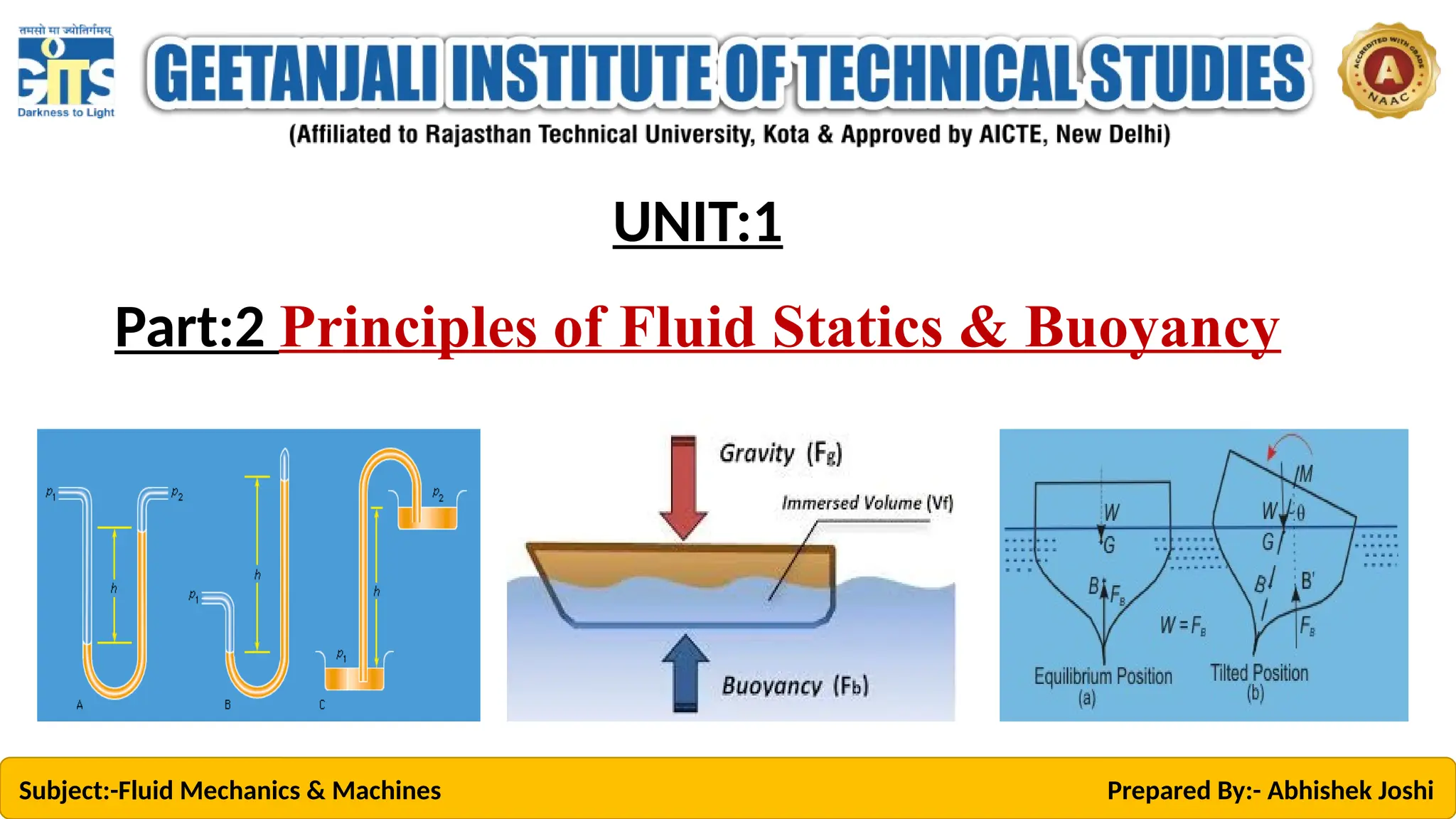
Part:2 Principles of Fluid Statics & Buoyancy
Syllabus
Principles of Fluid Statics: Basic equations, Pascal Law, Type of pressure:-
atmospheric pressure, Gauge pressure, vacuum pressure, absolute pressure,
manometers, Bourdon pressure gauge
Buoyancy; Forces acting on immersed plane surface. Centre of pressure, forces
on curved surfaces. Conditions of equilibrium for floating bodies, meta-centre
and analytical determination of meta centric height.
UNIT 1 Part 2
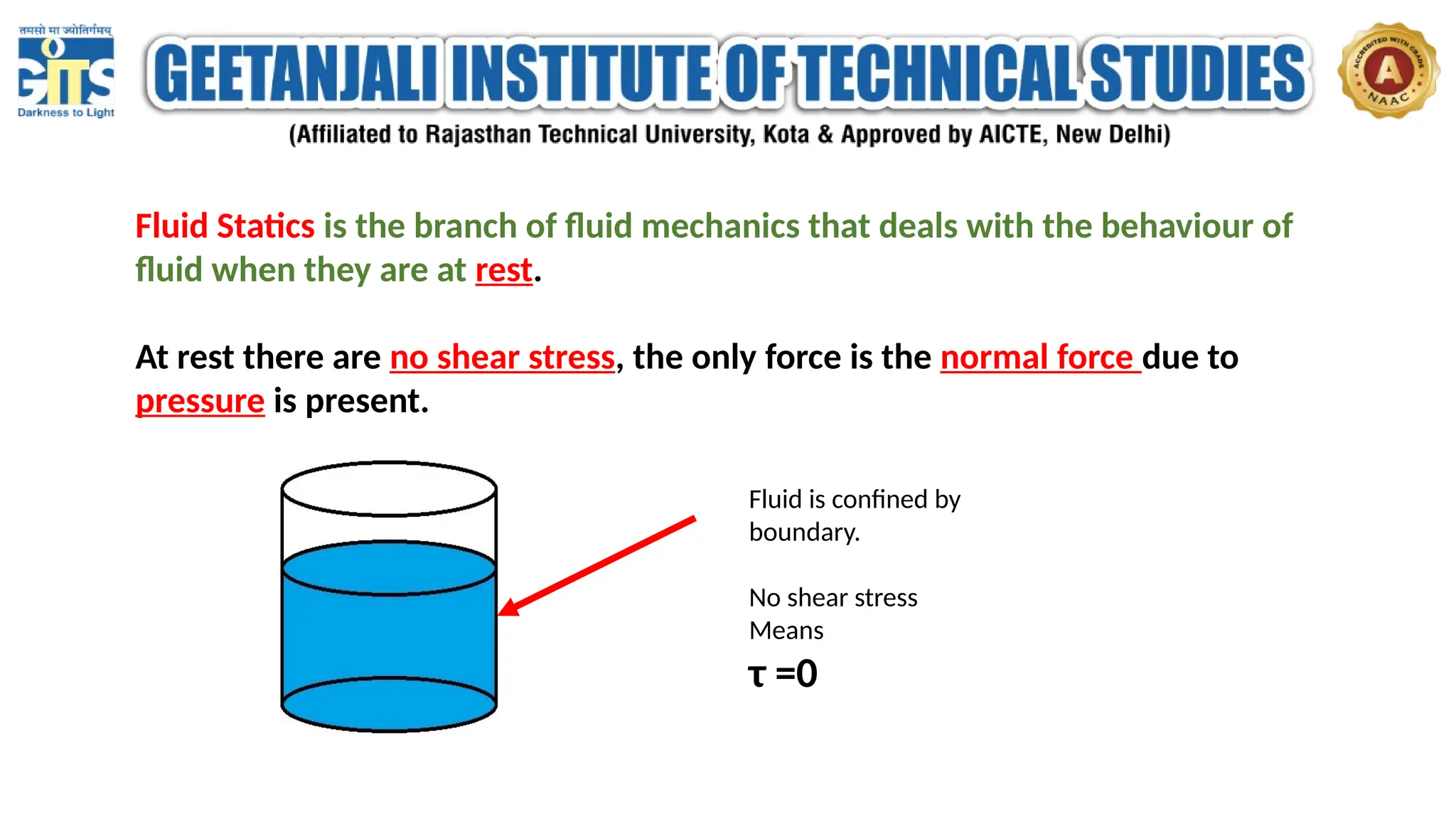
Fluid Statics is the branch of fluid mechanics that deals with the behaviour of
fluid when they are at rest.
At rest there are no shear stress, the only force is the normal force due to
pressure is present.
Fluid is confined by
boundary.
No shear stress
Means
τ =0
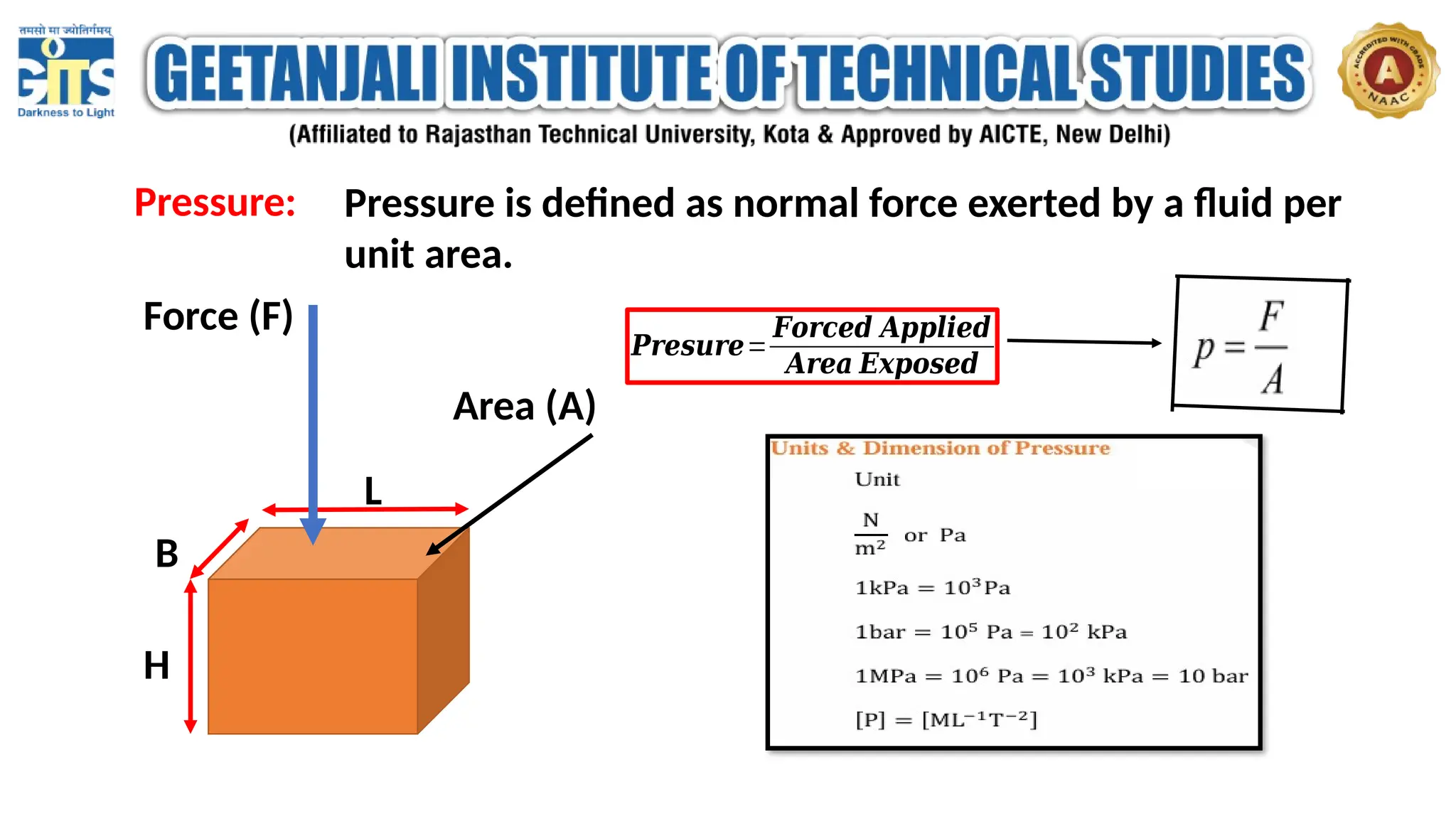
Pressure:
L
B
Area (A)
H
Pressure is defined as normal force exerted by a fluid per
unit area.
Force (F)
𝑷𝒓𝒆𝒔𝒖𝒓𝒆=
𝑭𝒐𝒓𝒄𝒆𝒅 𝑨𝒑𝒑𝒍𝒊𝒆𝒅
𝑨𝒓𝒆𝒂 𝑬𝒙𝒑𝒐𝒔𝒆𝒅
Pascal Law
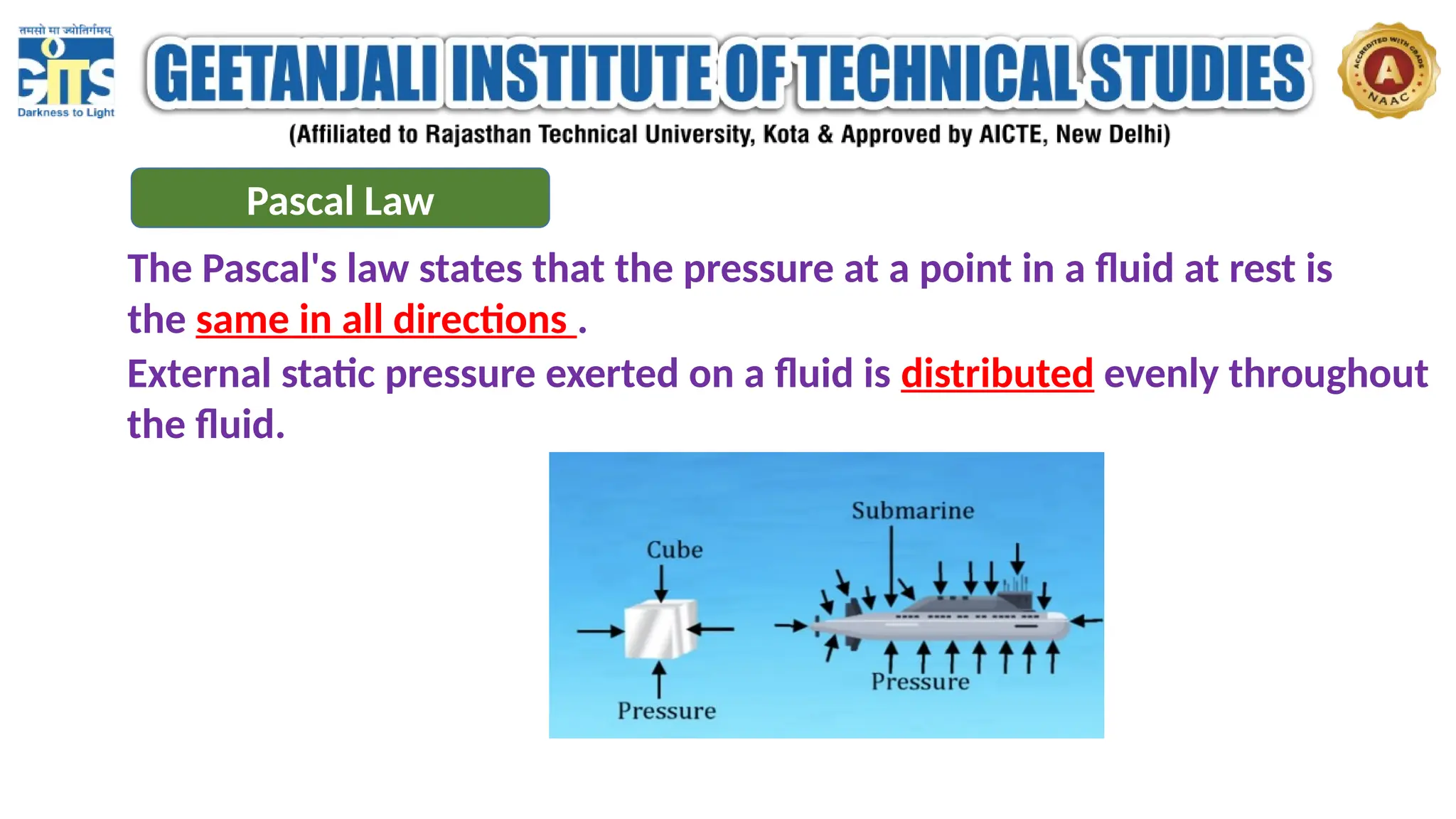
The Pascal's law states that the pressure at a point in a fluid at rest is
the same in all directions .
External static pressure exerted on a fluid is distributed evenly throughout
the fluid.
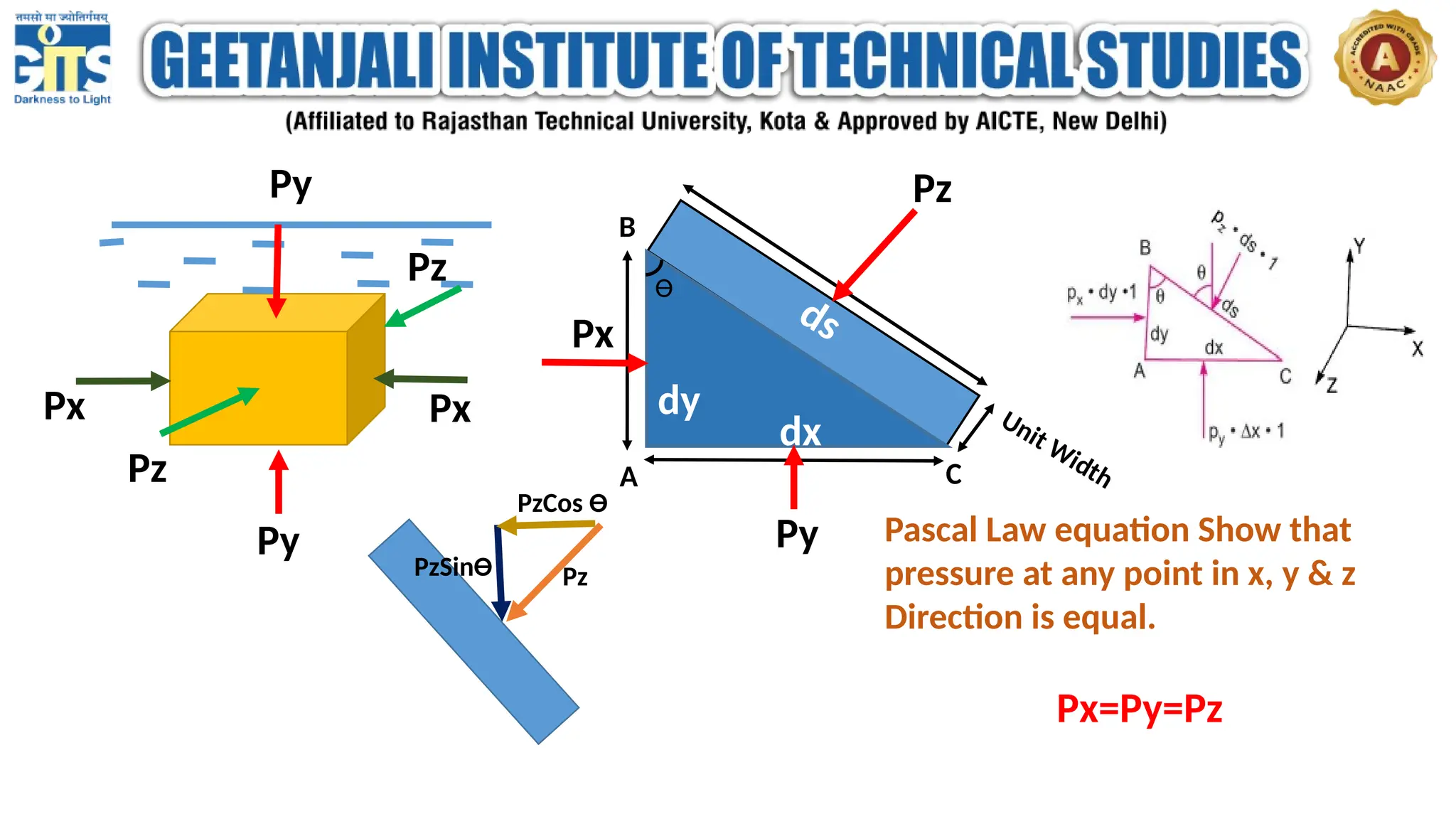
Px
Py
Py
Pz
Pz A
B
C
Unit Width
dy
Px
ds
Py
dx
Pz
Px
ϴ
Pz
PzCos ϴ
PzSinϴ
Pascal Law equation Show that
pressure at any point in x, y & z
Direction is equal.
Px=Py=Pz
Hydrostatic Law
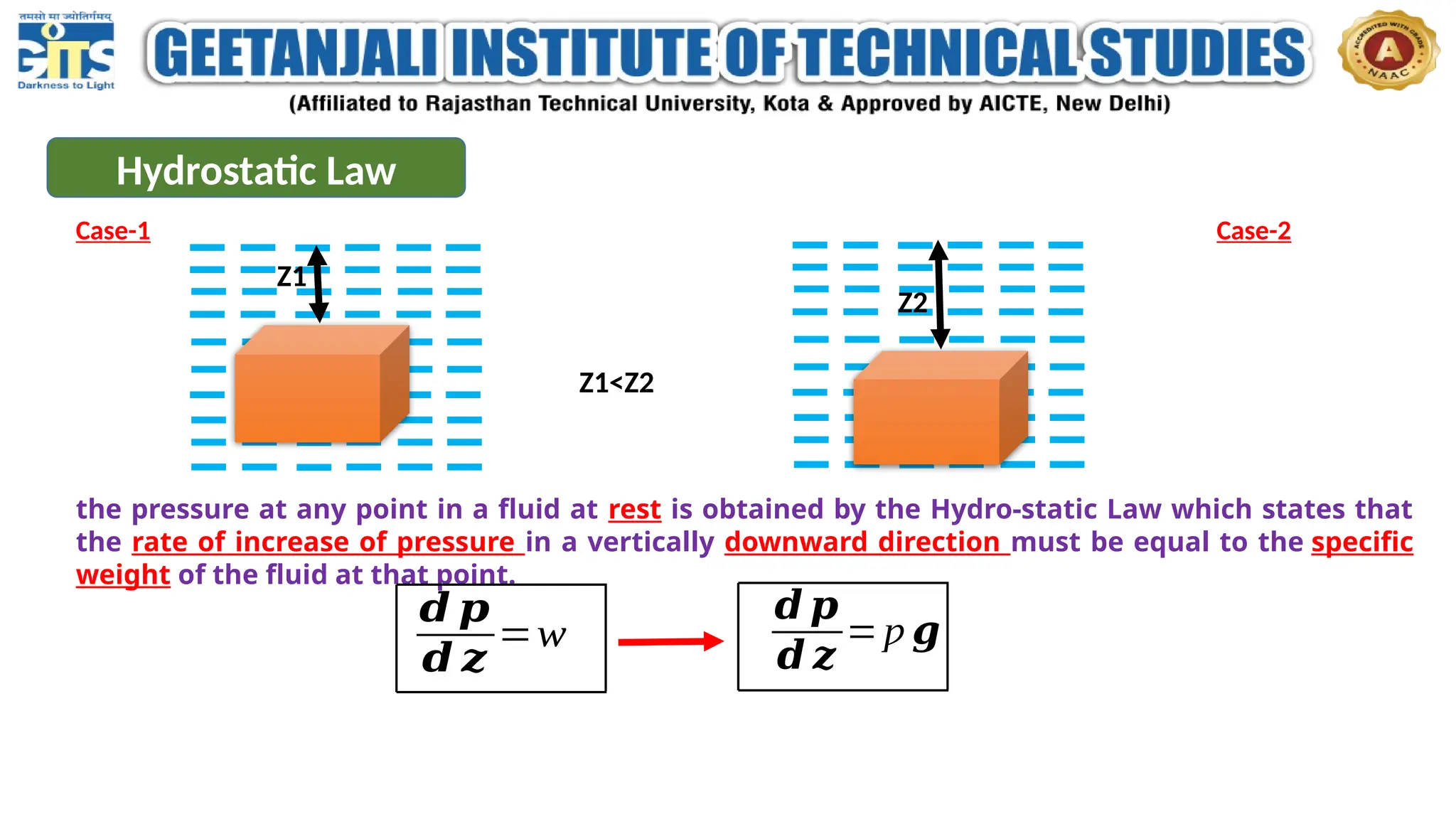
the pressure at any point in a fluid at rest is obtained by the Hydro-static Law which states that
the rate of increase of pressure in a vertically downward direction must be equal to the specific
weight of the fluid at that point.
Z1
Z2
Z1<Z2
Case-1 Case-2
𝒅 𝒑
𝒅 𝒛
=w
𝒅 𝒑
𝒅 𝒛
=ƿ 𝒈
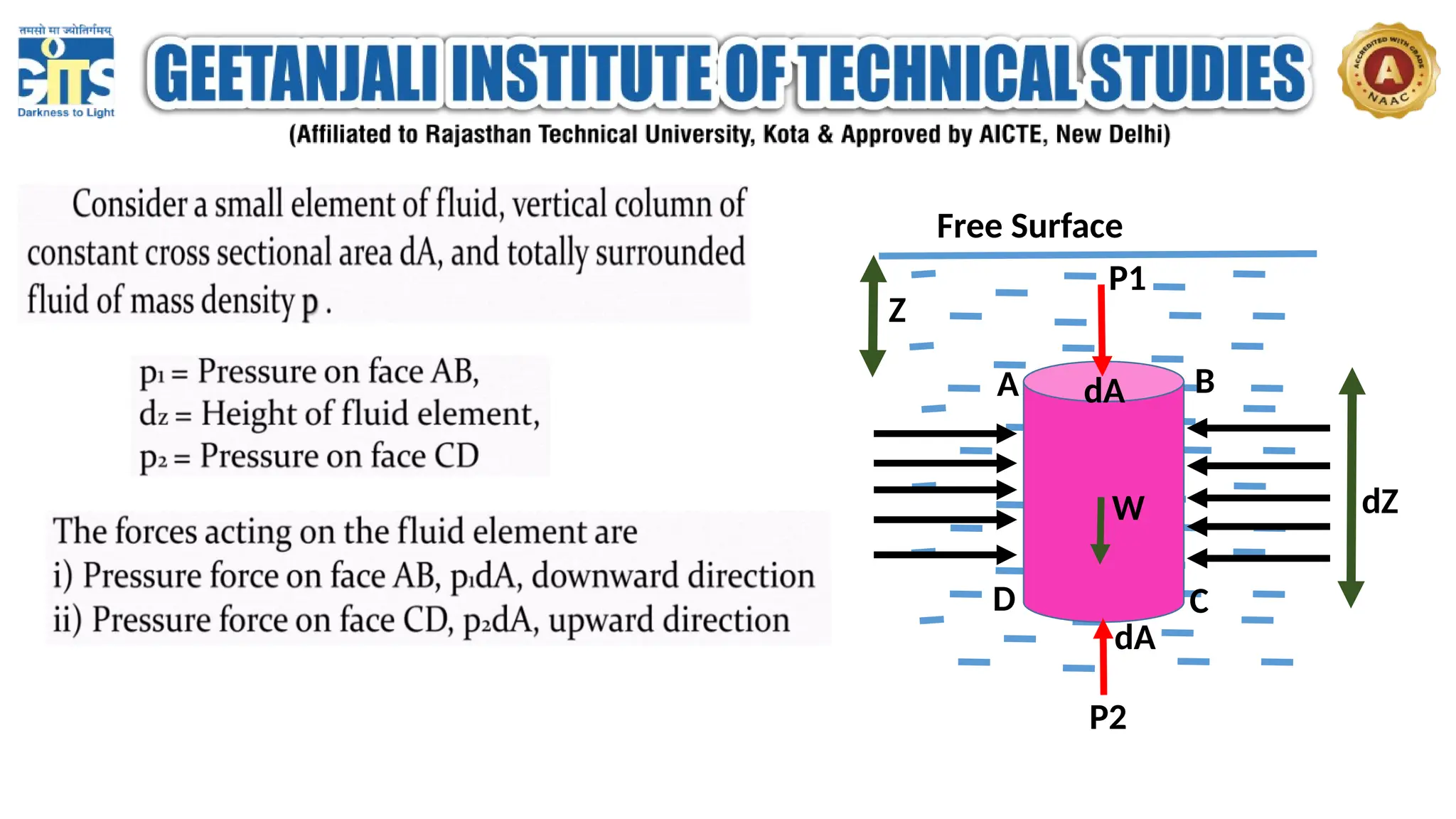
A B
D C
P1
P2
Z
dZ
Free Surface
dA
dA
W
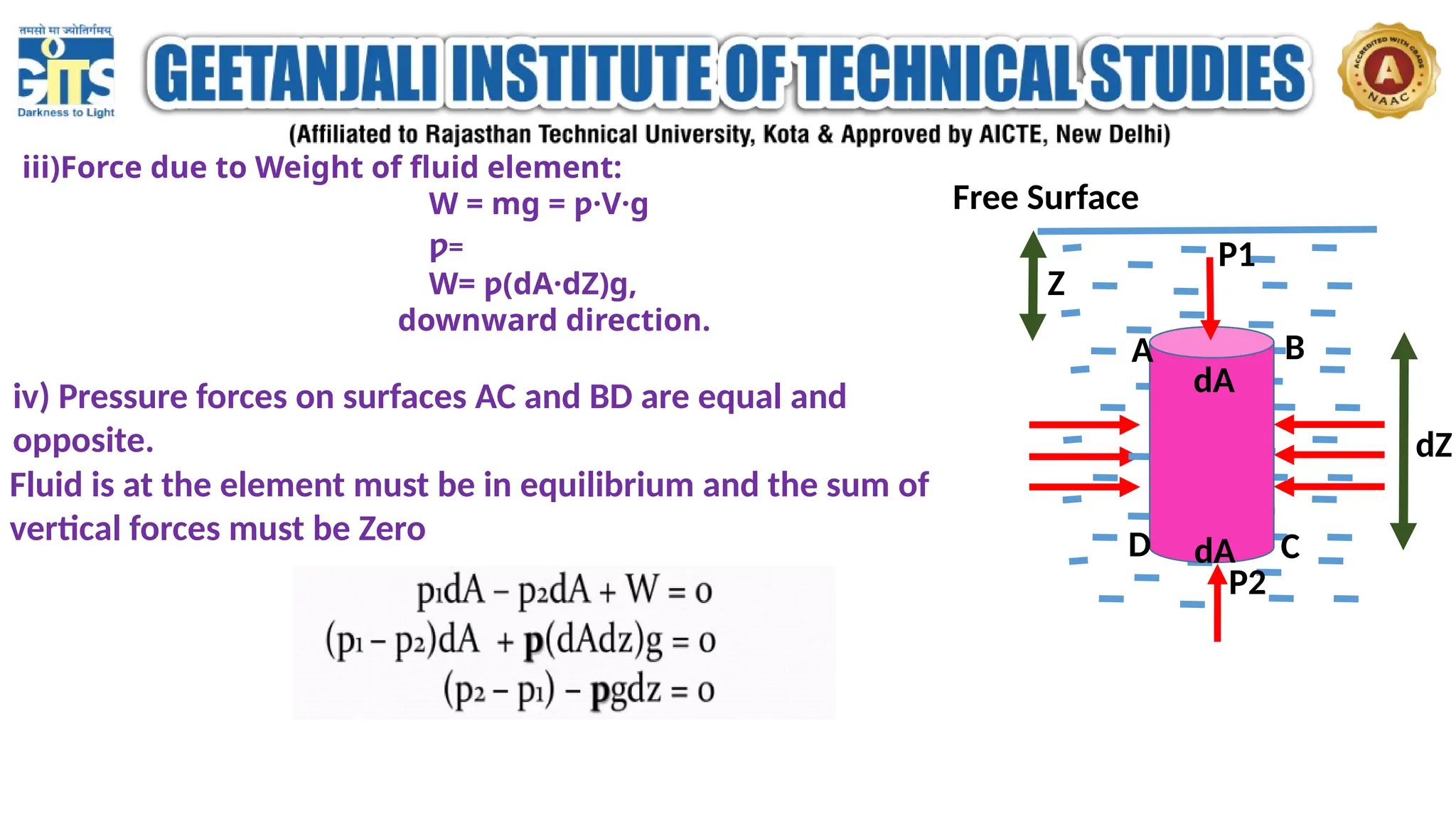
iii)Force due to Weight of fluid element:
W = mg = ƿ·V·g
ƿ=
W= ƿ(dA·dZ)g,
downward direction.
iv) Pressure forces on surfaces AC and BD are equal and
opposite.
Fluid is at the element must be in equilibrium and the sum of
vertical forces must be Zero
Free Surface
A B
D C
P1
Z
dA
dA
dZ
P2
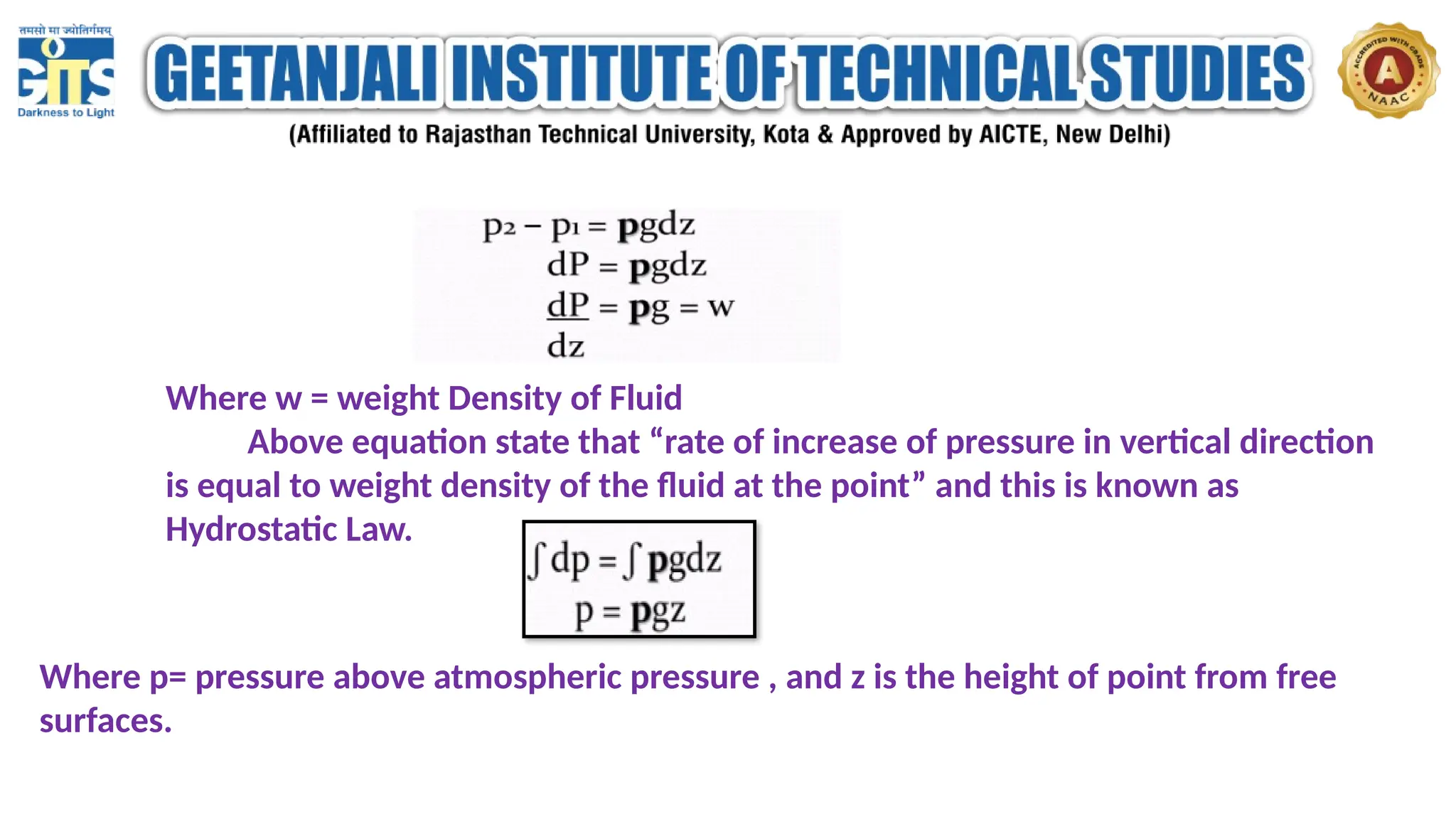
Where w = weight Density of Fluid
Above equation state that “rate of increase of pressure in vertical direction
is equal to weight density of the fluid at the point” and this is known as
Hydrostatic Law.
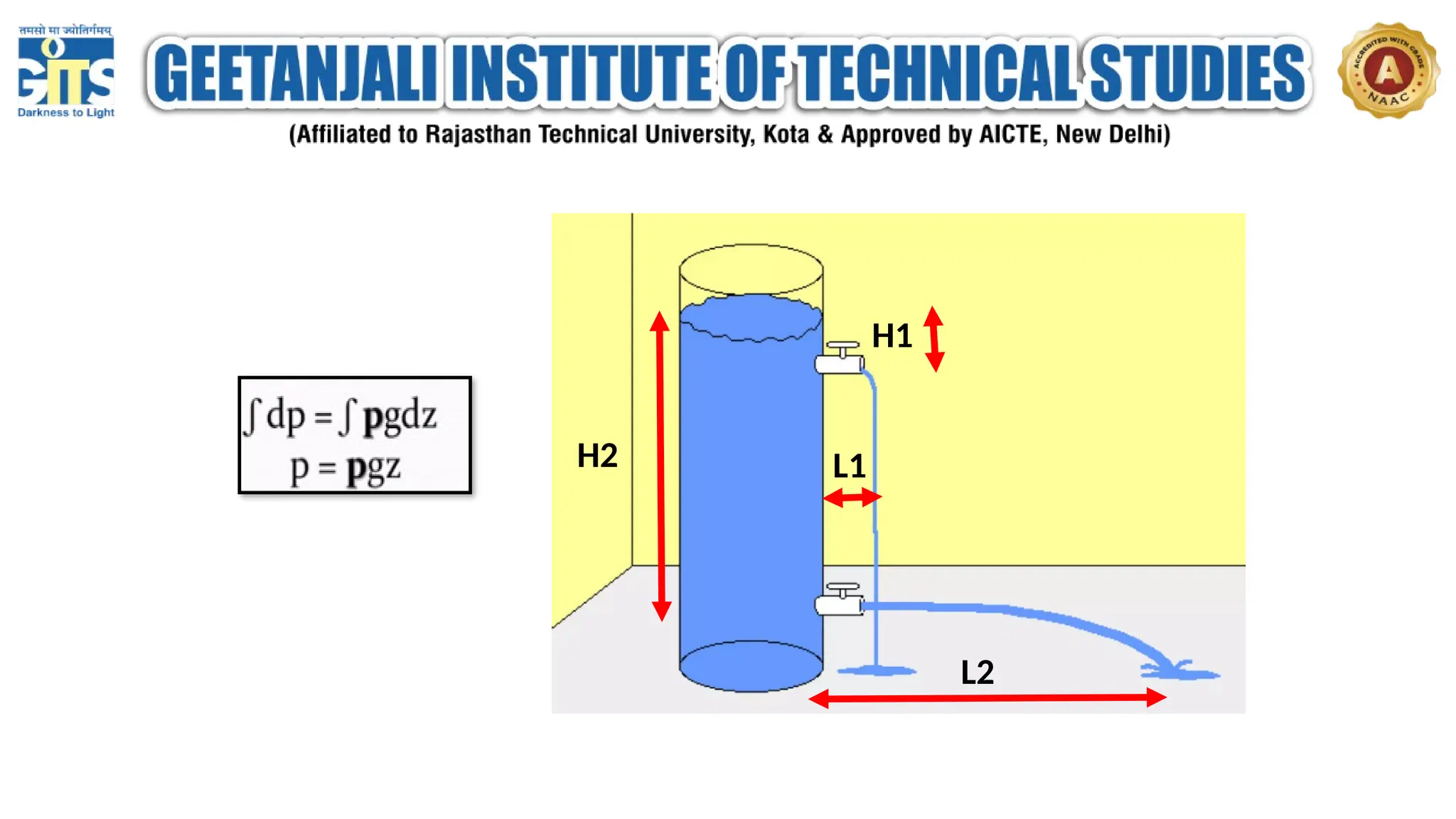
Where p= pressure above atmospheric pressure , and z is the height of point from free
surfaces.
H1
H2
L2
L1
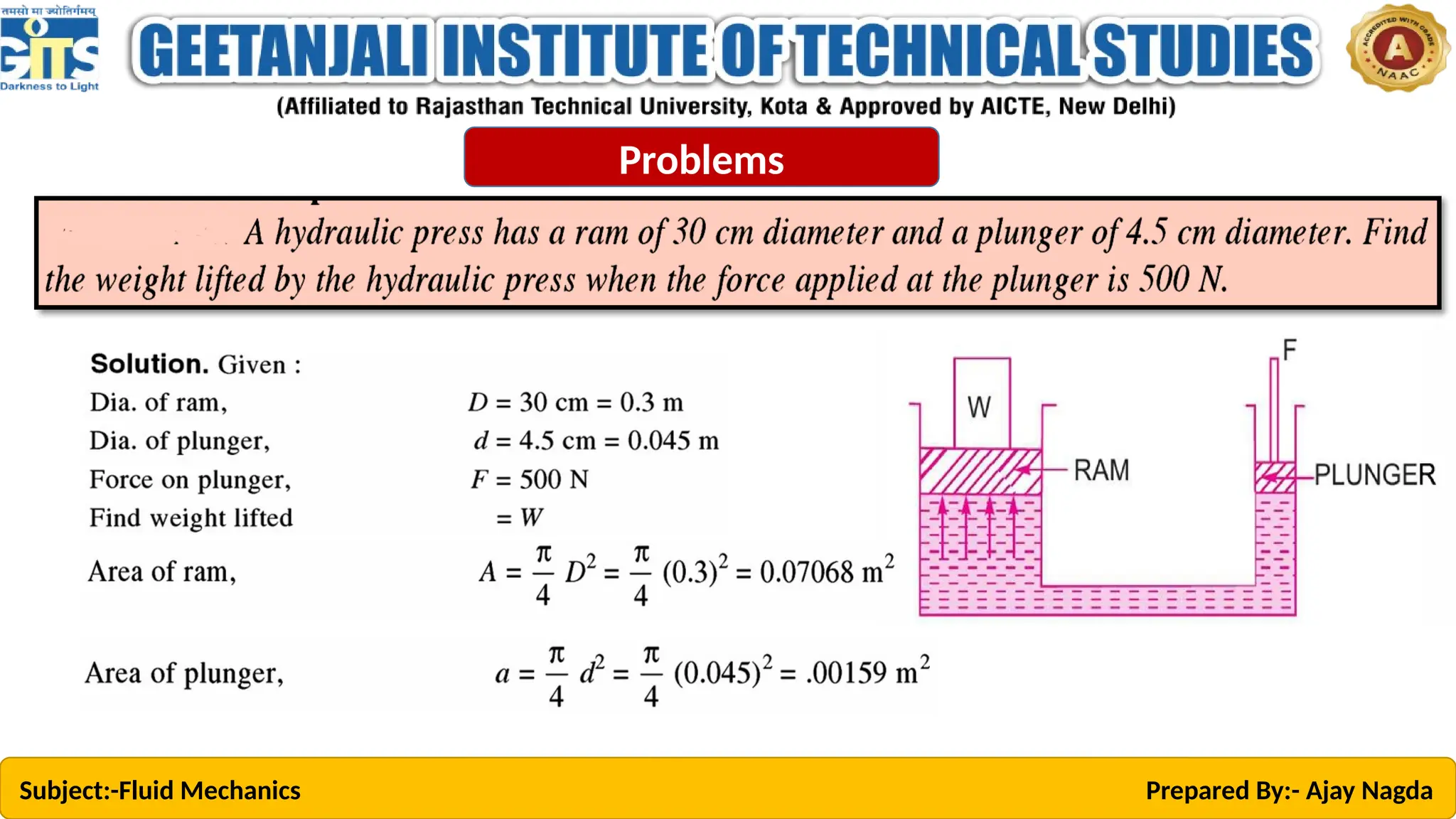
Subject:-Fluid Mechanics Prepared By:- Ajay Nagda
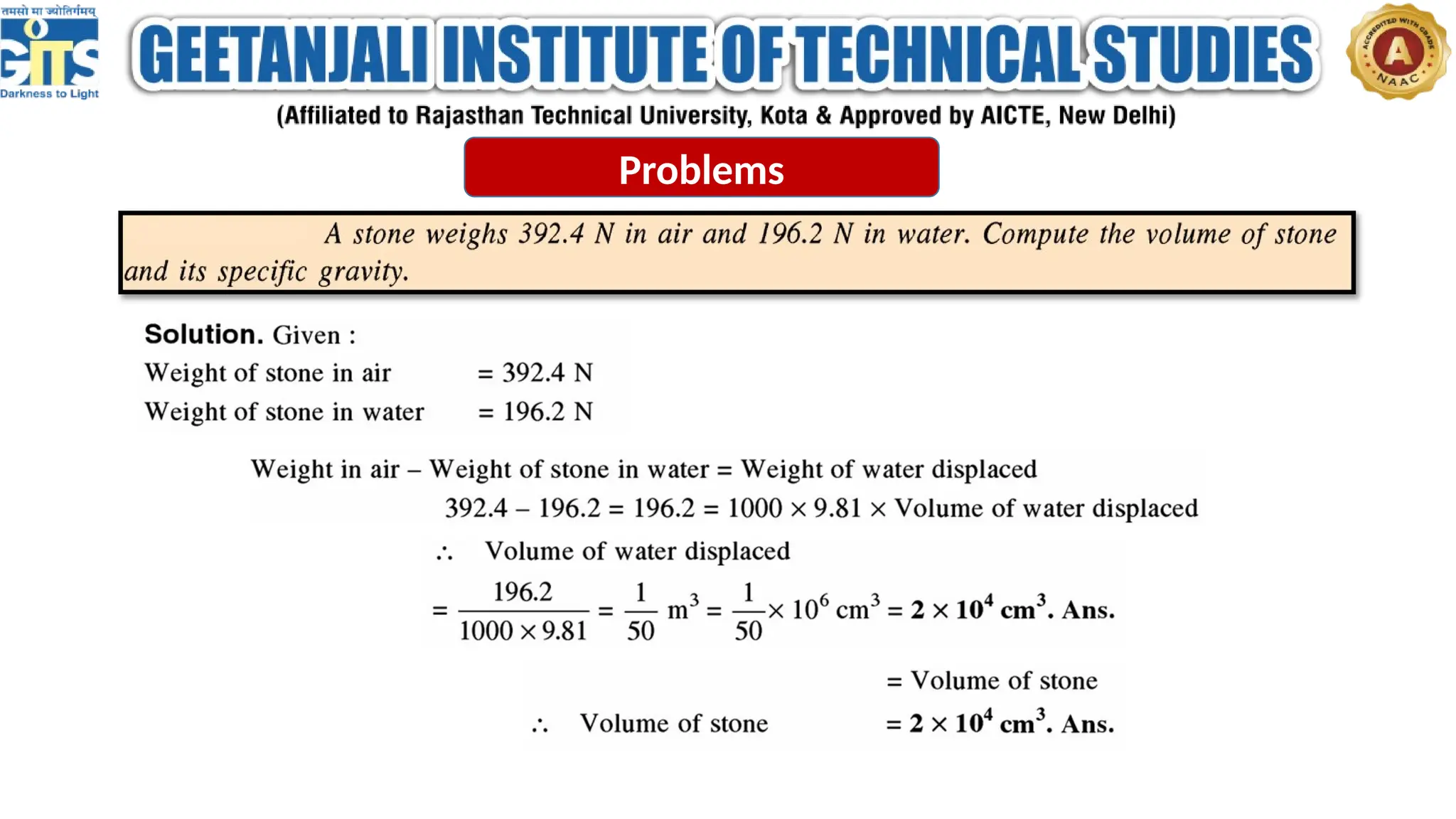
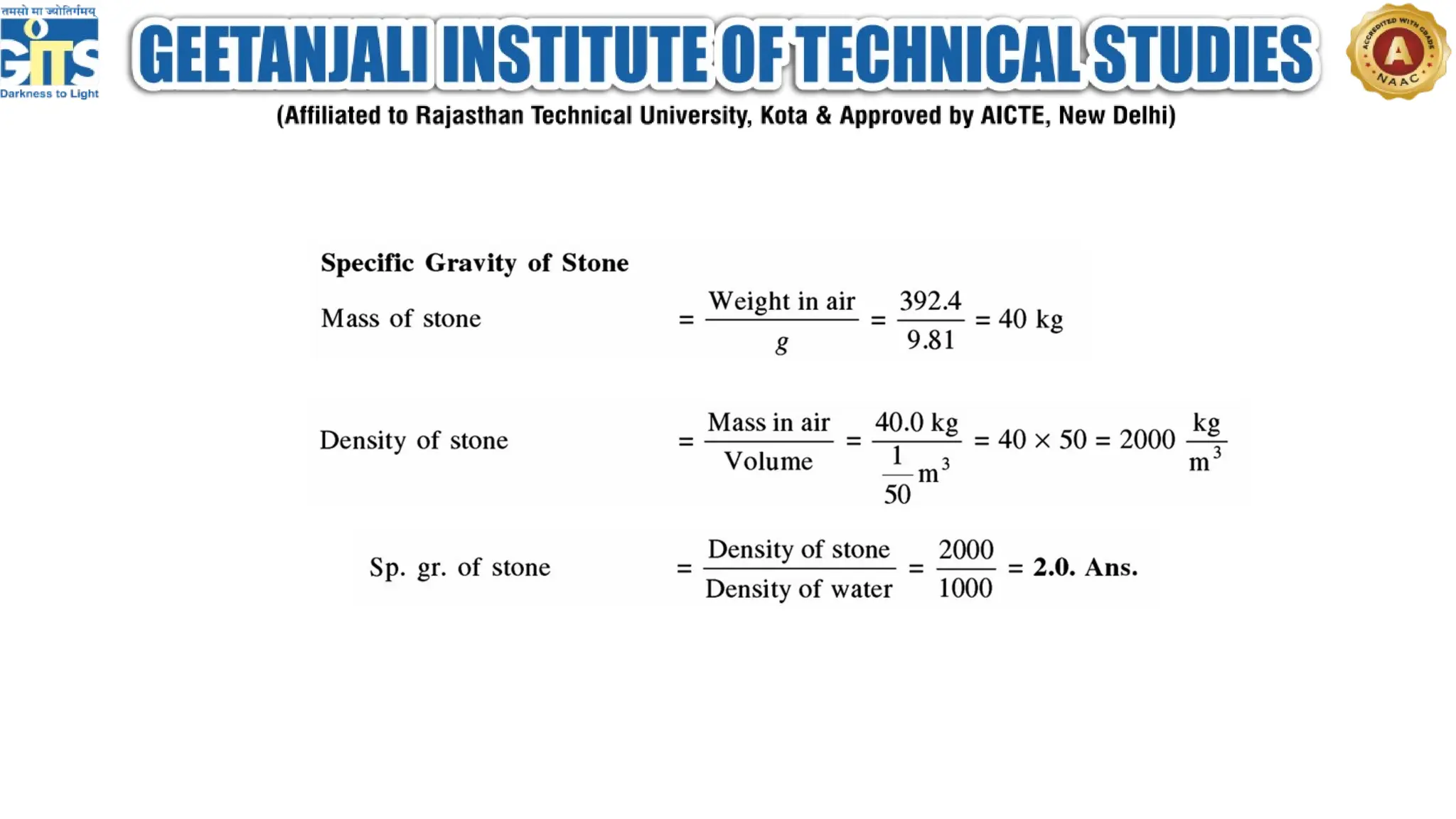
Problems
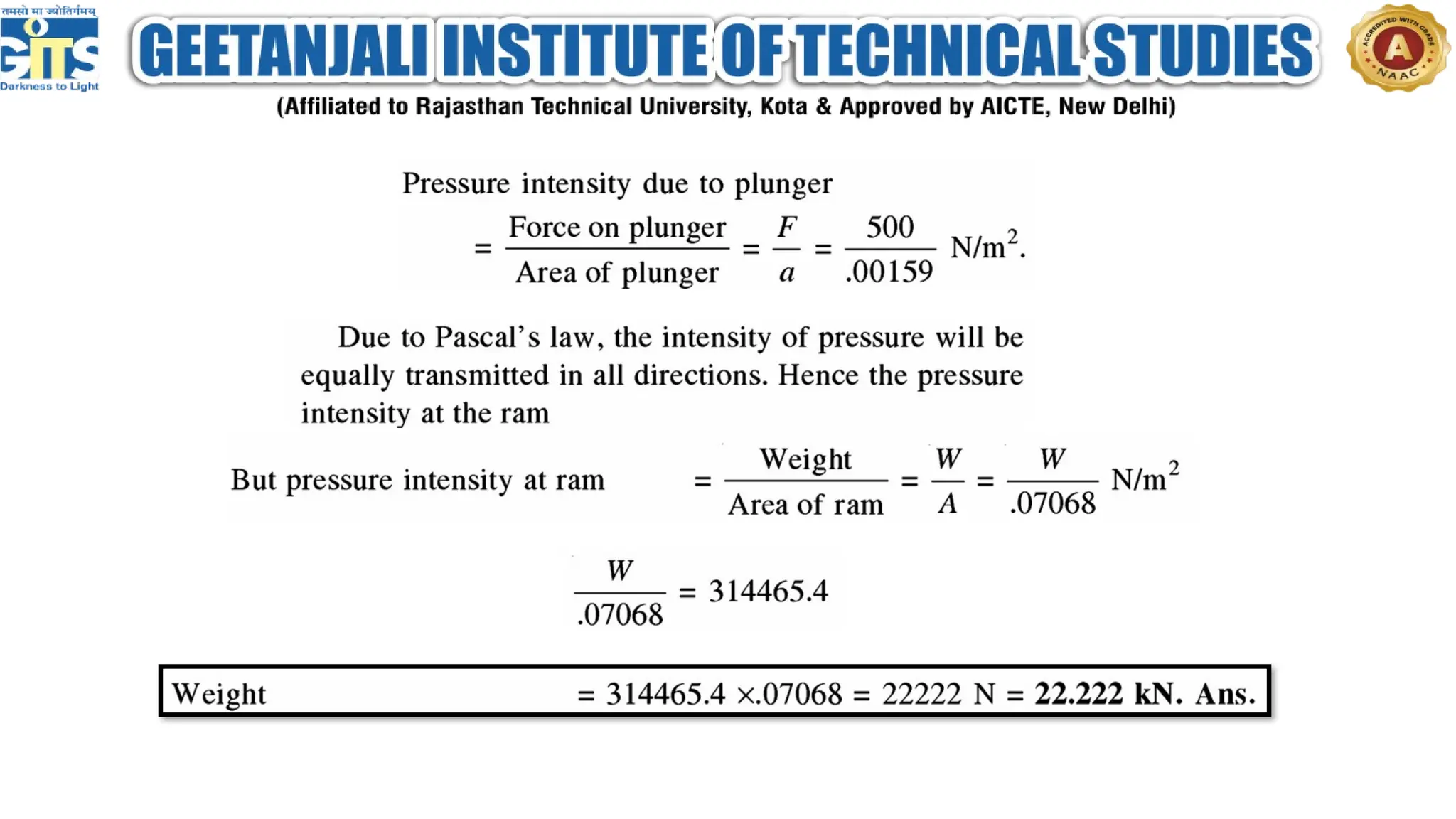
Problems
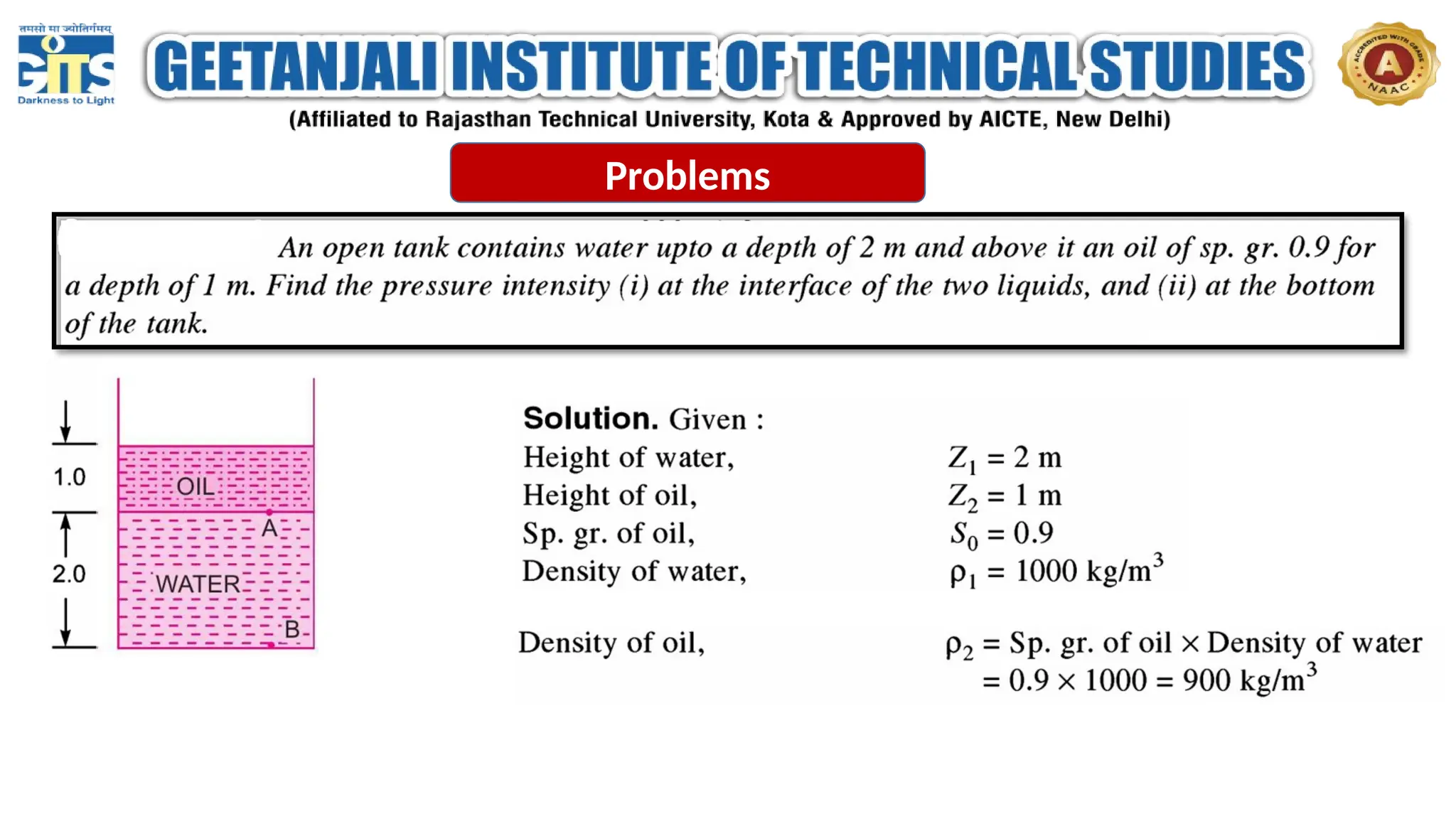
Problems
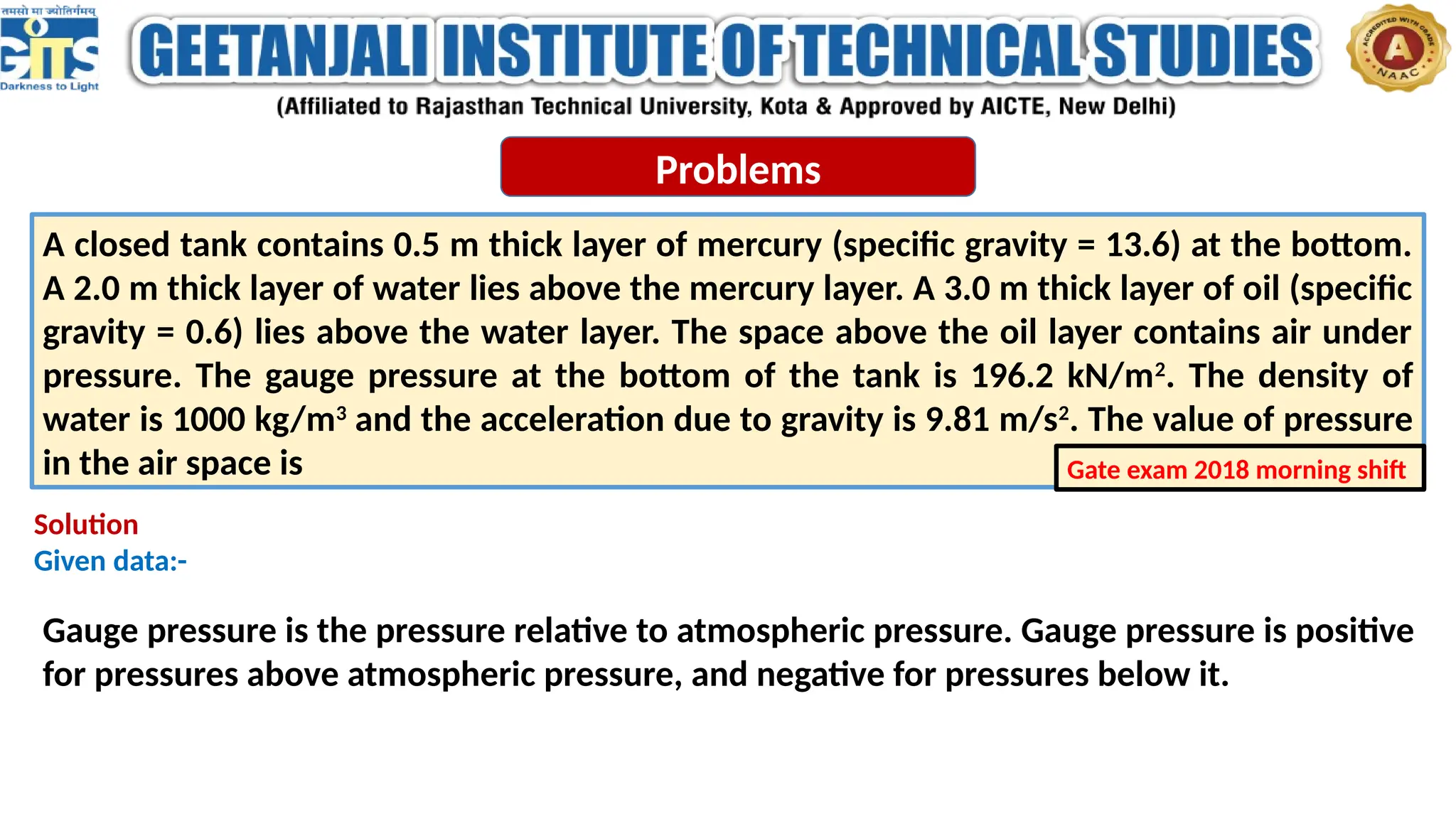
A closed tank contains 0.5 m thick layer of mercury (specific gravity = 13.6) at the bottom.
A 2.0 m thick layer of water lies above the mercury layer. A 3.0 m thick layer of oil (specific
gravity = 0.6) lies above the water layer. The space above the oil layer contains air under
pressure. The gauge pressure at the bottom of the tank is 196.2 kN/m2
. The density of
water is 1000 kg/m3
and the acceleration due to gravity is 9.81 m/s2
. The value of pressure
in the air space is Gate exam 2018 morning shift
Solution
Given data:-
Gauge pressure is the pressure relative to atmospheric pressure. Gauge pressure is positive
for pressures above atmospheric pressure, and negative for pressures below it.
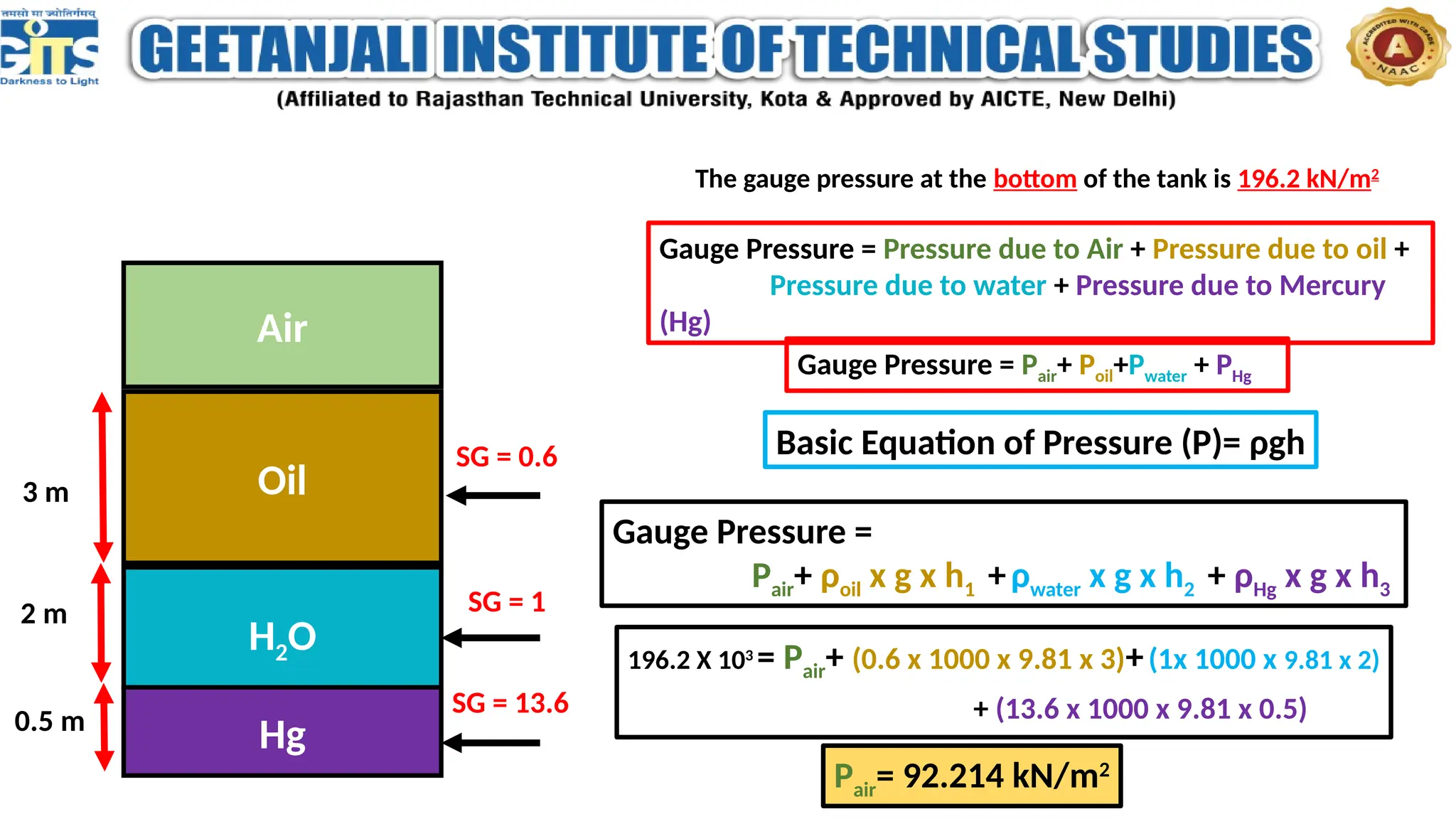
Hg
H2O
Oil
Air
0.5 m
2 m
3 m
SG = 13.6
SG = 1
SG = 0.6
The gauge pressure at the bottom of the tank is 196.2 kN/m2
Gauge Pressure = Pressure due to Air + Pressure due to oil +
Pressure due to water + Pressure due to Mercury
(Hg)
Gauge Pressure = Pair+ Poil+Pwater + PHg
Basic Equation of Pressure (P)= ρgh
Gauge Pressure =
Pair+ ρoil x g x h1 +ρwater x g x h2 + ρHg x g x h3
196.2 X 103
= Pair+ (0.6 x 1000 x 9.81 x 3)+(1x 1000 x 9.81 x 2)
+ (13.6 x 1000 x 9.81 x 0.5)
Pair= 92.214 kN/m2
Types of Pressure System
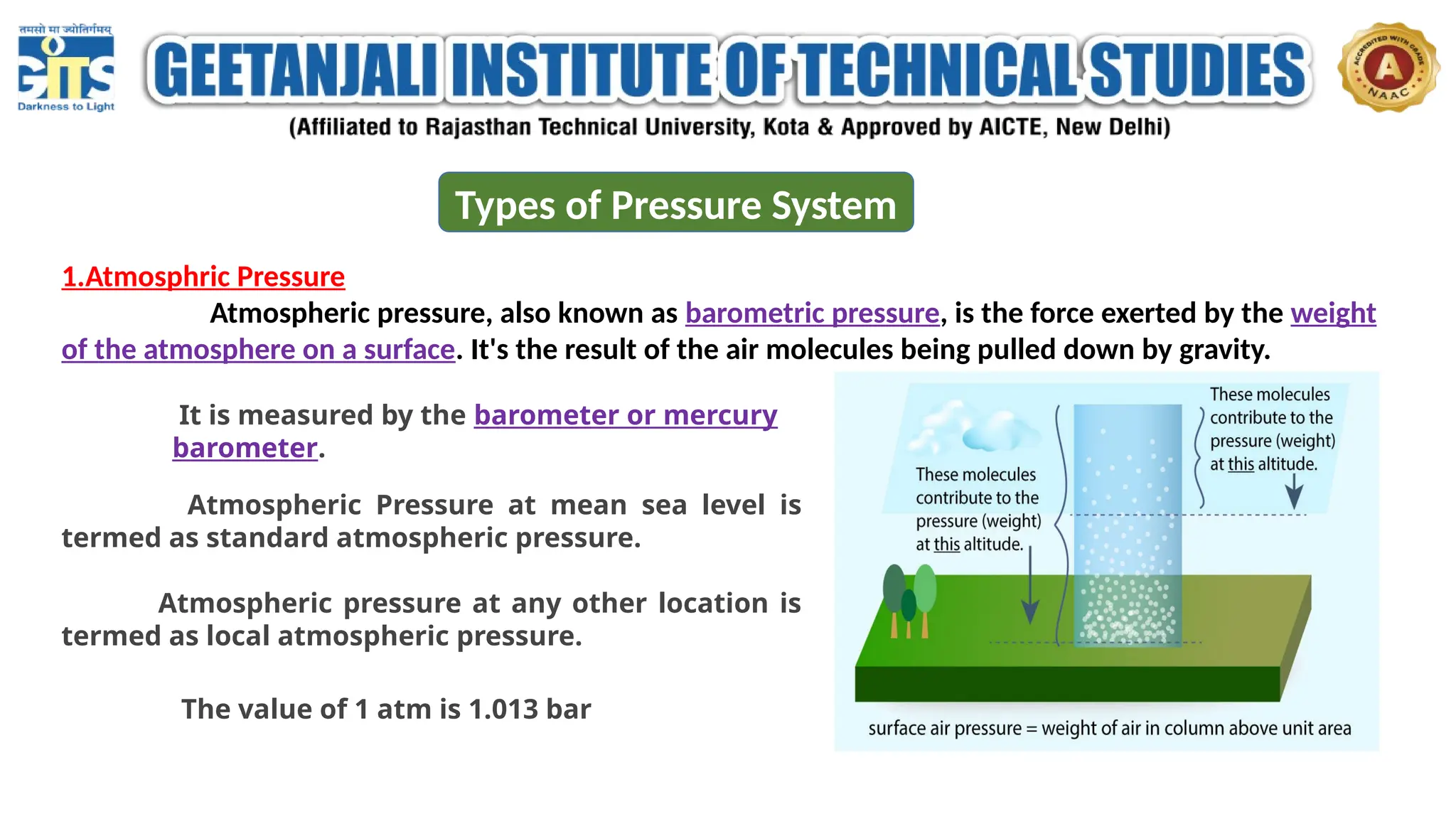
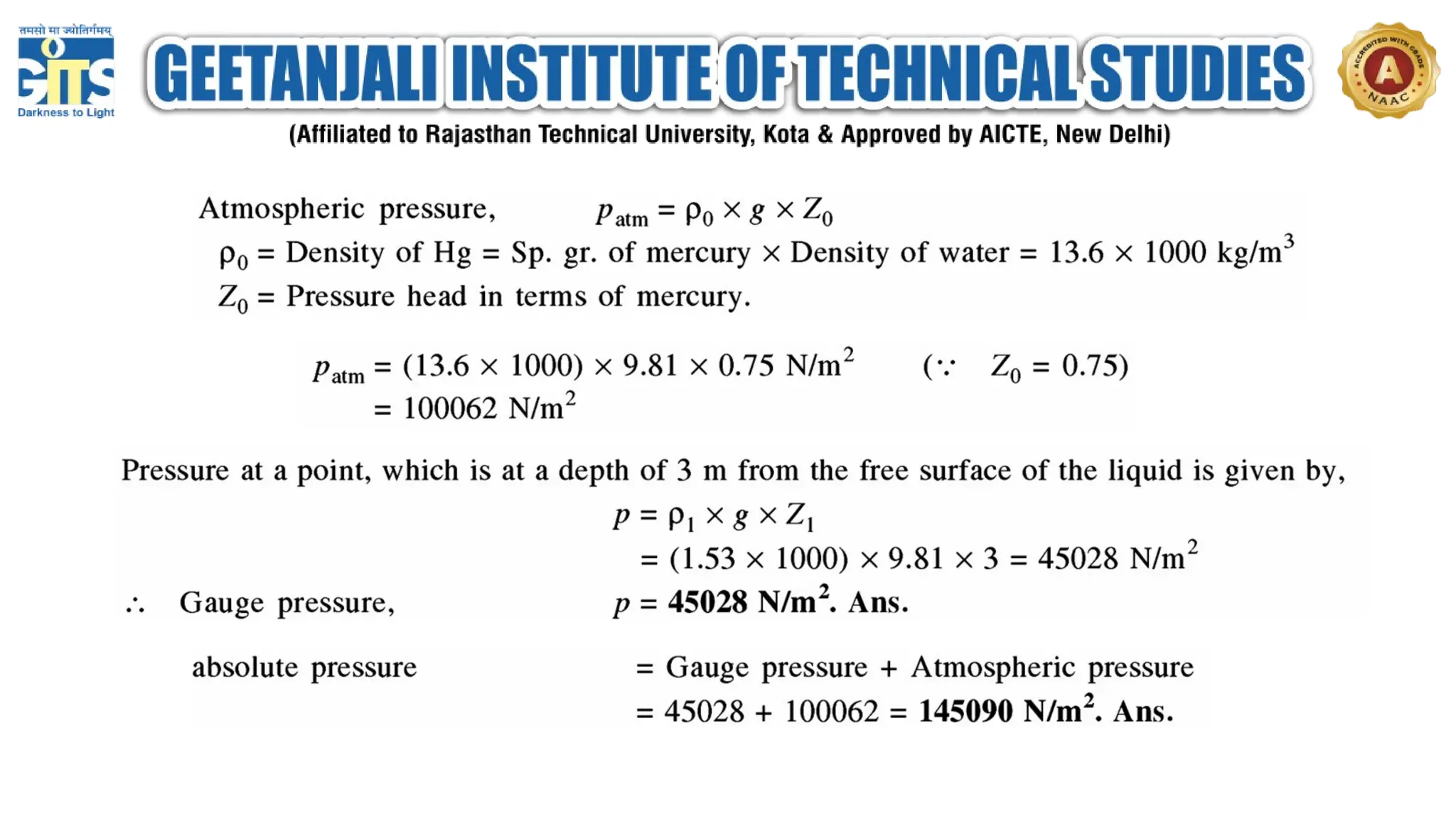
1.Atmosphric Pressure
Atmospheric pressure, also known as barometric pressure, is the force exerted by the weight
of the atmosphere on a surface. It's the result of the air molecules being pulled down by gravity.
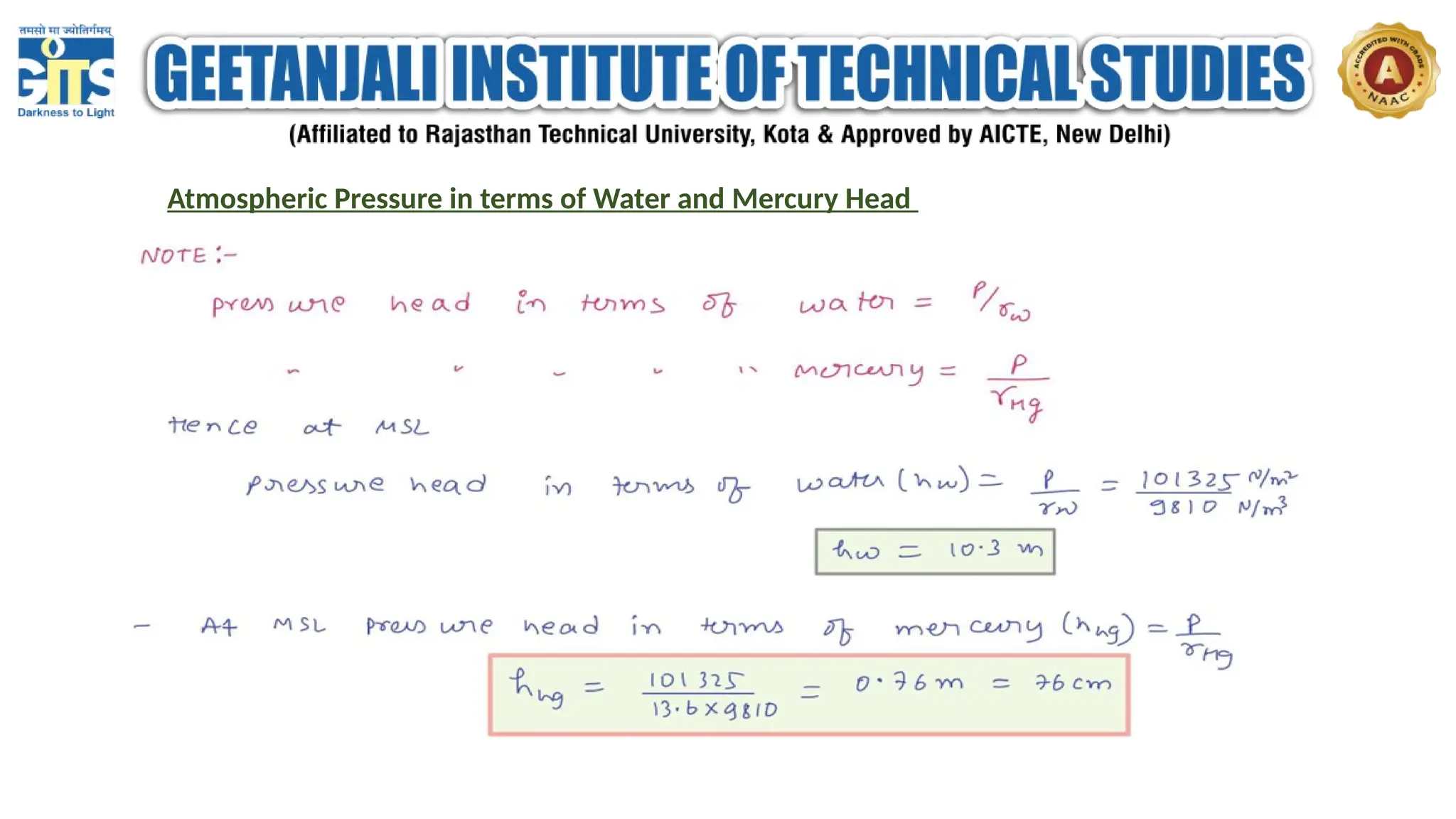
Atmospheric Pressure at mean sea level is
termed as standard atmospheric pressure.
Atmospheric pressure at any other location is
termed as local atmospheric pressure.
It is measured by the barometer or mercury
barometer.
The value of 1 atm is 1.013 bar
Atmospheric Pressure in terms of Water and Mercury Head
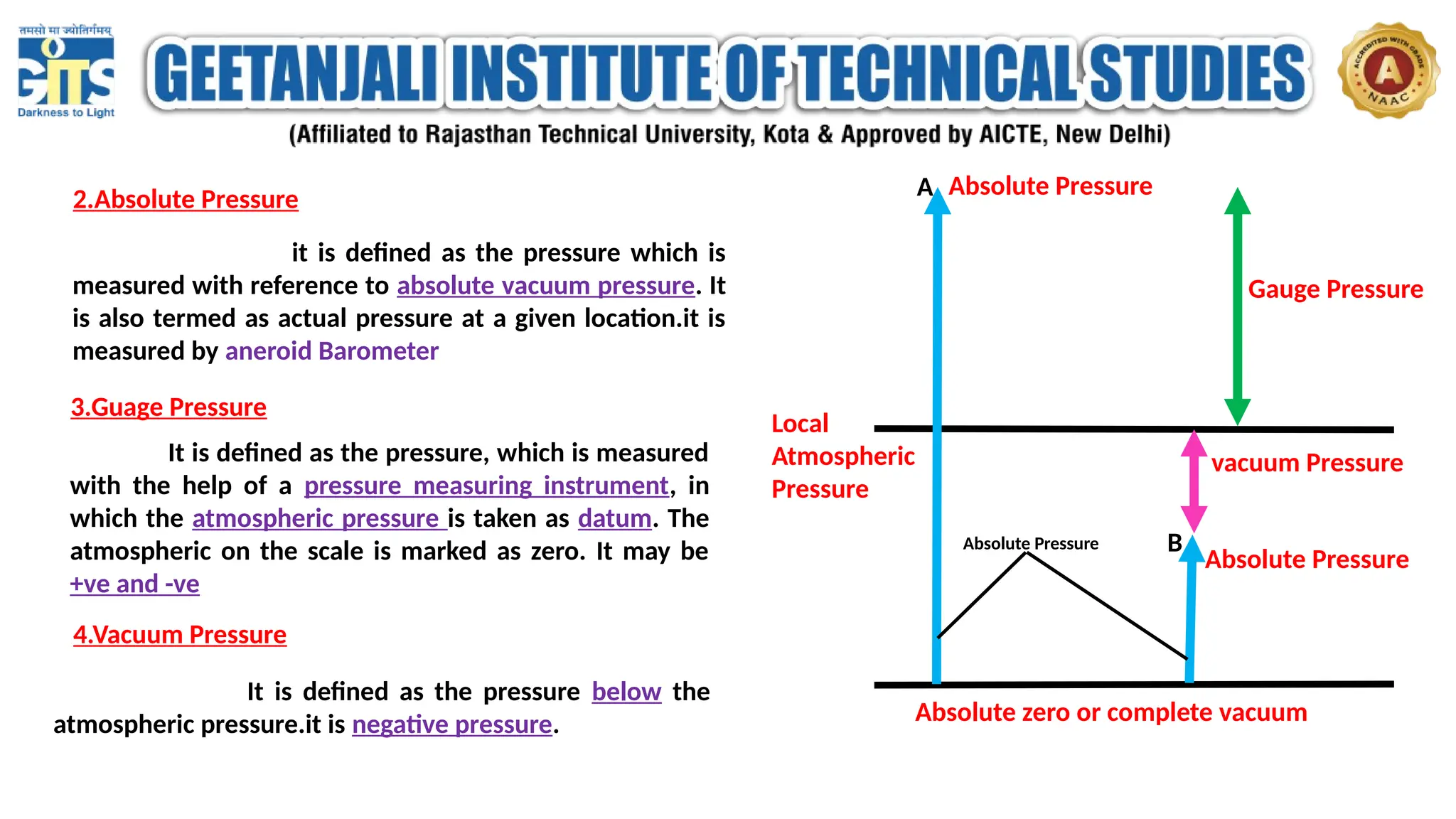
2.Absolute Pressure
it is defined as the pressure which is
measured with reference to absolute vacuum pressure. It
is also termed as actual pressure at a given location.it is
measured by aneroid Barometer
3.Guage Pressure
It is defined as the pressure, which is measured
with the help of a pressure measuring instrument, in
which the atmospheric pressure is taken as datum. The
atmospheric on the scale is marked as zero. It may be
+ve and -ve
4.Vacuum Pressure
It is defined as the pressure below the
atmospheric pressure.it is negative pressure. Absolute zero or complete vacuum
Local
Atmospheric
Pressure
Absolute Pressure
Absolute Pressure
Gauge Pressure
vacuum Pressure
A
B
Absolute Pressure
Absolute zero or complete vacuum
Absolute
Pressure
vacuum
Pressure
B
Absolute Pressure
Gauge Pressure
Absolute
Pressure
Local
Atmospheric
Pressure
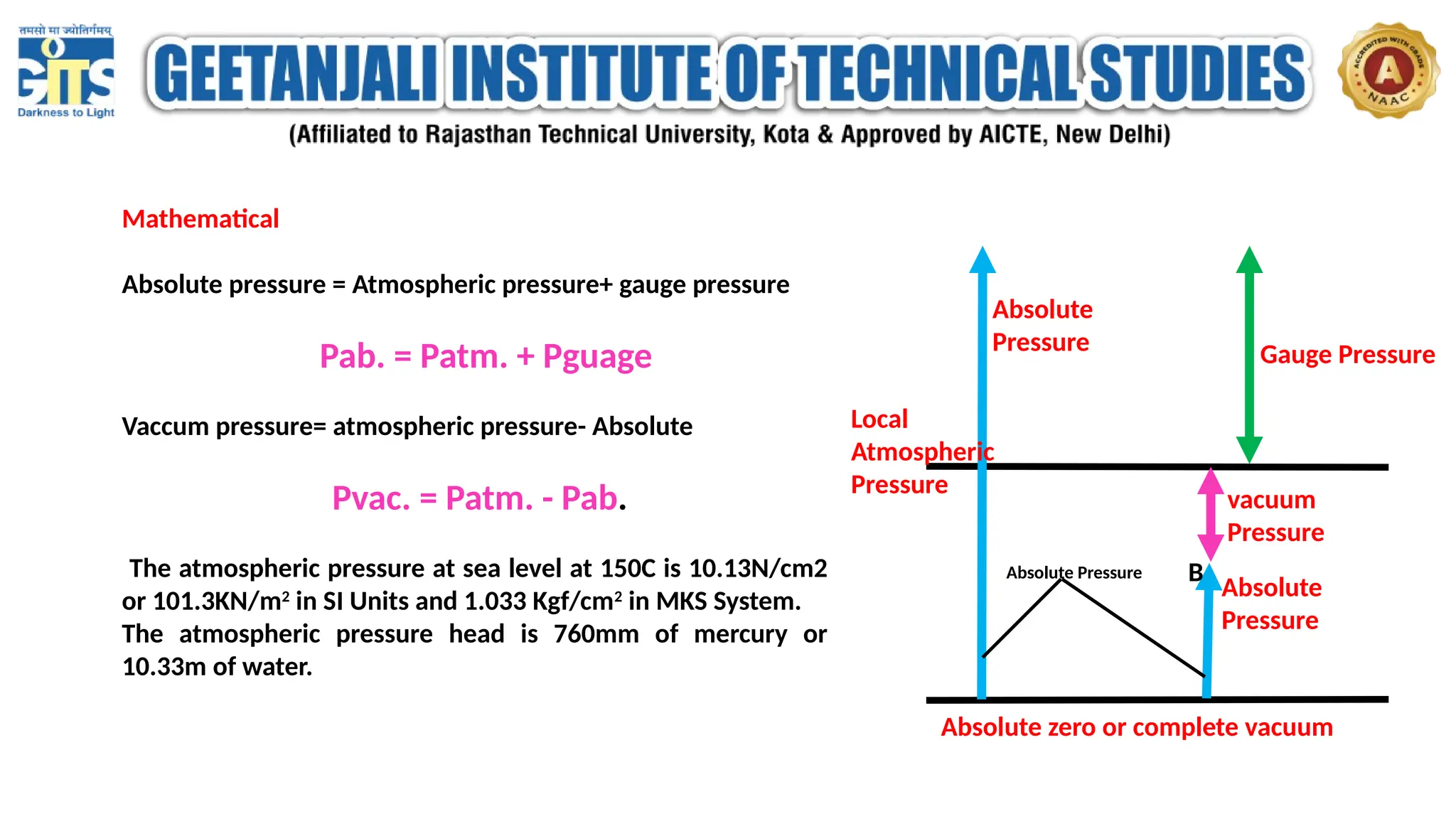
Mathematical
Absolute pressure = Atmospheric pressure+ gauge pressure
Pab. = Patm. + Pguage
Vaccum pressure= atmospheric pressure- Absolute
Pvac. = Patm. - Pab.
The atmospheric pressure at sea level at 150C is 10.13N/cm2
or 101.3KN/m2
in SI Units and 1.033 Kgf/cm2
in MKS System.
The atmospheric pressure head is 760mm of mercury or
10.33m of water.
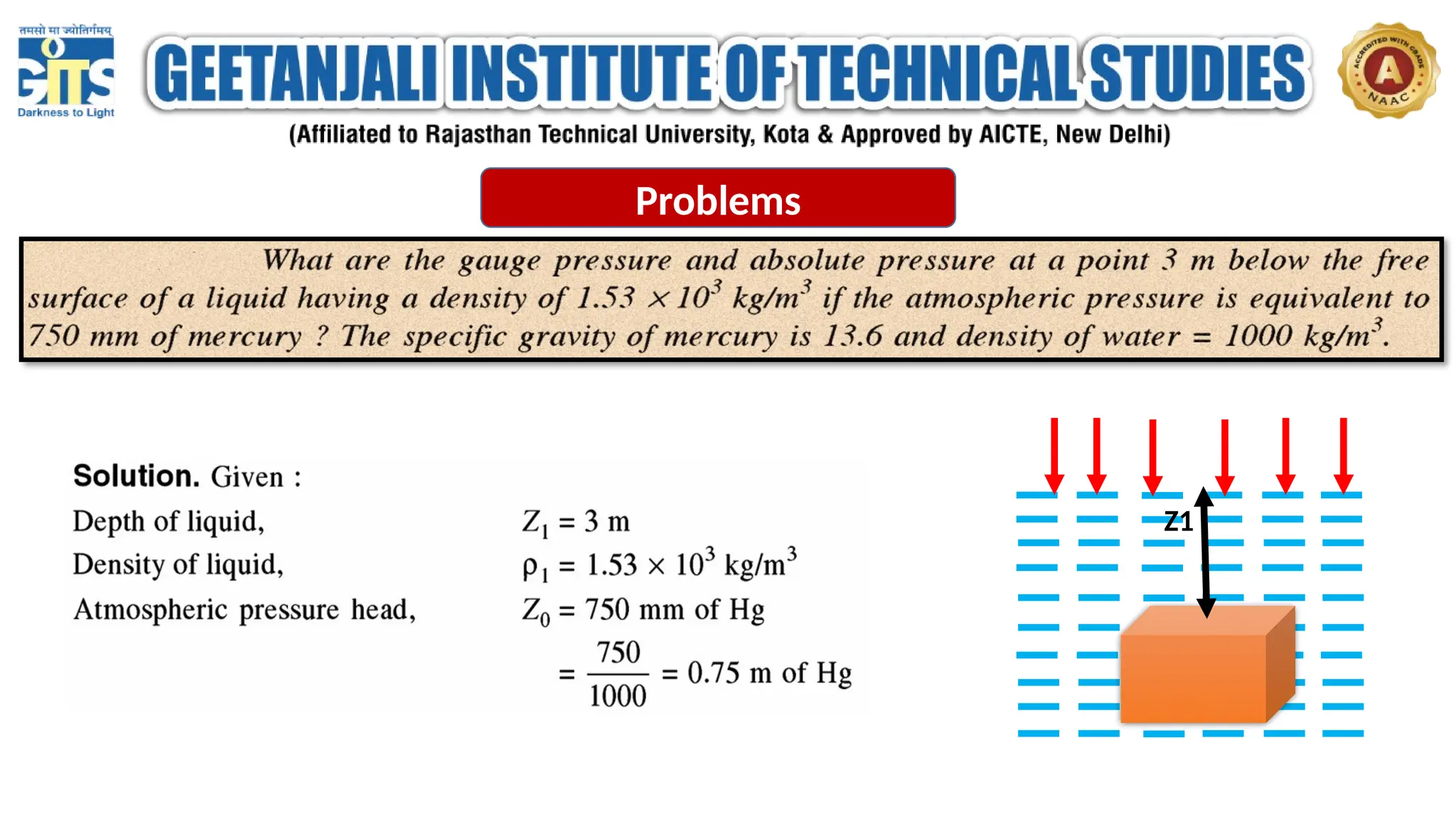
Problems
Z1
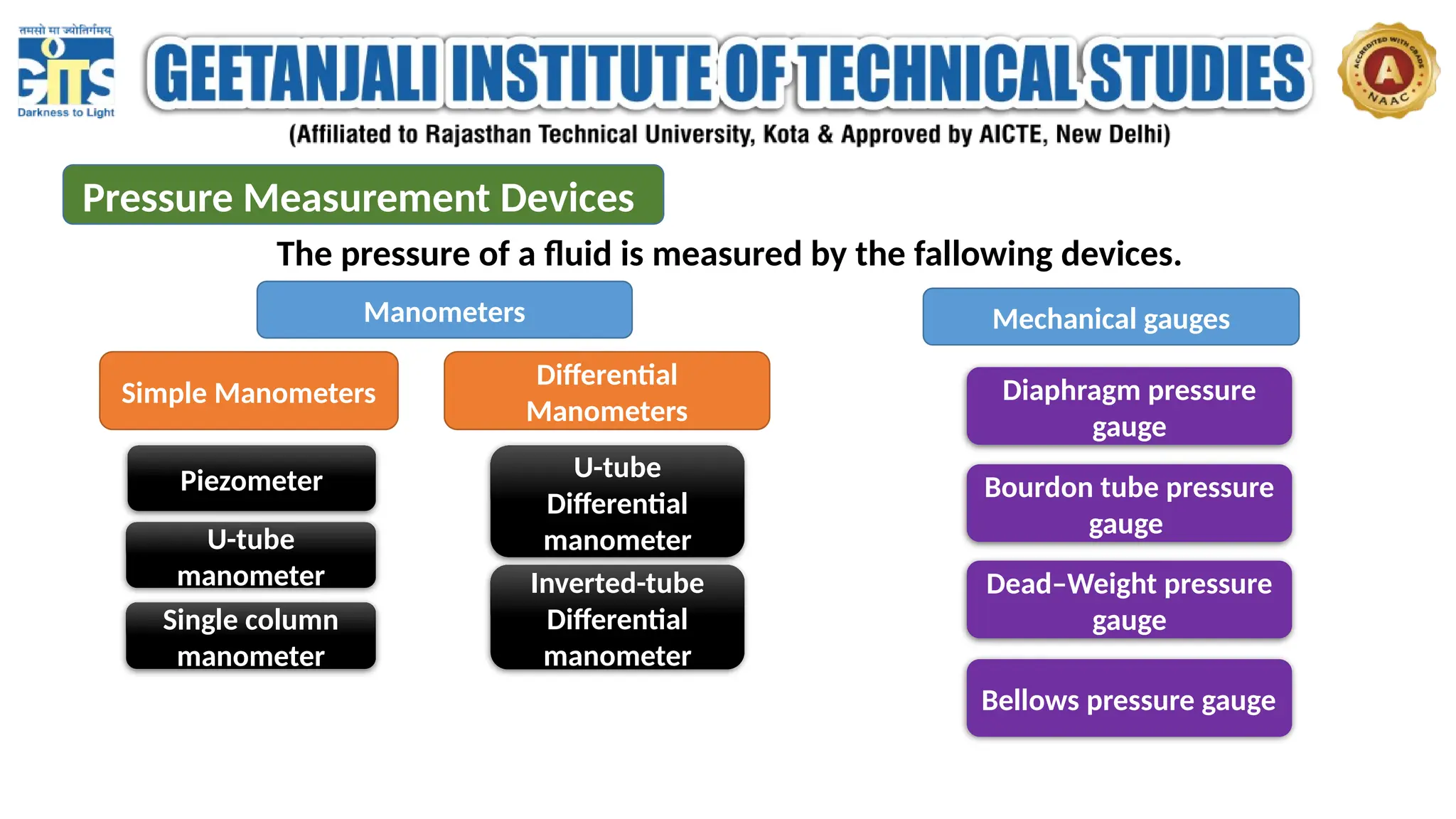
Pressure Measurement Devices
The pressure of a fluid is measured by the fallowing devices.
Manometers Mechanical gauges
Simple Manometers
Differential
Manometers
Piezometer
U-tube
manometer
Single column
manometer
U-tube
Differential
manometer
Inverted-tube
Differential
manometer
Diaphragm pressure
gauge
Bourdon tube pressure
gauge
Dead–Weight pressure
gauge
Bellows pressure gauge
Simple Manometers
A simple manometer consists of a glass tube having one of its ends connected to a point where
pressure is to be measured and the other end remains open to the atmosphere.
The common types of simple manometers are:
1. Piezometer
2. U-tube manometer (for gauge & vacuum pressure)
3. Single column manometer
a) Vertical Single column manometer
b) Inclined Single column manometer
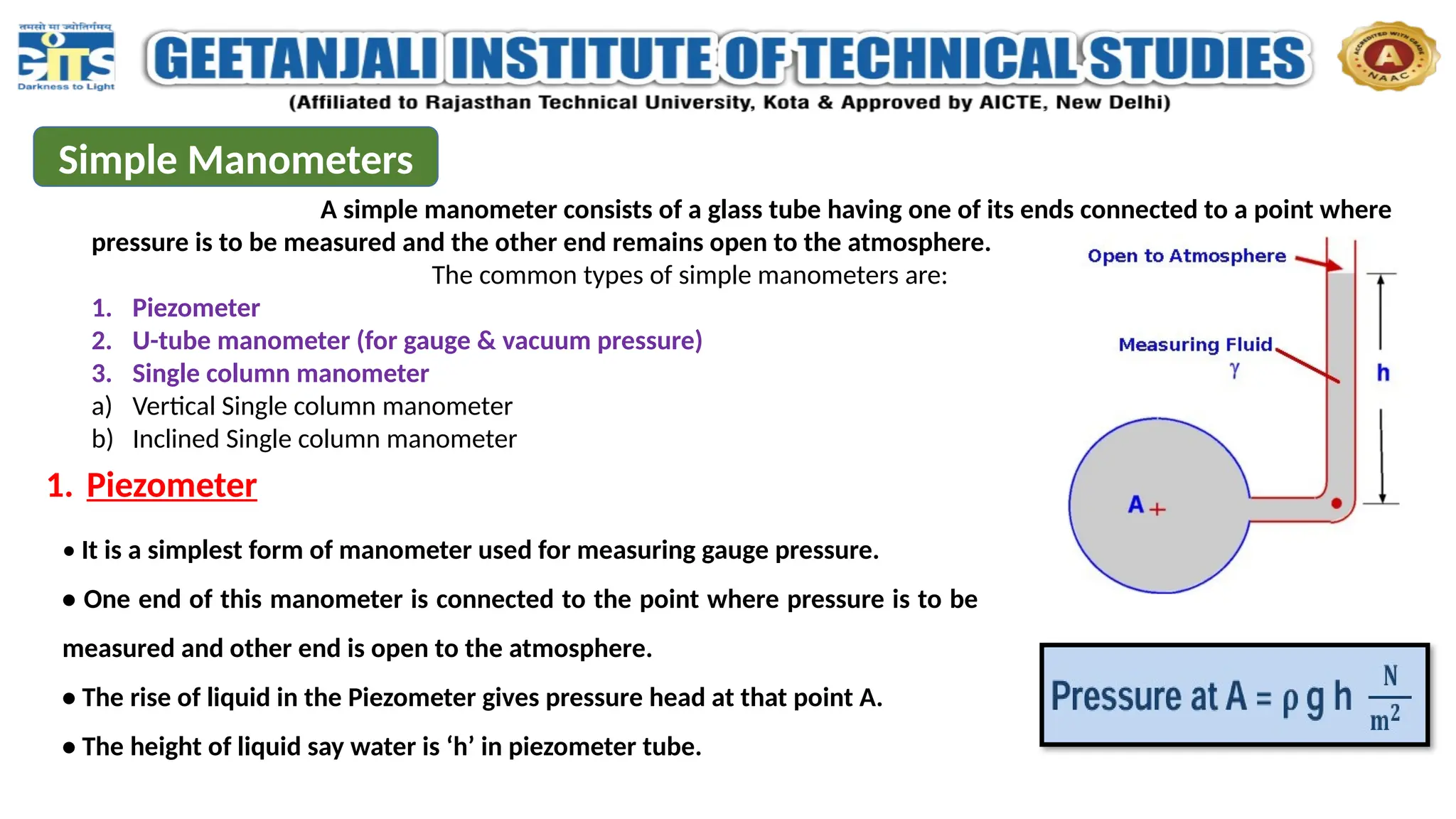
1. Piezometer
• It is a simplest form of manometer used for measuring gauge pressure.
• One end of this manometer is connected to the point where pressure is to be
measured and other end is open to the atmosphere.
• The rise of liquid in the Piezometer gives pressure head at that point A.
• The height of liquid say water is ‘h’ in piezometer tube.
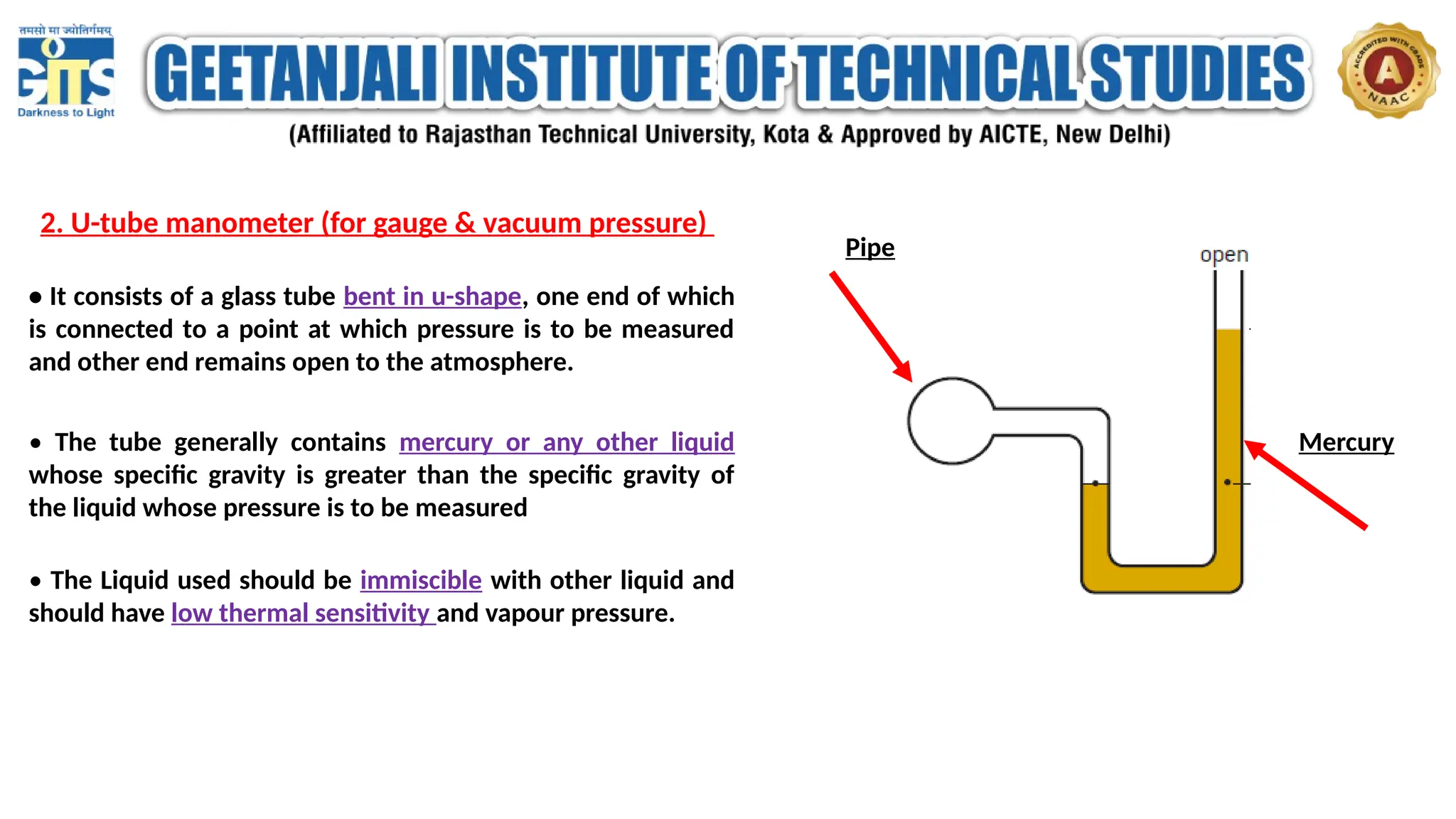
2. U-tube manometer (for gauge & vacuum pressure)
• It consists of a glass tube bent in u-shape, one end of which
is connected to a point at which pressure is to be measured
and other end remains open to the atmosphere.
• The tube generally contains mercury or any other liquid
whose specific gravity is greater than the specific gravity of
the liquid whose pressure is to be measured
• The Liquid used should be immiscible with other liquid and
should have low thermal sensitivity and vapour pressure.
Pipe
Mercury
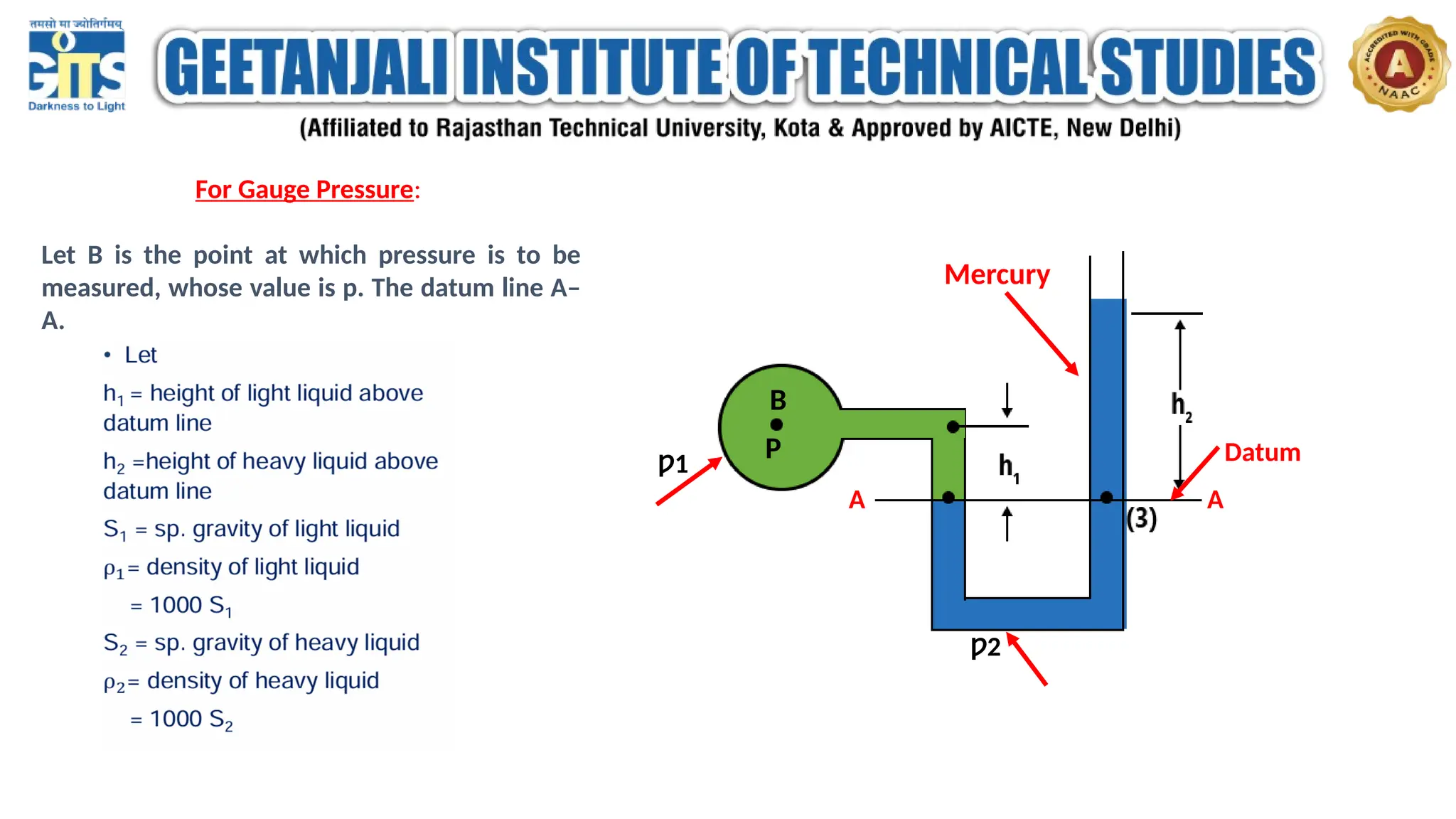
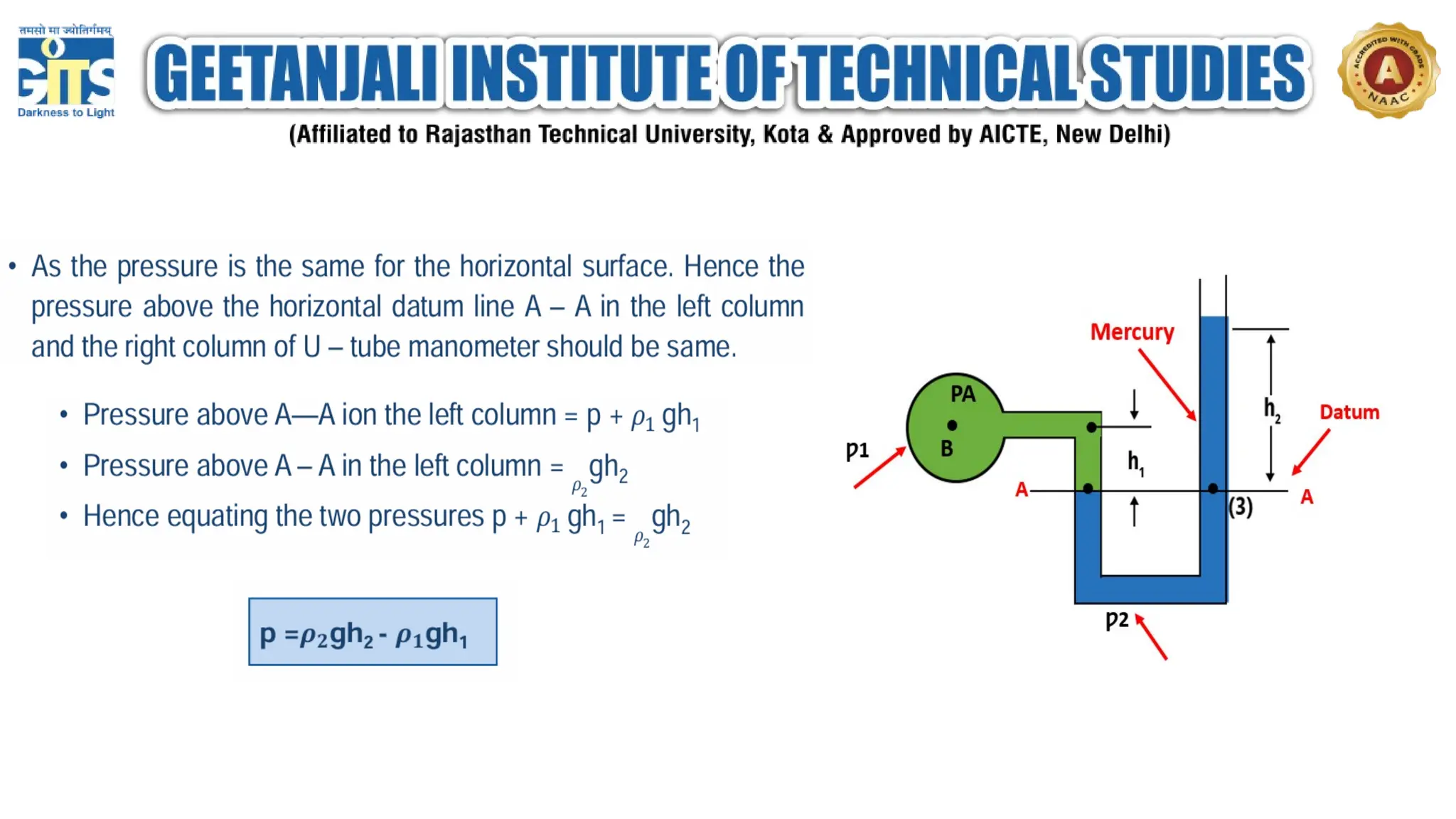
For Gauge Pressure:
Let B is the point at which pressure is to be
measured, whose value is p. The datum line A–
A.
Datum
A
A
B
P
Mercury
Ƿ1
Ƿ2
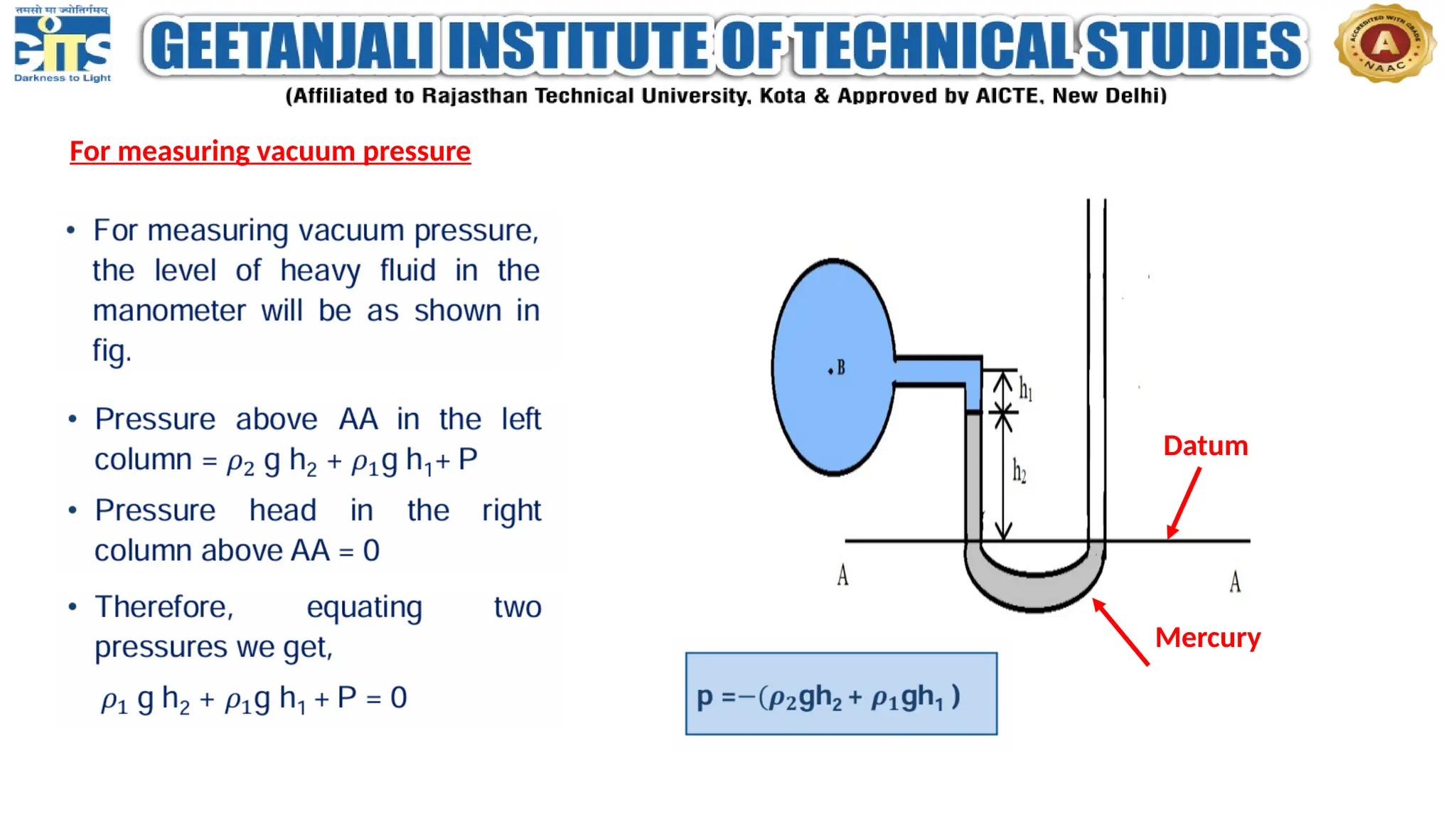
For measuring vacuum pressure
Datum
Mercury
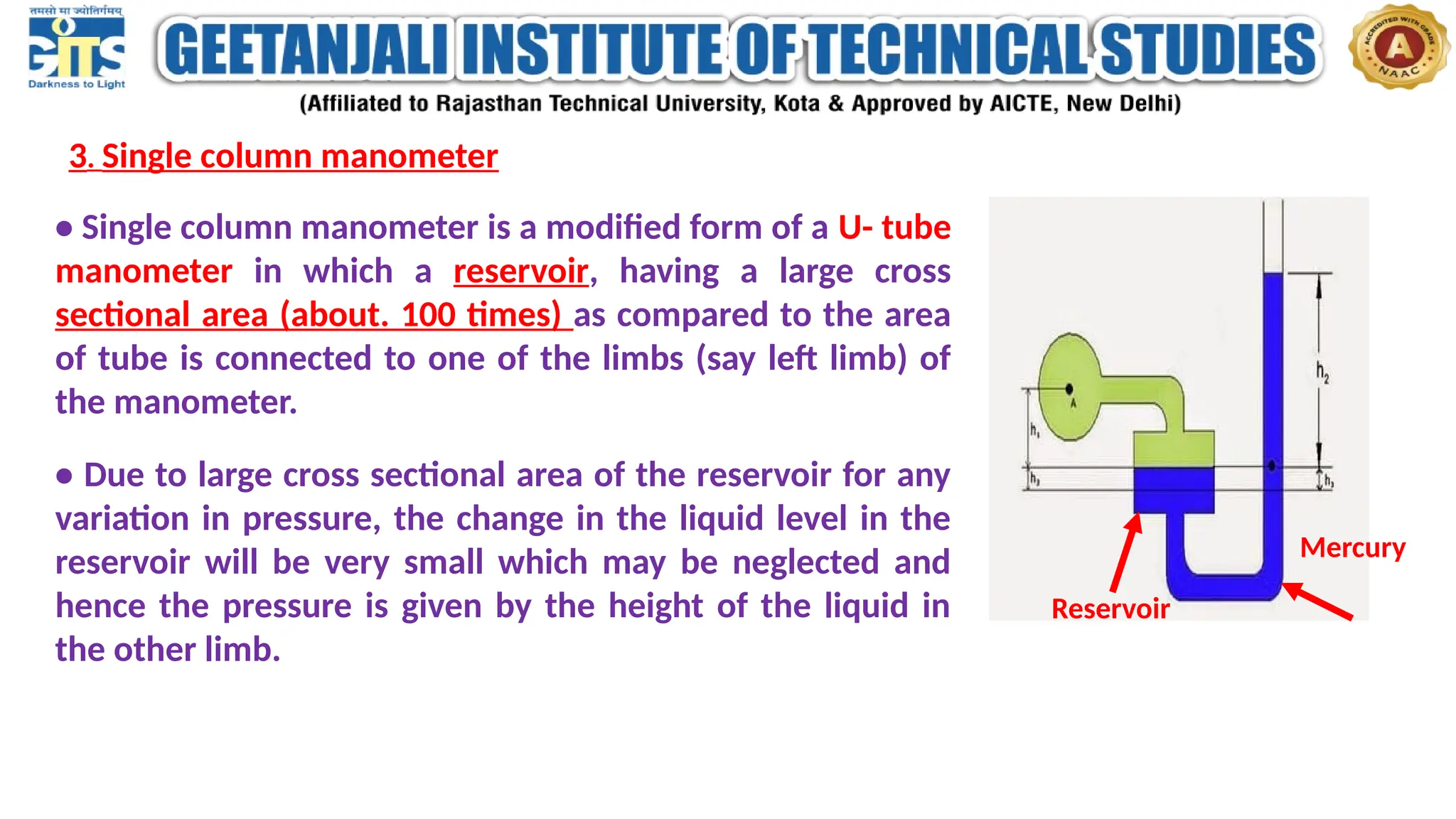
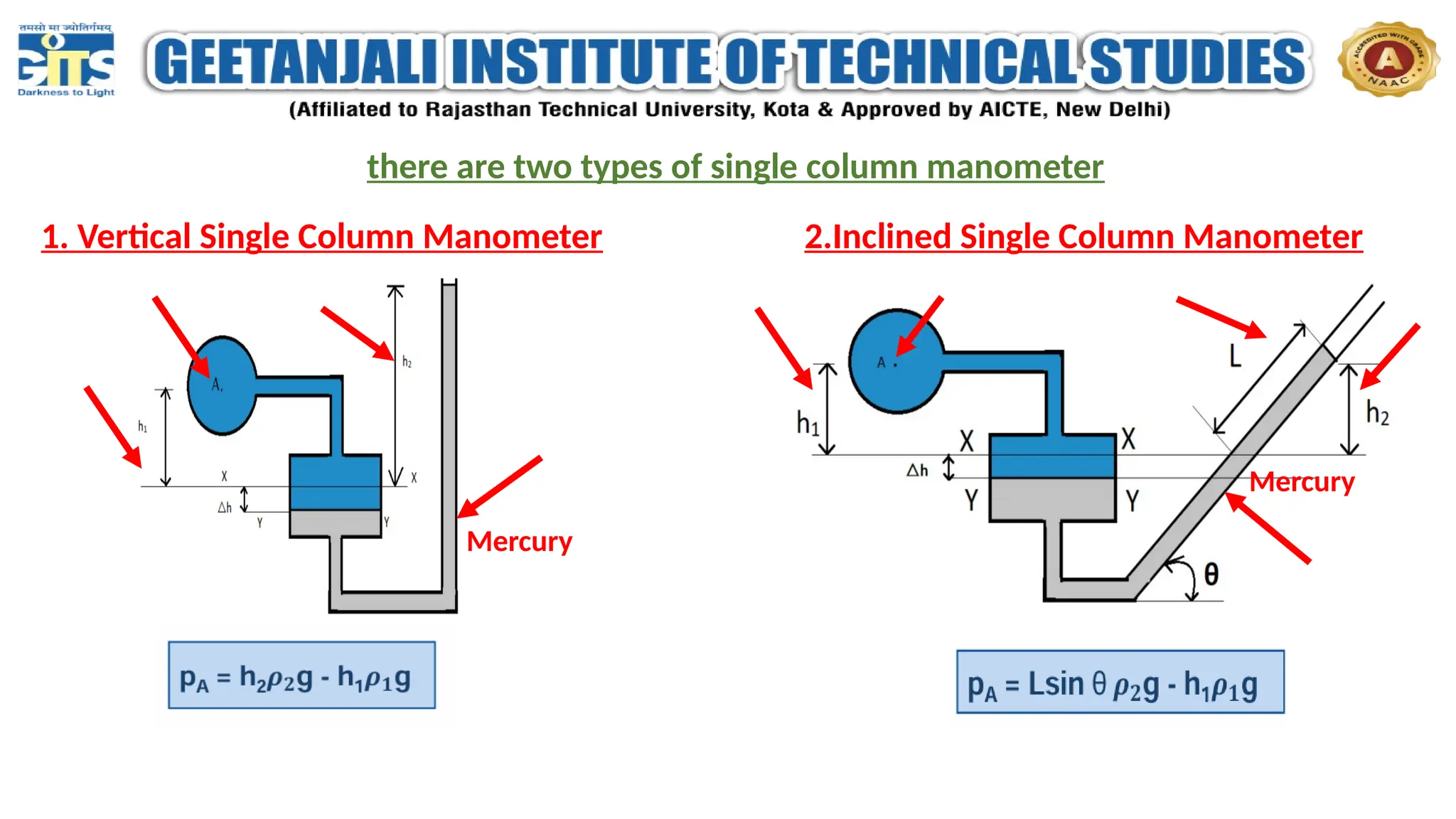
3. Single column manometer
• Single column manometer is a modified form of a U- tube
manometer in which a reservoir, having a large cross
sectional area (about. 100 times) as compared to the area
of tube is connected to one of the limbs (say left limb) of
the manometer.
• Due to large cross sectional area of the reservoir for any
variation in pressure, the change in the liquid level in the
reservoir will be very small which may be neglected and
hence the pressure is given by the height of the liquid in
the other limb.
Mercury
Reservoir
there are two types of single column manometer
1. Vertical Single Column Manometer 2.Inclined Single Column Manometer
Mercury
Mercury
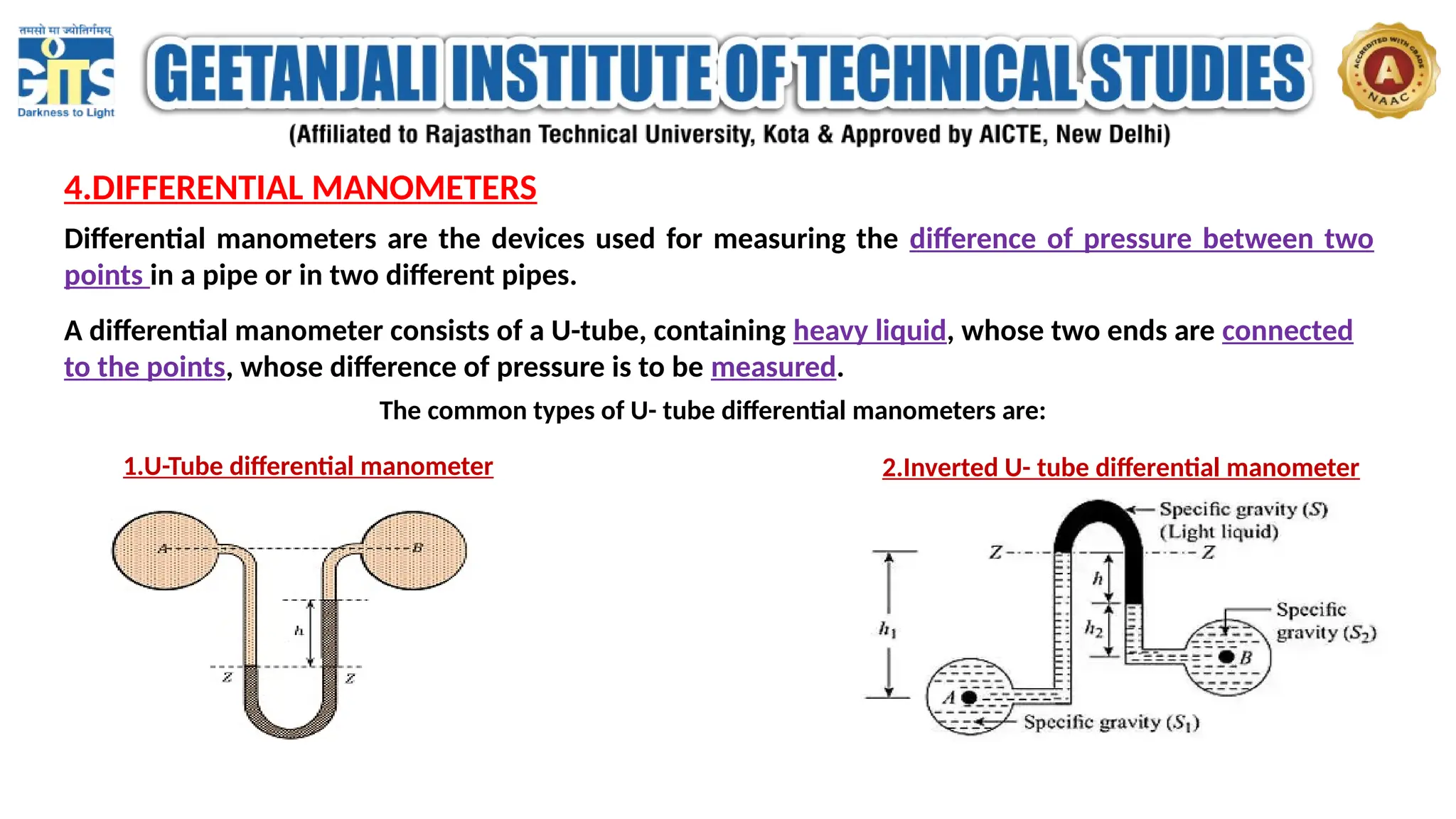
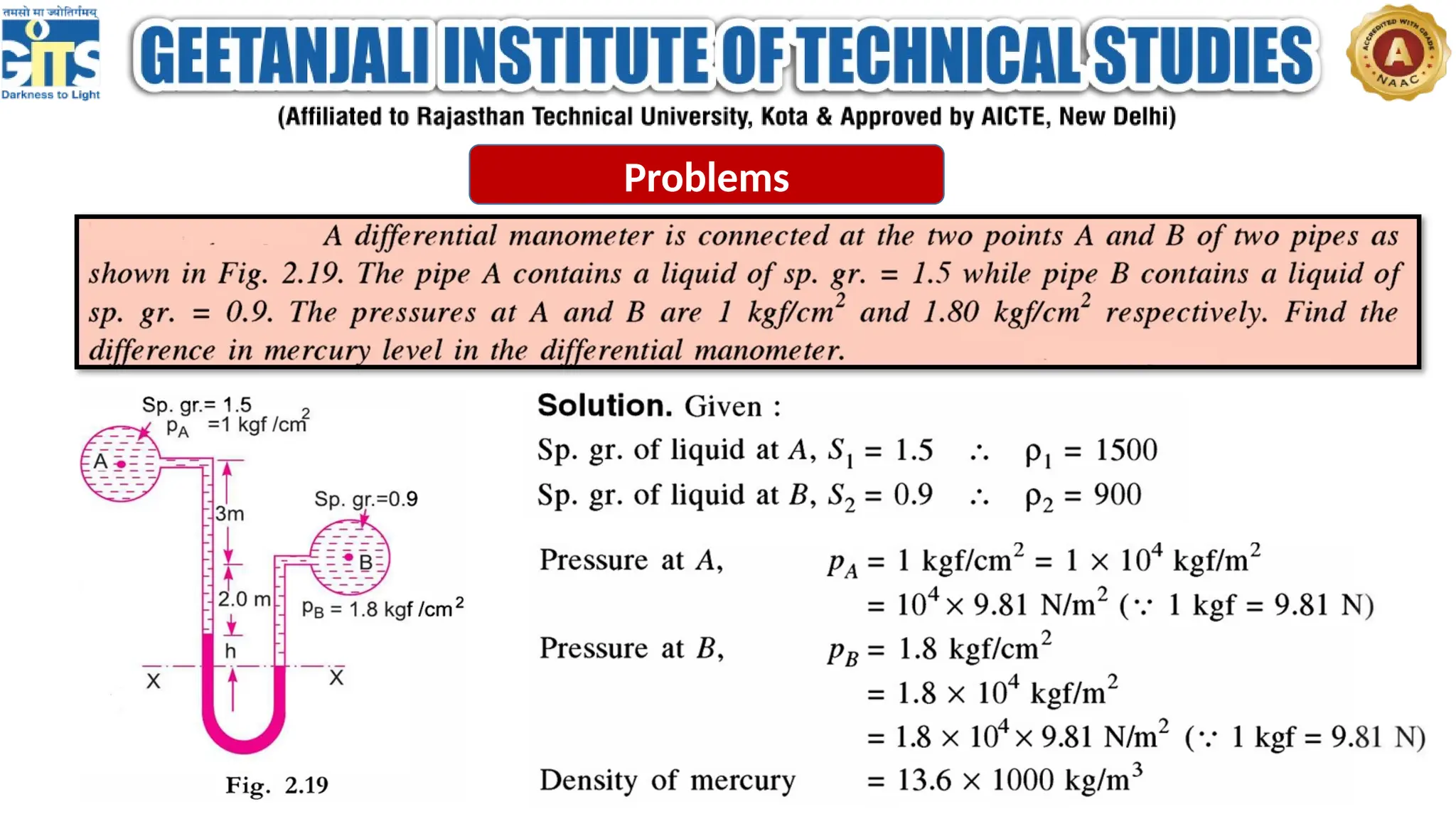
4.DIFFERENTIAL MANOMETERS
Differential manometers are the devices used for measuring the difference of pressure between two
points in a pipe or in two different pipes.
A differential manometer consists of a U-tube, containing heavy liquid, whose two ends are connected
to the points, whose difference of pressure is to be measured.
The common types of U- tube differential manometers are:
1.U-Tube differential manometer 2.Inverted U- tube differential manometer
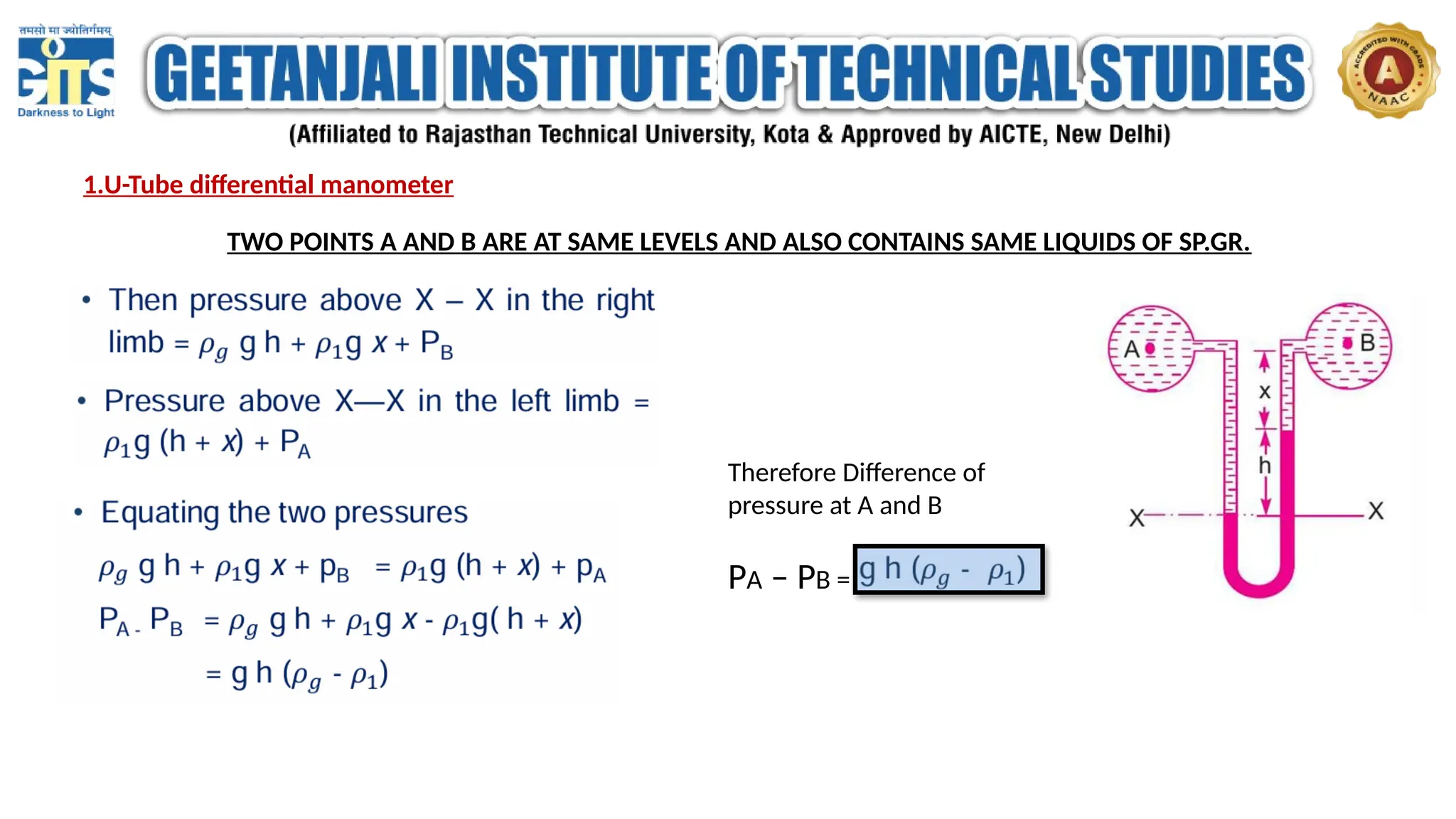
1.U-Tube differential manometer
TWO POINTS A AND B ARE AT SAME LEVELS AND ALSO CONTAINS SAME LIQUIDS OF SP.GR.
Therefore Difference of
pressure at A and B
PA – PB =
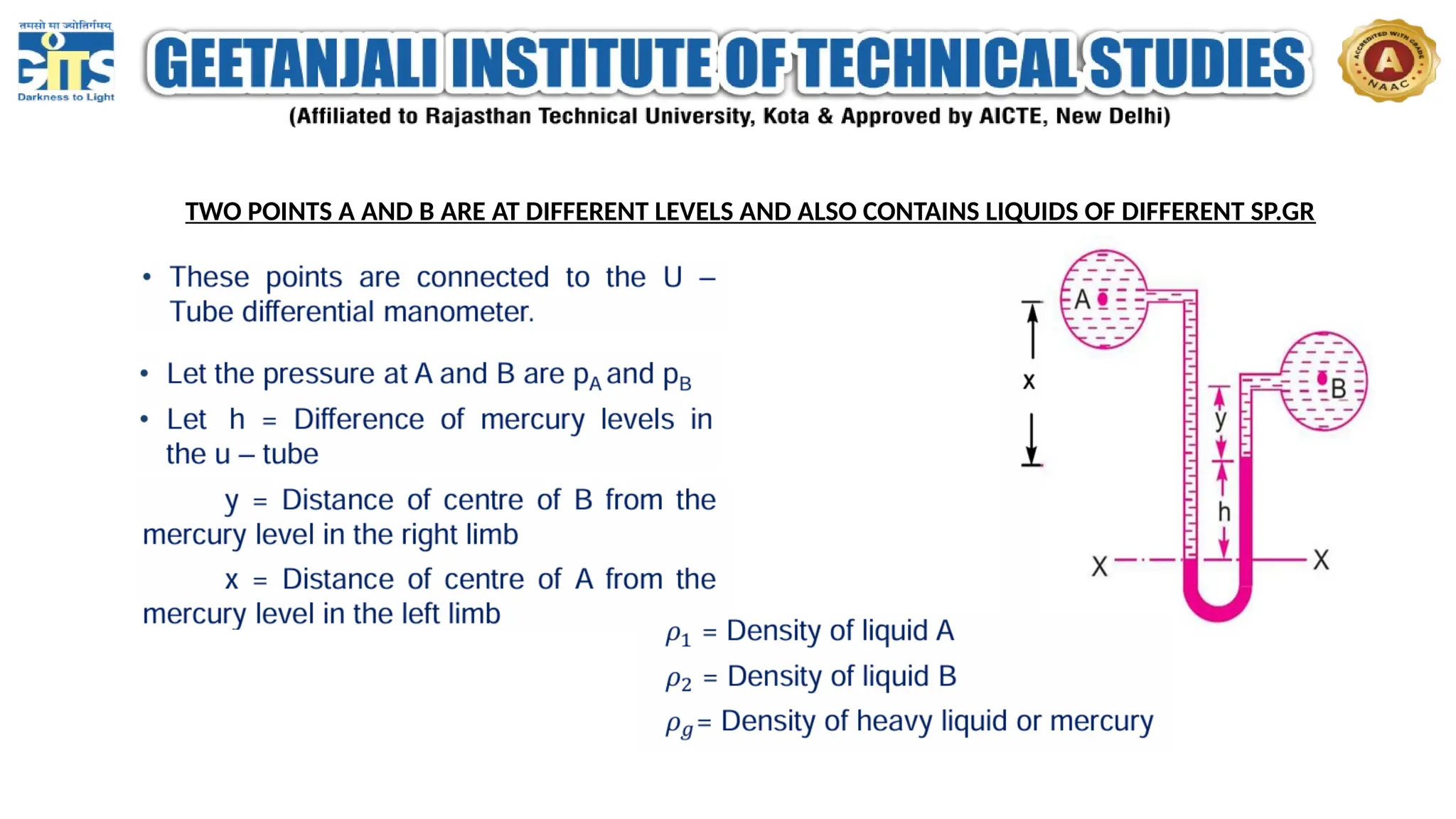
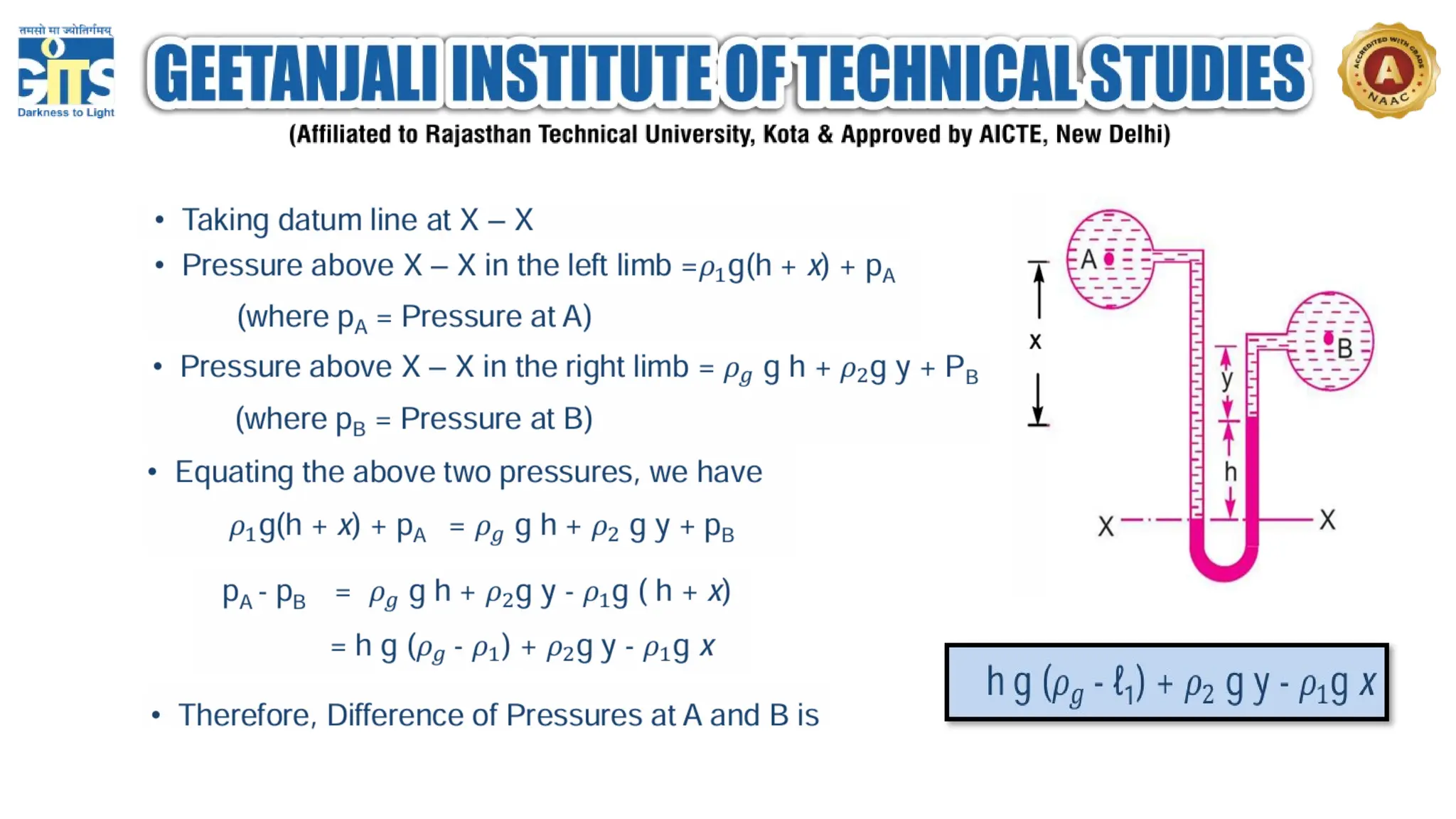
TWO POINTS A AND B ARE AT DIFFERENT LEVELS AND ALSO CONTAINS LIQUIDS OF DIFFERENT SP.GR
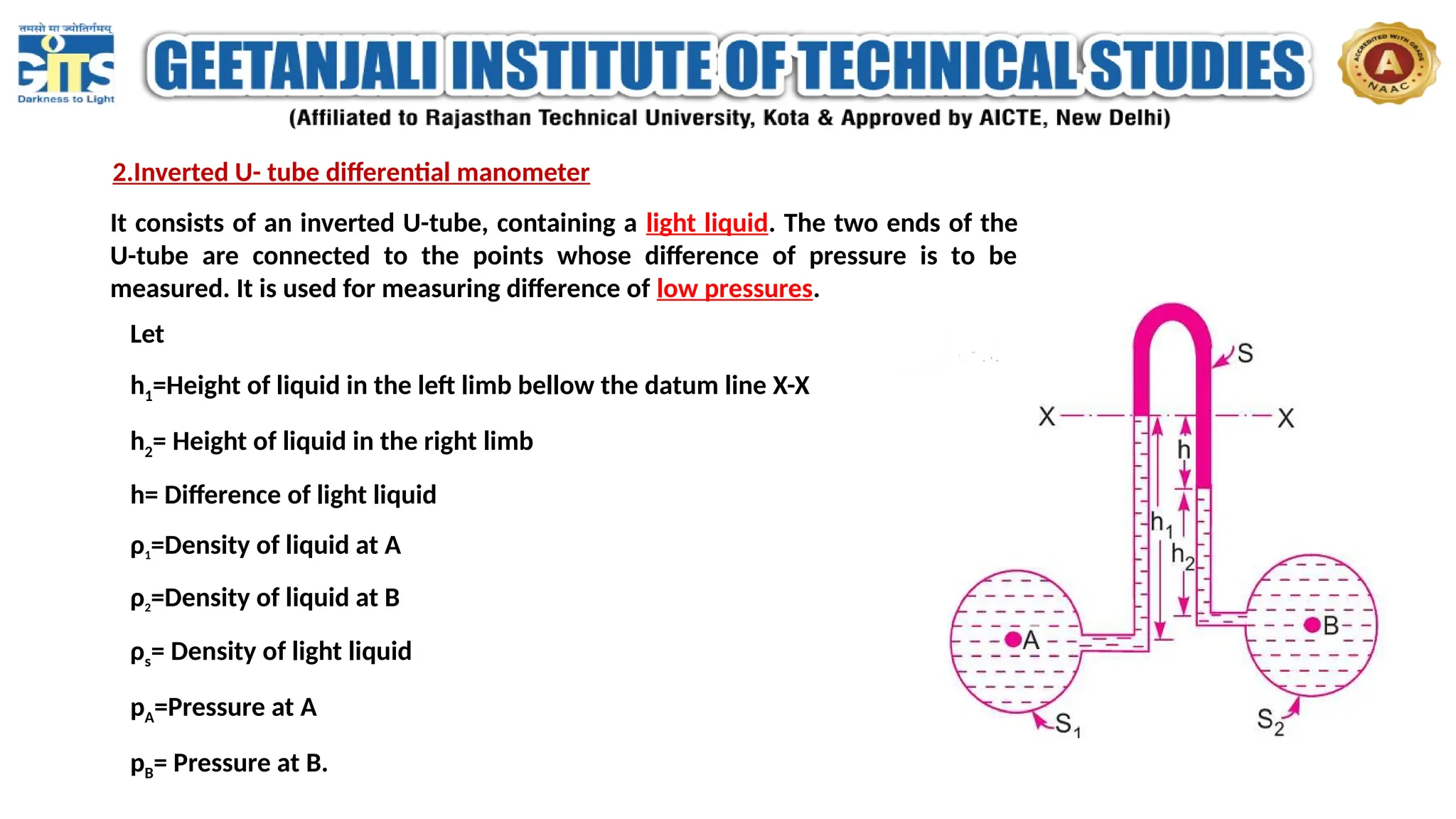
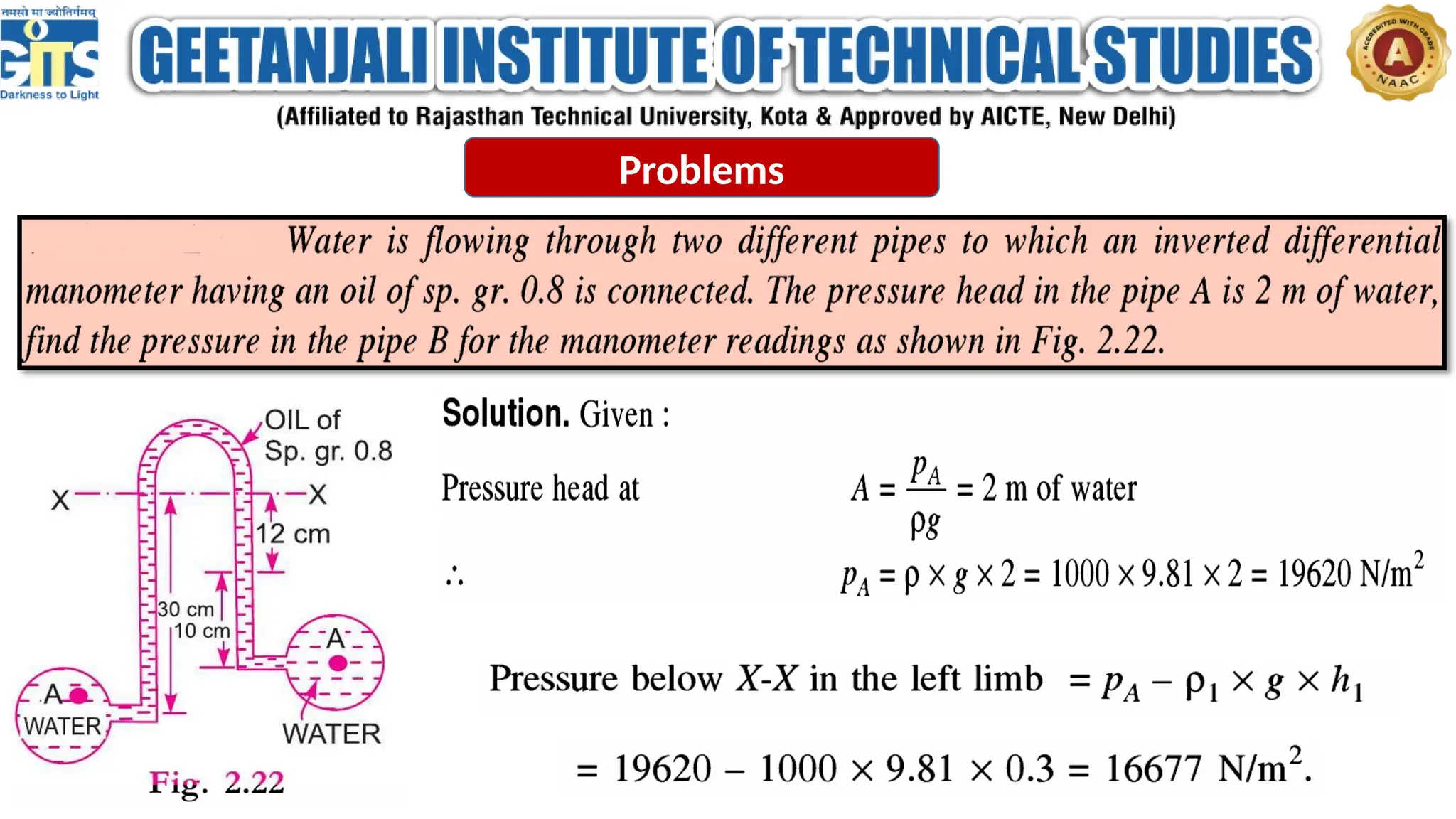
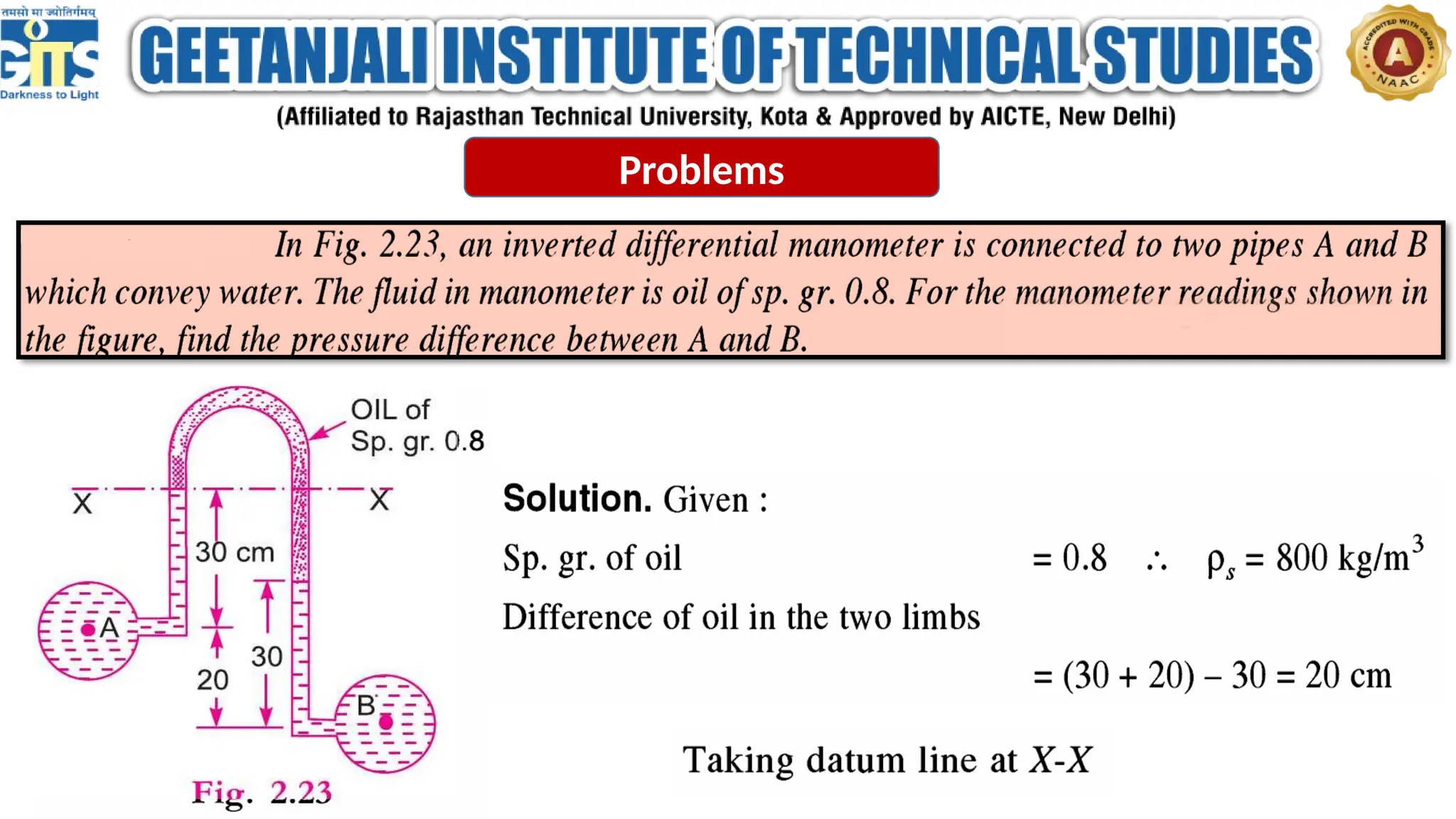
2.Inverted U- tube differential manometer
It consists of an inverted U-tube, containing a light liquid. The two ends of the
U-tube are connected to the points whose difference of pressure is to be
measured. It is used for measuring difference of low pressures.
Let
h1=Height of liquid in the left limb bellow the datum line X-X
h2= Height of liquid in the right limb
h= Difference of light liquid
ρ1=Density of liquid at A
ρ2=Density of liquid at B
ρs= Density of light liquid
pA=Pressure at A
pB= Pressure at B.
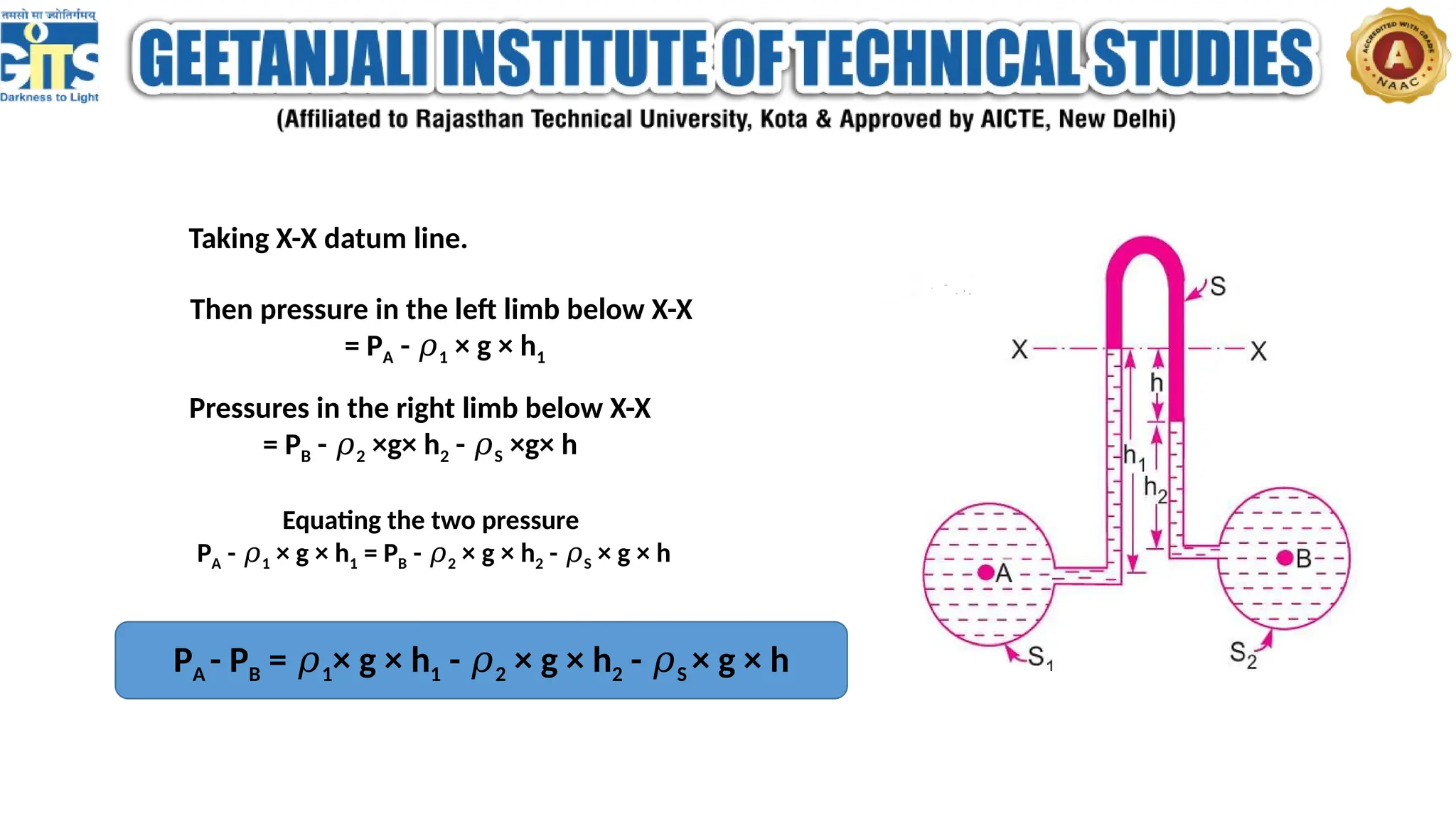
Taking X-X datum line.
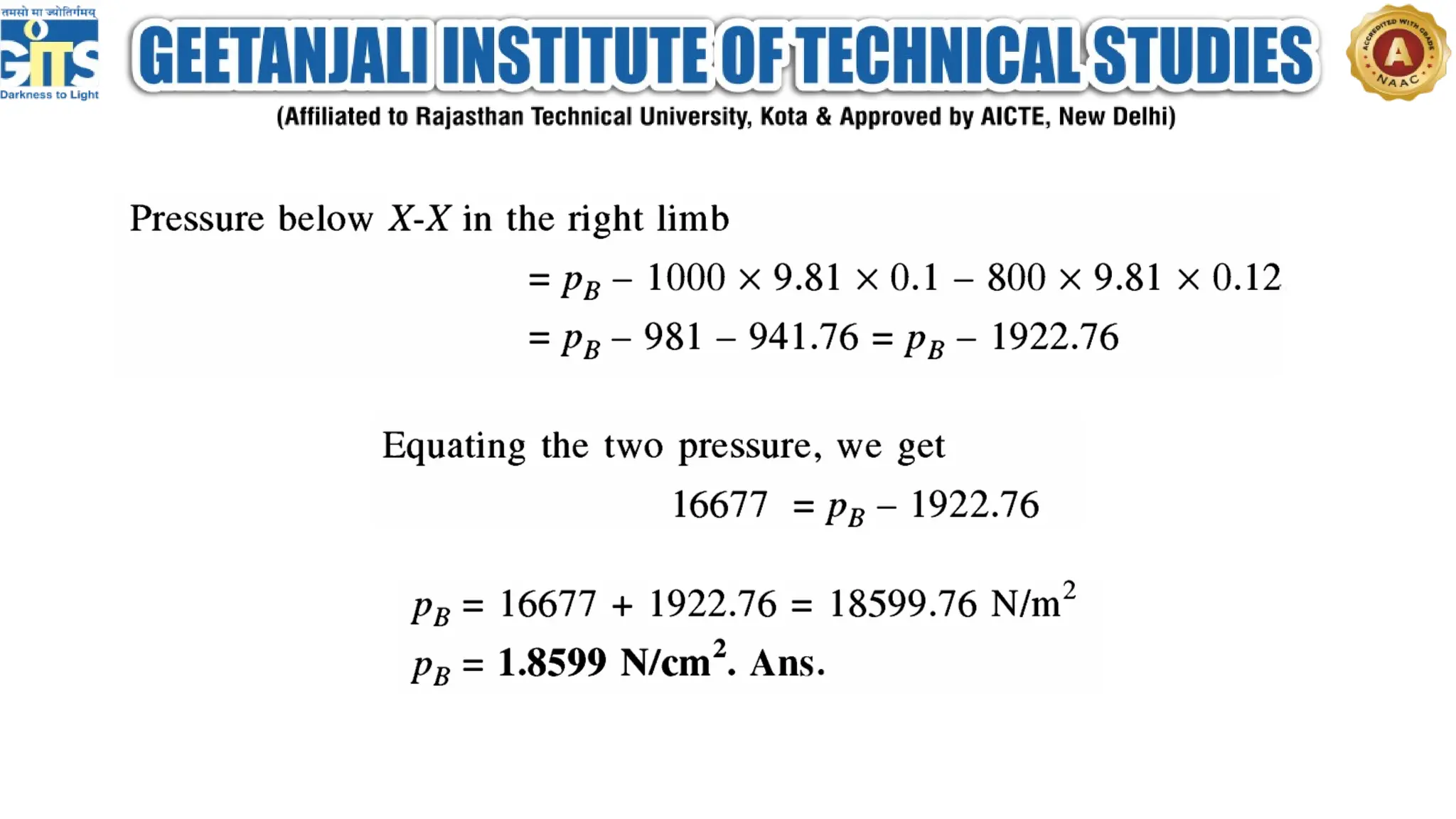
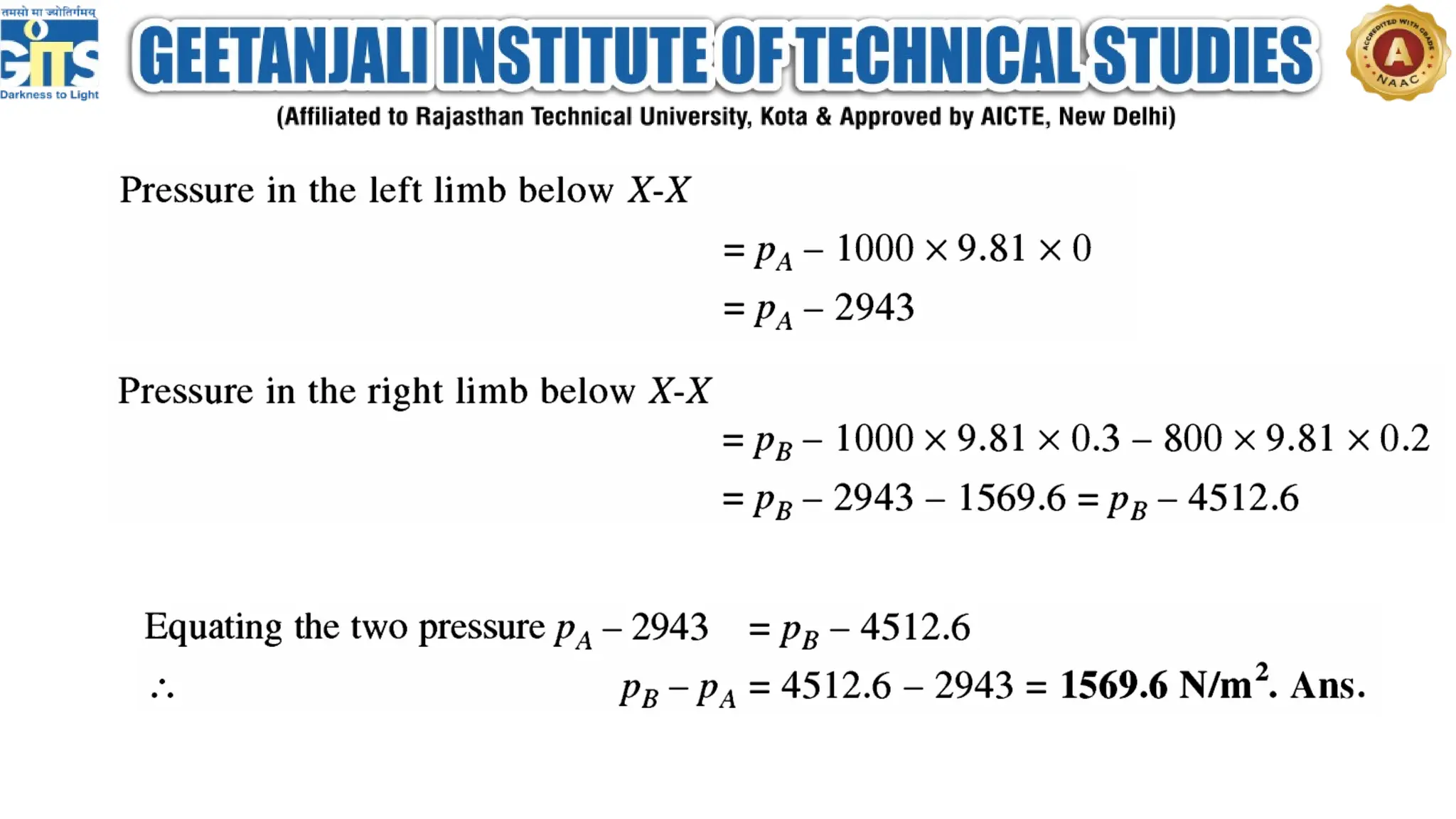
Then pressure in the left limb below X-X
= PA - 𝜌1 × g × h1
Pressures in the right limb below X-X
= PB - 𝜌2 ×g× h2 - 𝜌S ×g× h
Equating the two pressure
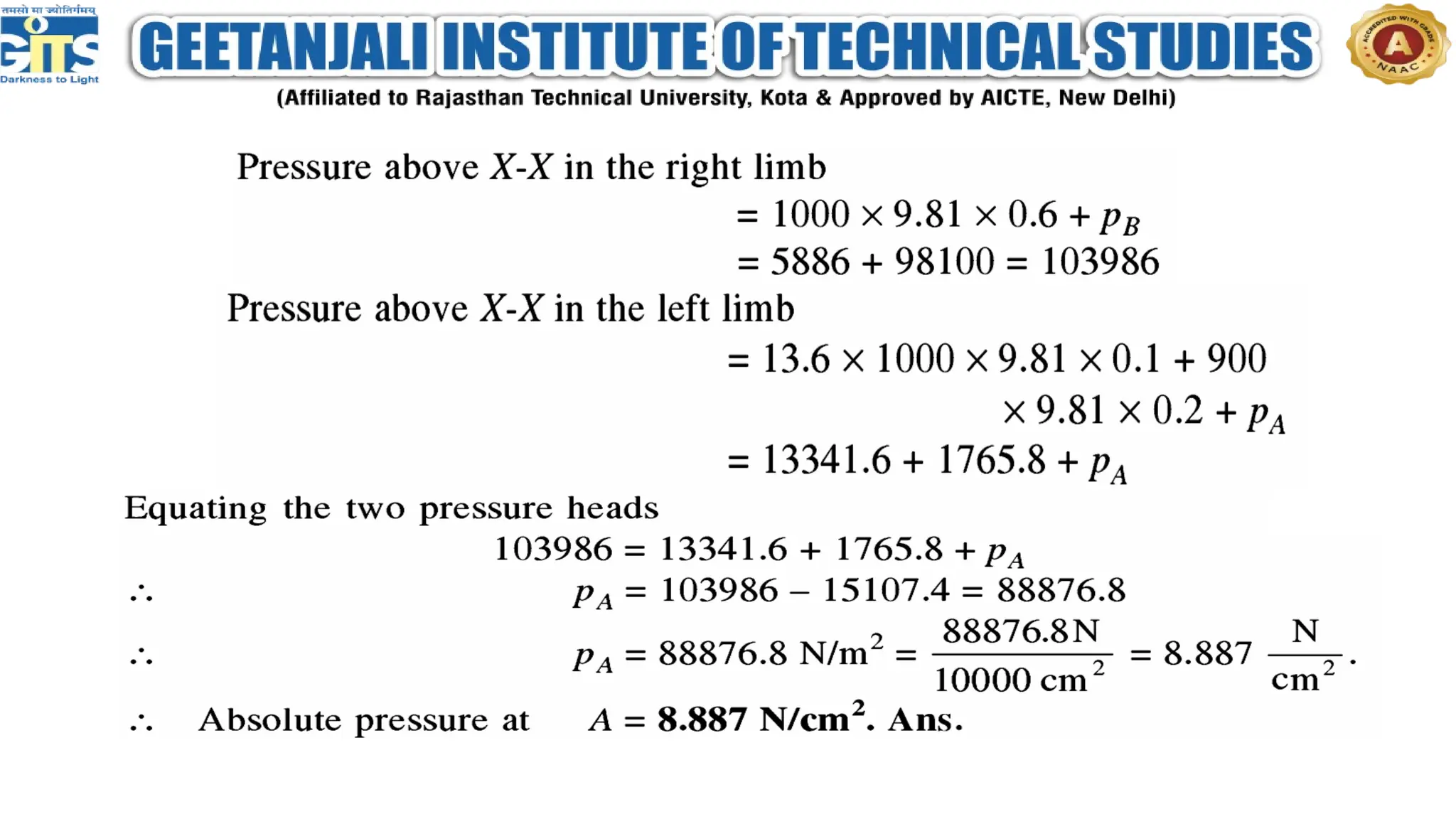
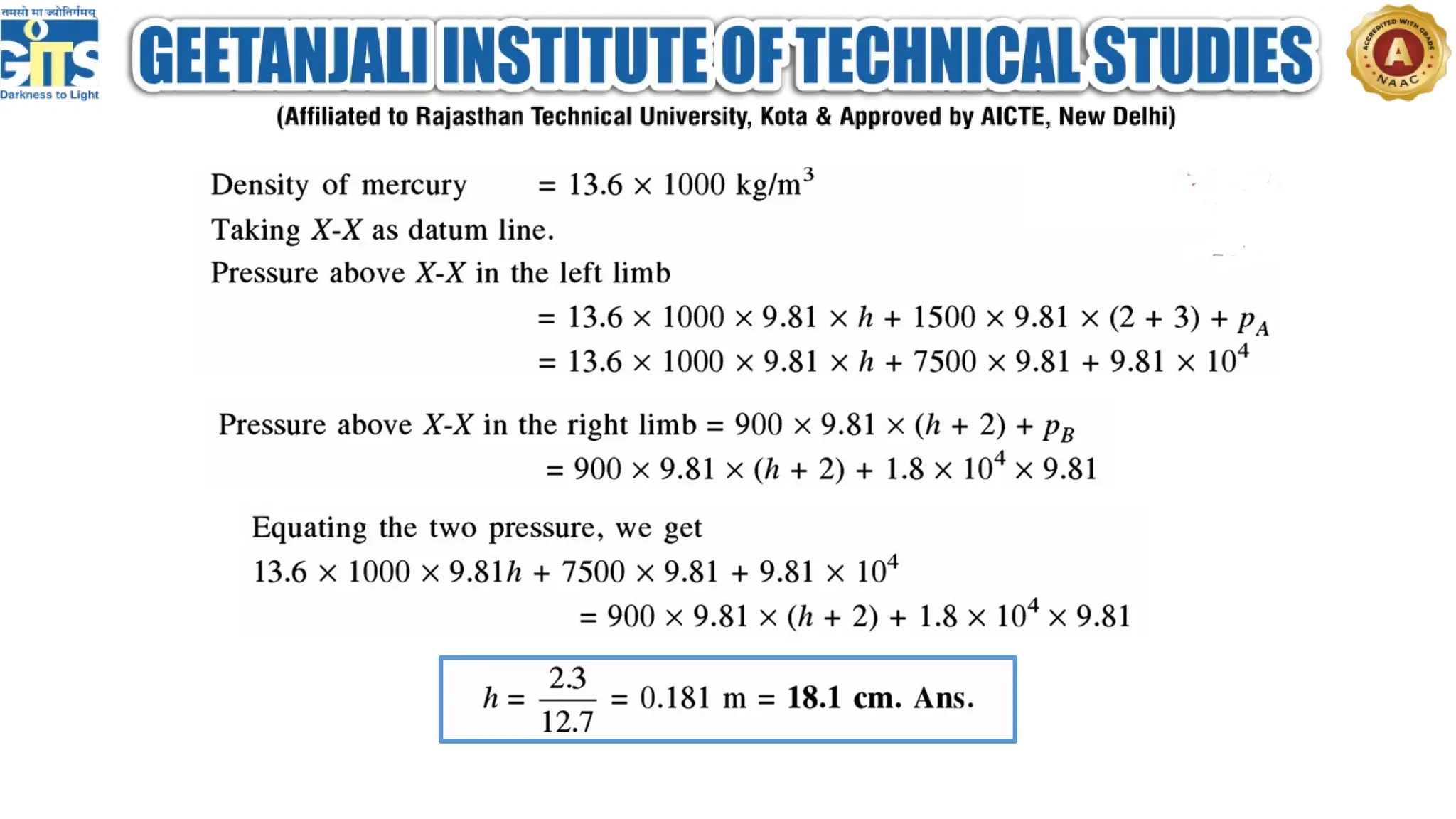
PA - 𝜌1 × g × h1 = PB - 𝜌2 × g × h2 - 𝜌S × g × h
PA - PB = 𝜌1× g × h1 - 𝜌2 × g × h2 - 𝜌S × g × h
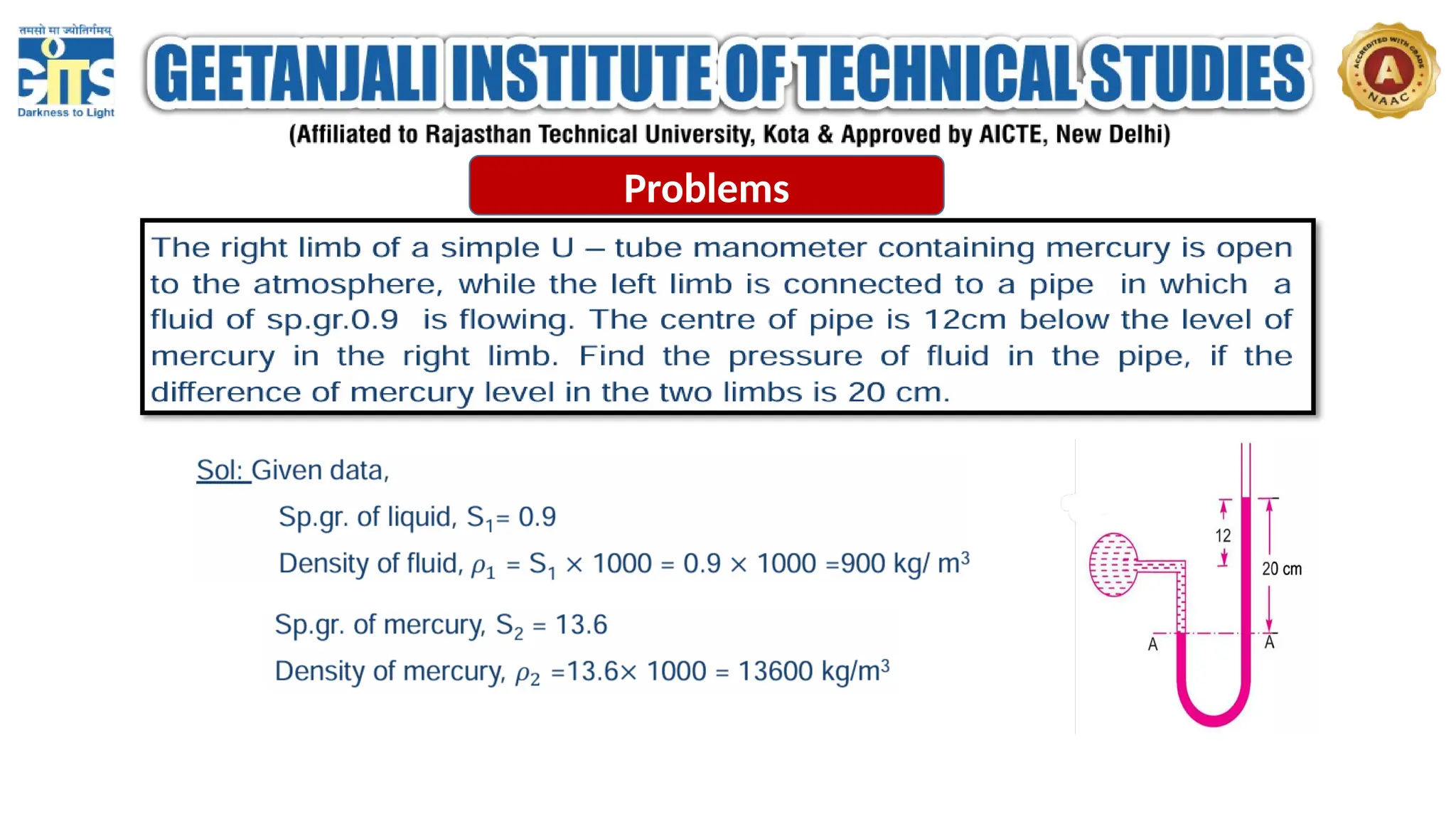
Problems
Problems
Problems
Problems
Problems
Problems
Problems
Buoyancy
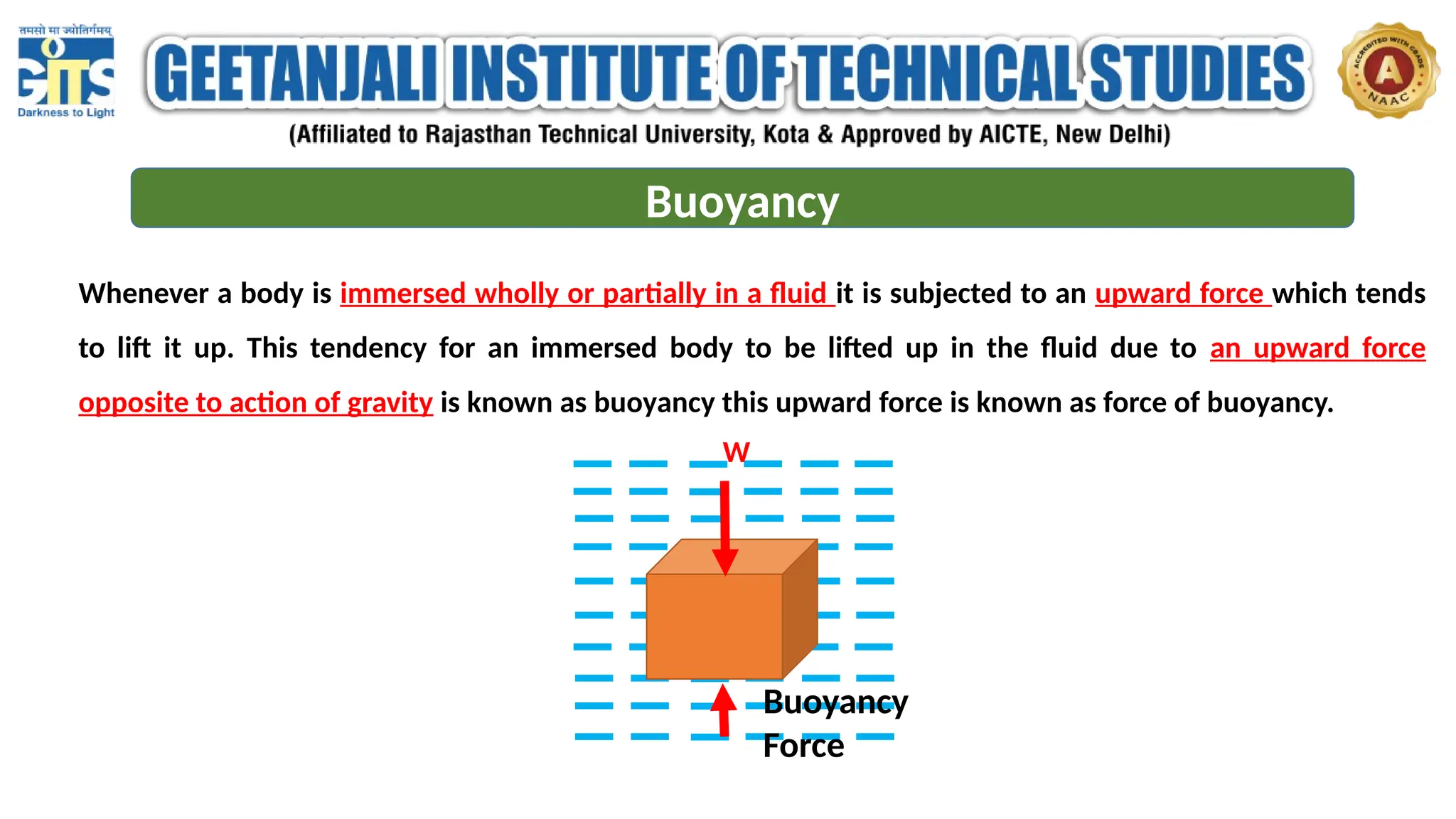
Whenever a body is immersed wholly or partially in a fluid it is subjected to an upward force which tends
to lift it up. This tendency for an immersed body to be lifted up in the fluid due to an upward force
opposite to action of gravity is known as buoyancy this upward force is known as force of buoyancy.
W
Buoyancy
Force
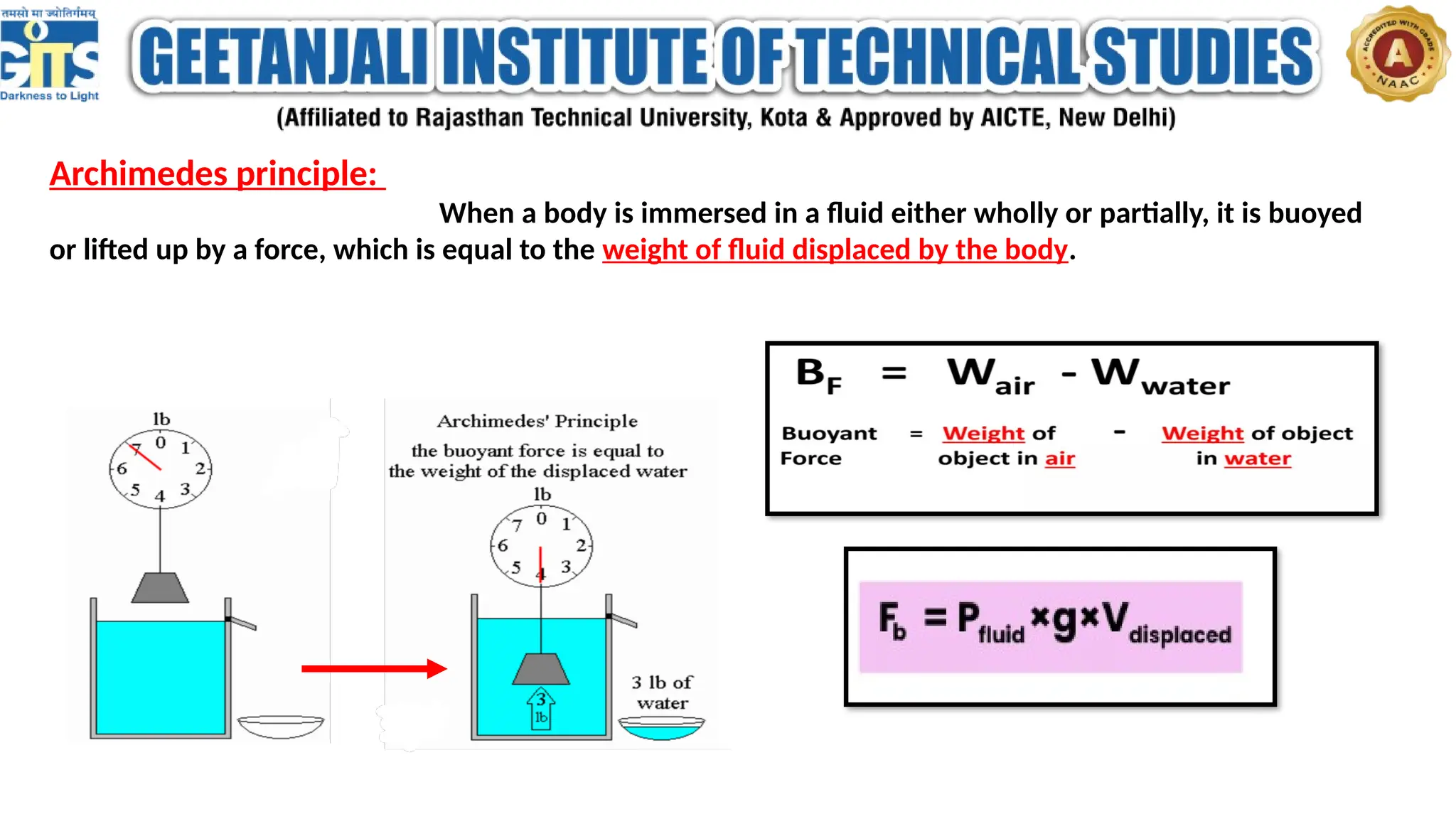
Archimedes principle:
When a body is immersed in a fluid either wholly or partially, it is buoyed
or lifted up by a force, which is equal to the weight of fluid displaced by the body.
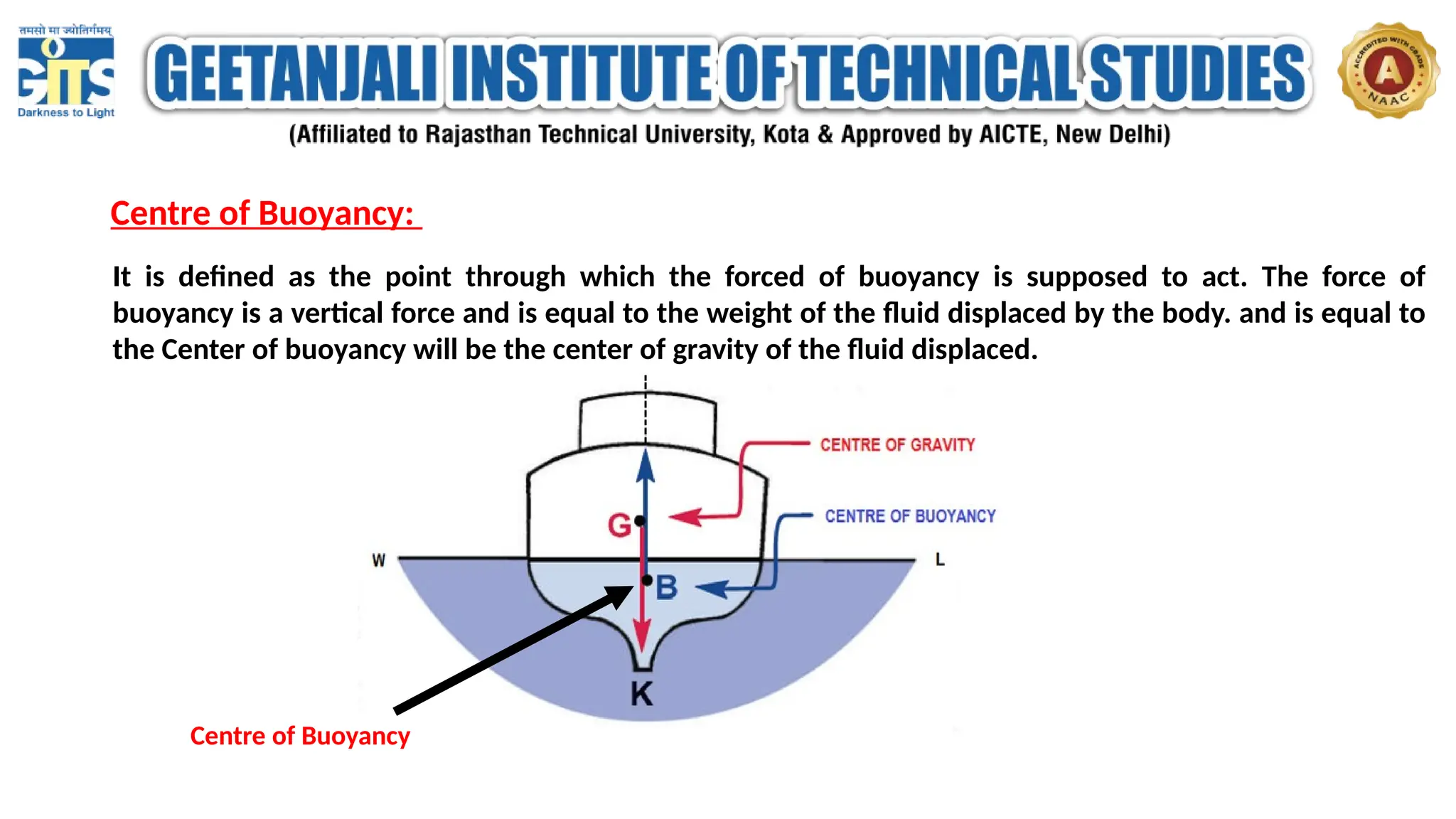
It is defined as the point through which the forced of buoyancy is supposed to act. The force of
buoyancy is a vertical force and is equal to the weight of the fluid displaced by the body. and is equal to
the Center of buoyancy will be the center of gravity of the fluid displaced.
Centre of Buoyancy:
Centre of Buoyancy
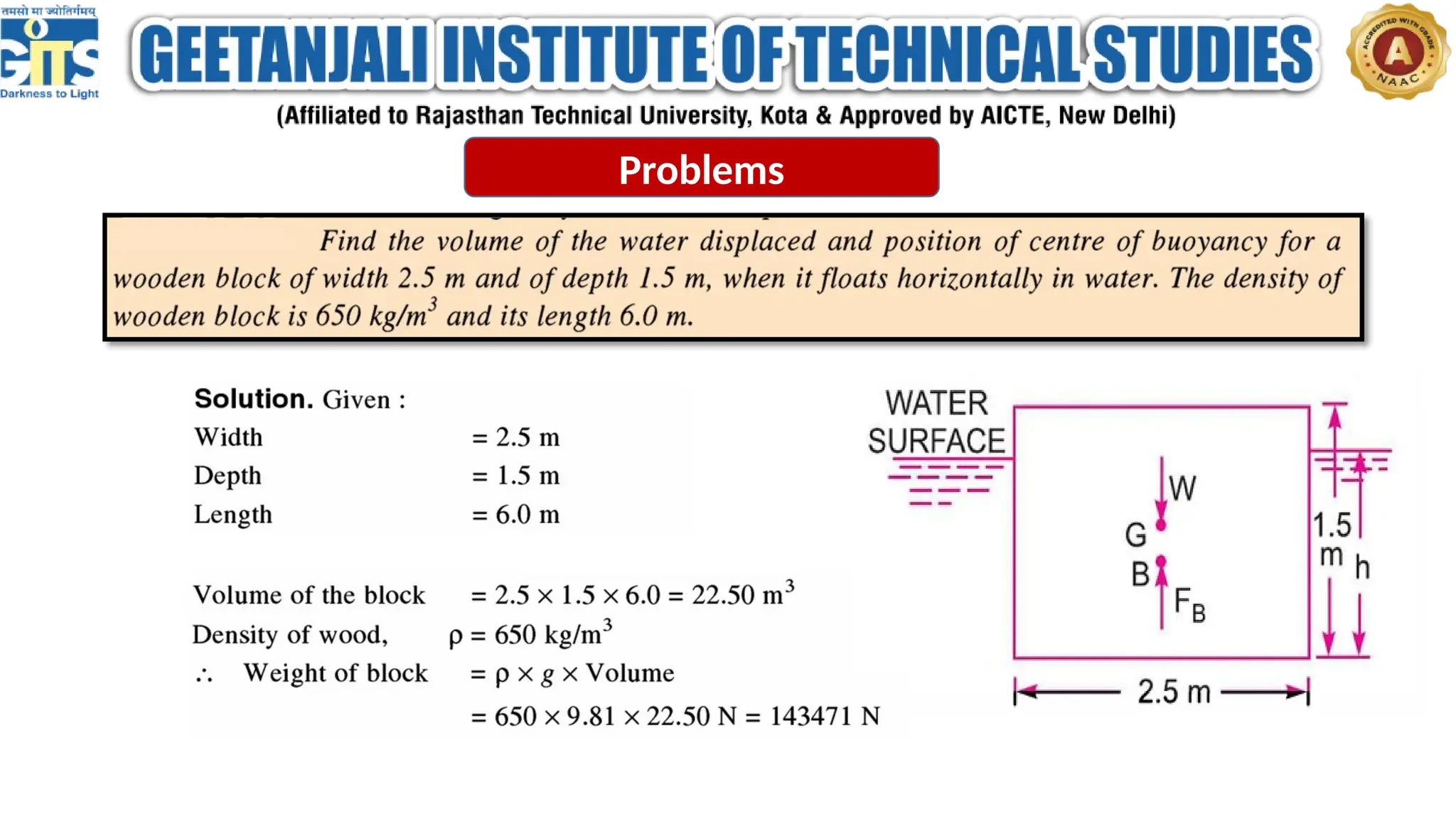
Problems
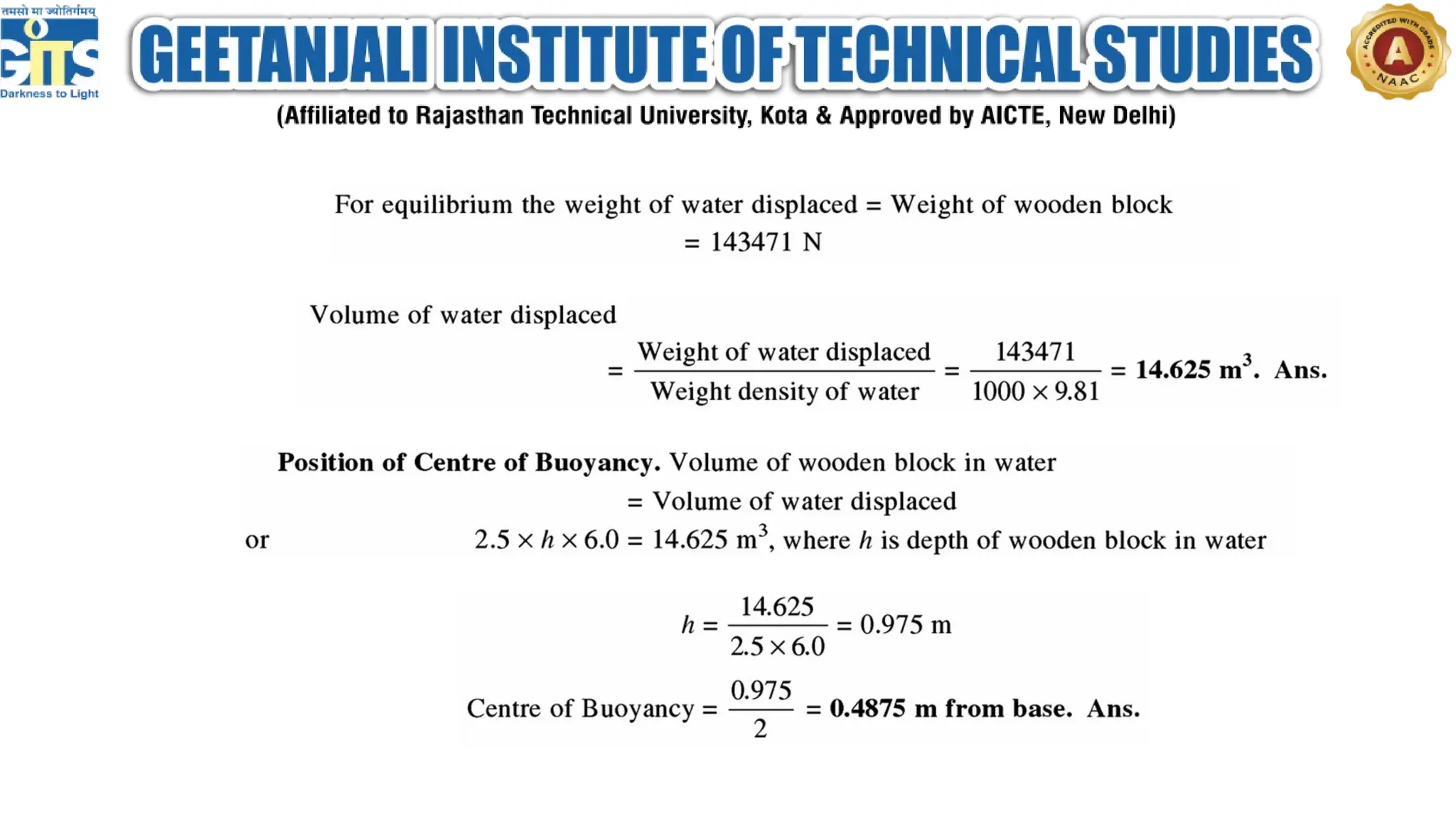
Problems
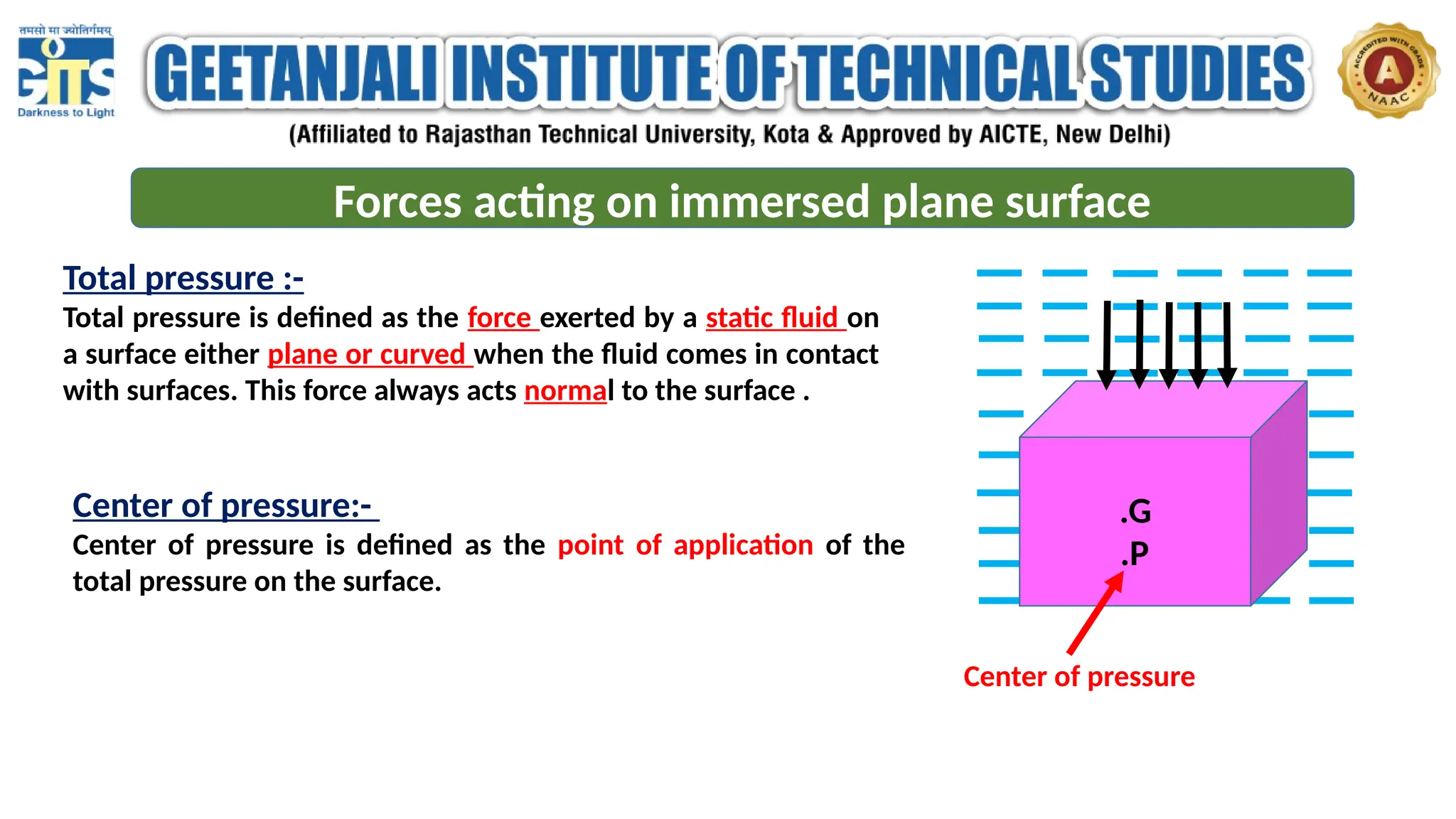
Forces acting on immersed plane surface
Total pressure :-
Total pressure is defined as the force exerted by a static fluid on
a surface either plane or curved when the fluid comes in contact
with surfaces. This force always acts normal to the surface .
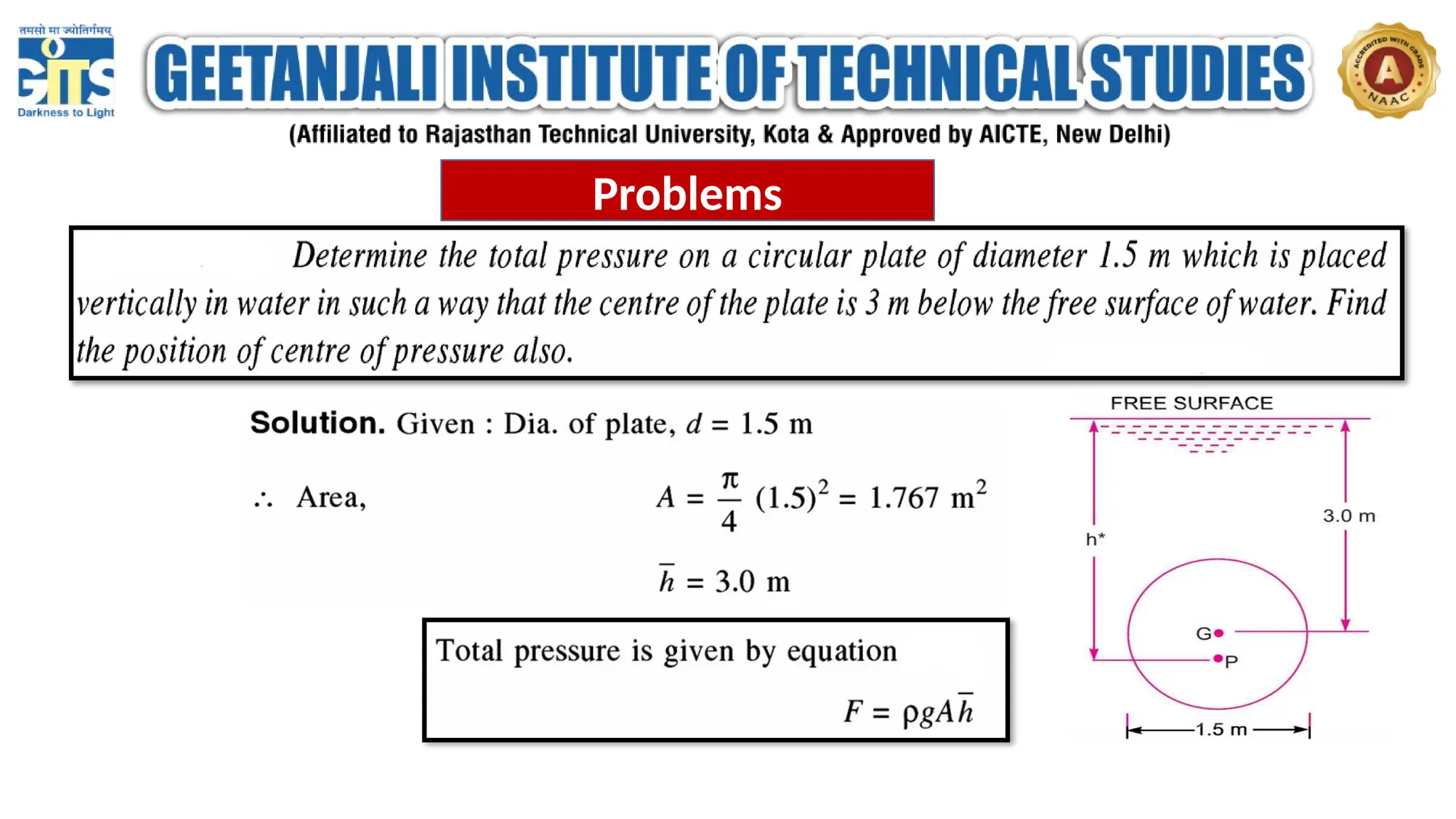
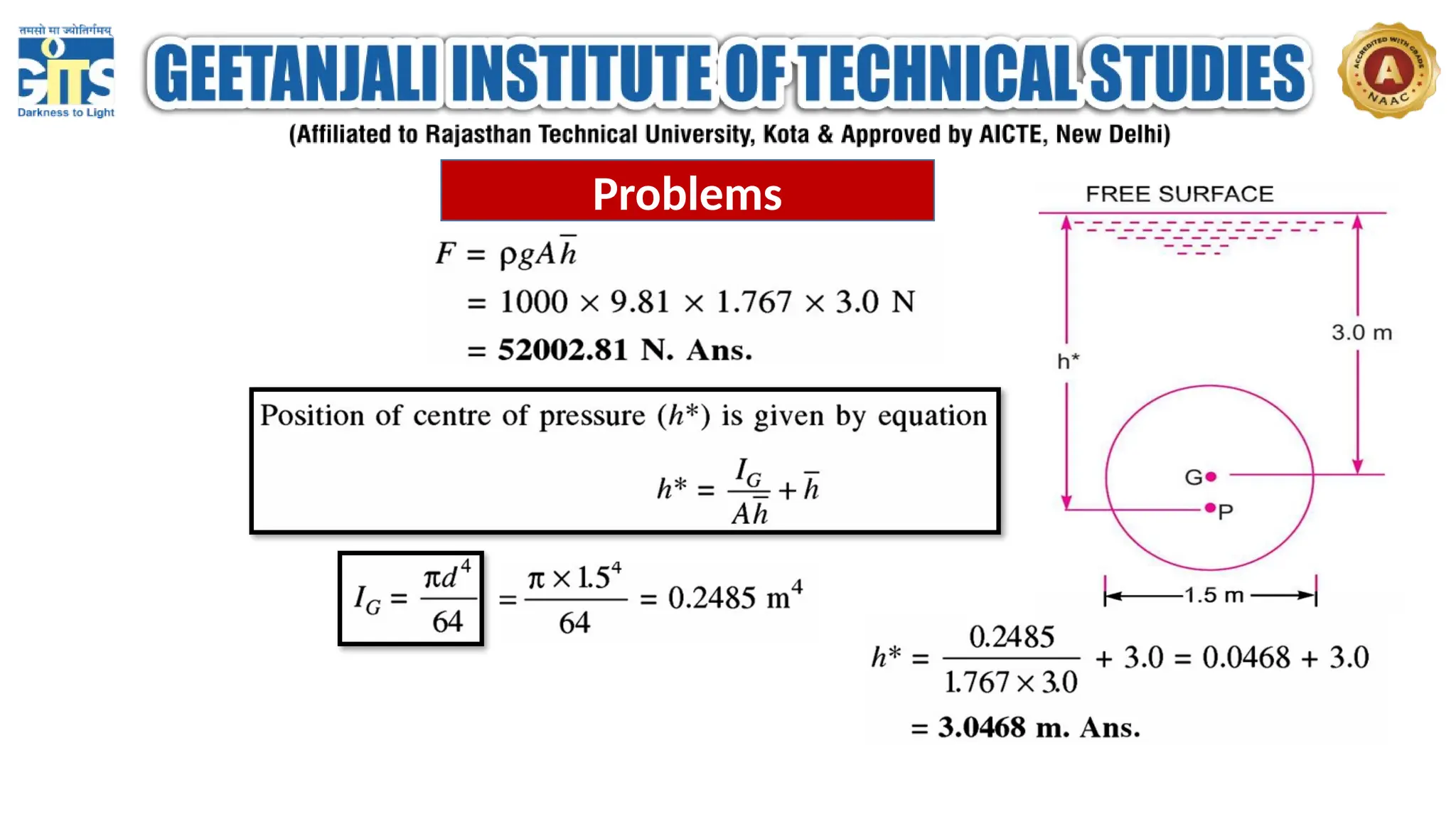
.G
Center of pressure:-
Center of pressure is defined as the point of application of the
total pressure on the surface.
.P
Center of pressure
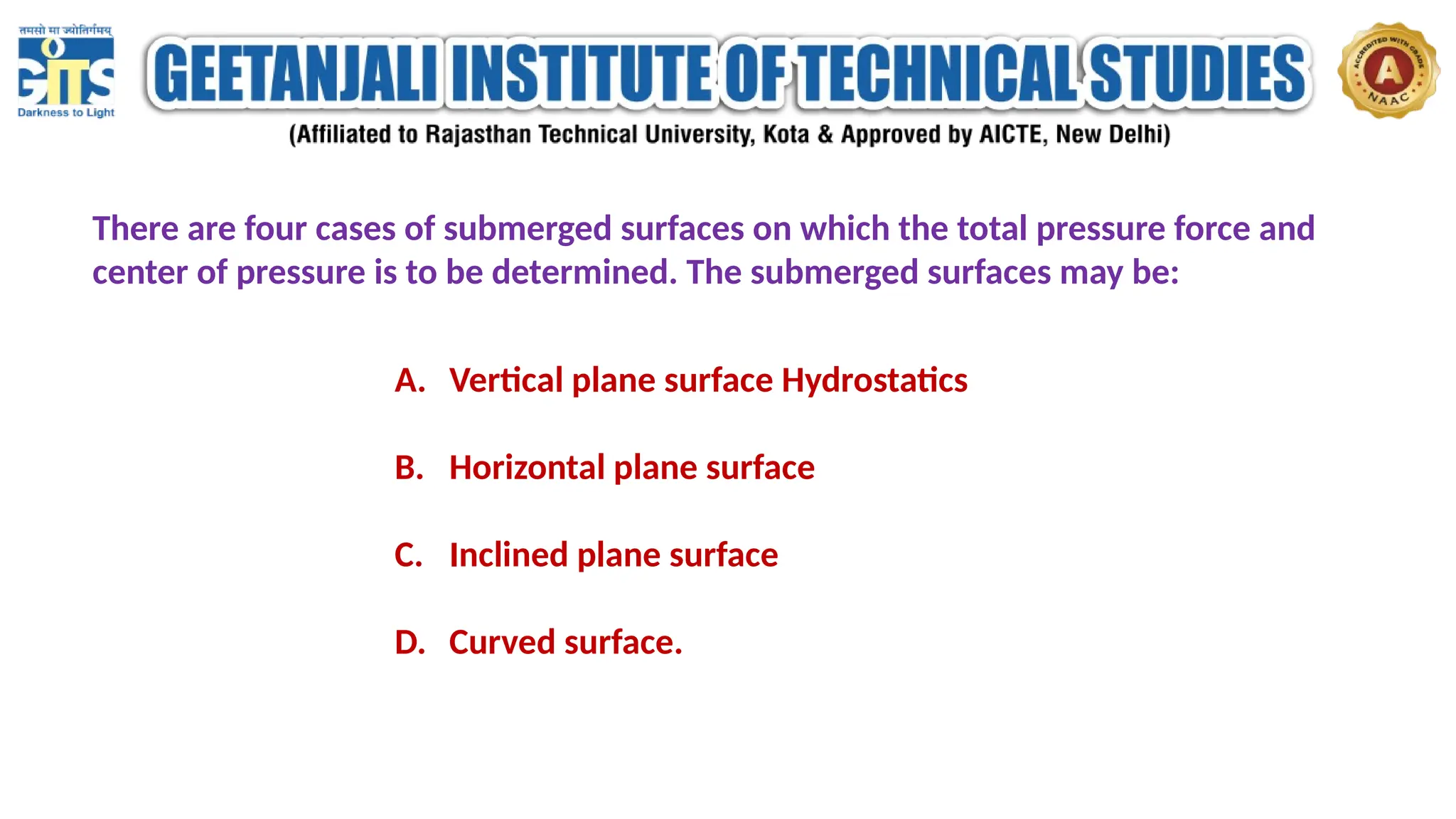
There are four cases of submerged surfaces on which the total pressure force and
center of pressure is to be determined. The submerged surfaces may be:
A. Vertical plane surface Hydrostatics
B. Horizontal plane surface
C. Inclined plane surface
D. Curved surface.
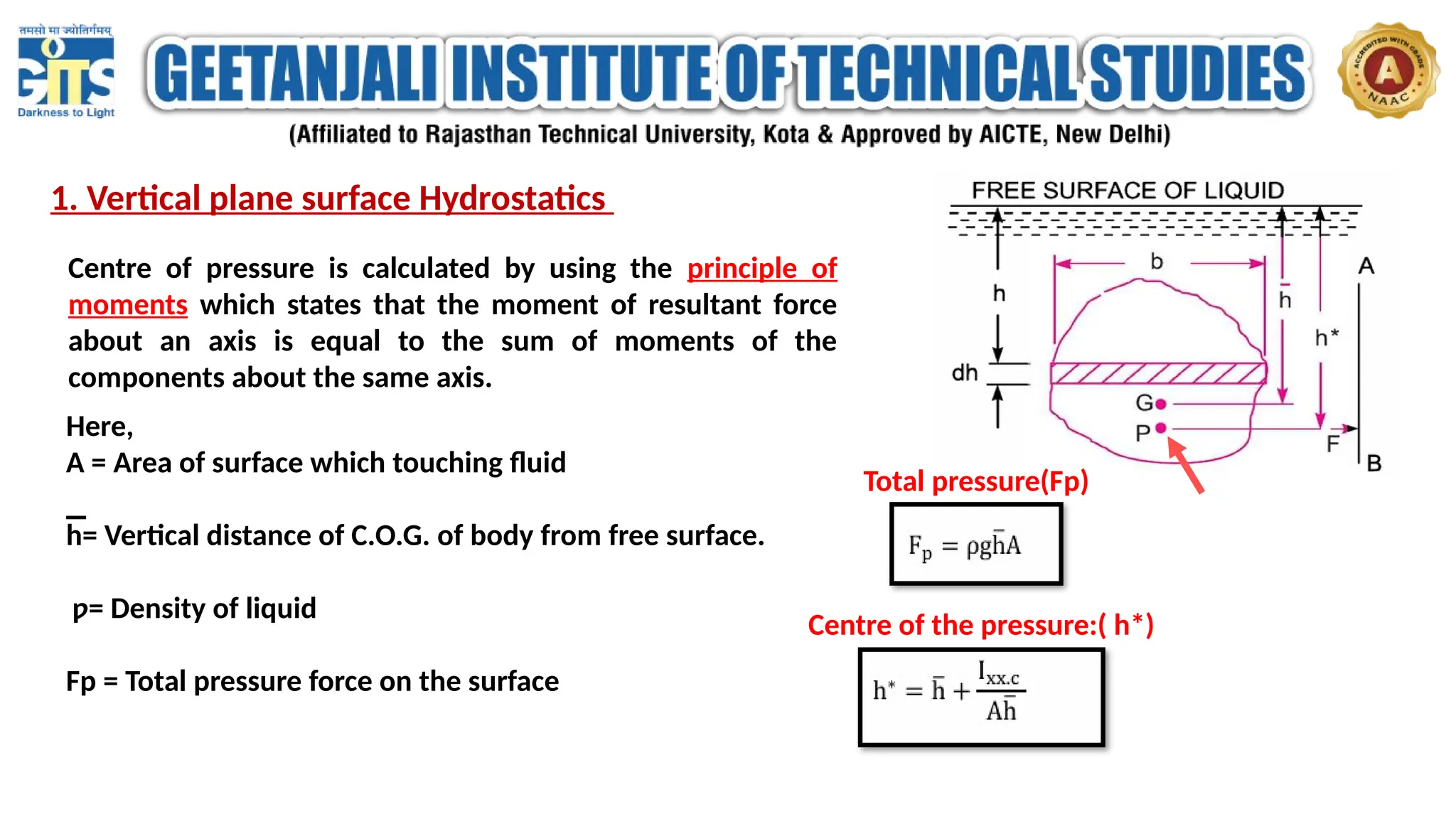
1. Vertical plane surface Hydrostatics
Centre of pressure is calculated by using the principle of
moments which states that the moment of resultant force
about an axis is equal to the sum of moments of the
components about the same axis.
Here,
A = Area of surface which touching fluid
h= Vertical distance of C.O.G. of body from free surface.
ƿ= Density of liquid
Fp = Total pressure force on the surface
Total pressure(Fp)
Centre of the pressure:( h*)
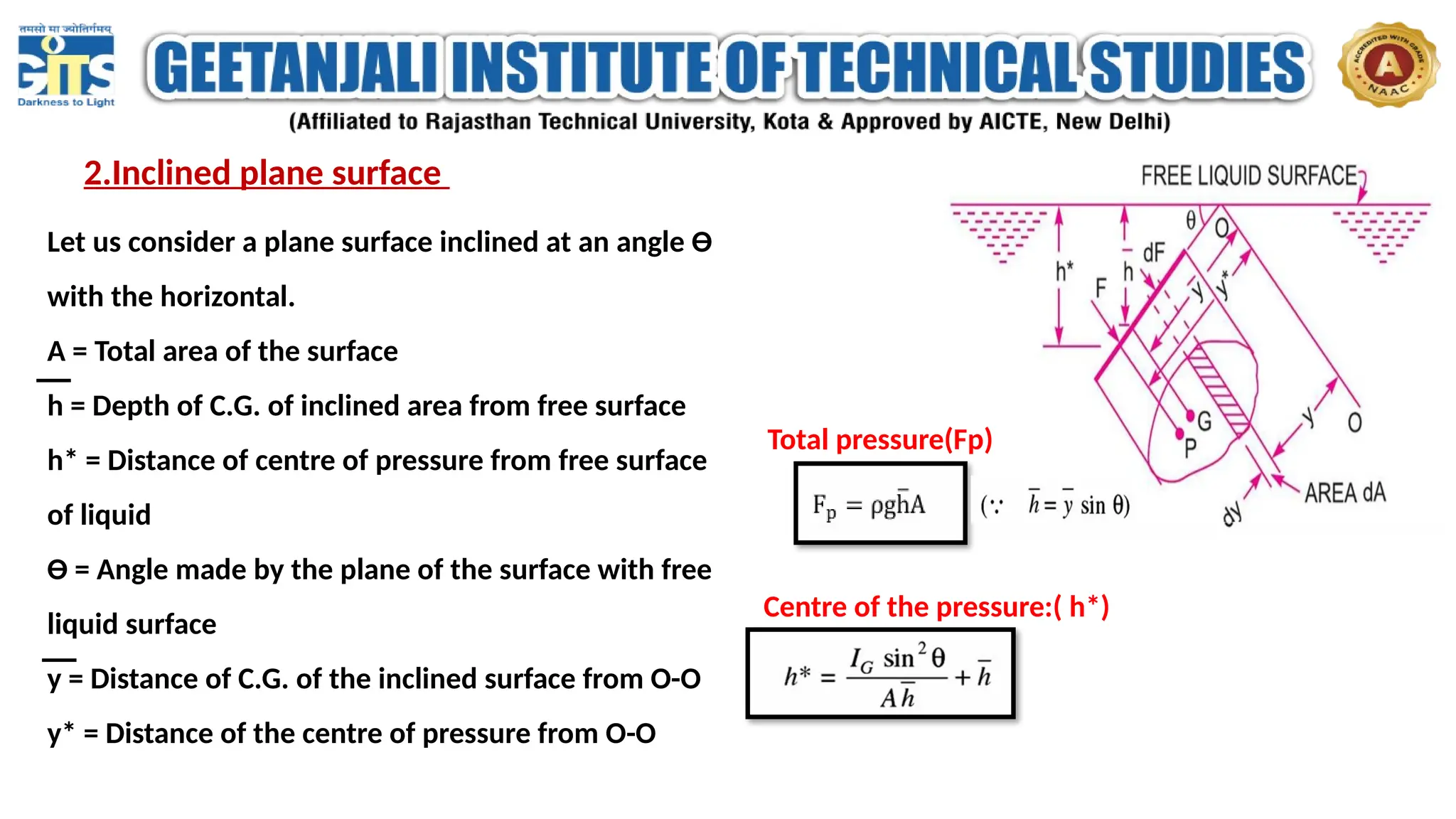
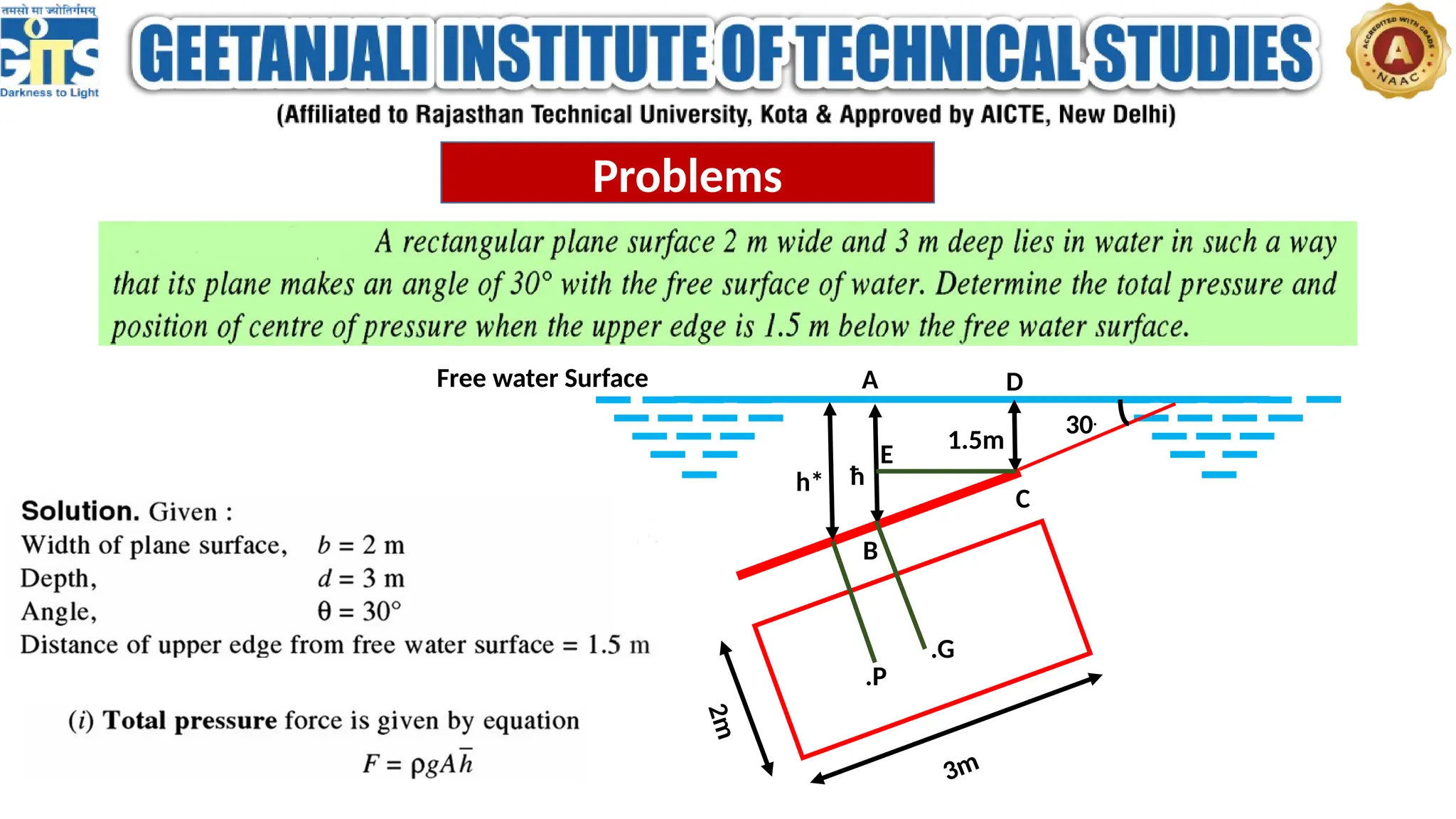
2.Inclined plane surface
Let us consider a plane surface inclined at an angle ϴ
with the horizontal.
A = Total area of the surface
h = Depth of C.G. of inclined area from free surface
h* = Distance of centre of pressure from free surface
of liquid
ϴ = Angle made by the plane of the surface with free
liquid surface
y = Distance of C.G. of the inclined surface from O-O
y* = Distance of the centre of pressure from O-O
Total pressure(Fp)
Centre of the pressure:( h*)
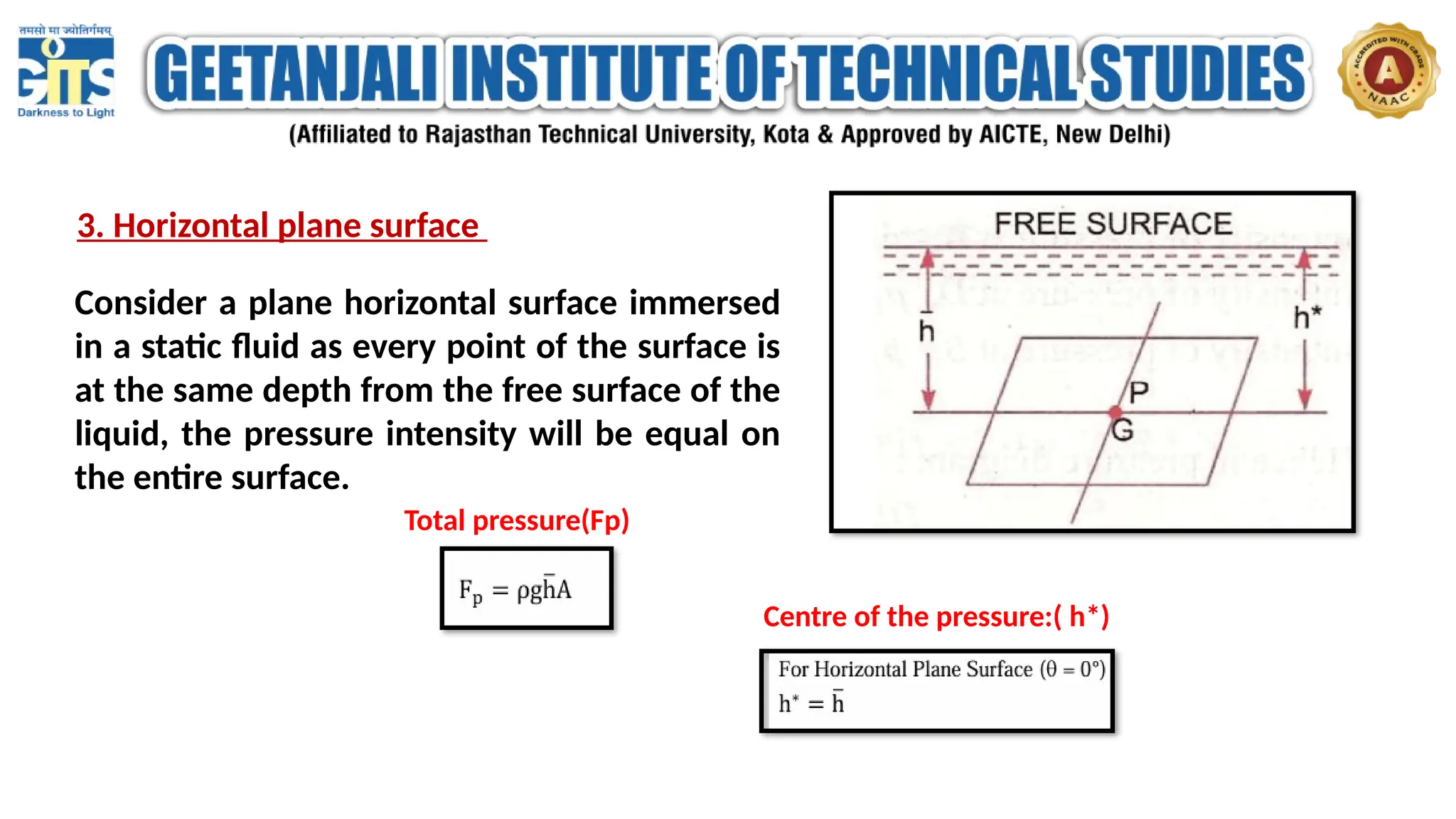
3. Horizontal plane surface
Consider a plane horizontal surface immersed
in a static fluid as every point of the surface is
at the same depth from the free surface of the
liquid, the pressure intensity will be equal on
the entire surface.
Total pressure(Fp)
Centre of the pressure:( h*)
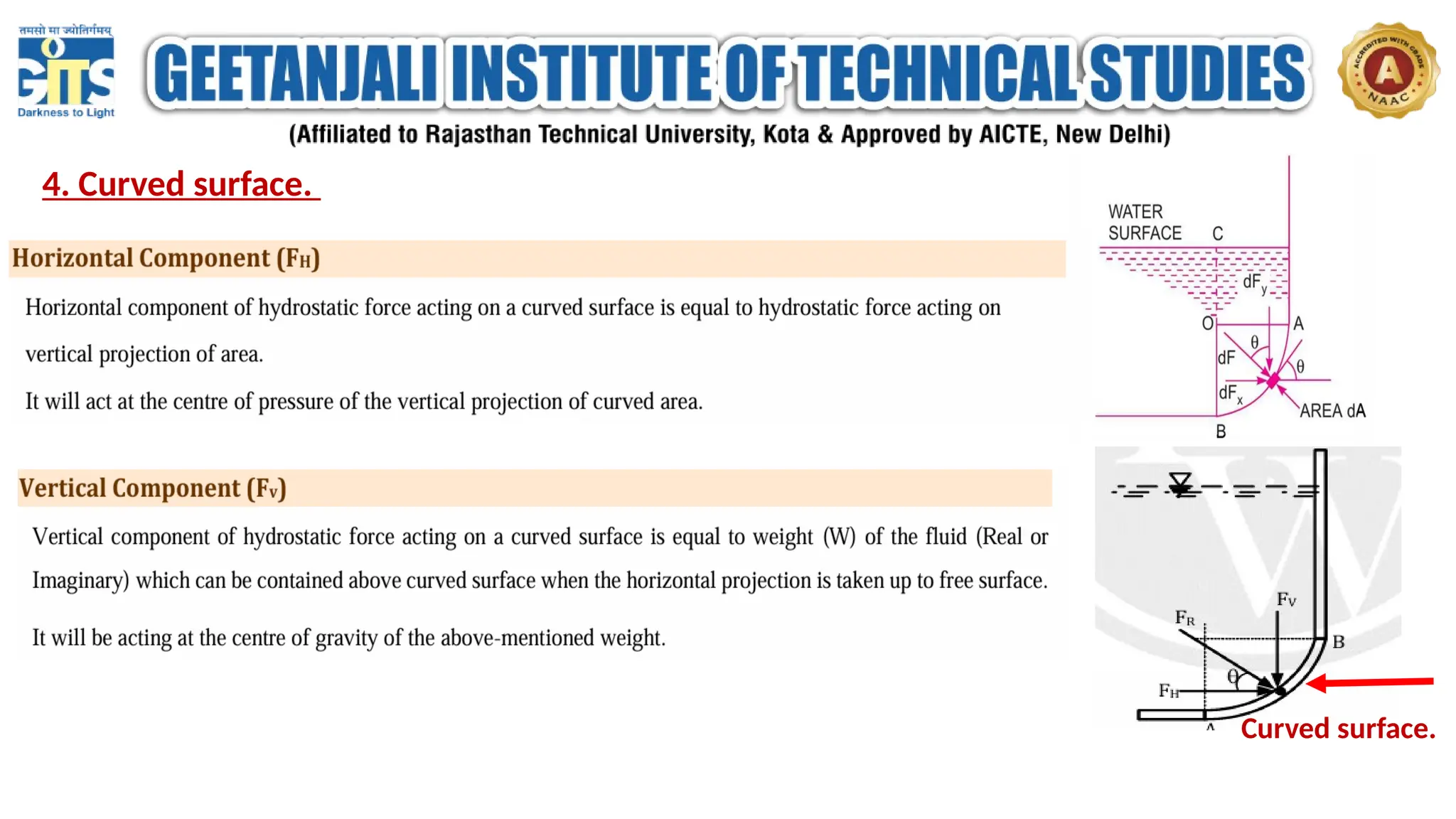
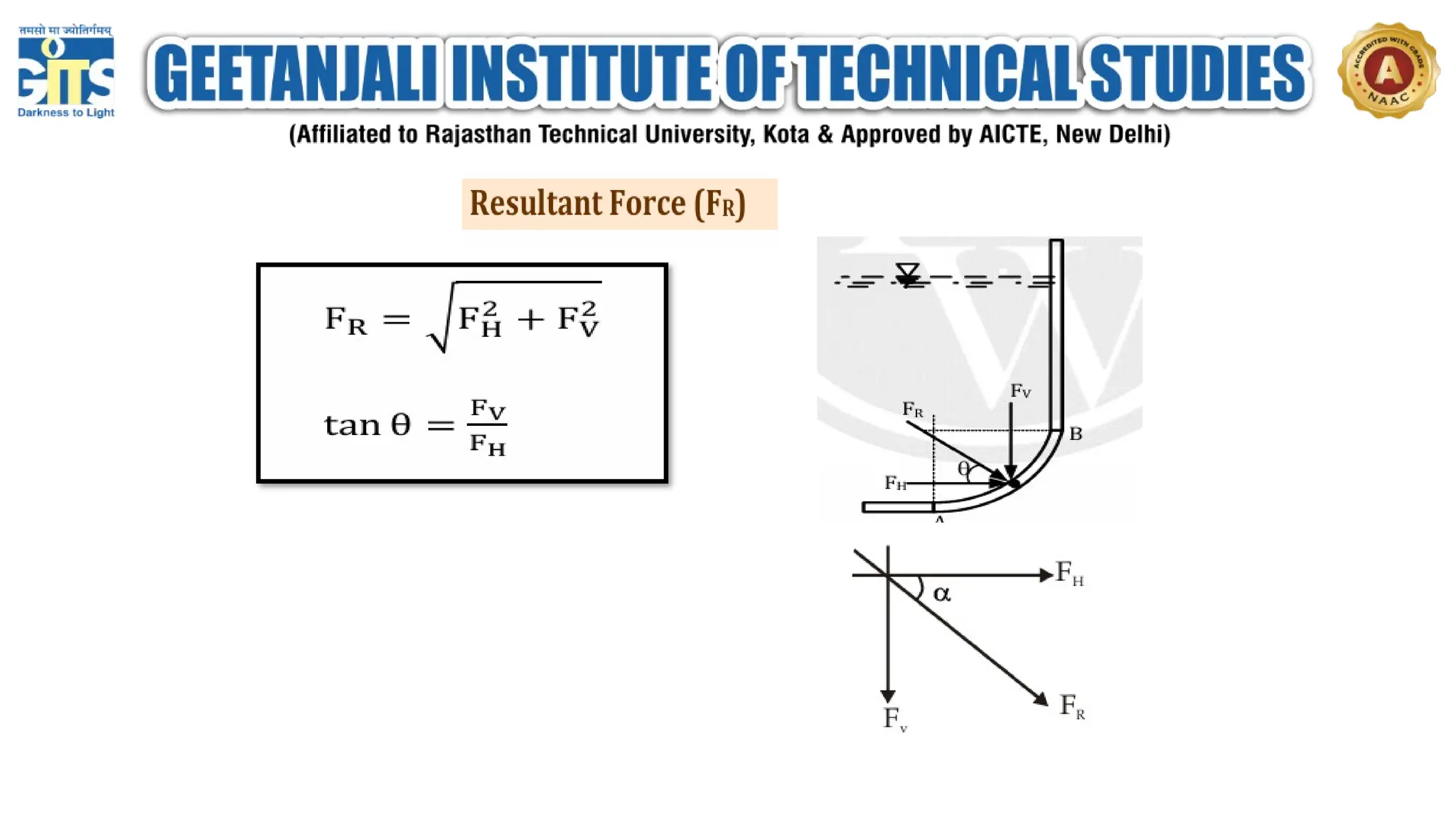
4. Curved surface.
Curved surface.
Problems
Problems
Problems
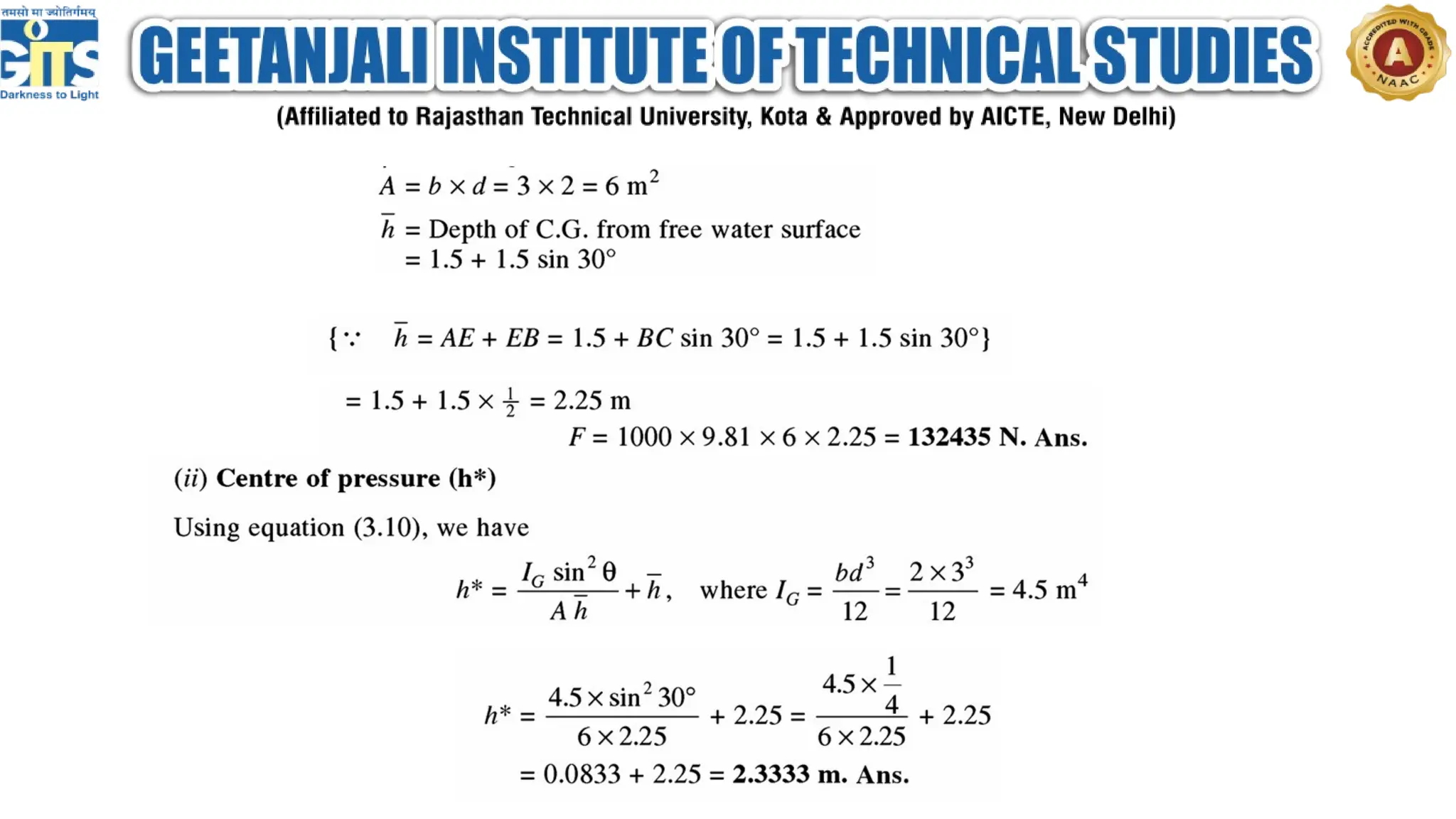
.G
.P
1.5m
ħ
h*
30.
3m
2
m
A
B
C
D
E
Free water Surface
Meta-centre and Meta centric height
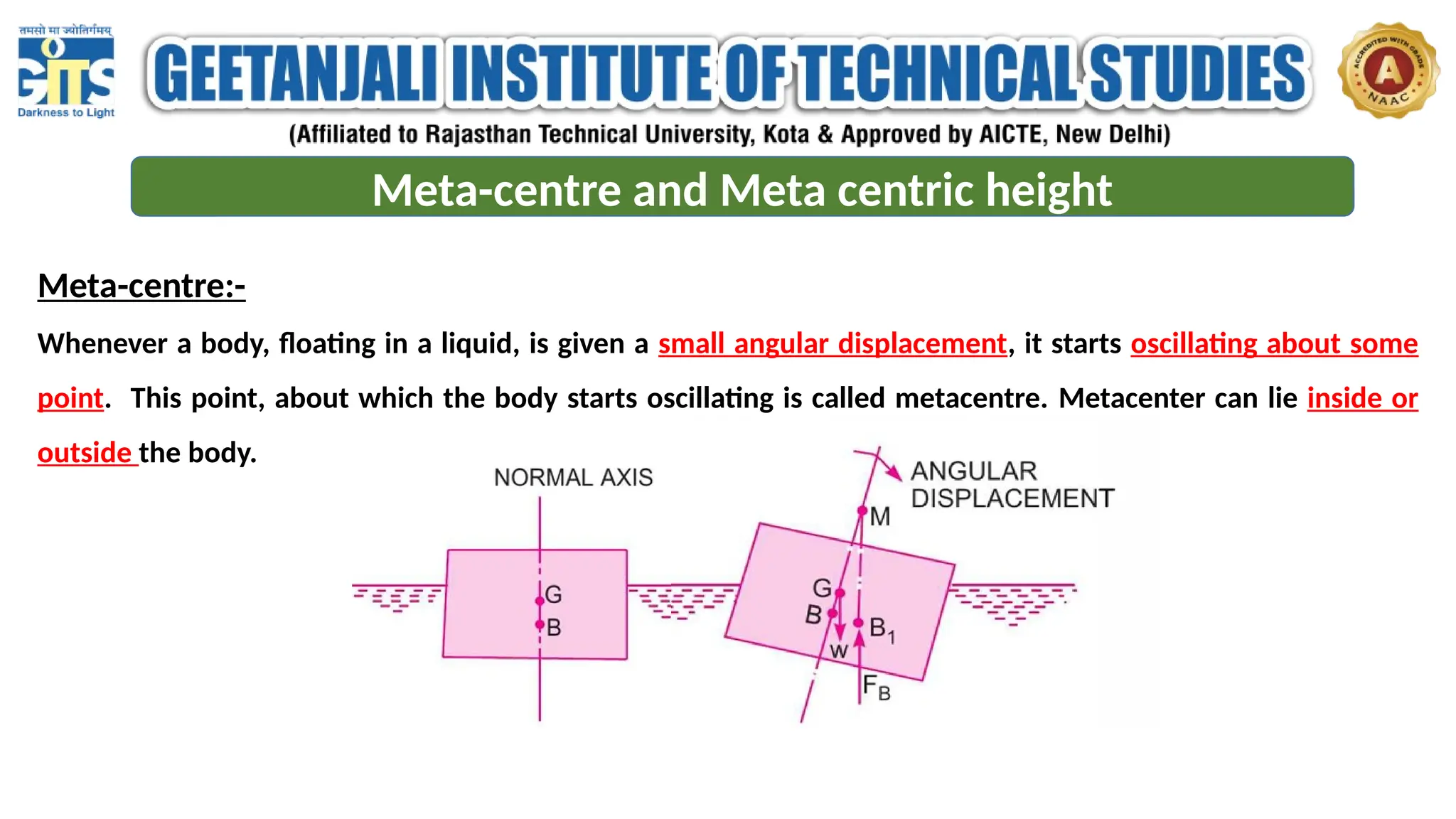
Meta-centre:-
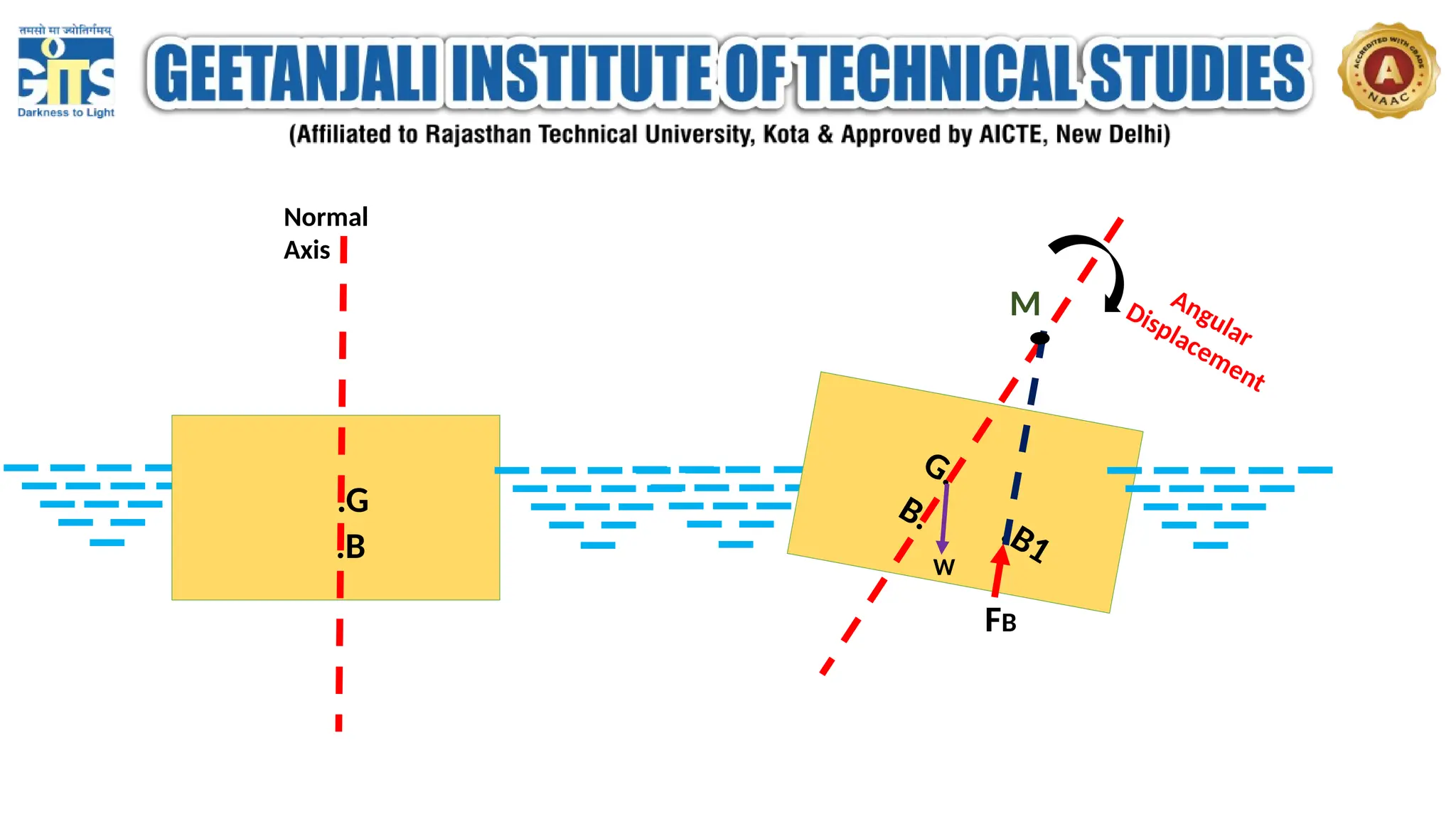
Whenever a body, floating in a liquid, is given a small angular displacement, it starts oscillating about some
point. This point, about which the body starts oscillating is called metacentre. Metacenter can lie inside or
outside the body.
.G
.B
Normal
Axis
G.
B. .B1
M
W
FB
Angular
Displacement
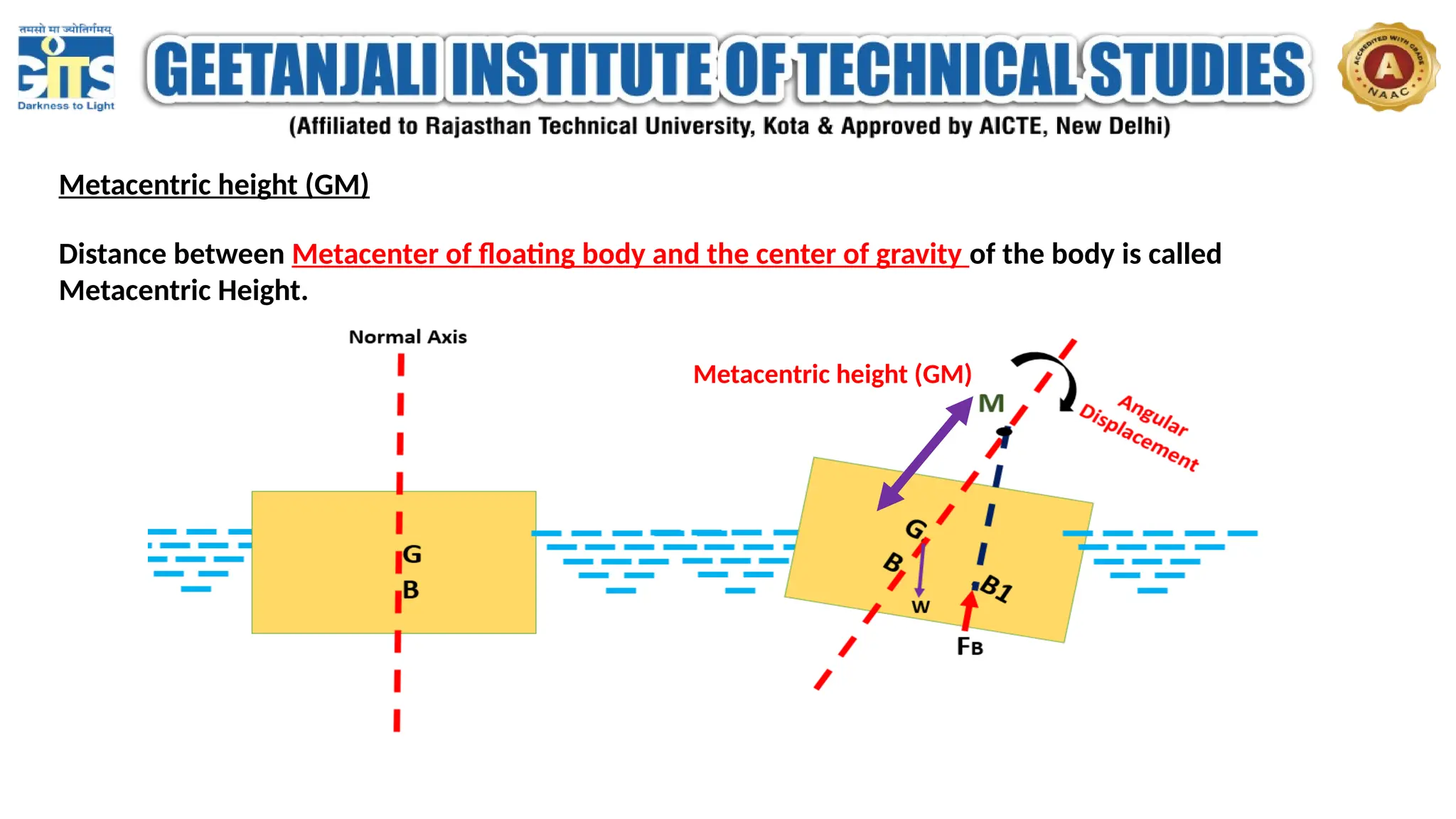
Metacentric height (GM)
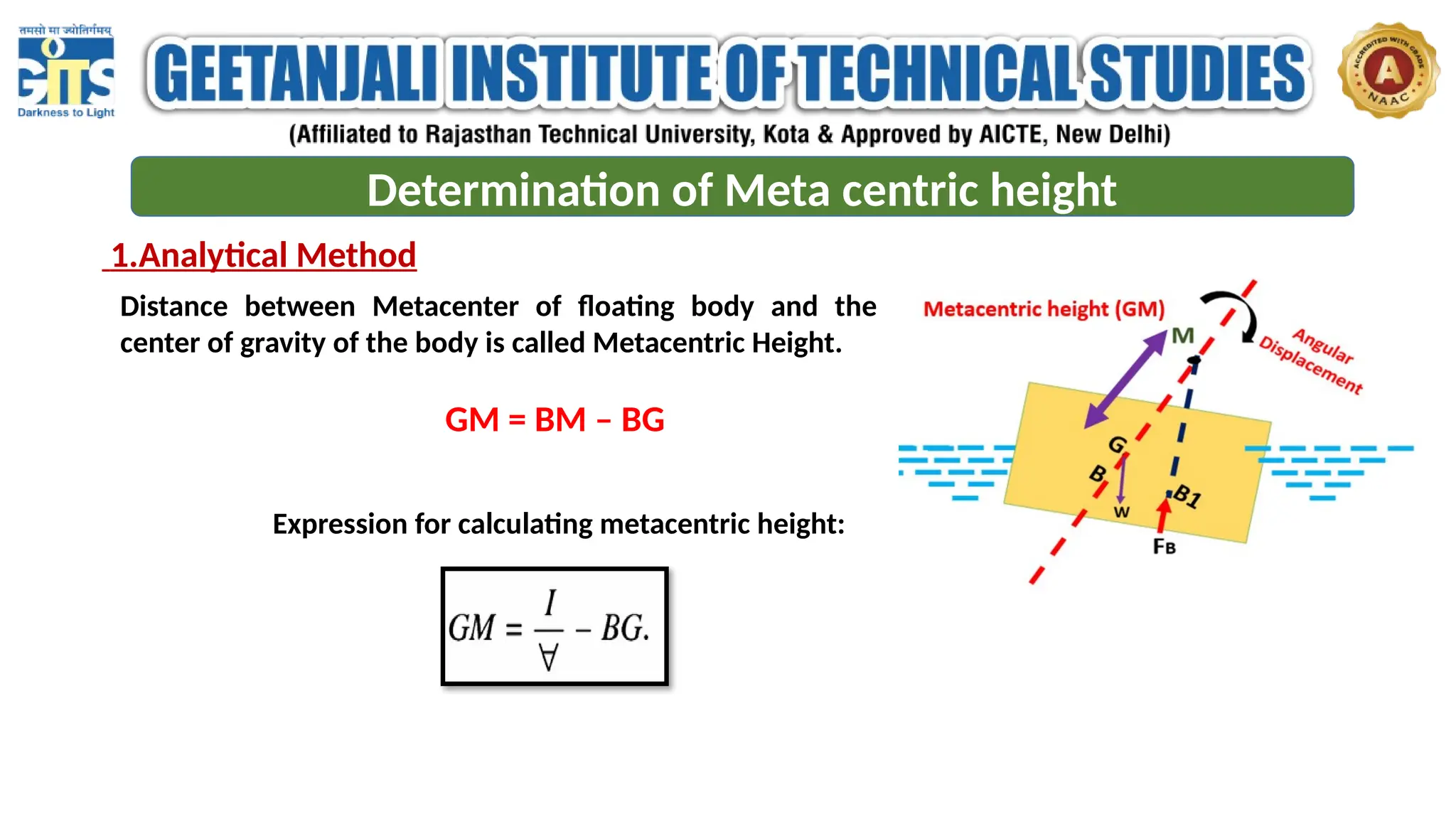
Distance between Metacenter of floating body and the center of gravity of the body is called
Metacentric Height.
Metacentric height (GM)
Importance of Meta centric height
Importance:
It directly measures the stability of the floating body.
Stability relation: Greater metacentric height means higher stability,
and vice versa.
Typical values of metacentric height:
1. Merchant Ships: up to 1.0 m
2. Sailing Ships: up to 1.5 m
3. Battle Ships: up to 2.0 m
4. River Craft: up to 3.5 m
Determination of Meta centric height
1.Analytical Method
Distance between Metacenter of floating body and the
center of gravity of the body is called Metacentric Height.
GM = BM – BG
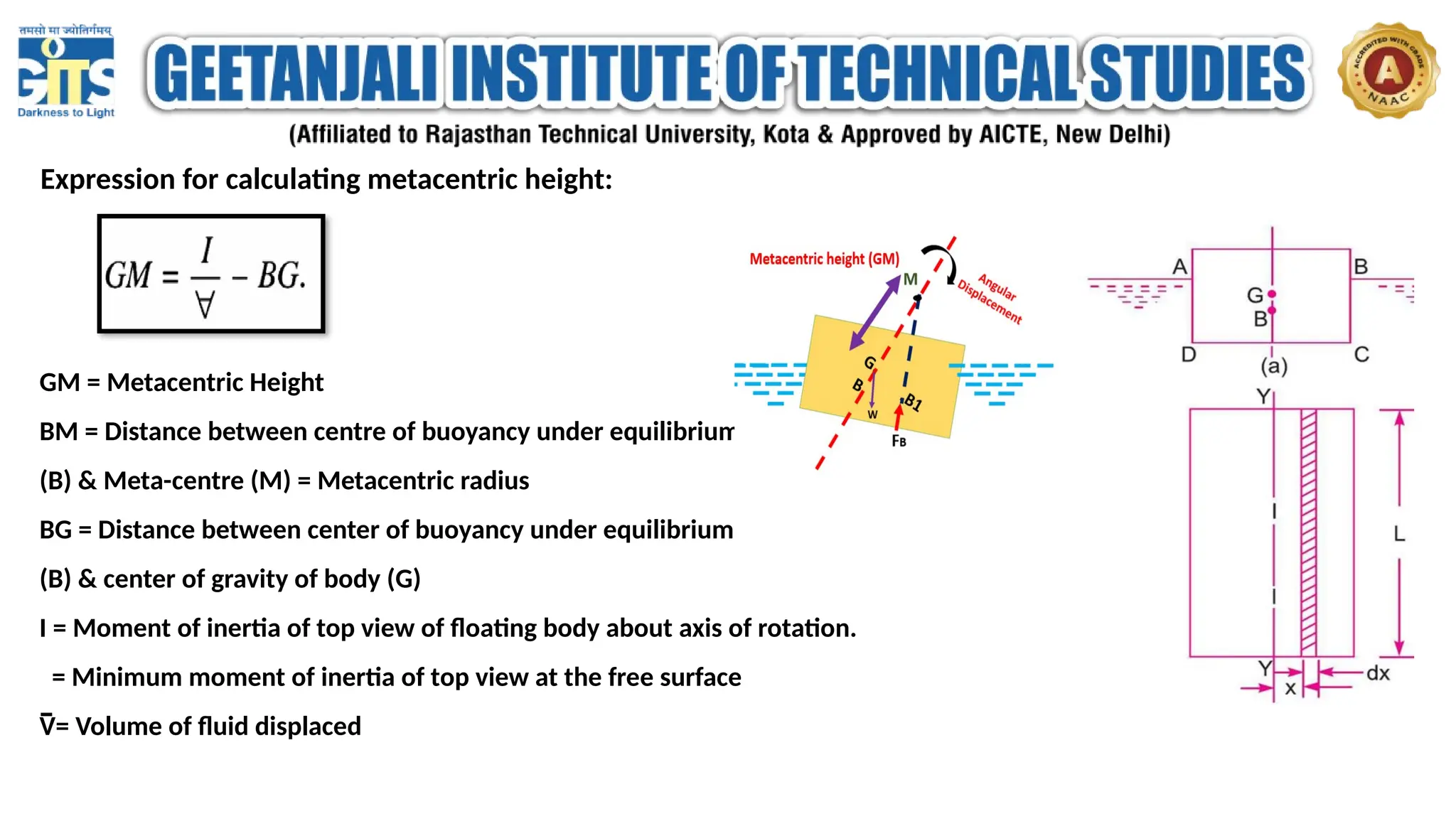
Expression for calculating metacentric height:
GM = Metacentric Height
BM = Distance between centre of buoyancy under equilibrium
(B) & Meta-centre (M) = Metacentric radius
BG = Distance between center of buoyancy under equilibrium
(B) & center of gravity of body (G)
I = Moment of inertia of top view of floating body about axis of rotation.
= Minimum moment of inertia of top view at the free surface
V= Volume of fluid displaced
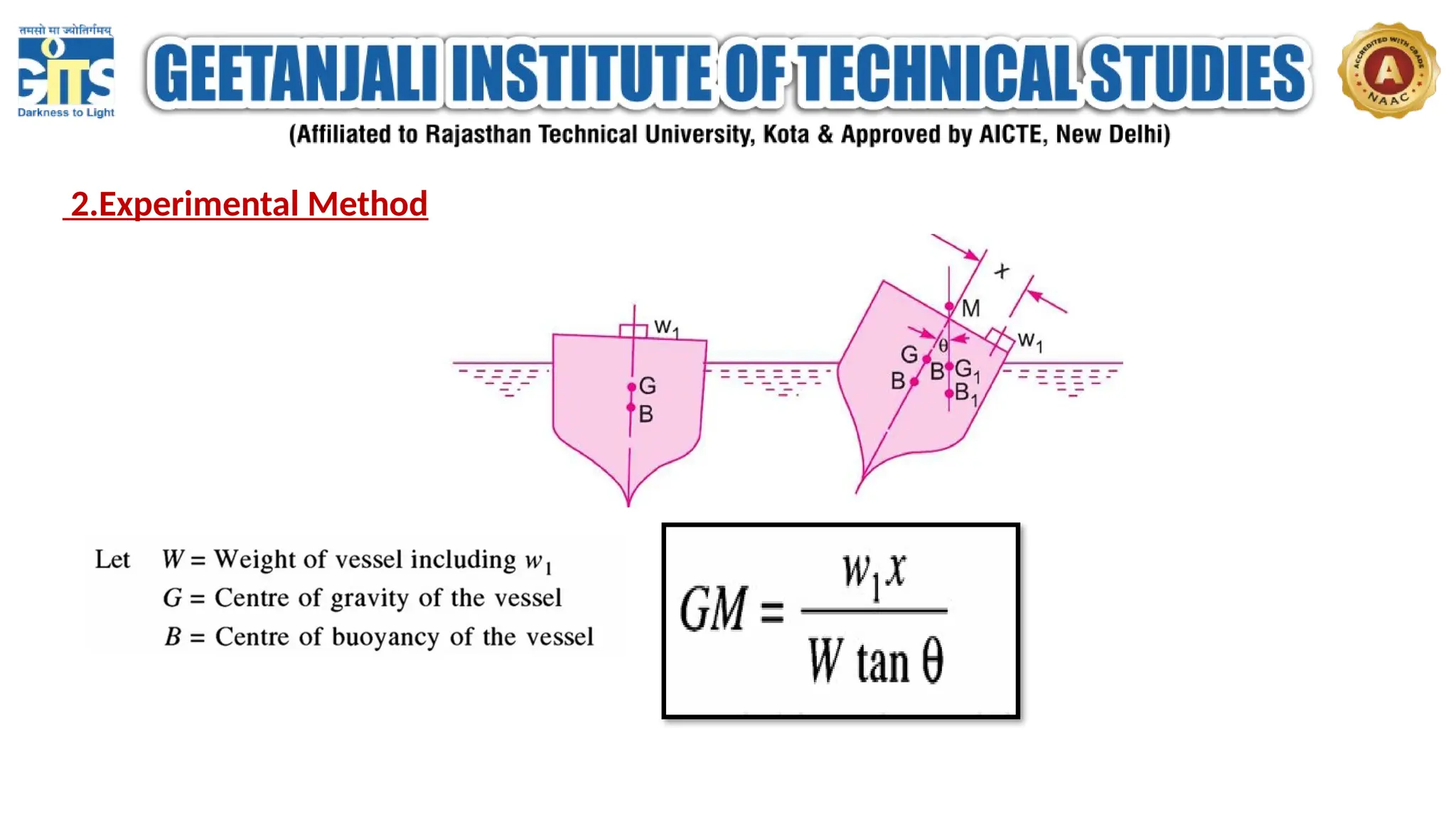
2.Experimental Method
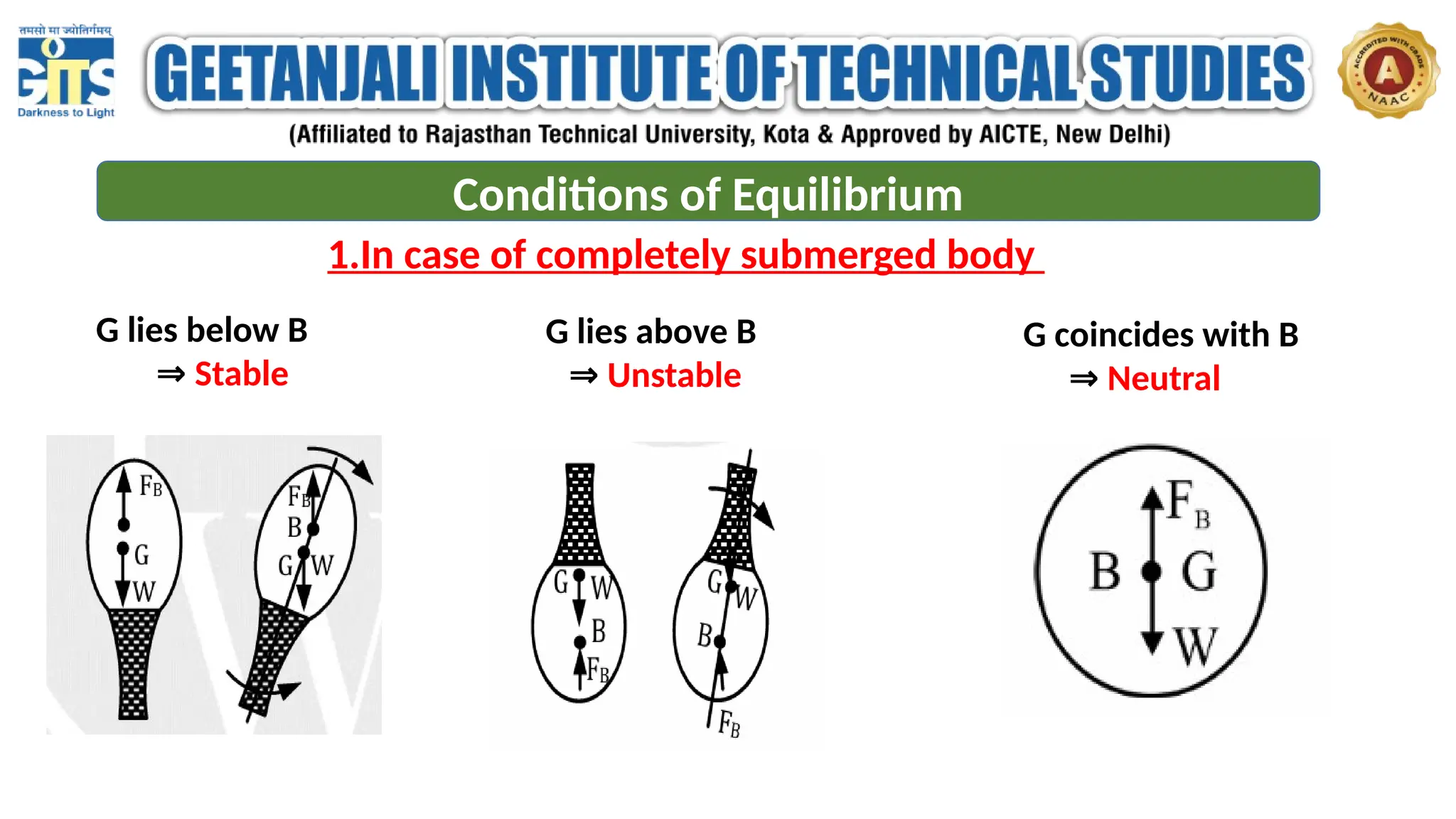
Conditions of Equilibrium
1.In case of completely submerged body
G lies below B
⇒ Stable
G lies above B
⇒ Unstable
G coincides with B
⇒ Neutral
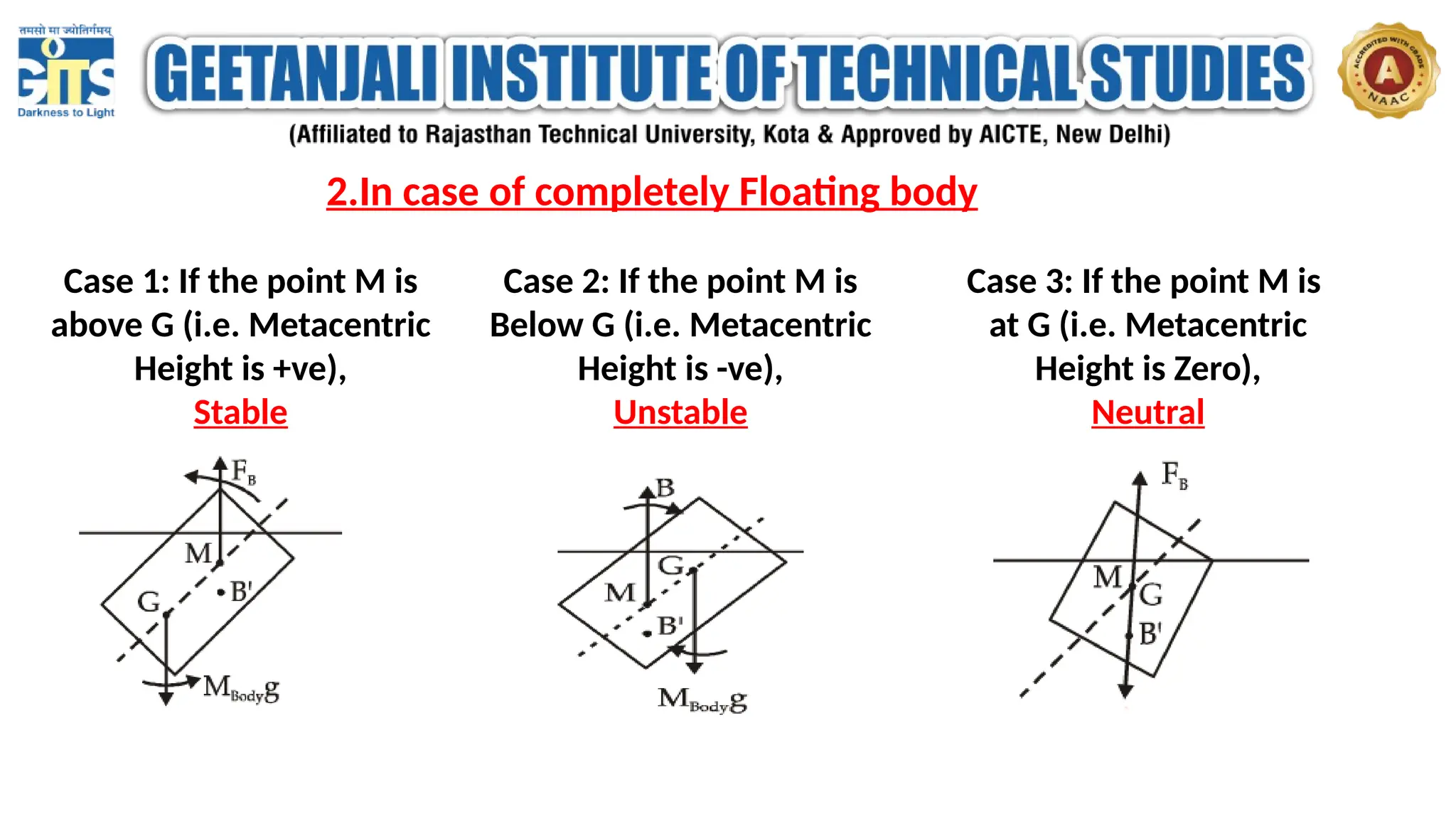
2.In case of completely Floating body
Case 1: If the point M is
above G (i.e. Metacentric
Height is +ve),
Stable
Case 2: If the point M is
Below G (i.e. Metacentric
Height is -ve),
Unstable
Case 3: If the point M is
at G (i.e. Metacentric
Height is Zero),
Neutral
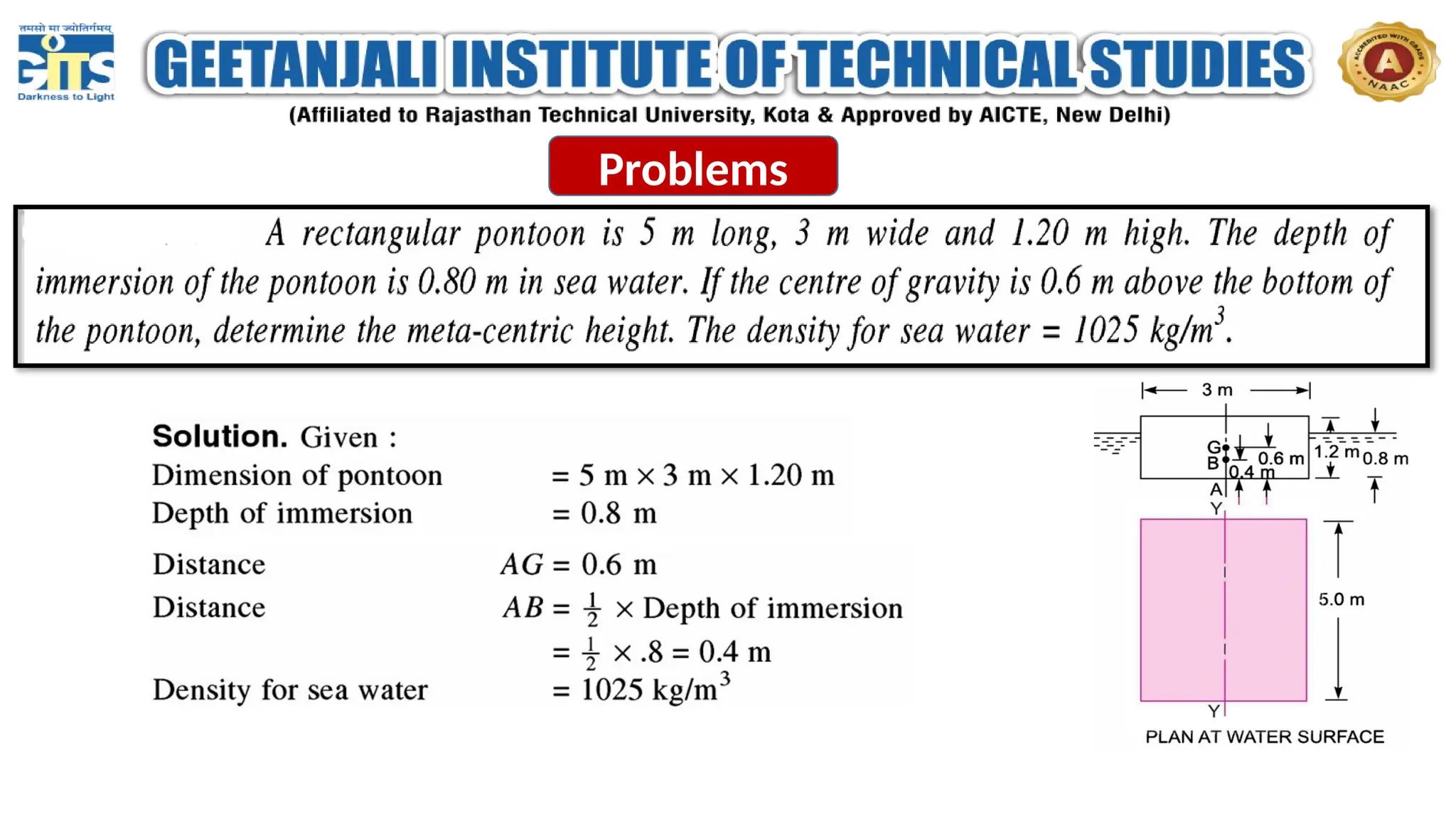
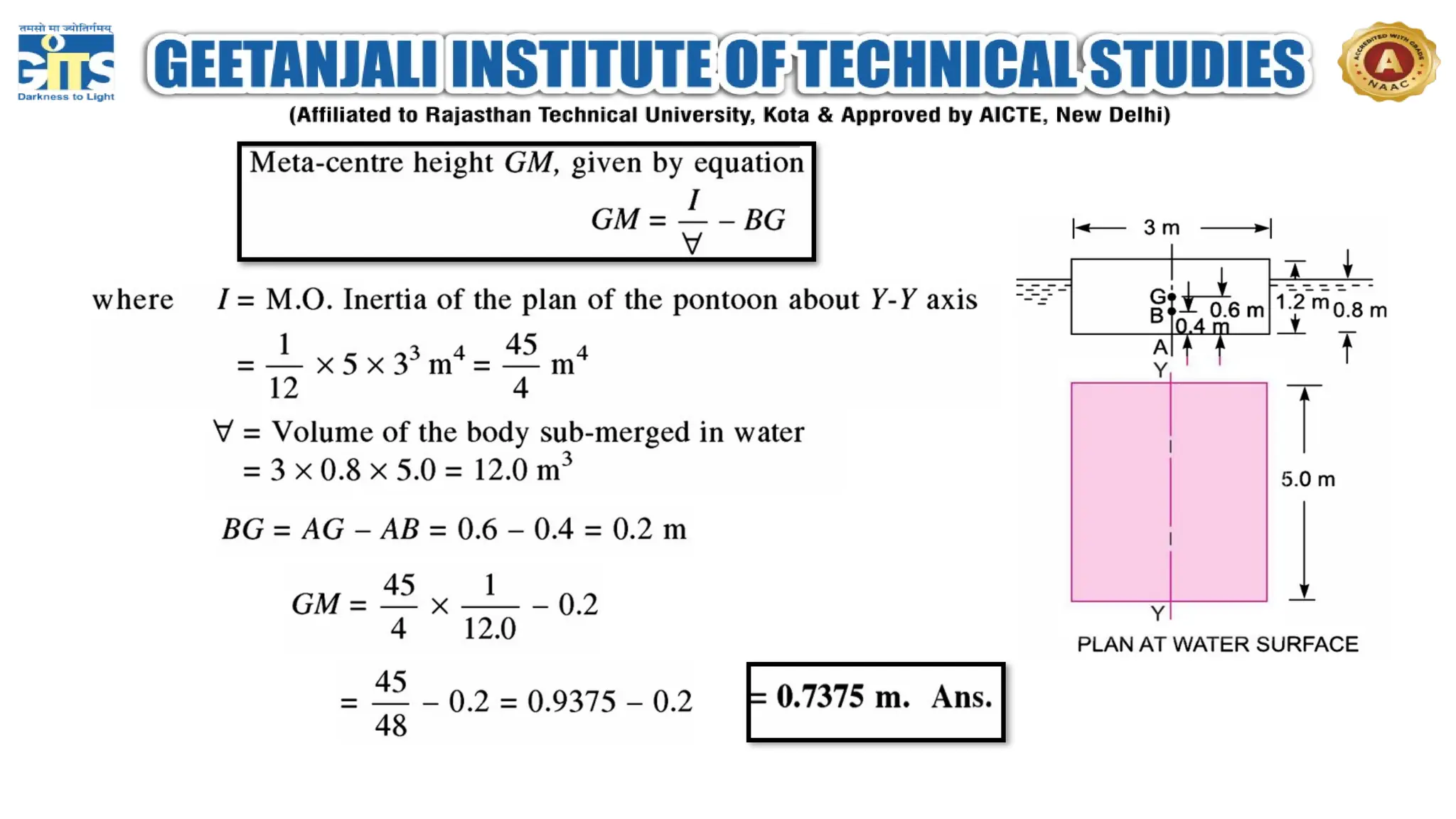
Problems
FM UNIT I FM basic and concepts of fluid mechanics

FM UNIT I FM basic and concepts of fluid mechanics

  • 1.
    Subject:-Fluid Mechanics &Machines Prepared By:- Abhishek Joshi UNIT:1 Part:2 Principles of Fluid Statics & Buoyancy
  • 2.
    Syllabus Principles of FluidStatics: Basic equations, Pascal Law, Type of pressure:- atmospheric pressure, Gauge pressure, vacuum pressure, absolute pressure, manometers, Bourdon pressure gauge Buoyancy; Forces acting on immersed plane surface. Centre of pressure, forces on curved surfaces. Conditions of equilibrium for floating bodies, meta-centre and analytical determination of meta centric height. UNIT 1 Part 2
  • 3.
    Fluid Statics isthe branch of fluid mechanics that deals with the behaviour of fluid when they are at rest. At rest there are no shear stress, the only force is the normal force due to pressure is present. Fluid is confined by boundary. No shear stress Means τ =0
  • 4.
    Pressure: L B Area (A) H Pressure isdefined as normal force exerted by a fluid per unit area. Force (F) 𝑷𝒓𝒆𝒔𝒖𝒓𝒆= 𝑭𝒐𝒓𝒄𝒆𝒅 𝑨𝒑𝒑𝒍𝒊𝒆𝒅 𝑨𝒓𝒆𝒂 𝑬𝒙𝒑𝒐𝒔𝒆𝒅
  • 5.
    Pascal Law The Pascal'slaw states that the pressure at a point in a fluid at rest is the same in all directions . External static pressure exerted on a fluid is distributed evenly throughout the fluid.
  • 6.
    Px Py Py Pz Pz A B C Unit Width dy Px ds Py dx Pz Px ϴ Pz PzCosϴ PzSinϴ Pascal Law equation Show that pressure at any point in x, y & z Direction is equal. Px=Py=Pz
  • 7.
    Hydrostatic Law the pressureat any point in a fluid at rest is obtained by the Hydro-static Law which states that the rate of increase of pressure in a vertically downward direction must be equal to the specific weight of the fluid at that point. Z1 Z2 Z1<Z2 Case-1 Case-2 𝒅 𝒑 𝒅 𝒛 =w 𝒅 𝒑 𝒅 𝒛 =ƿ 𝒈
  • 8.
    A B D C P1 P2 Z dZ FreeSurface dA dA W
  • 9.
    iii)Force due toWeight of fluid element: W = mg = ƿ·V·g ƿ= W= ƿ(dA·dZ)g, downward direction. iv) Pressure forces on surfaces AC and BD are equal and opposite. Fluid is at the element must be in equilibrium and the sum of vertical forces must be Zero Free Surface A B D C P1 Z dA dA dZ P2
  • 10.
    Where w =weight Density of Fluid Above equation state that “rate of increase of pressure in vertical direction is equal to weight density of the fluid at the point” and this is known as Hydrostatic Law. Where p= pressure above atmospheric pressure , and z is the height of point from free surfaces.
  • 11.
  • 12.
    Subject:-Fluid Mechanics PreparedBy:- Ajay Nagda Problems
  • 14.
  • 16.
    Problems A closed tankcontains 0.5 m thick layer of mercury (specific gravity = 13.6) at the bottom. A 2.0 m thick layer of water lies above the mercury layer. A 3.0 m thick layer of oil (specific gravity = 0.6) lies above the water layer. The space above the oil layer contains air under pressure. The gauge pressure at the bottom of the tank is 196.2 kN/m2 . The density of water is 1000 kg/m3 and the acceleration due to gravity is 9.81 m/s2 . The value of pressure in the air space is Gate exam 2018 morning shift Solution Given data:- Gauge pressure is the pressure relative to atmospheric pressure. Gauge pressure is positive for pressures above atmospheric pressure, and negative for pressures below it.
  • 17.
    Hg H2O Oil Air 0.5 m 2 m 3m SG = 13.6 SG = 1 SG = 0.6 The gauge pressure at the bottom of the tank is 196.2 kN/m2 Gauge Pressure = Pressure due to Air + Pressure due to oil + Pressure due to water + Pressure due to Mercury (Hg) Gauge Pressure = Pair+ Poil+Pwater + PHg Basic Equation of Pressure (P)= ρgh Gauge Pressure = Pair+ ρoil x g x h1 +ρwater x g x h2 + ρHg x g x h3 196.2 X 103 = Pair+ (0.6 x 1000 x 9.81 x 3)+(1x 1000 x 9.81 x 2) + (13.6 x 1000 x 9.81 x 0.5) Pair= 92.214 kN/m2
  • 18.
    Types of PressureSystem 1.Atmosphric Pressure Atmospheric pressure, also known as barometric pressure, is the force exerted by the weight of the atmosphere on a surface. It's the result of the air molecules being pulled down by gravity. Atmospheric Pressure at mean sea level is termed as standard atmospheric pressure. Atmospheric pressure at any other location is termed as local atmospheric pressure. It is measured by the barometer or mercury barometer. The value of 1 atm is 1.013 bar
  • 19.
    Atmospheric Pressure interms of Water and Mercury Head
  • 20.
    2.Absolute Pressure it isdefined as the pressure which is measured with reference to absolute vacuum pressure. It is also termed as actual pressure at a given location.it is measured by aneroid Barometer 3.Guage Pressure It is defined as the pressure, which is measured with the help of a pressure measuring instrument, in which the atmospheric pressure is taken as datum. The atmospheric on the scale is marked as zero. It may be +ve and -ve 4.Vacuum Pressure It is defined as the pressure below the atmospheric pressure.it is negative pressure. Absolute zero or complete vacuum Local Atmospheric Pressure Absolute Pressure Absolute Pressure Gauge Pressure vacuum Pressure A B Absolute Pressure
  • 21.
    Absolute zero orcomplete vacuum Absolute Pressure vacuum Pressure B Absolute Pressure Gauge Pressure Absolute Pressure Local Atmospheric Pressure Mathematical Absolute pressure = Atmospheric pressure+ gauge pressure Pab. = Patm. + Pguage Vaccum pressure= atmospheric pressure- Absolute Pvac. = Patm. - Pab. The atmospheric pressure at sea level at 150C is 10.13N/cm2 or 101.3KN/m2 in SI Units and 1.033 Kgf/cm2 in MKS System. The atmospheric pressure head is 760mm of mercury or 10.33m of water.
  • 22.
  • 24.
    Pressure Measurement Devices Thepressure of a fluid is measured by the fallowing devices. Manometers Mechanical gauges Simple Manometers Differential Manometers Piezometer U-tube manometer Single column manometer U-tube Differential manometer Inverted-tube Differential manometer Diaphragm pressure gauge Bourdon tube pressure gauge Dead–Weight pressure gauge Bellows pressure gauge
  • 25.
    Simple Manometers A simplemanometer consists of a glass tube having one of its ends connected to a point where pressure is to be measured and the other end remains open to the atmosphere. The common types of simple manometers are: 1. Piezometer 2. U-tube manometer (for gauge & vacuum pressure) 3. Single column manometer a) Vertical Single column manometer b) Inclined Single column manometer 1. Piezometer • It is a simplest form of manometer used for measuring gauge pressure. • One end of this manometer is connected to the point where pressure is to be measured and other end is open to the atmosphere. • The rise of liquid in the Piezometer gives pressure head at that point A. • The height of liquid say water is ‘h’ in piezometer tube.
  • 26.
    2. U-tube manometer(for gauge & vacuum pressure) • It consists of a glass tube bent in u-shape, one end of which is connected to a point at which pressure is to be measured and other end remains open to the atmosphere. • The tube generally contains mercury or any other liquid whose specific gravity is greater than the specific gravity of the liquid whose pressure is to be measured • The Liquid used should be immiscible with other liquid and should have low thermal sensitivity and vapour pressure. Pipe Mercury
  • 27.
    For Gauge Pressure: LetB is the point at which pressure is to be measured, whose value is p. The datum line A– A. Datum A A B P Mercury Ƿ1 Ƿ2
  • 29.
    For measuring vacuumpressure Datum Mercury
  • 30.
    3. Single columnmanometer • Single column manometer is a modified form of a U- tube manometer in which a reservoir, having a large cross sectional area (about. 100 times) as compared to the area of tube is connected to one of the limbs (say left limb) of the manometer. • Due to large cross sectional area of the reservoir for any variation in pressure, the change in the liquid level in the reservoir will be very small which may be neglected and hence the pressure is given by the height of the liquid in the other limb. Mercury Reservoir
  • 31.
    there are twotypes of single column manometer 1. Vertical Single Column Manometer 2.Inclined Single Column Manometer Mercury Mercury
  • 32.
    4.DIFFERENTIAL MANOMETERS Differential manometersare the devices used for measuring the difference of pressure between two points in a pipe or in two different pipes. A differential manometer consists of a U-tube, containing heavy liquid, whose two ends are connected to the points, whose difference of pressure is to be measured. The common types of U- tube differential manometers are: 1.U-Tube differential manometer 2.Inverted U- tube differential manometer
  • 33.
    1.U-Tube differential manometer TWOPOINTS A AND B ARE AT SAME LEVELS AND ALSO CONTAINS SAME LIQUIDS OF SP.GR. Therefore Difference of pressure at A and B PA – PB =
  • 34.
    TWO POINTS AAND B ARE AT DIFFERENT LEVELS AND ALSO CONTAINS LIQUIDS OF DIFFERENT SP.GR
  • 36.
    2.Inverted U- tubedifferential manometer It consists of an inverted U-tube, containing a light liquid. The two ends of the U-tube are connected to the points whose difference of pressure is to be measured. It is used for measuring difference of low pressures. Let h1=Height of liquid in the left limb bellow the datum line X-X h2= Height of liquid in the right limb h= Difference of light liquid ρ1=Density of liquid at A ρ2=Density of liquid at B ρs= Density of light liquid pA=Pressure at A pB= Pressure at B.
  • 37.
    Taking X-X datumline. Then pressure in the left limb below X-X = PA - 𝜌1 × g × h1 Pressures in the right limb below X-X = PB - 𝜌2 ×g× h2 - 𝜌S ×g× h Equating the two pressure PA - 𝜌1 × g × h1 = PB - 𝜌2 × g × h2 - 𝜌S × g × h PA - PB = 𝜌1× g × h1 - 𝜌2 × g × h2 - 𝜌S × g × h
  • 38.
  • 39.
  • 40.
  • 42.
  • 44.
  • 46.
  • 48.
  • 50.
    Buoyancy Whenever a bodyis immersed wholly or partially in a fluid it is subjected to an upward force which tends to lift it up. This tendency for an immersed body to be lifted up in the fluid due to an upward force opposite to action of gravity is known as buoyancy this upward force is known as force of buoyancy. W Buoyancy Force
  • 51.
    Archimedes principle: When abody is immersed in a fluid either wholly or partially, it is buoyed or lifted up by a force, which is equal to the weight of fluid displaced by the body.
  • 52.
    It is definedas the point through which the forced of buoyancy is supposed to act. The force of buoyancy is a vertical force and is equal to the weight of the fluid displaced by the body. and is equal to the Center of buoyancy will be the center of gravity of the fluid displaced. Centre of Buoyancy: Centre of Buoyancy
  • 53.
  • 55.
  • 57.
    Forces acting onimmersed plane surface Total pressure :- Total pressure is defined as the force exerted by a static fluid on a surface either plane or curved when the fluid comes in contact with surfaces. This force always acts normal to the surface . .G Center of pressure:- Center of pressure is defined as the point of application of the total pressure on the surface. .P Center of pressure
  • 58.
    There are fourcases of submerged surfaces on which the total pressure force and center of pressure is to be determined. The submerged surfaces may be: A. Vertical plane surface Hydrostatics B. Horizontal plane surface C. Inclined plane surface D. Curved surface.
  • 59.
    1. Vertical planesurface Hydrostatics Centre of pressure is calculated by using the principle of moments which states that the moment of resultant force about an axis is equal to the sum of moments of the components about the same axis. Here, A = Area of surface which touching fluid h= Vertical distance of C.O.G. of body from free surface. ƿ= Density of liquid Fp = Total pressure force on the surface Total pressure(Fp) Centre of the pressure:( h*)
  • 60.
    2.Inclined plane surface Letus consider a plane surface inclined at an angle ϴ with the horizontal. A = Total area of the surface h = Depth of C.G. of inclined area from free surface h* = Distance of centre of pressure from free surface of liquid ϴ = Angle made by the plane of the surface with free liquid surface y = Distance of C.G. of the inclined surface from O-O y* = Distance of the centre of pressure from O-O Total pressure(Fp) Centre of the pressure:( h*)
  • 61.
    3. Horizontal planesurface Consider a plane horizontal surface immersed in a static fluid as every point of the surface is at the same depth from the free surface of the liquid, the pressure intensity will be equal on the entire surface. Total pressure(Fp) Centre of the pressure:( h*)
  • 62.
  • 64.
  • 65.
  • 66.
  • 68.
    Meta-centre and Metacentric height Meta-centre:- Whenever a body, floating in a liquid, is given a small angular displacement, it starts oscillating about some point. This point, about which the body starts oscillating is called metacentre. Metacenter can lie inside or outside the body.
  • 69.
  • 70.
    Metacentric height (GM) Distancebetween Metacenter of floating body and the center of gravity of the body is called Metacentric Height. Metacentric height (GM)
  • 71.
    Importance of Metacentric height Importance: It directly measures the stability of the floating body. Stability relation: Greater metacentric height means higher stability, and vice versa. Typical values of metacentric height: 1. Merchant Ships: up to 1.0 m 2. Sailing Ships: up to 1.5 m 3. Battle Ships: up to 2.0 m 4. River Craft: up to 3.5 m
  • 72.
    Determination of Metacentric height 1.Analytical Method Distance between Metacenter of floating body and the center of gravity of the body is called Metacentric Height. GM = BM – BG Expression for calculating metacentric height:
  • 73.
    Expression for calculatingmetacentric height: GM = Metacentric Height BM = Distance between centre of buoyancy under equilibrium (B) & Meta-centre (M) = Metacentric radius BG = Distance between center of buoyancy under equilibrium (B) & center of gravity of body (G) I = Moment of inertia of top view of floating body about axis of rotation. = Minimum moment of inertia of top view at the free surface V= Volume of fluid displaced
  • 74.
  • 75.
    Conditions of Equilibrium 1.Incase of completely submerged body G lies below B ⇒ Stable G lies above B ⇒ Unstable G coincides with B ⇒ Neutral
  • 76.
    2.In case ofcompletely Floating body Case 1: If the point M is above G (i.e. Metacentric Height is +ve), Stable Case 2: If the point M is Below G (i.e. Metacentric Height is -ve), Unstable Case 3: If the point M is at G (i.e. Metacentric Height is Zero), Neutral
  • 77.