ARBAMINCH UNIVERSITY
COLLEGE OF NATURAL SCIENCES
DEPARTMENT OF CHEMISTRY
Fluid Mechanics for Chemical Engineers
Cheg 2152
Unit-2
Prepared By Dr.Ballekallu
Fluid Statics
Fluid Statics
Instructor: Dr.Ballekallu
Fluid statics
Introduction to pressure
Pressure and Pascal’s law
Pressure variation in static fluid –
Hydrostatic equilibrium
Pressure measurement- manometers,
barometer.
Solve Exercise problems.
2
Introduction
• This chapter deals with forces applied by fluids at rest or
in rigid-body motion(there is no relative motion between
adjacent layers).
• In both instances there will be no shearing stresses in the
fluid, and the only forces that develop on the surfaces of
the particles will be due to the pressure.
• The fluid property responsible for those forces is
pressure, which is a normal force exerted by a fluid per
unit area.
• Thus, our principal concern is to investigate pressure and
its variation throughout a fluid and the effect of pressure
on submerged surfaces.
3
Pressure
• Pressure is defined as a normal force exerted by a fluid
per unit area.
• We speak of pressure only when we deal with a gas or a
liquid. The counterpart of pressure in solids is normal
stress.
• Since pressure is defined as force per unit area, it has the
unit of newtons per square meter (N/m2
), which is called
a Pascal (Pa). That is,
1 Pa = 1 N/m2
• The pressure unit Pascal is too small for pressures
encountered in practice. Therefore, its multiples
kilopascal (1 kPa =103
Pa) and mega-pascal (1 MPa
=106
Pa) are commonly used.
4
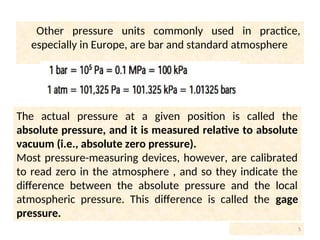
Other pressure units commonly used in practice,
especially in Europe, are bar and standard atmosphere
5
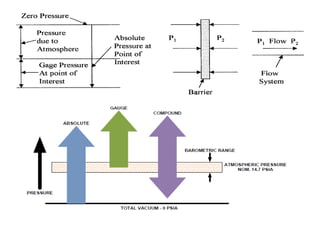
The actual pressure at a given position is called the
absolute pressure, and it is measured relative to absolute
vacuum (i.e., absolute zero pressure).
Most pressure-measuring devices, however, are calibrated
to read zero in the atmosphere , and so they indicate the
difference between the absolute pressure and the local
atmospheric pressure. This difference is called the gage
pressure.
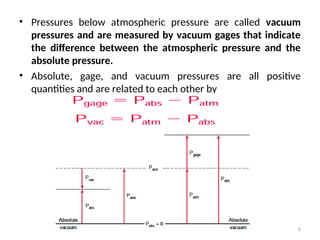
• Pressures below atmospheric pressure are called vacuum
pressures and are measured by vacuum gages that indicate
the difference between the atmospheric pressure and the
absolute pressure.
• Absolute, gage, and vacuum pressures are all positive
quantities and are related to each other by
6
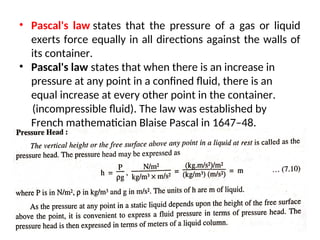
• Pascal's law states that the pressure of a gas or liquid
exerts force equally in all directions against the walls of
its container.
• Pascal's law states that when there is an increase in
pressure at any point in a confined fluid, there is an
equal increase at every other point in the container.
(incompressible fluid). The law was established by
French mathematician Blaise Pascal in 1647–48.
8
HYDROSTATIC EQULIBRIUM
• Hydrostatic balance occurs when compression due to gravity
is balanced by a pressure gradient force in the opposite
direction.
Derivation
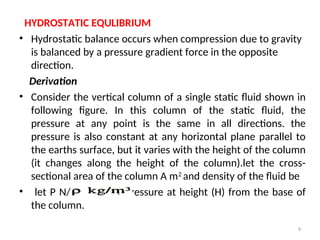
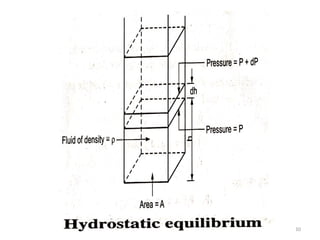
• Consider the vertical column of a single static fluid shown in
following figure. In this column of the static fluid, the
pressure at any point is the same in all directions. the
pressure is also constant at any horizontal plane parallel to
the earths surface, but it varies with the height of the column
(it changes along the height of the column).let the cross-
sectional area of the column A m2
and density of the fluid be
• let P N/ m2
be the pressure at height (H) from the base of
the column.
9
10
11
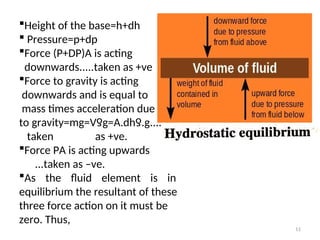
Height of the base=h+dh
 Pressure=p+dp
Force (P+DP)A is acting
downwards.....taken as +ve
Force to gravity is acting
downwards and is equal to
mass times acceleration due
to gravity=mg=Vƍg=A.dhƍ.g....
taken as +ve.
Force PA is acting upwards
...taken as –ve.
As the fluid element is in
equilibrium the resultant of these
three force action on it must be
zero. Thus,
12
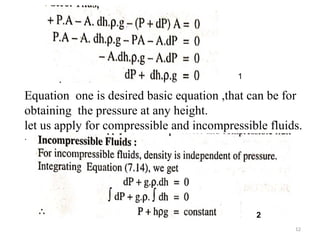
1
Equation one is desired basic equation ,that can be for
obtaining the pressure at any height.
let us apply for compressible and incompressible fluids.
.
2
13
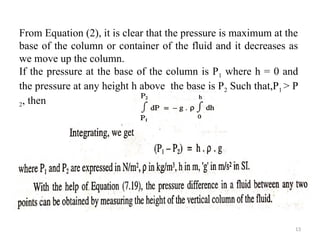
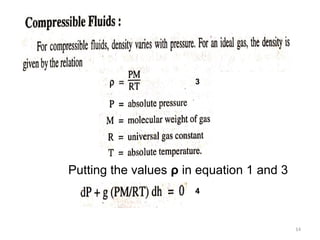
From Equation (2), it is clear that the pressure is maximum at the
base of the column or container of the fluid and it decreases as
we move up the column.
If the pressure at the base of the column is P1 where h = 0 and
the pressure at any height h above the base is P2 Such that,P1 > P
2, then
14
3
Putting the values ρ in equation 1 and 3
4
15
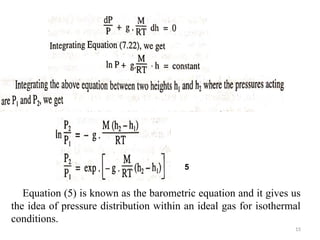
5
Equation (5) is known as the barometric equation and it gives us
the idea of pressure distribution within an ideal gas for isothermal
conditions.
16
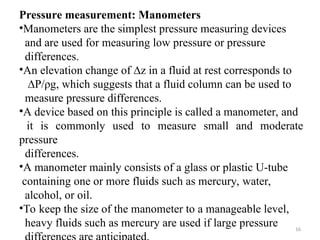
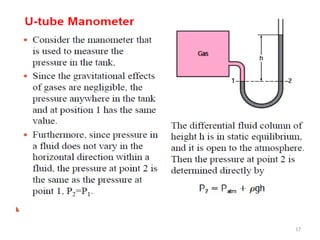
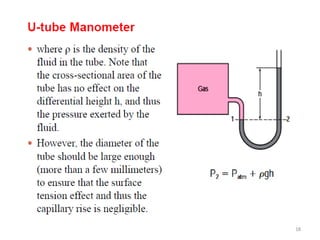
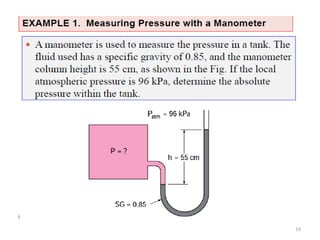
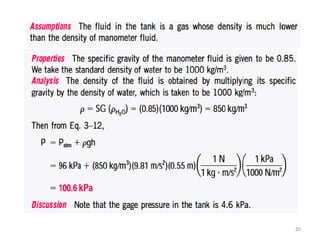
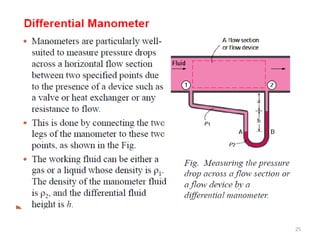
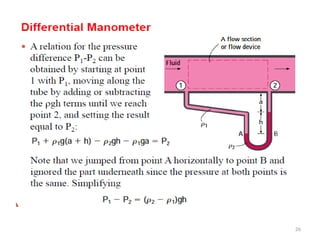
Pressure measurement: Manometers
•Manometers are the simplest pressure measuring devices
and are used for measuring low pressure or pressure
differences.
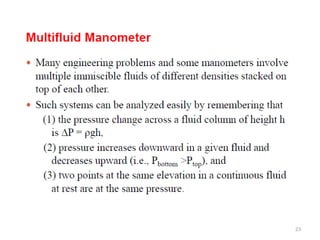
•An elevation change of ∆z in a fluid at rest corresponds to
∆P/ρg, which suggests that a fluid column can be used to
measure pressure differences.
•A device based on this principle is called a manometer, and
it is commonly used to measure small and moderate
pressure
differences.
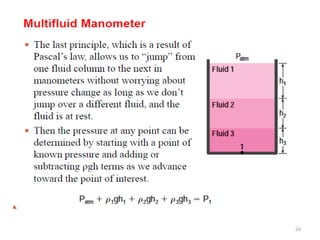
•A manometer mainly consists of a glass or plastic U-tube
containing one or more fluids such as mercury, water,
alcohol, or oil.
•To keep the size of the manometer to a manageable level,
heavy fluids such as mercury are used if large pressure
17
18
19
20
21
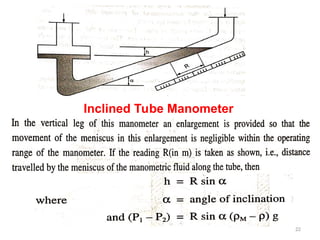
Inclined Manometer
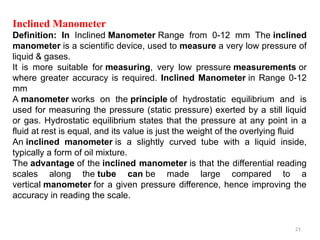
Definition: In Inclined Manometer Range from 0-12 mm The inclined
manometer is a scientific device, used to measure a very low pressure of
liquid & gases.
It is more suitable for measuring, very low pressure measurements or
where greater accuracy is required. Inclined Manometer in Range 0-12
mm
A manometer works on the principle of hydrostatic equilibrium and is
used for measuring the pressure (static pressure) exerted by a still liquid
or gas. Hydrostatic equilibrium states that the pressure at any point in a
fluid at rest is equal, and its value is just the weight of the overlying fluid
An inclined manometer is a slightly curved tube with a liquid inside,
typically a form of oil mixture.
The advantage of the inclined manometer is that the differential reading
scales along the tube can be made large compared to a
vertical manometer for a given pressure difference, hence improving the
accuracy in reading the scale.
22
Inclined Tube Manometer
23
24
25
26
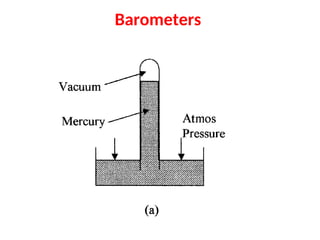
Barometers
•They are used for measuring atmospheric pressure. A
simple barometer is the mercury barometer shown in Fig.
a.
•It is now rarely used due to its fragility and the toxicity of
mercury.
•The aneroid (no fluid) barometer is favored for direct
reading and the solid-state absolute pressure sensor for
electrical outputs.
Barometers

fluid Mech unit-2.pppppppppppppppppppppt

  • 1.
    ARBAMINCH UNIVERSITY COLLEGE OFNATURAL SCIENCES DEPARTMENT OF CHEMISTRY Fluid Mechanics for Chemical Engineers Cheg 2152 Unit-2 Prepared By Dr.Ballekallu Fluid Statics
  • 2.
    Fluid Statics Instructor: Dr.Ballekallu Fluidstatics Introduction to pressure Pressure and Pascal’s law Pressure variation in static fluid – Hydrostatic equilibrium Pressure measurement- manometers, barometer. Solve Exercise problems. 2
  • 3.
    Introduction • This chapterdeals with forces applied by fluids at rest or in rigid-body motion(there is no relative motion between adjacent layers). • In both instances there will be no shearing stresses in the fluid, and the only forces that develop on the surfaces of the particles will be due to the pressure. • The fluid property responsible for those forces is pressure, which is a normal force exerted by a fluid per unit area. • Thus, our principal concern is to investigate pressure and its variation throughout a fluid and the effect of pressure on submerged surfaces. 3
  • 4.
    Pressure • Pressure isdefined as a normal force exerted by a fluid per unit area. • We speak of pressure only when we deal with a gas or a liquid. The counterpart of pressure in solids is normal stress. • Since pressure is defined as force per unit area, it has the unit of newtons per square meter (N/m2 ), which is called a Pascal (Pa). That is, 1 Pa = 1 N/m2 • The pressure unit Pascal is too small for pressures encountered in practice. Therefore, its multiples kilopascal (1 kPa =103 Pa) and mega-pascal (1 MPa =106 Pa) are commonly used. 4
  • 5.
    Other pressure unitscommonly used in practice, especially in Europe, are bar and standard atmosphere 5 The actual pressure at a given position is called the absolute pressure, and it is measured relative to absolute vacuum (i.e., absolute zero pressure). Most pressure-measuring devices, however, are calibrated to read zero in the atmosphere , and so they indicate the difference between the absolute pressure and the local atmospheric pressure. This difference is called the gage pressure.
  • 6.
    • Pressures belowatmospheric pressure are called vacuum pressures and are measured by vacuum gages that indicate the difference between the atmospheric pressure and the absolute pressure. • Absolute, gage, and vacuum pressures are all positive quantities and are related to each other by 6
  • 8.
    • Pascal's lawstates that the pressure of a gas or liquid exerts force equally in all directions against the walls of its container. • Pascal's law states that when there is an increase in pressure at any point in a confined fluid, there is an equal increase at every other point in the container. (incompressible fluid). The law was established by French mathematician Blaise Pascal in 1647–48. 8
  • 9.
    HYDROSTATIC EQULIBRIUM • Hydrostaticbalance occurs when compression due to gravity is balanced by a pressure gradient force in the opposite direction. Derivation • Consider the vertical column of a single static fluid shown in following figure. In this column of the static fluid, the pressure at any point is the same in all directions. the pressure is also constant at any horizontal plane parallel to the earths surface, but it varies with the height of the column (it changes along the height of the column).let the cross- sectional area of the column A m2 and density of the fluid be • let P N/ m2 be the pressure at height (H) from the base of the column. 9
  • 10.
  • 11.
    11 Height of thebase=h+dh  Pressure=p+dp Force (P+DP)A is acting downwards.....taken as +ve Force to gravity is acting downwards and is equal to mass times acceleration due to gravity=mg=Vƍg=A.dhƍ.g.... taken as +ve. Force PA is acting upwards ...taken as –ve. As the fluid element is in equilibrium the resultant of these three force action on it must be zero. Thus,
  • 12.
    12 1 Equation one isdesired basic equation ,that can be for obtaining the pressure at any height. let us apply for compressible and incompressible fluids. . 2
  • 13.
    13 From Equation (2),it is clear that the pressure is maximum at the base of the column or container of the fluid and it decreases as we move up the column. If the pressure at the base of the column is P1 where h = 0 and the pressure at any height h above the base is P2 Such that,P1 > P 2, then
  • 14.
    14 3 Putting the valuesρ in equation 1 and 3 4
  • 15.
    15 5 Equation (5) isknown as the barometric equation and it gives us the idea of pressure distribution within an ideal gas for isothermal conditions.
  • 16.
    16 Pressure measurement: Manometers •Manometersare the simplest pressure measuring devices and are used for measuring low pressure or pressure differences. •An elevation change of ∆z in a fluid at rest corresponds to ∆P/ρg, which suggests that a fluid column can be used to measure pressure differences. •A device based on this principle is called a manometer, and it is commonly used to measure small and moderate pressure differences. •A manometer mainly consists of a glass or plastic U-tube containing one or more fluids such as mercury, water, alcohol, or oil. •To keep the size of the manometer to a manageable level, heavy fluids such as mercury are used if large pressure
  • 17.
  • 18.
  • 19.
  • 20.
  • 21.
    21 Inclined Manometer Definition: InInclined Manometer Range from 0-12 mm The inclined manometer is a scientific device, used to measure a very low pressure of liquid & gases. It is more suitable for measuring, very low pressure measurements or where greater accuracy is required. Inclined Manometer in Range 0-12 mm A manometer works on the principle of hydrostatic equilibrium and is used for measuring the pressure (static pressure) exerted by a still liquid or gas. Hydrostatic equilibrium states that the pressure at any point in a fluid at rest is equal, and its value is just the weight of the overlying fluid An inclined manometer is a slightly curved tube with a liquid inside, typically a form of oil mixture. The advantage of the inclined manometer is that the differential reading scales along the tube can be made large compared to a vertical manometer for a given pressure difference, hence improving the accuracy in reading the scale.
  • 22.
  • 23.
  • 24.
  • 25.
  • 26.
  • 27.
    Barometers •They are usedfor measuring atmospheric pressure. A simple barometer is the mercury barometer shown in Fig. a. •It is now rarely used due to its fragility and the toxicity of mercury. •The aneroid (no fluid) barometer is favored for direct reading and the solid-state absolute pressure sensor for electrical outputs.

  • 28.