Presented To:
Honorable Teacher
Sir Engr. Muneeb
Presented By:
Sajid Ghafoor (2kx5-103)
Muhammad Shahid (2kx5-105)
Salman Hafeez (2kx5-106)
Hasnain Saeed (2kx5-116)
CONTENTS:
• Reynolds Number
• Definition
• Types
• Experiment
• Applications
• Pressure Head
• Definition
• Types
• Instruments & Measurements
• Application
REYNOLDS NUMBER
REYNOLDS NUMBERS
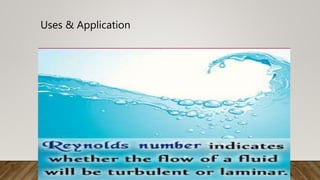
What is Reynolds Number?
The ratio between the internal forces and viscous forces.
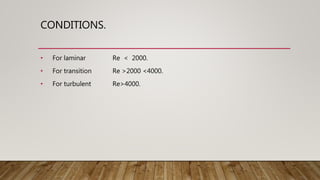
CONDITIONS.
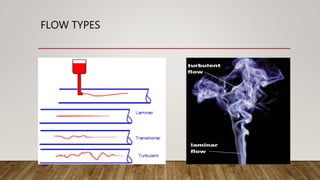
• For laminar Re < 2000.
• For transition Re >2000 <4000.
• For turbulent Re>4000.
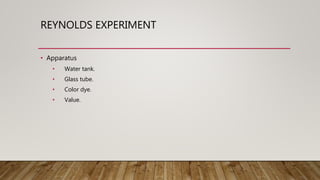
REYNOLDS EXPERIMENT
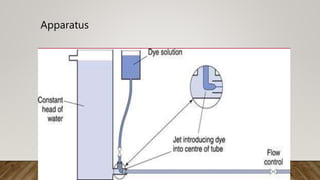
• Apparatus
• Water tank.
• Glass tube.
• Color dye.
• Value.
Apparatus
PROCEDURE
• Take water in container.
• Attach glass tube.
• Colour dye.
• Open the valve .
• Analyze the flow.
FLOW TYPES
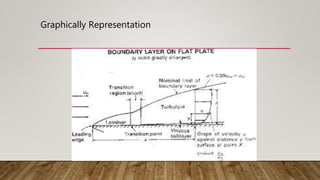
Graphically Representation
Graphically
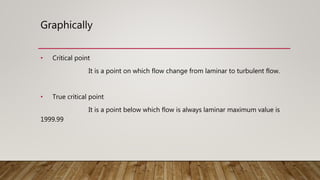
• Critical point
It is a point on which flow change from laminar to turbulent flow.
• True critical point
It is a point below which flow is always laminar maximum value is
1999.99
Conclusion
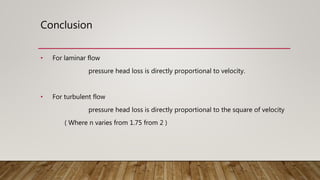
• For laminar flow
pressure head loss is directly proportional to velocity.
• For turbulent flow
pressure head loss is directly proportional to the square of velocity
( Where n varies from 1.75 from 2 )
Uses & Application
APPLICATION OF REYNOLDS NUMBER
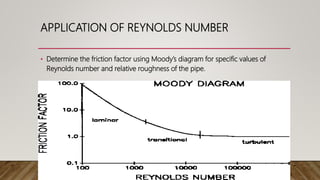
• Determine the friction factor using Moody’s diagram for specific values of
Reynolds number and relative roughness of the pipe.
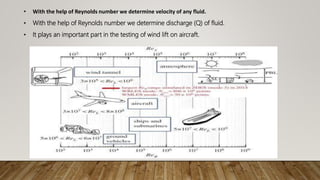
• With the help of Reynolds number we determine velocity of any fluid.
• With the help of Reynolds number we determine discharge (Q) of fluid.
• It plays an important part in the testing of wind lift on aircraft.
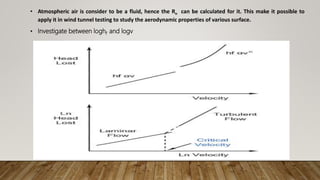
• Atmospheric air is consider to be a fluid, hence the Rn can be calculated for it. This make it possible to
apply it in wind tunnel testing to study the aerodynamic properties of various surface.
• Investigate between loghf and logv
• By the help of Reynolds number we control failure of fluid structure.
• Swimming pool design
PRESSURE HEAD
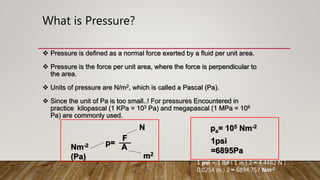
 Pressure is defined as a normal force exerted by a fluid per unit area.
 Pressure is the force per unit area, where the force is perpendicular to
the area.
 Units of pressure are N/m2, which is called a Pascal (Pa).
 Since the unit of Pa is too small..! For pressures Encountered in
practice kilopascal (1 KPa = 103 Pa) and megapascal (1 MPa = 106
Pa) are commonly used.
p=
A
m2
Nm-2
(Pa)
N
F
pa= 105 Nm-2
1psi
=6895Pa
1 psi = 1 lbf ( 1 in ) 2 ≈ 4.4482 N (
0.0254 m ) 2 ≈ 6894.757 Nm-2
What is Pressure?
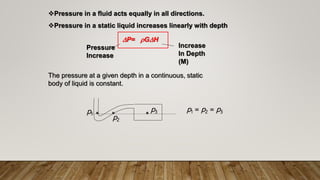
Pressure in a fluid acts equally in all directions.
Pressure in a static liquid increases linearly with depth
P=
Increase
In Depth
(M)
Pressure
Increase
GH
The pressure at a given depth in a continuous, static
body of liquid is constant.
p1
p2
p3 p1 = p2 = p3
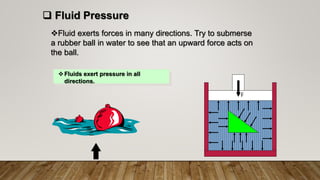
Fluid exerts forces in many directions. Try to submerse
a rubber ball in water to see that an upward force acts on
the ball.
Fluids exert pressure in all
directions.
 Fluid Pressure
F
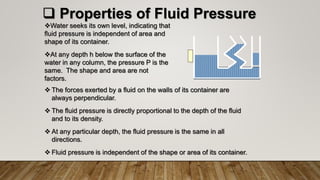
 Properties of Fluid Pressure
Water seeks its own level, indicating that
fluid pressure is independent of area and
shape of its container.
At any depth h below the surface of the
water in any column, the pressure P is the
same. The shape and area are not
factors.
 The forces exerted by a fluid on the walls of its container are
always perpendicular.
 The fluid pressure is directly proportional to the depth of the fluid
and to its density.
 At any particular depth, the fluid pressure is the same in all
directions.
 Fluid pressure is independent of the shape or area of its container.
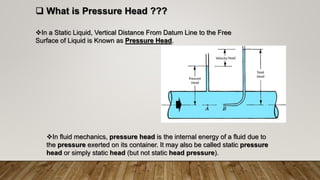
 What is Pressure Head ???
In a Static Liquid, Vertical Distance From Datum Line to the Free
Surface of Liquid is Known as Pressure Head.

In fluid mechanics, pressure head is the internal energy of a fluid due to
the pressure exerted on its container. It may also be called static pressure
head or simply static head (but not static head pressure).
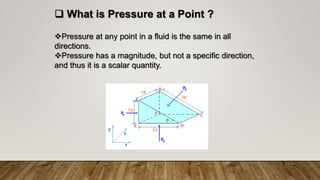
 What is Pressure at a Point ?
Pressure at any point in a fluid is the same in all
directions.
Pressure has a magnitude, but not a specific direction,
and thus it is a scalar quantity.
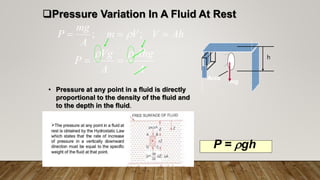
Pressure Variation In A Fluid At Rest
; ;
mg
P m V V Ah
A
  
Vg Ahg
P
A A
 
  h
mg
Area
P = gh
• Pressure at any point in a fluid is directly
proportional to the density of the fluid and
to the depth in the fluid.
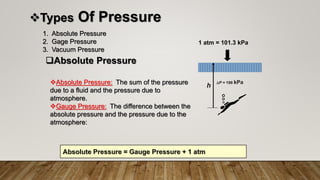
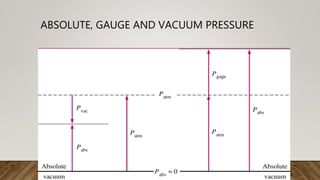
1. Absolute Pressure
2. Gage Pressure
3. Vacuum Pressure
Types Of Pressure
Absolute Pressure
Absolute Pressure: The sum of the pressure
due to a fluid and the pressure due to
atmosphere.
Gauge Pressure: The difference between the
absolute pressure and the pressure due to the
atmosphere:
Absolute Pressure = Gauge Pressure + 1 atm
h
P = 196 kPa
1 atm = 101.3 kPa
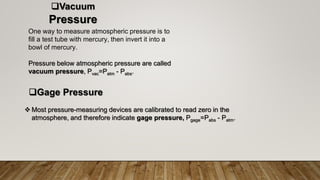
Vacuum
Pressure
One way to measure atmospheric pressure is to
fill a test tube with mercury, then invert it into a
bowl of mercury.
Pressure below atmospheric pressure are called
vacuum pressure, Pvac=Patm - Pabs.
Gage Pressure
 Most pressure-measuring devices are calibrated to read zero in the
atmosphere, and therefore indicate gage pressure, Pgage=Pabs - Patm.
ABSOLUTE, GAUGE AND VACUUM PRESSURE
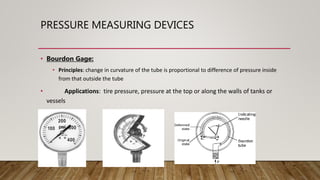
PRESSURE MEASURING DEVICES
• Bourdon Gage:
• Principles: change in curvature of the tube is proportional to difference of pressure inside
from that outside the tube
• Applications: tire pressure, pressure at the top or along the walls of tanks or
vessels
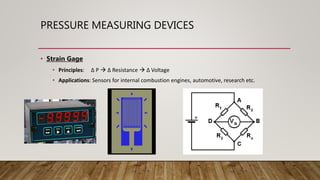
PRESSURE MEASURING DEVICES
• Strain Gage
• Principles: ∆ P  ∆ Resistance  ∆ Voltage
• Applications: Sensors for internal combustion engines, automotive, research etc.
PRESSURE MEASURING DEVICES
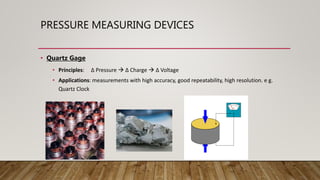
• Quartz Gage
• Principles: ∆ Pressure  ∆ Charge  ∆ Voltage
• Applications: measurements with high accuracy, good repeatability, high resolution. e g.
Quartz Clock
PRESSURE MEASURING DEVICES
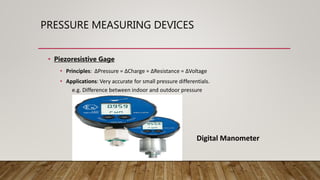
• Piezoresistive Gage
• Principles: ∆Pressure = ∆Charge = ∆Resistance = ∆Voltage
• Applications: Very accurate for small pressure differentials.
e.g. Difference between indoor and outdoor pressure
Digital Manometer
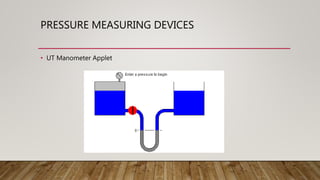
PRESSURE MEASURING DEVICES
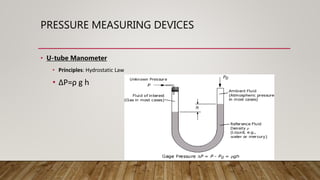
• U-tube Manometer
• Principles: Hydrostatic Law
• ∆P=ρ g h
PRESSURE MEASURING DEVICES
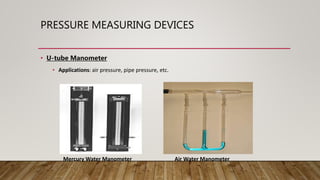
• U-tube Manometer
• Applications: air pressure, pipe pressure, etc.
Air Water ManometerMercury Water Manometer
PRESSURE MEASURING DEVICES
• UT Manometer Applet
Applications
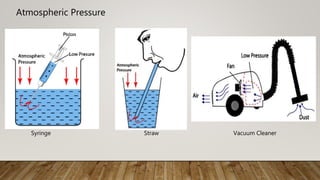
Syringe Straw Vacuum Cleaner
Atmospheric Pressure
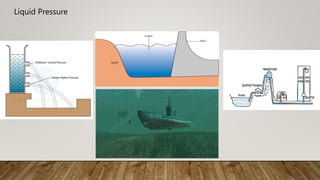
Liquid Pressure
Fluid mechanics (lab)

Fluid mechanics (lab)

  • 2.
    Presented To: Honorable Teacher SirEngr. Muneeb Presented By: Sajid Ghafoor (2kx5-103) Muhammad Shahid (2kx5-105) Salman Hafeez (2kx5-106) Hasnain Saeed (2kx5-116)
  • 3.
    CONTENTS: • Reynolds Number •Definition • Types • Experiment • Applications • Pressure Head • Definition • Types • Instruments & Measurements • Application
  • 4.
  • 5.
    REYNOLDS NUMBERS What isReynolds Number? The ratio between the internal forces and viscous forces.
  • 6.
    CONDITIONS. • For laminarRe < 2000. • For transition Re >2000 <4000. • For turbulent Re>4000.
  • 7.
    REYNOLDS EXPERIMENT • Apparatus •Water tank. • Glass tube. • Color dye. • Value.
  • 8.
  • 9.
    PROCEDURE • Take waterin container. • Attach glass tube. • Colour dye. • Open the valve . • Analyze the flow.
  • 10.
  • 11.
  • 12.
    Graphically • Critical point Itis a point on which flow change from laminar to turbulent flow. • True critical point It is a point below which flow is always laminar maximum value is 1999.99
  • 13.
    Conclusion • For laminarflow pressure head loss is directly proportional to velocity. • For turbulent flow pressure head loss is directly proportional to the square of velocity ( Where n varies from 1.75 from 2 )
  • 14.
  • 16.
    APPLICATION OF REYNOLDSNUMBER • Determine the friction factor using Moody’s diagram for specific values of Reynolds number and relative roughness of the pipe.
  • 17.
    • With thehelp of Reynolds number we determine velocity of any fluid. • With the help of Reynolds number we determine discharge (Q) of fluid. • It plays an important part in the testing of wind lift on aircraft.
  • 18.
    • Atmospheric airis consider to be a fluid, hence the Rn can be calculated for it. This make it possible to apply it in wind tunnel testing to study the aerodynamic properties of various surface. • Investigate between loghf and logv
  • 19.
    • By thehelp of Reynolds number we control failure of fluid structure. • Swimming pool design
  • 20.
  • 21.
     Pressure isdefined as a normal force exerted by a fluid per unit area.  Pressure is the force per unit area, where the force is perpendicular to the area.  Units of pressure are N/m2, which is called a Pascal (Pa).  Since the unit of Pa is too small..! For pressures Encountered in practice kilopascal (1 KPa = 103 Pa) and megapascal (1 MPa = 106 Pa) are commonly used. p= A m2 Nm-2 (Pa) N F pa= 105 Nm-2 1psi =6895Pa 1 psi = 1 lbf ( 1 in ) 2 ≈ 4.4482 N ( 0.0254 m ) 2 ≈ 6894.757 Nm-2 What is Pressure?
  • 22.
    Pressure in afluid acts equally in all directions. Pressure in a static liquid increases linearly with depth P= Increase In Depth (M) Pressure Increase GH The pressure at a given depth in a continuous, static body of liquid is constant. p1 p2 p3 p1 = p2 = p3
  • 23.
    Fluid exerts forcesin many directions. Try to submerse a rubber ball in water to see that an upward force acts on the ball. Fluids exert pressure in all directions.  Fluid Pressure F
  • 24.
     Properties ofFluid Pressure Water seeks its own level, indicating that fluid pressure is independent of area and shape of its container. At any depth h below the surface of the water in any column, the pressure P is the same. The shape and area are not factors.  The forces exerted by a fluid on the walls of its container are always perpendicular.  The fluid pressure is directly proportional to the depth of the fluid and to its density.  At any particular depth, the fluid pressure is the same in all directions.  Fluid pressure is independent of the shape or area of its container.
  • 25.
     What isPressure Head ??? In a Static Liquid, Vertical Distance From Datum Line to the Free Surface of Liquid is Known as Pressure Head. In fluid mechanics, pressure head is the internal energy of a fluid due to the pressure exerted on its container. It may also be called static pressure head or simply static head (but not static head pressure).
  • 26.
     What isPressure at a Point ? Pressure at any point in a fluid is the same in all directions. Pressure has a magnitude, but not a specific direction, and thus it is a scalar quantity.
  • 27.
    Pressure Variation InA Fluid At Rest ; ; mg P m V V Ah A    Vg Ahg P A A     h mg Area P = gh • Pressure at any point in a fluid is directly proportional to the density of the fluid and to the depth in the fluid.
  • 28.
    1. Absolute Pressure 2.Gage Pressure 3. Vacuum Pressure Types Of Pressure Absolute Pressure Absolute Pressure: The sum of the pressure due to a fluid and the pressure due to atmosphere. Gauge Pressure: The difference between the absolute pressure and the pressure due to the atmosphere: Absolute Pressure = Gauge Pressure + 1 atm h P = 196 kPa 1 atm = 101.3 kPa
  • 29.
    Vacuum Pressure One way tomeasure atmospheric pressure is to fill a test tube with mercury, then invert it into a bowl of mercury. Pressure below atmospheric pressure are called vacuum pressure, Pvac=Patm - Pabs. Gage Pressure  Most pressure-measuring devices are calibrated to read zero in the atmosphere, and therefore indicate gage pressure, Pgage=Pabs - Patm.
  • 30.
    ABSOLUTE, GAUGE ANDVACUUM PRESSURE
  • 31.
    PRESSURE MEASURING DEVICES •Bourdon Gage: • Principles: change in curvature of the tube is proportional to difference of pressure inside from that outside the tube • Applications: tire pressure, pressure at the top or along the walls of tanks or vessels
  • 32.
    PRESSURE MEASURING DEVICES •Strain Gage • Principles: ∆ P  ∆ Resistance  ∆ Voltage • Applications: Sensors for internal combustion engines, automotive, research etc.
  • 33.
    PRESSURE MEASURING DEVICES •Quartz Gage • Principles: ∆ Pressure  ∆ Charge  ∆ Voltage • Applications: measurements with high accuracy, good repeatability, high resolution. e g. Quartz Clock
  • 34.
    PRESSURE MEASURING DEVICES •Piezoresistive Gage • Principles: ∆Pressure = ∆Charge = ∆Resistance = ∆Voltage • Applications: Very accurate for small pressure differentials. e.g. Difference between indoor and outdoor pressure Digital Manometer
  • 35.
    PRESSURE MEASURING DEVICES •U-tube Manometer • Principles: Hydrostatic Law • ∆P=ρ g h
  • 36.
    PRESSURE MEASURING DEVICES •U-tube Manometer • Applications: air pressure, pipe pressure, etc. Air Water ManometerMercury Water Manometer
  • 37.
    PRESSURE MEASURING DEVICES •UT Manometer Applet
  • 38.
  • 39.
    Syringe Straw VacuumCleaner Atmospheric Pressure
  • 40.