Ministry of Higher Education & Scientific Research
Foundation of Technical Education
Technical College of Basrah
CH2: Hydrostatic Pressure
Training Package
in
Fluid Mechanics
Modular unit 2
Hydrostatic Pressure
By
Risala A. Mohammed
M.Sc. Civil Engineering
Asst. Lect.
Environmental & Pollution Engineering Department
2011
Dr. Risalah A. Mohammed
1- Over view
1-1 Target population
CH.1: fluid properties
For the students of second class in
Environmental engineering Department in
Technical College
1-2 Rationale
CH2: Hydrostatic Pressure
The study of static pressure of the fluids is
very important in industrial applications and
measuring the pressure inside the pipe and the walls
of the tanks containing the fluid. In addition to
identify the devices that used to measure the
pressure of fluids and their use in applied fields.
1-3 Central Idea
CH2: Hydrostatic Pressure
The main goal of this chapter are:
1- Define the hydrostatic pressure.
2-Know the pressure devices measurement.
1-4 Instructions
CH.1: fluid properties
1- Study over view thoroughly
2- Identify the goal of this modular unit
3- Do the Pretest and if you :-
*Get 9 or more you do not need to proceed
*Get less than 9 you have to study this modular
4- After studying the text of this modular unit , do the post test
and if you :-
*Get 9 or more , so go on studying modular unit three
*Get less than 9 , go back and study the modular unit two
1-5 Performance Objectives
CH2: Hydrostatic Pressure
At the end of this modular unit the student will be able
to :-
1- Define the hydrostatic pressure and its unit.
2- Know the pascal’s law
3- Calculate the pressure at point in the liquid.
4- Describe the pressure devices
5- Calculate the pressure of liquid by using manometers.
2- Pre test
-
CH2: Hydrostatic Pressure
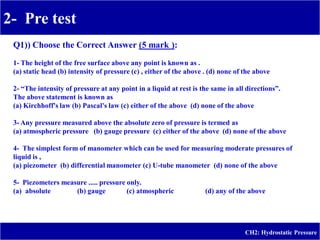
Q1)) Choose the Correct Answer (5 mark ):
1- The height of the free surface above any point is known as .
(a) static head (b) intensity of pressure (c) , either of the above . (d) none of the above
2- “The intensity of pressure at any point in a liquid at rest is the same in all directions”.
The above statement is known as
(a) Kirchhoff's law (b) Pascal's law (c) either of the above (d) none of the above
3- Any pressure measured above the absolute zero of pressure is termed as
(a) atmospheric pressure (b) gauge pressure (c) either of the above (d) none of the above
4- The simplest form of manometer which can be used for measuring moderate pressures of
liquid is ,
(a) piezometer (b) differential manometer (c) U-tube manometer (d) none of the above
5- Piezometers measure ..... pressure only.
(a) absolute (b) gauge (c) atmospheric (d) any of the above
Pre test
-
CH2: Hydrostatic Pressure
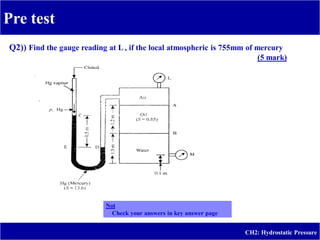
Q2)) Find the gauge reading at L , if the local atmospheric is 755mm of mercury
mark)
5
(
Not
Check your answers in key answer page
3- The Text
3-1 Introduction
-
CH2: Hydrostatic Pressure
 Pressure is defined as a normal force exerted by a fluid
per unit area.
 Units of pressure are N/m2, which is called a Pascal (Pa).
 Since the unit Pa is too small for pressures encountered
in practice, kilopascal (1 kPa = 103 Pa) and megapascal
(1 MPa = 106 Pa) are commonly used.
 Other units include bar, atm, kgf/cm2, lbf/in2=psi
3-2 Absolute, gage, and vacuum pressures
-
CH2: Hydrostatic Pressure
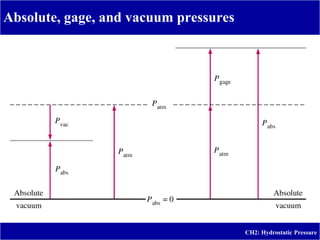
 Actual pressure at a give point is called the absolute pressure.
 Most pressure-measuring devices are calibrated to read zero
in the atmosphere, and therefore indicate gage pressure,
Pgage=Pabs - Patm.
 Pressure below atmospheric pressure are called vacuum
pressure, Pvac=Patm - Pabs.
Absolute, gage, and vacuum pressures
-
CH2: Hydrostatic Pressure
3-3 Pressure at a Point
-
CH2: Hydrostatic Pressure
 Pressure at any point in a fluid is the same in all directions.
 Pressure has a magnitude, but not a specific direction, and thus it is a scalar quantity.
Pascal’s Law
Pressure is the normal force per unit area at a given point acting on a given plane
within a fluid mass of interest.
p is average pressure in the x, y, and z direction.
Ps is the average pressure on the surface
q is the plane inclination

is the length is each coordinate direction, x, y, z
ds is the length of the plane
g is the specific weight
Pressure at a Point
-
CH2: Hydrostatic Pressure
p1xs
psxs
p2x
s
ps = p1 = p2
Note: In dynamic system subject to shear, the normal stress representing the
pressure in the fluid is not necessarily the same in all directions. In such a case the
pressure is taken as the average of the three directions.
3-4 Variation of Pressure with Depth
-
CH2: Hydrostatic Pressure
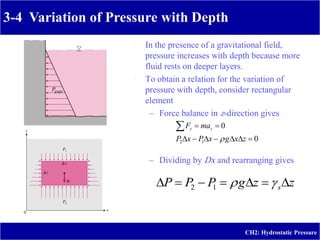
 In the presence of a gravitational field,
pressure increases with depth because more
fluid rests on deeper layers.
 To obtain a relation for the variation of
pressure with depth, consider rectangular
element
– Force balance in z-direction gives
– Dividing by Dx and rearranging gives
2 1
0
0
z z
F ma
P x P x g x z

 
      

2 1 s
P P P g z z
 
      
Variation of Pressure with Depth
-
CH2: Hydrostatic Pressure
 Pressure changes with elevation
 Pressure does not change in the horizontal x-y plane
 The pressure gradient in the vertical direction is negative
 The pressure decreases as we move upward in a fluid at rest
 Pressure in a liquid does not change due to the shape of the container
 Specific Weight g does not have to be constant in a fluid at rest
 Air and other gases will likely have a varying g
 Thus, fluids could be incompressible or compressible statically
3-5 Hydrostatic Condition: Incompressible Fluids
-
CH2: Hydrostatic Pressure
If we are working exclusively with a liquid, then there is a free surface at
the liquid-gas interface. For most applications, the pressure exerted at
the surface is atmospheric pressure, po. Then the equation is written as
follows:
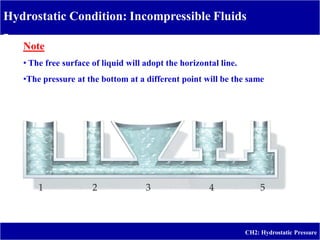
The Pressure in a homogenous, incompressible fluid at rest depends on the
depth of the fluid relative to some reference and is not influenced by the
shape of the container.
p = po
p = p1
p = p2
For p2 = p = h + po
h1
For p1 = p = h1 + po
Hydrostatic Condition: Incompressible Fluids
-
CH2: Hydrostatic Pressure
Note
• The free surface of liquid will adopt the horizontal line.
•The pressure at the bottom at a different point will be the same
3-6 Pressure measurement: Manometers
-
CH2: Hydrostatic Pressure
Manometers is a standard technique for measuring pressure using liquid columns
in vertical or include tubes
1. The operation of three types of manometers will be discussed today:
2. The Piezometer Tube
3. The U-Tube Manometer
4. The Inclined Tube Manometer
The fundamental equation for manometers since they involve columns of
fluid at rest is the following:
h is positive moving downward, and negative moving upward, that is pressure in
columns of fluid decrease with gains in height, and increase with gain in depth.
3-6-1 Piezometer Tube
-
CH2: Hydrostatic Pressure
pA (abs)
Moving from left to right: pA(abs) - 1h1 = po
po
Move Up the
Tube
Rearranging: 1
1h
p
p o
A 


Gage Pressure
Disadvantages:
1)The pressure in the container has to be greater than
atmospheric pressure.
2) Pressure must be relatively small to maintain a small
column of fluid.
3) The measurement of pressure must be of a liquid.
Note: pA = p1 because they are at the same level
“Container”
3-6-2 U-Tube Manometer
-
CH2: Hydrostatic Pressure
pA
Since, one end is open we can work entirely in gage pressure:
Moving from left to right: pA + g1h1 = 0
- g2h2
Then the equation for the pressure in the container is the following:
If the fluid in the container is a gas, then the fluid 1 terms can be ignored:
Note: in the same fluid we can “jump” across from 2 to 3 as
they are at the same level, and thus must have the same
pressure.
The fluid in the U-tube is known as the gage fluid. The gage
fluid type depends on the application, i.e. pressures attained,
and whether the fluid measured is a gas or liquid.
3-6-3 Differential Manometer
-
CH2: Hydrostatic Pressure
Measuring a Pressure Differential
pA
pB
Closed End
“Container”
Closed End
“Container”
Moving from left to right: pA + g1h1 - g2h2 = pB
- g3h3
Then the equation for the pressure difference in the container is the following:
Final notes:
1)Common gage fluids are Hg and
Water, some oils, and must be
immiscible.
2)Temp. must be considered in very
accurate measurements, as the gage
fluid properties can change.
3) Capillarity can play a role, but in
many cases each meniscus will cancel.
3-6-4 Inclined-Tube Manometer
-
CH2: Hydrostatic Pressure
This type of manometer is used to measure small pressure changes.
pA
pB
Moving from left to right: pA + g1h1 - g2h2 = pB
- g3h3
h2
q
q
h2
l2
2
2
sin
l
h

 
sin
2
2 l
h 
Substituting for h2:
Rearranging to Obtain the Difference:
If the pressure difference is between gases:
Thus, for the length of the tube we can measure a greater pressure differential.
3-6-5 The Barometer
-
CH2: Hydrostatic Pressure
 Atmospheric pressure is
measured by a device called a
barometer; thus, atmospheric
pressure is often referred to as
the barometric pressure.
 PC can be taken to be zero since
there is only Hg vapor above
point C, and it is very low
relative to Patm.
 Change in atmospheric pressure
due to elevation has many
effects: Cooking, nose bleeds,
engine performance, aircraft
performance.
C atm
atm
P gh P
P gh


 

3-6-6 Bourdon Gauge (Mechanical)
-
CH2: Hydrostatic Pressure
Key concept: pressure
difference across different
areas of inner and outer
surfaces causes crescent to flex
Example(1)
CH2: Hydrostatic Pressure
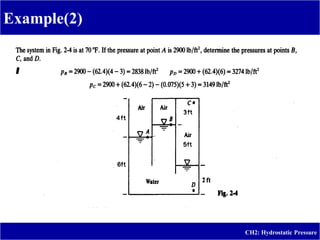
Example(2)
CH2: Hydrostatic Pressure
Example(3)
CH2: Hydrostatic Pressure
Example(4)
CH2: Hydrostatic Pressure
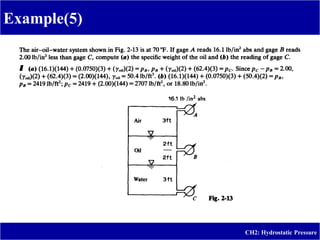
Example(5)
CH2: Hydrostatic Pressure
Example(6)
CH2: Hydrostatic Pressure
Example(7)
CH2: Hydrostatic Pressure
Example(8)
CH2: Hydrostatic Pressure
.
Solution
Sp. gravity of liquid B:
Pressure at L = pressure at M
-18+(1.5 x 9.81 x 0.6)=PM
PM=-9.17 kN/m2
Between points M and U, since there is an air
column which can be neglected, therefore,
. PM=Pu (=-9.17kN/m2)
Also, pressure at N = pressure at T ,
But point T being at atmosatmospheric pressure,
PT = 0 = PN
Thus PN=PU + S x 9.81 x 0. 8 =0
or 0 =- 9.17 + 7.848 S
S = 1.17 (Ans.)
4- Post test
CH2: Hydrostatic Pressure
Q1))
Determine specific gravity o the gage liquid B if the pressure at A is 18 kNm2
(5 mark)
Post test
CH2: Hydrostatic Pressure
Q2// (5 mark)
For a gage reading at A of -2.50 psi, determine the (a) elevations of the liquids in the
open piezometer columns E, F, and G and (b) deflection of the mercury in the U-tube
gage . Neglect the weight of the air
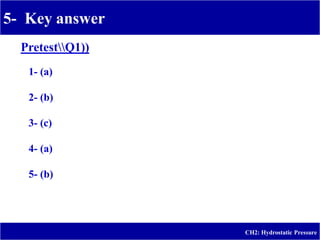
5- Key answer
CH2: Hydrostatic Pressure
PretestQ1))
1- (a)
2- (b)
3- (c)
4- (a)
5- (b)
Key answer
CH2: Hydrostatic Pressure
Q2))
Key answer
CH2: Hydrostatic Pressure
))
1
Q


test
Post
.
Solution
Sp. gravity of liquid B:
Pressure at L = pressure at M
-18+(1.5 x 9.81 x 0.6)=PM
PM=-9.17 kN/m2
Between points M and U, since there is an air
column which can be neglected, therefore,
. PM=PU (=-9.17kN/m2)
Also, pressure at N = pressure at T ,
But point T being at atmospheric pressure,
PT = 0 = PN
Thus PN=PU + S x 9.81 x 0. 8 =0
or 0 =- 9.17 + 7.848 S
S = 1.17 (Ans.)
Key answer
CH2: Hydrostatic Pressure
))
2
Q


Post test
6- References
CH1: Fluid Properties
1. Evett, J., B. and Liu, C. 1989 “2500 solved problems in fluid mechanics and
hydraulics” Library of Congress Cataloging- in-Publication Data, (Schaum's
solved problems series) ISBN 0-07-019783-0
2. Rajput, R.,K. 2000 “ A Text Book of Fluid Mechanics and Hydraulic
Machines”. S.Chand & Company LTD.
3. White, F., M. 2000 “ Fluid Mechanics”. McGraw-Hill Series in Mechanical
Engineering.
4. Wily, S., 1983 “ Fluid Mechanics”. McGraw-Hill Series in Mechanical
Engineering.

Hydrostatic pressure

  • 1.
    Ministry of HigherEducation & Scientific Research Foundation of Technical Education Technical College of Basrah CH2: Hydrostatic Pressure Training Package in Fluid Mechanics Modular unit 2 Hydrostatic Pressure By Risala A. Mohammed M.Sc. Civil Engineering Asst. Lect. Environmental & Pollution Engineering Department 2011 Dr. Risalah A. Mohammed
  • 2.
    1- Over view 1-1Target population CH.1: fluid properties For the students of second class in Environmental engineering Department in Technical College
  • 3.
    1-2 Rationale CH2: HydrostaticPressure The study of static pressure of the fluids is very important in industrial applications and measuring the pressure inside the pipe and the walls of the tanks containing the fluid. In addition to identify the devices that used to measure the pressure of fluids and their use in applied fields.
  • 4.
    1-3 Central Idea CH2:Hydrostatic Pressure The main goal of this chapter are: 1- Define the hydrostatic pressure. 2-Know the pressure devices measurement.
  • 5.
    1-4 Instructions CH.1: fluidproperties 1- Study over view thoroughly 2- Identify the goal of this modular unit 3- Do the Pretest and if you :- *Get 9 or more you do not need to proceed *Get less than 9 you have to study this modular 4- After studying the text of this modular unit , do the post test and if you :- *Get 9 or more , so go on studying modular unit three *Get less than 9 , go back and study the modular unit two
  • 6.
    1-5 Performance Objectives CH2:Hydrostatic Pressure At the end of this modular unit the student will be able to :- 1- Define the hydrostatic pressure and its unit. 2- Know the pascal’s law 3- Calculate the pressure at point in the liquid. 4- Describe the pressure devices 5- Calculate the pressure of liquid by using manometers.
  • 7.
    2- Pre test - CH2:Hydrostatic Pressure Q1)) Choose the Correct Answer (5 mark ): 1- The height of the free surface above any point is known as . (a) static head (b) intensity of pressure (c) , either of the above . (d) none of the above 2- “The intensity of pressure at any point in a liquid at rest is the same in all directions”. The above statement is known as (a) Kirchhoff's law (b) Pascal's law (c) either of the above (d) none of the above 3- Any pressure measured above the absolute zero of pressure is termed as (a) atmospheric pressure (b) gauge pressure (c) either of the above (d) none of the above 4- The simplest form of manometer which can be used for measuring moderate pressures of liquid is , (a) piezometer (b) differential manometer (c) U-tube manometer (d) none of the above 5- Piezometers measure ..... pressure only. (a) absolute (b) gauge (c) atmospheric (d) any of the above
  • 8.
    Pre test - CH2: HydrostaticPressure Q2)) Find the gauge reading at L , if the local atmospheric is 755mm of mercury mark) 5 ( Not Check your answers in key answer page
  • 9.
    3- The Text 3-1Introduction - CH2: Hydrostatic Pressure  Pressure is defined as a normal force exerted by a fluid per unit area.  Units of pressure are N/m2, which is called a Pascal (Pa).  Since the unit Pa is too small for pressures encountered in practice, kilopascal (1 kPa = 103 Pa) and megapascal (1 MPa = 106 Pa) are commonly used.  Other units include bar, atm, kgf/cm2, lbf/in2=psi
  • 10.
    3-2 Absolute, gage,and vacuum pressures - CH2: Hydrostatic Pressure  Actual pressure at a give point is called the absolute pressure.  Most pressure-measuring devices are calibrated to read zero in the atmosphere, and therefore indicate gage pressure, Pgage=Pabs - Patm.  Pressure below atmospheric pressure are called vacuum pressure, Pvac=Patm - Pabs.
  • 11.
    Absolute, gage, andvacuum pressures - CH2: Hydrostatic Pressure
  • 12.
    3-3 Pressure ata Point - CH2: Hydrostatic Pressure  Pressure at any point in a fluid is the same in all directions.  Pressure has a magnitude, but not a specific direction, and thus it is a scalar quantity. Pascal’s Law Pressure is the normal force per unit area at a given point acting on a given plane within a fluid mass of interest. p is average pressure in the x, y, and z direction. Ps is the average pressure on the surface q is the plane inclination  is the length is each coordinate direction, x, y, z ds is the length of the plane g is the specific weight
  • 13.
    Pressure at aPoint - CH2: Hydrostatic Pressure p1xs psxs p2x s ps = p1 = p2 Note: In dynamic system subject to shear, the normal stress representing the pressure in the fluid is not necessarily the same in all directions. In such a case the pressure is taken as the average of the three directions.
  • 14.
    3-4 Variation ofPressure with Depth - CH2: Hydrostatic Pressure  In the presence of a gravitational field, pressure increases with depth because more fluid rests on deeper layers.  To obtain a relation for the variation of pressure with depth, consider rectangular element – Force balance in z-direction gives – Dividing by Dx and rearranging gives 2 1 0 0 z z F ma P x P x g x z            2 1 s P P P g z z         
  • 15.
    Variation of Pressurewith Depth - CH2: Hydrostatic Pressure  Pressure changes with elevation  Pressure does not change in the horizontal x-y plane  The pressure gradient in the vertical direction is negative  The pressure decreases as we move upward in a fluid at rest  Pressure in a liquid does not change due to the shape of the container  Specific Weight g does not have to be constant in a fluid at rest  Air and other gases will likely have a varying g  Thus, fluids could be incompressible or compressible statically
  • 16.
    3-5 Hydrostatic Condition:Incompressible Fluids - CH2: Hydrostatic Pressure If we are working exclusively with a liquid, then there is a free surface at the liquid-gas interface. For most applications, the pressure exerted at the surface is atmospheric pressure, po. Then the equation is written as follows: The Pressure in a homogenous, incompressible fluid at rest depends on the depth of the fluid relative to some reference and is not influenced by the shape of the container. p = po p = p1 p = p2 For p2 = p = h + po h1 For p1 = p = h1 + po
  • 17.
    Hydrostatic Condition: IncompressibleFluids - CH2: Hydrostatic Pressure Note • The free surface of liquid will adopt the horizontal line. •The pressure at the bottom at a different point will be the same
  • 18.
    3-6 Pressure measurement:Manometers - CH2: Hydrostatic Pressure Manometers is a standard technique for measuring pressure using liquid columns in vertical or include tubes 1. The operation of three types of manometers will be discussed today: 2. The Piezometer Tube 3. The U-Tube Manometer 4. The Inclined Tube Manometer The fundamental equation for manometers since they involve columns of fluid at rest is the following: h is positive moving downward, and negative moving upward, that is pressure in columns of fluid decrease with gains in height, and increase with gain in depth.
  • 19.
    3-6-1 Piezometer Tube - CH2:Hydrostatic Pressure pA (abs) Moving from left to right: pA(abs) - 1h1 = po po Move Up the Tube Rearranging: 1 1h p p o A    Gage Pressure Disadvantages: 1)The pressure in the container has to be greater than atmospheric pressure. 2) Pressure must be relatively small to maintain a small column of fluid. 3) The measurement of pressure must be of a liquid. Note: pA = p1 because they are at the same level “Container”
  • 20.
    3-6-2 U-Tube Manometer - CH2:Hydrostatic Pressure pA Since, one end is open we can work entirely in gage pressure: Moving from left to right: pA + g1h1 = 0 - g2h2 Then the equation for the pressure in the container is the following: If the fluid in the container is a gas, then the fluid 1 terms can be ignored: Note: in the same fluid we can “jump” across from 2 to 3 as they are at the same level, and thus must have the same pressure. The fluid in the U-tube is known as the gage fluid. The gage fluid type depends on the application, i.e. pressures attained, and whether the fluid measured is a gas or liquid.
  • 21.
    3-6-3 Differential Manometer - CH2:Hydrostatic Pressure Measuring a Pressure Differential pA pB Closed End “Container” Closed End “Container” Moving from left to right: pA + g1h1 - g2h2 = pB - g3h3 Then the equation for the pressure difference in the container is the following: Final notes: 1)Common gage fluids are Hg and Water, some oils, and must be immiscible. 2)Temp. must be considered in very accurate measurements, as the gage fluid properties can change. 3) Capillarity can play a role, but in many cases each meniscus will cancel.
  • 22.
    3-6-4 Inclined-Tube Manometer - CH2:Hydrostatic Pressure This type of manometer is used to measure small pressure changes. pA pB Moving from left to right: pA + g1h1 - g2h2 = pB - g3h3 h2 q q h2 l2 2 2 sin l h    sin 2 2 l h  Substituting for h2: Rearranging to Obtain the Difference: If the pressure difference is between gases: Thus, for the length of the tube we can measure a greater pressure differential.
  • 23.
    3-6-5 The Barometer - CH2:Hydrostatic Pressure  Atmospheric pressure is measured by a device called a barometer; thus, atmospheric pressure is often referred to as the barometric pressure.  PC can be taken to be zero since there is only Hg vapor above point C, and it is very low relative to Patm.  Change in atmospheric pressure due to elevation has many effects: Cooking, nose bleeds, engine performance, aircraft performance. C atm atm P gh P P gh     
  • 24.
    3-6-6 Bourdon Gauge(Mechanical) - CH2: Hydrostatic Pressure Key concept: pressure difference across different areas of inner and outer surfaces causes crescent to flex
  • 25.
  • 26.
  • 27.
  • 28.
  • 29.
  • 30.
  • 31.
  • 32.
    Example(8) CH2: Hydrostatic Pressure . Solution Sp.gravity of liquid B: Pressure at L = pressure at M -18+(1.5 x 9.81 x 0.6)=PM PM=-9.17 kN/m2 Between points M and U, since there is an air column which can be neglected, therefore, . PM=Pu (=-9.17kN/m2) Also, pressure at N = pressure at T , But point T being at atmosatmospheric pressure, PT = 0 = PN Thus PN=PU + S x 9.81 x 0. 8 =0 or 0 =- 9.17 + 7.848 S S = 1.17 (Ans.)
  • 33.
    4- Post test CH2:Hydrostatic Pressure Q1)) Determine specific gravity o the gage liquid B if the pressure at A is 18 kNm2 (5 mark)
  • 34.
    Post test CH2: HydrostaticPressure Q2// (5 mark) For a gage reading at A of -2.50 psi, determine the (a) elevations of the liquids in the open piezometer columns E, F, and G and (b) deflection of the mercury in the U-tube gage . Neglect the weight of the air
  • 35.
    5- Key answer CH2:Hydrostatic Pressure PretestQ1)) 1- (a) 2- (b) 3- (c) 4- (a) 5- (b)
  • 36.
  • 37.
    Key answer CH2: HydrostaticPressure )) 1 Q test Post . Solution Sp. gravity of liquid B: Pressure at L = pressure at M -18+(1.5 x 9.81 x 0.6)=PM PM=-9.17 kN/m2 Between points M and U, since there is an air column which can be neglected, therefore, . PM=PU (=-9.17kN/m2) Also, pressure at N = pressure at T , But point T being at atmospheric pressure, PT = 0 = PN Thus PN=PU + S x 9.81 x 0. 8 =0 or 0 =- 9.17 + 7.848 S S = 1.17 (Ans.)
  • 38.
    Key answer CH2: HydrostaticPressure )) 2 Q Post test
  • 39.
    6- References CH1: FluidProperties 1. Evett, J., B. and Liu, C. 1989 “2500 solved problems in fluid mechanics and hydraulics” Library of Congress Cataloging- in-Publication Data, (Schaum's solved problems series) ISBN 0-07-019783-0 2. Rajput, R.,K. 2000 “ A Text Book of Fluid Mechanics and Hydraulic Machines”. S.Chand & Company LTD. 3. White, F., M. 2000 “ Fluid Mechanics”. McGraw-Hill Series in Mechanical Engineering. 4. Wily, S., 1983 “ Fluid Mechanics”. McGraw-Hill Series in Mechanical Engineering.