Chapter 3
Prescriptive Process
Models

       - Generic process framework (revisited)
       - Traditional process models
       - Specialized process models
       - The unified process
Generic Process Framework

 Communication
    Involves communication among the customer and other stake holders;
     encompasses requirements gathering
 Planning
    Establishes a plan for software engineering work; addresses technical
     tasks, resources, work products, and work schedule
 Modelling (Analyze, Design)
    Encompasses the creation of models to better under the requirements and
     the design
 Construction (Code, Test)
    Combines code generation and testing to uncover errors
 Deployment
    Involves delivery of software to the customer for evaluation and feedback

                                                                             2
Modeling: Software
Requirements Analysis
 Helps software engineers to better understand the problem they
  will work to solve
 Encompasses the set of tasks that lead to an understanding of
  what the business impact of the software will be, what the
  customer wants, and how end-users will interact with the
  software
 Uses a combination of text and diagrams to depict requirements
  for data, function, and behavior
    Provides a relatively easy way to understand and review
     requirements for correctness, completeness and consistency


                                                                  3
Modeling: Software Design


 Form the “blueprint” for a product
 Creates a model that that provides detail about software data structures,
  software architecture, interfaces, and components that are necessary to
  implement the system
 Architectural design
     Represents the structure of data and program components that are required
      to build the software
 User Interface Design
     Creates an effective communication medium between a human and a
      computer
 Component-level Design
     Defines the data structures, algorithms, interface characteristics, and
      communication mechanisms allocated to each software component


                                                                                4
Traditional Process Models
Prescriptive Process Model

 Defines a distinct set of activities, actions, tasks, milestones,
  and work products that are required to engineer high-quality
  software
 The activities may be linear, incremental, or evolutionary


                                                                      6
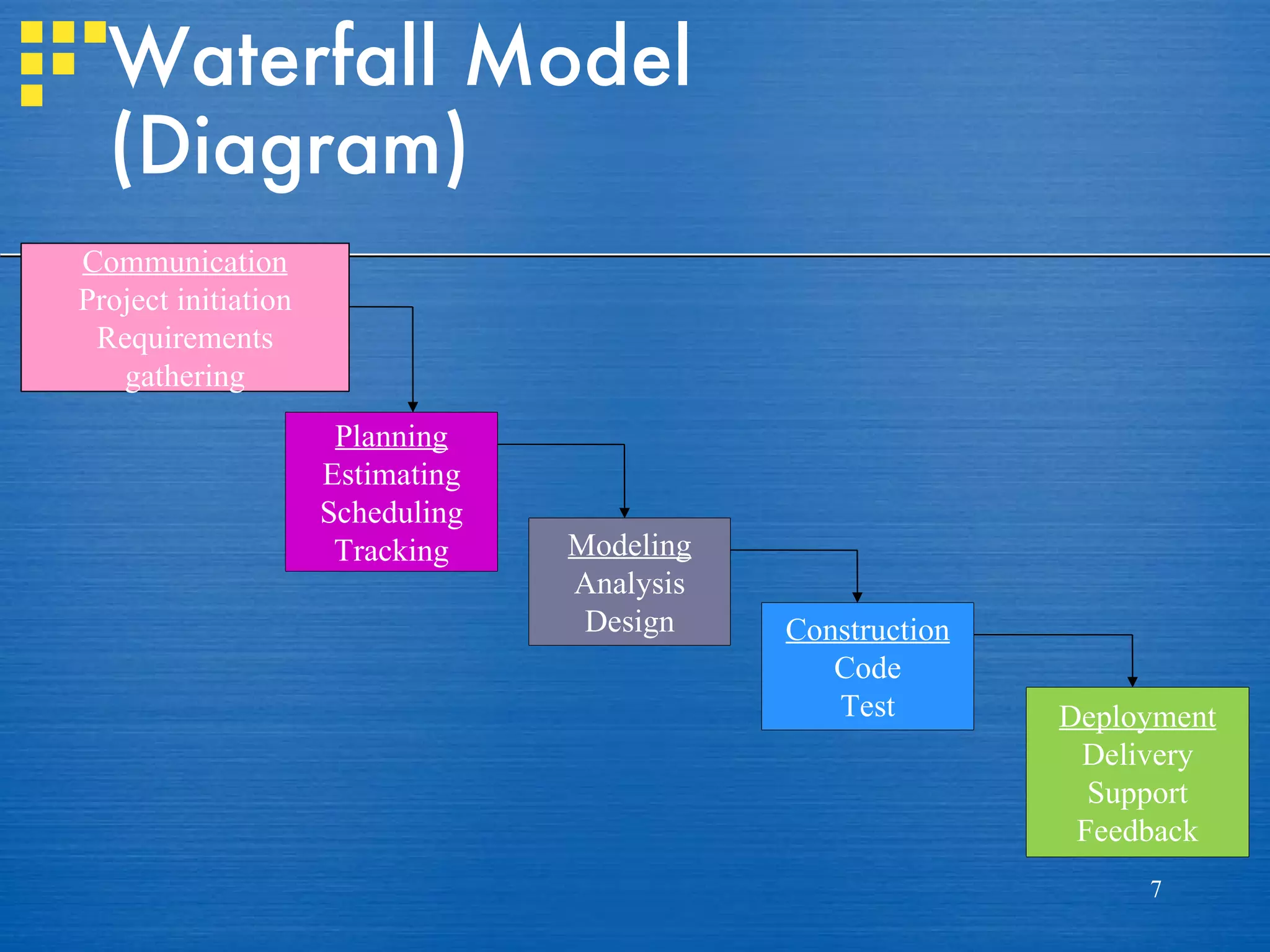
Waterfall Model
  (Diagram)
Communication
Project initiation
 Requirements
   gathering
                      Planning
                     Estimating
                     Scheduling
                      Tracking    Modeling
                                  Analysis
                                   Design    Construction
                                                Code
                                                Test        Deployment
                                                             Delivery
                                                              Support
                                                             Feedback
                                                                 7
Waterfall Model
 (Description)
 Oldest software lifecycle model and best understood by upper
  management
 Used when requirements are well understood and risk is low
 Work flow is in a linear (i.e., sequential) fashion
 Used often with well-defined adaptations or enhancements to current
  software


                                                                 8
Waterfall Model
  (Problems)
 Doesn't support iteration, so changes can cause confusion
 Difficult for customers to state all requirements explicitly and up front
 Requires customer patience because a working version of the
  program doesn't occur until the final phase
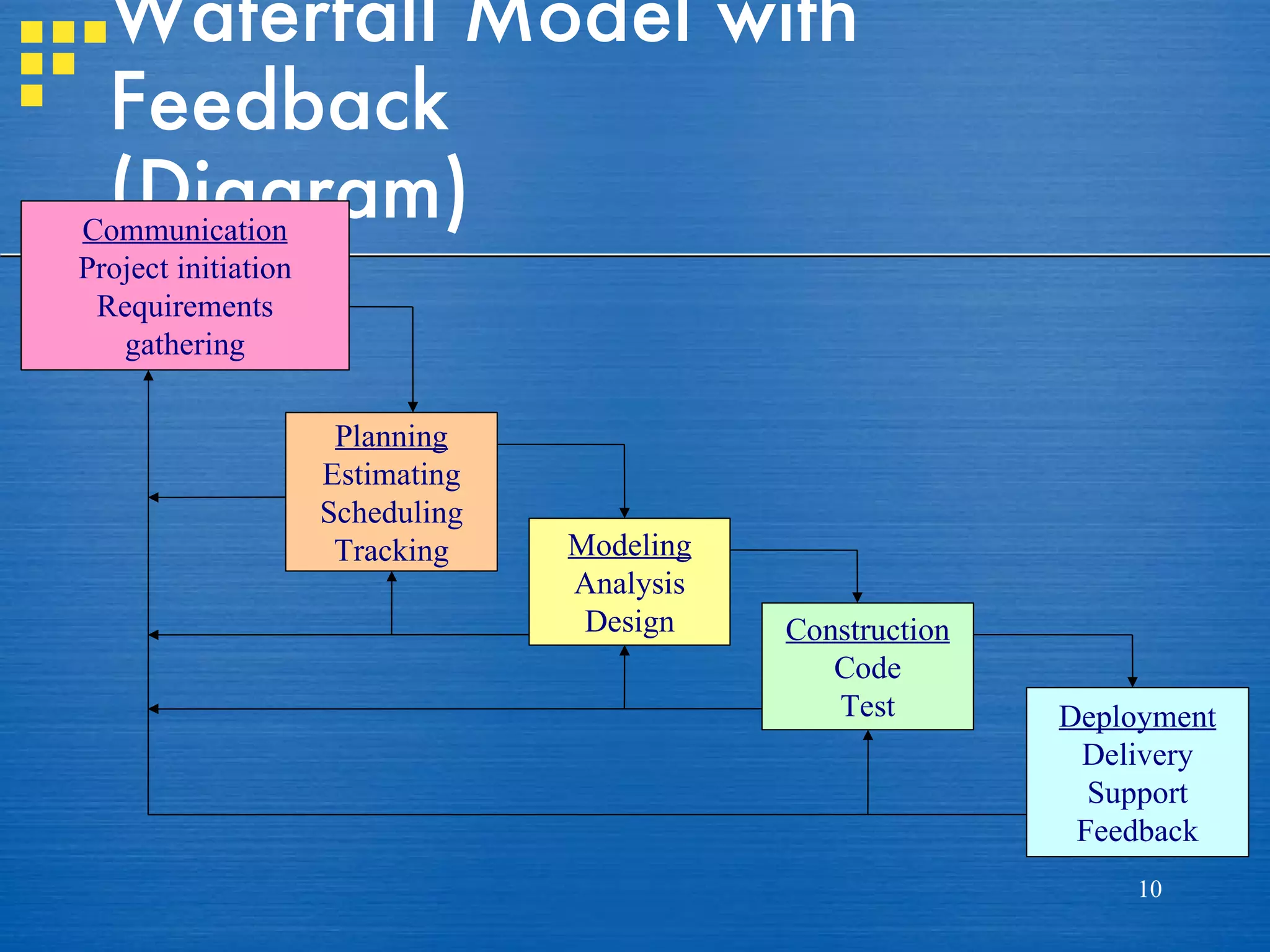
 Problems can be somewhat alleviated in the model through the
  addition of feedback loops (see the next slide)


                                                                        9
Waterfall Model with
 Feedback
 (Diagram)
Communication
Project initiation
 Requirements
   gathering

                      Planning
                     Estimating
                     Scheduling
                      Tracking    Modeling
                                  Analysis
                                   Design    Construction
                                                Code
                                                Test        Deployment
                                                             Delivery
                                                              Support
                                                             Feedback
                                                                10
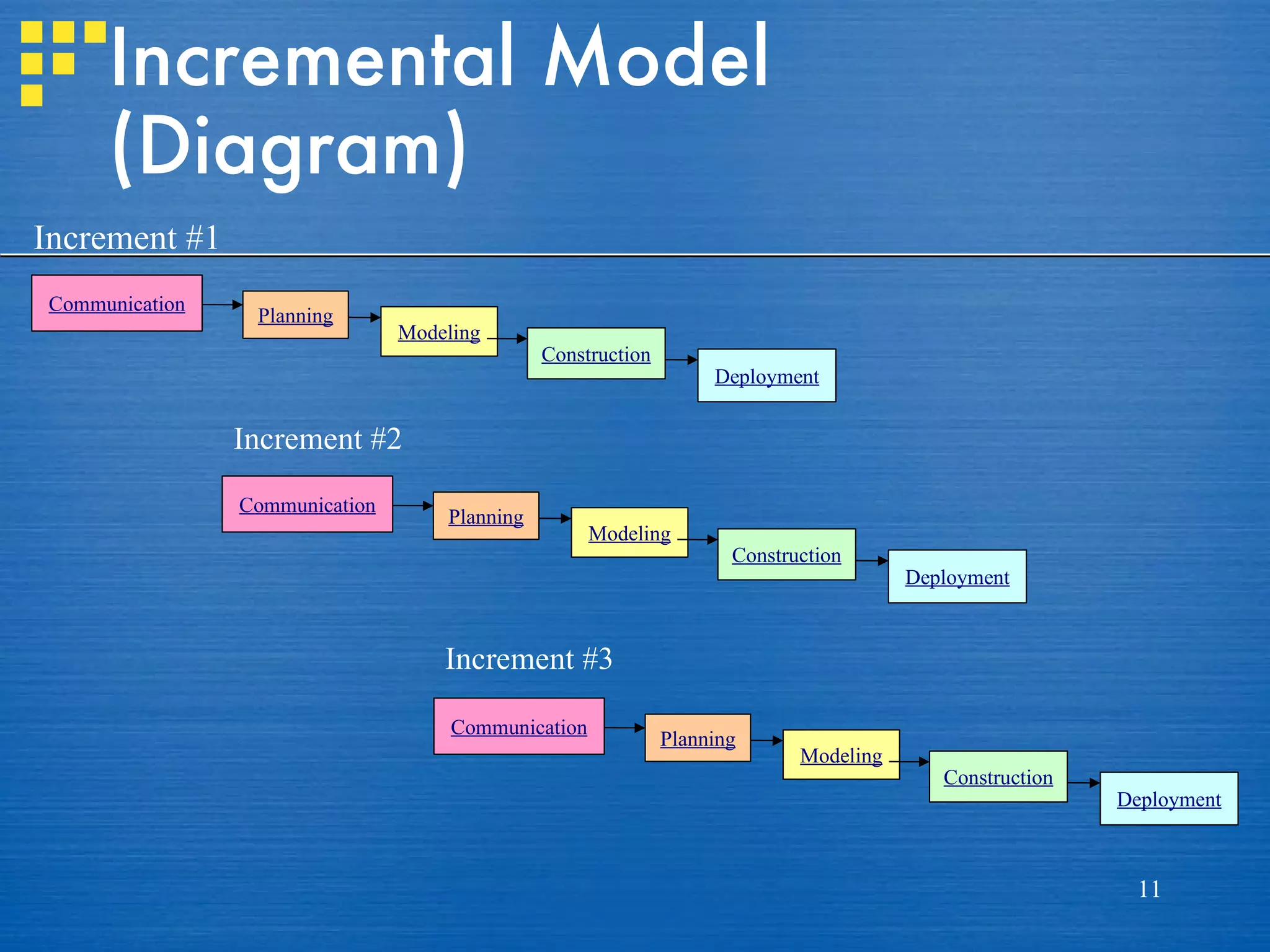
Incremental Model
     (Diagram)
Increment #1
Communication
                 Planning
                                Modeling
                                               Construction
                                                                   Deployment


                Increment #2
                Communication
                                    Planning
                                                     Modeling
                                                                     Construction
                                                                                       Deployment


                                    Increment #3

                                     Communication
                                                              Planning
                                                                            Modeling
                                                                                          Construction
                                                                                                         Deployment


                                                                                                          11
Incremental Model
  (Description)
 Used when requirements are well understood
 Multiple independent deliveries are identified
 Work flow is in a linear (i.e., sequential) fashion within an increment
  and is staggered between increments
 Iterative in nature; focuses on an operational product with each
  increment
 Provides a needed set of functionality sooner while delivering optional
  components later
 Useful also when staffing is too short for a full-scale development


                                                                    12
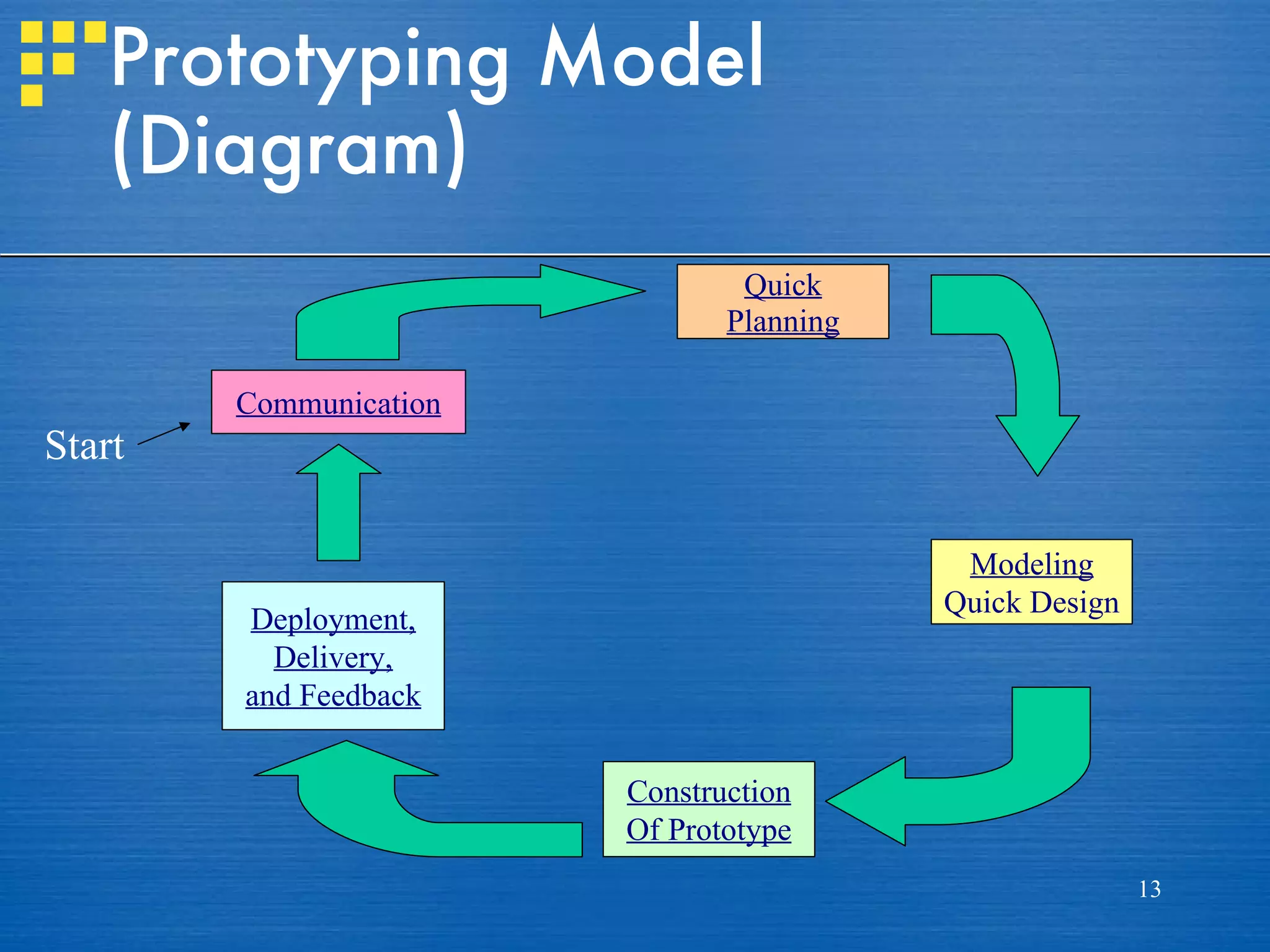
Prototyping Model
   (Diagram)
                                Quick
                               Planning

        Communication
Start

                                           Modeling
                                          Quick Design
        Deployment,
          Delivery,
        and Feedback


                        Construction
                        Of Prototype
                                                         13
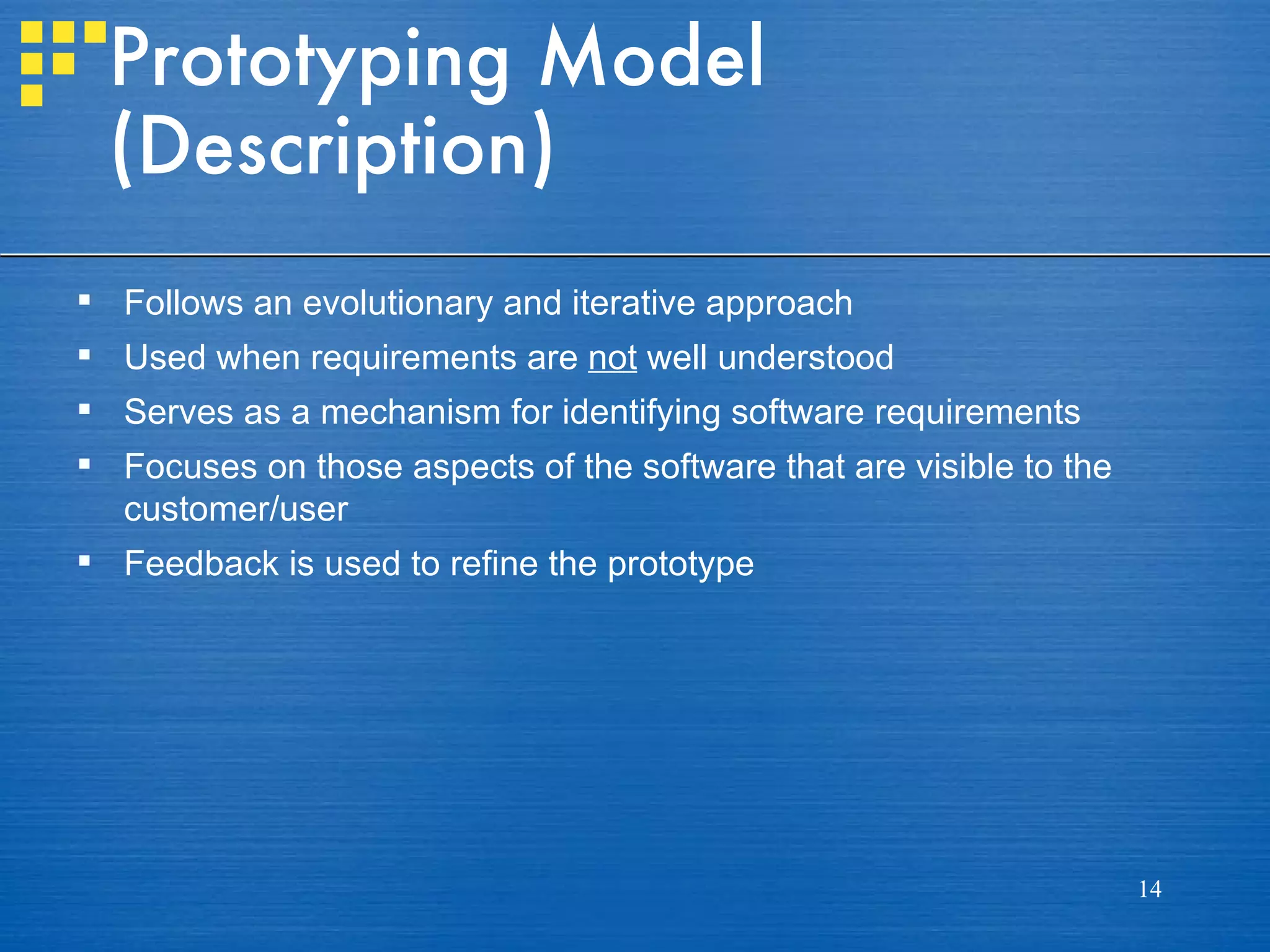
Prototyping Model
  (Description)
 Follows an evolutionary and iterative approach
 Used when requirements are not well understood
 Serves as a mechanism for identifying software requirements
 Focuses on those aspects of the software that are visible to the
  customer/user
 Feedback is used to refine the prototype


                                                                     14
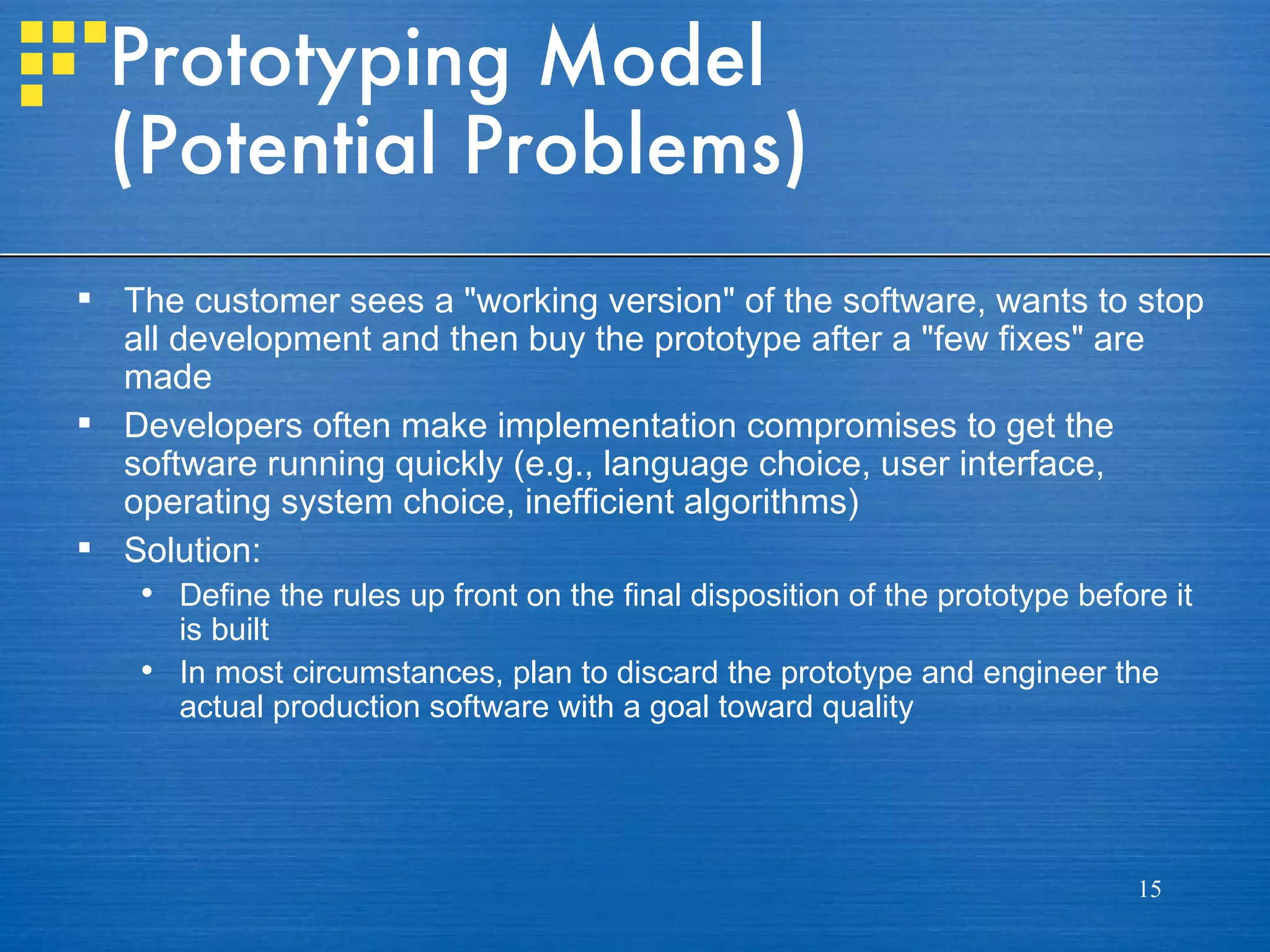
Prototyping Model
 (Potential Problems)
 The customer sees a "working version" of the software, wants to stop
  all development and then buy the prototype after a "few fixes" are
  made
 Developers often make implementation compromises to get the
  software running quickly (e.g., language choice, user interface,
  operating system choice, inefficient algorithms)
 Solution:
    Define the rules up front on the final disposition of the prototype before it
     is built
    In most circumstances, plan to discard the prototype and engineer the
     actual production software with a goal toward quality


                                                                             15
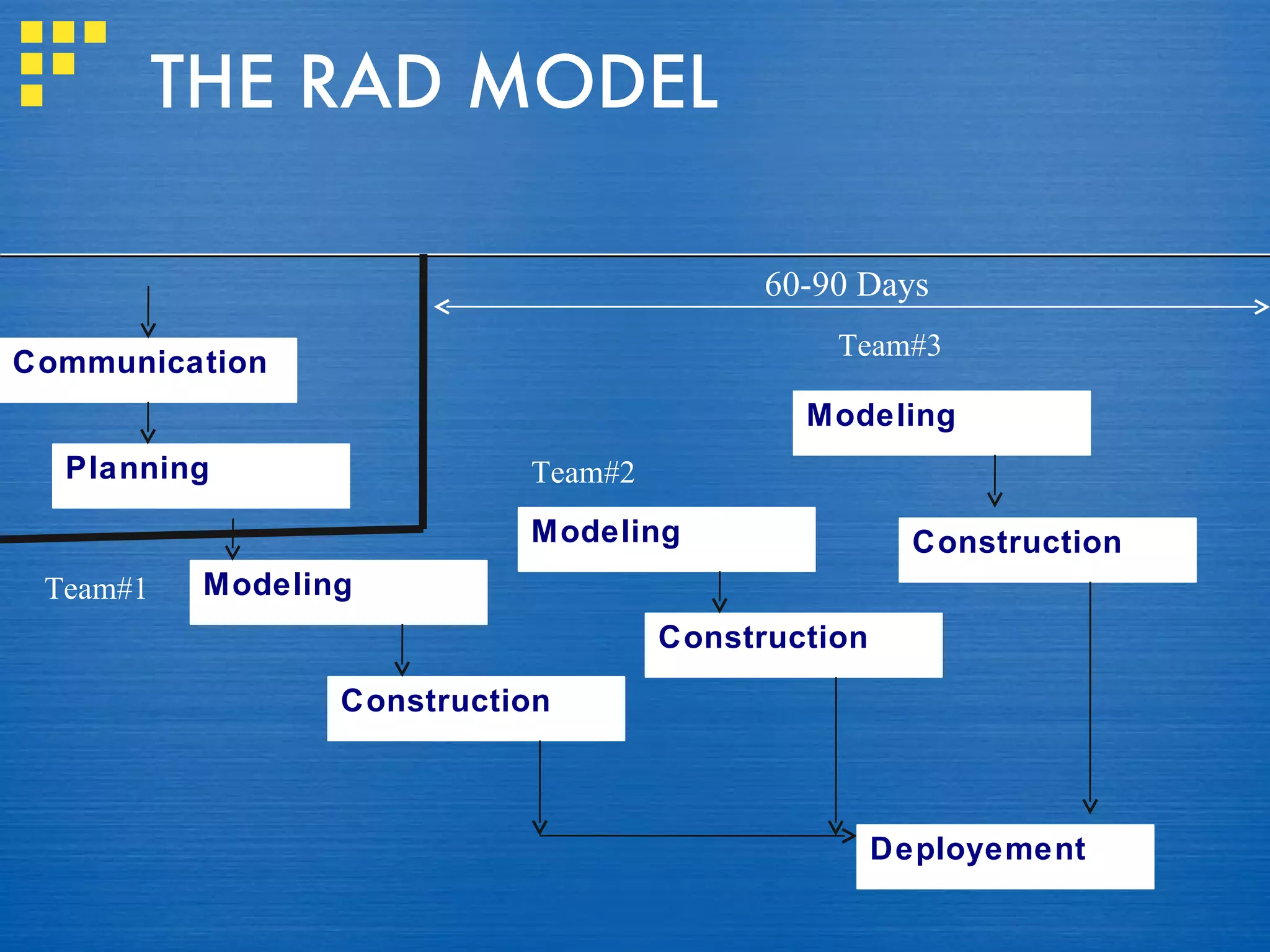
THE RAD MODEL

                                           60-90 Days
                                               Team#3
Communication
                                             Modeling
  Planning                  Team#2
                            Modeling                  Construction
 Team#1    Modeling
                                     Construction

                  Construction


                                                    Deployement
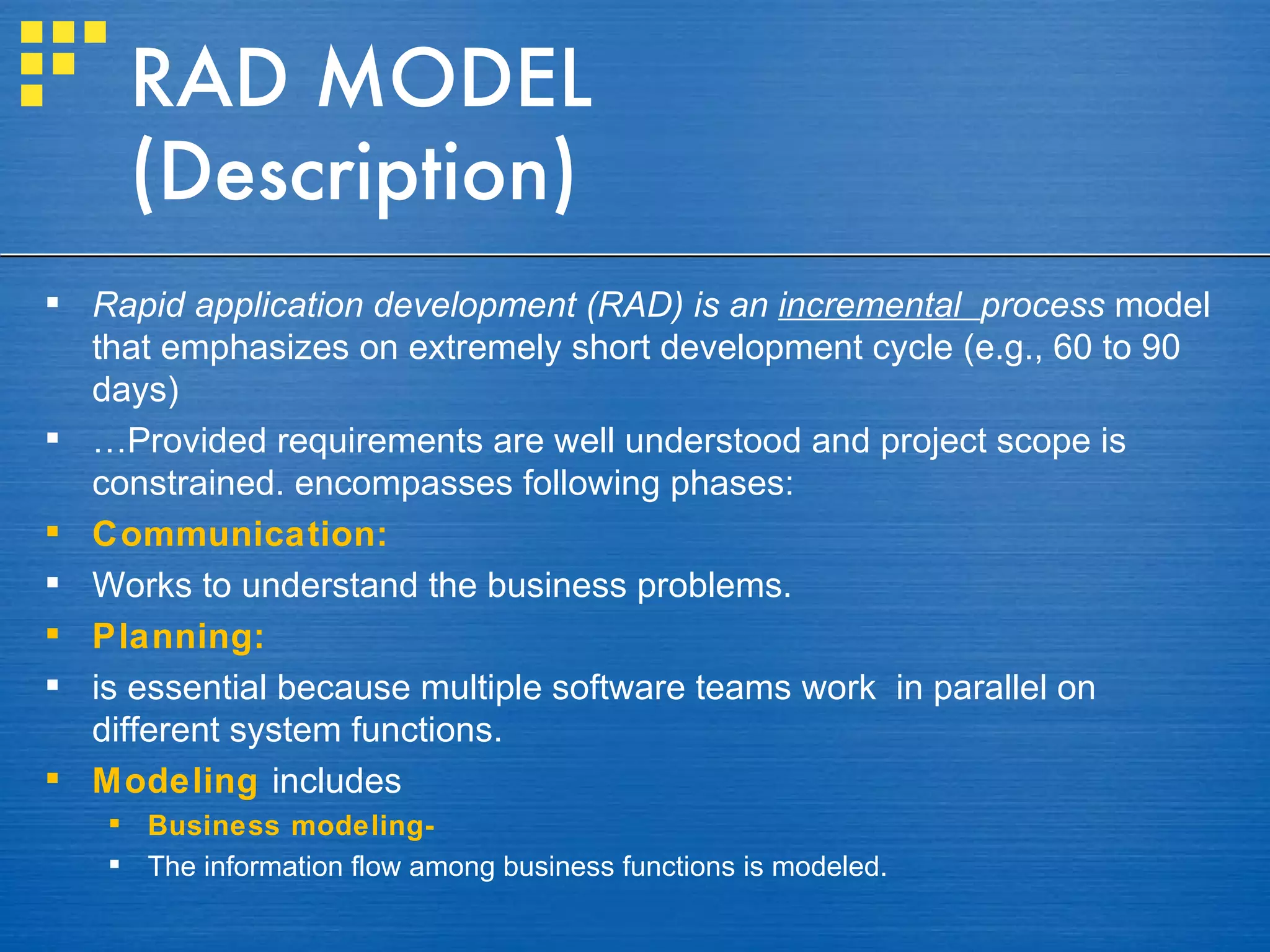
RAD MODEL
     (Description)
 Rapid application development (RAD) is an incremental process model
  that emphasizes on extremely short development cycle (e.g., 60 to 90
  days)
 …Provided requirements are well understood and project scope is
  constrained. encompasses following phases:
 Communication:
 Works to understand the business problems.
 Planning:
 is essential because multiple software teams work in parallel on
  different system functions.
 Modeling includes
    Business modeling-
    The information flow among business functions is modeled.
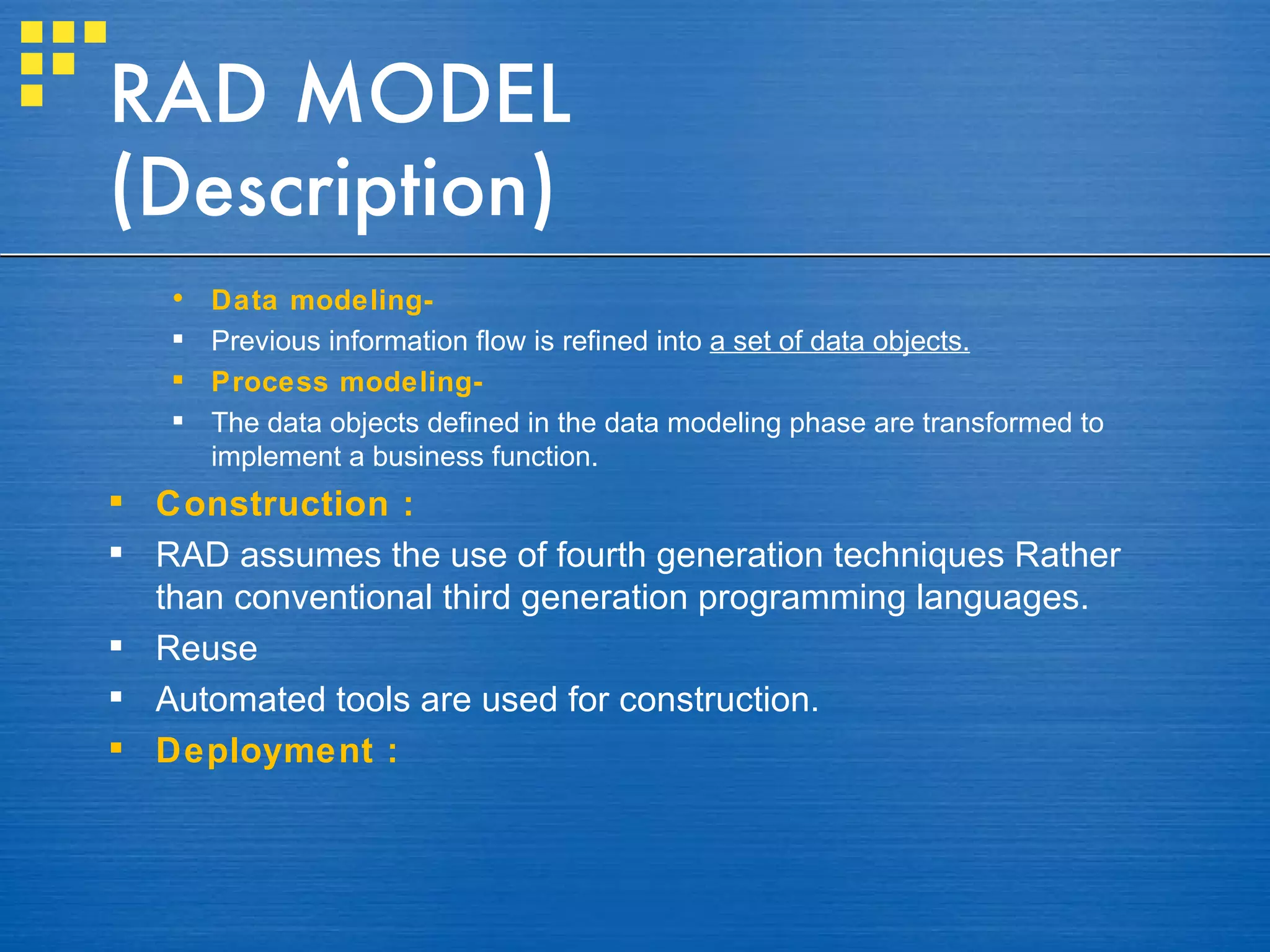
RAD MODEL
(Description)
      Data modeling-
      Previous information flow is refined into a set of data objects.
      Process modeling-
      The data objects defined in the data modeling phase are transformed to
       implement a business function.
 Construction :
 RAD assumes the use of fourth generation techniques Rather
  than conventional third generation programming languages.
 Reuse
 Automated tools are used for construction.
 Deployment :
RAD MODEL
(Drawbacks)
 For large but scalable projects, RAD requires sufficient human
  resources to create the right number of RAD teams.
 RAD requires developers and customers who are committed to
  rapid fire activities.
 Not all types of applications are appropriate for RAD.
 RAD is not appropriate when technical risks are high.
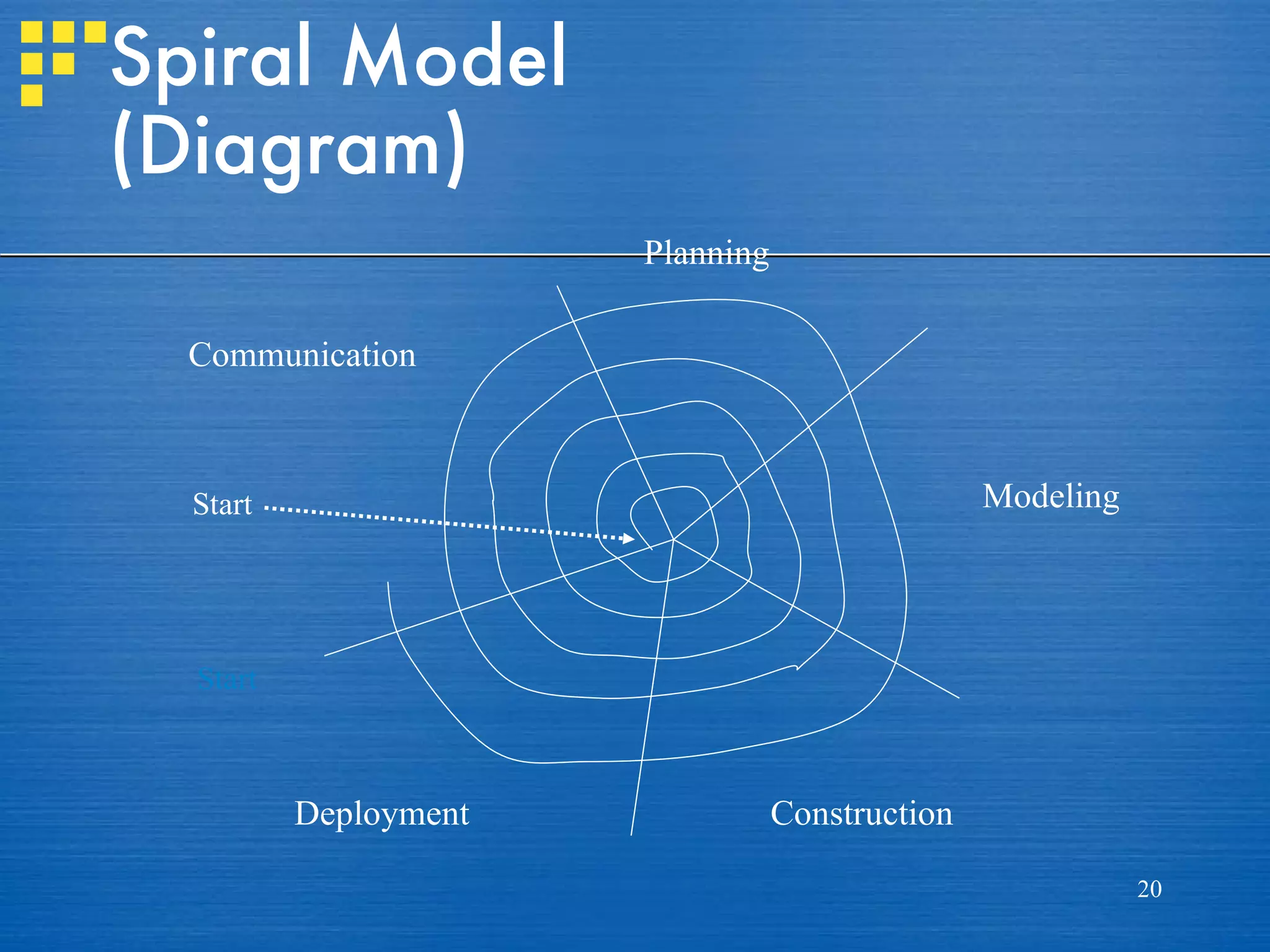
Spiral Model
(Diagram)
                       Planning

  Communication


  Start                                          Modeling


  Start


          Deployment              Construction

                                                            20
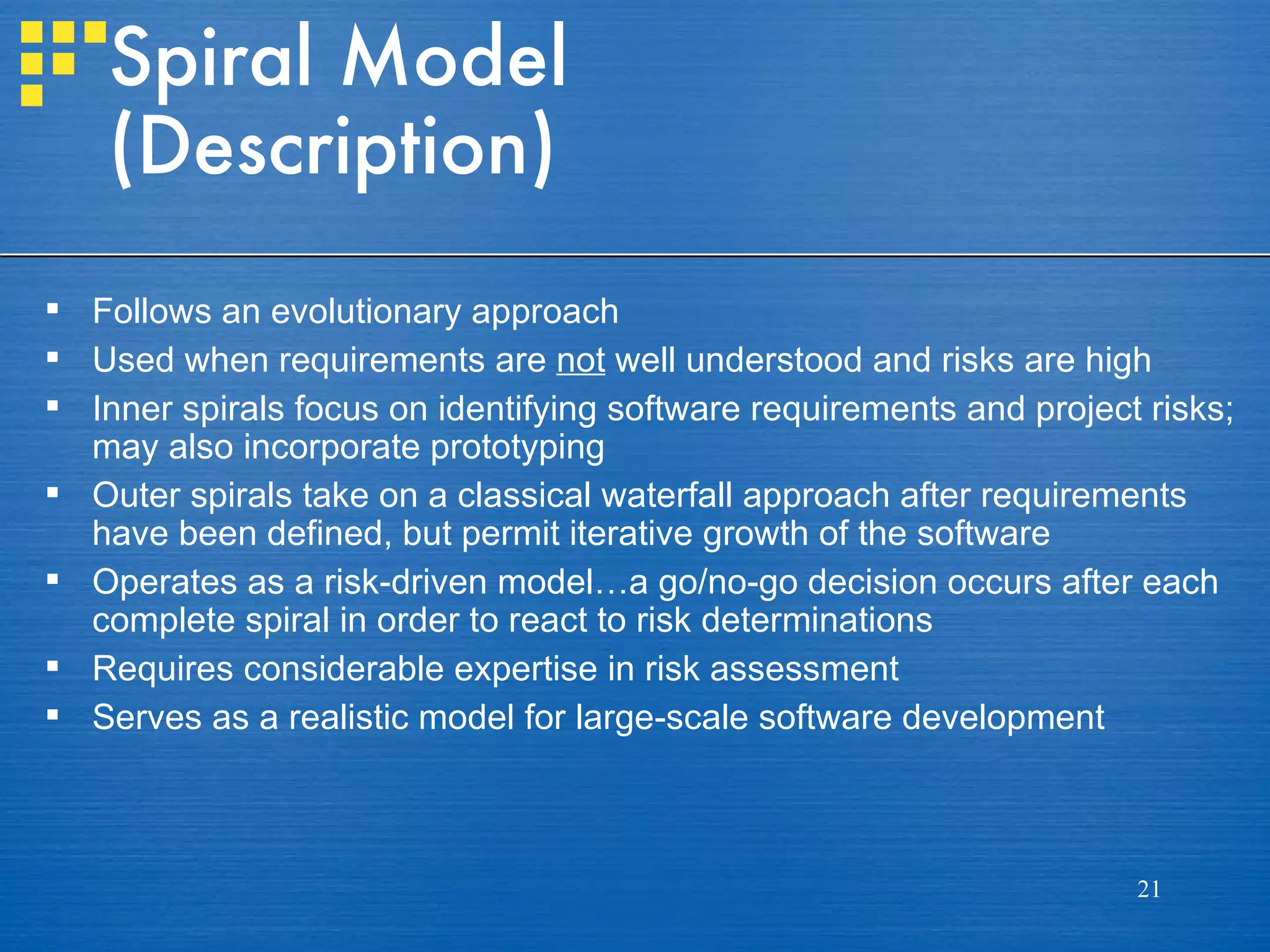
Spiral Model
    (Description)
 Follows an evolutionary approach
 Used when requirements are not well understood and risks are high
 Inner spirals focus on identifying software requirements and project risks;
  may also incorporate prototyping
 Outer spirals take on a classical waterfall approach after requirements
  have been defined, but permit iterative growth of the software
 Operates as a risk-driven model…a go/no-go decision occurs after each
  complete spiral in order to react to risk determinations
 Requires considerable expertise in risk assessment
 Serves as a realistic model for large-scale software development


                                                                      21
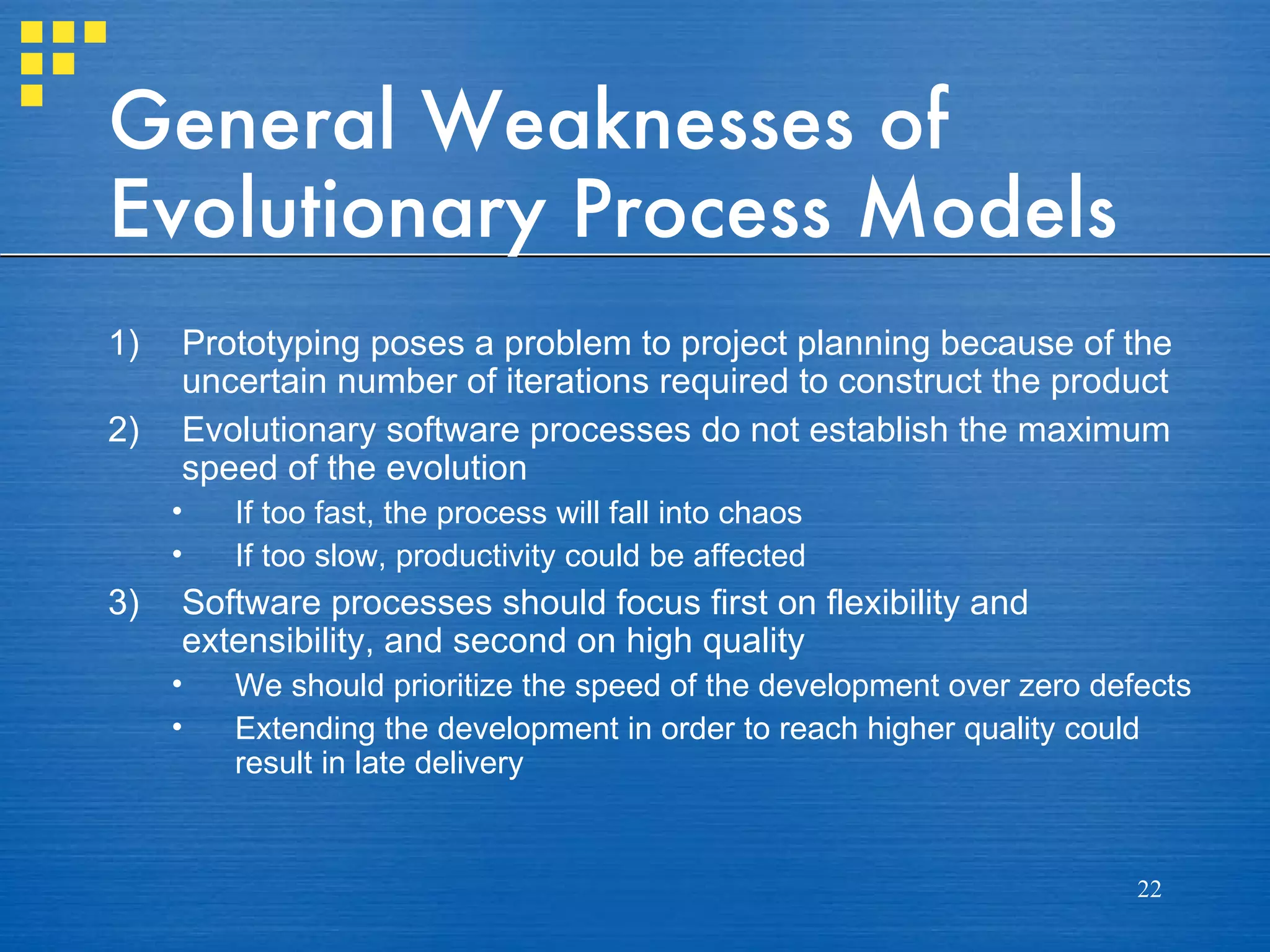
General Weaknesses of
Evolutionary Process Models
1)   Prototyping poses a problem to project planning because of the
     uncertain number of iterations required to construct the product
2)   Evolutionary software processes do not establish the maximum
     speed of the evolution
     •   If too fast, the process will fall into chaos
     •   If too slow, productivity could be affected
3)   Software processes should focus first on flexibility and
     extensibility, and second on high quality
     •   We should prioritize the speed of the development over zero defects
     •   Extending the development in order to reach higher quality could
         result in late delivery


                                                                        22
Specialized Process Models
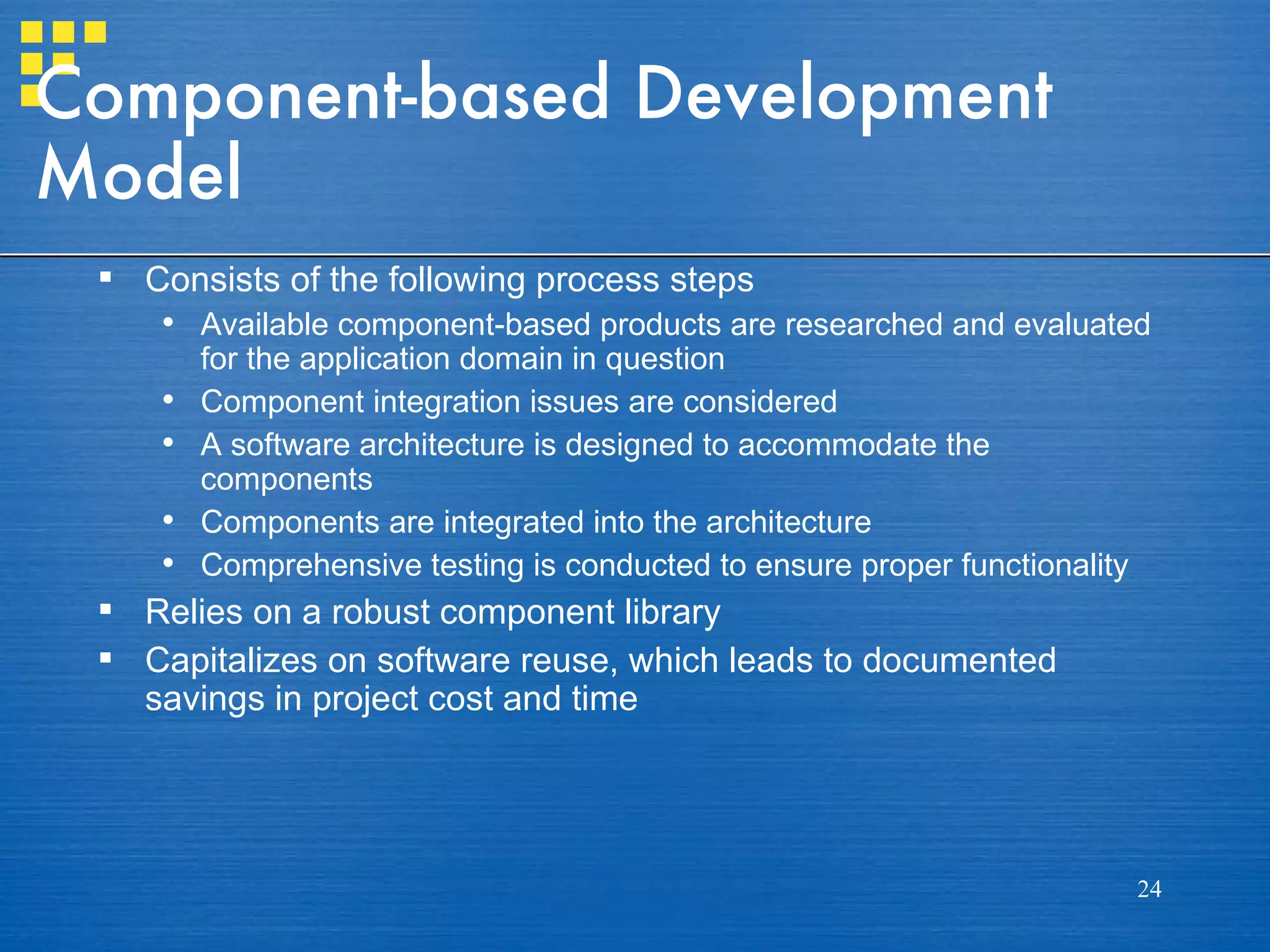
Component-based Development
Model
  Consists of the following process steps
     Available component-based products are researched and evaluated
      for the application domain in question
     Component integration issues are considered
     A software architecture is designed to accommodate the
      components
     Components are integrated into the architecture
     Comprehensive testing is conducted to ensure proper functionality
  Relies on a robust component library
  Capitalizes on software reuse, which leads to documented
   savings in project cost and time


                                                                      24
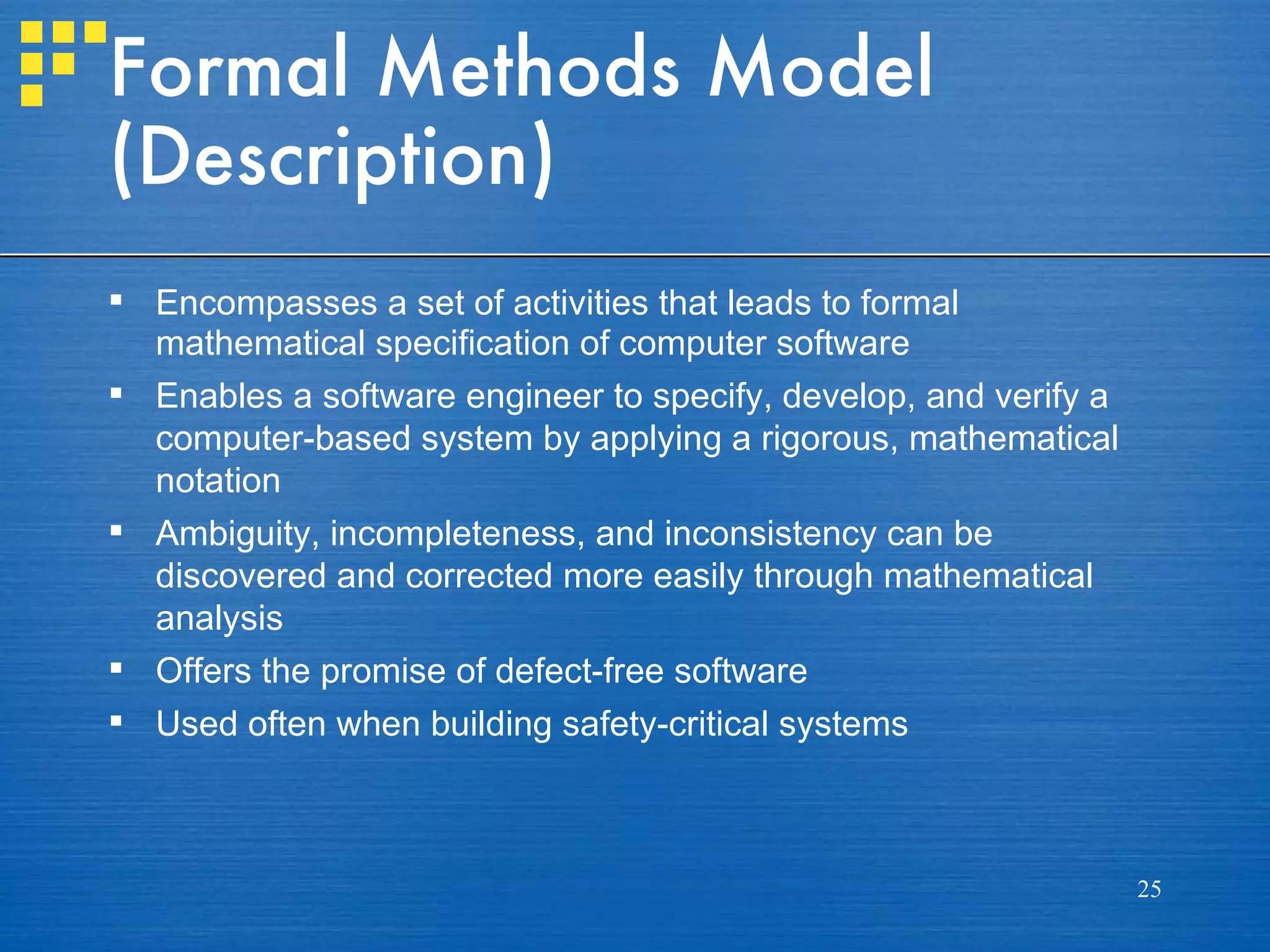
Formal Methods Model
(Description)
 Encompasses a set of activities that leads to formal
  mathematical specification of computer software
 Enables a software engineer to specify, develop, and verify a
  computer-based system by applying a rigorous, mathematical
  notation
 Ambiguity, incompleteness, and inconsistency can be
  discovered and corrected more easily through mathematical
  analysis
 Offers the promise of defect-free software
 Used often when building safety-critical systems


                                                                  25
Formal Methods Model
(Challenges)
 Development of formal methods is currently quite time-
  consuming and expensive
 Because few software developers have the necessary
  background to apply formal methods, extensive training is
  required
 It is difficult to use the models as a communication mechanism
  for technically unsophisticated customers


                                                                   26

Pressman ch-3-prescriptive-process-models

  • 1.
    Chapter 3 Prescriptive Process Models - Generic process framework (revisited) - Traditional process models - Specialized process models - The unified process
  • 2.
    Generic Process Framework Communication  Involves communication among the customer and other stake holders; encompasses requirements gathering  Planning  Establishes a plan for software engineering work; addresses technical tasks, resources, work products, and work schedule  Modelling (Analyze, Design)  Encompasses the creation of models to better under the requirements and the design  Construction (Code, Test)  Combines code generation and testing to uncover errors  Deployment  Involves delivery of software to the customer for evaluation and feedback 2
  • 3.
    Modeling: Software Requirements Analysis Helps software engineers to better understand the problem they will work to solve  Encompasses the set of tasks that lead to an understanding of what the business impact of the software will be, what the customer wants, and how end-users will interact with the software  Uses a combination of text and diagrams to depict requirements for data, function, and behavior  Provides a relatively easy way to understand and review requirements for correctness, completeness and consistency 3
  • 4.
    Modeling: Software Design Form the “blueprint” for a product  Creates a model that that provides detail about software data structures, software architecture, interfaces, and components that are necessary to implement the system  Architectural design  Represents the structure of data and program components that are required to build the software  User Interface Design  Creates an effective communication medium between a human and a computer  Component-level Design  Defines the data structures, algorithms, interface characteristics, and communication mechanisms allocated to each software component 4
  • 5.
  • 6.
    Prescriptive Process Model Defines a distinct set of activities, actions, tasks, milestones, and work products that are required to engineer high-quality software  The activities may be linear, incremental, or evolutionary 6
  • 7.
    Waterfall Model (Diagram) Communication Project initiation Requirements gathering Planning Estimating Scheduling Tracking Modeling Analysis Design Construction Code Test Deployment Delivery Support Feedback 7
  • 8.
    Waterfall Model (Description) Oldest software lifecycle model and best understood by upper management  Used when requirements are well understood and risk is low  Work flow is in a linear (i.e., sequential) fashion  Used often with well-defined adaptations or enhancements to current software 8
  • 9.
    Waterfall Model (Problems)  Doesn't support iteration, so changes can cause confusion  Difficult for customers to state all requirements explicitly and up front  Requires customer patience because a working version of the program doesn't occur until the final phase  Problems can be somewhat alleviated in the model through the addition of feedback loops (see the next slide) 9
  • 10.
    Waterfall Model with Feedback (Diagram) Communication Project initiation Requirements gathering Planning Estimating Scheduling Tracking Modeling Analysis Design Construction Code Test Deployment Delivery Support Feedback 10
  • 11.
    Incremental Model (Diagram) Increment #1 Communication Planning Modeling Construction Deployment Increment #2 Communication Planning Modeling Construction Deployment Increment #3 Communication Planning Modeling Construction Deployment 11
  • 12.
    Incremental Model (Description)  Used when requirements are well understood  Multiple independent deliveries are identified  Work flow is in a linear (i.e., sequential) fashion within an increment and is staggered between increments  Iterative in nature; focuses on an operational product with each increment  Provides a needed set of functionality sooner while delivering optional components later  Useful also when staffing is too short for a full-scale development 12
  • 13.
    Prototyping Model (Diagram) Quick Planning Communication Start Modeling Quick Design Deployment, Delivery, and Feedback Construction Of Prototype 13
  • 14.
    Prototyping Model (Description)  Follows an evolutionary and iterative approach  Used when requirements are not well understood  Serves as a mechanism for identifying software requirements  Focuses on those aspects of the software that are visible to the customer/user  Feedback is used to refine the prototype 14
  • 15.
    Prototyping Model (PotentialProblems)  The customer sees a "working version" of the software, wants to stop all development and then buy the prototype after a "few fixes" are made  Developers often make implementation compromises to get the software running quickly (e.g., language choice, user interface, operating system choice, inefficient algorithms)  Solution:  Define the rules up front on the final disposition of the prototype before it is built  In most circumstances, plan to discard the prototype and engineer the actual production software with a goal toward quality 15
  • 16.
    THE RAD MODEL 60-90 Days Team#3 Communication Modeling Planning Team#2 Modeling Construction Team#1 Modeling Construction Construction Deployement
  • 17.
    RAD MODEL (Description)  Rapid application development (RAD) is an incremental process model that emphasizes on extremely short development cycle (e.g., 60 to 90 days)  …Provided requirements are well understood and project scope is constrained. encompasses following phases:  Communication:  Works to understand the business problems.  Planning:  is essential because multiple software teams work in parallel on different system functions.  Modeling includes  Business modeling-  The information flow among business functions is modeled.
  • 18.
    RAD MODEL (Description)  Data modeling-  Previous information flow is refined into a set of data objects.  Process modeling-  The data objects defined in the data modeling phase are transformed to implement a business function.  Construction :  RAD assumes the use of fourth generation techniques Rather than conventional third generation programming languages.  Reuse  Automated tools are used for construction.  Deployment :
  • 19.
    RAD MODEL (Drawbacks)  Forlarge but scalable projects, RAD requires sufficient human resources to create the right number of RAD teams.  RAD requires developers and customers who are committed to rapid fire activities.  Not all types of applications are appropriate for RAD.  RAD is not appropriate when technical risks are high.
  • 20.
    Spiral Model (Diagram) Planning Communication Start Modeling Start Deployment Construction 20
  • 21.
    Spiral Model (Description)  Follows an evolutionary approach  Used when requirements are not well understood and risks are high  Inner spirals focus on identifying software requirements and project risks; may also incorporate prototyping  Outer spirals take on a classical waterfall approach after requirements have been defined, but permit iterative growth of the software  Operates as a risk-driven model…a go/no-go decision occurs after each complete spiral in order to react to risk determinations  Requires considerable expertise in risk assessment  Serves as a realistic model for large-scale software development 21
  • 22.
    General Weaknesses of EvolutionaryProcess Models 1) Prototyping poses a problem to project planning because of the uncertain number of iterations required to construct the product 2) Evolutionary software processes do not establish the maximum speed of the evolution • If too fast, the process will fall into chaos • If too slow, productivity could be affected 3) Software processes should focus first on flexibility and extensibility, and second on high quality • We should prioritize the speed of the development over zero defects • Extending the development in order to reach higher quality could result in late delivery 22
  • 23.
  • 24.
    Component-based Development Model Consists of the following process steps  Available component-based products are researched and evaluated for the application domain in question  Component integration issues are considered  A software architecture is designed to accommodate the components  Components are integrated into the architecture  Comprehensive testing is conducted to ensure proper functionality  Relies on a robust component library  Capitalizes on software reuse, which leads to documented savings in project cost and time 24
  • 25.
    Formal Methods Model (Description) Encompasses a set of activities that leads to formal mathematical specification of computer software  Enables a software engineer to specify, develop, and verify a computer-based system by applying a rigorous, mathematical notation  Ambiguity, incompleteness, and inconsistency can be discovered and corrected more easily through mathematical analysis  Offers the promise of defect-free software  Used often when building safety-critical systems 25
  • 26.
    Formal Methods Model (Challenges) Development of formal methods is currently quite time- consuming and expensive  Because few software developers have the necessary background to apply formal methods, extensive training is required  It is difficult to use the models as a communication mechanism for technically unsophisticated customers 26