Microsoft ®  ADO.NET Presented by Joseph J. Sarna Jr. JJS Systems, LLC
Agenda ADO versus ADO.NET ADO.NET Architecture Connection Object Command Object DataReader Object DataAdapter Object DataSet Object DataView Object Use ADO.NET to access data in an application
ADO versus ADO.NET Uses DATASET object (contains one or more DATATABLE objects) Uses RECORDSET object (contains one table) Form of data in memory Transfers DATASET object via XML.  No data conversions required Uses COM to marshal RECORDSET  Disconnected access across multi-tiers Uses DATASETCOMMAND object with OLEDB Uses CONNECTION object and RECORDSET object with OLEDB Disconnected access Disconnected collection of data from data server Client/server coupled  Primary Aim ADO.NET ADO Feature
ADO versus ADO.NET (continued) XML flows through the firewall via HTTP Firewalls block system-level COM marshalling Firewalls Managed code library – Uses Common Language Runtime, therefore, language agnostic Coupled to the language used, various implementation Code XML is the native transfer medium for the objects XML aware XML capabilities ADO.NET ADO Feature
Agenda ADO versus ADO.NET ADO.NET Architecture Connection Object Command Object DataReader Object DataAdapter Object DataSet Object DataView Object Use ADO.NET to access data in an application
ADO.NET Architecture Diagram
ADO.NET Namespaces Native data types in Microsoft® SQL Server System.Data.SqlTypes Types that are optimized to connect to Microsoft® SQL Server System.Data.SqlClient Types that allow connection to OLE DB compliant data sources System.Data.OleDb Types shared between managed providers System.Data.Common Core namespace, defines types that represent data System.data
Importing the ADO.NET Namespaces Needed to build a data access application For OLE DB: Imports System.Data Imports System.Data.OleDB For SQL Server: Imports System.Data Imports System.Data.SQLClient
Agenda ADO versus ADO.NET ADO.NET Architecture Connection Object Command Object DataReader Object DataAdapter Object DataSet Object DataView Object Use ADO.NET to access data in an application
Connection object Connects to databases.  Two provider-specific classes  SqlConnection   OleDbConnection .  Connections can be opened in two ways: Explicitly by calling the  Open  method on the connection Implicitly when using a  DataAdapter .  Connections handle transactions
Agenda ADO versus ADO.NET ADO.NET Architecture Connection Object Command Object DataReader Object DataAdapter Object DataSet Object DataView Object Use ADO.NET to access data in an application
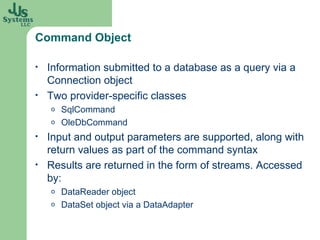
Command Object Information submitted to a database as a query via a Connection object Two provider-specific classes SqlCommand OleDbCommand Input and output parameters are supported, along with return values as part of the command syntax Results are returned in the form of streams. Accessed by: DataReader  object DataSet  object via a  DataAdapter
Agenda ADO versus ADO.NET ADO.NET Architecture Connection Object Command Object DataReader Object DataAdapter Object DataSet Object DataView Object Use ADO.NET to access data in an application
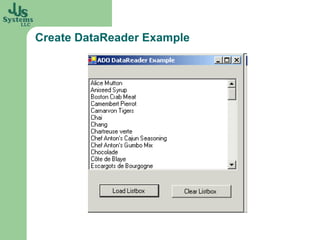
DataReader Object Provides methods and properties that deliver a forward-only stream of data rows from a data source When a  DataReader  is used, parts of the ADO.NET model are cut out, providing faster and more efficient data access
Create DataReader Example
Agenda ADO versus ADO.NET ADO.NET Architecture Connection Object Command Object DataReader Object DataAdapter Object DataSet Object DataView Object Use ADO.NET to access data in an application
DataAdapter Object Provides a set of methods and properties to retrieve and save data between a  DataSet  and its source data store Allows the use of stored procedures Connects to the database to fill the  DataSet and also update the database
Agenda ADO versus ADO.NET ADO.NET Architecture Connection Object Command Object DataReader Object DataAdapter Object DataSet Object DataView Object Use ADO.NET to access data in an application
DataSet Object Replaces the ADO Recordset Represents a cache of data that contains tables, columns, relationships, and constraints, just like a database Regardless of where the source data comes from, data can all be placed into  DataSet  objects Tracks changes that are made to the data it holds before updating the source data DataSet  are also fully XML-featured Works with all current models of data storage: flat, relational, and hierarchical
Agenda ADO versus ADO.NET ADO.NET Architecture Connection Object Command Object DataReader Object DataAdapter Object DataSet Object DataView Object Use ADO.NET to access data in an application
DataView Object Provides methods and properties that enable UI objects such as a DataGrid to bind to a DataSet  A view of the data contained in the DataSet Only used in conjunction with a DataSet
Agenda ADO versus ADO.NET ADO.NET Architecture Connection Object Command Object DataReader Object DataAdapter Object DataSet Object DataView Object Use ADO.NET to access data in an application
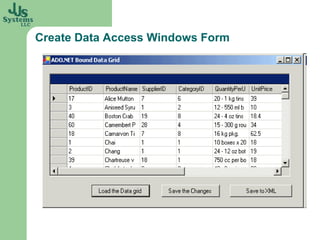
Create Data Access Windows Form
Create Multiple Table DataSet Example
Summary ADO versus ADO.NET ADO.NET Architecture Connection Object Command Object DataReader Object DataAdapter Object DataSet Object DataView Object Use ADO.NET to access data in an application
New Hampshire Access/Visual Basic User Group Meets 4 th  Wednesday of each month Meetings held at Southern New Hampshire University Link to Information - http://www. jjssystems .net

Ado.net

  • 1.
    Microsoft ® ADO.NET Presented by Joseph J. Sarna Jr. JJS Systems, LLC
  • 2.
    Agenda ADO versusADO.NET ADO.NET Architecture Connection Object Command Object DataReader Object DataAdapter Object DataSet Object DataView Object Use ADO.NET to access data in an application
  • 3.
    ADO versus ADO.NETUses DATASET object (contains one or more DATATABLE objects) Uses RECORDSET object (contains one table) Form of data in memory Transfers DATASET object via XML. No data conversions required Uses COM to marshal RECORDSET Disconnected access across multi-tiers Uses DATASETCOMMAND object with OLEDB Uses CONNECTION object and RECORDSET object with OLEDB Disconnected access Disconnected collection of data from data server Client/server coupled Primary Aim ADO.NET ADO Feature
  • 4.
    ADO versus ADO.NET(continued) XML flows through the firewall via HTTP Firewalls block system-level COM marshalling Firewalls Managed code library – Uses Common Language Runtime, therefore, language agnostic Coupled to the language used, various implementation Code XML is the native transfer medium for the objects XML aware XML capabilities ADO.NET ADO Feature
  • 5.
    Agenda ADO versusADO.NET ADO.NET Architecture Connection Object Command Object DataReader Object DataAdapter Object DataSet Object DataView Object Use ADO.NET to access data in an application
  • 6.
  • 7.
    ADO.NET Namespaces Nativedata types in Microsoft® SQL Server System.Data.SqlTypes Types that are optimized to connect to Microsoft® SQL Server System.Data.SqlClient Types that allow connection to OLE DB compliant data sources System.Data.OleDb Types shared between managed providers System.Data.Common Core namespace, defines types that represent data System.data
  • 8.
    Importing the ADO.NETNamespaces Needed to build a data access application For OLE DB: Imports System.Data Imports System.Data.OleDB For SQL Server: Imports System.Data Imports System.Data.SQLClient
  • 9.
    Agenda ADO versusADO.NET ADO.NET Architecture Connection Object Command Object DataReader Object DataAdapter Object DataSet Object DataView Object Use ADO.NET to access data in an application
  • 10.
    Connection object Connectsto databases. Two provider-specific classes SqlConnection OleDbConnection . Connections can be opened in two ways: Explicitly by calling the Open method on the connection Implicitly when using a DataAdapter . Connections handle transactions
  • 11.
    Agenda ADO versusADO.NET ADO.NET Architecture Connection Object Command Object DataReader Object DataAdapter Object DataSet Object DataView Object Use ADO.NET to access data in an application
  • 12.
    Command Object Informationsubmitted to a database as a query via a Connection object Two provider-specific classes SqlCommand OleDbCommand Input and output parameters are supported, along with return values as part of the command syntax Results are returned in the form of streams. Accessed by: DataReader object DataSet object via a DataAdapter
  • 13.
    Agenda ADO versusADO.NET ADO.NET Architecture Connection Object Command Object DataReader Object DataAdapter Object DataSet Object DataView Object Use ADO.NET to access data in an application
  • 14.
    DataReader Object Providesmethods and properties that deliver a forward-only stream of data rows from a data source When a DataReader is used, parts of the ADO.NET model are cut out, providing faster and more efficient data access
  • 15.
  • 16.
    Agenda ADO versusADO.NET ADO.NET Architecture Connection Object Command Object DataReader Object DataAdapter Object DataSet Object DataView Object Use ADO.NET to access data in an application
  • 17.
    DataAdapter Object Providesa set of methods and properties to retrieve and save data between a DataSet and its source data store Allows the use of stored procedures Connects to the database to fill the DataSet and also update the database
  • 18.
    Agenda ADO versusADO.NET ADO.NET Architecture Connection Object Command Object DataReader Object DataAdapter Object DataSet Object DataView Object Use ADO.NET to access data in an application
  • 19.
    DataSet Object Replacesthe ADO Recordset Represents a cache of data that contains tables, columns, relationships, and constraints, just like a database Regardless of where the source data comes from, data can all be placed into DataSet objects Tracks changes that are made to the data it holds before updating the source data DataSet are also fully XML-featured Works with all current models of data storage: flat, relational, and hierarchical
  • 20.
    Agenda ADO versusADO.NET ADO.NET Architecture Connection Object Command Object DataReader Object DataAdapter Object DataSet Object DataView Object Use ADO.NET to access data in an application
  • 21.
    DataView Object Providesmethods and properties that enable UI objects such as a DataGrid to bind to a DataSet A view of the data contained in the DataSet Only used in conjunction with a DataSet
  • 22.
    Agenda ADO versusADO.NET ADO.NET Architecture Connection Object Command Object DataReader Object DataAdapter Object DataSet Object DataView Object Use ADO.NET to access data in an application
  • 23.
    Create Data AccessWindows Form
  • 24.
    Create Multiple TableDataSet Example
  • 25.
    Summary ADO versusADO.NET ADO.NET Architecture Connection Object Command Object DataReader Object DataAdapter Object DataSet Object DataView Object Use ADO.NET to access data in an application
  • 26.
    New Hampshire Access/VisualBasic User Group Meets 4 th Wednesday of each month Meetings held at Southern New Hampshire University Link to Information - http://www. jjssystems .net