Jana- gana - mana – Adhinayaka , Jaya He 
Bharata- Bhagya- Vidhata 
Punjab- Sindhu -Gujarata-Maratha 
Dravida-Utkala-Banga 
Vindhya- Himachala-Yamuna- Ganga 
Uchchhala- JaladthaTaranga 
Tava Subha Name Jage 
Tava Subha Ashisa Mage 
Gahe Tava Jaya Gatha. 
Jana-Gana- Mangala Dayaka, Jaya He 
Bharata-Bhagya-Vidhata, 
Jaya He, Jaya He, Jaya He, 
Jaya, Jaya, Jaya, Jaya He
 DEFINITION 
 RATIONAL FORM 
 VARIOUS FORMS 
 ADDITION & SUBTRACTION 
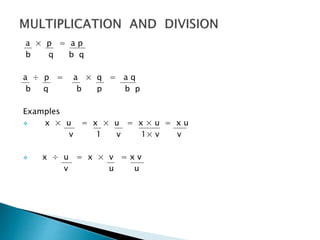
 MULTIPLICATION & DIVISION 
 DECIMAL FORMS
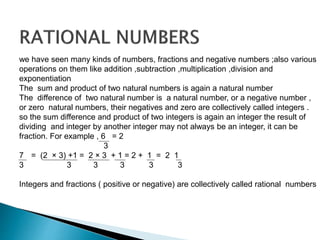
we have seen many kinds of numbers, fractions and negative numbers ;also various 
operations on them like addition ,subtraction ,multiplication ,division and 
exponentiation 
The sum and product of two natural numbers is again a natural number 
The difference of two natural number is a natural number, or a negative number , 
or zero natural numbers, their negatives and zero are collectively called integers . 
so the sum difference and product of two integers is again an integer the result of 
dividing and integer by another integer may not always be an integer, it can be 
fraction. For example , 6 = 2 
3 
7 = (2 × 3) +1 = 2 × 3 + 1 = 2 + 1 = 2 1 
3 3 3 3 3 3 
Integers and fractions ( positive or negative) are collectively called rational numbers
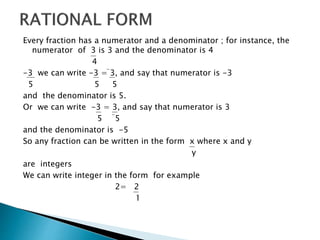
Every fraction has a numerator and a denominator ; for instance, the 
numerator of 3 is 3 and the denominator is 4 
4 
-3 we can write -3 = 3, and say that numerator is -3 
5 5 5 
and the denominator is 5. 
Or we can write -3 = 3, and say that numerator is 3 
5 5 
and the denominator is -5 
So any fraction can be written in the form x where x and y 
y 
are integers 
We can write integer in the form for example 
2= 2 
1
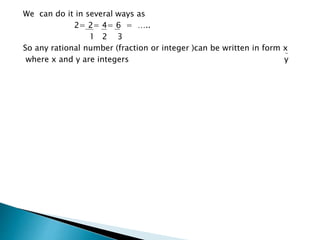
We can do it in several ways as 
2= 2= 4= 6 = ….. 
1 2 3 
So any rational number (fraction or integer )can be written in form x 
where x and y are integers y
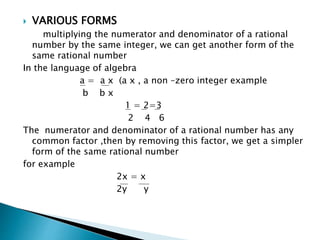
 VARIOUS FORMS 
multiplying the numerator and denominator of a rational 
number by the same integer, we can get another form of the 
same rational number 
In the language of algebra 
a = a x (a x , a non –zero integer example 
b b x 
1 = 2=3 
2 4 6 
The numerator and denominator of a rational number has any 
common factor ,then by removing this factor, we get a simpler 
form of the same rational number 
for example 
2x = x 
2y y
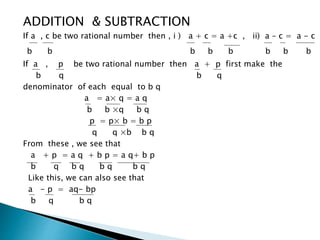
ADDITION & SUBTRACTION 
If a , c be two rational number then , i ) a + c = a +c , ii) a – c = a - c 
b b b b b b b b 
If a , p be two rational number then a + p first make the 
b q b q 
denominator of each equal to b q 
a = a× q = a q 
b b ×q b q 
p = p× b = b p 
q q ×b b q 
From these , we see that 
a + p = a q + b p = a q+ b p 
b q b q b q b q 
Like this, we can also see that 
a - p = aq- bp 
b q b q
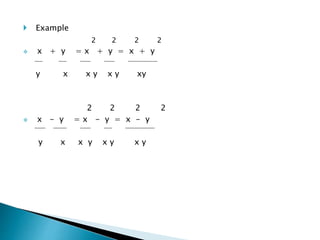
 Example 
2 2 2 2 
 x + y = x + y = x + y 
y x x y x y xy 
2 2 2 2 
 x - y = x - y = x - y 
y x x y x y x y
a × p = a p 
b q b q 
a ÷ p = a × q = a q 
b q b p b p 
Examples 
 x × u = x × u = x × u = x u 
v 1 v 1× v v 
 x ÷ u = x × v = x v 
v u u
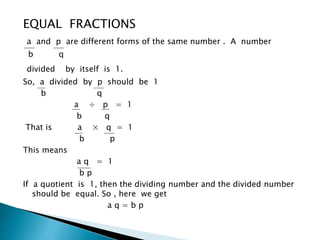
EQUAL FRACTIONS 
a and p are different forms of the same number . A number 
b q 
divided by itself is 1. 
So, a divided by p should be 1 
b q 
a ÷ p = 1 
b q 
That is a × q = 1 
b p 
This means 
a q = 1 
b p 
If a quotient is 1, then the dividing number and the divided number 
should be equal. So , here we get 
a q = b p
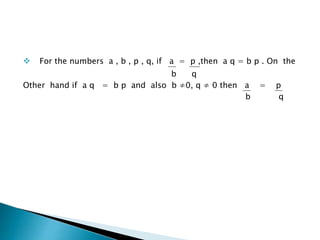
 For the numbers a , b , p , q, if a = p ,then a q = b p . On the 
b q 
Other hand if a q = b p and also b ≠0, q ≠ 0 then a = p 
b q
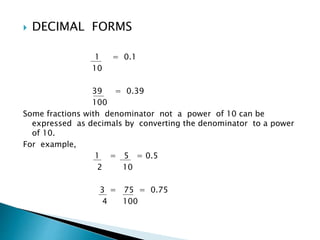
 DECIMAL FORMS 
1 = 0.1 
10 
39 = 0.39 
100 
Some fractions with denominator not a power of 10 can be 
expressed as decimals by converting the denominator to a power 
of 10. 
For example, 
1 = 5 = 0.5 
2 10 
3 = 75 = 0.75 
4 100
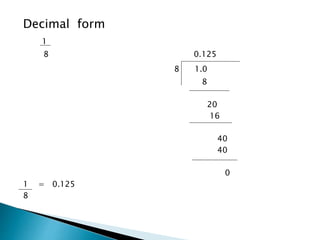
Decimal form 
1 
8 0.125 
8 1.0 
8 
20 
16 
40 
40 
0 
1 = 0.125 
8
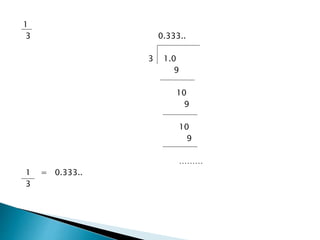
1 
3 0.333.. 
3 1.0 
9 
10 
9 
10 
9 
……… 
1 = 0.333.. 
3
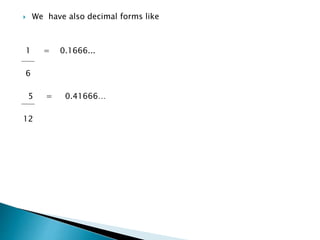
 We have also decimal forms like 
1 = 0.1666... 
6 
5 = 0.41666… 
12

Presentation2

  • 2.
    Jana- gana -mana – Adhinayaka , Jaya He Bharata- Bhagya- Vidhata Punjab- Sindhu -Gujarata-Maratha Dravida-Utkala-Banga Vindhya- Himachala-Yamuna- Ganga Uchchhala- JaladthaTaranga Tava Subha Name Jage Tava Subha Ashisa Mage Gahe Tava Jaya Gatha. Jana-Gana- Mangala Dayaka, Jaya He Bharata-Bhagya-Vidhata, Jaya He, Jaya He, Jaya He, Jaya, Jaya, Jaya, Jaya He
  • 3.
     DEFINITION RATIONAL FORM  VARIOUS FORMS  ADDITION & SUBTRACTION  MULTIPLICATION & DIVISION  DECIMAL FORMS
  • 4.
    we have seenmany kinds of numbers, fractions and negative numbers ;also various operations on them like addition ,subtraction ,multiplication ,division and exponentiation The sum and product of two natural numbers is again a natural number The difference of two natural number is a natural number, or a negative number , or zero natural numbers, their negatives and zero are collectively called integers . so the sum difference and product of two integers is again an integer the result of dividing and integer by another integer may not always be an integer, it can be fraction. For example , 6 = 2 3 7 = (2 × 3) +1 = 2 × 3 + 1 = 2 + 1 = 2 1 3 3 3 3 3 3 Integers and fractions ( positive or negative) are collectively called rational numbers
  • 5.
    Every fraction hasa numerator and a denominator ; for instance, the numerator of 3 is 3 and the denominator is 4 4 -3 we can write -3 = 3, and say that numerator is -3 5 5 5 and the denominator is 5. Or we can write -3 = 3, and say that numerator is 3 5 5 and the denominator is -5 So any fraction can be written in the form x where x and y y are integers We can write integer in the form for example 2= 2 1
  • 6.
    We can doit in several ways as 2= 2= 4= 6 = ….. 1 2 3 So any rational number (fraction or integer )can be written in form x where x and y are integers y
  • 7.
     VARIOUS FORMS multiplying the numerator and denominator of a rational number by the same integer, we can get another form of the same rational number In the language of algebra a = a x (a x , a non –zero integer example b b x 1 = 2=3 2 4 6 The numerator and denominator of a rational number has any common factor ,then by removing this factor, we get a simpler form of the same rational number for example 2x = x 2y y
  • 8.
    ADDITION & SUBTRACTION If a , c be two rational number then , i ) a + c = a +c , ii) a – c = a - c b b b b b b b b If a , p be two rational number then a + p first make the b q b q denominator of each equal to b q a = a× q = a q b b ×q b q p = p× b = b p q q ×b b q From these , we see that a + p = a q + b p = a q+ b p b q b q b q b q Like this, we can also see that a - p = aq- bp b q b q
  • 9.
     Example 22 2 2  x + y = x + y = x + y y x x y x y xy 2 2 2 2  x - y = x - y = x - y y x x y x y x y
  • 10.
    a × p= a p b q b q a ÷ p = a × q = a q b q b p b p Examples  x × u = x × u = x × u = x u v 1 v 1× v v  x ÷ u = x × v = x v v u u
  • 11.
    EQUAL FRACTIONS aand p are different forms of the same number . A number b q divided by itself is 1. So, a divided by p should be 1 b q a ÷ p = 1 b q That is a × q = 1 b p This means a q = 1 b p If a quotient is 1, then the dividing number and the divided number should be equal. So , here we get a q = b p
  • 12.
     For thenumbers a , b , p , q, if a = p ,then a q = b p . On the b q Other hand if a q = b p and also b ≠0, q ≠ 0 then a = p b q
  • 13.
     DECIMAL FORMS 1 = 0.1 10 39 = 0.39 100 Some fractions with denominator not a power of 10 can be expressed as decimals by converting the denominator to a power of 10. For example, 1 = 5 = 0.5 2 10 3 = 75 = 0.75 4 100
  • 14.
    Decimal form 1 8 0.125 8 1.0 8 20 16 40 40 0 1 = 0.125 8
  • 15.
    1 3 0.333.. 3 1.0 9 10 9 10 9 ……… 1 = 0.333.. 3
  • 16.
     We havealso decimal forms like 1 = 0.1666... 6 5 = 0.41666… 12