Unit 1 : Integers
Unit 2 : Groups
Unit 3 : Finite Groups & Subgroup
Unit 4 : Groups And Coding Theory
1. Equivalence Relation(Revision)
2. Congruence Relation
3. Equivalence Class Partition
4. Division Algorithm
5. G.C.D. using division Algorithm
6. Euclid's Lemma
 Give the students a sufficient knowledge of fundamental
principles ,methods and a clear perception of innumerous
power of mathematical ideas and tools and know how to
use them by modeling ,solving and interpreting.
 Reflecting the broad nature of the subject and developing
mathematical tools for continuing further study in various
fields of science.
 Enhancing students overall development and to equip them
with mathematical modeling abilities, problem solving
skills , creative talent and power of communication
necessary for various kinds of employment .
 Enabling students to develop a positive attitude towards
mathematics as an interesting and valuable subject of study.
 A student should be able to recall basic facts about mathematics and
should be able to display knowledge of conventions such as notations,
terminology and recognize basic geometrical figures and graphical
displays, state important facts resulting from their studies.
 A student should get a relational understanding of mathematical
concepts and concerned structures, and should be able to follow the
patterns involved, mathematical reasoning.
 A student should get adequate exposure to global and local concerns
that explore them many aspects of Mathematical Sciences.

A student be able to apply their skills and knowledge, that is, translate
information presented verbally into mathematical form, select and use
appropriate mathematical formulae or techniques in order to process
the information and draw the relevant conclusion.
 A student should be made aware of history of mathematics and hence
of its past, present and future role as part of our culture.
Text Books:-
Contemporary Abstract Algebra By J. A,
Gallian (Seventh Edition)
Unit 1:Chapter 1, Unit 2: Chapter 2, Unit 3:
Chapter 3 ,4, 5 and 7
Discrete Mathematical Stuctures By Bernard
Kolman, Robert C. Busby and Sharon Ross
(6th Edition) Pearson Education Publication
 we know that the numbers ………-3,-2,-
1,0,1,2,3,………….. Are called integers & the set of
all these numbers is denoted by the symbol Z.
 The numbers 0,1,2,3…………… are called non-
negative integers (or whole numbers).The numbers
0,1,2,3,……………… are called positive integers or
natural numbers.
 Relation :
Let A and B be two sets. A relation R from A to B is a
subset of A X B. that is , R is a set of ordered pairs , when the
first co ordinate of the pair belongs to A and the second co
ordinate belongs to B .
If (a,b) ε R then we say that a is related b by relation R then it is
denoted by aRb.
We write aRb, if a is not related to b.
Example : Let A ={1,2,3} and B = {4,5}
then R ={(1,4),(2,5),(3,4)} is subset of A X B.
therefore R is relation from A to B.
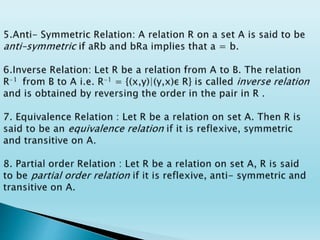
1. Empty Relation : Let R be a relation from set A to B.
then R is called a empty relation if {R} =Φ . i.e. if R does
not contain any ordered pair .
2. Reflexive Relation : A relation R on a set A is said to
be reflexive if aRa , for all a belongs to A .
3. Symmetric Relation : Let R be a relation on a set A.
Then R is said to be symmetric if aRb implies that bRa .
i.e. if (a,b) is in R then (b,a)is also in R . For a , b in A .
4.Transitive Relation : Let R be a relation on set A. R is
said to be transitive if aRb and bRc then aRc.
Let R be an equivalence relation on set A.
If a ε A ; then the set [a] = {b ε A |aRb} is
called equivalence class of a.
Equivalence class of a is denoted by [a] or a .
Note: 1. For every a ε A , a ε [a] as aRa.
2. The set of all the equivalence classes is
denoted by A/R.
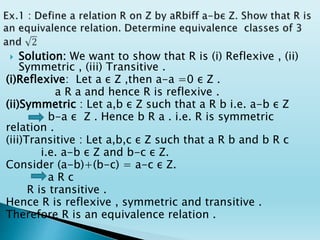
 Solution: We want to show that R is (i) Reflexive , (ii)
Symmetric , (iii) Transitive .
(i)Reflexive: Let a ε Z ,then a-a =0 ε Z .
a R a and hence R is reflexive .
(ii)Symmetric : Let a,b ε Z such that a R b i.e. a-b ε Z
b-a ε Z . Hence b R a . i.e. R is symmetric
relation .
(iii)Transitive : Let a,b,c ε Z such that a R b and b R c
i.e. a-b ε Z and b-c ε Z.
Consider (a-b)+(b-c) = a-c ε Z.
a R c
R is transitive .
Hence R is reflexive , symmetric and transitive .
Therefore R is an equivalence relation .
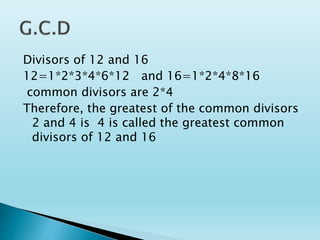
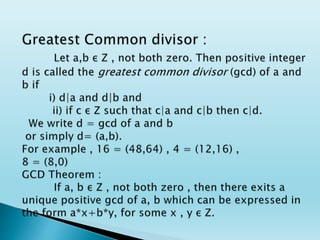
Divisors of 12 and 16
12=1*2*3*4*6*12 and 16=1*2*4*8*16
common divisors are 2*4
Therefore, the greatest of the common divisors
2 and 4 is 4 is called the greatest common
divisors of 12 and 16
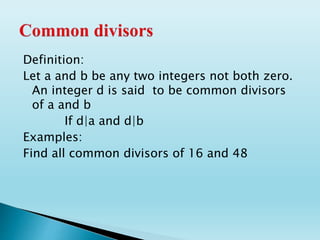
Definition:
Let a and b be any two integers not both zero.
An integer d is said to be common divisors
of a and b
If d|a and d|b
Examples:
Find all common divisors of 16 and 48
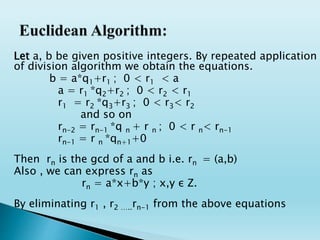
Let a, b be given positive integers. By repeated application
of division algorithm we obtain the equations.
b = a*q1+r1 ; 0 < r1 < a
a = r1 *q2+r2 ; 0 < r2 < r1
r1 = r2 *q3+r3 ; 0 < r3< r2
and so on
rn-2 = rn-1 *q n + r n ; 0 < r n< rn-1
rn-1 = r n *qn+1+0
Then rn is the gcd of a and b i.e. rn = (a,b)
Also , we can express rn as
rn = a*x+b*y ; x,y ε Z.
By eliminating r1 , r2 …..rn-1 from the above equations
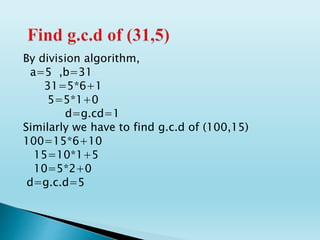
By division algorithm,
a=5 ,b=31
31=5*6+1
5=5*1+0
d=g.cd=1
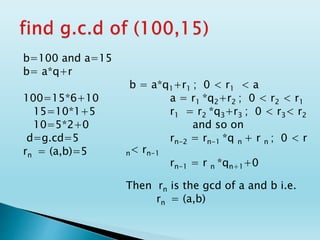
Similarly we have to find g.c.d of (100,15)
100=15*6+10
15=10*1+5
10=5*2+0
d=g.c.d=5
b=100 and a=15
b= a*q+r
100=15*6+10
15=10*1+5
10=5*2+0
d=g.cd=5
rn = (a,b)=5
b = a*q1+r1 ; 0 < r1 < a
a = r1 *q2+r2 ; 0 < r2 < r1
r1 = r2 *q3+r3 ; 0 < r3< r2
and so on
rn-2 = rn-1 *q n + r n ; 0 < r
n< rn-1
rn-1 = r n *qn+1+0
Then rn is the gcd of a and b i.e.
rn = (a,b)
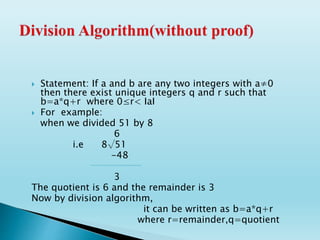
 Statement: If a and b are any two integers with a≠0
then there exist unique integers q and r such that
b=a*q+r where 0≤r< IaI
 For example:
when we divided 51 by 8
6
i.e 8√51
-48
3
The quotient is 6 and the remainder is 3
Now by division algorithm,
it can be written as b=a*q+r
where r=remainder,q=quotient
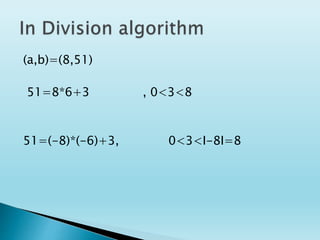
(a,b)=(8,51)
51=8*6+3 , 0<3<8
51=(-8)*(-6)+3, 0<3<I-8I=8
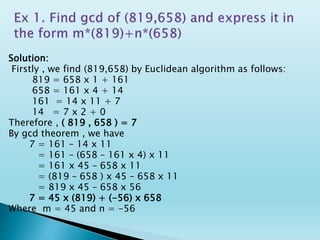
Solution:
Firstly , we find (819,658) by Euclidean algorithm as follows:
819 = 658 x 1 + 161
658 = 161 x 4 + 14
161 = 14 x 11 + 7
14 = 7 x 2 + 0
Therefore , ( 819 , 658 ) = 7
By gcd theorem , we have
7 = 161 – 14 x 11
= 161 – (658 – 161 x 4) x 11
= 161 x 45 – 658 x 11
= (819 – 658 ) x 45 – 658 x 11
= 819 x 45 – 658 x 56
7 = 45 x (819) + (-56) x 658
Where m = 45 and n = -56
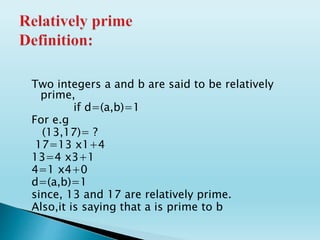
Two integers a and b are said to be relatively
prime,
if d=(a,b)=1
For e.g
(13,17)= ?
17=13 x1+4
13=4 x3+1
4=1 x4+0
d=(a,b)=1
since, 13 and 17 are relatively prime.
Also,it is saying that a is prime to b
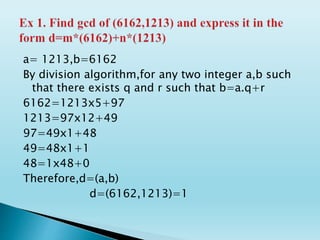
a= 1213,b=6162
By division algorithm,for any two integer a,b such
that there exists q and r such that b=a.q+r
6162=1213x5+97
1213=97x12+49
97=49x1+48
49=48x1+1
48=1x48+0
Therefore,d=(a,b)
d=(6162,1213)=1
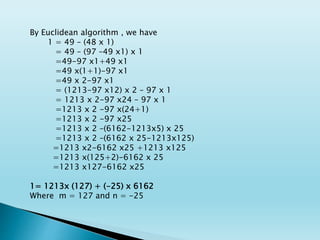
By Euclidean algorithm , we have
1 = 49 – (48 x 1)
= 49 – (97 –49 x1) x 1
=49-97 x1+49 x1
=49 x(1+1)-97 x1
=49 x 2-97 x1
= (1213-97 x12) x 2 – 97 x 1
= 1213 x 2-97 x24 – 97 x 1
=1213 x 2 -97 x(24+1)
=1213 x 2 -97 x25
=1213 x 2 –(6162-1213x5) x 25
=1213 x 2 –(6162 x 25-1213x125)
=1213 x2-6162 x25 +1213 x125
=1213 x(125+2)-6162 x 25
=1213 x127-6162 x25
1= 1213x (127) + (-25) x 6162
Where m = 127 and n = -25
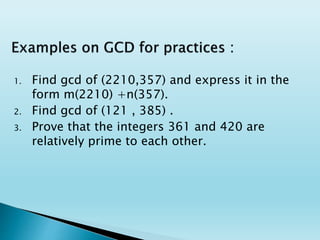
1. Find gcd of (2210,357) and express it in the
form m(2210) +n(357).
2. Find gcd of (121 , 385) .
3. Prove that the integers 361 and 420 are
relatively prime to each other.
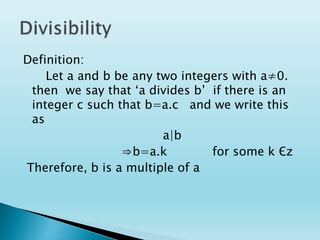
Definition:
Let a and b be any two integers with a≠0.
then we say that ‘a divides b’ if there is an
integer c such that b=a.c and we write this
as
a|b
⇒b=a.k for some k Єz
Therefore, b is a multiple of a
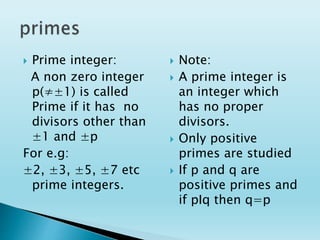
 Prime integer:
A non zero integer
p(≠±1) is called
Prime if it has no
divisors other than
±1 and ±p
For e.g:
±2, ±3, ±5, ±7 etc
prime integers.
 Note:
 A prime integer is
an integer which
has no proper
divisors.
 Only positive
primes are studied
 If p and q are
positive primes and
if pIq then q=p
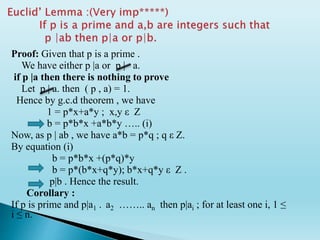
Proof: Given that p is a prime .
We have either p |a or p | a.
if p |a then there is nothing to prove
Let p | a. then ( p , a) = 1.
Hence by g.c.d theorem , we have
1 = p*x+a*y ; x,y ε Z
b = p*b*x +a*b*y ….. (i)
Now, as p | ab , we have a*b = p*q ; q ε Z.
By equation (i)
b = p*b*x +(p*q)*y
b = p*(b*x+q*y); b*x+q*y ε Z .
p|b . Hence the result.
Corollary :
If p is prime and p|a1 . a2 …….. an then p|ai ; for at least one i, 1 ≤
i ≤ n.
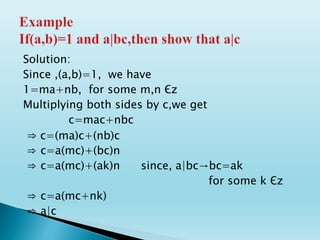
Solution:
Since ,(a,b)=1, we have
1=ma+nb, for some m,n Єz
Multiplying both sides by c,we get
c=mac+nbc
⇒ c=(ma)c+(nb)c
⇒ c=a(mc)+(bc)n
⇒ c=a(mc)+(ak)n since, a|bc→bc=ak
for some k Єz
⇒ c=a(mc+nk)
⇒ a|c
 Proof:
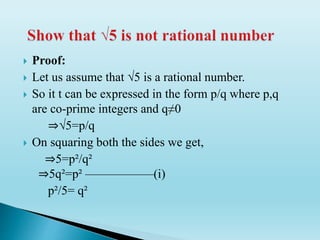
 Let us assume that √5 is a rational number.
 So it t can be expressed in the form p/q where p,q
are co-prime integers and q≠0
⇒√5=p/q
 On squaring both the sides we get,
⇒5=p²/q²
⇒5q²=p² —————–(i)
p²/5= q²
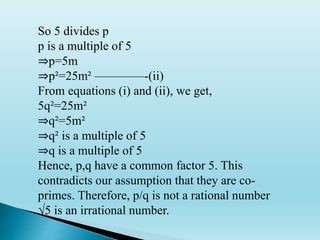
So 5 divides p
p is a multiple of 5
⇒p=5m
⇒p²=25m² ————-(ii)
From equations (i) and (ii), we get,
5q²=25m²
⇒q²=5m²
⇒q² is a multiple of 5
⇒q is a multiple of 5
Hence, p,q have a common factor 5. This
contradicts our assumption that they are co-
primes. Therefore, p/q is not a rational number
√5 is an irrational number.
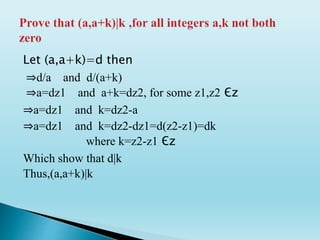
Let (a,a+k)=d then
⇒d/a and d/(a+k)
⇒a=dz1 and a+k=dz2, for some z1,z2 Єz
⇒a=dz1 and k=dz2-a
⇒a=dz1 and k=dz2-dz1=d(z2-z1)=dk
where k=z2-z1 Єz
Which show that d|k
Thus,(a,a+k)|k
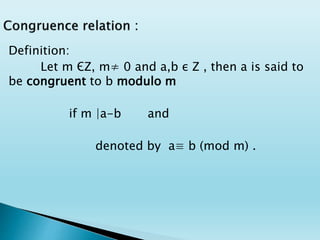
Definition:
Let m ЄZ, m≠ 0 and a,b ε Z , then a is said to
be congruent to b modulo m
if m |a-b and
denoted by a≡ b (mod m) .
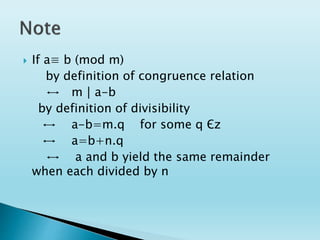
 If a≡ b (mod m)
by definition of congruence relation
↔ m│a-b
by definition of divisibility
↔ a-b=m.q for some q Єz
↔ a=b+n.q
↔ a and b yield the same remainder
when each divided by n
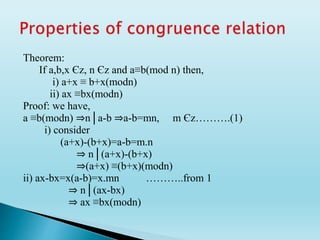
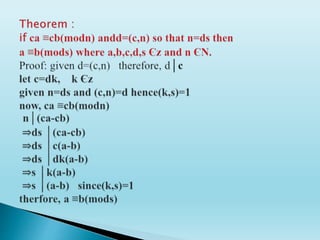
Theorem:
If a,b,x Єz, n Єz and a≡b(mod n) then,
i) a+x ≡ b+x(modn)
ii) ax ≡bx(modn)
Proof: we have,
a ≡b(modn) ⇒n│a-b ⇒a-b=mn, m Єz……….(1)
i) consider
(a+x)-(b+x)=a-b=m.n
⇒ n│(a+x)-(b+x)
⇒(a+x) ≡(b+x)(modn)
ii) ax-bx=x(a-b)=x.mn ………..from 1
⇒ n│(ax-bx)
⇒ ax ≡bx(modn)
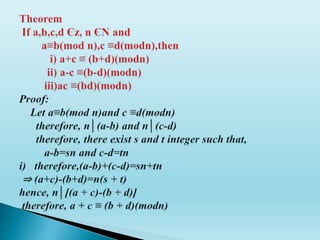
 Proof:
Consider,(a-c)-(b-d)=(a-b)-(c-d)
= sn-tn
=(s-t)n
since,s-t is any integer
By definition of divisibility,
We write it as,
Therefore,
n│[(a-c)-(b-d)]
Therefore,
a-c ≡(b-d)(modn)
 Proof:
Consider,
ac-bd=ac-bc+bc-bd
=c(a-b)+b(c-d)
=csn+btn
=n(cs+bt)
where,cs+bt is integer
by definition of divisibility,
ac-bd=nZ
Therefore,
n│[(ac-bd)]
⇒ ac ≡bd(modn)
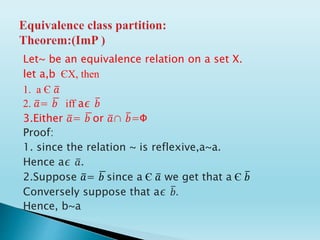
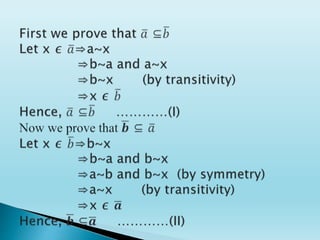
Let~ be an equivalence relation on a set X.
let a,b ЄX, then
1. a Є 𝑎
2. 𝑎= 𝑏 iff a∊ 𝑏
3.Either 𝑎= 𝑏 or 𝑎∩ 𝑏=Ф
Proof:
1. since the relation ~ is reflexive,a~a.
Hence a∊ 𝑎.
2.Suppose 𝑎= 𝑏 since a Є 𝑎 we get that a Є 𝑏
Conversely suppose that a∊ 𝑏.
Hence, b~a
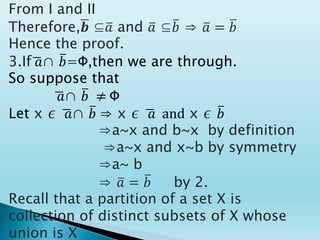
From I and II
Therefore,𝒃 ⊆𝑎 and 𝑎 ⊆𝑏 ⇒ 𝑎 = 𝑏
Hence the proof.
3.If 𝑎∩ 𝑏=Ф,then we are through.
So suppose that
𝑎∩ 𝑏 ≠ Ф
Let x ∊ 𝑎∩ 𝑏 ⇒ x ∊ 𝑎 and x ∊ 𝑏
⇒a~x and b~x by definition
⇒a~x and x~b by symmetry
⇒a~ b
⇒ 𝑎 = 𝑏 by 2.
Recall that a partition of a set X is
collection of distinct subsets of X whose
union is X
Prof:
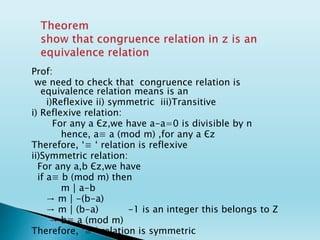
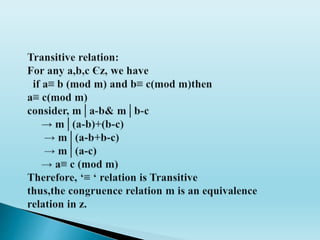
we need to check that congruence relation is
equivalence relation means is an
i)Reflexive ii) symmetric iii)Transitive
i) Reflexive relation:
For any a Єz,we have a-a=0 is divisible by n
hence, a≡ a (mod m) ,for any a Єz
Therefore, ‘≡ ‘ relation is reflexive
ii)Symmetric relation:
For any a,b Єz,we have
if a≡ b (mod m) then
m│a-b
→ m│-(b-a)
→ m│(b-a) -1 is an integer this belongs to Z
→ b≡ a (mod m)
Therefore, ‘≡ ‘ relation is symmetric
 Definition:
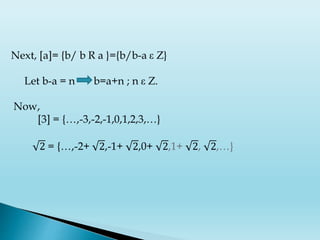
For a ε Z ; then the set
[a] or a = {x Є Z | x≡ a (mod n)} is called
“congruent class of a modulo n” or “Residue
class of a modulo n”
thus, the residue class of a is the set of all
integers which are congruent to a modulo n.
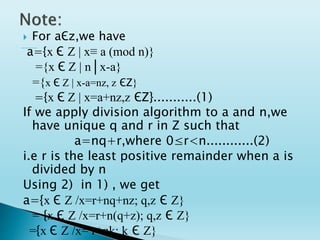
 For aЄz,we have
a={x Є Z | x≡ a (mod n)}
={x Є Z | n│x-a}
={x Є Z | x-a=nz, z ЄZ}
={x Є Z | x=a+nz,z ЄZ}...........(1)
If we apply division algorithm to a and n,we
have unique q and r in Z such that
a=nq+r,where 0≤r<n............(2)
i.e r is the least positive remainder when a is
divided by n
Using 2) in 1) , we get
a={x Є Z /x=r+nq+nz; q,z Є Z}
= {x Є Z /x=r+n(q+z); q,z Є Z}
={x Є Z /x= r+nk; k Є Z}
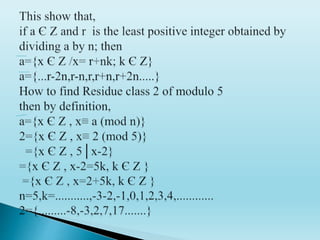
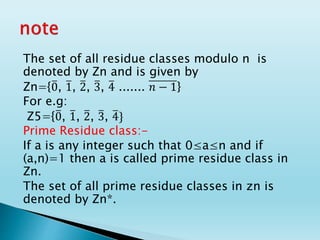
The set of all residue classes modulo n is
denoted by Zn and is given by
Zn={0, 1, 2, 3, 4 ....... 𝑛 − 1}
For e.g:
Z5={0, 1, 2, 3, 4}
Prime Residue class:-
If a is any integer such that 0≤a≤n and if
(a,n)=1 then a is called prime residue class in
Zn.
The set of all prime residue classes in zn is
denoted by Zn*.
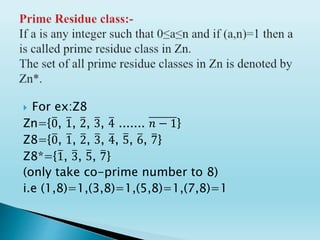
 For ex:Z8
Zn={0, 1, 2, 3, 4 ....... 𝑛 − 1}
Z8={0, 1, 2, 3, 4, 5, 6, 7}
Z8*={1, 3, 5, 7}
(only take co-prime number to 8)
i.e (1,8)=1,(3,8)=1,(5,8)=1,(7,8)=1
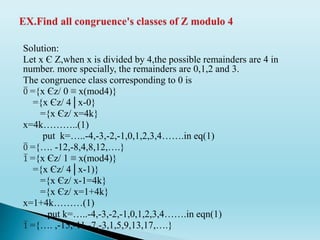
Solution:
Let x Є Z,when x is divided by 4,the possible remainders are 4 in
number. more specially, the remainders are 0,1,2 and 3.
The congruence class corresponding to 0 is
0 ={x Єz/ 0 ≡ x(mod4)}
={x Єz/ 4│x-0}
={x Єz/ x=4k}
x=4k………..(1)
put k=…..-4,-3,-2,-1,0,1,2,3,4…….in eq(1)
0 ={…. -12,-8,4,8,12,….}
1 ={x Єz/ 1 ≡ x(mod4)}
={x Єz/ 4│x-1)}
={x Єz/ x-1=4k}
={x Єz/ x=1+4k}
x=1+4k………(1)
put k=…..-4,-3,-2,-1,0,1,2,3,4…….in eqn(1)
1 ={…. ,-15,-11,-7,-3,1,5,9,13,17,….}
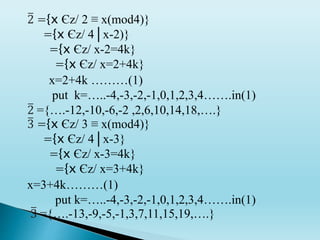
2 ={x Єz/ 2 ≡ x(mod4)}
={x Єz/ 4│x-2)}
={x Єz/ x-2=4k}
={x Єz/ x=2+4k}
x=2+4k ………(1)
put k=…..-4,-3,-2,-1,0,1,2,3,4…….in(1)
2 ={….-12,-10,-6,-2 ,2,6,10,14,18,….}
3 ={x Єz/ 3 ≡ x(mod4)}
={x Єz/ 4│x-3}
={x Єz/ x-3=4k}
={x Єz/ x=3+4k}
x=3+4k………(1)
put k=…..-4,-3,-2,-1,0,1,2,3,4…….in(1)
3 ={….-13,-9,-5,-1,3,7,11,15,19,….}
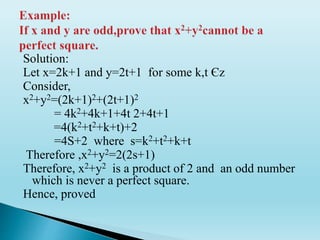
Solution:
Let x=2k+1 and y=2t+1 for some k,t Єz
Consider,
x2+y2=(2k+1)2+(2t+1)2
= 4k2+4k+1+4t 2+4t+1
=4(k2+t2+k+t)+2
=4S+2 where s=k2+t2+k+t
Therefore ,x2+y2=2(2s+1)
Therefore, x2+y2 is a product of 2 and an odd number
which is never a perfect square.
Hence, proved
Chapter1.integer s.y.b.c.s

Chapter1.integer s.y.b.c.s

  • 1.
    Unit 1 :Integers Unit 2 : Groups Unit 3 : Finite Groups & Subgroup Unit 4 : Groups And Coding Theory
  • 2.
    1. Equivalence Relation(Revision) 2.Congruence Relation 3. Equivalence Class Partition 4. Division Algorithm 5. G.C.D. using division Algorithm 6. Euclid's Lemma
  • 3.
     Give thestudents a sufficient knowledge of fundamental principles ,methods and a clear perception of innumerous power of mathematical ideas and tools and know how to use them by modeling ,solving and interpreting.  Reflecting the broad nature of the subject and developing mathematical tools for continuing further study in various fields of science.  Enhancing students overall development and to equip them with mathematical modeling abilities, problem solving skills , creative talent and power of communication necessary for various kinds of employment .  Enabling students to develop a positive attitude towards mathematics as an interesting and valuable subject of study.
  • 4.
     A studentshould be able to recall basic facts about mathematics and should be able to display knowledge of conventions such as notations, terminology and recognize basic geometrical figures and graphical displays, state important facts resulting from their studies.  A student should get a relational understanding of mathematical concepts and concerned structures, and should be able to follow the patterns involved, mathematical reasoning.  A student should get adequate exposure to global and local concerns that explore them many aspects of Mathematical Sciences.  A student be able to apply their skills and knowledge, that is, translate information presented verbally into mathematical form, select and use appropriate mathematical formulae or techniques in order to process the information and draw the relevant conclusion.  A student should be made aware of history of mathematics and hence of its past, present and future role as part of our culture.
  • 5.
    Text Books:- Contemporary AbstractAlgebra By J. A, Gallian (Seventh Edition) Unit 1:Chapter 1, Unit 2: Chapter 2, Unit 3: Chapter 3 ,4, 5 and 7 Discrete Mathematical Stuctures By Bernard Kolman, Robert C. Busby and Sharon Ross (6th Edition) Pearson Education Publication
  • 6.
     we knowthat the numbers ………-3,-2,- 1,0,1,2,3,………….. Are called integers & the set of all these numbers is denoted by the symbol Z.  The numbers 0,1,2,3…………… are called non- negative integers (or whole numbers).The numbers 0,1,2,3,……………… are called positive integers or natural numbers.
  • 7.
     Relation : LetA and B be two sets. A relation R from A to B is a subset of A X B. that is , R is a set of ordered pairs , when the first co ordinate of the pair belongs to A and the second co ordinate belongs to B . If (a,b) ε R then we say that a is related b by relation R then it is denoted by aRb. We write aRb, if a is not related to b. Example : Let A ={1,2,3} and B = {4,5} then R ={(1,4),(2,5),(3,4)} is subset of A X B. therefore R is relation from A to B.
  • 8.
    1. Empty Relation: Let R be a relation from set A to B. then R is called a empty relation if {R} =Φ . i.e. if R does not contain any ordered pair . 2. Reflexive Relation : A relation R on a set A is said to be reflexive if aRa , for all a belongs to A . 3. Symmetric Relation : Let R be a relation on a set A. Then R is said to be symmetric if aRb implies that bRa . i.e. if (a,b) is in R then (b,a)is also in R . For a , b in A . 4.Transitive Relation : Let R be a relation on set A. R is said to be transitive if aRb and bRc then aRc.
  • 10.
    Let R bean equivalence relation on set A. If a ε A ; then the set [a] = {b ε A |aRb} is called equivalence class of a. Equivalence class of a is denoted by [a] or a . Note: 1. For every a ε A , a ε [a] as aRa. 2. The set of all the equivalence classes is denoted by A/R.
  • 11.
     Solution: Wewant to show that R is (i) Reflexive , (ii) Symmetric , (iii) Transitive . (i)Reflexive: Let a ε Z ,then a-a =0 ε Z . a R a and hence R is reflexive . (ii)Symmetric : Let a,b ε Z such that a R b i.e. a-b ε Z b-a ε Z . Hence b R a . i.e. R is symmetric relation . (iii)Transitive : Let a,b,c ε Z such that a R b and b R c i.e. a-b ε Z and b-c ε Z. Consider (a-b)+(b-c) = a-c ε Z. a R c R is transitive . Hence R is reflexive , symmetric and transitive . Therefore R is an equivalence relation .
  • 13.
    Divisors of 12and 16 12=1*2*3*4*6*12 and 16=1*2*4*8*16 common divisors are 2*4 Therefore, the greatest of the common divisors 2 and 4 is 4 is called the greatest common divisors of 12 and 16
  • 14.
    Definition: Let a andb be any two integers not both zero. An integer d is said to be common divisors of a and b If d|a and d|b Examples: Find all common divisors of 16 and 48
  • 16.
    Let a, bbe given positive integers. By repeated application of division algorithm we obtain the equations. b = a*q1+r1 ; 0 < r1 < a a = r1 *q2+r2 ; 0 < r2 < r1 r1 = r2 *q3+r3 ; 0 < r3< r2 and so on rn-2 = rn-1 *q n + r n ; 0 < r n< rn-1 rn-1 = r n *qn+1+0 Then rn is the gcd of a and b i.e. rn = (a,b) Also , we can express rn as rn = a*x+b*y ; x,y ε Z. By eliminating r1 , r2 …..rn-1 from the above equations
  • 17.
    By division algorithm, a=5,b=31 31=5*6+1 5=5*1+0 d=g.cd=1 Similarly we have to find g.c.d of (100,15) 100=15*6+10 15=10*1+5 10=5*2+0 d=g.c.d=5
  • 18.
    b=100 and a=15 b=a*q+r 100=15*6+10 15=10*1+5 10=5*2+0 d=g.cd=5 rn = (a,b)=5 b = a*q1+r1 ; 0 < r1 < a a = r1 *q2+r2 ; 0 < r2 < r1 r1 = r2 *q3+r3 ; 0 < r3< r2 and so on rn-2 = rn-1 *q n + r n ; 0 < r n< rn-1 rn-1 = r n *qn+1+0 Then rn is the gcd of a and b i.e. rn = (a,b)
  • 19.
     Statement: Ifa and b are any two integers with a≠0 then there exist unique integers q and r such that b=a*q+r where 0≤r< IaI  For example: when we divided 51 by 8 6 i.e 8√51 -48 3 The quotient is 6 and the remainder is 3 Now by division algorithm, it can be written as b=a*q+r where r=remainder,q=quotient
  • 20.
  • 21.
    Solution: Firstly , wefind (819,658) by Euclidean algorithm as follows: 819 = 658 x 1 + 161 658 = 161 x 4 + 14 161 = 14 x 11 + 7 14 = 7 x 2 + 0 Therefore , ( 819 , 658 ) = 7 By gcd theorem , we have 7 = 161 – 14 x 11 = 161 – (658 – 161 x 4) x 11 = 161 x 45 – 658 x 11 = (819 – 658 ) x 45 – 658 x 11 = 819 x 45 – 658 x 56 7 = 45 x (819) + (-56) x 658 Where m = 45 and n = -56
  • 22.
    Two integers aand b are said to be relatively prime, if d=(a,b)=1 For e.g (13,17)= ? 17=13 x1+4 13=4 x3+1 4=1 x4+0 d=(a,b)=1 since, 13 and 17 are relatively prime. Also,it is saying that a is prime to b
  • 23.
    a= 1213,b=6162 By divisionalgorithm,for any two integer a,b such that there exists q and r such that b=a.q+r 6162=1213x5+97 1213=97x12+49 97=49x1+48 49=48x1+1 48=1x48+0 Therefore,d=(a,b) d=(6162,1213)=1
  • 24.
    By Euclidean algorithm, we have 1 = 49 – (48 x 1) = 49 – (97 –49 x1) x 1 =49-97 x1+49 x1 =49 x(1+1)-97 x1 =49 x 2-97 x1 = (1213-97 x12) x 2 – 97 x 1 = 1213 x 2-97 x24 – 97 x 1 =1213 x 2 -97 x(24+1) =1213 x 2 -97 x25 =1213 x 2 –(6162-1213x5) x 25 =1213 x 2 –(6162 x 25-1213x125) =1213 x2-6162 x25 +1213 x125 =1213 x(125+2)-6162 x 25 =1213 x127-6162 x25 1= 1213x (127) + (-25) x 6162 Where m = 127 and n = -25
  • 25.
    1. Find gcdof (2210,357) and express it in the form m(2210) +n(357). 2. Find gcd of (121 , 385) . 3. Prove that the integers 361 and 420 are relatively prime to each other.
  • 26.
    Definition: Let a andb be any two integers with a≠0. then we say that ‘a divides b’ if there is an integer c such that b=a.c and we write this as a|b ⇒b=a.k for some k Єz Therefore, b is a multiple of a
  • 27.
     Prime integer: Anon zero integer p(≠±1) is called Prime if it has no divisors other than ±1 and ±p For e.g: ±2, ±3, ±5, ±7 etc prime integers.  Note:  A prime integer is an integer which has no proper divisors.  Only positive primes are studied  If p and q are positive primes and if pIq then q=p
  • 28.
    Proof: Given thatp is a prime . We have either p |a or p | a. if p |a then there is nothing to prove Let p | a. then ( p , a) = 1. Hence by g.c.d theorem , we have 1 = p*x+a*y ; x,y ε Z b = p*b*x +a*b*y ….. (i) Now, as p | ab , we have a*b = p*q ; q ε Z. By equation (i) b = p*b*x +(p*q)*y b = p*(b*x+q*y); b*x+q*y ε Z . p|b . Hence the result. Corollary : If p is prime and p|a1 . a2 …….. an then p|ai ; for at least one i, 1 ≤ i ≤ n.
  • 29.
    Solution: Since ,(a,b)=1, wehave 1=ma+nb, for some m,n Єz Multiplying both sides by c,we get c=mac+nbc ⇒ c=(ma)c+(nb)c ⇒ c=a(mc)+(bc)n ⇒ c=a(mc)+(ak)n since, a|bc→bc=ak for some k Єz ⇒ c=a(mc+nk) ⇒ a|c
  • 30.
     Proof:  Letus assume that √5 is a rational number.  So it t can be expressed in the form p/q where p,q are co-prime integers and q≠0 ⇒√5=p/q  On squaring both the sides we get, ⇒5=p²/q² ⇒5q²=p² —————–(i) p²/5= q²
  • 31.
    So 5 dividesp p is a multiple of 5 ⇒p=5m ⇒p²=25m² ————-(ii) From equations (i) and (ii), we get, 5q²=25m² ⇒q²=5m² ⇒q² is a multiple of 5 ⇒q is a multiple of 5 Hence, p,q have a common factor 5. This contradicts our assumption that they are co- primes. Therefore, p/q is not a rational number √5 is an irrational number.
  • 32.
    Let (a,a+k)=d then ⇒d/aand d/(a+k) ⇒a=dz1 and a+k=dz2, for some z1,z2 Єz ⇒a=dz1 and k=dz2-a ⇒a=dz1 and k=dz2-dz1=d(z2-z1)=dk where k=z2-z1 Єz Which show that d|k Thus,(a,a+k)|k
  • 33.
    Definition: Let m ЄZ,m≠ 0 and a,b ε Z , then a is said to be congruent to b modulo m if m |a-b and denoted by a≡ b (mod m) .
  • 34.
     If a≡b (mod m) by definition of congruence relation ↔ m│a-b by definition of divisibility ↔ a-b=m.q for some q Єz ↔ a=b+n.q ↔ a and b yield the same remainder when each divided by n
  • 35.
    Theorem: If a,b,x Єz,n Єz and a≡b(mod n) then, i) a+x ≡ b+x(modn) ii) ax ≡bx(modn) Proof: we have, a ≡b(modn) ⇒n│a-b ⇒a-b=mn, m Єz……….(1) i) consider (a+x)-(b+x)=a-b=m.n ⇒ n│(a+x)-(b+x) ⇒(a+x) ≡(b+x)(modn) ii) ax-bx=x(a-b)=x.mn ………..from 1 ⇒ n│(ax-bx) ⇒ ax ≡bx(modn)
  • 37.
     Proof: Consider,(a-c)-(b-d)=(a-b)-(c-d) = sn-tn =(s-t)n since,s-tis any integer By definition of divisibility, We write it as, Therefore, n│[(a-c)-(b-d)] Therefore, a-c ≡(b-d)(modn)
  • 38.
     Proof: Consider, ac-bd=ac-bc+bc-bd =c(a-b)+b(c-d) =csn+btn =n(cs+bt) where,cs+bt isinteger by definition of divisibility, ac-bd=nZ Therefore, n│[(ac-bd)] ⇒ ac ≡bd(modn)
  • 41.
    Let~ be anequivalence relation on a set X. let a,b ЄX, then 1. a Є 𝑎 2. 𝑎= 𝑏 iff a∊ 𝑏 3.Either 𝑎= 𝑏 or 𝑎∩ 𝑏=Ф Proof: 1. since the relation ~ is reflexive,a~a. Hence a∊ 𝑎. 2.Suppose 𝑎= 𝑏 since a Є 𝑎 we get that a Є 𝑏 Conversely suppose that a∊ 𝑏. Hence, b~a
  • 43.
    From I andII Therefore,𝒃 ⊆𝑎 and 𝑎 ⊆𝑏 ⇒ 𝑎 = 𝑏 Hence the proof. 3.If 𝑎∩ 𝑏=Ф,then we are through. So suppose that 𝑎∩ 𝑏 ≠ Ф Let x ∊ 𝑎∩ 𝑏 ⇒ x ∊ 𝑎 and x ∊ 𝑏 ⇒a~x and b~x by definition ⇒a~x and x~b by symmetry ⇒a~ b ⇒ 𝑎 = 𝑏 by 2. Recall that a partition of a set X is collection of distinct subsets of X whose union is X
  • 44.
    Prof: we need tocheck that congruence relation is equivalence relation means is an i)Reflexive ii) symmetric iii)Transitive i) Reflexive relation: For any a Єz,we have a-a=0 is divisible by n hence, a≡ a (mod m) ,for any a Єz Therefore, ‘≡ ‘ relation is reflexive ii)Symmetric relation: For any a,b Єz,we have if a≡ b (mod m) then m│a-b → m│-(b-a) → m│(b-a) -1 is an integer this belongs to Z → b≡ a (mod m) Therefore, ‘≡ ‘ relation is symmetric
  • 46.
     Definition: For aε Z ; then the set [a] or a = {x Є Z | x≡ a (mod n)} is called “congruent class of a modulo n” or “Residue class of a modulo n” thus, the residue class of a is the set of all integers which are congruent to a modulo n.
  • 47.
     For aЄz,wehave a={x Є Z | x≡ a (mod n)} ={x Є Z | n│x-a} ={x Є Z | x-a=nz, z ЄZ} ={x Є Z | x=a+nz,z ЄZ}...........(1) If we apply division algorithm to a and n,we have unique q and r in Z such that a=nq+r,where 0≤r<n............(2) i.e r is the least positive remainder when a is divided by n Using 2) in 1) , we get a={x Є Z /x=r+nq+nz; q,z Є Z} = {x Є Z /x=r+n(q+z); q,z Є Z} ={x Є Z /x= r+nk; k Є Z}
  • 49.
    The set ofall residue classes modulo n is denoted by Zn and is given by Zn={0, 1, 2, 3, 4 ....... 𝑛 − 1} For e.g: Z5={0, 1, 2, 3, 4} Prime Residue class:- If a is any integer such that 0≤a≤n and if (a,n)=1 then a is called prime residue class in Zn. The set of all prime residue classes in zn is denoted by Zn*.
  • 50.
     For ex:Z8 Zn={0,1, 2, 3, 4 ....... 𝑛 − 1} Z8={0, 1, 2, 3, 4, 5, 6, 7} Z8*={1, 3, 5, 7} (only take co-prime number to 8) i.e (1,8)=1,(3,8)=1,(5,8)=1,(7,8)=1
  • 51.
    Solution: Let x ЄZ,when x is divided by 4,the possible remainders are 4 in number. more specially, the remainders are 0,1,2 and 3. The congruence class corresponding to 0 is 0 ={x Єz/ 0 ≡ x(mod4)} ={x Єz/ 4│x-0} ={x Єz/ x=4k} x=4k………..(1) put k=…..-4,-3,-2,-1,0,1,2,3,4…….in eq(1) 0 ={…. -12,-8,4,8,12,….} 1 ={x Єz/ 1 ≡ x(mod4)} ={x Єz/ 4│x-1)} ={x Єz/ x-1=4k} ={x Єz/ x=1+4k} x=1+4k………(1) put k=…..-4,-3,-2,-1,0,1,2,3,4…….in eqn(1) 1 ={…. ,-15,-11,-7,-3,1,5,9,13,17,….}
  • 52.
    2 ={x Єz/2 ≡ x(mod4)} ={x Єz/ 4│x-2)} ={x Єz/ x-2=4k} ={x Єz/ x=2+4k} x=2+4k ………(1) put k=…..-4,-3,-2,-1,0,1,2,3,4…….in(1) 2 ={….-12,-10,-6,-2 ,2,6,10,14,18,….} 3 ={x Єz/ 3 ≡ x(mod4)} ={x Єz/ 4│x-3} ={x Єz/ x-3=4k} ={x Єz/ x=3+4k} x=3+4k………(1) put k=…..-4,-3,-2,-1,0,1,2,3,4…….in(1) 3 ={….-13,-9,-5,-1,3,7,11,15,19,….}
  • 53.
    Solution: Let x=2k+1 andy=2t+1 for some k,t Єz Consider, x2+y2=(2k+1)2+(2t+1)2 = 4k2+4k+1+4t 2+4t+1 =4(k2+t2+k+t)+2 =4S+2 where s=k2+t2+k+t Therefore ,x2+y2=2(2s+1) Therefore, x2+y2 is a product of 2 and an odd number which is never a perfect square. Hence, proved