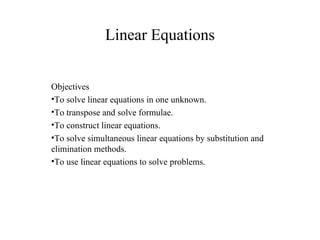
Linear Equations Objectives To solve linear equations in one unknown. To transpose and solve formulae. To construct linear equations. To solve simultaneous linear equations by substitution and elimination methods. To use linear equations to solve problems.
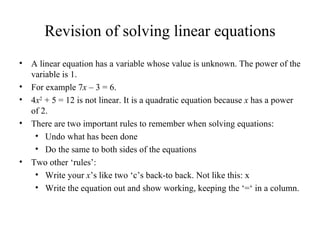
Revision of solving linear equations A linear equation has a variable whose value is unknown. The power of the variable is 1. For example 7 x  – 3 = 6. 4 x 2  + 5 = 12 is not linear. It is a quadratic equation because  x  has a power of 2. There are two important rules to remember when solving equations: Undo what has been done Do the same to both sides of the equations Two other ‘rules’: Write your  x ’s like two ‘c’s back-to back. Not like this: x Write the equation out and show working, keeping the ‘=‘ in a column.
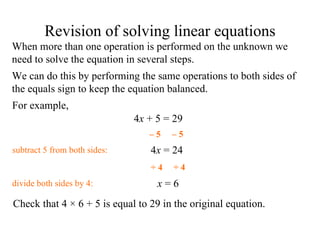
When more than one operation is performed on the unknown we need to solve the equation in several steps. We can do this by performing the same operations to both sides of the equals sign to keep the equation balanced. For example, 4 x  + 5 = 29 4 x  = 24 x  = 6 Check that 4  × 6 + 5 is equal to 29 in the original equation. Revision of solving linear equations subtract  5 from both sides: –  5 –  5 ÷ 4 ÷ 4 divide  both sides by 4:
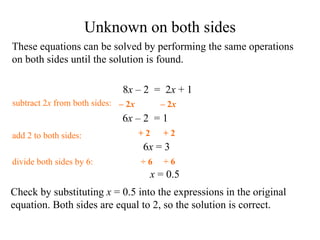
These equations can be solved by performing the same operations on both sides until the solution is found. Check by substituting  x  = 0.5 into the expressions in the original equation .  Both sides are equal to 2, so the solution is correct. 6 x   – 2  = 1 add 2 to  both sides: divide  both sides by 6: x  = 0.5 6 x  =  3 subtract 2 x  from  both sides: Unknown on both sides 8 x   – 2  =  2 x  + 1 + 2 + 2 ÷ 6 ÷ 6 –  2 x –  2 x
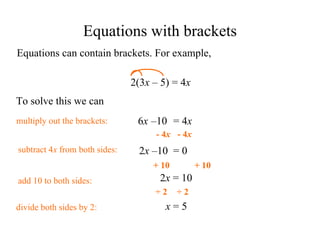
Equations can contain brackets. For example, 2(3 x   –  5) = 4 x To solve this we can multiply out the brackets: 6 x – 10 = 4 x 2 x  – 10   = 0 2 x  = 10 x  = 5 Equations with brackets + 10 + 10 add 10 to both sides: - 4 x - 4 x subtract 4 x  from both sides: ÷ 2 ÷ 2 divide both sides by 2:
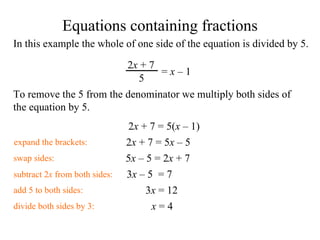
In this example the whole of one side of the equation is divided by 5. To remove the 5 from the denominator we multiply both sides of the equation by 5. 2 x  + 7 = 5( x   – 1) swap sides: 5 x   – 5  = 2 x  + 7  add 5 to both sides: 3 x   – 5   = 7 subtract 2 x  from both sides: 3 x  = 12 divide both sides by 3: x  = 4 expand the brackets: 2 x  + 7 = 5 x   – 5   Equations containing fractions 2 x  + 7 5 =  x   – 1
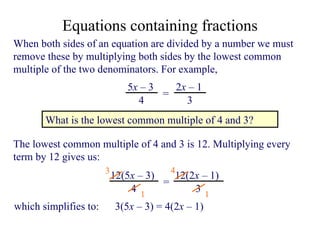
When both sides of an equation are divided by a number we must remove these by multiplying both sides by the lowest common multiple of the two denominators. For example,  What is the lowest common multiple of 4 and 3? The lowest common multiple of 4 and 3 is 12. Multiplying every term by 12 gives us: 3 1 4 1 which simplifies to:  3( 5 x   –  3) = 4(2 x   –  1) Equations containing fractions 5 x   –  3 4 = 2 x   –  1 3 12(5 x   –  3) 4 = 12(2 x   –  1) 3
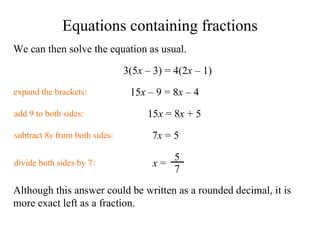
We can then solve the equation as usual. 3( 5 x   –  3) = 4(2 x   –  1) expand the brackets: 1 5 x   –  9 = 8 x   –  4 add 9 to both sides: 1 5 x  = 8 x   + 5 subtract 8 x  from both sides: 7 x  =  5 divide both sides by 7: Although this answer could be written as a rounded decimal, it is more exact left as a fraction. Equations containing fractions x  = 5 7
Revision of solving linear equations For further help, check out these Youtube clips. http://www.youtube.com/watch?v=W7fPsSw74TM&feature=related Lesson 1 – basic equations http://www.youtube.com/watch?v=58mHEQR8GFs&feature=related Lesson 2 – equations with fractions  http://www.youtube.com/watch?v=juG-iIuTJQE&feature=related Lesson 3 – harder equations with fractions http://www.youtube.com/watch?v=9teKXGoWIQM& Equations with unknown on both sides

Equations Revision

  • 1.
    Linear Equations ObjectivesTo solve linear equations in one unknown. To transpose and solve formulae. To construct linear equations. To solve simultaneous linear equations by substitution and elimination methods. To use linear equations to solve problems.
  • 2.
    Revision of solvinglinear equations A linear equation has a variable whose value is unknown. The power of the variable is 1. For example 7 x – 3 = 6. 4 x 2 + 5 = 12 is not linear. It is a quadratic equation because x has a power of 2. There are two important rules to remember when solving equations: Undo what has been done Do the same to both sides of the equations Two other ‘rules’: Write your x ’s like two ‘c’s back-to back. Not like this: x Write the equation out and show working, keeping the ‘=‘ in a column.
  • 3.
    When more thanone operation is performed on the unknown we need to solve the equation in several steps. We can do this by performing the same operations to both sides of the equals sign to keep the equation balanced. For example, 4 x + 5 = 29 4 x = 24 x = 6 Check that 4 × 6 + 5 is equal to 29 in the original equation. Revision of solving linear equations subtract 5 from both sides: – 5 – 5 ÷ 4 ÷ 4 divide both sides by 4:
  • 4.
    These equations canbe solved by performing the same operations on both sides until the solution is found. Check by substituting x = 0.5 into the expressions in the original equation . Both sides are equal to 2, so the solution is correct. 6 x – 2 = 1 add 2 to both sides: divide both sides by 6: x = 0.5 6 x = 3 subtract 2 x from both sides: Unknown on both sides 8 x – 2 = 2 x + 1 + 2 + 2 ÷ 6 ÷ 6 – 2 x – 2 x
  • 5.
    Equations can containbrackets. For example, 2(3 x – 5) = 4 x To solve this we can multiply out the brackets: 6 x – 10 = 4 x 2 x – 10 = 0 2 x = 10 x = 5 Equations with brackets + 10 + 10 add 10 to both sides: - 4 x - 4 x subtract 4 x from both sides: ÷ 2 ÷ 2 divide both sides by 2:
  • 6.
    In this examplethe whole of one side of the equation is divided by 5. To remove the 5 from the denominator we multiply both sides of the equation by 5. 2 x + 7 = 5( x – 1) swap sides: 5 x – 5 = 2 x + 7 add 5 to both sides: 3 x – 5 = 7 subtract 2 x from both sides: 3 x = 12 divide both sides by 3: x = 4 expand the brackets: 2 x + 7 = 5 x – 5 Equations containing fractions 2 x + 7 5 = x – 1
  • 7.
    When both sidesof an equation are divided by a number we must remove these by multiplying both sides by the lowest common multiple of the two denominators. For example, What is the lowest common multiple of 4 and 3? The lowest common multiple of 4 and 3 is 12. Multiplying every term by 12 gives us: 3 1 4 1 which simplifies to: 3( 5 x – 3) = 4(2 x – 1) Equations containing fractions 5 x – 3 4 = 2 x – 1 3 12(5 x – 3) 4 = 12(2 x – 1) 3
  • 8.
    We can thensolve the equation as usual. 3( 5 x – 3) = 4(2 x – 1) expand the brackets: 1 5 x – 9 = 8 x – 4 add 9 to both sides: 1 5 x = 8 x + 5 subtract 8 x from both sides: 7 x = 5 divide both sides by 7: Although this answer could be written as a rounded decimal, it is more exact left as a fraction. Equations containing fractions x = 5 7
  • 9.
    Revision of solvinglinear equations For further help, check out these Youtube clips. http://www.youtube.com/watch?v=W7fPsSw74TM&feature=related Lesson 1 – basic equations http://www.youtube.com/watch?v=58mHEQR8GFs&feature=related Lesson 2 – equations with fractions http://www.youtube.com/watch?v=juG-iIuTJQE&feature=related Lesson 3 – harder equations with fractions http://www.youtube.com/watch?v=9teKXGoWIQM& Equations with unknown on both sides