BACULOVIRUS IN
BIOCONTROL
Habitat
• Baculoviruses can be found wherever
insects exist.
• Because rain and wind readily carry
baculoviruses from place to place, it is
likely that every piece of land and body of
water contains some virus particles.
Properties
• Baculoviruses are pathogens that attack
insects and other arthropods (infects
Lepidoptera, Hymenoptera, and Diptera)
• Like some human viruses, they are usually
extremely small (less than a thousandth of
a millimeter across),
Hosts
• Baculoviruses have very species-specific
tropisms among the invertebrates with over
600 host species having been described.
• Immature (larval) forms of moth species are
the most common hosts, but these viruses
have also been found infecting sawflies,
mosquitoes, and shrimp.
• They are not known to replicate in mammalian
or other vertebrate animal cells.
Rods
• rod-shaped virus
• 40-50nm (Dia) X 200-400nm (L)
• Circular, double-stranded DNA genome
(80-200kb)
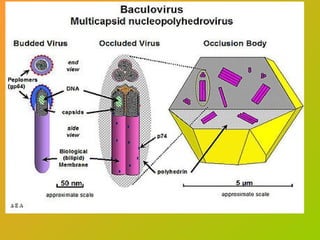
Rod-shaped
• The baculoviruses are a family of large rod-
shaped - that can be divided to two genera:
nucleopolyhedroviruses (NPV) and
Granuloviruses(GV).
• GVs contain only one nucleocapsid per
envelope,
• NPVs contain either single (SNPV) or multiple
(MNPV) nucleocapsids per envelope.
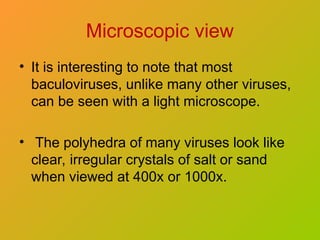
Microscopic view
• It is interesting to note that most
baculoviruses, unlike many other viruses,
can be seen with a light microscope.
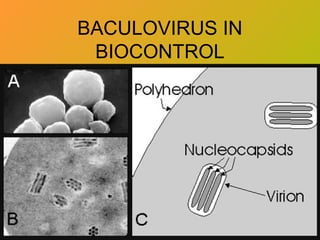
• The polyhedra of many viruses look like
clear, irregular crystals of salt or sand
when viewed at 400x or 1000x.
DNA
• Are composed primarily of
double-stranded DNA that codes
for genes needed for virus
establishment and reproduction.
Polyhedron
• Because this genetic material is
easily destroyed by exposure to
sunlight or by conditions in the
host's gut, an infective
baculovirus particle (virion) is
protected by protein coat called a
polyhedron
Virion structure
• The most studied baculovirus is Autographa
californica multicapsid nucleopolyhedrovirus
(AcMNPV). The virus was originally isolated
from the alfalfa looper (a lepidopteran) and
contains a 134-kbp genome
• The major capsid protein VP39 together with
some minor proteins forms the nucleocapsid
(21 nm x 260 nm) that encloses the DNA with
p6.9 protein
Appearance
• Insects killed by baculoviruses have a
characteristic shiny-oily appearance, and
are often seen hanging from vegetation.
• They are extremely fragile to the touch,
rupturing to release fluid filled with
infective virus particles.
• This tendency to remain attached to
foliage and then rupture is an important
aspect of the virus life-cycle.
• Infection of other insects will only occur if
they eat foliage that has been
contaminated by virus-killed larvae.
Life cycle
• The baculovirus life cycle involves two
distinct forms of virus.
• Occlusion derived virus (ODV) is present in a
protein matrix (polyhedrin or granulin) and is
responsible for the primary infection of the
host
• while the budded virus (BV) is released from
the infected host cells later during the
secondary infection
Life cycle
• Viruses are unable to reproduce without a
host - they are obligate parasites.
• Baculoviruses are parasites in insects,
multiplies in host & produces more virus
particles & cause the host insect to die in a
way that will maximize the chance that other
insects will come in contact with the virus
and become infected in turn
Cycle…
• Infection by baculovirus begins when an
insect eats virus particles on a plant -
perhaps from a sprayed treatment.
• The infected insect dies and "melts" or
falls apart on foliage, releasing more virus.
• This additional infective material can
infect more insects, continuing the cycle.
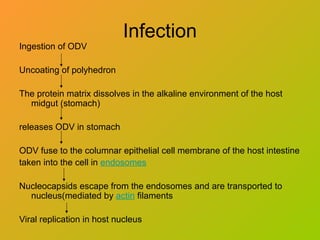
Infection
Ingestion of ODV
Uncoating of polyhedron
The protein matrix dissolves in the alkaline environment of the host
midgut (stomach)
releases ODV in stomach
ODV fuse to the columnar epithelial cell membrane of the host intestine
taken into the cell in endosomes
Nucleocapsids escape from the endosomes and are transported to
nucleus(mediated by actin filaments
Viral replication in host nucleus
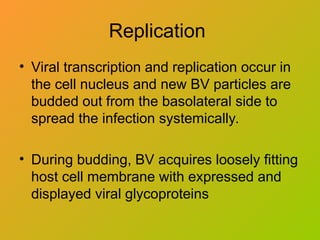
Replication
• Viral transcription and replication occur in
the cell nucleus and new BV particles are
budded out from the basolateral side to
spread the infection systemically.
• During budding, BV acquires loosely fitting
host cell membrane with expressed and
displayed viral glycoproteins
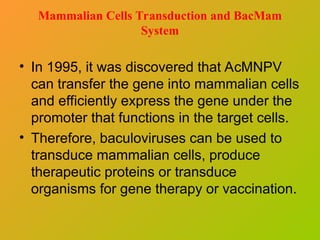
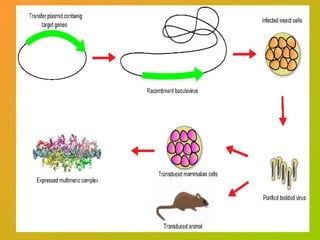
Mammalian Cells Transduction and BacMam
System
• In 1995, it was discovered that AcMNPV
can transfer the gene into mammalian cells
and efficiently express the gene under the
promoter that functions in the target cells.
• Therefore, baculoviruses can be used to
transduce mammalian cells, produce
therapeutic proteins or transduce
organisms for gene therapy or vaccination.
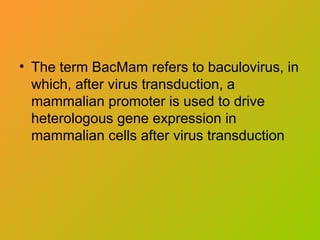
• The term BacMam refers to baculovirus, in
which, after virus transduction, a
mammalian promoter is used to drive
heterologous gene expression in
mammalian cells after virus transduction
• Since viral genomes can stably
accommodate an insert sequence of at least
40 kb, BacMam is particularly suitable for
expressing multimeric complexes.
• In recent years, BacMam has been used as a
carrier to deliver many polypeptide genes
(including secreted and transmembrane
proteins) to mammalian cells.
Success rate
• When using a high MOI, transduction
efficiencies near 100% can be reached
• With this high transduction efficiency and
flexibility, BacMam can easily enable the
coexpression of multiple genes with
multiple baculoviruses and modulation of
expression level by dosing and timing.
Advantages
• Baculo virus expression vector (BEVS) is
a convenient, versatile eukaryotic system
for heterologous gene expression
• BEVS provides correct folding of
recombinant protein & di sulphide bond
formation, and other post translational
modifications
• High level ptn expression
• Yields 100mg ptn/109
cells
• Capacity of large cDNA inserts-genes upto
15kb
• Simultaneous expression of multiple
genes
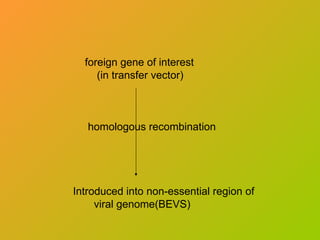
foreign gene of interest
(in transfer vector)
homologous recombination
Introduced into non-essential region of
viral genome(BEVS)
Applications
Baculovirus expression in insect cells
represents a robust method for producing
recombinant glycoproteins.
Baculovirus-produced proteins are currently
under study as therapeutic cancer
vaccines with several immunologic
advantages over proteins derived from
mammalian sources
• BEVS (from BD Biosciences
Pharminogen)
Modified Autographa californica nuclear
polyhedrosis virus-AcNPV
Infect insect cell lines-Spodoptera frugiperda
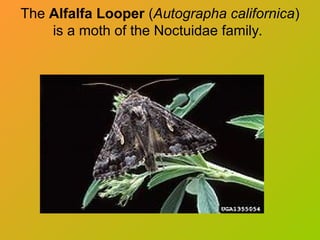
The Alfalfa Looper (Autographa californica)
is a moth of the Noctuidae family.
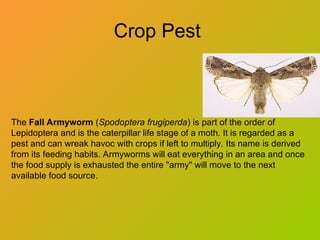
Crop Pest
The Fall Armyworm (Spodoptera frugiperda) is part of the order of
Lepidoptera and is the caterpillar life stage of a moth. It is regarded as a
pest and can wreak havoc with crops if left to multiply. Its name is derived
from its feeding habits. Armyworms will eat everything in an area and once
the food supply is exhausted the entire "army" will move to the next
available food source.
BV as expression vector
Many non-essential genes
• may be replaced by gene of interest
Powerful viral promoters
• particularly for late (L) and very late (VL)
phase genes
Polyhedrin (major protein in polyhedral matrix)
• p10 (fibrous structures in cytoplasm and
nucleus)
Advantages of BEVS
High recombinant protein expression levels
• 30-50% of total cellular protein
• Typical yields:
• 1-3mg/L for intracellular proteins (up to 50mg/L)
• 3-15mg/L for secreted proteins
Limitless size of expressed protein
• E. coli upper limit ~100kDa
• Eukaryotic system
Proper protein folding and processing
Post-translational modifications
Gypchek
• The US Forest Service currently uses the
gypsy moth nuclear polyhedrosis virus
(LdNPV) to aerially spray thousands of
acres of forest each year.
• This product, registered as Gypchek, is
effective against gypsy moths but leaves
all other animals unharmed

baculoviruses as an efficient viral vector

  • 1.
  • 2.
    Habitat • Baculoviruses canbe found wherever insects exist. • Because rain and wind readily carry baculoviruses from place to place, it is likely that every piece of land and body of water contains some virus particles.
  • 3.
    Properties • Baculoviruses arepathogens that attack insects and other arthropods (infects Lepidoptera, Hymenoptera, and Diptera) • Like some human viruses, they are usually extremely small (less than a thousandth of a millimeter across),
  • 4.
    Hosts • Baculoviruses havevery species-specific tropisms among the invertebrates with over 600 host species having been described. • Immature (larval) forms of moth species are the most common hosts, but these viruses have also been found infecting sawflies, mosquitoes, and shrimp. • They are not known to replicate in mammalian or other vertebrate animal cells.
  • 5.
    Rods • rod-shaped virus •40-50nm (Dia) X 200-400nm (L) • Circular, double-stranded DNA genome (80-200kb)
  • 6.
    Rod-shaped • The baculovirusesare a family of large rod- shaped - that can be divided to two genera: nucleopolyhedroviruses (NPV) and Granuloviruses(GV). • GVs contain only one nucleocapsid per envelope, • NPVs contain either single (SNPV) or multiple (MNPV) nucleocapsids per envelope.
  • 8.
    Microscopic view • Itis interesting to note that most baculoviruses, unlike many other viruses, can be seen with a light microscope. • The polyhedra of many viruses look like clear, irregular crystals of salt or sand when viewed at 400x or 1000x.
  • 9.
    DNA • Are composedprimarily of double-stranded DNA that codes for genes needed for virus establishment and reproduction.
  • 10.
    Polyhedron • Because thisgenetic material is easily destroyed by exposure to sunlight or by conditions in the host's gut, an infective baculovirus particle (virion) is protected by protein coat called a polyhedron
  • 11.
    Virion structure • Themost studied baculovirus is Autographa californica multicapsid nucleopolyhedrovirus (AcMNPV). The virus was originally isolated from the alfalfa looper (a lepidopteran) and contains a 134-kbp genome • The major capsid protein VP39 together with some minor proteins forms the nucleocapsid (21 nm x 260 nm) that encloses the DNA with p6.9 protein
  • 12.
    Appearance • Insects killedby baculoviruses have a characteristic shiny-oily appearance, and are often seen hanging from vegetation. • They are extremely fragile to the touch, rupturing to release fluid filled with infective virus particles.
  • 13.
    • This tendencyto remain attached to foliage and then rupture is an important aspect of the virus life-cycle. • Infection of other insects will only occur if they eat foliage that has been contaminated by virus-killed larvae.
  • 14.
    Life cycle • Thebaculovirus life cycle involves two distinct forms of virus. • Occlusion derived virus (ODV) is present in a protein matrix (polyhedrin or granulin) and is responsible for the primary infection of the host • while the budded virus (BV) is released from the infected host cells later during the secondary infection
  • 15.
    Life cycle • Virusesare unable to reproduce without a host - they are obligate parasites. • Baculoviruses are parasites in insects, multiplies in host & produces more virus particles & cause the host insect to die in a way that will maximize the chance that other insects will come in contact with the virus and become infected in turn
  • 16.
    Cycle… • Infection bybaculovirus begins when an insect eats virus particles on a plant - perhaps from a sprayed treatment. • The infected insect dies and "melts" or falls apart on foliage, releasing more virus. • This additional infective material can infect more insects, continuing the cycle.
  • 17.
    Infection Ingestion of ODV Uncoatingof polyhedron The protein matrix dissolves in the alkaline environment of the host midgut (stomach) releases ODV in stomach ODV fuse to the columnar epithelial cell membrane of the host intestine taken into the cell in endosomes Nucleocapsids escape from the endosomes and are transported to nucleus(mediated by actin filaments Viral replication in host nucleus
  • 18.
    Replication • Viral transcriptionand replication occur in the cell nucleus and new BV particles are budded out from the basolateral side to spread the infection systemically. • During budding, BV acquires loosely fitting host cell membrane with expressed and displayed viral glycoproteins
  • 19.
    Mammalian Cells Transductionand BacMam System • In 1995, it was discovered that AcMNPV can transfer the gene into mammalian cells and efficiently express the gene under the promoter that functions in the target cells. • Therefore, baculoviruses can be used to transduce mammalian cells, produce therapeutic proteins or transduce organisms for gene therapy or vaccination.
  • 20.
    • The termBacMam refers to baculovirus, in which, after virus transduction, a mammalian promoter is used to drive heterologous gene expression in mammalian cells after virus transduction
  • 21.
    • Since viralgenomes can stably accommodate an insert sequence of at least 40 kb, BacMam is particularly suitable for expressing multimeric complexes. • In recent years, BacMam has been used as a carrier to deliver many polypeptide genes (including secreted and transmembrane proteins) to mammalian cells.
  • 22.
    Success rate • Whenusing a high MOI, transduction efficiencies near 100% can be reached • With this high transduction efficiency and flexibility, BacMam can easily enable the coexpression of multiple genes with multiple baculoviruses and modulation of expression level by dosing and timing.
  • 24.
    Advantages • Baculo virusexpression vector (BEVS) is a convenient, versatile eukaryotic system for heterologous gene expression • BEVS provides correct folding of recombinant protein & di sulphide bond formation, and other post translational modifications • High level ptn expression • Yields 100mg ptn/109 cells
  • 25.
    • Capacity oflarge cDNA inserts-genes upto 15kb • Simultaneous expression of multiple genes
  • 26.
    foreign gene ofinterest (in transfer vector) homologous recombination Introduced into non-essential region of viral genome(BEVS)
  • 27.
    Applications Baculovirus expression ininsect cells represents a robust method for producing recombinant glycoproteins. Baculovirus-produced proteins are currently under study as therapeutic cancer vaccines with several immunologic advantages over proteins derived from mammalian sources
  • 28.
    • BEVS (fromBD Biosciences Pharminogen) Modified Autographa californica nuclear polyhedrosis virus-AcNPV Infect insect cell lines-Spodoptera frugiperda
  • 29.
    The Alfalfa Looper(Autographa californica) is a moth of the Noctuidae family.
  • 30.
    Crop Pest The FallArmyworm (Spodoptera frugiperda) is part of the order of Lepidoptera and is the caterpillar life stage of a moth. It is regarded as a pest and can wreak havoc with crops if left to multiply. Its name is derived from its feeding habits. Armyworms will eat everything in an area and once the food supply is exhausted the entire "army" will move to the next available food source.
  • 31.
    BV as expressionvector Many non-essential genes • may be replaced by gene of interest Powerful viral promoters • particularly for late (L) and very late (VL) phase genes Polyhedrin (major protein in polyhedral matrix) • p10 (fibrous structures in cytoplasm and nucleus)
  • 32.
    Advantages of BEVS Highrecombinant protein expression levels • 30-50% of total cellular protein • Typical yields: • 1-3mg/L for intracellular proteins (up to 50mg/L) • 3-15mg/L for secreted proteins Limitless size of expressed protein • E. coli upper limit ~100kDa • Eukaryotic system Proper protein folding and processing Post-translational modifications
  • 33.
    Gypchek • The USForest Service currently uses the gypsy moth nuclear polyhedrosis virus (LdNPV) to aerially spray thousands of acres of forest each year. • This product, registered as Gypchek, is effective against gypsy moths but leaves all other animals unharmed