BANARASHINDUUERSITY
INSTITUTE OF AGRICULTURAL SCIENCE
EXPERIENCIAL LEARNING MODULE
(4TH
YEAR SECOND SEMESTER)
ENT-422(PRODUCTION TECHNOLOGY OF BIO-CONTROL AGENT AND BIO-
FERTILIZER
REPORT ON – MASS PRODUCTION OF BIO-CONTROL AGENT
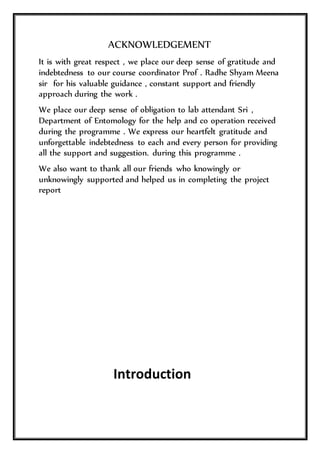
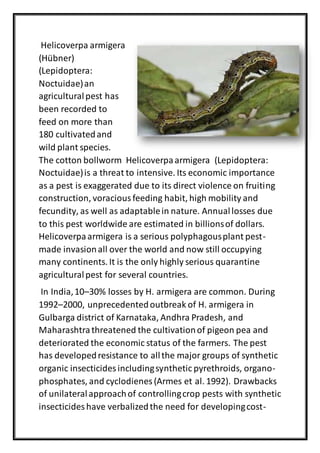
1.Production of HaNPV(Helicoverpa armigera neuclear poly-hedrosis virus)
SUBMITTED TO-: SUBMITTED BY-:
Prof. BRINCH SHARMA AMIT YADAV
Dr. RS MEENA ID-18212AGC024
Dr. N. SRINIVAS
ACKNOWLEDGEMENT
It is with great respect , we place our deep sense of gratitude and
indebtedness to our course coordinator Prof . Radhe Shyam Meena
sir for his valuable guidance , constant support and friendly
approach during the work .
We place our deep sense of obligation to lab attendant Sri ,
Department of Entomology for the help and co operation received
during the programme . We express our heartfelt gratitude and
unforgettable indebtedness to each and every person for providing
all the support and suggestion. during this programme .
We also want to thank all our friends who knowingly or
unknowingly supported and helped us in completing the project
report
Introduction
Helicoverpa armigera
(Hübner)
(Lepidoptera:
Noctuidae)an
agriculturalpest has
been recorded to
feed on more than
180 cultivatedand
wild plant species.
The cotton bollworm Helicoverpaarmigera (Lepidoptera:
Noctuidae)is a threat to intensive. Its economic importance
as a pest is exaggerated due to its direct violence on fruiting
construction, voraciousfeeding habit, high mobility and
fecundity, as well as adaptablein nature. Annuallosses due
to this pest worldwide are estimated in billionsof dollars.
Helicoverpaarmigera is a serious polyphagousplant pest-
made invasionall over the world and now still occupying
many continents. It is the only highly serious quarantine
agriculturalpest for several countries.
In India,10–30% losses by H. armigera are common. During
1992–2000, unprecedentedoutbreak of H. armigera in
Gulbarga district of Karnataka, Andhra Pradesh, and
Maharashtrathreatened the cultivationof pigeon pea and
deteriorated the economic status of the farmers. The pest
has developedresistance to allthe major groups of synthetic
organic insecticides includingsynthetic pyrethroids, organo-
phosphates, and cyclodienes (Armes et al. 1992). Drawbacks
of unilateralapproachof controllingcrop pests with synthetic
insecticides have verbalizedthe need for developingcost-
effective, eco-friendly, and safe pest control strategies.
However, growing of Bt cotton in India, to some extent,
reduced the pest incident only in cotton field, but it is still
dominatingin other economic plant species.
Beneficially,the pest is highly prone to its pathogen,nuclear
polyhedrosisvirus (NPV) of Baculoviridae,and has
established history of use as biopesticidedue to its high
virulence, high specificity, and nonpollutingnature, and it can
be appliedto crops using conventionalequipmentdesigned
for chemical insecticides. Studies have shown that the virus
can be used effectively as biopesticidein the field The
nuclearpolyhedrosisvirus of H. armigera (HaNPV) has been
found effective against H. armigera on chickpea, cotton,
pigeon pea, tomato, The NPV has been considered as a viable
alternativeto chemical insecticides. As a result, Government
of India has been popularizingIntegrated Pest Management
(IPM) for promoting the biologicalcontrol method using NPV
as one of the important tools in the management of the pest.
Although Indian farmers are aware of the effectiveness of
NPV against H. armigera, they rarely employ NPV in the
bollworm control, primarilydue to unavailabilityof the host-
specific biopesticidein the market.
Many factors that influence the use and performance of the
viruses are production,biologicalactivity(virulence), and
persistence. Major challenges that result in incomplete
extension of baculovirususe comprise narrow host range and
technicaland economic difficulties for in vitro commercial
production.As the virus is an obligate pathogen,it can be
multipliedonly by in vivo method using H. armigera larvae,
which is labor-intensiveand highly skill-oriented.Hence,
successful productionof NPV dependson the large-scale
productionof host insect larvae often in millionson semi-
synthetic diet in the laboratory.As NPV is being quite stable
in storage, it can be produced in large amount and stored in
concentrated form. As a prerequisite, the maintenanceof
disease-free and geneticallysuitable and uniform parental
laboratory coloniesof H. armigera is a basic necessity in the
mass productionof HaNPV.
Biology of Helicoverpaarmigera
Helicoverpaanmigera is the most prevalent, highly
phytophagouspest in India and is of most relevance to
agriculturaleconomy. It hasposed a serious threat to many
crops and the apparentimportance of the pest calls attention
to vital biology of it.
Its life cycle on several crops has been studied at several
locationsby many workers.
Singh.H and Singh. G (1975) have studied the variousstages
in the lifecycle of Helicoverpa, The larvae pass through six
instars. There is vast variationin the colour of the developed
larvae. The total larval developmentperiod was around 18-
20 days.
Biology of Nuclear PolyhedrosisVirus (NPV)
The nuclearpolyhedrosisvirus belong to the family of
occluded DNA viruses,Baculoviridae.Representatives of the
nuclearpolyhedrosisvirus (NPV) were the first insect viruses
investigated. The virus is characterized by the presence of
inclusion bodies, the so-called polyhedra,in infected insects.
The nature and significance of these polyhedraremained a
mystery for a long time until the electron microscope was
availablethat the virus particle could be isolated and
identifiedas the infectious viral agent.
The word, "polyhedra"willdesignate inclusion/occlusion
bodies found in the nucleusof the cells of insects as a result
of virus infection.Size and Shape of Polyhedra:The size and
shape of polyhedravaries considerablynot only between the
polyhedrafrom different insects, but of ten also within
polyhedraof the same species.
Majority of the polyhedralinclusionbodies (PIBs) of H.
armigera NPV are spherical while some of them are irregular
in shape. The size ranged from 0.6 pm to 2.3 pm averaging to
1.35 pm. The diameter of polyhedraranges about 0.5 to 1.5
pm, dependingon the insect species. Fig. 6 shows the cross-
section of polyhedronof HNPV.
In the boundaryof polyhedron,the polyhedralenvelope(PE)
appearsas an electron dense layer.
The distance between the polyhedralenvelopand polyhedral
crystalline matrixis not uniform aroundthe polyhedron.The
fine structure of polyhedral reveals crystalline lattice of the
polyhedraprotein molecules, which are arranged in a cubic
system.
Although there is no true membrane covering the PIB,
difficulties in staining PIB, the retention of their shape, and
the presence of a membrane-like coat followingchemical and
physical treatment indicatethat the exterior portion of a PIB
is different for the interior portion. On the whole they are
very stable and can persist indefinitelyin the environment.
(Gernot H. Bergold et al, 1982)
Morphologyand size of viruses: Electron microscopic
observationsare necessary in order to investigate their exact
morphology. The viruses can exist in the morphological states
free virus particles isolatedfrom polyhedra;virus particles
still enclosed in polyhedraand virus particles within infected
cell nuclei.
In general they are rod-shaped, about 20-50 nm in diameter
(incl. the developmental membrane), and about 200-400 nm
long. Virion:Mectious, rod-shaped virionsare randomly
occluded and singly embedded in PIBs without any apparent
disruptionof the lattice;an 8 nm layer separates virionfrom
the protein matrix. Alkaline-liberatedvirionsreadily lose the
envelopes to reveal nucleocapsidseach made up, of a capsid
surrounding a DNA core. The capsid, in turn, consists of
protein subunitsarranged along its long axis. The virions
contain double-stranded,circular DNA molecules present
super coiled and packed in the nucleocapsid.Physico-
chemical and chemical properties: It has been known for
some time that acids or alkalidisrupt PIBs and thus
presumably destroy the viral activity. Polyhedrado not
dissolve in hot or cold water, alcohol,ether, chloroform,
benzol, or acetone.
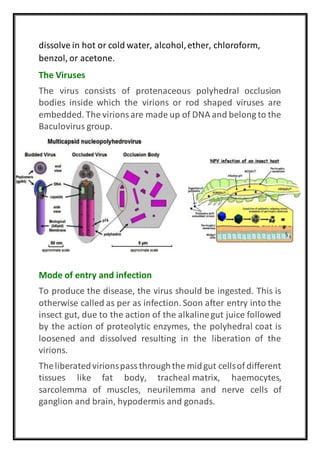
The Viruses
The virus consists of protenaceous polyhedral occlusion
bodies inside which the virions or rod shaped viruses are
embedded. The virionsare made up of DNA and belong to the
Baculovirus group.
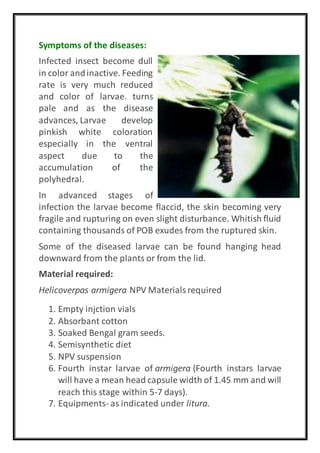
Mode of entry and infection
To produce the disease, the virus should be ingested. This is
otherwise called as per as infection. Soon after entry into the
insect gut, due to the action of the alkalinegut juice followed
by the action of proteolytic enzymes, the polyhedral coat is
loosened and dissolved resulting in the liberation of the
virions.
Theliberatedvirionspassthroughthe midgut cellsof different
tissues like fat body, tracheal matrix, haemocytes,
sarcolemma of muscles, neurilemma and nerve cells of
ganglion and brain, hypodermis and gonads.
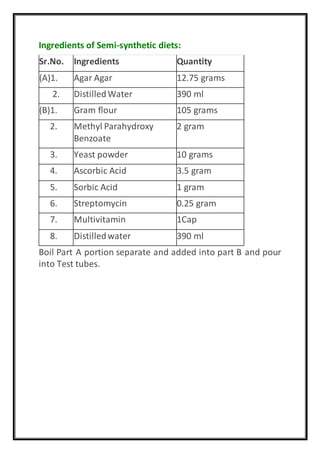
Symptoms of the diseases:
Infected insect become dull
in color andinactive. Feeding
rate is very much reduced
and color of larvae. turns
pale and as the disease
advances, Larvae develop
pinkish white coloration
especially in the ventral
aspect due to the
accumulation of the
polyhedral.
In advanced stages of
infection the larvae become flaccid, the skin becoming very
fragile and rupturing on even slight disturbance. Whitish fluid
containing thousands of POB exudes from the ruptured skin.
Some of the diseased larvae can be found hanging head
downward from the plants or from the lid.
Material required:
Helicoverpas armigera NPV Materialsrequired
1. Empty injction vials
2. Absorbant cotton
3. Soaked Bengal gram seeds.
4. Semisynthetic diet
5. NPV suspension
6. Fourth instar larvae of armigera (Fourth instars larvae
will have a mean head capsule width of 1.45 mm and will
reach this stage within 5-7 days).
7. Equipments- as indicated under litura.
Ingredients of Semi-synthetic diets:
Sr.No. Ingredients Quantity
(A)1. Agar Agar 12.75 grams
2. DistilledWater 390 ml
(B)1. Gram flour 105 grams
2. Methyl Parahydroxy
Benzoate
2 gram
3. Yeast powder 10 grams
4. Ascorbic Acid 3.5 gram
5. Sorbic Acid 1 gram
6. Streptomycin 0.25 gram
7. Multivitamin 1Cap
8. Distilledwater 390 ml
Boil Part A portion separate and added into part B and pour
into Test tubes.
Virus production methods
- Rearing On
the lab
- Direct field
method
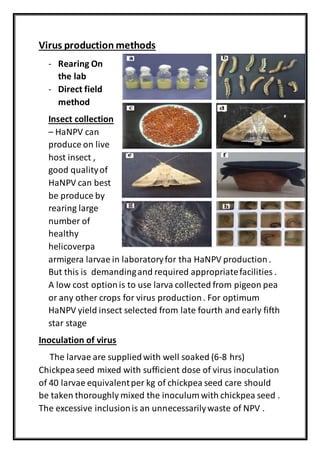
Insect collection
– HaNPV can
produce on live
host insect ,
good qualityof
HaNPV can best
be produce by
rearing large
number of
healthy
helicoverpa
armigera larvae in laboratoryfor tha HaNPV production.
But this is demandingand required appropriatefacilities .
A low cost optionis to use larva collected from pigeon pea
or any other crops for virus production. For optimum
HaNPV yield insect selected from late fourth and early fifth
star stage
Inoculation of virus
The larvae are suppliedwith well soaked (6-8 hrs)
Chickpeaseed mixed with sufficient dose of virus inoculation
of 40 larvae equivalentper kg of chickpea seed care should
be taken thoroughly mixed the inoculum with chickpea seed .
The excessive inclusionis an unnecessarilywaste of NPV .
While under dosing with effective every insect kept in
individualcompartment provided with 2-3 chickpeavirus
inoculatedseed labelledand left for infection.
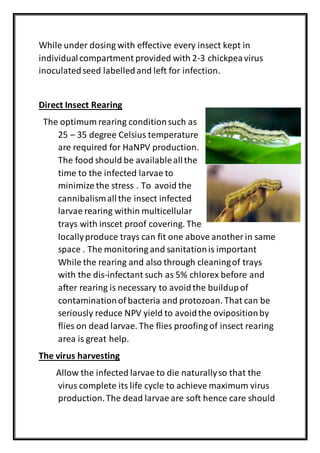
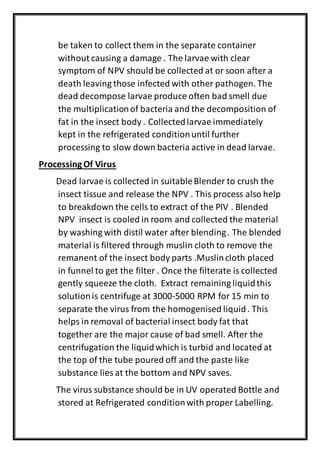
Direct Insect Rearing
The optimum rearing conditionsuch as
25 – 35 degree Celsius temperature
are required for HaNPV production.
The food should be availableallthe
time to the infected larvae to
minimize the stress . To avoid the
cannibalismallthe insect infected
larvae rearing within multicellular
trays with inscet proof covering. The
locallyproduce trays can fit one above another in same
space . The monitoring and sanitationis important
While the rearing and also through cleaningof trays
with the dis-infectant such as 5% chlorex before and
after rearing is necessary to avoidthe buildupof
contaminationof bacteria and protozoan. That can be
seriously reduce NPV yield to avoidthe ovipositionby
flies on dead larvae. The flies proofing of insect rearing
area is great help.
The virus harvesting
Allow the infected larvae to die naturallyso that the
virus complete its life cycle to achieve maximum virus
production.The dead larvae are soft hence care should
be taken to collect them in the separate container
without causing a damage . The larvae with clear
symptom of NPV should be collected at or soon after a
death leaving those infected with other pathogen. The
dead decompose larvae produce often bad smell due
the multiplicationof bacteria and the decomposition of
fat in the insect body . Collectedlarvae immediately
kept in the refrigerated conditionuntil further
processing to slow down bacteria active in dead larvae.
ProcessingOf Virus
Dead larvae is collected in suitableBlender to crush the
insect tissue and release the NPV . This process also help
to breakdown the cells to extract of the PIV . Blended
NPV insect is cooled in room and collected the material
by washing with distil water after blending. The blended
material is filtered through muslin cloth to remove the
remanent of the insect body parts .Muslincloth placed
in funnel to get the filter . Once the filterate is collected
gently squeeze the cloth. Extract remaining liquidthis
solutionis centrifuge at 3000-5000 RPM for 15 min to
separate the virus from the homogenised liquid. This
helps in removal of bacterial insect body fat that
together are the major cause of bad smell. After the
centrifugation the liquidwhich is turbid and located at
the top of the tube poured off and the paste like
substance lies at the bottom and NPV saves.
The virus substance should be in UV operated Bottle and
stored at Refrigerated conditionwith proper Labelling.
Virus Quality Measures:-
Assessing the qualityof virus that is produce is highly
essential. A haemocytometer is an essential tool to
measure the quality of virus in a sample. The dark phase
or phase contrast microscope is needed to count the PIV
using a haemocytometer. The NPV should be counted
and recorded as per ml however it is common practice
to quantify NPV in India. In term of larval equivalentLE.
This represent the average NPV count of single
Optimizely infected host larvae. While the use of LE
should not replace actuallycounting of NPV. The use of
term LE is widespread and may be used as additional
description for an NPV product provide the LE finger is
supported by direct count. The currently proposed
Indianstandard for an LE is that it is 6×10⁹
POB. It is the
important also bats of NTV viruses to confirm the
potency of the virus to the target insect
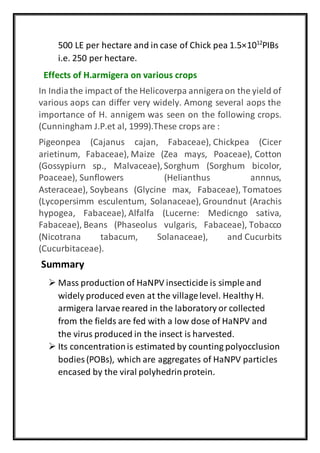
Application of HaNPV:-
NPV is sensitive to UV rays of
Sun. for improving the
effectiveness of NPV spray
late in the day after peak
sunshine. The additionally
adding UV absorbent such
as 1ml of Robin blue to a litre of spray solution has been
reported in improving the effectiveness of the NPV .for
the pigeon pea HaNPV should be used at 3×10¹²
PIBs i.e
500 LE per hectare and in case of Chick pea 1.5×10¹²
PIBs
i.e. 250 per hectare.
Effects of H.armigera on various crops
In Indiathe impact of the Helicoverpa annigeraon the yield of
various aops can differ very widely. Among several aops the
importance of H. annigem was seen on the following crops.
(Cunningham J.P.et al, 1999).These crops are :
Pigeonpea (Cajanus cajan, Fabaceae), Chickpea (Cicer
arietinum, Fabaceae), Maize (Zea mays, Poaceae), Cotton
(Gossypiurn sp., Malvaceae),Sorghum (Sorghum bicolor,
Poaceae), Sunflowers (Helianthus annnus,
Asteraceae), Soybeans (Glycine max, Fabaceae), Tomatoes
(Lycopersimm esculentum, Solanaceae), Groundnut (Arachis
hypogea, Fabaceae), Alfalfa (Lucerne: Medicngo sativa,
Fabaceae), Beans (Phaseolus vulgaris, Fabaceae), Tobacco
(Nicotrana tabacum, Solanaceae), and Cucurbits
(Cucurbitaceae).
Summary
 Mass production of HaNPV insecticide is simple and
widely produced even at the villagelevel. Healthy H.
armigera larvae reared in the laboratory or collected
from the fields are fed with a low dose of HaNPV and
the virus produced in the insect is harvested.
 Its concentrationis estimated by counting polyocclusion
bodies (POBs), which are aggregates of HaNPV particles
encased by the viral polyhedrinprotein.
 The effectiveness of the viral insecticide is critically
dependenton the concentrationof POB, which is
expressed as larval equivalent(LE).
 A standard 1 LE stock preparationshould consist of 6
x10⁹ POBs/ml.

AMIT ent 422 HaNPV productin.docx

  • 1.
    BANARASHINDUUERSITY INSTITUTE OF AGRICULTURALSCIENCE EXPERIENCIAL LEARNING MODULE (4TH YEAR SECOND SEMESTER) ENT-422(PRODUCTION TECHNOLOGY OF BIO-CONTROL AGENT AND BIO- FERTILIZER REPORT ON – MASS PRODUCTION OF BIO-CONTROL AGENT 1.Production of HaNPV(Helicoverpa armigera neuclear poly-hedrosis virus) SUBMITTED TO-: SUBMITTED BY-: Prof. BRINCH SHARMA AMIT YADAV Dr. RS MEENA ID-18212AGC024 Dr. N. SRINIVAS
  • 2.
    ACKNOWLEDGEMENT It is withgreat respect , we place our deep sense of gratitude and indebtedness to our course coordinator Prof . Radhe Shyam Meena sir for his valuable guidance , constant support and friendly approach during the work . We place our deep sense of obligation to lab attendant Sri , Department of Entomology for the help and co operation received during the programme . We express our heartfelt gratitude and unforgettable indebtedness to each and every person for providing all the support and suggestion. during this programme . We also want to thank all our friends who knowingly or unknowingly supported and helped us in completing the project report Introduction
  • 3.
    Helicoverpa armigera (Hübner) (Lepidoptera: Noctuidae)an agriculturalpest has beenrecorded to feed on more than 180 cultivatedand wild plant species. The cotton bollworm Helicoverpaarmigera (Lepidoptera: Noctuidae)is a threat to intensive. Its economic importance as a pest is exaggerated due to its direct violence on fruiting construction, voraciousfeeding habit, high mobility and fecundity, as well as adaptablein nature. Annuallosses due to this pest worldwide are estimated in billionsof dollars. Helicoverpaarmigera is a serious polyphagousplant pest- made invasionall over the world and now still occupying many continents. It is the only highly serious quarantine agriculturalpest for several countries. In India,10–30% losses by H. armigera are common. During 1992–2000, unprecedentedoutbreak of H. armigera in Gulbarga district of Karnataka, Andhra Pradesh, and Maharashtrathreatened the cultivationof pigeon pea and deteriorated the economic status of the farmers. The pest has developedresistance to allthe major groups of synthetic organic insecticides includingsynthetic pyrethroids, organo- phosphates, and cyclodienes (Armes et al. 1992). Drawbacks of unilateralapproachof controllingcrop pests with synthetic insecticides have verbalizedthe need for developingcost-
  • 4.
    effective, eco-friendly, andsafe pest control strategies. However, growing of Bt cotton in India, to some extent, reduced the pest incident only in cotton field, but it is still dominatingin other economic plant species. Beneficially,the pest is highly prone to its pathogen,nuclear polyhedrosisvirus (NPV) of Baculoviridae,and has established history of use as biopesticidedue to its high virulence, high specificity, and nonpollutingnature, and it can be appliedto crops using conventionalequipmentdesigned for chemical insecticides. Studies have shown that the virus can be used effectively as biopesticidein the field The nuclearpolyhedrosisvirus of H. armigera (HaNPV) has been found effective against H. armigera on chickpea, cotton, pigeon pea, tomato, The NPV has been considered as a viable alternativeto chemical insecticides. As a result, Government of India has been popularizingIntegrated Pest Management (IPM) for promoting the biologicalcontrol method using NPV as one of the important tools in the management of the pest. Although Indian farmers are aware of the effectiveness of NPV against H. armigera, they rarely employ NPV in the bollworm control, primarilydue to unavailabilityof the host- specific biopesticidein the market. Many factors that influence the use and performance of the viruses are production,biologicalactivity(virulence), and persistence. Major challenges that result in incomplete extension of baculovirususe comprise narrow host range and technicaland economic difficulties for in vitro commercial production.As the virus is an obligate pathogen,it can be
  • 5.
    multipliedonly by invivo method using H. armigera larvae, which is labor-intensiveand highly skill-oriented.Hence, successful productionof NPV dependson the large-scale productionof host insect larvae often in millionson semi- synthetic diet in the laboratory.As NPV is being quite stable in storage, it can be produced in large amount and stored in concentrated form. As a prerequisite, the maintenanceof disease-free and geneticallysuitable and uniform parental laboratory coloniesof H. armigera is a basic necessity in the mass productionof HaNPV. Biology of Helicoverpaarmigera Helicoverpaanmigera is the most prevalent, highly phytophagouspest in India and is of most relevance to agriculturaleconomy. It hasposed a serious threat to many crops and the apparentimportance of the pest calls attention to vital biology of it. Its life cycle on several crops has been studied at several locationsby many workers. Singh.H and Singh. G (1975) have studied the variousstages in the lifecycle of Helicoverpa, The larvae pass through six instars. There is vast variationin the colour of the developed larvae. The total larval developmentperiod was around 18- 20 days. Biology of Nuclear PolyhedrosisVirus (NPV) The nuclearpolyhedrosisvirus belong to the family of occluded DNA viruses,Baculoviridae.Representatives of the
  • 6.
    nuclearpolyhedrosisvirus (NPV) werethe first insect viruses investigated. The virus is characterized by the presence of inclusion bodies, the so-called polyhedra,in infected insects. The nature and significance of these polyhedraremained a mystery for a long time until the electron microscope was availablethat the virus particle could be isolated and identifiedas the infectious viral agent. The word, "polyhedra"willdesignate inclusion/occlusion bodies found in the nucleusof the cells of insects as a result of virus infection.Size and Shape of Polyhedra:The size and shape of polyhedravaries considerablynot only between the polyhedrafrom different insects, but of ten also within polyhedraof the same species. Majority of the polyhedralinclusionbodies (PIBs) of H. armigera NPV are spherical while some of them are irregular in shape. The size ranged from 0.6 pm to 2.3 pm averaging to 1.35 pm. The diameter of polyhedraranges about 0.5 to 1.5 pm, dependingon the insect species. Fig. 6 shows the cross- section of polyhedronof HNPV. In the boundaryof polyhedron,the polyhedralenvelope(PE) appearsas an electron dense layer. The distance between the polyhedralenvelopand polyhedral crystalline matrixis not uniform aroundthe polyhedron.The fine structure of polyhedral reveals crystalline lattice of the polyhedraprotein molecules, which are arranged in a cubic system.
  • 7.
    Although there isno true membrane covering the PIB, difficulties in staining PIB, the retention of their shape, and the presence of a membrane-like coat followingchemical and physical treatment indicatethat the exterior portion of a PIB is different for the interior portion. On the whole they are very stable and can persist indefinitelyin the environment. (Gernot H. Bergold et al, 1982) Morphologyand size of viruses: Electron microscopic observationsare necessary in order to investigate their exact morphology. The viruses can exist in the morphological states free virus particles isolatedfrom polyhedra;virus particles still enclosed in polyhedraand virus particles within infected cell nuclei. In general they are rod-shaped, about 20-50 nm in diameter (incl. the developmental membrane), and about 200-400 nm long. Virion:Mectious, rod-shaped virionsare randomly occluded and singly embedded in PIBs without any apparent disruptionof the lattice;an 8 nm layer separates virionfrom the protein matrix. Alkaline-liberatedvirionsreadily lose the envelopes to reveal nucleocapsidseach made up, of a capsid surrounding a DNA core. The capsid, in turn, consists of protein subunitsarranged along its long axis. The virions contain double-stranded,circular DNA molecules present super coiled and packed in the nucleocapsid.Physico- chemical and chemical properties: It has been known for some time that acids or alkalidisrupt PIBs and thus presumably destroy the viral activity. Polyhedrado not
  • 8.
    dissolve in hotor cold water, alcohol,ether, chloroform, benzol, or acetone. The Viruses The virus consists of protenaceous polyhedral occlusion bodies inside which the virions or rod shaped viruses are embedded. The virionsare made up of DNA and belong to the Baculovirus group. Mode of entry and infection To produce the disease, the virus should be ingested. This is otherwise called as per as infection. Soon after entry into the insect gut, due to the action of the alkalinegut juice followed by the action of proteolytic enzymes, the polyhedral coat is loosened and dissolved resulting in the liberation of the virions. Theliberatedvirionspassthroughthe midgut cellsof different tissues like fat body, tracheal matrix, haemocytes, sarcolemma of muscles, neurilemma and nerve cells of ganglion and brain, hypodermis and gonads.
  • 9.
    Symptoms of thediseases: Infected insect become dull in color andinactive. Feeding rate is very much reduced and color of larvae. turns pale and as the disease advances, Larvae develop pinkish white coloration especially in the ventral aspect due to the accumulation of the polyhedral. In advanced stages of infection the larvae become flaccid, the skin becoming very fragile and rupturing on even slight disturbance. Whitish fluid containing thousands of POB exudes from the ruptured skin. Some of the diseased larvae can be found hanging head downward from the plants or from the lid. Material required: Helicoverpas armigera NPV Materialsrequired 1. Empty injction vials 2. Absorbant cotton 3. Soaked Bengal gram seeds. 4. Semisynthetic diet 5. NPV suspension 6. Fourth instar larvae of armigera (Fourth instars larvae will have a mean head capsule width of 1.45 mm and will reach this stage within 5-7 days). 7. Equipments- as indicated under litura.
  • 10.
    Ingredients of Semi-syntheticdiets: Sr.No. Ingredients Quantity (A)1. Agar Agar 12.75 grams 2. DistilledWater 390 ml (B)1. Gram flour 105 grams 2. Methyl Parahydroxy Benzoate 2 gram 3. Yeast powder 10 grams 4. Ascorbic Acid 3.5 gram 5. Sorbic Acid 1 gram 6. Streptomycin 0.25 gram 7. Multivitamin 1Cap 8. Distilledwater 390 ml Boil Part A portion separate and added into part B and pour into Test tubes.
  • 11.
    Virus production methods -Rearing On the lab - Direct field method Insect collection – HaNPV can produce on live host insect , good qualityof HaNPV can best be produce by rearing large number of healthy helicoverpa armigera larvae in laboratoryfor tha HaNPV production. But this is demandingand required appropriatefacilities . A low cost optionis to use larva collected from pigeon pea or any other crops for virus production. For optimum HaNPV yield insect selected from late fourth and early fifth star stage Inoculation of virus The larvae are suppliedwith well soaked (6-8 hrs) Chickpeaseed mixed with sufficient dose of virus inoculation of 40 larvae equivalentper kg of chickpea seed care should be taken thoroughly mixed the inoculum with chickpea seed . The excessive inclusionis an unnecessarilywaste of NPV .
  • 12.
    While under dosingwith effective every insect kept in individualcompartment provided with 2-3 chickpeavirus inoculatedseed labelledand left for infection. Direct Insect Rearing The optimum rearing conditionsuch as 25 – 35 degree Celsius temperature are required for HaNPV production. The food should be availableallthe time to the infected larvae to minimize the stress . To avoid the cannibalismallthe insect infected larvae rearing within multicellular trays with inscet proof covering. The locallyproduce trays can fit one above another in same space . The monitoring and sanitationis important While the rearing and also through cleaningof trays with the dis-infectant such as 5% chlorex before and after rearing is necessary to avoidthe buildupof contaminationof bacteria and protozoan. That can be seriously reduce NPV yield to avoidthe ovipositionby flies on dead larvae. The flies proofing of insect rearing area is great help. The virus harvesting Allow the infected larvae to die naturallyso that the virus complete its life cycle to achieve maximum virus production.The dead larvae are soft hence care should
  • 13.
    be taken tocollect them in the separate container without causing a damage . The larvae with clear symptom of NPV should be collected at or soon after a death leaving those infected with other pathogen. The dead decompose larvae produce often bad smell due the multiplicationof bacteria and the decomposition of fat in the insect body . Collectedlarvae immediately kept in the refrigerated conditionuntil further processing to slow down bacteria active in dead larvae. ProcessingOf Virus Dead larvae is collected in suitableBlender to crush the insect tissue and release the NPV . This process also help to breakdown the cells to extract of the PIV . Blended NPV insect is cooled in room and collected the material by washing with distil water after blending. The blended material is filtered through muslin cloth to remove the remanent of the insect body parts .Muslincloth placed in funnel to get the filter . Once the filterate is collected gently squeeze the cloth. Extract remaining liquidthis solutionis centrifuge at 3000-5000 RPM for 15 min to separate the virus from the homogenised liquid. This helps in removal of bacterial insect body fat that together are the major cause of bad smell. After the centrifugation the liquidwhich is turbid and located at the top of the tube poured off and the paste like substance lies at the bottom and NPV saves. The virus substance should be in UV operated Bottle and stored at Refrigerated conditionwith proper Labelling.
  • 14.
    Virus Quality Measures:- Assessingthe qualityof virus that is produce is highly essential. A haemocytometer is an essential tool to measure the quality of virus in a sample. The dark phase or phase contrast microscope is needed to count the PIV using a haemocytometer. The NPV should be counted and recorded as per ml however it is common practice to quantify NPV in India. In term of larval equivalentLE. This represent the average NPV count of single Optimizely infected host larvae. While the use of LE should not replace actuallycounting of NPV. The use of term LE is widespread and may be used as additional description for an NPV product provide the LE finger is supported by direct count. The currently proposed Indianstandard for an LE is that it is 6×10⁹ POB. It is the important also bats of NTV viruses to confirm the potency of the virus to the target insect Application of HaNPV:- NPV is sensitive to UV rays of Sun. for improving the effectiveness of NPV spray late in the day after peak sunshine. The additionally adding UV absorbent such as 1ml of Robin blue to a litre of spray solution has been reported in improving the effectiveness of the NPV .for the pigeon pea HaNPV should be used at 3×10¹² PIBs i.e
  • 15.
    500 LE perhectare and in case of Chick pea 1.5×10¹² PIBs i.e. 250 per hectare. Effects of H.armigera on various crops In Indiathe impact of the Helicoverpa annigeraon the yield of various aops can differ very widely. Among several aops the importance of H. annigem was seen on the following crops. (Cunningham J.P.et al, 1999).These crops are : Pigeonpea (Cajanus cajan, Fabaceae), Chickpea (Cicer arietinum, Fabaceae), Maize (Zea mays, Poaceae), Cotton (Gossypiurn sp., Malvaceae),Sorghum (Sorghum bicolor, Poaceae), Sunflowers (Helianthus annnus, Asteraceae), Soybeans (Glycine max, Fabaceae), Tomatoes (Lycopersimm esculentum, Solanaceae), Groundnut (Arachis hypogea, Fabaceae), Alfalfa (Lucerne: Medicngo sativa, Fabaceae), Beans (Phaseolus vulgaris, Fabaceae), Tobacco (Nicotrana tabacum, Solanaceae), and Cucurbits (Cucurbitaceae). Summary  Mass production of HaNPV insecticide is simple and widely produced even at the villagelevel. Healthy H. armigera larvae reared in the laboratory or collected from the fields are fed with a low dose of HaNPV and the virus produced in the insect is harvested.  Its concentrationis estimated by counting polyocclusion bodies (POBs), which are aggregates of HaNPV particles encased by the viral polyhedrinprotein.
  • 16.
     The effectivenessof the viral insecticide is critically dependenton the concentrationof POB, which is expressed as larval equivalent(LE).  A standard 1 LE stock preparationshould consist of 6 x10⁹ POBs/ml.