Presentation
on:
Viruses as Biocontrol Agents
Submitted to:
Dr Abhishek Sharma
Principal Virologist
Submitted by :
Gurpinder Singh
(L-2020-A-52-M)
Contents:
• Biocontrol (Biological Control )
• Microbial Control
• Entomopathogenic Viruses
• Viruses used as Biocontrol Agent
• Mode of Action of Viral Insecticides
• Symptoms of Viral Infection
• Commercialization
• Commercially available viral pesticides
Biocontrol (Biological Control ):
• Biological control or biocontrol refers to the use of living organisms to suppress
the population density or impact of specific pest organisms, making it
less abundant or less damaging than it would otherwise be.
• Macrobial Control -
Birds and Arthropods (Predators & Parasitoids)
• Microbial control -
Entomopathogens (Bacteria, Viruses, Fungi and Nematodes)
Microbial Control
Microbial Control refers to exploitation of entomopathogens to reduce the
population of Insect pests below the damaging level.
Need of Microbial Control of Pest:
• Indiscriminate and excessive use of Insecticides leads to several problems :
• Resistance & Resurgence
• Residue Problem
• Contamination of envrionment, soil ,water
• Affects human health
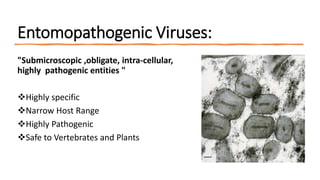
Entomopathogenic Viruses:
"Submicroscopic ,obligate, intra-cellular,
highly pathogenic entities "
Highly specific
Narrow Host Range
Highly Pathogenic
Safe to Vertebrates and Plants
Viruses used as Biocontrol Agent:
Seven families of viruses, namely,
• Baculoviridae
• Reoviridae
• Iridoviridae
• Poxviridae
• Parvoviridae
• Picornaviridae
• Rhabdoviridae cause diseases in insects.
• The Genus Baculoviruses contains three subgroups of viral types: nuclear polyhedrosis
viruses (NPVs), granulosis viruses (GVs) and nonoccluded viruses.
Family : Baculoviridae
• Genera Nucleopolyhedrovirus (NPV) Ex. Autographa californica NPV
• Genera Granulovirus(GV) Ex. Cydia pomonella GV
• Baculoviruses are Circular dsDNA viruses ,Bacilliform and have OBs .
• Occluded Viruses:
Mature Virus particle ,after formation in infected cells ,are embedded
within a protein matrix, forming Para crystalline bodies –Occlusion
bodies (OBs).OBs help in long-period persistence of viruses in the
environment .
Nucleopolyhedrovirus:
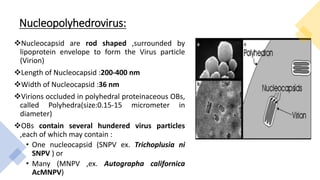
Nucleocapsid are rod shaped ,surrounded by
lipoprotein envelope to form the Virus particle
(Virion)
Length of Nucleocapsid :200-400 nm
Width of Nucleocapsid :36 nm
Virions occluded in polyhedral proteinaceous OBs,
called Polyhedra(size:0.15-15 micrometer in
diameter)
OBs contain several hundered virus particles
,each of which may contain :
• One nucleocapsid (SNPV ex. Trichoplusia ni
SNPV ) or
• Many (MNPV ,ex. Autographa californica
AcMNPV)
Granulovirus(GV):
Virions occluded in Capsular proteinaceous
bodies (OBs)
OBs are known as Granules
Granulin is the major granule protein in GV's
OBs is smaller than those of NPV(size:0.3-0.5
micrometer in length)
Contain one virion (singly enveloped
nucleocapsid )per OB or granule.
More Specific than NPV (repoarted only from
Lepidoptera ,ex. Cydia pomonella GV)
MODE OF ACTION :
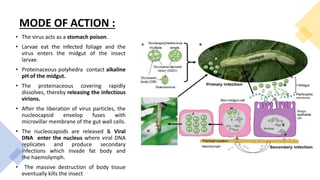
• The virus acts as a stomach poison.
• Larvae eat the infected foliage and the
virus enters the midgut of the insect
larvae.
• Proteinaceous polyhedra contact alkaline
pH of the midgut.
• The proteinaceous covering rapidly
dissolves, thereby releasing the infectious
virions.
• After the liberation of virus particles, the
nucleocapsid envelop fuses with
microvillar membrane of the gut wall cells.
• The nucleocapsids are released & Viral
DNA enter the nucleus where viral DNA
replicates and produce secondary
infections which invade fat body and
the haemolymph.
• The massive destruction of body tissue
eventually kills the insect
Symptoms of Viral Infection :
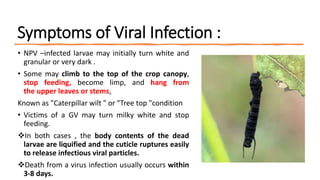
• NPV –infected larvae may initially turn white and
granular or very dark .
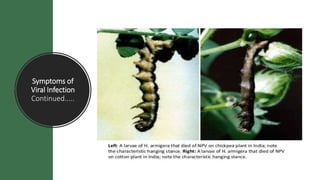
• Some may climb to the top of the crop canopy,
stop feeding, become limp, and hang from
the upper leaves or stems,
Known as "Caterpillar wilt " or "Tree top "condition
• Victims of a GV may turn milky white and stop
feeding.
In both cases , the body contents of the dead
larvae are liquified and the cuticle ruptures easily
to release infectious viral particles.
Death from a virus infection usually occurs within
3-8 days.
Symptoms of
Viral Infection
Continued.....
Commercialization:
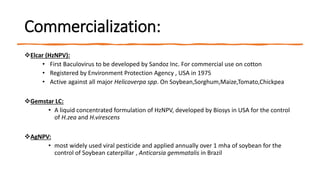
Elcar (HzNPV):
• First Baculovirus to be developed by Sandoz Inc. For commercial use on cotton
• Registered by Environment Protection Agency , USA in 1975
• Active against all major Helicoverpa spp. On Soybean,Sorghum,Maize,Tomato,Chickpea
Gemstar LC:
• A liquid concentrated formulation of HzNPV, developed by Biosys in USA for the control
of H.zea and H.virescens
AgNPV:
• most widely used viral pesticide and applied annually over 1 mha of soybean for the
control of Soybean caterpillar , Anticarsia gemmatalis in Brazil
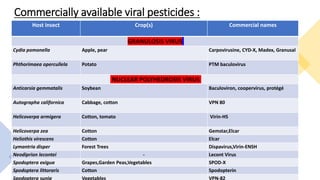
Commercially available viral pesticides :
Host insect Crop(s) Commercial names
GRANULOSIS VIRUS
Cydia pomonella Apple, pear Carpovirusine, CYD-X, Madex, Granusal
Phthorimaea opercullela Potato PTM baculovirus
NUCLEAR POLYHEDROSIS VIRUS
Anticarsia gemmatalis Soybean Baculoviron, coopervirus, protégé
Autographa californica Cabbage, cotton VPN 80
Helicoverpa armigera Cotton, tomato Virin-HS
Helicoverpa zea Cotton Gemstar,Elcar
Heliothis virescens Cotton Elcar
Lymantria disper Forest Trees Dispavirus,Virin-ENSH
Neodiprion lecontei - Lecont Virus
Spodoptera exigua Grapes,Garden Peas,Vegetables SPOD-X
Spodoptera littoraris Cotton Spodopterin
Spodoptera sunia Vegetables VPN-82
References:
• A.S. Perryt , I. Yamamoto ,I. Ishaaya ,R. Perry Insecticides in
Agriculture and Environment Retrospects and Prospects
• Kalawate, Aparna. (2014). Microbial Viral Insecticides.
10.1007/978-81-322-1877-7_4.
• Basic and Applied Aspects of Biopesticides by K. Sahayaraj
• Del Rincón-Castro, Ma & Ibarra, Jorge. (2011). Entomopathogenic
Viruses..
Viruses as biocontrol agents (1)

Viruses as biocontrol agents (1)

  • 1.
    Presentation on: Viruses as BiocontrolAgents Submitted to: Dr Abhishek Sharma Principal Virologist Submitted by : Gurpinder Singh (L-2020-A-52-M)
  • 2.
    Contents: • Biocontrol (BiologicalControl ) • Microbial Control • Entomopathogenic Viruses • Viruses used as Biocontrol Agent • Mode of Action of Viral Insecticides • Symptoms of Viral Infection • Commercialization • Commercially available viral pesticides
  • 3.
    Biocontrol (Biological Control): • Biological control or biocontrol refers to the use of living organisms to suppress the population density or impact of specific pest organisms, making it less abundant or less damaging than it would otherwise be. • Macrobial Control - Birds and Arthropods (Predators & Parasitoids) • Microbial control - Entomopathogens (Bacteria, Viruses, Fungi and Nematodes)
  • 4.
    Microbial Control Microbial Controlrefers to exploitation of entomopathogens to reduce the population of Insect pests below the damaging level. Need of Microbial Control of Pest: • Indiscriminate and excessive use of Insecticides leads to several problems : • Resistance & Resurgence • Residue Problem • Contamination of envrionment, soil ,water • Affects human health
  • 5.
    Entomopathogenic Viruses: "Submicroscopic ,obligate,intra-cellular, highly pathogenic entities " Highly specific Narrow Host Range Highly Pathogenic Safe to Vertebrates and Plants
  • 6.
    Viruses used asBiocontrol Agent: Seven families of viruses, namely, • Baculoviridae • Reoviridae • Iridoviridae • Poxviridae • Parvoviridae • Picornaviridae • Rhabdoviridae cause diseases in insects. • The Genus Baculoviruses contains three subgroups of viral types: nuclear polyhedrosis viruses (NPVs), granulosis viruses (GVs) and nonoccluded viruses.
  • 7.
    Family : Baculoviridae •Genera Nucleopolyhedrovirus (NPV) Ex. Autographa californica NPV • Genera Granulovirus(GV) Ex. Cydia pomonella GV • Baculoviruses are Circular dsDNA viruses ,Bacilliform and have OBs . • Occluded Viruses: Mature Virus particle ,after formation in infected cells ,are embedded within a protein matrix, forming Para crystalline bodies –Occlusion bodies (OBs).OBs help in long-period persistence of viruses in the environment .
  • 8.
    Nucleopolyhedrovirus: Nucleocapsid are rodshaped ,surrounded by lipoprotein envelope to form the Virus particle (Virion) Length of Nucleocapsid :200-400 nm Width of Nucleocapsid :36 nm Virions occluded in polyhedral proteinaceous OBs, called Polyhedra(size:0.15-15 micrometer in diameter) OBs contain several hundered virus particles ,each of which may contain : • One nucleocapsid (SNPV ex. Trichoplusia ni SNPV ) or • Many (MNPV ,ex. Autographa californica AcMNPV)
  • 9.
    Granulovirus(GV): Virions occluded inCapsular proteinaceous bodies (OBs) OBs are known as Granules Granulin is the major granule protein in GV's OBs is smaller than those of NPV(size:0.3-0.5 micrometer in length) Contain one virion (singly enveloped nucleocapsid )per OB or granule. More Specific than NPV (repoarted only from Lepidoptera ,ex. Cydia pomonella GV)
  • 10.
    MODE OF ACTION: • The virus acts as a stomach poison. • Larvae eat the infected foliage and the virus enters the midgut of the insect larvae. • Proteinaceous polyhedra contact alkaline pH of the midgut. • The proteinaceous covering rapidly dissolves, thereby releasing the infectious virions. • After the liberation of virus particles, the nucleocapsid envelop fuses with microvillar membrane of the gut wall cells. • The nucleocapsids are released & Viral DNA enter the nucleus where viral DNA replicates and produce secondary infections which invade fat body and the haemolymph. • The massive destruction of body tissue eventually kills the insect
  • 11.
    Symptoms of ViralInfection : • NPV –infected larvae may initially turn white and granular or very dark . • Some may climb to the top of the crop canopy, stop feeding, become limp, and hang from the upper leaves or stems, Known as "Caterpillar wilt " or "Tree top "condition • Victims of a GV may turn milky white and stop feeding. In both cases , the body contents of the dead larvae are liquified and the cuticle ruptures easily to release infectious viral particles. Death from a virus infection usually occurs within 3-8 days.
  • 12.
  • 13.
    Commercialization: Elcar (HzNPV): • FirstBaculovirus to be developed by Sandoz Inc. For commercial use on cotton • Registered by Environment Protection Agency , USA in 1975 • Active against all major Helicoverpa spp. On Soybean,Sorghum,Maize,Tomato,Chickpea Gemstar LC: • A liquid concentrated formulation of HzNPV, developed by Biosys in USA for the control of H.zea and H.virescens AgNPV: • most widely used viral pesticide and applied annually over 1 mha of soybean for the control of Soybean caterpillar , Anticarsia gemmatalis in Brazil
  • 14.
    Commercially available viralpesticides : Host insect Crop(s) Commercial names GRANULOSIS VIRUS Cydia pomonella Apple, pear Carpovirusine, CYD-X, Madex, Granusal Phthorimaea opercullela Potato PTM baculovirus NUCLEAR POLYHEDROSIS VIRUS Anticarsia gemmatalis Soybean Baculoviron, coopervirus, protégé Autographa californica Cabbage, cotton VPN 80 Helicoverpa armigera Cotton, tomato Virin-HS Helicoverpa zea Cotton Gemstar,Elcar Heliothis virescens Cotton Elcar Lymantria disper Forest Trees Dispavirus,Virin-ENSH Neodiprion lecontei - Lecont Virus Spodoptera exigua Grapes,Garden Peas,Vegetables SPOD-X Spodoptera littoraris Cotton Spodopterin Spodoptera sunia Vegetables VPN-82
  • 15.
    References: • A.S. Perryt, I. Yamamoto ,I. Ishaaya ,R. Perry Insecticides in Agriculture and Environment Retrospects and Prospects • Kalawate, Aparna. (2014). Microbial Viral Insecticides. 10.1007/978-81-322-1877-7_4. • Basic and Applied Aspects of Biopesticides by K. Sahayaraj • Del Rincón-Castro, Ma & Ibarra, Jorge. (2011). Entomopathogenic Viruses..