INSECT TOXIN: GENE STRUCTURE AND
USE FOR INSECT CONTROL USING
BACULOVIRUS VECTOR
Seminar Incharge :
Dr.S.S. Shaw
Professor
Department Of Entomology
Presented By:
Aishwarya Ray
Ph.D. Scholar
INTRODUCTION
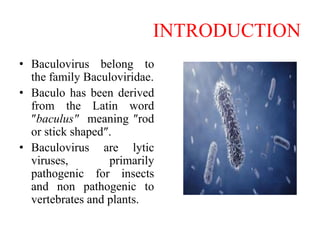
• Baculovirus belong to
the family Baculoviridae.
• Baculo has been derived
from the Latin word
″baculus″ meaning ″rod
or stick shaped″.
• Baculovirus are lytic
viruses, primarily
pathogenic for insects
and non pathogenic to
vertebrates and plants.
Historical Influence
• The earliest records of baculovirus can be found in the
literature from as early as the sixteenth century in reports
of "wilting disease" infecting silk-producing larva.
• Paillot (1926) described the first granulosis disease from
the larvae of Pieris brassicae
• Bergold (1947) provided definitive evidence of the viral
nature of disease.
• In 1970 Elcar was the first baculovirus to be developed
for commercial use.
• Since the 1990s Baculoviruses have been utilized for
producing complex eukaryotic proteins in insect cell
cultures .
Structure Of Baculovirus
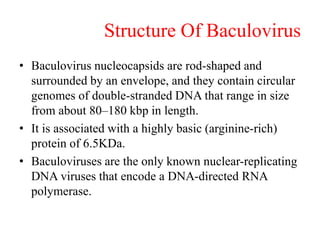
• Baculovirus nucleocapsids are rod-shaped and
surrounded by an envelope, and they contain circular
genomes of double-stranded DNA that range in size
from about 80–180 kbp in length.
• It is associated with a highly basic (arginine-rich)
protein of 6.5KDa.
• Baculoviruses are the only known nuclear-replicating
DNA viruses that encode a DNA-directed RNA
polymerase.
Cont…
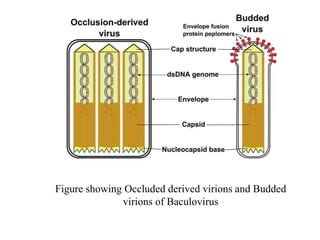
• They produce two distinct types of enveloped virions:
occlusion-derived virions (ODV), which are
embedded in large (5–10 micron) protein crystals
called occlusion bodies and are responsible for
horizontal transmission between insects, and budded
virions (BV) are non-occluded which spread infection
from cell to cell.
- Hawtin,1993
Figure showing Occluded derived virions and Budded
virions of Baculovirus
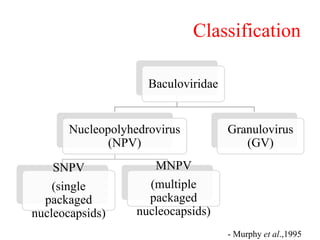
Classification
Baculoviridae
Nucleopolyhedrovirus
(NPV)
SNPV
(single
packaged
nucleocapsids)
MNPV
(multiple
packaged
nucleocapsids)
Granulovirus
(GV)
- Murphy et al.,1995
Cont…..
• The genus NPV is characterized by the presence
of polyhedral shaped viral occlusions (polyhedra)
containing randomly occluded viral particles.
• The genus granulose virus (GV) has one
nucleocapsid per envelope and has granule shaped
viral occlusions (capsules) containing one or
rarely 2 or more virions.
• GVs are more specific than NPVs as they have
been reported only from Lepidoptera.
Taxonomic Status of Baculoviridae
The family has been divided into four genera:
1) Alphabaculovirus (lepidopteran-specific
nucleopolyhedroviruses)
2) Betabaculovirus (lepidopteran-specific Granulovirus
3) Gammabaculovirus (hymenopteran-specific
nucleopolyhedroviruses)
4) Deltabaculovirus (dipteran-specific
nucleopolyhedroviruses)
(Source- www.ictvonline.org)
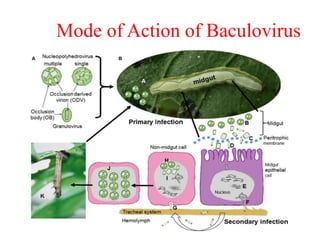
Mode of Action of Baculovirus
Cont…
• Baculovirus infection can be divided to three
distinct phases:
Early (0–6 h post-infection),
Late (6–24 h p.i.)
Very late phase (18–24 to 72 h p.i)
* BV is produced in the late phase whereas the
ODV form is produced in the very late phase
acquiring the envelope from host cell nucleus and
embedded in the matrix of occlusion body protein.
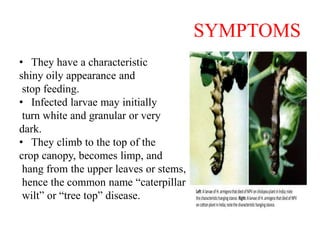
SYMPTOMS
• They have a characteristic
shiny oily appearance and
stop feeding.
• Infected larvae may initially
turn white and granular or very
dark.
• They climb to the top of the
crop canopy, becomes limp, and
hang from the upper leaves or stems,
hence the common name “caterpillar
wilt” or “tree top” disease.
Structure of the Virion
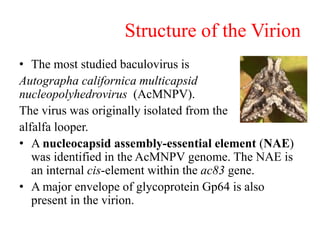
• The most studied baculovirus is
Autographa californica multicapsid
nucleopolyhedrovirus (AcMNPV).
The virus was originally isolated from the
alfalfa looper.
• A nucleocapsid assembly-essential element (NAE)
was identified in the AcMNPV genome. The NAE is
an internal cis-element within the ac83 gene.
• A major envelope of glycoprotein Gp64 is also
present in the virion.
Baculoviruses: Sophisticated Pathogen
of Insects
Baculovirus-infected larvae exhibit several interesting examples
of pathogen-modified physiology and behavior.
1) Inhibition of larval development :-baculovirus-infected larvae
do not molt, due to the action of a viral enzyme called
ecdysteroid UDP-glucosyltransferase (EGT).
2) Increased larval locomotory activity:- induced by
expression of a viral protein called protein tyrosine
phosphatase (PTP).
Phylogenetic analyses indicate that both the egt and ptp genes
appear to have a lepidopteran origin, indicating that baculoviruses
have acquired many advantageous genes during coevolution with
their hosts.
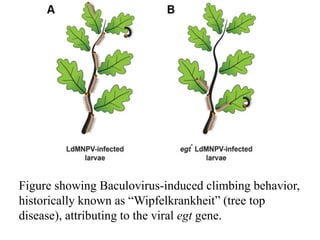
Figure showing Baculovirus-induced climbing behavior,
historically known as “Wipfelkrankheit” (tree top
disease), attributing to the viral egt gene.
Baculovirus Expression Vector System
• The Baculovirus Expression Vector System (BEVS) is one of
the most powerful and versatile eukaryotic expression systems
available.
• The BEVS is a helper- independent viral system which has
been used to express heterologous gene from many different
cells.
• AcNPV is the widely used Baculovirus DNA in BEVS.
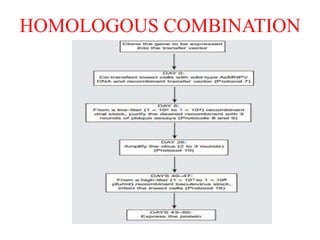
• Co-transfection of the transfer vector and AcNPV DNA into
Spodoptera frugiperda cells allows recombination between
homologous sites.
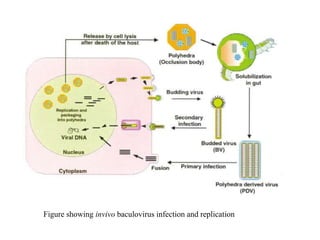
• Major difference between the naturally occuring invivo
infection and the recombinant invitro infection is that the
naturally occuring polyhedrin gene within the wildtype
baculovirus genome is replaced with a recombinant gene.
Figure showing invivo baculovirus infection and replication
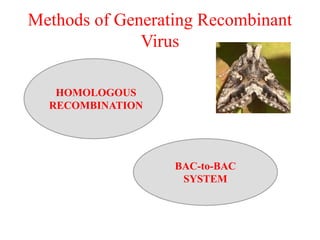
Methods of Generating Recombinant
Virus
HOMOLOGOUS
RECOMBINATION
BAC-to-BAC
SYSTEM
HOMOLOGOUS COMBINATION
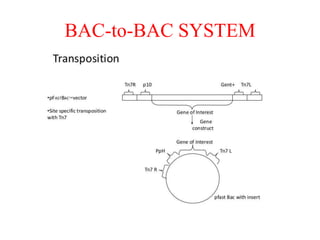
BAC-to-BAC SYSTEM
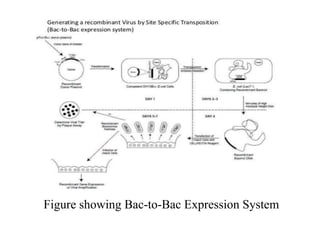
Figure showing Bac-to-Bac Expression System
Advantages of using BEVS
1) Functional activity of the recombinant protein
2) Post translations modifications
3) High expression levels
4) Capacity for large inserts
5) Capacity to express unspliced genes
6) Simplicity of technology
7) Simultaneous expression of multiple genes
8) Localization of recombinant proteins
9) Ease of purification
10) Direct cloning
Neurobactrus
• Neurobactrus, a novel, highly effective and
environmentally friendly recombinant Baculovirus
Insecticide was constructed to develop an improved
baculovirus insecticide with additional beneficial
properties such as higher insecticidal activity and
improved recovery, compared to wild-type baculovirus.
• It was constructed by introducing Bt cry1-5 gene into
the AcMNPV genome and on the opposite direction, an
insect –specific neurotoxin gene, AaIT, from
Androctonus australis was introduced.
• It was activated by treatment with trypsin.
Cont…
• Neurobactrus showed a high level of
insecticidal activity against Plutella xylostella
larvae and a significant reduction in the
median lethal time against Spodoptera exigua
larvae compared to those of wild-type AcNPV.
(Source-http://aem.asm.org)
Commercialization of Baculoviruses
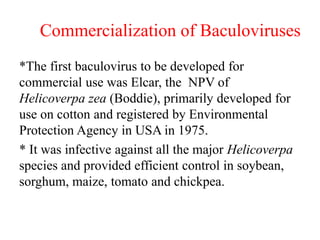
*The first baculovirus to be developed for
commercial use was Elcar, the NPV of
Helicoverpa zea (Boddie), primarily developed for
use on cotton and registered by Environmental
Protection Agency in USA in 1975.
* It was infective against all the major Helicoverpa
species and provided efficient control in soybean,
sorghum, maize, tomato and chickpea.
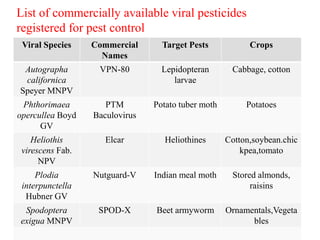
List of commercially available viral pesticides
registered for pest control
Viral Species Commercial
Names
Target Pests Crops
Autographa
californica
Speyer MNPV
VPN-80 Lepidopteran
larvae
Cabbage, cotton
Phthorimaea
opercullea Boyd
GV
PTM
Baculovirus
Potato tuber moth Potatoes
Heliothis
virescens Fab.
NPV
Elcar Heliothines Cotton,soybean.chic
kpea,tomato
Plodia
interpunctella
Hubner GV
Nutguard-V Indian meal moth Stored almonds,
raisins
Spodoptera
exigua MNPV
SPOD-X Beet armyworm Ornamentals,Vegeta
bles
Resistance to Baculoviruses
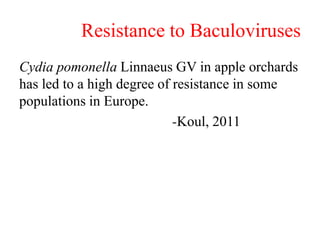
Cydia pomonella Linnaeus GV in apple orchards
has led to a high degree of resistance in some
populations in Europe.
-Koul, 2011
Advantages of Baculovirus
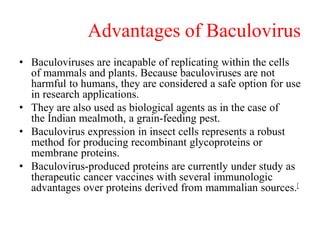
• Baculoviruses are incapable of replicating within the cells
of mammals and plants. Because baculoviruses are not
harmful to humans, they are considered a safe option for use
in research applications.
• They are also used as biological agents as in the case of
the Indian mealmoth, a grain-feeding pest.
• Baculovirus expression in insect cells represents a robust
method for producing recombinant glycoproteins or
membrane proteins.
• Baculovirus-produced proteins are currently under study as
therapeutic cancer vaccines with several immunologic
advantages over proteins derived from mammalian sources.[
Conclusions
• Baculoviruses are the most important tool for
the study of basic virology and biology.
• Baculoviruses are highly beneficial viruses
since they do not infect man or plants but they
do provide effective natural biological control
of many insect species.
• Baculoviruses are also versatile vectors for the
expression of proteins for basic research and
medical applications.
 INSECT CONTROL USING BACULOVIRUS VECTOR

INSECT CONTROL USING BACULOVIRUS VECTOR

  • 1.
    INSECT TOXIN: GENESTRUCTURE AND USE FOR INSECT CONTROL USING BACULOVIRUS VECTOR Seminar Incharge : Dr.S.S. Shaw Professor Department Of Entomology Presented By: Aishwarya Ray Ph.D. Scholar
  • 2.
    INTRODUCTION • Baculovirus belongto the family Baculoviridae. • Baculo has been derived from the Latin word ″baculus″ meaning ″rod or stick shaped″. • Baculovirus are lytic viruses, primarily pathogenic for insects and non pathogenic to vertebrates and plants.
  • 3.
    Historical Influence • Theearliest records of baculovirus can be found in the literature from as early as the sixteenth century in reports of "wilting disease" infecting silk-producing larva. • Paillot (1926) described the first granulosis disease from the larvae of Pieris brassicae • Bergold (1947) provided definitive evidence of the viral nature of disease. • In 1970 Elcar was the first baculovirus to be developed for commercial use. • Since the 1990s Baculoviruses have been utilized for producing complex eukaryotic proteins in insect cell cultures .
  • 4.
    Structure Of Baculovirus •Baculovirus nucleocapsids are rod-shaped and surrounded by an envelope, and they contain circular genomes of double-stranded DNA that range in size from about 80–180 kbp in length. • It is associated with a highly basic (arginine-rich) protein of 6.5KDa. • Baculoviruses are the only known nuclear-replicating DNA viruses that encode a DNA-directed RNA polymerase.
  • 5.
    Cont… • They producetwo distinct types of enveloped virions: occlusion-derived virions (ODV), which are embedded in large (5–10 micron) protein crystals called occlusion bodies and are responsible for horizontal transmission between insects, and budded virions (BV) are non-occluded which spread infection from cell to cell. - Hawtin,1993
  • 6.
    Figure showing Occludedderived virions and Budded virions of Baculovirus
  • 7.
  • 8.
    Cont….. • The genusNPV is characterized by the presence of polyhedral shaped viral occlusions (polyhedra) containing randomly occluded viral particles. • The genus granulose virus (GV) has one nucleocapsid per envelope and has granule shaped viral occlusions (capsules) containing one or rarely 2 or more virions. • GVs are more specific than NPVs as they have been reported only from Lepidoptera.
  • 9.
    Taxonomic Status ofBaculoviridae The family has been divided into four genera: 1) Alphabaculovirus (lepidopteran-specific nucleopolyhedroviruses) 2) Betabaculovirus (lepidopteran-specific Granulovirus 3) Gammabaculovirus (hymenopteran-specific nucleopolyhedroviruses) 4) Deltabaculovirus (dipteran-specific nucleopolyhedroviruses) (Source- www.ictvonline.org)
  • 10.
    Mode of Actionof Baculovirus
  • 11.
    Cont… • Baculovirus infectioncan be divided to three distinct phases: Early (0–6 h post-infection), Late (6–24 h p.i.) Very late phase (18–24 to 72 h p.i) * BV is produced in the late phase whereas the ODV form is produced in the very late phase acquiring the envelope from host cell nucleus and embedded in the matrix of occlusion body protein.
  • 12.
    SYMPTOMS • They havea characteristic shiny oily appearance and stop feeding. • Infected larvae may initially turn white and granular or very dark. • They climb to the top of the crop canopy, becomes limp, and hang from the upper leaves or stems, hence the common name “caterpillar wilt” or “tree top” disease.
  • 13.
    Structure of theVirion • The most studied baculovirus is Autographa californica multicapsid nucleopolyhedrovirus (AcMNPV). The virus was originally isolated from the alfalfa looper. • A nucleocapsid assembly-essential element (NAE) was identified in the AcMNPV genome. The NAE is an internal cis-element within the ac83 gene. • A major envelope of glycoprotein Gp64 is also present in the virion.
  • 14.
    Baculoviruses: Sophisticated Pathogen ofInsects Baculovirus-infected larvae exhibit several interesting examples of pathogen-modified physiology and behavior. 1) Inhibition of larval development :-baculovirus-infected larvae do not molt, due to the action of a viral enzyme called ecdysteroid UDP-glucosyltransferase (EGT). 2) Increased larval locomotory activity:- induced by expression of a viral protein called protein tyrosine phosphatase (PTP). Phylogenetic analyses indicate that both the egt and ptp genes appear to have a lepidopteran origin, indicating that baculoviruses have acquired many advantageous genes during coevolution with their hosts.
  • 15.
    Figure showing Baculovirus-inducedclimbing behavior, historically known as “Wipfelkrankheit” (tree top disease), attributing to the viral egt gene.
  • 16.
    Baculovirus Expression VectorSystem • The Baculovirus Expression Vector System (BEVS) is one of the most powerful and versatile eukaryotic expression systems available. • The BEVS is a helper- independent viral system which has been used to express heterologous gene from many different cells. • AcNPV is the widely used Baculovirus DNA in BEVS. • Co-transfection of the transfer vector and AcNPV DNA into Spodoptera frugiperda cells allows recombination between homologous sites. • Major difference between the naturally occuring invivo infection and the recombinant invitro infection is that the naturally occuring polyhedrin gene within the wildtype baculovirus genome is replaced with a recombinant gene.
  • 17.
    Figure showing invivobaculovirus infection and replication
  • 18.
    Methods of GeneratingRecombinant Virus HOMOLOGOUS RECOMBINATION BAC-to-BAC SYSTEM
  • 19.
  • 20.
  • 21.
    Figure showing Bac-to-BacExpression System
  • 22.
    Advantages of usingBEVS 1) Functional activity of the recombinant protein 2) Post translations modifications 3) High expression levels 4) Capacity for large inserts 5) Capacity to express unspliced genes 6) Simplicity of technology 7) Simultaneous expression of multiple genes 8) Localization of recombinant proteins 9) Ease of purification 10) Direct cloning
  • 23.
    Neurobactrus • Neurobactrus, anovel, highly effective and environmentally friendly recombinant Baculovirus Insecticide was constructed to develop an improved baculovirus insecticide with additional beneficial properties such as higher insecticidal activity and improved recovery, compared to wild-type baculovirus. • It was constructed by introducing Bt cry1-5 gene into the AcMNPV genome and on the opposite direction, an insect –specific neurotoxin gene, AaIT, from Androctonus australis was introduced. • It was activated by treatment with trypsin.
  • 24.
    Cont… • Neurobactrus showeda high level of insecticidal activity against Plutella xylostella larvae and a significant reduction in the median lethal time against Spodoptera exigua larvae compared to those of wild-type AcNPV. (Source-http://aem.asm.org)
  • 25.
    Commercialization of Baculoviruses *Thefirst baculovirus to be developed for commercial use was Elcar, the NPV of Helicoverpa zea (Boddie), primarily developed for use on cotton and registered by Environmental Protection Agency in USA in 1975. * It was infective against all the major Helicoverpa species and provided efficient control in soybean, sorghum, maize, tomato and chickpea.
  • 26.
    List of commerciallyavailable viral pesticides registered for pest control Viral Species Commercial Names Target Pests Crops Autographa californica Speyer MNPV VPN-80 Lepidopteran larvae Cabbage, cotton Phthorimaea opercullea Boyd GV PTM Baculovirus Potato tuber moth Potatoes Heliothis virescens Fab. NPV Elcar Heliothines Cotton,soybean.chic kpea,tomato Plodia interpunctella Hubner GV Nutguard-V Indian meal moth Stored almonds, raisins Spodoptera exigua MNPV SPOD-X Beet armyworm Ornamentals,Vegeta bles
  • 27.
    Resistance to Baculoviruses Cydiapomonella Linnaeus GV in apple orchards has led to a high degree of resistance in some populations in Europe. -Koul, 2011
  • 28.
    Advantages of Baculovirus •Baculoviruses are incapable of replicating within the cells of mammals and plants. Because baculoviruses are not harmful to humans, they are considered a safe option for use in research applications. • They are also used as biological agents as in the case of the Indian mealmoth, a grain-feeding pest. • Baculovirus expression in insect cells represents a robust method for producing recombinant glycoproteins or membrane proteins. • Baculovirus-produced proteins are currently under study as therapeutic cancer vaccines with several immunologic advantages over proteins derived from mammalian sources.[
  • 29.
    Conclusions • Baculoviruses arethe most important tool for the study of basic virology and biology. • Baculoviruses are highly beneficial viruses since they do not infect man or plants but they do provide effective natural biological control of many insect species. • Baculoviruses are also versatile vectors for the expression of proteins for basic research and medical applications.