

Dehydration
pure (tissue) water loss and hypovolemia
to sodium loss and thus loss of blood
volume.
Loss of water from the extracellular fluid
volume, vascular and interstitial fluids.
It is literally the removal of water or
deficiency of fluid within an organism.
Extracellular Fluid Volume Deficit
(ECFVD)
 Intracellular fluid Volume
Deficit (ICFVD)
Losses can be :
1. Mild – loss of 1 to 2 L of water (2% of
body weight is lost).
2. Moderate – loss of 3 to 5 L of water (5% of
body weight is lost).
3. Severe – loss of 5 to 10 L of water (8% of
body weight is lost).
Fluids are normally found in three spaces:
 Inside the cells (Intracellular)
 Around the cells (Interstitial)
 In the bloodstream (Intravascular)
Pathophysiology
Dehydration is seen when the normal
compensation for fluid in the bloodstream
cannot be corrected by stored fluid elsewhere.
When fluids are lost from the intravascular
spaces because of lack of intake or excess loss,
interstitial fluids move in to restore vascular
volume. Because the actual volume of fluid in
the interstitial space limited, other
compensation systems are initiated to restore
fluid volume.
If the dehydration is not corrected, fluid is
shifted from the cells into the vascular system.
Cellular Dehydration
The loss of cellular fluid is dangerous because the
cells need fluid for cellular function.
 Intracellular fluid Volume Deficit (ICFVD)
 Less fluid is available for temperature regulation via
sweating, and lowered blood volume decreases the
body’s ability to transport core heat to the
periphery for conducive loss.
 There is cerebrospinal fluid and less fluid in fat pads
around the eyes. If cerebral cells become
dehydrated, thought processes may be impaired.
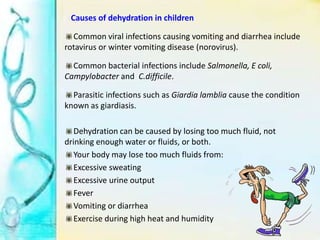
Causes of dehydration in children
Common viral infections causing vomiting and diarrhea include
rotavirus or winter vomiting disease (norovirus).
Common bacterial infections include Salmonella, E coli,
Campylobacter and C.difficile.
Parasitic infections such as Giardia lamblia cause the condition
known as giardiasis.
Dehydration can be caused by losing too much fluid, not
drinking enough water or fluids, or both.
Your body may lose too much fluids from:
Excessive sweating
Excessive urine output
Fever
Vomiting or diarrhea
Exercise during high heat and humidity
Clinical Manifestations of Dehydration
Clinical
Manifestations
Mild
Dehydration
Moderate
Dehydration
Severe Dehydration
Level of
consciousness
Alert Lethargic Obtunded
Capillary refill time 2 seconds 2-4 seconds
Greater than 4 seconds,
cool limbs
Mucous membranes Normal Dry Parched, cracked
Heart rate
Slight
increase
Increased Very increased
Respiratory rate Normal Increased
Increased and
hyperpnea
Blood pressure Normal
Normal, but
orthostatic
Decreased
Pulse Normal Thready Faint or impalpable
Skin turgor Normal Slow Tenting
Eyes Normal Sunken Very sunken
Urine output Decreased Oliguria Oliguria/anuria
√ Three types of dehydration based on serum sodium
levels:
1.hypotonic or hyponatremic (referring to this as primarily
a loss of electrolytes, sodium in particular)
2.hypertonic or hypernatremic (referring to this as
primarily a loss of water)
3.isotonic or isonatremic (referring to this as equal loss of
water and electrolytes).
Differential Diagnosis:
External or stress-related causes
Infectious diseases
Malnutrition
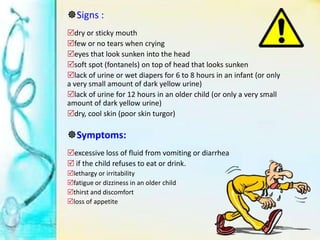
Signs :
dry or sticky mouth
few or no tears when crying
eyes that look sunken into the head
soft spot (fontanels) on top of head that looks sunken
lack of urine or wet diapers for 6 to 8 hours in an infant (or only
a very small amount of dark yellow urine)
lack of urine for 12 hours in an older child (or only a very small
amount of dark yellow urine)
dry, cool skin (poor skin turgor)
Symptoms:
excessive loss of fluid from vomiting or diarrhea
 if the child refuses to eat or drink.
lethargy or irritability
fatigue or dizziness in an older child
thirst and discomfort
loss of appetite
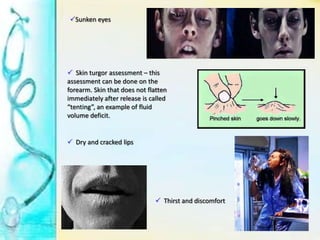
 Skin turgor assessment – this
assessment can be done on the
forearm. Skin that does not flatten
immediately after release is called
“tenting”, an example of fluid
volume deficit.
 Dry and cracked lips
Sunken eyes
 Thirst and discomfort
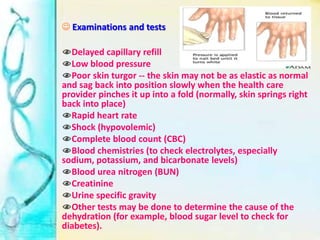
 Examinations and tests
Delayed capillary refill
Low blood pressure
Poor skin turgor -- the skin may not be as elastic as normal
and sag back into position slowly when the health care
provider pinches it up into a fold (normally, skin springs right
back into place)
Rapid heart rate
Shock (hypovolemic)
Complete blood count (CBC)
Blood chemistries (to check electrolytes, especially
sodium, potassium, and bicarbonate levels)
Blood urea nitrogen (BUN)
Creatinine
Urine specific gravity
Other tests may be done to determine the cause of the
dehydration (for example, blood sugar level to check for
diabetes).
Management
Mild and Moderate Dehydration:
1. Fluid Restoration
 Oral Rehydration
› Oral Rehydration Solution “ORS”
› Standard home solutions
 Intravenous Rehydration
 Monitoring for complications of fluid
restoration
 Monitor Intake and Output for fluid
replacement
 Nutritious food and supplements
Severe Dehydration:
1. Laboratory evaluation and intravenous rehydration
are required. The underlying cause of the
dehydration must be determined and appropriately
treated.
 Phase 1 focuses on emergency management. Severe
dehydration is characterized by a state of
hypovolemic shock requiring rapid treatment.
o IV fluid
o Tachycardia, capillary refill, urine output, and mental status
all should improve.
 Phase 2 focuses on deficit replacement, provision of
maintenance fluids, and replacement of ongoing
losses.
 Maintenance fluid requirements are equal to
measured fluid losses
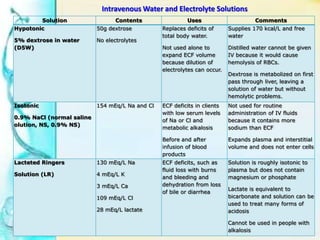
Solution Contents Uses Comments
Hypotonic
5% dextrose in water
(D5W)
50g dextrose
No electrolytes
Replaces deficits of
total body water.
Not used alone to
expand ECF volume
because dilution of
electrolytes can occur.
Supplies 170 kcal/L and free
water
Distilled water cannot be given
IV because it would cause
hemolysis of RBCs.
Dextrose is metabolized on first
pass through liver, leaving a
solution of water but without
hemolytic problems.
Isotonic
0.9% NaCl (normal saline
olution, NS, 0.9% NS)
154 mEq/L Na and Cl ECF deficits in clients
with low serum levels
of Na or Cl and
metabolic alkalosis
Before and after
infusion of blood
products
Not used for routine
administration of IV fluids
because it contains more
sodium than ECF
Expands plasma and interstitial
volume and does not enter cells
Lacteted Ringers
Solution (LR)
130 mEq/L Na
4 mEq/L K
3 mEq/L Ca
109 mEq/L Cl
28 mEq/L lactate
ECF deficits, such as
fluid loss with burns
and bleeding and
dehydration from loss
of bile or diarrhea
Solution is roughly isotonic to
plasma but does not contain
magnesium or phosphate
Lactate is equivalent to
bicarbonate and solution can be
used to treat many forms of
acidosis
Cannot be used in people with
alkalosis
Intravenous Water and Electrolyte Solutions
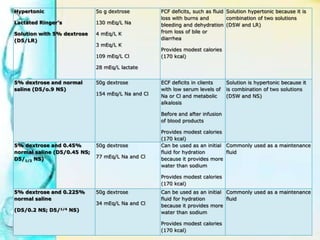
Hypertonic
Lactated Ringer’s
Solution with 5% dextrose
(D5/LR)
5o g dextrose
130 mEq/L Na
4 mEq/L K
3 mEq/L K
109 mEq/L Cl
28 mEq/L lactate
FCF deficits, such as fluid
loss with burns and
bleeding and dehydration
from loss of bile or
diarrhea
Provides modest calories
(170 kcal)
Solution hypertonic because it is
combination of two solutions
(D5W and LR)
5% dextrose and normal
saline (D5/o.9 NS)
50g dextrose
154 mEq/L Na and Cl
ECF deficits in clients
with low serum levels of
Na or Cl and metabolic
alkalosis
Before and after infusion
of blood products
Provides modest calories
(170 kcal)
Solution is hypertonic because it
is combination of two solutions
(D5W and NS)
5% dextrose and 0.45%
normal saline (D5/0.45 NS;
D5/1/2 NS)
50g dextrose
77 mEq/L Na and Cl
Can be used as an initial
fluid for hydration
because it provides more
water than sodium
Provides modest calories
(170 kcal)
Commonly used as a maintenance
fluid
5% dextrose and 0.225%
normal saline
(D5/0.2 NS; D5/1/4 NS)
50g dextrose
34 mEq/L Na and Cl
Can be used as an initial
fluid for hydration
because it provides more
water than sodium
Provides modest calories
(170 kcal)
Commonly used as a maintenance
fluid
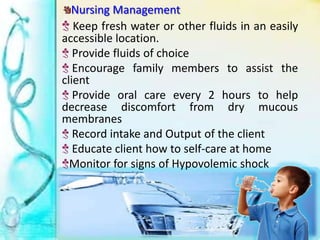
Nursing Management
Keep fresh water or other fluids in an easily
accessible location.
Provide fluids of choice
Encourage family members to assist the
client
Provide oral care every 2 hours to help
decrease discomfort from dry mucous
membranes
Record intake and Output of the client
Educate client how to self-care at home
Monitor for signs of Hypovolemic shock
 Preventive measures
 Even when you are healthy, drink plenty of fluids every
day. Drink more when the weather is hot or you are
exercising.
 Carefully monitor someone who is ill. If you believe that
the child is getting dehydrated, call your health care
provider before the person becomes dehydrated. Begin
fluid replacement as soon as vomiting and diarrhea
start -- DO NOT wait for signs of dehydration.
 Always encourage a child who is sick to drink fluids.
Remember that fluid needs are greater with a fever,
vomiting, or diarrhea. The easiest signs to monitor are
urine output (there should be frequent wet diapers or
trips to the bathroom), saliva in the mouth, and tears
when crying.
 Encourage adequate rest balanced with moderate
 activity.
 Promote adequate nutritional intake.
Treatment
Oral re-hydration solutions (ORS)
Fluid replacement
Intravenous rehydration therapy
Alternative therapies
Proper food intake
Adequate rest and sleep pattern
Monitor intake and output
Severe cases: IVF/ NGT
Medical treatment:
In cases of severe dehydration, admission to
hospital may be required. Fluid may be given
through a tube through the nose or saline drip
intravenously.
 Complications
Untreated severe dehydration may lead
to:
Death
Permanent brain damage
 Seizures
 Cholera
 Gastroenteritis
 Shigellosis
 Fever
 Electrolyte disturbance
Hypernatremia (also caused by dehydration)
Hyponatremia, especially from
restricted salt diets
Thank you and God
Bless 

Presentation1 dehydration

  • 3.
    Dehydration pure (tissue) waterloss and hypovolemia to sodium loss and thus loss of blood volume. Loss of water from the extracellular fluid volume, vascular and interstitial fluids. It is literally the removal of water or deficiency of fluid within an organism. Extracellular Fluid Volume Deficit (ECFVD)  Intracellular fluid Volume Deficit (ICFVD)
  • 4.
    Losses can be: 1. Mild – loss of 1 to 2 L of water (2% of body weight is lost). 2. Moderate – loss of 3 to 5 L of water (5% of body weight is lost). 3. Severe – loss of 5 to 10 L of water (8% of body weight is lost). Fluids are normally found in three spaces:  Inside the cells (Intracellular)  Around the cells (Interstitial)  In the bloodstream (Intravascular)
  • 5.
    Pathophysiology Dehydration is seenwhen the normal compensation for fluid in the bloodstream cannot be corrected by stored fluid elsewhere. When fluids are lost from the intravascular spaces because of lack of intake or excess loss, interstitial fluids move in to restore vascular volume. Because the actual volume of fluid in the interstitial space limited, other compensation systems are initiated to restore fluid volume. If the dehydration is not corrected, fluid is shifted from the cells into the vascular system.
  • 6.
    Cellular Dehydration The lossof cellular fluid is dangerous because the cells need fluid for cellular function.  Intracellular fluid Volume Deficit (ICFVD)  Less fluid is available for temperature regulation via sweating, and lowered blood volume decreases the body’s ability to transport core heat to the periphery for conducive loss.  There is cerebrospinal fluid and less fluid in fat pads around the eyes. If cerebral cells become dehydrated, thought processes may be impaired.
  • 7.
    Causes of dehydrationin children Common viral infections causing vomiting and diarrhea include rotavirus or winter vomiting disease (norovirus). Common bacterial infections include Salmonella, E coli, Campylobacter and C.difficile. Parasitic infections such as Giardia lamblia cause the condition known as giardiasis. Dehydration can be caused by losing too much fluid, not drinking enough water or fluids, or both. Your body may lose too much fluids from: Excessive sweating Excessive urine output Fever Vomiting or diarrhea Exercise during high heat and humidity
  • 8.
    Clinical Manifestations ofDehydration Clinical Manifestations Mild Dehydration Moderate Dehydration Severe Dehydration Level of consciousness Alert Lethargic Obtunded Capillary refill time 2 seconds 2-4 seconds Greater than 4 seconds, cool limbs Mucous membranes Normal Dry Parched, cracked Heart rate Slight increase Increased Very increased Respiratory rate Normal Increased Increased and hyperpnea Blood pressure Normal Normal, but orthostatic Decreased Pulse Normal Thready Faint or impalpable Skin turgor Normal Slow Tenting Eyes Normal Sunken Very sunken Urine output Decreased Oliguria Oliguria/anuria
  • 9.
    √ Three typesof dehydration based on serum sodium levels: 1.hypotonic or hyponatremic (referring to this as primarily a loss of electrolytes, sodium in particular) 2.hypertonic or hypernatremic (referring to this as primarily a loss of water) 3.isotonic or isonatremic (referring to this as equal loss of water and electrolytes). Differential Diagnosis: External or stress-related causes Infectious diseases Malnutrition
  • 10.
    Signs : dry orsticky mouth few or no tears when crying eyes that look sunken into the head soft spot (fontanels) on top of head that looks sunken lack of urine or wet diapers for 6 to 8 hours in an infant (or only a very small amount of dark yellow urine) lack of urine for 12 hours in an older child (or only a very small amount of dark yellow urine) dry, cool skin (poor skin turgor) Symptoms: excessive loss of fluid from vomiting or diarrhea  if the child refuses to eat or drink. lethargy or irritability fatigue or dizziness in an older child thirst and discomfort loss of appetite
  • 11.
     Skin turgorassessment – this assessment can be done on the forearm. Skin that does not flatten immediately after release is called “tenting”, an example of fluid volume deficit.  Dry and cracked lips Sunken eyes  Thirst and discomfort
  • 12.
     Examinations andtests Delayed capillary refill Low blood pressure Poor skin turgor -- the skin may not be as elastic as normal and sag back into position slowly when the health care provider pinches it up into a fold (normally, skin springs right back into place) Rapid heart rate Shock (hypovolemic) Complete blood count (CBC) Blood chemistries (to check electrolytes, especially sodium, potassium, and bicarbonate levels) Blood urea nitrogen (BUN) Creatinine Urine specific gravity Other tests may be done to determine the cause of the dehydration (for example, blood sugar level to check for diabetes).
  • 13.
    Management Mild and ModerateDehydration: 1. Fluid Restoration  Oral Rehydration › Oral Rehydration Solution “ORS” › Standard home solutions  Intravenous Rehydration  Monitoring for complications of fluid restoration  Monitor Intake and Output for fluid replacement  Nutritious food and supplements
  • 14.
    Severe Dehydration: 1. Laboratoryevaluation and intravenous rehydration are required. The underlying cause of the dehydration must be determined and appropriately treated.  Phase 1 focuses on emergency management. Severe dehydration is characterized by a state of hypovolemic shock requiring rapid treatment. o IV fluid o Tachycardia, capillary refill, urine output, and mental status all should improve.  Phase 2 focuses on deficit replacement, provision of maintenance fluids, and replacement of ongoing losses.  Maintenance fluid requirements are equal to measured fluid losses
  • 15.
    Solution Contents UsesComments Hypotonic 5% dextrose in water (D5W) 50g dextrose No electrolytes Replaces deficits of total body water. Not used alone to expand ECF volume because dilution of electrolytes can occur. Supplies 170 kcal/L and free water Distilled water cannot be given IV because it would cause hemolysis of RBCs. Dextrose is metabolized on first pass through liver, leaving a solution of water but without hemolytic problems. Isotonic 0.9% NaCl (normal saline olution, NS, 0.9% NS) 154 mEq/L Na and Cl ECF deficits in clients with low serum levels of Na or Cl and metabolic alkalosis Before and after infusion of blood products Not used for routine administration of IV fluids because it contains more sodium than ECF Expands plasma and interstitial volume and does not enter cells Lacteted Ringers Solution (LR) 130 mEq/L Na 4 mEq/L K 3 mEq/L Ca 109 mEq/L Cl 28 mEq/L lactate ECF deficits, such as fluid loss with burns and bleeding and dehydration from loss of bile or diarrhea Solution is roughly isotonic to plasma but does not contain magnesium or phosphate Lactate is equivalent to bicarbonate and solution can be used to treat many forms of acidosis Cannot be used in people with alkalosis Intravenous Water and Electrolyte Solutions
  • 16.
    Hypertonic Lactated Ringer’s Solution with5% dextrose (D5/LR) 5o g dextrose 130 mEq/L Na 4 mEq/L K 3 mEq/L K 109 mEq/L Cl 28 mEq/L lactate FCF deficits, such as fluid loss with burns and bleeding and dehydration from loss of bile or diarrhea Provides modest calories (170 kcal) Solution hypertonic because it is combination of two solutions (D5W and LR) 5% dextrose and normal saline (D5/o.9 NS) 50g dextrose 154 mEq/L Na and Cl ECF deficits in clients with low serum levels of Na or Cl and metabolic alkalosis Before and after infusion of blood products Provides modest calories (170 kcal) Solution is hypertonic because it is combination of two solutions (D5W and NS) 5% dextrose and 0.45% normal saline (D5/0.45 NS; D5/1/2 NS) 50g dextrose 77 mEq/L Na and Cl Can be used as an initial fluid for hydration because it provides more water than sodium Provides modest calories (170 kcal) Commonly used as a maintenance fluid 5% dextrose and 0.225% normal saline (D5/0.2 NS; D5/1/4 NS) 50g dextrose 34 mEq/L Na and Cl Can be used as an initial fluid for hydration because it provides more water than sodium Provides modest calories (170 kcal) Commonly used as a maintenance fluid
  • 17.
    Nursing Management Keep freshwater or other fluids in an easily accessible location. Provide fluids of choice Encourage family members to assist the client Provide oral care every 2 hours to help decrease discomfort from dry mucous membranes Record intake and Output of the client Educate client how to self-care at home Monitor for signs of Hypovolemic shock
  • 18.
     Preventive measures Even when you are healthy, drink plenty of fluids every day. Drink more when the weather is hot or you are exercising.  Carefully monitor someone who is ill. If you believe that the child is getting dehydrated, call your health care provider before the person becomes dehydrated. Begin fluid replacement as soon as vomiting and diarrhea start -- DO NOT wait for signs of dehydration.  Always encourage a child who is sick to drink fluids. Remember that fluid needs are greater with a fever, vomiting, or diarrhea. The easiest signs to monitor are urine output (there should be frequent wet diapers or trips to the bathroom), saliva in the mouth, and tears when crying.  Encourage adequate rest balanced with moderate  activity.  Promote adequate nutritional intake.
  • 19.
    Treatment Oral re-hydration solutions(ORS) Fluid replacement Intravenous rehydration therapy Alternative therapies Proper food intake Adequate rest and sleep pattern Monitor intake and output Severe cases: IVF/ NGT Medical treatment: In cases of severe dehydration, admission to hospital may be required. Fluid may be given through a tube through the nose or saline drip intravenously.
  • 20.
     Complications Untreated severedehydration may lead to: Death Permanent brain damage  Seizures  Cholera  Gastroenteritis  Shigellosis  Fever  Electrolyte disturbance Hypernatremia (also caused by dehydration) Hyponatremia, especially from restricted salt diets
  • 21.
    Thank you andGod Bless 