DefinitionDefinition
 is defined as an excessive loss of
body fluid & electrolytes.
 Output is more than input.
CausesCauses
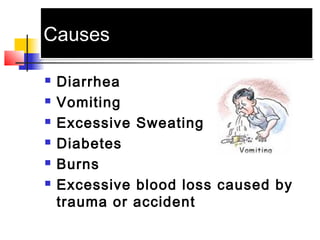
 Diarrhea
 Vomiting
 Excessive Sweating
 Diabetes
 Burns
 Excessive blood loss caused by
trauma or accident
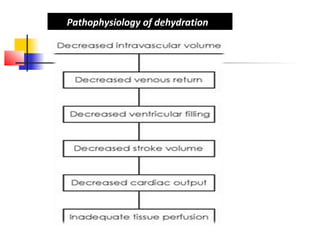
Pathophysiology of dehydration
Types of dehydration based on
severity
 Mild :
when the total fluid loss reaches 5% or
less .
 Moderate :
when the total fluid loss reaches 5 - 10%
.
 Severe :
when the total fluid loss reaches more
than 10%, considered an emergency case
.
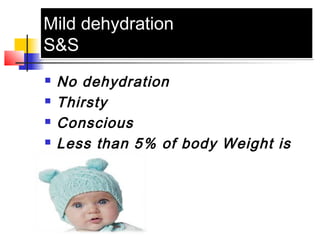
Mild dehydration
S&S
Mild dehydration
S&S
 No dehydration
 Thirsty
 Conscious
 Less than 5% of body Weight is
lost.
Moderate dehydration
S&S
Moderate dehydration
S&S
 Dry skin and
mucous membranes
 Thirst
 Decreased urine
output
 Crying baby with
tears
 Muscle weakness
 Drowsiness
 light head ache
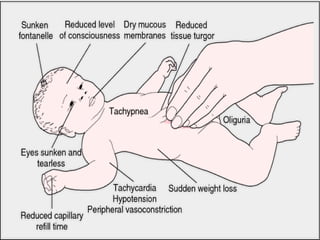
 sunken fontanels
 Decreased BP
 Increased Pulse
rate (tachycardia)
 Capillary refill
 Shallow rapid RR
 5 to10 % of body
Weight is lost
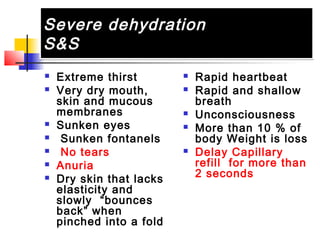
Severe dehydration
S&S
Severe dehydration
S&S
 Extreme thirst
 Very dry mouth,
skin and mucous
membranes
 Sunken eyes
 Sunken fontanels
 No tears
 Anuria
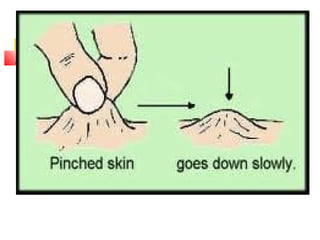
 Dry skin that lacks
elasticity and
slowly “bounces
back” when
pinched into a fold
 Rapid heartbeat
 Rapid and shallow
breath
 Unconsciousness
 More than 10 % of
body Weight is loss
 Delay Capillary
refill for more than
2 seconds
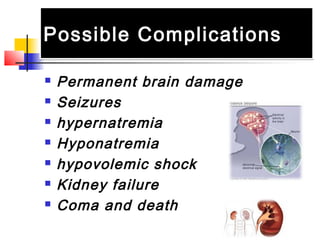
Possible ComplicationsPossible Complications
 Permanent brain damage
 Seizures
 hypernatremia
 Hyponatremia
 hypovolemic shock
 Kidney failure
 Coma and death
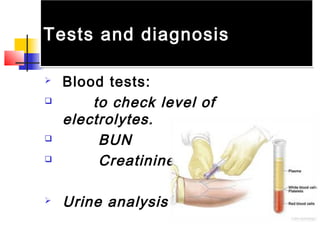
Tests and diagnosisTests and diagnosis
 Blood tests:
 to check level of
electrolytes.
 BUN
 Creatinine
 Urine analysis
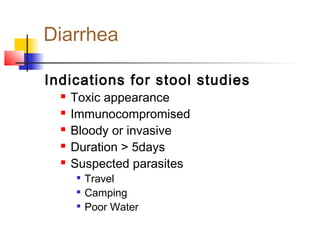
Diarrhea
Indications for stool studies
 Toxic appearance
 Immunocompromised
 Bloody or invasive
 Duration > 5days
 Suspected parasites

Travel

Camping

Poor Water
TreatmentTreatment
 dehydration treatment depends on
age,weight , the severity of dehydration and
its cause.
 Oral rehydration solution (ORS) for mild and
moderate dehydration
 IV fluid replacement (for sever dehydration)
 Treating the cause of dehydration
 A single dose of ondansetron (Zofran)
oraly(tablet)
Treatment of mild and
moderate dehydration
Treatment of mild and
moderate dehydration
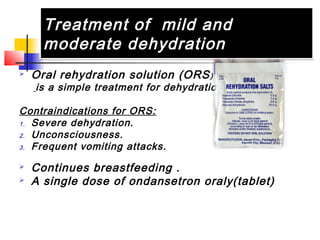
 Oral rehydration solution (ORS)
is a simple treatment for dehydration
Contraindications for ORS:
1. Severe dehydration.
2. Unconsciousness.
3. Frequent vomiting attacks.
 Continues breastfeeding .
 A single dose of ondansetron oraly(tablet)
Treatment of sever
dehydration
Treatment of sever
dehydration
 NPO.
 IV fluid replacement.
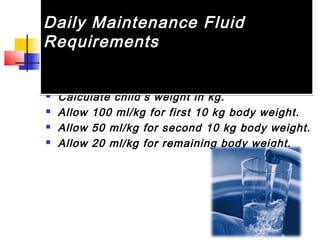
Daily Maintenance Fluid Requirements
 Calculate child’s weight in kg.
 Allow 100 ml/kg for first 10 kg body weight.
 Allow 50 ml/kg for second 10 kg body weight.
 Allow 20 ml/kg for remaining body weight.
Daily Maintenance Fluid
Requirements
Daily Maintenance Fluid
Requirements
Calculating replacementCalculating replacement
Correction of deficit:
 Deficit in ml = wt (kg) x % dehydrated x 10
(ideally the pre-dehydration weight should be
used).
 example :
14 kg child who is 5% dehydrated has a deficit
of
14 x 5 x 10 = 700 ml.
Fluid requirements(burn
victim )
Fluid requirements(burn
victim )
 TBSA burned(%) x Wt(kg) x 4 ml
example : a child weighs 15kg,he has his
leg burned
TBSA=18
18x15x4=1080ml.
 Give half of total requirements in first 8
hour,second half over next 16 hour.
 Give IV fluid to the burned victim (child )
If the TBSA is 10% or more .
Rule of nine for
measuring TBSA
Rule of nine for
measuring TBSA
Calculating Drop rate per
minutes
Calculating Drop rate per
minutes
(Solution) ml x 15 /hr x min
 Example :
540 ml x15/8 hr x 60 =16 drops per
minute.
540mlx15/16x60=8 drops per
minute.
Prevention and home carePrevention and home care
FAMILY EDUCATION:
 If your child has vomiting or diarrhea more than
four to five times in 24 consecutive hours, start
fluid replacement & increasing fluid intake.
 Even when you are healthy, drink plenty of fluids
every day and drink more when the weather is
hot.
 Begin fluid replacement as soon as vomiting and
diarrhea start -- DO NOT wait for signs of
dehydration.
 Remind family that fluid needs are greater with
fever, vomiting, or diarrhea .
 Notify physician immediately in case of
continues vomiting and diarrhea.
 teach the mother how to prepare ORS
at home
Prevention and home carePrevention and home care
Approach
Approach to Peds Dehydration
1) Initial Resuscitation
2) Determine % dehydration
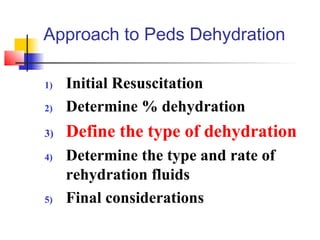
3) Define the type of dehydration
4) Determine the type and rate of
rehydration fluids
5) Final considerations
The gospel according to Rob
Hall
Approach to Peds Dehydration
1) Initial Resuscitation
2) Determine % dehydration
3) Define the type of dehydration
4) Determine the type and rate of
rehydration fluids
5) Final considerations
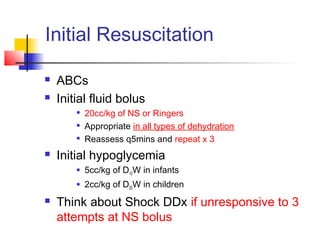
Initial Resuscitation
 ABCs
 Initial fluid bolus

20cc/kg of NS or Ringers

Appropriate in all types of dehydration

Reassess q5mins and repeat x 3
 Initial hypoglycemia
 5cc/kg of D10W in infants
 2cc/kg of D25W in children
 Think about Shock DDx if unresponsive to 3
attempts at NS bolus
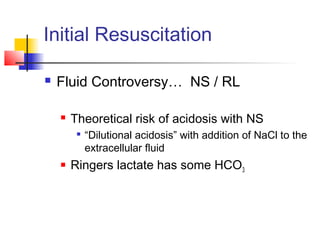
Initial Resuscitation
 Fluid Controversy… NS / RL
 Theoretical risk of acidosis with NS

“Dilutional acidosis” with addition of NaCl to the
extracellular fluid
 Ringers lactate has some HCO3
Approach to Peds Dehydration
1) Initial Resuscitation
2) Determine % dehydration
3) Define the type of dehydration
4) Determine the type and rate of
rehydration fluids
5) Final considerations
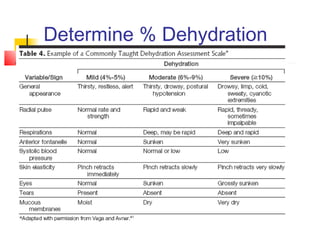
Determine % Dehydration
What are the best clinical
markers?
 Prolonged cap
refill
 Sunken eyes
 Poor overall
appearance
 Sunken fontanelle
 Absent tears
 Increased HR
 Weak Pulse
 Dry mucous
membranes
 Abnormal resp
pattern
 Abnormal skin turgor
or tenting
Determine % Dehydration
 Does lab work help you in determining
the degree of dehydration?
 What lab values do people use to
assess severity of dehydration?

Tests such as BUN and bicarbonate are
only helpful when results are markedly
abnormal

A normal bicarbonate concentration
reduces the likelihood of dehydration

No lab test should be considered
definitive for dehydration
Approach to Peds Dehydration
1) Initial Resuscitation
2) Determine % dehydration
3) Define the type of dehydration
4) Determine the type and rate of
rehydration fluids
5) Final considerations
Define the type of
dehydration
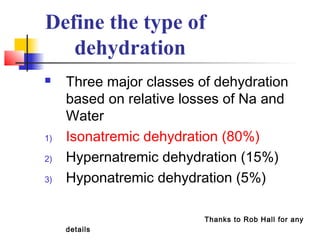
 Three major classes of dehydration
based on relative losses of Na and
Water
1) Isonatremic dehydration (80%)
2) Hypernatremic dehydration (15%)
3) Hyponatremic dehydration (5%)
Thanks to Rob Hall for any
details
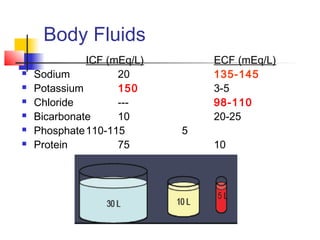
Body Fluids
ICF (mEq/L) ECF (mEq/L)
 Sodium 20 135-145
 Potassium 150 3-5
 Chloride --- 98-110
 Bicarbonate 10 20-25
 Phosphate110-115 5
 Protein 75 10
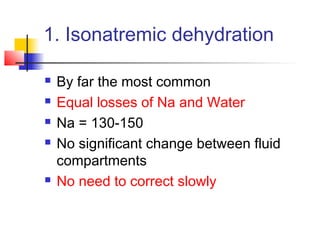
1. Isonatremic dehydration
 By far the most common
 Equal losses of Na and Water
 Na = 130-150
 No significant change between fluid
compartments
 No need to correct slowly
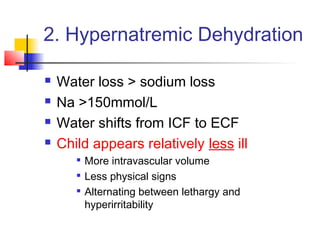
2. Hypernatremic Dehydration
 Water loss > sodium loss
 Na >150mmol/L
 Water shifts from ICF to ECF
 Child appears relatively less ill

More intravascular volume

Less physical signs

Alternating between lethargy and
hyperirritability
Hypernatremic Dehydration
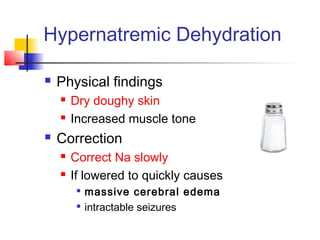
 Physical findings
 Dry doughy skin
 Increased muscle tone
 Correction
 Correct Na slowly
 If lowered to quickly causes

massive cerebral edema

intractable seizures
3. Hyponatremic Dehydration
 Sodium loss > Water loss
 Na <130mmol/L
 Water shifts from ECF to ICF
 Child appears relatively more ill

Less intravascular volume

More clinical signs

Cerebral edema

Seizure and Coma with Na <120
Hyponatremic Dehydration
 Correction
 Must again be performed slowly unless
actively seizing
 Rapid correction of chronic hyponatremia
thought to contribute to….
Central Pontine Myelinolysis

Fluctuating LOC

Pseudobulbar palsy

Quadraparesis
Approach to Peds Dehydration
1) Initial Resuscitation
2) Determine % dehydration
3) Define the type of dehydration
4) Determine the type and rate of
rehydration fluids
5) Final considerations
Determine the type and rate
of rehydration fluids
 Oral Rehydration Therapy (ORT) vs
Intravenous therapy (IVT)
“ To poke or not to poke,
that is the question”
ORT
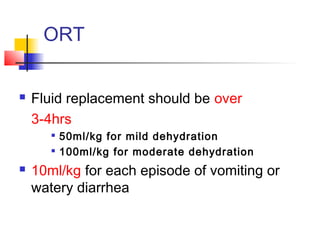
 Fluid replacement should be over
3-4hrs

50ml/kg for mild dehydration

100ml/kg for moderate dehydration
 10ml/kg for each episode of vomiting or
watery diarrhea
ORT
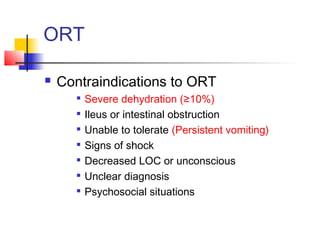
 Contraindications to ORT

Severe dehydration (≥10%)

Ileus or intestinal obstruction

Unable to tolerate (Persistent vomiting)

Signs of shock

Decreased LOC or unconscious

Unclear diagnosis

Psychosocial situations
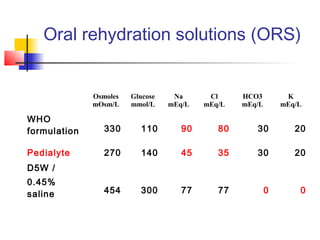
Oral rehydration solutions (ORS)
 
Osmoles
mOsm/L
Glucose
mmol/L
Na
mEq/L
Cl
mEq/L
HCO3
mEq/L
K
mEq/L
WHO
formulation 330 110 90 80 30 20
Pedialyte 270 140 45 35 30 20
D5W /
0.45%
saline 454 300 77 77 0 0
NGT???
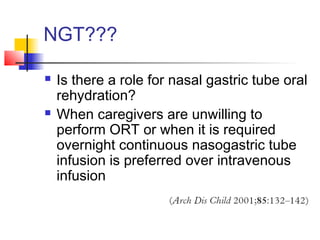
 Is there a role for nasal gastric tube oral
rehydration?
 When caregivers are unwilling to
perform ORT or when it is required
overnight continuous nasogastric tube
infusion is preferred over intravenous
infusion
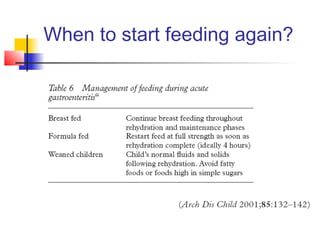
When to start feeding again?
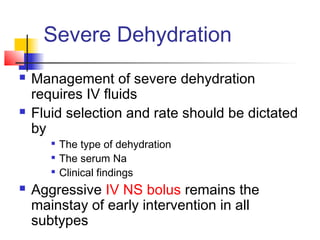
Severe Dehydration
 Management of severe dehydration
requires IV fluids
 Fluid selection and rate should be dictated
by

The type of dehydration

The serum Na

Clinical findings
 Aggressive IV NS bolus remains the
mainstay of early intervention in all
subtypes
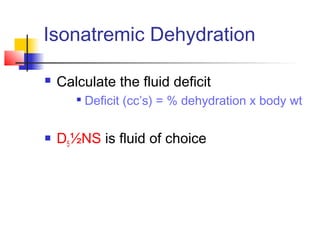
Isonatremic Dehydration
 Calculate the fluid deficit

Deficit (cc’s) = % dehydration x body wt
 D5½NS is fluid of choice
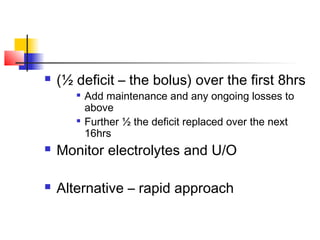
 (½ deficit – the bolus) over the first 8hrs

Add maintenance and any ongoing losses to
above

Further ½ the deficit replaced over the next
16hrs
 Monitor electrolytes and U/O
 Alternative – rapid approach
Hypernatremic Dehydration
 Fluid deficit =
• Replace with D50.2%NS
• Replace over 48hrs
• Reduce sodium by no more than 10mEq/L/24hrs
 Water deficit (in L) = [(current Na level in mEq/L ÷ 145
mEq/L) - 1] X 0.6 X weight (in kg)
 (½ deficit – the bolus) over the first 24hrs
 Add maintenance and any ongoing losses to above
 Further ½ the deficit replaced over the next 24hrs
Hyponatremic dehydration
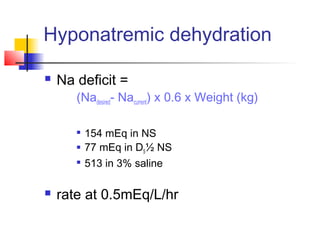
 Na deficit =
(Nadesired- Nacurrent) x 0.6 x Weight (kg)

154 mEq in NS
 77 mEq in D5½ NS

513 in 3% saline
 rate at 0.5mEq/L/hr
Hyponatremic Dehydration
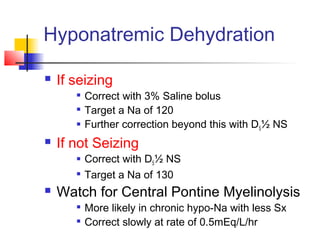
 If seizing

Correct with 3% Saline bolus

Target a Na of 120
 Further correction beyond this with D5½ NS
 If not Seizing
 Correct with D5½ NS

Target a Na of 130
 Watch for Central Pontine Myelinolysis

More likely in chronic hypo-Na with less Sx

Correct slowly at rate of 0.5mEq/L/hr
Approach to Peds Dehydration
1) Initial Resuscitation
2) Determine % dehydration
3) Define the type of dehydration
4) Determine the type and rate of
rehydration fluids
5) Final considerations
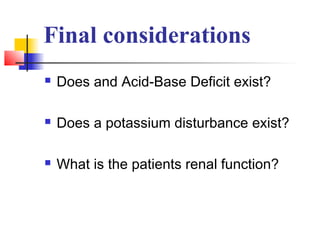
Final considerations
 Does and Acid-Base Deficit exist?
 Does a potassium disturbance exist?
 What is the patients renal function?
Does and Acid-Base Deficit
exist?
 Acidosis

Lactate

Ketones

Loss of Bicarb in diarrhea
 Most will resolve with simple
rehydration
 Consider HCO3 for pH<7.0
Does a potassium disturbance
exist?
 K+
losses

GI

Renal
 Remember that K shifts with acidosis
and certain therapies
 Always insure renal function prior to IV
replacement
Rapid Fire Cases
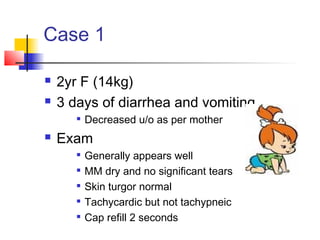
Case 1
 2yr F (14kg)
 3 days of diarrhea and vomiting

Decreased u/o as per mother
 Exam

Generally appears well

MM dry and no significant tears

Skin turgor normal

Tachycardic but not tachypneic

Cap refill 2 seconds
Approach to Peds Dehydration
1) Initial Resuscitation
2) Determine % dehydration
3) Define the type of dehydration
4) Determine the type and rate of
rehydration fluids
5) Final considerations
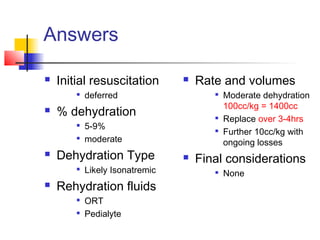
Answers
 Initial resuscitation

deferred
 % dehydration

5-9%

moderate
 Dehydration Type

Likely Isonatremic
 Rehydration fluids

ORT

Pedialyte
 Rate and volumes

Moderate dehydration
100cc/kg = 1400cc

Replace over 3-4hrs

Further 10cc/kg with
ongoing losses
 Final considerations

None
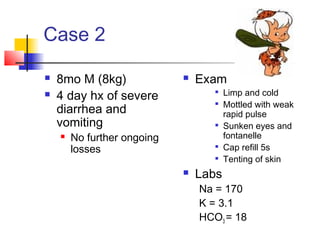
Case 2
 8mo M (8kg)
 4 day hx of severe
diarrhea and
vomiting
 No further ongoing
losses
 Exam

Limp and cold

Mottled with weak
rapid pulse

Sunken eyes and
fontanelle

Cap refill 5s

Tenting of skin
 Labs
Na = 170
K = 3.1
HCO3 = 18
Approach to Peds Dehydration
1) Initial Resuscitation
2) Determine % dehydration
3) Define the type of dehydration
4) Determine the type and rate of
rehydration fluids
5) Final considerations
Answers
 Initial resuscitation

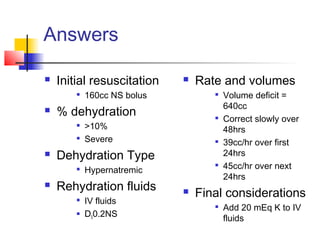
160cc NS bolus
 % dehydration

>10%

Severe
 Dehydration Type

Hypernatremic
 Rehydration fluids

IV fluids
 D50.2NS
 Rate and volumes

Volume deficit =
640cc

Correct slowly over
48hrs

39cc/hr over first
24hrs

45cc/hr over next
24hrs
 Final considerations

Add 20 mEq K to IV
fluids
Case 3
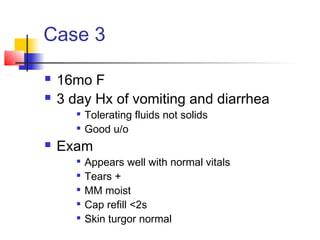
 16mo F
 3 day Hx of vomiting and diarrhea

Tolerating fluids not solids

Good u/o
 Exam

Appears well with normal vitals

Tears +

MM moist

Cap refill <2s

Skin turgor normal
Approach to Peds Dehydration
1) Initial Resuscitation
2) Determine % dehydration
3) Define the type of dehydration
4) Determine the type and rate of
rehydration fluids
5) Final considerations
Answers
Send this kid home!!!
Case 4
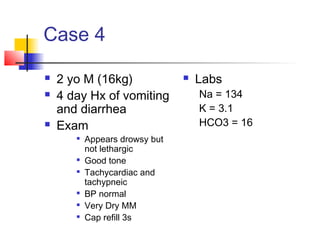
 2 yo M (16kg)
 4 day Hx of vomiting
and diarrhea
 Exam

Appears drowsy but
not lethargic

Good tone

Tachycardiac and
tachypneic

BP normal

Very Dry MM

Cap refill 3s
 Labs
Na = 134
K = 3.1
HCO3 = 16
Approach to Peds Dehydration
1) Initial Resuscitation
2) Determine % dehydration
3) Define the type of dehydration
4) Determine the type and rate of
rehydration fluids
5) Final considerations
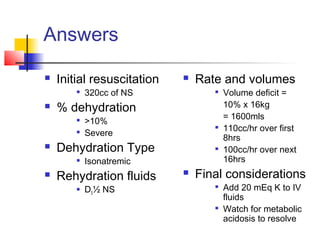
Answers
 Initial resuscitation

320cc of NS
 % dehydration

>10%

Severe
 Dehydration Type

Isonatremic
 Rehydration fluids
 D5½ NS
 Rate and volumes

Volume deficit =
10% x 16kg
= 1600mls

110cc/hr over first
8hrs

100cc/hr over next
16hrs
 Final considerations

Add 20 mEq K to IV
fluids

Watch for metabolic
acidosis to resolve
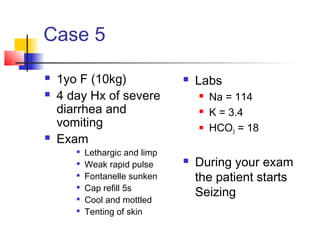
Case 5
 1yo F (10kg)
 4 day Hx of severe
diarrhea and
vomiting
 Exam

Lethargic and limp

Weak rapid pulse

Fontanelle sunken

Cap refill 5s

Cool and mottled

Tenting of skin
 Labs
 Na = 114
 K = 3.4
 HCO3 = 18
 During your exam
the patient starts
Seizing
Approach to Peds Dehydration
1) Initial Resuscitation
2) Determine % dehydration
3) Define the type of dehydration
4) Determine the type and rate of
rehydration fluids
5) Final considerations
Answers
 Initial resuscitation

200cc NS
 % dehydration

>10%

Severe
 Dehydration Type

Hyponatremic
 Rehydration fluids

IV

Initially 3% saline
 D5½ NS after above
 Rate and volumes

Initially correct to Na
of 120 with 3%
= 70cc bolus

Then correct to Na of
130 with D5½ NS at
rate of 0.5mEq/L/hr
= 39cc/hr
 Final considerations

Add 20 mEq K to IV
fluids
THANK YOU
http://
www.medcalc.com/pedifen.html

Dehydraton in pediatrics

  • 2.
    DefinitionDefinition  is definedas an excessive loss of body fluid & electrolytes.  Output is more than input.
  • 3.
    CausesCauses  Diarrhea  Vomiting Excessive Sweating  Diabetes  Burns  Excessive blood loss caused by trauma or accident
  • 4.
  • 5.
    Types of dehydrationbased on severity  Mild : when the total fluid loss reaches 5% or less .  Moderate : when the total fluid loss reaches 5 - 10% .  Severe : when the total fluid loss reaches more than 10%, considered an emergency case .
  • 6.
    Mild dehydration S&S Mild dehydration S&S No dehydration  Thirsty  Conscious  Less than 5% of body Weight is lost.
  • 7.
    Moderate dehydration S&S Moderate dehydration S&S Dry skin and mucous membranes  Thirst  Decreased urine output  Crying baby with tears  Muscle weakness  Drowsiness  light head ache  sunken fontanels  Decreased BP  Increased Pulse rate (tachycardia)  Capillary refill  Shallow rapid RR  5 to10 % of body Weight is lost
  • 9.
    Severe dehydration S&S Severe dehydration S&S Extreme thirst  Very dry mouth, skin and mucous membranes  Sunken eyes  Sunken fontanels  No tears  Anuria  Dry skin that lacks elasticity and slowly “bounces back” when pinched into a fold  Rapid heartbeat  Rapid and shallow breath  Unconsciousness  More than 10 % of body Weight is loss  Delay Capillary refill for more than 2 seconds
  • 11.
    Possible ComplicationsPossible Complications Permanent brain damage  Seizures  hypernatremia  Hyponatremia  hypovolemic shock  Kidney failure  Coma and death
  • 12.
    Tests and diagnosisTestsand diagnosis  Blood tests:  to check level of electrolytes.  BUN  Creatinine  Urine analysis
  • 13.
    Diarrhea Indications for stoolstudies  Toxic appearance  Immunocompromised  Bloody or invasive  Duration > 5days  Suspected parasites  Travel  Camping  Poor Water
  • 14.
    TreatmentTreatment  dehydration treatmentdepends on age,weight , the severity of dehydration and its cause.  Oral rehydration solution (ORS) for mild and moderate dehydration  IV fluid replacement (for sever dehydration)  Treating the cause of dehydration  A single dose of ondansetron (Zofran) oraly(tablet)
  • 15.
    Treatment of mildand moderate dehydration Treatment of mild and moderate dehydration  Oral rehydration solution (ORS) is a simple treatment for dehydration Contraindications for ORS: 1. Severe dehydration. 2. Unconsciousness. 3. Frequent vomiting attacks.  Continues breastfeeding .  A single dose of ondansetron oraly(tablet)
  • 16.
    Treatment of sever dehydration Treatmentof sever dehydration  NPO.  IV fluid replacement.
  • 17.
    Daily Maintenance FluidRequirements  Calculate child’s weight in kg.  Allow 100 ml/kg for first 10 kg body weight.  Allow 50 ml/kg for second 10 kg body weight.  Allow 20 ml/kg for remaining body weight. Daily Maintenance Fluid Requirements Daily Maintenance Fluid Requirements
  • 18.
    Calculating replacementCalculating replacement Correctionof deficit:  Deficit in ml = wt (kg) x % dehydrated x 10 (ideally the pre-dehydration weight should be used).  example : 14 kg child who is 5% dehydrated has a deficit of 14 x 5 x 10 = 700 ml.
  • 19.
    Fluid requirements(burn victim ) Fluidrequirements(burn victim )  TBSA burned(%) x Wt(kg) x 4 ml example : a child weighs 15kg,he has his leg burned TBSA=18 18x15x4=1080ml.  Give half of total requirements in first 8 hour,second half over next 16 hour.  Give IV fluid to the burned victim (child ) If the TBSA is 10% or more .
  • 20.
    Rule of ninefor measuring TBSA Rule of nine for measuring TBSA
  • 21.
    Calculating Drop rateper minutes Calculating Drop rate per minutes (Solution) ml x 15 /hr x min  Example : 540 ml x15/8 hr x 60 =16 drops per minute. 540mlx15/16x60=8 drops per minute.
  • 22.
    Prevention and homecarePrevention and home care FAMILY EDUCATION:  If your child has vomiting or diarrhea more than four to five times in 24 consecutive hours, start fluid replacement & increasing fluid intake.  Even when you are healthy, drink plenty of fluids every day and drink more when the weather is hot.  Begin fluid replacement as soon as vomiting and diarrhea start -- DO NOT wait for signs of dehydration.  Remind family that fluid needs are greater with fever, vomiting, or diarrhea .
  • 23.
     Notify physicianimmediately in case of continues vomiting and diarrhea.  teach the mother how to prepare ORS at home Prevention and home carePrevention and home care
  • 24.
  • 25.
    Approach to PedsDehydration 1) Initial Resuscitation 2) Determine % dehydration 3) Define the type of dehydration 4) Determine the type and rate of rehydration fluids 5) Final considerations The gospel according to Rob Hall
  • 26.
    Approach to PedsDehydration 1) Initial Resuscitation 2) Determine % dehydration 3) Define the type of dehydration 4) Determine the type and rate of rehydration fluids 5) Final considerations
  • 27.
    Initial Resuscitation  ABCs Initial fluid bolus  20cc/kg of NS or Ringers  Appropriate in all types of dehydration  Reassess q5mins and repeat x 3  Initial hypoglycemia  5cc/kg of D10W in infants  2cc/kg of D25W in children  Think about Shock DDx if unresponsive to 3 attempts at NS bolus
  • 28.
    Initial Resuscitation  FluidControversy… NS / RL  Theoretical risk of acidosis with NS  “Dilutional acidosis” with addition of NaCl to the extracellular fluid  Ringers lactate has some HCO3
  • 29.
    Approach to PedsDehydration 1) Initial Resuscitation 2) Determine % dehydration 3) Define the type of dehydration 4) Determine the type and rate of rehydration fluids 5) Final considerations
  • 30.
  • 31.
    What are thebest clinical markers?  Prolonged cap refill  Sunken eyes  Poor overall appearance  Sunken fontanelle  Absent tears  Increased HR  Weak Pulse  Dry mucous membranes  Abnormal resp pattern  Abnormal skin turgor or tenting
  • 32.
    Determine % Dehydration Does lab work help you in determining the degree of dehydration?  What lab values do people use to assess severity of dehydration?
  • 33.
     Tests such asBUN and bicarbonate are only helpful when results are markedly abnormal  A normal bicarbonate concentration reduces the likelihood of dehydration  No lab test should be considered definitive for dehydration
  • 34.
    Approach to PedsDehydration 1) Initial Resuscitation 2) Determine % dehydration 3) Define the type of dehydration 4) Determine the type and rate of rehydration fluids 5) Final considerations
  • 35.
    Define the typeof dehydration  Three major classes of dehydration based on relative losses of Na and Water 1) Isonatremic dehydration (80%) 2) Hypernatremic dehydration (15%) 3) Hyponatremic dehydration (5%) Thanks to Rob Hall for any details
  • 36.
    Body Fluids ICF (mEq/L)ECF (mEq/L)  Sodium 20 135-145  Potassium 150 3-5  Chloride --- 98-110  Bicarbonate 10 20-25  Phosphate110-115 5  Protein 75 10
  • 37.
    1. Isonatremic dehydration By far the most common  Equal losses of Na and Water  Na = 130-150  No significant change between fluid compartments  No need to correct slowly
  • 38.
    2. Hypernatremic Dehydration Water loss > sodium loss  Na >150mmol/L  Water shifts from ICF to ECF  Child appears relatively less ill  More intravascular volume  Less physical signs  Alternating between lethargy and hyperirritability
  • 39.
    Hypernatremic Dehydration  Physicalfindings  Dry doughy skin  Increased muscle tone  Correction  Correct Na slowly  If lowered to quickly causes  massive cerebral edema  intractable seizures
  • 40.
    3. Hyponatremic Dehydration Sodium loss > Water loss  Na <130mmol/L  Water shifts from ECF to ICF  Child appears relatively more ill  Less intravascular volume  More clinical signs  Cerebral edema  Seizure and Coma with Na <120
  • 41.
    Hyponatremic Dehydration  Correction Must again be performed slowly unless actively seizing  Rapid correction of chronic hyponatremia thought to contribute to…. Central Pontine Myelinolysis  Fluctuating LOC  Pseudobulbar palsy  Quadraparesis
  • 42.
    Approach to PedsDehydration 1) Initial Resuscitation 2) Determine % dehydration 3) Define the type of dehydration 4) Determine the type and rate of rehydration fluids 5) Final considerations
  • 43.
    Determine the typeand rate of rehydration fluids  Oral Rehydration Therapy (ORT) vs Intravenous therapy (IVT) “ To poke or not to poke, that is the question”
  • 44.
    ORT  Fluid replacementshould be over 3-4hrs  50ml/kg for mild dehydration  100ml/kg for moderate dehydration  10ml/kg for each episode of vomiting or watery diarrhea
  • 45.
    ORT  Contraindications toORT  Severe dehydration (≥10%)  Ileus or intestinal obstruction  Unable to tolerate (Persistent vomiting)  Signs of shock  Decreased LOC or unconscious  Unclear diagnosis  Psychosocial situations
  • 46.
    Oral rehydration solutions(ORS)   Osmoles mOsm/L Glucose mmol/L Na mEq/L Cl mEq/L HCO3 mEq/L K mEq/L WHO formulation 330 110 90 80 30 20 Pedialyte 270 140 45 35 30 20 D5W / 0.45% saline 454 300 77 77 0 0
  • 47.
    NGT???  Is therea role for nasal gastric tube oral rehydration?  When caregivers are unwilling to perform ORT or when it is required overnight continuous nasogastric tube infusion is preferred over intravenous infusion
  • 48.
    When to startfeeding again?
  • 49.
    Severe Dehydration  Managementof severe dehydration requires IV fluids  Fluid selection and rate should be dictated by  The type of dehydration  The serum Na  Clinical findings  Aggressive IV NS bolus remains the mainstay of early intervention in all subtypes
  • 50.
    Isonatremic Dehydration  Calculatethe fluid deficit  Deficit (cc’s) = % dehydration x body wt  D5½NS is fluid of choice
  • 51.
     (½ deficit– the bolus) over the first 8hrs  Add maintenance and any ongoing losses to above  Further ½ the deficit replaced over the next 16hrs  Monitor electrolytes and U/O  Alternative – rapid approach
  • 52.
    Hypernatremic Dehydration  Fluiddeficit = • Replace with D50.2%NS • Replace over 48hrs • Reduce sodium by no more than 10mEq/L/24hrs  Water deficit (in L) = [(current Na level in mEq/L ÷ 145 mEq/L) - 1] X 0.6 X weight (in kg)  (½ deficit – the bolus) over the first 24hrs  Add maintenance and any ongoing losses to above  Further ½ the deficit replaced over the next 24hrs
  • 53.
    Hyponatremic dehydration  Nadeficit = (Nadesired- Nacurrent) x 0.6 x Weight (kg)  154 mEq in NS  77 mEq in D5½ NS  513 in 3% saline  rate at 0.5mEq/L/hr
  • 54.
    Hyponatremic Dehydration  Ifseizing  Correct with 3% Saline bolus  Target a Na of 120  Further correction beyond this with D5½ NS  If not Seizing  Correct with D5½ NS  Target a Na of 130  Watch for Central Pontine Myelinolysis  More likely in chronic hypo-Na with less Sx  Correct slowly at rate of 0.5mEq/L/hr
  • 55.
    Approach to PedsDehydration 1) Initial Resuscitation 2) Determine % dehydration 3) Define the type of dehydration 4) Determine the type and rate of rehydration fluids 5) Final considerations
  • 56.
    Final considerations  Doesand Acid-Base Deficit exist?  Does a potassium disturbance exist?  What is the patients renal function?
  • 57.
    Does and Acid-BaseDeficit exist?  Acidosis  Lactate  Ketones  Loss of Bicarb in diarrhea  Most will resolve with simple rehydration  Consider HCO3 for pH<7.0
  • 58.
    Does a potassiumdisturbance exist?  K+ losses  GI  Renal  Remember that K shifts with acidosis and certain therapies  Always insure renal function prior to IV replacement
  • 59.
  • 60.
    Case 1  2yrF (14kg)  3 days of diarrhea and vomiting  Decreased u/o as per mother  Exam  Generally appears well  MM dry and no significant tears  Skin turgor normal  Tachycardic but not tachypneic  Cap refill 2 seconds
  • 61.
    Approach to PedsDehydration 1) Initial Resuscitation 2) Determine % dehydration 3) Define the type of dehydration 4) Determine the type and rate of rehydration fluids 5) Final considerations
  • 62.
    Answers  Initial resuscitation  deferred % dehydration  5-9%  moderate  Dehydration Type  Likely Isonatremic  Rehydration fluids  ORT  Pedialyte  Rate and volumes  Moderate dehydration 100cc/kg = 1400cc  Replace over 3-4hrs  Further 10cc/kg with ongoing losses  Final considerations  None
  • 63.
    Case 2  8moM (8kg)  4 day hx of severe diarrhea and vomiting  No further ongoing losses  Exam  Limp and cold  Mottled with weak rapid pulse  Sunken eyes and fontanelle  Cap refill 5s  Tenting of skin  Labs Na = 170 K = 3.1 HCO3 = 18
  • 64.
    Approach to PedsDehydration 1) Initial Resuscitation 2) Determine % dehydration 3) Define the type of dehydration 4) Determine the type and rate of rehydration fluids 5) Final considerations
  • 65.
    Answers  Initial resuscitation  160ccNS bolus  % dehydration  >10%  Severe  Dehydration Type  Hypernatremic  Rehydration fluids  IV fluids  D50.2NS  Rate and volumes  Volume deficit = 640cc  Correct slowly over 48hrs  39cc/hr over first 24hrs  45cc/hr over next 24hrs  Final considerations  Add 20 mEq K to IV fluids
  • 66.
    Case 3  16moF  3 day Hx of vomiting and diarrhea  Tolerating fluids not solids  Good u/o  Exam  Appears well with normal vitals  Tears +  MM moist  Cap refill <2s  Skin turgor normal
  • 67.
    Approach to PedsDehydration 1) Initial Resuscitation 2) Determine % dehydration 3) Define the type of dehydration 4) Determine the type and rate of rehydration fluids 5) Final considerations
  • 68.
  • 69.
    Case 4  2yo M (16kg)  4 day Hx of vomiting and diarrhea  Exam  Appears drowsy but not lethargic  Good tone  Tachycardiac and tachypneic  BP normal  Very Dry MM  Cap refill 3s  Labs Na = 134 K = 3.1 HCO3 = 16
  • 70.
    Approach to PedsDehydration 1) Initial Resuscitation 2) Determine % dehydration 3) Define the type of dehydration 4) Determine the type and rate of rehydration fluids 5) Final considerations
  • 71.
    Answers  Initial resuscitation  320ccof NS  % dehydration  >10%  Severe  Dehydration Type  Isonatremic  Rehydration fluids  D5½ NS  Rate and volumes  Volume deficit = 10% x 16kg = 1600mls  110cc/hr over first 8hrs  100cc/hr over next 16hrs  Final considerations  Add 20 mEq K to IV fluids  Watch for metabolic acidosis to resolve
  • 72.
    Case 5  1yoF (10kg)  4 day Hx of severe diarrhea and vomiting  Exam  Lethargic and limp  Weak rapid pulse  Fontanelle sunken  Cap refill 5s  Cool and mottled  Tenting of skin  Labs  Na = 114  K = 3.4  HCO3 = 18  During your exam the patient starts Seizing
  • 73.
    Approach to PedsDehydration 1) Initial Resuscitation 2) Determine % dehydration 3) Define the type of dehydration 4) Determine the type and rate of rehydration fluids 5) Final considerations
  • 74.
    Answers  Initial resuscitation  200ccNS  % dehydration  >10%  Severe  Dehydration Type  Hyponatremic  Rehydration fluids  IV  Initially 3% saline  D5½ NS after above  Rate and volumes  Initially correct to Na of 120 with 3% = 70cc bolus  Then correct to Na of 130 with D5½ NS at rate of 0.5mEq/L/hr = 39cc/hr  Final considerations  Add 20 mEq K to IV fluids
  • 75.

Editor's Notes

  • #31 Really we don’t care about kids &lt;5% dehydrated. The ones that are &gt;10% dehydrated are usually obviously unwell, so the challenge comes from trying to tease out those kids that fall within the mild-moderate range of dehydration
  • #37 Most of our physical signs are determined by the ECF compartment Most of the neurological changes come from changes in the ICF compartment
  • #39 Or increased Na+ intake due to incorrect formula
  • #41 Most common cause is sodium poor replacement of GI losses
  • #45 Frequent and small is the way to go – preferably with a syringe CPS states 20cc/kg/hr 1 st hour then 10cc/kg/hr over the next 6-8hrs if mild and 15-20cc/kg/hr over next 6-8hrs if moderate
  • #47 Know this chart for any exam written by Dr. Bryan Young!!!
  • #48 Opinions of respected authorities only EBM review says that it is a viable and useful alternative
  • #66 (½ deficit – the bolus) over the first 24hrs Add maintenance and any ongoing losses to above Further ½ the deficit replaced over the next 24hrs
  • #75 Na deficit = (Na desired - Na current ) x 0.6 x Weight (kg) Divide above by Na in mEq/L within the replacement fluid 154 mEq in NS 77 mEq in D 5 ½ NS 513 in 3% saline divide by deficit x 2 to determine rate at 0.5mEq/L/hr