Faculty of medical science
                                  School of nursing
                                  Kurdistan /Iraq


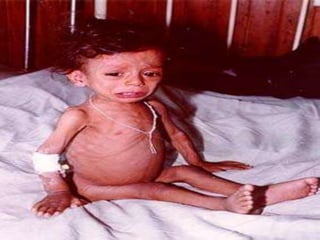
Dehydration in pediatrics


       Prepared by students :
         Raveen Ismail Abdullah
           Hayman Ahmad A.
            Viyan Murad H.
Objectives
 Dehydration Overview.
 Definition of dehydration & pathophysiology .
 For understanding the main type of dehydrations depending on
  degree of severity and amount of fluid & electrolyte loss, &
  Differentiation between degree of dehydration.
 To know the causes of Dehydration .
 How we can diagnose dehydration and required investigations for
  conforming diagnosis .
 To know the sign & symptoms of dehydration .
 Understanding further complications of dehydration .
 Appropriate Treatment of dehydration depending on patient age
  and weight & severity of dehydration and its causes.
 Nursing considerations and nursing care plan .
 How we can prevent dehydration.
Dehydration overview
 Water is a essential element of the body..Up to 75% of the body's
  weight is made up of water. Most of the water is found in :

 (intracellular space)
 (extravascular space)
 (interstitial space).

 Dehydration occurs when the amount of water leaving the body is
  greater than the amount being taken in.

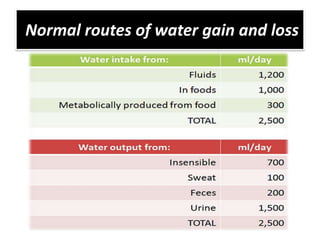
 In normal situations the body is in water balance it means that
  input is equal to out put
Definition
Dehydration
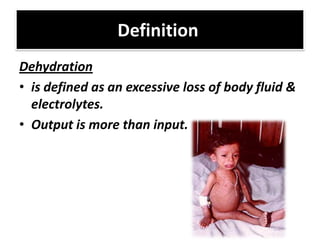
• is defined as an excessive loss of body fluid &
  electrolytes.
• Output is more than input.
Normal routes of water gain and loss
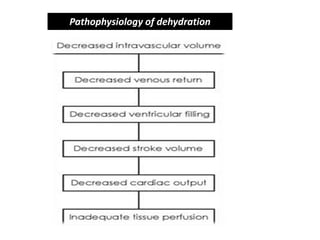
Pathophysiology of dehydration
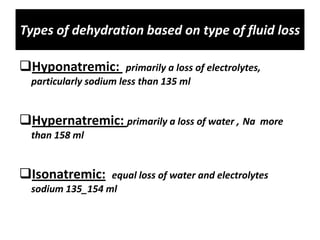
Types of dehydration based on type of fluid loss

Hyponatremic:          primarily a loss of electrolytes,
  particularly sodium less than 135 ml


Hypernatremic: primarily a loss of water , Na          more
  than 158 ml


Isonatremic:     equal loss of water and electrolytes
  sodium 135_154 ml
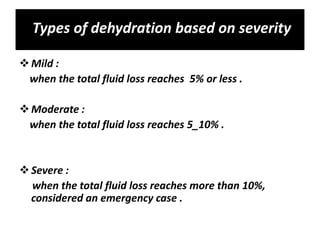
Types of dehydration based on severity

 Mild :
 when the total fluid loss reaches 5% or less .

 Moderate :
 when the total fluid loss reaches 5_10% .


 Severe :
  when the total fluid loss reaches more than 10%,
  considered an emergency case .
Causes
•   Diarrhea
•   Vomiting
•   Excessive Sweating
•   Diabetes
•   Burns
•   Excessive blood loss caused by trauma or
    accident
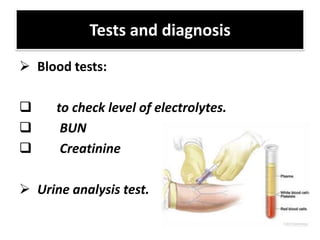
Tests and diagnosis
 Blood tests:

     to check level of electrolytes.
      BUN
      Creatinine

 Urine analysis test.
Mild dehydration
                     S&S
•   No dehydration
•   Thirsty
•   Conscious
•   Less than 5% of body Weight is lost.
Moderate dehydration
                       S&S
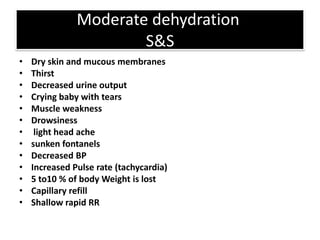
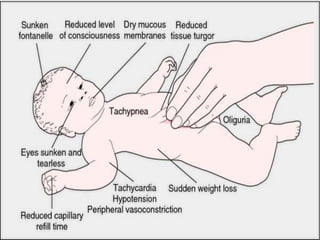
•   Dry skin and mucous membranes
•   Thirst
•   Decreased urine output
•   Crying baby with tears
•   Muscle weakness
•   Drowsiness
•    light head ache
•   sunken fontanels
•   Decreased BP
•   Increased Pulse rate (tachycardia)
•   5 to10 % of body Weight is lost
•   Capillary refill
•   Shallow rapid RR
Severe dehydration
                          S&S
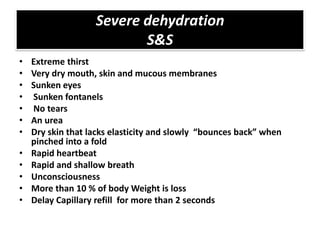
•   Extreme thirst
•   Very dry mouth, skin and mucous membranes
•   Sunken eyes
•   Sunken fontanels
•   No tears
•   An urea
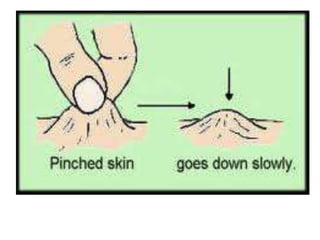
•   Dry skin that lacks elasticity and slowly “bounces back” when
    pinched into a fold
•   Rapid heartbeat
•   Rapid and shallow breath
•   Unconsciousness
•   More than 10 % of body Weight is loss
•   Delay Capillary refill for more than 2 seconds
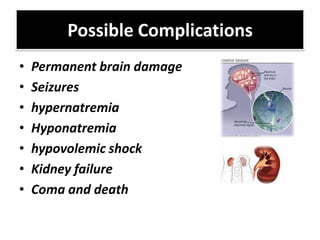
Possible Complications
•   Permanent brain damage
•   Seizures
•   hypernatremia
•   Hyponatremia
•   hypovolemic shock
•   Kidney failure
•   Coma and death
Treatment
• dehydration treatment depends on age,weight , the severity
  of dehydration and its cause.
 Oral rehydration solution (ORS) for mild and moderate
  dehydration
 IV fluid replacement (for sever dehydration)
 Treating the cause of dehydration
 A single dose of ondansetron (Zofran) oraly(tablet)
Treatment of mild and moderate
                dehydration
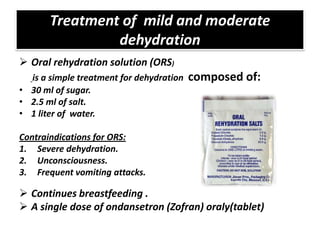
 Oral rehydration solution (ORS)
  is a simple treatment for dehydration   composed of:
• 30 ml of sugar.
• 2.5 ml of salt.
• 1 liter of water.

Contraindications for ORS:
1. Severe dehydration.
2. Unconsciousness.
3. Frequent vomiting attacks.

 Continues breastfeeding .
 A single dose of ondansetron (Zofran) oraly(tablet)
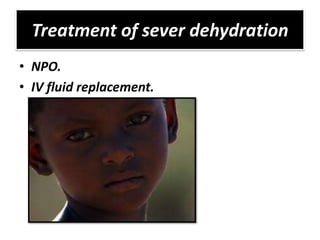
Treatment of sever dehydration
• NPO.
• IV fluid replacement.
Daily Maintenance Fluid Requirements

Daily Maintenance Fluid Requirements
•   Calculate child’s weight in kg.
•   Allow 100 ml/kg for first 10 kg body weight.
•   Allow 50 ml/kg for second 10 kg body weight.
•   Allow 20 ml/kg for remaining body weight.
Calculating replacement
Correction of deficit:
• Deficit in ml = wt (kg) x % dehydrated x 10 (ideally the pre-
  dehydration weight should be used).


 example :
 14 kg child who is 5% dehydrated has a deficit of
 14 x 5 x 10 = 700 ml.
Fluid requirements(burn victim )
 TBSA burned(%) x Wt(kg) x 4 ml
example : a child weighs 15kg,he has his leg burned
  TBSA=18
  18x15x4=1080ml.

 Give half of total requirements in first 8 hour,second
  half over next 16 hour.

 Give IV fluid to the burned victim (child )
    If the TBSA is 10% or more .
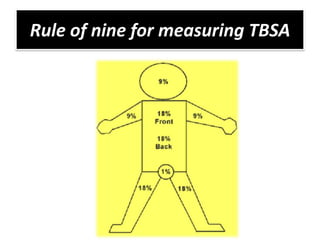
Rule of nine for measuring TBSA
Calculating Drop rate per minutes
(Solution) ml x 15 /hr x min


Example :
540 ml x15/8 hr x 60 =16 drops per minute.
540mlx15/16x60=8 drops per minute.
Nursing Considerations
 Assess vital signs, noting peripheral pulses.
 Monitor blood pressure.
 Monitor intake and output.
 Observe the physical properties of the urine.
 Correctly infuse the right amount of IVF in case
  of sever dehydration .
 Encourage small, frequent feedings.
 Provide skin care
 Administer medications as prescribe
Nursing care plan

• Nursing diagnosis :
    Deficient fluid volume may be related to active fluid loss due to
    (hemorrhage, vomiting, diarrhea, burns, wounds)


• Nursing intervention
•   Assist with identification and treatment of underlying cause.
•   Encourage fluid intake..
•   Monitor intake and output.
•   Give IV fluid as ordered if needed.
Nursing care plan

• Nursing diagnosis
  Poor skin turgor related to loss of fluid.

• Nursing intervention
• Provide skin care .
• Turn frequently, gently massage skin, and protect bony
  prominences.
• Encourage fluid intake.
• Advice to use skin moisturizers .
Prevention and home care
 FAMILY EDUCATION:
• If your child has vomiting or diarrhea more than four to five times
   in 24 consecutive hours, start fluid replacement & increasing fluid
   intake.

• Even when you are healthy, drink plenty of fluids every day and
  drink more when the weather is hot.

•   Begin fluid replacement as soon as vomiting and diarrhea start --
    DO NOT wait for signs of dehydration.

• Remind family that fluid needs are greater with fever, vomiting, or
  diarrhea .
Prevention and home care
• Notify physician immediately in case of continues
  vomiting and diarrhea.

• teach the mother how to prepare ORS at home
  in case of mild and moderate dehydration if Oral
  rehydration solution (ORS) was not available :

• (6 tea spoon ) of sugar.
• (1/2 tea spoon) of salt.
• (4.25 Cups) of water.
References
1.   http://www.emedicinehealth.com/dehydration_in_children/pag
     e6_em.htm

2.   http://www.aafp.org/afp/2009/1001/p692.html

3.   http://www.medscape.com/viewarticle/710684

4.   http://www.webmd.com/fitness-exercise/tc/dehydration-topic-
     overview

5.   http://bodyandhealth.canada.com/channel_condition_info_det
     ails.asp?disease_id=153&channel_id=9&relation_id=10860

Dehydration in children

  • 1.
    Faculty of medicalscience School of nursing Kurdistan /Iraq Dehydration in pediatrics Prepared by students : Raveen Ismail Abdullah Hayman Ahmad A. Viyan Murad H.
  • 3.
    Objectives  Dehydration Overview. Definition of dehydration & pathophysiology .  For understanding the main type of dehydrations depending on degree of severity and amount of fluid & electrolyte loss, & Differentiation between degree of dehydration.  To know the causes of Dehydration .  How we can diagnose dehydration and required investigations for conforming diagnosis .  To know the sign & symptoms of dehydration .  Understanding further complications of dehydration .  Appropriate Treatment of dehydration depending on patient age and weight & severity of dehydration and its causes.  Nursing considerations and nursing care plan .  How we can prevent dehydration.
  • 4.
    Dehydration overview  Wateris a essential element of the body..Up to 75% of the body's weight is made up of water. Most of the water is found in :  (intracellular space)  (extravascular space)  (interstitial space).  Dehydration occurs when the amount of water leaving the body is greater than the amount being taken in.  In normal situations the body is in water balance it means that input is equal to out put
  • 5.
    Definition Dehydration • is definedas an excessive loss of body fluid & electrolytes. • Output is more than input.
  • 6.
    Normal routes ofwater gain and loss
  • 7.
  • 8.
    Types of dehydrationbased on type of fluid loss Hyponatremic: primarily a loss of electrolytes, particularly sodium less than 135 ml Hypernatremic: primarily a loss of water , Na more than 158 ml Isonatremic: equal loss of water and electrolytes sodium 135_154 ml
  • 9.
    Types of dehydrationbased on severity  Mild : when the total fluid loss reaches 5% or less .  Moderate : when the total fluid loss reaches 5_10% .  Severe : when the total fluid loss reaches more than 10%, considered an emergency case .
  • 10.
    Causes • Diarrhea • Vomiting • Excessive Sweating • Diabetes • Burns • Excessive blood loss caused by trauma or accident
  • 11.
    Tests and diagnosis Blood tests:  to check level of electrolytes.  BUN  Creatinine  Urine analysis test.
  • 12.
    Mild dehydration S&S • No dehydration • Thirsty • Conscious • Less than 5% of body Weight is lost.
  • 13.
    Moderate dehydration S&S • Dry skin and mucous membranes • Thirst • Decreased urine output • Crying baby with tears • Muscle weakness • Drowsiness • light head ache • sunken fontanels • Decreased BP • Increased Pulse rate (tachycardia) • 5 to10 % of body Weight is lost • Capillary refill • Shallow rapid RR
  • 15.
    Severe dehydration S&S • Extreme thirst • Very dry mouth, skin and mucous membranes • Sunken eyes • Sunken fontanels • No tears • An urea • Dry skin that lacks elasticity and slowly “bounces back” when pinched into a fold • Rapid heartbeat • Rapid and shallow breath • Unconsciousness • More than 10 % of body Weight is loss • Delay Capillary refill for more than 2 seconds
  • 17.
    Possible Complications • Permanent brain damage • Seizures • hypernatremia • Hyponatremia • hypovolemic shock • Kidney failure • Coma and death
  • 18.
    Treatment • dehydration treatmentdepends on age,weight , the severity of dehydration and its cause.  Oral rehydration solution (ORS) for mild and moderate dehydration  IV fluid replacement (for sever dehydration)  Treating the cause of dehydration  A single dose of ondansetron (Zofran) oraly(tablet)
  • 19.
    Treatment of mildand moderate dehydration  Oral rehydration solution (ORS) is a simple treatment for dehydration composed of: • 30 ml of sugar. • 2.5 ml of salt. • 1 liter of water. Contraindications for ORS: 1. Severe dehydration. 2. Unconsciousness. 3. Frequent vomiting attacks.  Continues breastfeeding .  A single dose of ondansetron (Zofran) oraly(tablet)
  • 20.
    Treatment of severdehydration • NPO. • IV fluid replacement.
  • 21.
    Daily Maintenance FluidRequirements Daily Maintenance Fluid Requirements • Calculate child’s weight in kg. • Allow 100 ml/kg for first 10 kg body weight. • Allow 50 ml/kg for second 10 kg body weight. • Allow 20 ml/kg for remaining body weight.
  • 22.
    Calculating replacement Correction ofdeficit: • Deficit in ml = wt (kg) x % dehydrated x 10 (ideally the pre- dehydration weight should be used).  example : 14 kg child who is 5% dehydrated has a deficit of 14 x 5 x 10 = 700 ml.
  • 23.
    Fluid requirements(burn victim)  TBSA burned(%) x Wt(kg) x 4 ml example : a child weighs 15kg,he has his leg burned TBSA=18 18x15x4=1080ml.  Give half of total requirements in first 8 hour,second half over next 16 hour.  Give IV fluid to the burned victim (child ) If the TBSA is 10% or more .
  • 24.
    Rule of ninefor measuring TBSA
  • 25.
    Calculating Drop rateper minutes (Solution) ml x 15 /hr x min Example : 540 ml x15/8 hr x 60 =16 drops per minute. 540mlx15/16x60=8 drops per minute.
  • 26.
    Nursing Considerations  Assessvital signs, noting peripheral pulses.  Monitor blood pressure.  Monitor intake and output.  Observe the physical properties of the urine.  Correctly infuse the right amount of IVF in case of sever dehydration .  Encourage small, frequent feedings.  Provide skin care  Administer medications as prescribe
  • 27.
    Nursing care plan •Nursing diagnosis : Deficient fluid volume may be related to active fluid loss due to (hemorrhage, vomiting, diarrhea, burns, wounds) • Nursing intervention • Assist with identification and treatment of underlying cause. • Encourage fluid intake.. • Monitor intake and output. • Give IV fluid as ordered if needed.
  • 28.
    Nursing care plan •Nursing diagnosis Poor skin turgor related to loss of fluid. • Nursing intervention • Provide skin care . • Turn frequently, gently massage skin, and protect bony prominences. • Encourage fluid intake. • Advice to use skin moisturizers .
  • 29.
    Prevention and homecare FAMILY EDUCATION: • If your child has vomiting or diarrhea more than four to five times in 24 consecutive hours, start fluid replacement & increasing fluid intake. • Even when you are healthy, drink plenty of fluids every day and drink more when the weather is hot. • Begin fluid replacement as soon as vomiting and diarrhea start -- DO NOT wait for signs of dehydration. • Remind family that fluid needs are greater with fever, vomiting, or diarrhea .
  • 30.
    Prevention and homecare • Notify physician immediately in case of continues vomiting and diarrhea. • teach the mother how to prepare ORS at home in case of mild and moderate dehydration if Oral rehydration solution (ORS) was not available : • (6 tea spoon ) of sugar. • (1/2 tea spoon) of salt. • (4.25 Cups) of water.
  • 31.
    References 1. http://www.emedicinehealth.com/dehydration_in_children/pag e6_em.htm 2. http://www.aafp.org/afp/2009/1001/p692.html 3. http://www.medscape.com/viewarticle/710684 4. http://www.webmd.com/fitness-exercise/tc/dehydration-topic- overview 5. http://bodyandhealth.canada.com/channel_condition_info_det ails.asp?disease_id=153&channel_id=9&relation_id=10860