CHARACTERISTICS OF HUMAN
LANGUAGE
1. Productivity/ Creativity
2. Cultural transmission
3. Displacement
4. Arbitrariness
5. Duality
6. Discreetness.
• PRODUCTIVITY/ CREATIVITY:
Whatever we speak or create is productivity.
Speaking itself is productivity.
• Humans can talk about topics that are
displaced. They can talk about the things that
may be present or not, or talk about anything
in past, present or future.
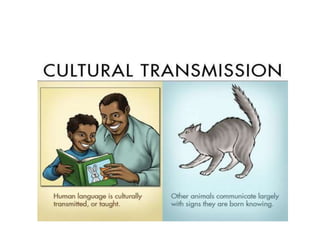
• CULTURAL TRANSMISSION:
a. Language can be culturally transmitted.
b. It cannot be transmitted through heredity.
c. Animals transmit their cries through
heredity.
d. What language the baby is going to speak is
determined by the culture the baby is born
into.
• DISPLACEMENT :
Human language can refer to the past and
future times. We can also refer to the things and
events that are not present, intangible, non
existance and non visible.
FOR EXAMPLE: moon, star, dragons, maths
equations, heaven and hell etc.
• ARBITRARINESS:
This feature was first proposed by Saussure. The
forms of linguistics signs bear no logical,
intrinsic, natural relationship to their meaning.
• FOR EXAMPLE: There is nothing in the word
‘bird’ that connects it to the concept of a bird.
• DUALITY:
Human language is organized at two levels
simultaneously. For example, at speech production
we have a physical level at which we can produce
individual sounds like n, b and i.
In a particular combination such as ‘bin’ we have
another level producing a meaning that is different
from the meaning of the combination in ‘nib’.
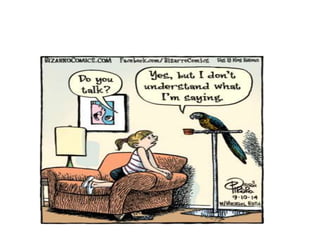
• In animals there is only one level that is sound.
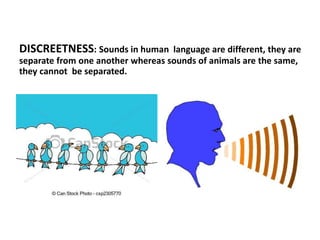
DISCREETNESS: Sounds in human language are different, they are
separate from one another whereas sounds of animals are the same,
they cannot be separated.
THANK YOU

Characteristics of Language

  • 2.
    CHARACTERISTICS OF HUMAN LANGUAGE 1.Productivity/ Creativity 2. Cultural transmission 3. Displacement 4. Arbitrariness 5. Duality 6. Discreetness.
  • 3.
    • PRODUCTIVITY/ CREATIVITY: Whateverwe speak or create is productivity. Speaking itself is productivity. • Humans can talk about topics that are displaced. They can talk about the things that may be present or not, or talk about anything in past, present or future.
  • 4.
    • CULTURAL TRANSMISSION: a.Language can be culturally transmitted. b. It cannot be transmitted through heredity. c. Animals transmit their cries through heredity. d. What language the baby is going to speak is determined by the culture the baby is born into.
  • 6.
    • DISPLACEMENT : Humanlanguage can refer to the past and future times. We can also refer to the things and events that are not present, intangible, non existance and non visible. FOR EXAMPLE: moon, star, dragons, maths equations, heaven and hell etc.
  • 7.
    • ARBITRARINESS: This featurewas first proposed by Saussure. The forms of linguistics signs bear no logical, intrinsic, natural relationship to their meaning. • FOR EXAMPLE: There is nothing in the word ‘bird’ that connects it to the concept of a bird.
  • 9.
    • DUALITY: Human languageis organized at two levels simultaneously. For example, at speech production we have a physical level at which we can produce individual sounds like n, b and i. In a particular combination such as ‘bin’ we have another level producing a meaning that is different from the meaning of the combination in ‘nib’. • In animals there is only one level that is sound.
  • 11.
    DISCREETNESS: Sounds inhuman language are different, they are separate from one another whereas sounds of animals are the same, they cannot be separated.
  • 12.