By
Aalaa Yhm

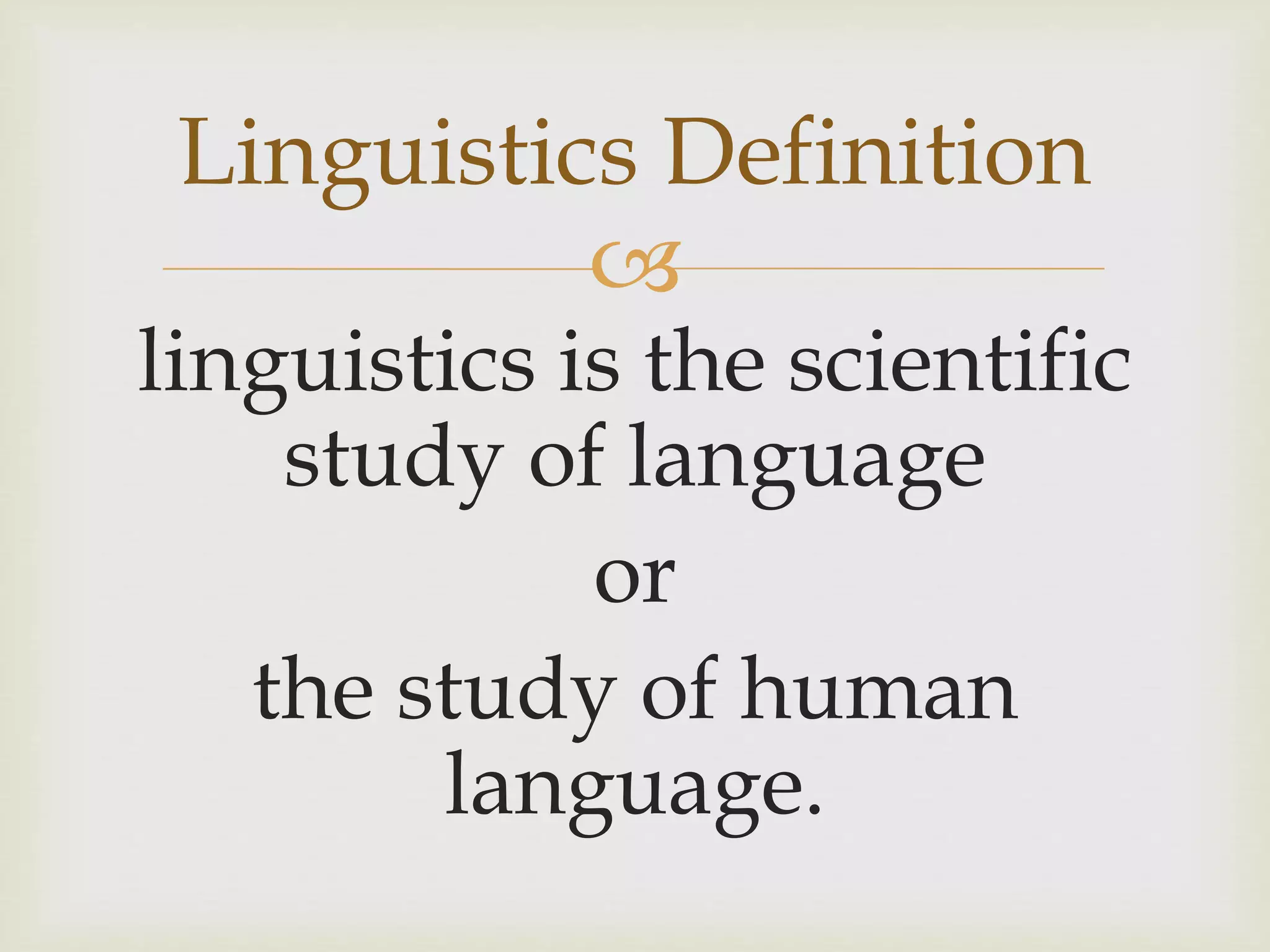
linguistics is the scientific
study of language
or
the study of human
language.
Linguistics Definition

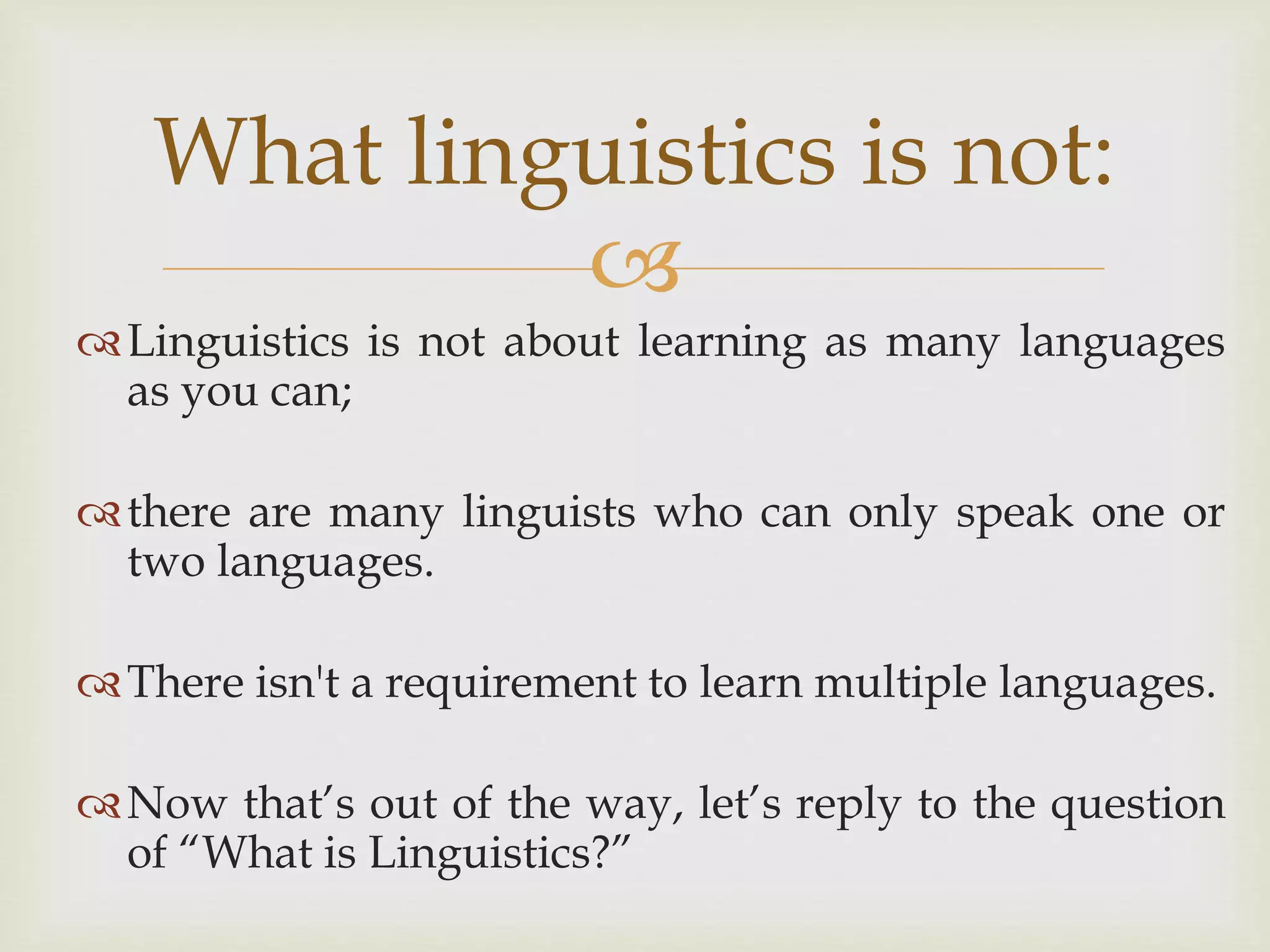
Linguistics is not about learning as many languages
as you can;
there are many linguists who can only speak one or
two languages.
There isn't a requirement to learn multiple languages.
Now that’s out of the way, let’s reply to the question
of “What is Linguistics?”
What linguistics is not:

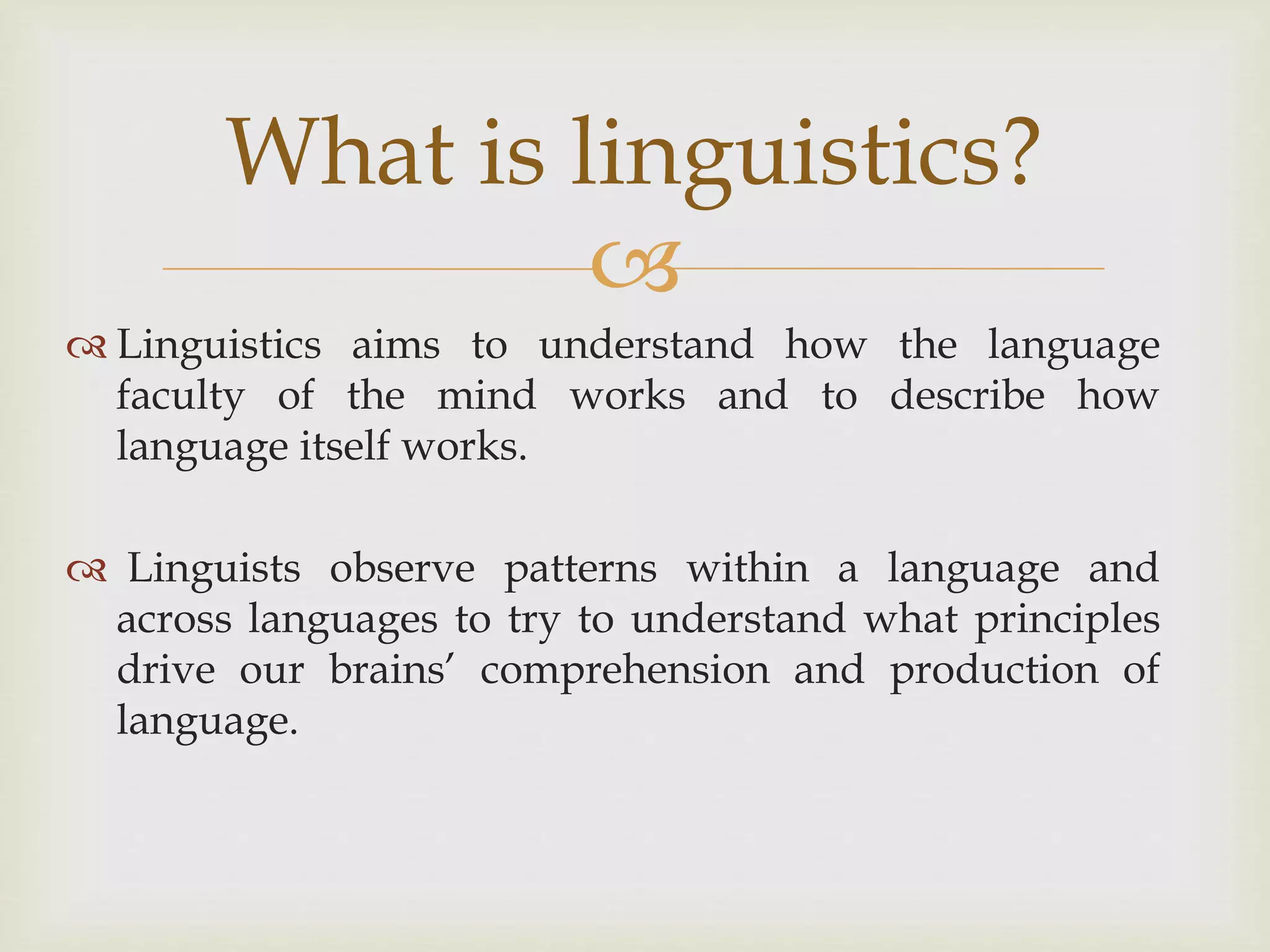
 Linguistics aims to understand how the language
faculty of the mind works and to describe how
language itself works.
 Linguists observe patterns within a language and
across languages to try to understand what principles
drive our brains’ comprehension and production of
language.
What is linguistics?

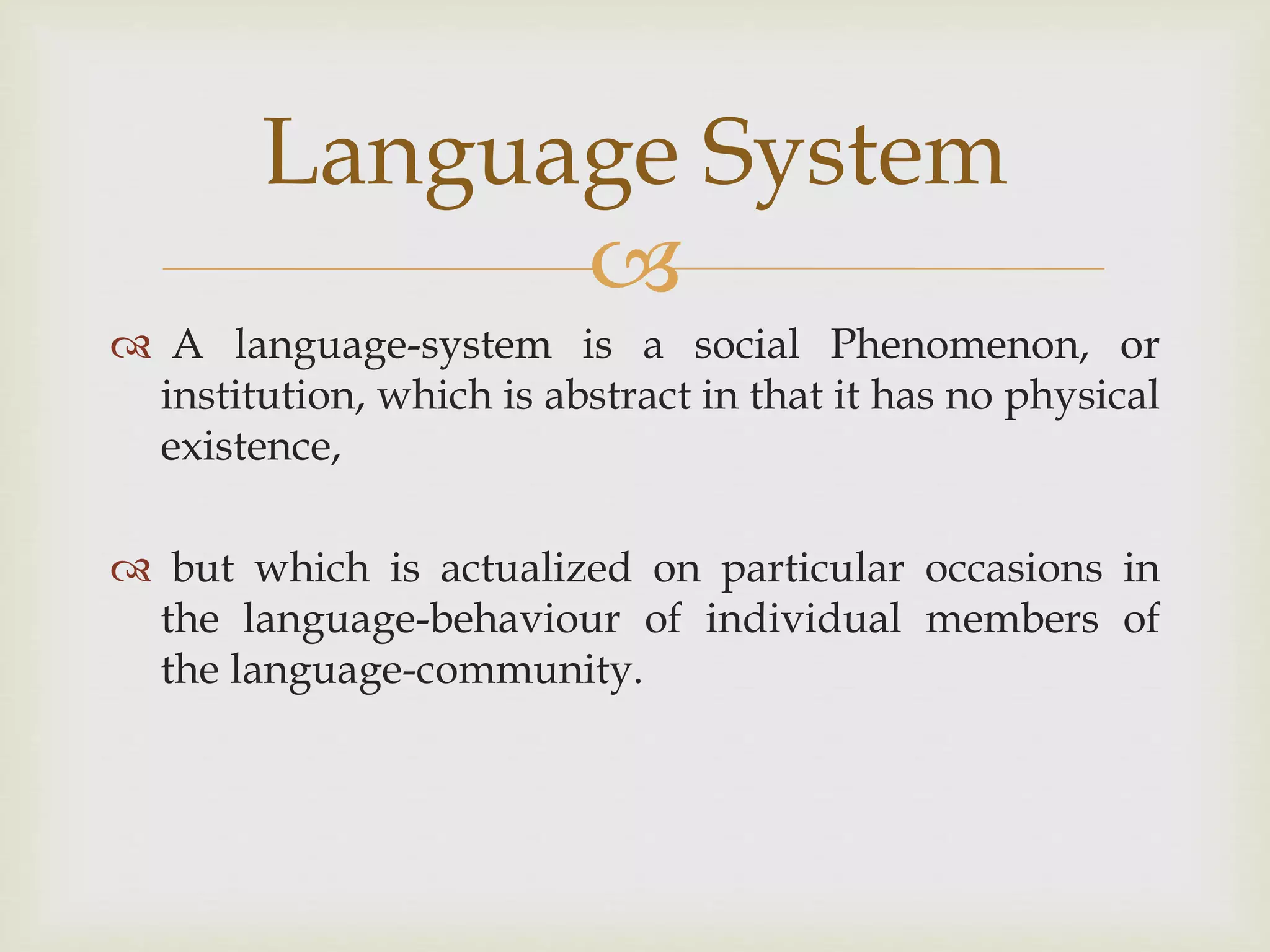
 A language-system is a social Phenomenon, or
institution, which is abstract in that it has no physical
existence,
 but which is actualized on particular occasions in
the language-behaviour of individual members of
the language-community.
Language System

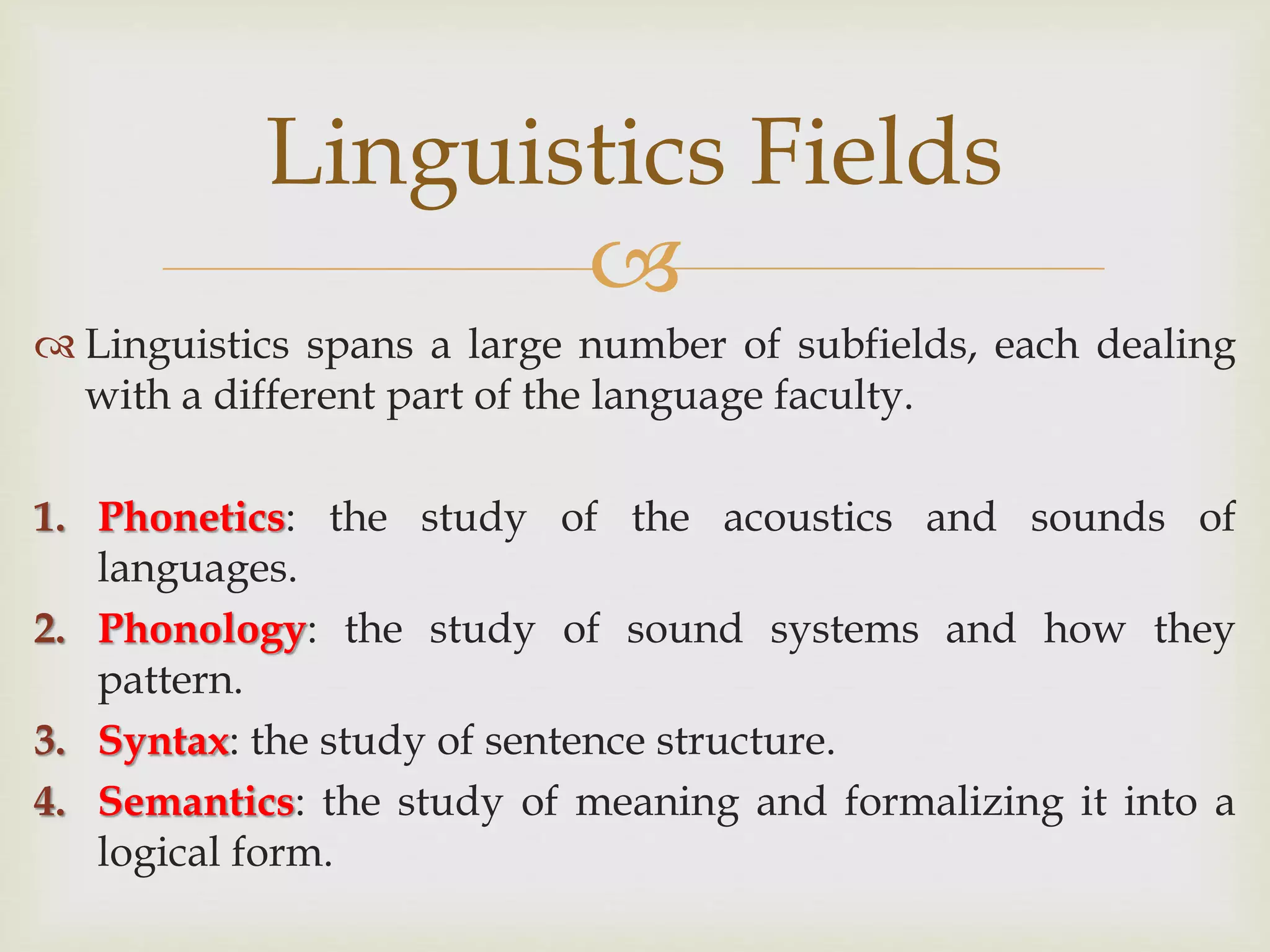
 Linguistics spans a large number of subfields, each dealing
with a different part of the language faculty.
1. Phonetics: the study of the acoustics and sounds of
languages.
2. Phonology: the study of sound systems and how they
pattern.
3. Syntax: the study of sentence structure.
4. Semantics: the study of meaning and formalizing it into a
logical form.
Linguistics Fields

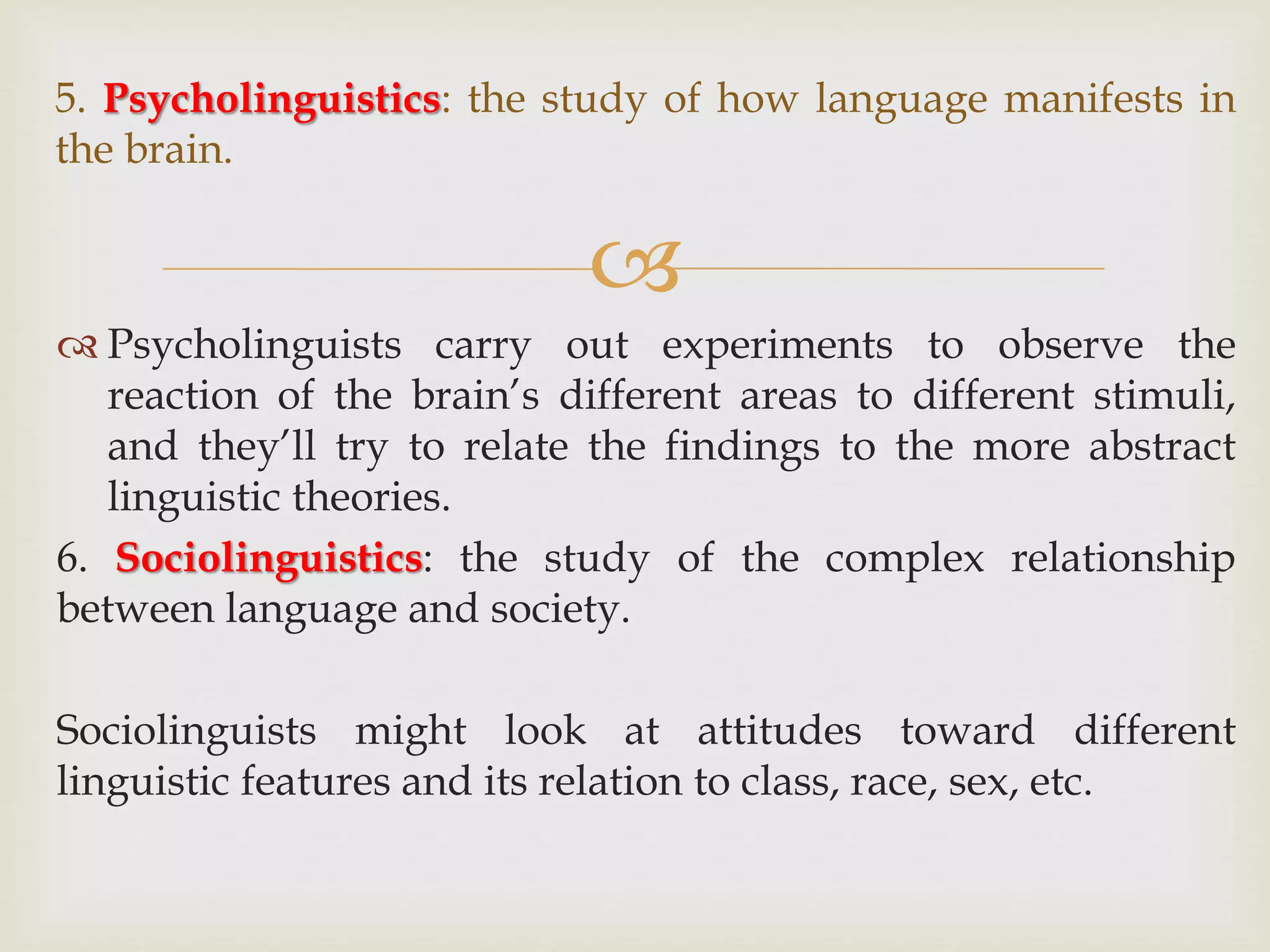
 Psycholinguists carry out experiments to observe the
reaction of the brain’s different areas to different stimuli,
and they’ll try to relate the findings to the more abstract
linguistic theories.
6. Sociolinguistics: the study of the complex relationship
between language and society.
Sociolinguists might look at attitudes toward different
linguistic features and its relation to class, race, sex, etc.
5. Psycholinguistics: the study of how language manifests in
the brain.

 Computational linguists might use programming to model
linguistic structure or change or for practical applications.
8. Historical linguistics: the study of how languages change
across time
 Historical linguists may work in language specific areas,
carrying out what is called reconstruction.
9. Applied linguistics: the study of applying linguistics to
real-life situations.
 An applied linguistic will likely work in fields such as such
as language education, translation, or language policy
7. Computational linguistics - the study of
applying computer science to linguistics

 11. Pragmatics: is the study of the speaker meaning
(i.e. what the speaker intends to say).
 It is considered as the “wastebasket”, which means
everything that you cannot be understood classified
within pragmatics.
10. Macrolinguistics: concerned with everything that
pertains in any way at all to language and languages.

1. Arbitrariness: there is often a recognizable link between
the actual signs and the message an animals wishes to
convey.
 In human language, the reverse is true. In the great majority
of cases, there is no link between the signal and the
message.
 For instance: there is no connection between the word
“elephant” and the animal it symbolizes.
Design Features of Human
Language

2. Duality : is meant the property of having 2 levels of structure,
 such that units of the primary level are composed of elements of the
secondary level and each of the 2 levels has its own principles of
organization.
 The sounds do not of themselves convey meaning.
 Their sole function is to combine with one another to make units which
do have a particular meaning.
 It because the smaller, lower-level elements are meaningless whereas
larger, higher-level units have a distinct meaning.
 The elements are described as secondary and the units as primary
Design Features of
Human Language

3. Discreteness: the sounds used in language are meaningfully
distinct.
Each sound is treated as a discrete unit, and the occurrence of
one sound instead of the other leads to a misuse of language.
For example, /p/ and /b/ sounds in a sentence like: “can I
park here” the use of the sound /b/ instead of /p/ is a wrong
use of language
Design Features of
Human Language

4. The productivity: the capacity of language users to produce
and understand an indefinitely large number of sentences; also
referred to as creativity.
 New utterances are continually being created, and the
language users manipulate their linguistic resources to
produce novel expressions and 2 sentences. A child, for
instance, learning a language is active in forming and
producing utterances which she or he has never heard
before
Design Features of
Human Language

5. Cultural Transmission: Language is passed from one
generation to another not genetically or biologically but
through a process of teaching and learning,
for example, a Chinese child born in England is likely to inherit
some physical characteristics from his parents genetically but
develops not necessarily the Chinese language.
This child will learn and use the English language which
he acquires part of his culture.
Design Features of
Human Language

6. Displacement: is the ability to use language to talk about
things and events not present in the immediate environment
(such as past and future time reference).
 It enables us to describe things and places which we are not
even so sure of their existence.
 The meaning of animal signals, by contrast, is restricted to
the setting in which they are used.
Design Features of
Human Language
Linguistics.pptx
Linguistics.pptx

Linguistics.pptx

  • 1.
  • 2.
     linguistics is thescientific study of language or the study of human language. Linguistics Definition
  • 3.
     Linguistics is notabout learning as many languages as you can; there are many linguists who can only speak one or two languages. There isn't a requirement to learn multiple languages. Now that’s out of the way, let’s reply to the question of “What is Linguistics?” What linguistics is not:
  • 4.
      Linguistics aimsto understand how the language faculty of the mind works and to describe how language itself works.  Linguists observe patterns within a language and across languages to try to understand what principles drive our brains’ comprehension and production of language. What is linguistics?
  • 5.
      A language-systemis a social Phenomenon, or institution, which is abstract in that it has no physical existence,  but which is actualized on particular occasions in the language-behaviour of individual members of the language-community. Language System
  • 6.
      Linguistics spansa large number of subfields, each dealing with a different part of the language faculty. 1. Phonetics: the study of the acoustics and sounds of languages. 2. Phonology: the study of sound systems and how they pattern. 3. Syntax: the study of sentence structure. 4. Semantics: the study of meaning and formalizing it into a logical form. Linguistics Fields
  • 7.
      Psycholinguists carryout experiments to observe the reaction of the brain’s different areas to different stimuli, and they’ll try to relate the findings to the more abstract linguistic theories. 6. Sociolinguistics: the study of the complex relationship between language and society. Sociolinguists might look at attitudes toward different linguistic features and its relation to class, race, sex, etc. 5. Psycholinguistics: the study of how language manifests in the brain.
  • 8.
      Computational linguistsmight use programming to model linguistic structure or change or for practical applications. 8. Historical linguistics: the study of how languages change across time  Historical linguists may work in language specific areas, carrying out what is called reconstruction. 9. Applied linguistics: the study of applying linguistics to real-life situations.  An applied linguistic will likely work in fields such as such as language education, translation, or language policy 7. Computational linguistics - the study of applying computer science to linguistics
  • 9.
      11. Pragmatics:is the study of the speaker meaning (i.e. what the speaker intends to say).  It is considered as the “wastebasket”, which means everything that you cannot be understood classified within pragmatics. 10. Macrolinguistics: concerned with everything that pertains in any way at all to language and languages.
  • 10.
     1. Arbitrariness: thereis often a recognizable link between the actual signs and the message an animals wishes to convey.  In human language, the reverse is true. In the great majority of cases, there is no link between the signal and the message.  For instance: there is no connection between the word “elephant” and the animal it symbolizes. Design Features of Human Language
  • 12.
     2. Duality :is meant the property of having 2 levels of structure,  such that units of the primary level are composed of elements of the secondary level and each of the 2 levels has its own principles of organization.  The sounds do not of themselves convey meaning.  Their sole function is to combine with one another to make units which do have a particular meaning.  It because the smaller, lower-level elements are meaningless whereas larger, higher-level units have a distinct meaning.  The elements are described as secondary and the units as primary Design Features of Human Language
  • 14.
     3. Discreteness: thesounds used in language are meaningfully distinct. Each sound is treated as a discrete unit, and the occurrence of one sound instead of the other leads to a misuse of language. For example, /p/ and /b/ sounds in a sentence like: “can I park here” the use of the sound /b/ instead of /p/ is a wrong use of language Design Features of Human Language
  • 15.
     4. The productivity:the capacity of language users to produce and understand an indefinitely large number of sentences; also referred to as creativity.  New utterances are continually being created, and the language users manipulate their linguistic resources to produce novel expressions and 2 sentences. A child, for instance, learning a language is active in forming and producing utterances which she or he has never heard before Design Features of Human Language
  • 16.
     5. Cultural Transmission:Language is passed from one generation to another not genetically or biologically but through a process of teaching and learning, for example, a Chinese child born in England is likely to inherit some physical characteristics from his parents genetically but develops not necessarily the Chinese language. This child will learn and use the English language which he acquires part of his culture. Design Features of Human Language
  • 17.
     6. Displacement: isthe ability to use language to talk about things and events not present in the immediate environment (such as past and future time reference).  It enables us to describe things and places which we are not even so sure of their existence.  The meaning of animal signals, by contrast, is restricted to the setting in which they are used. Design Features of Human Language