Computer Languages
Presented By :- Aditya Sheoran
Definition Of Computer
Languages
• Computer languages are
the languages by which a
user command the computer
to work on the algorithm
which a user has written to
het an output.
• Two types of computer
languages:-
Low Level Language
1. First Generation.
2. Second Generation.
First Generation Language (1GL)
• Represent the very early, primitive
Computer languages that consisted entirely
of 1’s and 0’s- The actual language that the
computer understands (machine language)
Second Generation Language (2GL)
Represent a step up from the 1GL. Allow
for the use of symbolic names instead of
just numbers. Second Generation
languages are known as assembly
languages. Code written in an assembly
language is converted into machine
language (1GL)
High Level Languages
• High Level programming languages allow the
specification of a problem solution in terms
closer to those used by human beings. These
languages were designed to make programming
far easier, less error-prone and to remove
the programmer from having to know the
details of internal structure of a particular
computer. This language is used in third
generation.
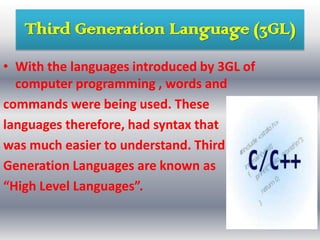
Third Generation Language (3GL)
• With the languages introduced by 3GL of
computer programming , words and
commands were being used. These
languages therefore, had syntax that
was much easier to understand. Third
Generation Languages are known as
“High Level Languages”.
TYPES
• C++
• Visual Basic
• Java
• Java script
C++
• C++ is statically typed, free-form, multi paradigm compiled,
general purpose programming language. It is regarded as a
“Middle Level Language” as it comprises a combination of
both high and low level language features.
• Language Features:-
1. Operators and operator overloading.
2. Templates.
3. Objects.
4. Polymorphism.
Visual Basic
• Visual Basic is the third generation event-driven
programming language and integrated development
environment (IDE) from Microsoft for its COM
programming Model. Visual Basic is relatively
easy to learn and use.
Characteristics
•
•
•
•
Computer Languages.

Computer Languages.

  • 1.
  • 2.
    Definition Of Computer Languages •Computer languages are the languages by which a user command the computer to work on the algorithm which a user has written to het an output. • Two types of computer languages:-
  • 3.
    Low Level Language 1.First Generation. 2. Second Generation.
  • 4.
    First Generation Language(1GL) • Represent the very early, primitive Computer languages that consisted entirely of 1’s and 0’s- The actual language that the computer understands (machine language)
  • 5.
    Second Generation Language(2GL) Represent a step up from the 1GL. Allow for the use of symbolic names instead of just numbers. Second Generation languages are known as assembly languages. Code written in an assembly language is converted into machine language (1GL)
  • 6.
    High Level Languages •High Level programming languages allow the specification of a problem solution in terms closer to those used by human beings. These languages were designed to make programming far easier, less error-prone and to remove the programmer from having to know the details of internal structure of a particular computer. This language is used in third generation.
  • 7.
    Third Generation Language(3GL) • With the languages introduced by 3GL of computer programming , words and commands were being used. These languages therefore, had syntax that was much easier to understand. Third Generation Languages are known as “High Level Languages”.
  • 8.
    TYPES • C++ • VisualBasic • Java • Java script
  • 9.
    C++ • C++ isstatically typed, free-form, multi paradigm compiled, general purpose programming language. It is regarded as a “Middle Level Language” as it comprises a combination of both high and low level language features. • Language Features:- 1. Operators and operator overloading. 2. Templates. 3. Objects. 4. Polymorphism.
  • 10.
    Visual Basic • VisualBasic is the third generation event-driven programming language and integrated development environment (IDE) from Microsoft for its COM programming Model. Visual Basic is relatively easy to learn and use.
  • 11.