Chapter One:  The Process of Human   Communication
What is communication?  Two views Communications Communication
Communication Defined The process by which one person stimulates meaning in the mind(s) of another person (or persons) through verbal and nonverbal messages.
Types of Communication Accidental Communication:  When a source communicates a message to a receiver that is unintentional and happens outside the source’s conscious control.
Expressive Communication: Messages sent by a source that expresses an internal emotional state.  Types of Communication
Two Levels of Expressive Communication Content level of messages:  words comprising the message. Relational level of messages:  expression of how we feel about the other person or our relationship with the other person, and suggests to the other person how he or she should interpret our message.
Rhetorical Communication:  Messages sent by a source that are goal directed and are intended to produce a specific meaning in the mind of another individual.   Types of Communication
Influence  and  Persuasion   Influence:  cause the person to alter her/his thinking or behavior.  Persuasion:  We try to alter her/his thinking or behavior, we do so with conscious intent.
Clarifying the Definition of Communication Stimulates Meaning  Verbal Messages  Nonverbal Messages
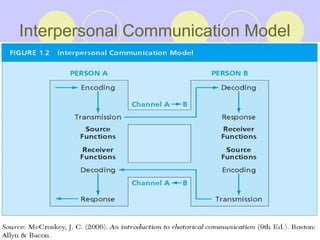
Critical Components of  Human Communication Source  Decide Meaning Encode  Transmit  Receiver   Receive Message  Decode  Respond
Critical Components of  Human Communication (continued)   Message: Any verbal or nonverbal stimulus that stimulates meaning in the receiver.  Channels: The means by which a message is carried from one person to another.
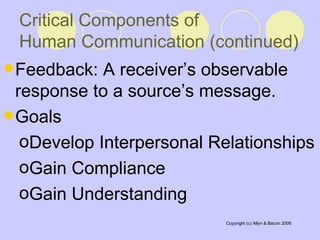
Feedback: A receiver’s observable response to a source’s message.   Goals  Develop Interpersonal Relationships  Gain Compliance Gain Understanding  Critical Components of  Human Communication (continued)
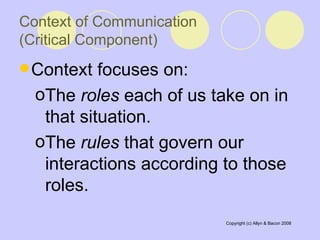
Context of Communication  (Critical Component) Context focuses on:  The  roles  each of us take on in that situation. The  rules  that govern our interactions according to those roles.
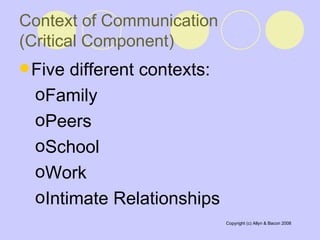
Five different contexts:  Family  Peers  School  Work  Intimate Relationships Context of Communication  (Critical Component)
Interpersonal Communication Model
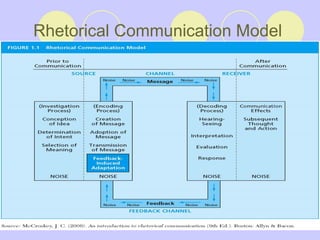
Rhetorical Communication Model
Ten Misconceptions of Communication
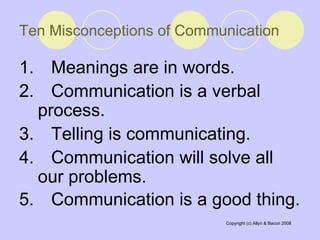
Ten Misconceptions of Communication 1.  Meanings are in words.  2.  Communication is a verbal process.  3.  Telling is communicating.  4.  Communication will solve all our problems. 5.  Communication is a good thing.
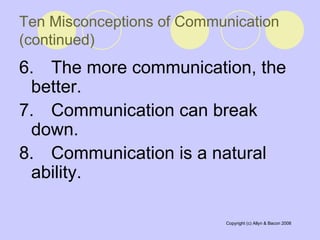
Ten Misconceptions of Communication (continued)  6.  The more communication, the better.  7.  Communication can break down.  8.  Communication is a natural ability.
Ten Misconceptions of Communication (continued) 9.  Interpersonal communication = intimate communication.  10.  Communication competence =  communication effectiveness.
How Did We Get Here? A Brief History of the Field of Communication Studies
The Ancient World
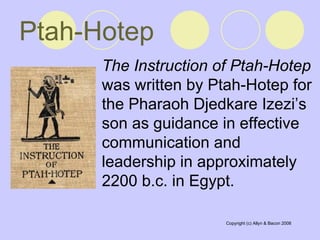
Ptah-Hotep  The Instruction of Ptah-Hotep  was written by Ptah-Hotep for the Pharaoh Djedkare Izezi’s son as guidance in effective communication and leadership in approximately 2200 b.c. in Egypt.
The Sicilian Thinkers 1) Totalitarian regime headed by Thrasybulus had stolen property from countless Sicilian citizens.  2) After the overthrow of Thrasybulus’ regime, a more democratic state was established.
The Sicilian Thinkers 3) In this new democratic state, Sicilian citizens who had property taken during Thrasybulus’ reign could go to court and attempt to recover their property.
The Sicilian Thinkers Corax and his pupil Tisius wrote the first manual on public speaking.
Greek  Thinkers
Life in Greece   450 BC – Development of the Athenian City States  Athens was about 1,000 square miles  The development of a city state created:  rules  laws  trade/bargaining  political systems  courts
Four Signs of Increased Rhetoric in City States   1) New Rationalism  a) Had proofs and arguments   b) Had to deal with probability  c) Had to show that someone “probably” committed a crime
Four Signs of Increased Rhetoric in City States   2) Dividing a speech into parts  3) New interest in prose styles  4) Study of philology:  Study of words.  [dictionary]
The Sophists   Sophists would tutor individuals in the areas of science, literature, philosophy, and rhetoric.  First, paid teachers.  Students were taught that people could be persuaded to any truth the rhetorician desired if he was a good speaker.
The Whores  of  Rhetoric
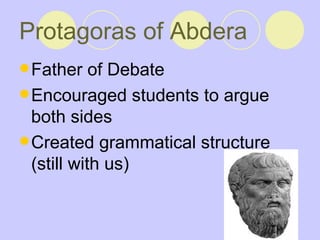
Protagoras of Abdera   Father of Debate Encouraged students to argue both sides  Created grammatical structure (still with us)
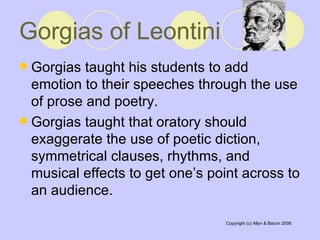
Gorgias of Leontini   Gorgias taught his students to add emotion to their speeches through the use of prose and poetry.  Gorgias taught that oratory should exaggerate the use of poetic diction, symmetrical clauses, rhythms, and musical effects to get one’s point across to an audience.
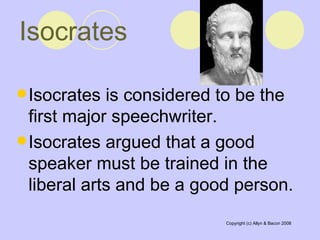
Isocrates  Isocrates is considered to be the first major speechwriter.  Isocrates argued that a good speaker must be trained in the liberal arts and be a good person.
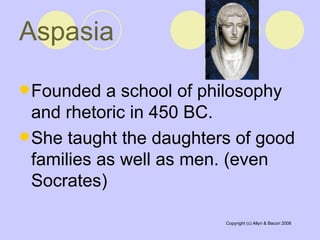
Aspasia   Founded a school of philosophy and rhetoric in 450 BC.  She taught the daughters of good families as well as men. (even Socrates)
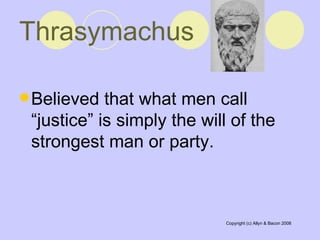
Thrasymachus  Believed that what men call “justice” is simply the will of the strongest man or party.
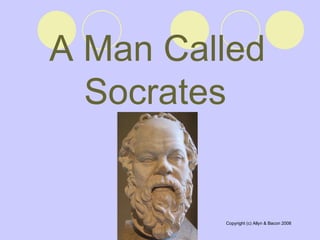
A Man Called Socrates
Debate over Authentication of Socrates
Differing Voices Alluding to Socrates   1) In Thucydides’  History of the Peloponnesian War,   Socrates was a brave warrior.  2)  In Xenofon’s  Memoribilia, Socrates is depicted as fairly dull, non insightful, and wrote that Socrates was often ridiculed by the Athenian people.
3) In Aristophanes’ comedic play  The Clouds,  Socrates is depicted as a slightly buffoonish teacher who always has his head in the clouds. 4) Antisthenes wrote about his time in jail with Socrates shortly before he was executed.
5) Diogenes of Sinope believed that Socrates was the intellectual founder of the Cynics because they were protesting the same types of issues.  6) Aristotle Primarily gives us a timeline on Socrates the actual man (470-399 BC).
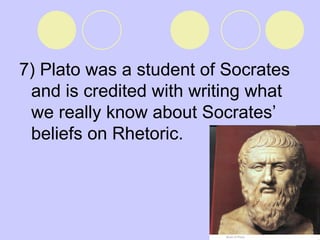
7) Plato was a student of Socrates and is credited with writing what we really know about Socrates’ beliefs on Rhetoric.
The Dialectic (Basis of the “Socratic Method”)
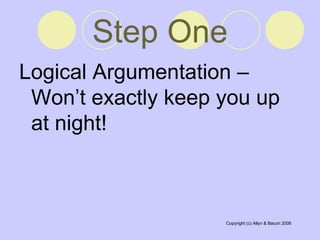
Step One Logical Argumentation – Won’t exactly keep you up at night!
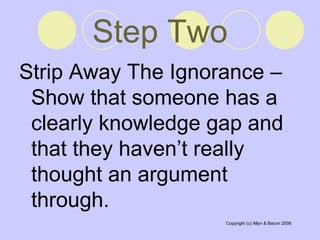
Step Two Strip Away The Ignorance – Show that someone has a clearly knowledge gap and that they haven’t really thought an argument through.
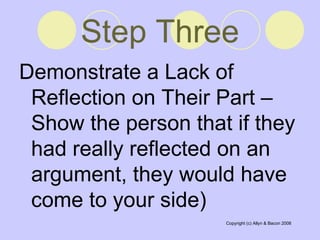
Step Three Demonstrate a Lack of Reflection on Their Part – Show the person that if they had really reflected on an argument, they would have come to your side)
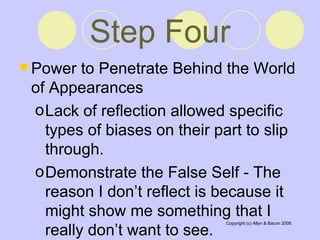
Power to Penetrate Behind the World of Appearances  Lack of reflection allowed specific types of biases on their part to slip through.  Demonstrate the False Self - The reason I don’t reflect is because it might show me something that I really don’t want to see.  Step Four
Step Five Changing of the Soul  - This process leads to a chemical transformation where a person is holistically changed.
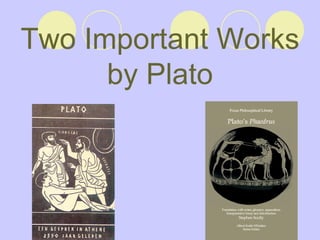
Two Important Works by Plato
Gorgias   Plato wrote that sophistry was akin to trickery .
Phaedrus   1) Non-lover:  someone who didn’t care about her/his relational partner.   2)   Evil-lover: someone who intended to manipulate her or his relational partner.  3)   Noble-lover: someone who cared about her or his relational partner and did not have an ulterior motive for the relationship.
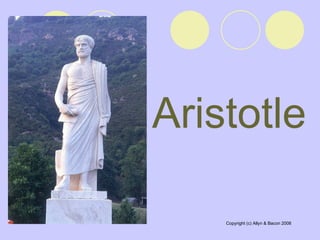
Aristotle
Rhetoric The ability to recognize and implement all of the available means of persuasion in a given situation.
Aristotle's  Rhetori c   Aristotle's  Rhetori c consists of three books: one focusing on the speaker, one on the audience, and one on the speech itself.   The  Rhetoric  is considered by historians, philosophers, and communication experts to be one of the most influential pieces of writing in the Western world.
Two Assumptions of Aristotelian Theory
Effective public speakers must consider their audience.
Proofs  Inartistic Proofs - Objects you can physically bring to a speech (witnesses, laws, oaths, contracts, torture)
Artistic Proofs  1)  Ethos – ethical credibility  2)  Pathos – emotional appeal  3)  Logos – logical appeal
Types of Rhetorical Speeches   1) Forensic:  Court room speeches.   2) Epideictic (ceremonial):  Speeches that praise, honor, blame or shame.   3) Deliberative:  Speeches associated with the future-what an audience will do or think as a result of a speaker's efforts.
Roman Thinkers
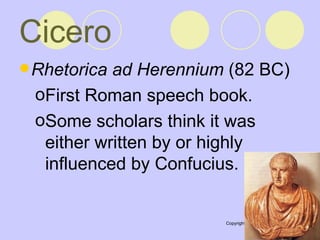
Cicero Rhetorica ad Herennium  (82 BC)  First Roman speech book.  Some scholars think it was either written by or highly influenced by Confucius.
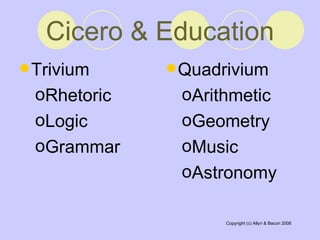
Cicero & Education Trivium  Rhetoric Logic Grammar Quadrivium  Arithmetic Geometry Music Astronomy
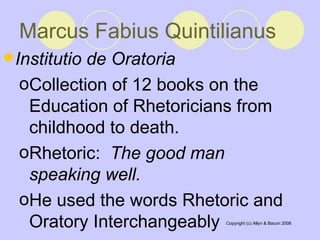
Marcus Fabius Quintilianus   Institutio de Oratoria   Collection of 12 books on the Education of Rhetoricians from childhood to death.  Rhetoric:  The good man speaking well.   He used the words Rhetoric and Oratory Interchangeably
Three Parts of Rhetoric   Art:  The knowledge of speaking well.   Artist (Artificer):  Has acquired the art of rhetoric. It is “his business to speak well.”   Work:  That which the artificer achieves; that is, “good speaking.”
From Late Antiquity to the Renaissance
 
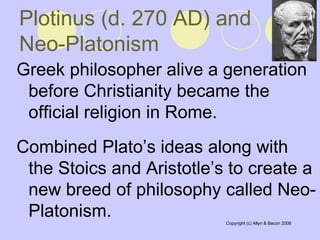
Plotinus (d. 270 AD) and Neo-Platonism   Greek philosopher alive a generation before Christianity became the official religion in Rome.  Combined Plato’s ideas along with the Stoics and Aristotle’s to create a new breed of philosophy called Neo-Platonism.
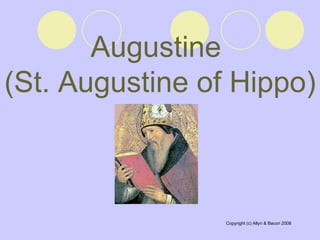
Augustine  (St. Augustine of Hippo)
Background of Augustine Born in Tagaste, Numidia (Africa)  Roman education at the University at Carthage  Went back home to teach at Tagaste and then back to Carthage as a rhetorical professor  Professor of rhetoric to the imperial court in Milan Here he converted to Christianity
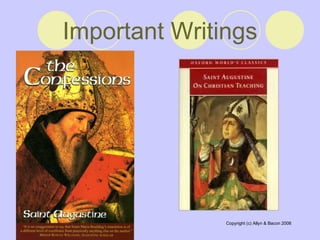
Important Writings
The Confessions The church believed that rhetoric wasn’t necessary because God had predetermined who would listen and be saved and who wouldn’t.  Since god had predetermined who would be a Christian, the priest’s speaking style was not a consideration.  The church also believed that rhetoric was of the Pagans so innately evil.
De Doctrina Christiana In this text, Augustine creates a new intellectual field called semiotics, or the study of signs and signifiers.  Sign:  A thing which, in addition to the impression it makes upon the senses, makes something else come into our thoughts.
Types of Signs Natural Signs (smoke as a sign of fire)  “ Given” or communicative signs (e.g., words)  Divinely given signs (Scripture and Sacraments)
Signs and Teaching   We use signs to teach things. BUT signs don’t teach things!  We learn the significance of signs from the things they signify, not the other way around.  (e.g., We don’t understand what a lion is until after we “see” what it is with our mind’s eye.)
We learn intelligible things from a divine inner teacher.  Ultimately, signs serve as a way to direct attention to something so we can look and see the thing for ourselves.  Signs and Teaching
Three Teaching Styles Plain Style -  for teaching  Middle Style -  for delighting or entertaining  Grand Style -  for Persuading
The Renaissance
Thomas Wilson   The Arte of Rhetorique   Rhetoric:  “Rhetorique is an Arte to let foorth by vtteraunce of words, matter at large, or (as Cicero doth say) it is learned, or rather artificiall declaration of the mynd, in the handling of any cause, called in contention, that may through reason largely be discussed.”
Three Things Required of an Orator   To Teach  To Delight  To Persuade
Pierre de la Ramée (Petrus Ramus) (1515-1572)   “ Quæcumque ab Aristotele dicta sunt, commentitia sunt ” (“All Aristotle’s doctrines are false”)  He believed that logic and art should be clearly disassociated from each other.
British Thinkers
Sir Francis Bacon  (1600-1725)   The Advancement of Learning  (1605) and  De Augmentis Scientiarum  (1623)  Argued that both speaking and writing were forms of rhetoric.
Friedrich Nietzsche (1824-1900)   Rhetoric:  “It is not difficult to prove that what is called “rhetorical,” as a means of conscious art, had been active as a means of unconscious art in language and its development, indeed, that the rhetorical is a further development ,  guided by the clear light of the understanding ,  of   the artistic means which are already found in language . ”  From  Description of Ancient Rhetoric
Rhetoric is on one hand an effect and on the other hand an expression of the power to get people to view the world from your point of view.
The Colonial Period in America (1492–1783)
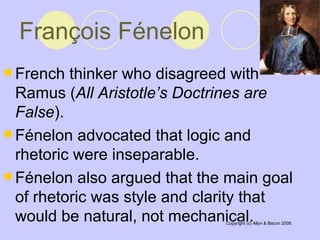
François Fénelon   French thinker who disagreed with Ramus ( All Aristotle’s Doctrines are False ).  Fénelon advocated that logic and rhetoric were inseparable.  Fénelon also argued that the main goal of rhetoric was style and clarity that would be natural, not mechanical.
Elocution Movement
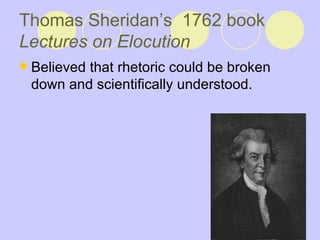
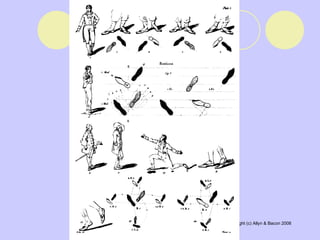
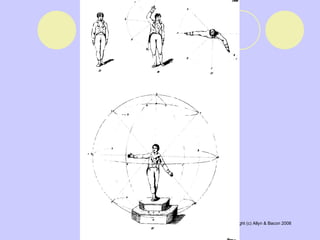
Thomas Sheridan’s  1762 book  Lectures on Elocution   Believed that rhetoric could be broken down and scientifically understood.
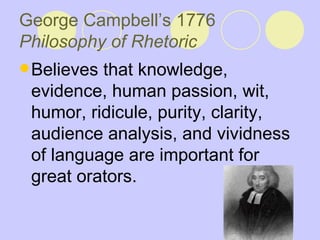
George Campbell’s 1776  Philosophy of Rhetoric   Believes that knowledge, evidence, human passion, wit, humor, ridicule, purity, clarity, audience analysis, and vividness of language are important for great orators.
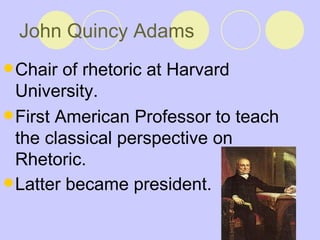
John Quincy Adams Chair of rhetoric at Harvard University. First American Professor to teach the classical perspective on Rhetoric.  Latter became president.
 
 
The  Twentieth Century
James A. Winans  vs.  Everett Lee Hunt   Winans  wanted rhetoric to be more scientific.  Hunt  believed that the scientific approach was antithetical to the enthusiasm and inspiration that was needed for good public speakers.
Carl Hovland & The Yale Studies   Post Hitler studies that focused on propaganda and persuasion.  The studies focused on how senders persuade people.
Kenneth Burke’s Dramatism Theory   The Act is simply what a person does.  The Scene provides the context surrounding the act.  The Agent is the person or people performing the act.
Kenneth Burke’s Dramatism Theory   Agency refers to the means used by the agent accomplishes the act (e.g., message strategies, storytelling, apologies, and speech making).  Purpose refers to the goal the agent had in mind for the act or the reason the act was performed.
Walter Fisher’s Narrative Narration:  Any verbal or nonverbal account with a sequence of events to which listeners assign a meaning.
Narrative Rationality Coherence:  The internal consistency of a narrative. Fidelity:  The truthfulness or reliability of the story. Stories with fidelity have the ring of truth to them for listeners.
The Rise of the Social Sciences
Areas of Study in Communication (Just to name a few) Argumentation & Forensics Comm & Aging Family Comm Group Comm Health Comm Computer-Mediated Comm Instructional Comm Social Cognition International/ Intercultural Comm Mass Comm Nonverbal Comm Interpersonal Comm Org. Comm Political Comm Visual Comm

Chapter1

  • 1.
    Chapter One: The Process of Human Communication
  • 2.
    What is communication? Two views Communications Communication
  • 3.
    Communication Defined Theprocess by which one person stimulates meaning in the mind(s) of another person (or persons) through verbal and nonverbal messages.
  • 4.
    Types of CommunicationAccidental Communication: When a source communicates a message to a receiver that is unintentional and happens outside the source’s conscious control.
  • 5.
    Expressive Communication: Messagessent by a source that expresses an internal emotional state. Types of Communication
  • 6.
    Two Levels ofExpressive Communication Content level of messages: words comprising the message. Relational level of messages: expression of how we feel about the other person or our relationship with the other person, and suggests to the other person how he or she should interpret our message.
  • 7.
    Rhetorical Communication: Messages sent by a source that are goal directed and are intended to produce a specific meaning in the mind of another individual. Types of Communication
  • 8.
    Influence and Persuasion Influence: cause the person to alter her/his thinking or behavior. Persuasion: We try to alter her/his thinking or behavior, we do so with conscious intent.
  • 9.
    Clarifying the Definitionof Communication Stimulates Meaning Verbal Messages Nonverbal Messages
  • 10.
    Critical Components of Human Communication Source Decide Meaning Encode Transmit Receiver Receive Message Decode Respond
  • 11.
    Critical Components of Human Communication (continued) Message: Any verbal or nonverbal stimulus that stimulates meaning in the receiver. Channels: The means by which a message is carried from one person to another.
  • 12.
    Feedback: A receiver’sobservable response to a source’s message. Goals Develop Interpersonal Relationships Gain Compliance Gain Understanding Critical Components of Human Communication (continued)
  • 13.
    Context of Communication (Critical Component) Context focuses on: The roles each of us take on in that situation. The rules that govern our interactions according to those roles.
  • 14.
    Five different contexts: Family Peers School Work Intimate Relationships Context of Communication (Critical Component)
  • 15.
  • 16.
  • 17.
    Ten Misconceptions ofCommunication
  • 18.
    Ten Misconceptions ofCommunication 1. Meanings are in words. 2. Communication is a verbal process. 3. Telling is communicating. 4. Communication will solve all our problems. 5. Communication is a good thing.
  • 19.
    Ten Misconceptions ofCommunication (continued) 6. The more communication, the better. 7. Communication can break down. 8. Communication is a natural ability.
  • 20.
    Ten Misconceptions ofCommunication (continued) 9. Interpersonal communication = intimate communication. 10. Communication competence = communication effectiveness.
  • 21.
    How Did WeGet Here? A Brief History of the Field of Communication Studies
  • 22.
  • 23.
    Ptah-Hotep TheInstruction of Ptah-Hotep was written by Ptah-Hotep for the Pharaoh Djedkare Izezi’s son as guidance in effective communication and leadership in approximately 2200 b.c. in Egypt.
  • 24.
    The Sicilian Thinkers1) Totalitarian regime headed by Thrasybulus had stolen property from countless Sicilian citizens. 2) After the overthrow of Thrasybulus’ regime, a more democratic state was established.
  • 25.
    The Sicilian Thinkers3) In this new democratic state, Sicilian citizens who had property taken during Thrasybulus’ reign could go to court and attempt to recover their property.
  • 26.
    The Sicilian ThinkersCorax and his pupil Tisius wrote the first manual on public speaking.
  • 27.
  • 28.
    Life in Greece 450 BC – Development of the Athenian City States Athens was about 1,000 square miles The development of a city state created: rules laws trade/bargaining political systems courts
  • 29.
    Four Signs ofIncreased Rhetoric in City States 1) New Rationalism a) Had proofs and arguments b) Had to deal with probability c) Had to show that someone “probably” committed a crime
  • 30.
    Four Signs ofIncreased Rhetoric in City States 2) Dividing a speech into parts 3) New interest in prose styles 4) Study of philology: Study of words. [dictionary]
  • 31.
    The Sophists Sophists would tutor individuals in the areas of science, literature, philosophy, and rhetoric. First, paid teachers. Students were taught that people could be persuaded to any truth the rhetorician desired if he was a good speaker.
  • 32.
    The Whores of Rhetoric
  • 33.
    Protagoras of Abdera Father of Debate Encouraged students to argue both sides Created grammatical structure (still with us)
  • 34.
    Gorgias of Leontini Gorgias taught his students to add emotion to their speeches through the use of prose and poetry. Gorgias taught that oratory should exaggerate the use of poetic diction, symmetrical clauses, rhythms, and musical effects to get one’s point across to an audience.
  • 35.
    Isocrates Isocratesis considered to be the first major speechwriter. Isocrates argued that a good speaker must be trained in the liberal arts and be a good person.
  • 36.
    Aspasia Founded a school of philosophy and rhetoric in 450 BC. She taught the daughters of good families as well as men. (even Socrates)
  • 37.
    Thrasymachus Believedthat what men call “justice” is simply the will of the strongest man or party.
  • 38.
    A Man CalledSocrates
  • 39.
  • 40.
    Differing Voices Alludingto Socrates 1) In Thucydides’ History of the Peloponnesian War, Socrates was a brave warrior. 2) In Xenofon’s Memoribilia, Socrates is depicted as fairly dull, non insightful, and wrote that Socrates was often ridiculed by the Athenian people.
  • 41.
    3) In Aristophanes’comedic play The Clouds, Socrates is depicted as a slightly buffoonish teacher who always has his head in the clouds. 4) Antisthenes wrote about his time in jail with Socrates shortly before he was executed.
  • 42.
    5) Diogenes ofSinope believed that Socrates was the intellectual founder of the Cynics because they were protesting the same types of issues. 6) Aristotle Primarily gives us a timeline on Socrates the actual man (470-399 BC).
  • 43.
    7) Plato wasa student of Socrates and is credited with writing what we really know about Socrates’ beliefs on Rhetoric.
  • 44.
    The Dialectic (Basisof the “Socratic Method”)
  • 45.
    Step One LogicalArgumentation – Won’t exactly keep you up at night!
  • 46.
    Step Two StripAway The Ignorance – Show that someone has a clearly knowledge gap and that they haven’t really thought an argument through.
  • 47.
    Step Three Demonstratea Lack of Reflection on Their Part – Show the person that if they had really reflected on an argument, they would have come to your side)
  • 48.
    Power to PenetrateBehind the World of Appearances Lack of reflection allowed specific types of biases on their part to slip through. Demonstrate the False Self - The reason I don’t reflect is because it might show me something that I really don’t want to see. Step Four
  • 49.
    Step Five Changingof the Soul - This process leads to a chemical transformation where a person is holistically changed.
  • 50.
  • 51.
    Gorgias Plato wrote that sophistry was akin to trickery .
  • 52.
    Phaedrus 1) Non-lover: someone who didn’t care about her/his relational partner. 2) Evil-lover: someone who intended to manipulate her or his relational partner. 3) Noble-lover: someone who cared about her or his relational partner and did not have an ulterior motive for the relationship.
  • 53.
  • 54.
    Rhetoric The abilityto recognize and implement all of the available means of persuasion in a given situation.
  • 55.
    Aristotle's Rhetoric Aristotle's Rhetori c consists of three books: one focusing on the speaker, one on the audience, and one on the speech itself. The Rhetoric is considered by historians, philosophers, and communication experts to be one of the most influential pieces of writing in the Western world.
  • 56.
    Two Assumptions ofAristotelian Theory
  • 57.
    Effective public speakersmust consider their audience.
  • 58.
    Proofs InartisticProofs - Objects you can physically bring to a speech (witnesses, laws, oaths, contracts, torture)
  • 59.
    Artistic Proofs 1) Ethos – ethical credibility 2) Pathos – emotional appeal 3) Logos – logical appeal
  • 60.
    Types of RhetoricalSpeeches 1) Forensic: Court room speeches. 2) Epideictic (ceremonial): Speeches that praise, honor, blame or shame. 3) Deliberative: Speeches associated with the future-what an audience will do or think as a result of a speaker's efforts.
  • 61.
  • 62.
    Cicero Rhetorica adHerennium (82 BC) First Roman speech book. Some scholars think it was either written by or highly influenced by Confucius.
  • 63.
    Cicero & EducationTrivium Rhetoric Logic Grammar Quadrivium Arithmetic Geometry Music Astronomy
  • 64.
    Marcus Fabius Quintilianus Institutio de Oratoria Collection of 12 books on the Education of Rhetoricians from childhood to death. Rhetoric: The good man speaking well. He used the words Rhetoric and Oratory Interchangeably
  • 65.
    Three Parts ofRhetoric Art: The knowledge of speaking well. Artist (Artificer): Has acquired the art of rhetoric. It is “his business to speak well.” Work: That which the artificer achieves; that is, “good speaking.”
  • 66.
    From Late Antiquityto the Renaissance
  • 67.
  • 68.
    Plotinus (d. 270AD) and Neo-Platonism Greek philosopher alive a generation before Christianity became the official religion in Rome. Combined Plato’s ideas along with the Stoics and Aristotle’s to create a new breed of philosophy called Neo-Platonism.
  • 69.
    Augustine (St.Augustine of Hippo)
  • 70.
    Background of AugustineBorn in Tagaste, Numidia (Africa) Roman education at the University at Carthage Went back home to teach at Tagaste and then back to Carthage as a rhetorical professor Professor of rhetoric to the imperial court in Milan Here he converted to Christianity
  • 71.
  • 72.
    The Confessions Thechurch believed that rhetoric wasn’t necessary because God had predetermined who would listen and be saved and who wouldn’t. Since god had predetermined who would be a Christian, the priest’s speaking style was not a consideration. The church also believed that rhetoric was of the Pagans so innately evil.
  • 73.
    De Doctrina ChristianaIn this text, Augustine creates a new intellectual field called semiotics, or the study of signs and signifiers. Sign: A thing which, in addition to the impression it makes upon the senses, makes something else come into our thoughts.
  • 74.
    Types of SignsNatural Signs (smoke as a sign of fire) “ Given” or communicative signs (e.g., words) Divinely given signs (Scripture and Sacraments)
  • 75.
    Signs and Teaching We use signs to teach things. BUT signs don’t teach things! We learn the significance of signs from the things they signify, not the other way around. (e.g., We don’t understand what a lion is until after we “see” what it is with our mind’s eye.)
  • 76.
    We learn intelligiblethings from a divine inner teacher. Ultimately, signs serve as a way to direct attention to something so we can look and see the thing for ourselves. Signs and Teaching
  • 77.
    Three Teaching StylesPlain Style - for teaching Middle Style - for delighting or entertaining Grand Style - for Persuading
  • 78.
  • 79.
    Thomas Wilson The Arte of Rhetorique Rhetoric: “Rhetorique is an Arte to let foorth by vtteraunce of words, matter at large, or (as Cicero doth say) it is learned, or rather artificiall declaration of the mynd, in the handling of any cause, called in contention, that may through reason largely be discussed.”
  • 80.
    Three Things Requiredof an Orator To Teach To Delight To Persuade
  • 81.
    Pierre de laRamée (Petrus Ramus) (1515-1572) “ Quæcumque ab Aristotele dicta sunt, commentitia sunt ” (“All Aristotle’s doctrines are false”) He believed that logic and art should be clearly disassociated from each other.
  • 82.
  • 83.
    Sir Francis Bacon (1600-1725) The Advancement of Learning (1605) and De Augmentis Scientiarum (1623) Argued that both speaking and writing were forms of rhetoric.
  • 84.
    Friedrich Nietzsche (1824-1900) Rhetoric: “It is not difficult to prove that what is called “rhetorical,” as a means of conscious art, had been active as a means of unconscious art in language and its development, indeed, that the rhetorical is a further development , guided by the clear light of the understanding , of the artistic means which are already found in language . ” From Description of Ancient Rhetoric
  • 85.
    Rhetoric is onone hand an effect and on the other hand an expression of the power to get people to view the world from your point of view.
  • 86.
    The Colonial Periodin America (1492–1783)
  • 87.
    François Fénelon French thinker who disagreed with Ramus ( All Aristotle’s Doctrines are False ). Fénelon advocated that logic and rhetoric were inseparable. Fénelon also argued that the main goal of rhetoric was style and clarity that would be natural, not mechanical.
  • 88.
  • 89.
    Thomas Sheridan’s 1762 book Lectures on Elocution Believed that rhetoric could be broken down and scientifically understood.
  • 90.
    George Campbell’s 1776 Philosophy of Rhetoric Believes that knowledge, evidence, human passion, wit, humor, ridicule, purity, clarity, audience analysis, and vividness of language are important for great orators.
  • 91.
    John Quincy AdamsChair of rhetoric at Harvard University. First American Professor to teach the classical perspective on Rhetoric. Latter became president.
  • 92.
  • 93.
  • 94.
  • 95.
    James A. Winans vs. Everett Lee Hunt Winans wanted rhetoric to be more scientific. Hunt believed that the scientific approach was antithetical to the enthusiasm and inspiration that was needed for good public speakers.
  • 96.
    Carl Hovland &The Yale Studies Post Hitler studies that focused on propaganda and persuasion. The studies focused on how senders persuade people.
  • 97.
    Kenneth Burke’s DramatismTheory The Act is simply what a person does. The Scene provides the context surrounding the act. The Agent is the person or people performing the act.
  • 98.
    Kenneth Burke’s DramatismTheory Agency refers to the means used by the agent accomplishes the act (e.g., message strategies, storytelling, apologies, and speech making). Purpose refers to the goal the agent had in mind for the act or the reason the act was performed.
  • 99.
    Walter Fisher’s NarrativeNarration: Any verbal or nonverbal account with a sequence of events to which listeners assign a meaning.
  • 100.
    Narrative Rationality Coherence: The internal consistency of a narrative. Fidelity: The truthfulness or reliability of the story. Stories with fidelity have the ring of truth to them for listeners.
  • 101.
    The Rise ofthe Social Sciences
  • 102.
    Areas of Studyin Communication (Just to name a few) Argumentation & Forensics Comm & Aging Family Comm Group Comm Health Comm Computer-Mediated Comm Instructional Comm Social Cognition International/ Intercultural Comm Mass Comm Nonverbal Comm Interpersonal Comm Org. Comm Political Comm Visual Comm