Animal and Human Communication:
Similarities and Differences
Sapir: “a purely human and non-instinctive
method of communicating ideas,
emotions and desires by means of
voluntarily produced symbols.”
Bloch & Trager: “a system of arbitrary vocal
symbols by means of which a social
group cooperates.”
Hall: “the institution whereby humans
communicate and interact with each other
by means of habitually used oral-auditory
arbitrary symbols.”
Chomsky: “a set (finite or infinite) of sentences,
each finite in length and constructed out
of a finite set of elements.”
Best guess seems that language
developed in parallel with the species.
We don’t know and we can never know.
Bad question.
Origins don’t necessarily explain
what’s going on
A signal is transmitted from a sender to a
receiver (or group of receivers) along a
channel of communication. The signal
will have a particular form and will convey
a particular meaning (or message). The
connection between form and meaning
constitutes a code.
 Charles Hockett (1960)
 Characterize language, distinguish it from
other communication systems
 If a system lacks even one feature, it is
communication, not language
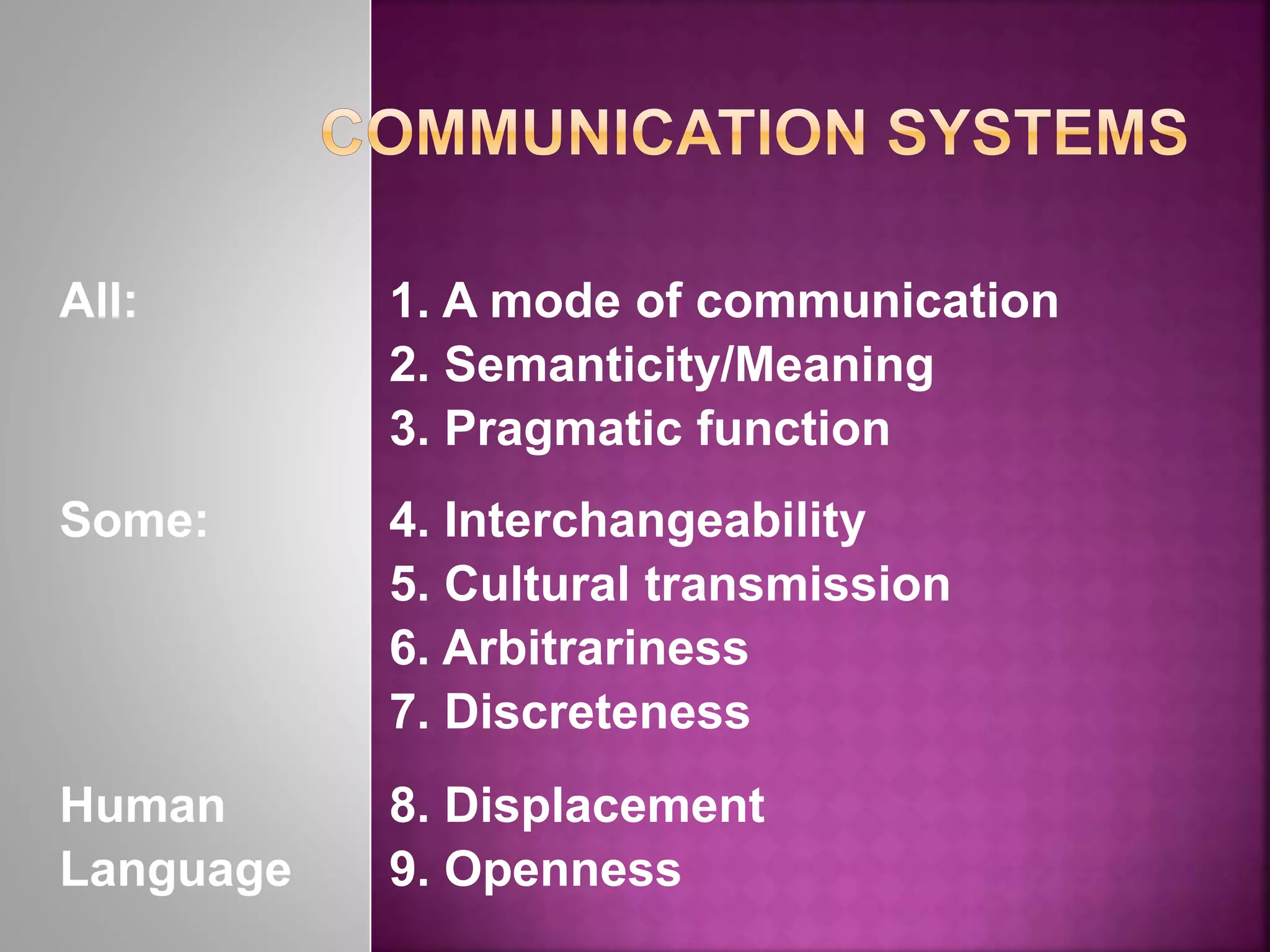
All: 1. A mode of communication
2. Semanticity/Meaning
3. Pragmatic function
Some: 4. Interchangeability
5. Cultural transmission
6. Arbitrariness
7. Discreteness
Human 8. Displacement
Language 9. Openness
There is no necessary link between a
particular sound in a language and a particular
meaning.
This means that any particular link between a
particular sound and a particular meaning in a
particular language is arbitrary.
Ape call systems lack arbitrariness.
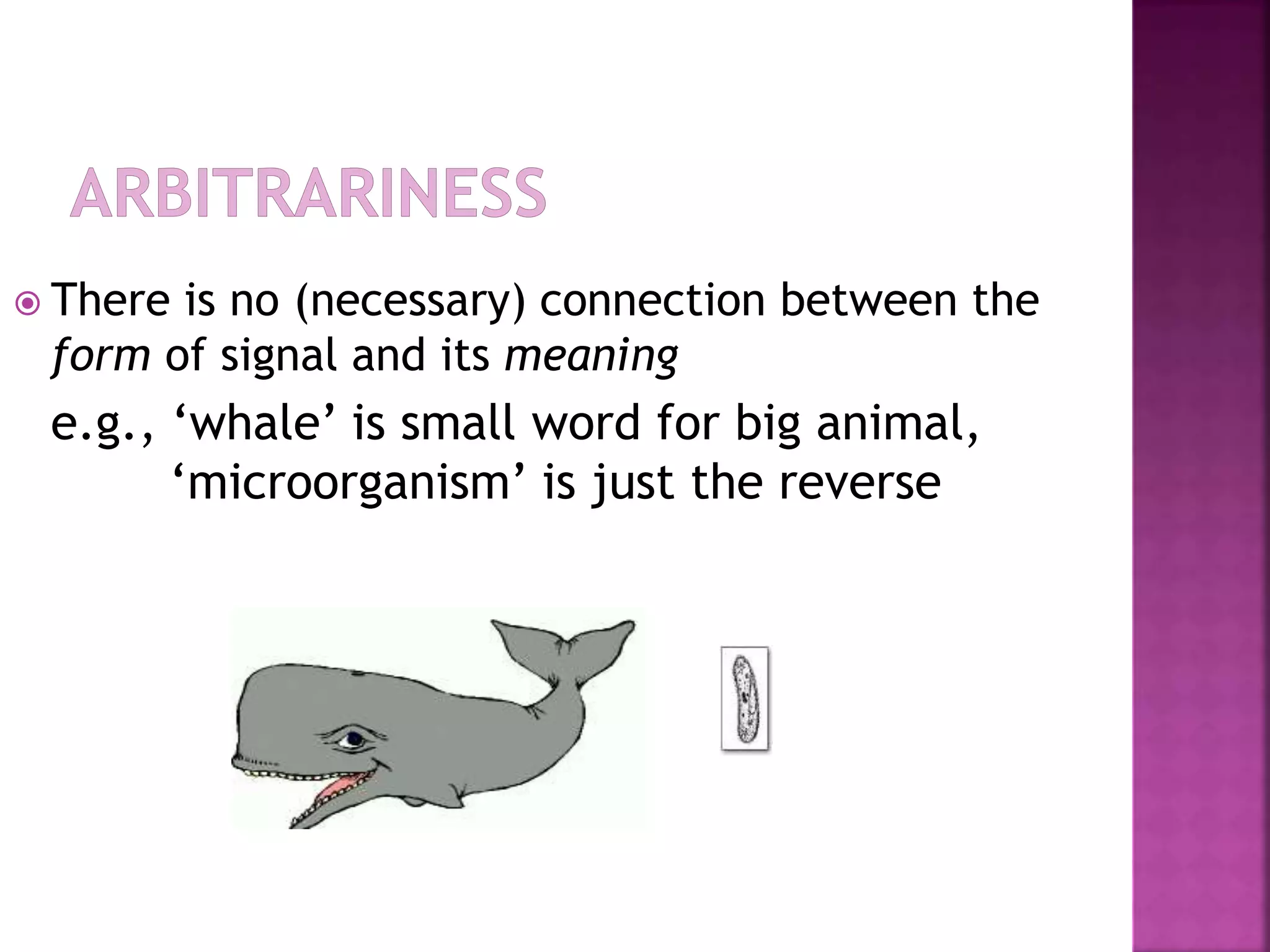
 There is no (necessary) connection between the
form of signal and its meaning
e.g., ‘whale’ is small word for big animal,
‘microorganism’ is just the reverse
 Larger, complex messages can be broken
down into smaller, discrete parts
e.g., [pat] [tap]
[apt]
p
a t
 units at one level can be combined to
form units at another level
 sounds form words, words form sentences
 at every level, there are patterns for how
sounds/words go together, but the sounds
can be combined into many different
words, and words can be combined to
create infinite sentences.
 Hockett spoke of only 2 levels:
 sound
 meaning
 Modern linguists recognize at least 5 levels:
 phonology (sounds)
 morphology (words/ morphemes)
 syntax (sentences)
 semantics (meaning relations within lexicon)
 pragmatics (use)
 Human language consists of several levels or
dimensions of knowledge
 used by linguists to separate language into
areas of study
 not entirely “modular” or discrete (e.g.,
phonetics and phonology inform each other)
 A user can both receive and broadcast the
same signal
e.g., speaker can be listener and vice
versa
Linguistic signals are associated with aspects
of the physical, cultural, and social world of
speakers.
Such association is always selective—it
highlights some features, downplays other
features.
Closed ape call systems appear to lack
semanticity.
Semantics
Relations within the lexicon of a language.
Semanticity
Relations linking the lexicon of a language
to the outside world.
Linguistic messages can be:
 false.
 meaningless, in the logician’s sense ( e.g.,
“A is not A.”).
We can tell lies.
We can write poetry.
We can form scientific hypotheses.
“Colorless green ideas sleep furiously.”
 Is this statement a lie?
 Does this proposition illustrate logical
contradiction?
 At least some aspect of communication system
is learned from other users
e.g., child of French-speaking parents will
learn French
 A person acquires a language in a culture
with other speakers and not from parental
genes.
 A human baby doesn’t speak any language at
birth. A Chinese baby is not born to speak
Chinese.
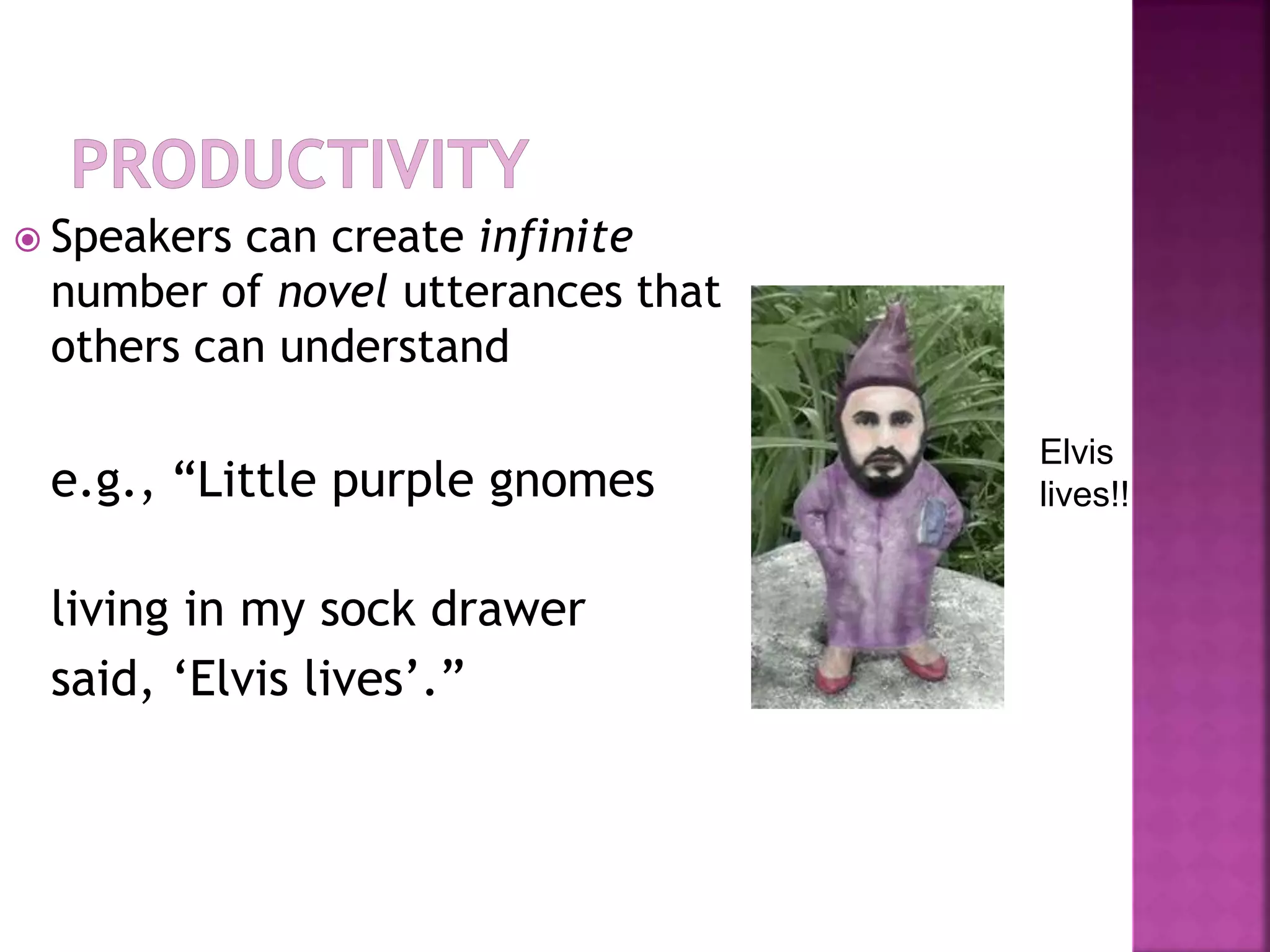
 Speakers can create infinite
number of novel utterances that
others can understand
e.g., “Little purple gnomes
living in my sock drawer
said, ‘Elvis lives’.”
Elvis
lives!!
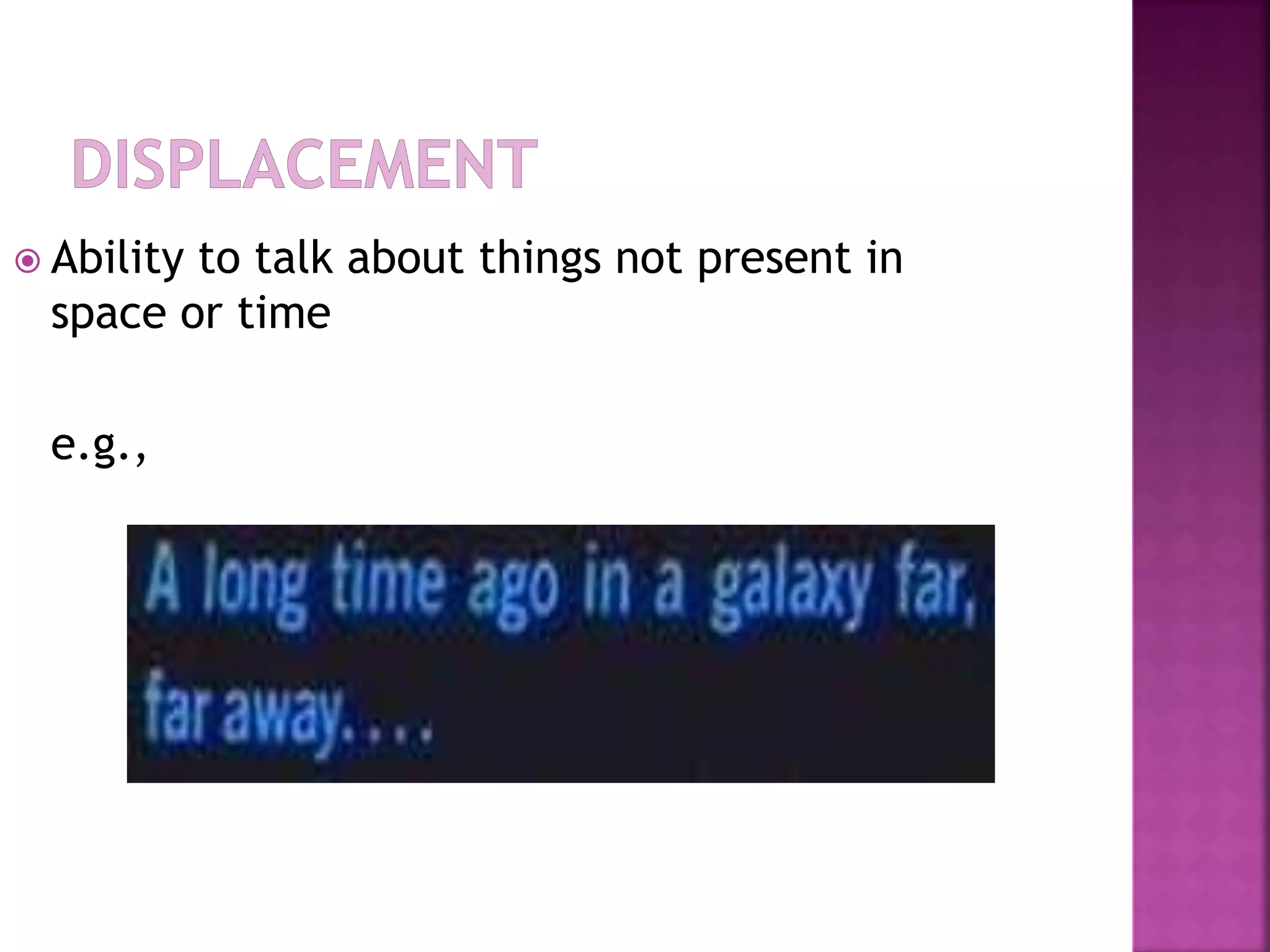
 Ability to talk about things not present in
space or time
e.g.,
Humans can talk about absent or nonexistent
objects, and about past or future events, as
easily as we can discuss our current situation.
Nonhuman primates, using closed call
systems, cannot do this. Their calls concern
only the here and now.
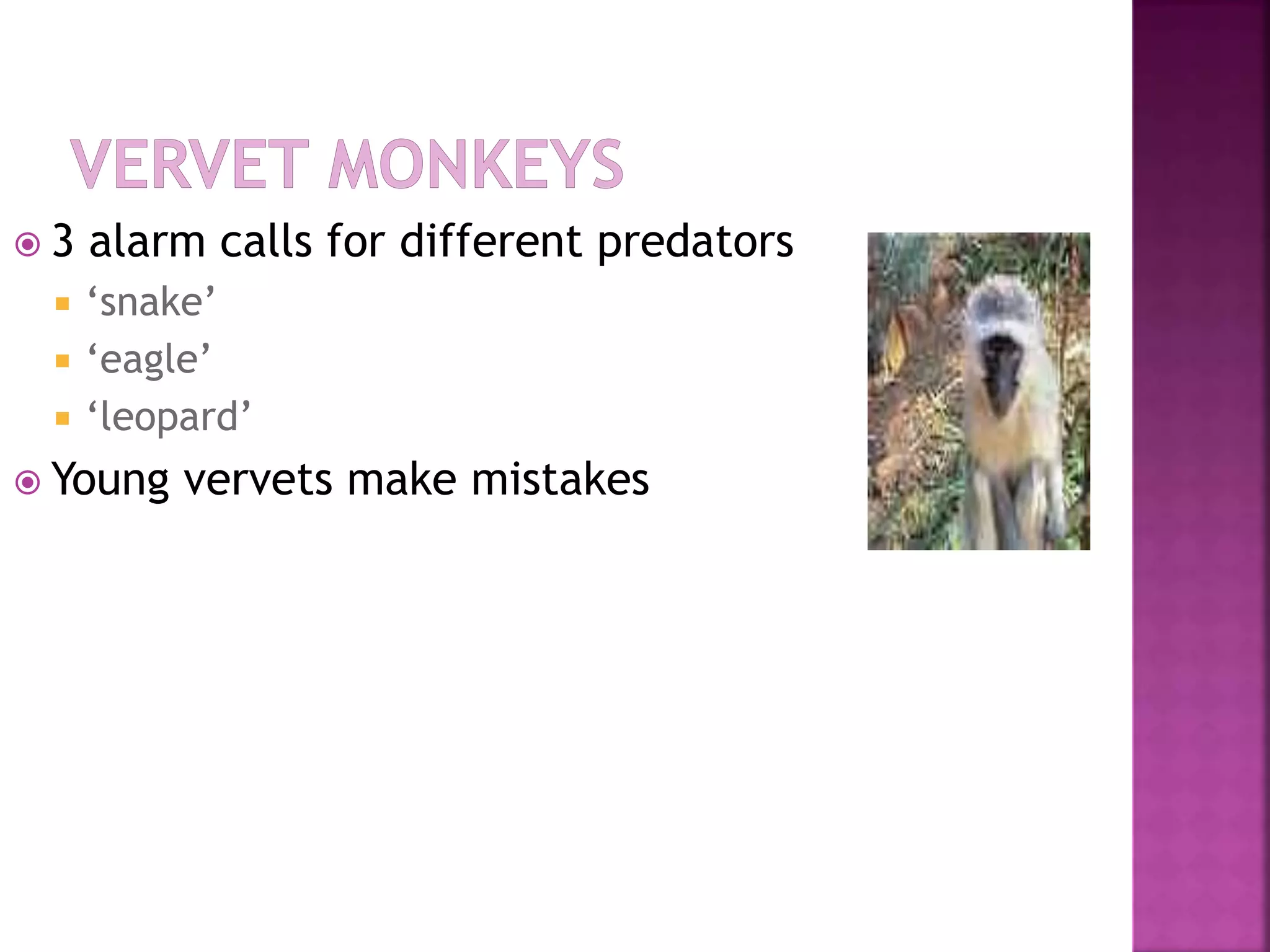
 3 alarm calls for different predators
 ‘snake’
 ‘eagle’
 ‘leopard’
 Young vervets make mistakes
 Yes:
 Arbitrariness, Cultural transmission,
Interchangeability
 No:
 Displacement, Productivity, Discreteness
A basic question about how human language is
different from other forms of animal
communication is whether the difference is one of
scale or one of kind.
- a difference of scale would mean that human
language is just a more elaborate form of animal
communication
- a difference of kind would mean that human
language is something completely different and
unique to human beings.
Displacement: can communicate about
things not present or not true
Productivity: open-ended system,
creative ability to
express novel ideas
 Human language does seem unique
 There are certain features which are shared
by almost all communication systems but
certain features are present only in human
language
 Productivity and Displacement are unique

Design features

  • 1.
    Animal and HumanCommunication: Similarities and Differences
  • 2.
    Sapir: “a purelyhuman and non-instinctive method of communicating ideas, emotions and desires by means of voluntarily produced symbols.” Bloch & Trager: “a system of arbitrary vocal symbols by means of which a social group cooperates.” Hall: “the institution whereby humans communicate and interact with each other by means of habitually used oral-auditory arbitrary symbols.” Chomsky: “a set (finite or infinite) of sentences, each finite in length and constructed out of a finite set of elements.”
  • 3.
    Best guess seemsthat language developed in parallel with the species. We don’t know and we can never know. Bad question. Origins don’t necessarily explain what’s going on
  • 4.
    A signal istransmitted from a sender to a receiver (or group of receivers) along a channel of communication. The signal will have a particular form and will convey a particular meaning (or message). The connection between form and meaning constitutes a code.
  • 5.
     Charles Hockett(1960)  Characterize language, distinguish it from other communication systems  If a system lacks even one feature, it is communication, not language
  • 6.
    All: 1. Amode of communication 2. Semanticity/Meaning 3. Pragmatic function Some: 4. Interchangeability 5. Cultural transmission 6. Arbitrariness 7. Discreteness Human 8. Displacement Language 9. Openness
  • 7.
    There is nonecessary link between a particular sound in a language and a particular meaning. This means that any particular link between a particular sound and a particular meaning in a particular language is arbitrary. Ape call systems lack arbitrariness.
  • 8.
     There isno (necessary) connection between the form of signal and its meaning e.g., ‘whale’ is small word for big animal, ‘microorganism’ is just the reverse
  • 9.
     Larger, complexmessages can be broken down into smaller, discrete parts e.g., [pat] [tap] [apt] p a t
  • 10.
     units atone level can be combined to form units at another level  sounds form words, words form sentences  at every level, there are patterns for how sounds/words go together, but the sounds can be combined into many different words, and words can be combined to create infinite sentences.
  • 11.
     Hockett spokeof only 2 levels:  sound  meaning  Modern linguists recognize at least 5 levels:  phonology (sounds)  morphology (words/ morphemes)  syntax (sentences)  semantics (meaning relations within lexicon)  pragmatics (use)
  • 12.
     Human languageconsists of several levels or dimensions of knowledge  used by linguists to separate language into areas of study  not entirely “modular” or discrete (e.g., phonetics and phonology inform each other)
  • 13.
     A usercan both receive and broadcast the same signal e.g., speaker can be listener and vice versa
  • 14.
    Linguistic signals areassociated with aspects of the physical, cultural, and social world of speakers. Such association is always selective—it highlights some features, downplays other features. Closed ape call systems appear to lack semanticity.
  • 15.
    Semantics Relations within thelexicon of a language. Semanticity Relations linking the lexicon of a language to the outside world.
  • 16.
    Linguistic messages canbe:  false.  meaningless, in the logician’s sense ( e.g., “A is not A.”). We can tell lies. We can write poetry. We can form scientific hypotheses.
  • 17.
    “Colorless green ideassleep furiously.”  Is this statement a lie?  Does this proposition illustrate logical contradiction?
  • 18.
     At leastsome aspect of communication system is learned from other users e.g., child of French-speaking parents will learn French
  • 19.
     A personacquires a language in a culture with other speakers and not from parental genes.  A human baby doesn’t speak any language at birth. A Chinese baby is not born to speak Chinese.
  • 20.
     Speakers cancreate infinite number of novel utterances that others can understand e.g., “Little purple gnomes living in my sock drawer said, ‘Elvis lives’.” Elvis lives!!
  • 21.
     Ability totalk about things not present in space or time e.g.,
  • 22.
    Humans can talkabout absent or nonexistent objects, and about past or future events, as easily as we can discuss our current situation. Nonhuman primates, using closed call systems, cannot do this. Their calls concern only the here and now.
  • 23.
     3 alarmcalls for different predators  ‘snake’  ‘eagle’  ‘leopard’  Young vervets make mistakes
  • 24.
     Yes:  Arbitrariness,Cultural transmission, Interchangeability  No:  Displacement, Productivity, Discreteness
  • 25.
    A basic questionabout how human language is different from other forms of animal communication is whether the difference is one of scale or one of kind. - a difference of scale would mean that human language is just a more elaborate form of animal communication - a difference of kind would mean that human language is something completely different and unique to human beings.
  • 26.
    Displacement: can communicateabout things not present or not true Productivity: open-ended system, creative ability to express novel ideas
  • 27.
     Human languagedoes seem unique  There are certain features which are shared by almost all communication systems but certain features are present only in human language  Productivity and Displacement are unique