Downloaded 100 times
![Aspects :
1. Economical
2. Environmental
3
THE IMPORTANCE OF RECOVERING WASTE[1]](https://image.slidesharecdn.com/presentation1-151210215727/85/Use-of-hydrometallurgy-in-metal-recovery-from-mine-wastes-3-320.jpg)
![ Resource conservation
Reduce energy usage
Air pollution, including reductions in greenhouse gas generation
Reduce water pollution (from land filling)
5
ENVIRONMENTALASPECTS[2]](https://image.slidesharecdn.com/presentation1-151210215727/85/Use-of-hydrometallurgy-in-metal-recovery-from-mine-wastes-5-320.jpg)
![6
MINERAL EXTRACTION: FROM MINING TO METAL[3]
Mining
Mineral processing
(beneficiation)
Metallurgical
extraction
Mineral
concentrate
Metal
Waste
rock
Tailings
Slags](https://image.slidesharecdn.com/presentation1-151210215727/85/Use-of-hydrometallurgy-in-metal-recovery-from-mine-wastes-6-320.jpg)
![7
COMPARISON OF WASTE AND PRODUCT[11]](https://image.slidesharecdn.com/presentation1-151210215727/85/Use-of-hydrometallurgy-in-metal-recovery-from-mine-wastes-7-320.jpg)
![ Cut – off grade ores
Tailings from mineral products
Residues
8
TYPES OF MINE WASTE[4][5]](https://image.slidesharecdn.com/presentation1-151210215727/85/Use-of-hydrometallurgy-in-metal-recovery-from-mine-wastes-8-320.jpg)
![9
CLASSIFICATION OF MINERALS WASTES[4]](https://image.slidesharecdn.com/presentation1-151210215727/85/Use-of-hydrometallurgy-in-metal-recovery-from-mine-wastes-9-320.jpg)
![10
WASTE CUT OFF GRADES[6]](https://image.slidesharecdn.com/presentation1-151210215727/85/Use-of-hydrometallurgy-in-metal-recovery-from-mine-wastes-10-320.jpg)
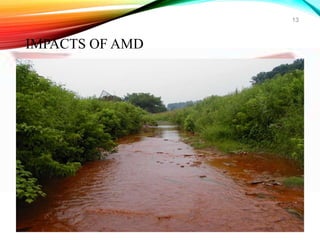
![ “Acid mine drainage” refers to a particular process whereby low
pH mine water is formed from the oxidation of sulphide minerals
AMD is particularly prevalent in both metallic mineral and coal
mines.
11
WHAT IS AMD[3]](https://image.slidesharecdn.com/presentation1-151210215727/85/Use-of-hydrometallurgy-in-metal-recovery-from-mine-wastes-11-320.jpg)
![12
PROCESS[7]](https://image.slidesharecdn.com/presentation1-151210215727/85/Use-of-hydrometallurgy-in-metal-recovery-from-mine-wastes-12-320.jpg)
![General equations for this process are:
2FeS2 + 7O2+ 2H2O → 2Fe2+ + 4SO4
2- + 4H+
4Fe2+ + O2 + 4H+ 4Fe3+ + 2H2O
4Fe3+ + 12H2O 4Fe(OH)3 + 12H+
FeS2 + 14Fe3+ + 8H2O → 15Fe2++ 2SO4
2- + 16H+
14
WHAT IS AMD[8]](https://image.slidesharecdn.com/presentation1-151210215727/85/Use-of-hydrometallurgy-in-metal-recovery-from-mine-wastes-14-320.jpg)
![ Aluminum
1. Gibbsite
2. Bohmite
3. Diaspore
15
MINE WASTE LEACHING[9]](https://image.slidesharecdn.com/presentation1-151210215727/85/Use-of-hydrometallurgy-in-metal-recovery-from-mine-wastes-15-320.jpg)
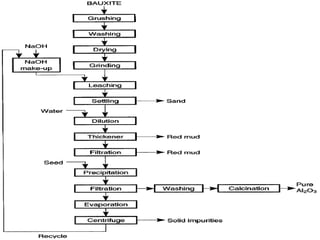
![50 % of bauxite is red-mud:- a waste-product from the Bayers
Process:
Fe2O3: 70 wt. pct. (35-38% metal value)
Al2O3: 10 wt. pct.
TiO2: 7.0 wt. pct.
CaO: 7.5 wt. pct
17
RED MUD[10]](https://image.slidesharecdn.com/presentation1-151210215727/85/Use-of-hydrometallurgy-in-metal-recovery-from-mine-wastes-17-320.jpg)
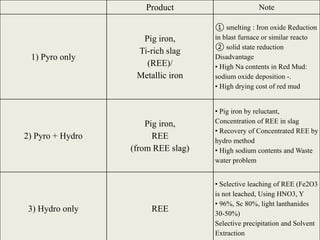
![19
RECOVERY OF IRON[10]](https://image.slidesharecdn.com/presentation1-151210215727/85/Use-of-hydrometallurgy-in-metal-recovery-from-mine-wastes-19-320.jpg)
![20
RECOVERY OF TITANIUM OXIDE[10]](https://image.slidesharecdn.com/presentation1-151210215727/85/Use-of-hydrometallurgy-in-metal-recovery-from-mine-wastes-20-320.jpg)
![Sintering
Al2O3 + Na2CO3 = 2NaAlO2 + CO2(g)
Temperature of operation : 850-1100oC
Time : 2 hours
Leaching
NaAlO2(s) = NaAlO2(aq)
Temperature of operation : 25-100 oC
Time : 5-30 minutes, Red Mud to water :
2-50 gpl
21
SINTERING AND LEACHING OF ALUMINA[10]](https://image.slidesharecdn.com/presentation1-151210215727/85/Use-of-hydrometallurgy-in-metal-recovery-from-mine-wastes-21-320.jpg)
![ Copper
1. Sandy ore (granular)
2. Slimy ore (composed of very fine particles that are difficult to
settle)
3. Molybdenite
4. Rhenium
5. Cobalt
22
MINE WASTE LEACHING[9]](https://image.slidesharecdn.com/presentation1-151210215727/85/Use-of-hydrometallurgy-in-metal-recovery-from-mine-wastes-22-320.jpg)
![23
SANDY ORE[9]](https://image.slidesharecdn.com/presentation1-151210215727/85/Use-of-hydrometallurgy-in-metal-recovery-from-mine-wastes-23-320.jpg)
![SLIMY ORE[9]
• Using sponge iron • Using hydrogen sulfide
24](https://image.slidesharecdn.com/presentation1-151210215727/85/Use-of-hydrometallurgy-in-metal-recovery-from-mine-wastes-24-320.jpg)
![25
MOLYBDENITE & RHENIUM[9]](https://image.slidesharecdn.com/presentation1-151210215727/85/Use-of-hydrometallurgy-in-metal-recovery-from-mine-wastes-25-320.jpg)
![26
COBALT[9]](https://image.slidesharecdn.com/presentation1-151210215727/85/Use-of-hydrometallurgy-in-metal-recovery-from-mine-wastes-26-320.jpg)
![ Platinum
1. Native platinum ores
2. Gold ores
3. Nonferrous metals sulfide ores
27
MINE WASTE LEACHING[9]
PtC14 + 2NH4Cl →(NH4)2[PtCl6]
PdC12 + 4NH3 →[Pd(NH3)4]C12
[Pd(NH3)4]C12 + 2HCI → [Pd(NH3)2]C12 + 2NH4C1](https://image.slidesharecdn.com/presentation1-151210215727/85/Use-of-hydrometallurgy-in-metal-recovery-from-mine-wastes-27-320.jpg)

This document discusses the use of hydrometallurgy in recovering metals from mine waste. It begins by introducing the types and classification of mine waste like waste rock, tailings, and slags. It then discusses aspects like economics and the environment. Mine waste leaching is examined as a process to extract metals. Various metals that can be recovered from mine waste are discussed, like aluminum from red mud, copper from different ore types, and platinum from native ores. References are provided to support the information presented.


