DEFENCE ENGINEERING COLLEGE
Metallurgical And Materials Engineering
Present By:
Weldebrhan Hadush (Maj.) 14 Nov., 2019
Content
Introduction
Basic approaches to refining
Purification of crude metal produced in bulk
Preparation of pure metals
General methods of refining
INTRODUCTION
Every metal or alloy-evaluated-in terms of some useful properties, for example,
i. Mechanical strength;
ii. Hardness;
iii. Ductility;
iv. Specific gravity;
General methods of refining
iv. Specific gravity;
v. Melting and boiling points;
vi. Thermal and electrical properties;
vii. Resistance to corrosion and Chemical reactivity.
All these properties are influenced by the properties of the impurity elements. In some cases,
even traces of an impurity may significantly change a specified property. Necessary to
remove impurities and refine the metal so as to improve its properties.
1
DUC 2019/20
Cont’d
Example: Effect of a trace impurity
• Traces of oxygen would hardly change the specific gravity of copper. If weight
were the criterion of any particular use, the presence of oxygen could be ignored.
• The dissolved oxygen could, however, drastically affect the electrical
conductivity of copper. Pure copper from the point of view of use as a conductor
General methods of refining
must, therefore, necessarily have a very low oxygen content. The presence of
oxygen influences the effect produced by the metal impurity through its oxidizing
power. For instant 0.01 percent oxygen causes iron and tin to precipitate as
oxides and thereby eliminates the deleterious effect of these impurities, namely
iron and tin, on electrical conductivity when they are present as a solid solution in
copper.
2
DUC 2019/20
BASIC APPROACHES TO REFINING
Metal obtained from the primary extraction process often contain impurities which
originated from the ore, the fluxes, or the fuel. For further use of the metals it is
usually necessary to subject them to one or several process. The refining may have as
its purpose to produce the metal as pure as possible: in some cases extreme purity is
desired. In other cases as,
General methods of refining
Example: In steel making the refining is to controlled amounts of desired impurities.
Finally, some refining processes are done in order to recover impurities which in
themselves are not harmful, but which have intrinsic value,
Example: The recovery of siliver from lead
Refining processes are always based on the principle that different elements distrubite
themselves differently in different phases, and that these phases may be separated
physically.
3
DUC 2019/20
PURIFICATION OF CRUDE METAL PRODUCED IN BULK
Except in the electrolytic reduction method, metals produced by any other method are
generally impure. The impurities may be in the form of: other metals, unreduced
metaloxides, non-metals like carbon, silicon, phosphorus, Sulpher etc. and flux or slag.
Several techniques refining crude metal are used depending upon the differences in
properties of the metal and the impurity. Some of them are listed below. :
General methods of Refining
4
properties of the metal and the impurity. Some of them are listed below. :
i. Distillation
ii. Liquation
iii. Poling
iv. Electrolysis
v. Transport reaction/ Vapour phase refining
vi. Chromatographic methods
DUC 2019/20
Distillation:
Volatile metals like zinc and mercury are purified by distillation. Distillation is a
metal-gas refining process that, impurities separated from the desired metal by
distillation at a suitable temperature.
It is customary to apply this method when the impurities are more volatile than the
metal so that the power required for heating purposes is low.
General methods of Refining
5
Example-destillation refining
a. Pure zinc (B.P=910 °C) can be preferentially distilled from brass, since
copper has a much higher B.P than zinc, i.e. 2575 °C.
b. Magnesium (B.P=1107 °C) can be preferentially distilled from aluminum,
since aluminium is much higher B.P than magnesium i.e 2467 °C.
DUC 2019/20
Liquation:
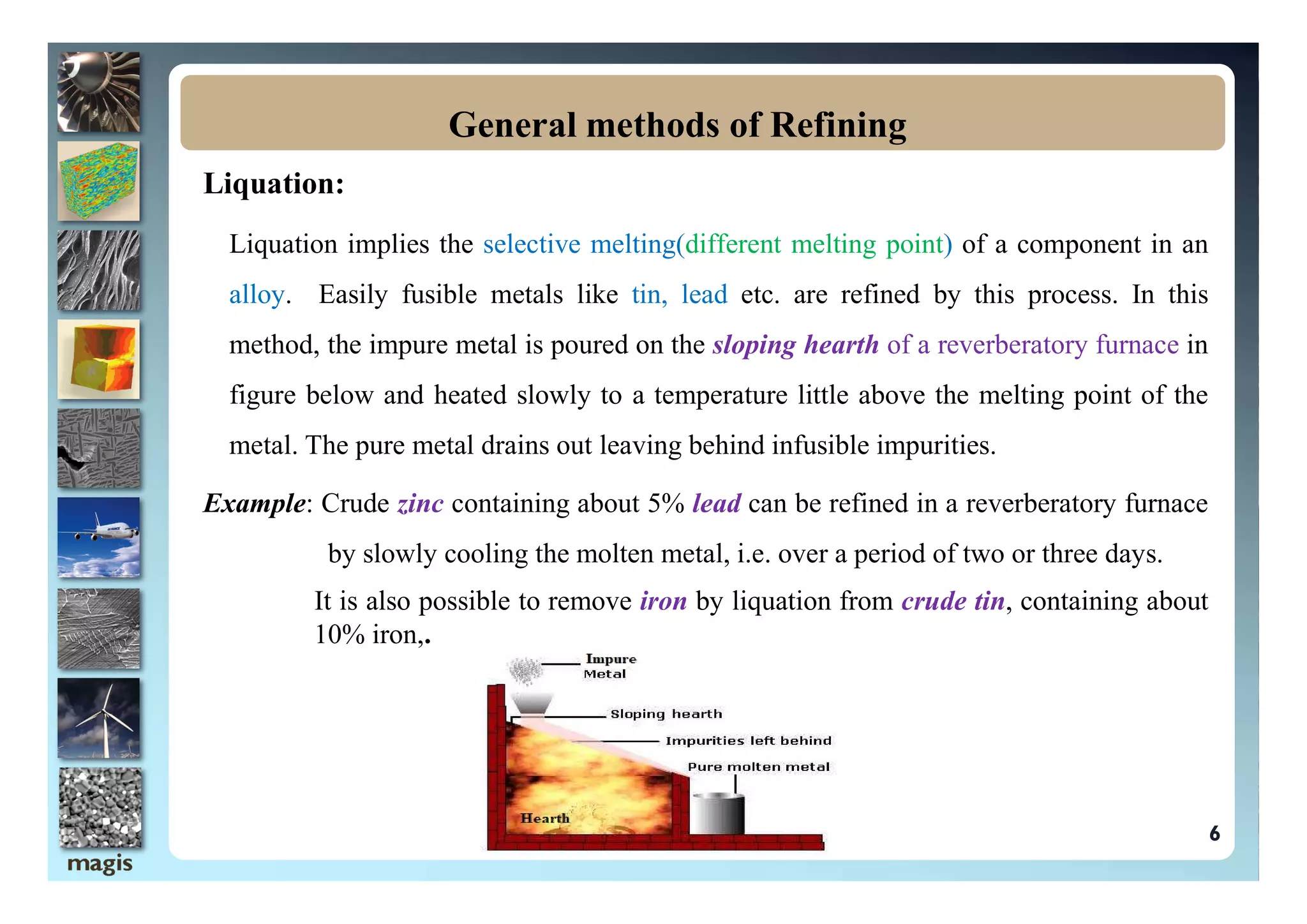
Liquation implies the selective melting(different melting point) of a component in an
alloy. Easily fusible metals like tin, lead etc. are refined by this process. In this
method, the impure metal is poured on the sloping hearth of a reverberatory furnace in
figure below and heated slowly to a temperature little above the melting point of the
metal. The pure metal drains out leaving behind infusible impurities.
General methods of Refining
6
Example: Crude zinc containing about 5% lead can be refined in a reverberatory furnace
by slowly cooling the molten metal, i.e. over a period of two or three days.
It is also possible to remove iron by liquation from crude tin, containing about
10% iron,.
Poling:
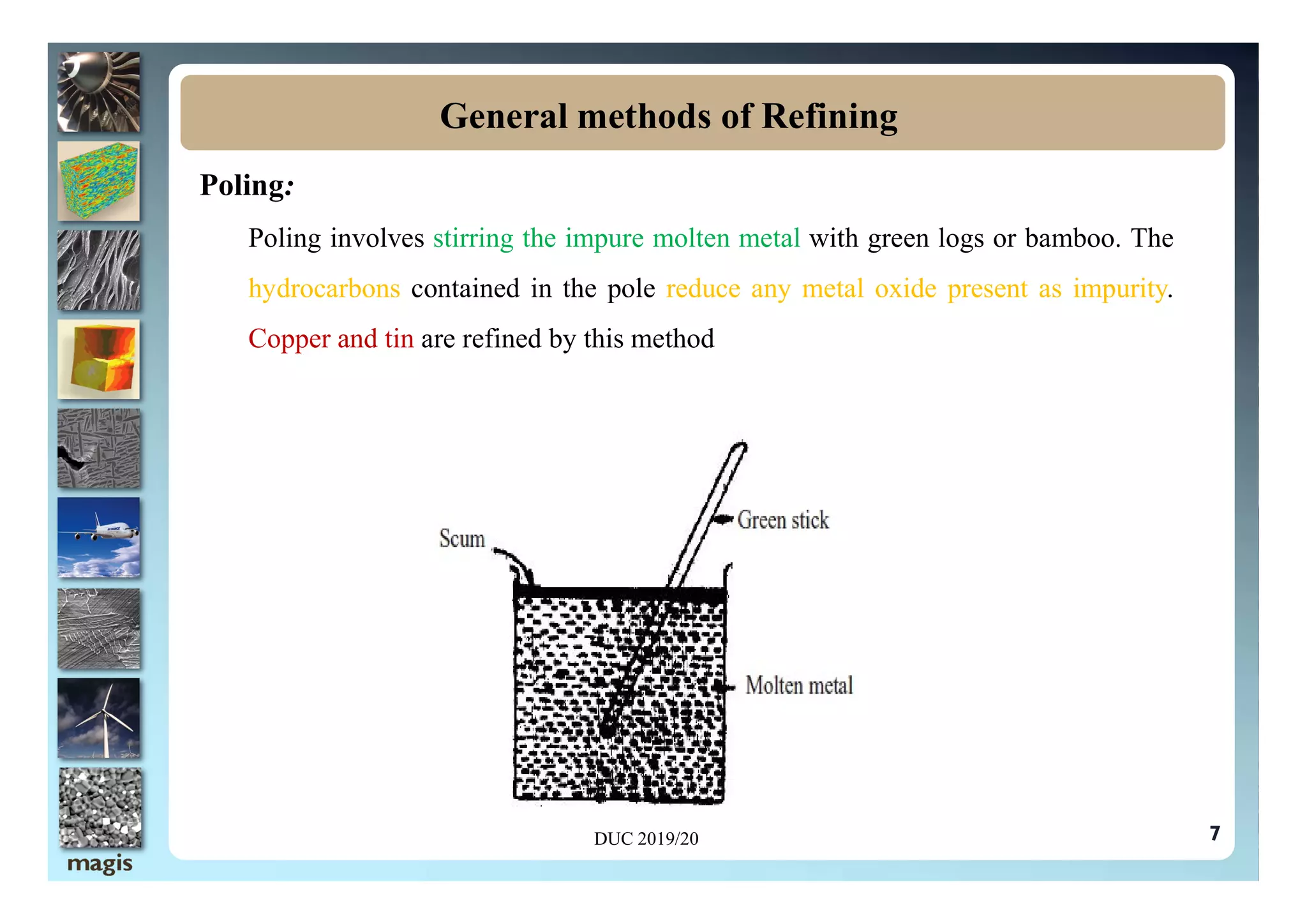
Poling involves stirring the impure molten metal with green logs or bamboo. The
hydrocarbons contained in the pole reduce any metal oxide present as impurity.
Copper and tin are refined by this method
General methods of Refining
DUC 2019/20 7
Electrolytic Refining:
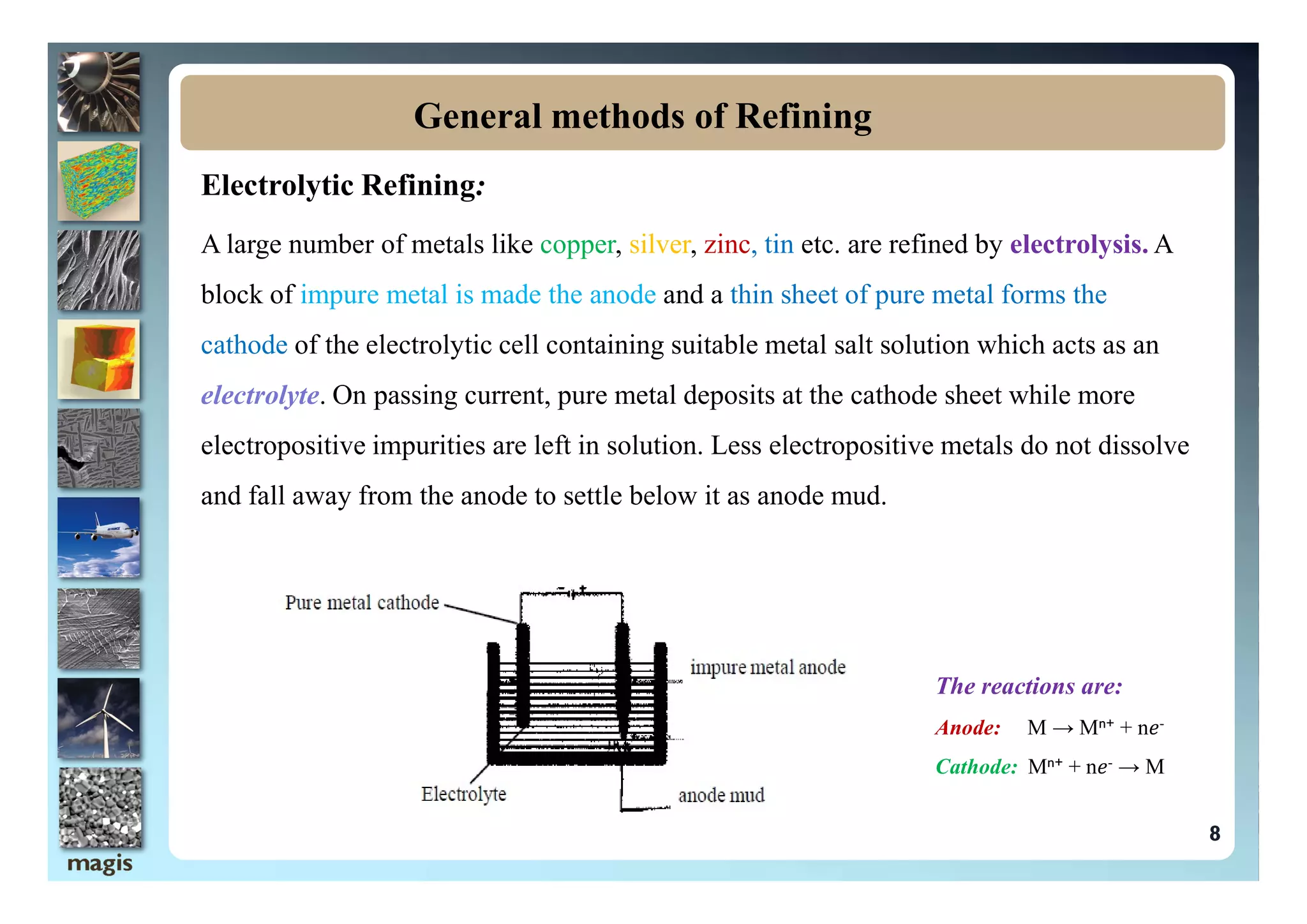
A large number of metals like copper, silver, zinc, tin etc. are refined by electrolysis. A
block of impure metal is made the anode and a thin sheet of pure metal forms the
cathode of the electrolytic cell containing suitable metal salt solution which acts as an
electrolyte. On passing current, pure metal deposits at the cathode sheet while more
electropositive impurities are left in solution. Less electropositive metals do not dissolve
General methods of Refining
and fall away from the anode to settle below it as anode mud.
The reactions are:
Anode: M → Mn+ + n𝑒-
Cathode: Mn+ + n𝑒- → M
8
Cont’d
Example: In the electrolytic refining of crude copper (blister copper), a large piece of
impure copper is made anode and a thin piece of pure copper is made the cathode.
An acidified solution of copper sulphate is used as an electrolyte. On passing an
electric current of low voltage through the solution copper (II) ions obtained from
copper sulphate solution go to the cathode where they are reduced to the free copper
General methods of Refining
metal and get deposited.
Reaction at Cathode: Cu+2 +2 -2 → (Reduction)
An equivalent amount of the metal from the anode dissolves into the electrolyte as
Cu+2 ions.
Reaction at Anode: → Cu+2 + 2 -2 (Oxidation)
As the process goes on, anode becomes thinner while the cathode becomes thicker.
The impurities like silver, gold settle down at the bottom of the cell as 'anode mud'.
DUC 2019/20 9
Transport reaction/ Catalytic distillations/ vapour phase refining:
In this method, the metal is converted into its volatile compound. It is then
decomposed to give pure metal. So, the two requirements are:
i. The metal should form a volatile compound with an available reagent,
ii. The volatile compound should be easily decomposable, so that the recovery is easy.
Examples: Mond Process for Refining Nickel:
General methods of Refining
10
Examples: Mond Process for Refining Nickel:
In this process, nickel is heated in a stream of carbon monoxide forming a volatile
complex, nickel tetra carbonyl.
Ni(s) + 4CO → Ni(CO)4 (g) at 50 °C Impurity metal do not form carbonyl
The nickel carbonyl gas is passed on another reactor which is kept at about 230 °C
which contain metallic nickel seeds. Carbonyl dissociates, solid nickel precipitated on
the seeds. Ni(CO)4 → Ni + 4CO NB: @ 1atm
DUC 2019/20
Cont’d
Examples : Sub-chloride process of Aluminum refining:
In this process, the impurity alloy is reacted with AlCl3 (g) at about 1200 °C where by
3AlCl(g) is formed. On cooling of the subchloride to about 700 °C the reaction
reverses, pure aluminum condenses, and volatile AlCl3 is reformed and return to the
process
General methods of Refining
11
2Al(l) +AlCl3 (g) = 3AlCl(g)
DUC 2019/20
Chromatographic methods:
This method is based on the principle that different components of a mixture are
differently adsorbed on an adsorbent.
The mixture is put in a liquid medium which is moved through the adsorbent.
Different components are adsorbed at different levels on the column. Later the
adsorbed components are removed by using suitable solvents.
General methods of Refining
12
adsorbed components are removed by using suitable solvents.
Example: Al2O3 is prepared in a glass tube and the moving medium containing a
solution of the components is in liquid form. This is very useful for purification of
the elements which are available in minute quantities and the impurities are not very
different in chemical properties from the element to be purified.
DUC 2019/20
PREPARATION OF PURE COMPOUNDS
• It is almost as difficult as to define « pure» as it is to define « rare» metals. Some
metals are sufficiently pure by normal production methodes. For the more reactive
metals small amount of impurities such as carbon, nitrogen and oxygen may
affect the properties and usefulness of the metal.
• For a lack of better definition we can say that a pure metal is one where the harmful
General methods of Refining
13
• For a lack of better definition we can say that a pure metal is one where the harmful
effects of the impurities have been vertually eliminated.
• The more noble metals such as iron, copper , etc. may be obtained relatively pure by
refining of crude metals, this can not be done for the more reactive metals, the
impurity useually being less reactive than the metal itself.
• This may be obtained by various hydrometallurgical methodes. The ore is leached ,
the solution is purified and a pure metal compound is precipitated .
DUC 2019/20
Cont’d
As already mentioned pure oxide may be reduced with carbon or silicon in vacuum,
or with aluminium, magnesium, or calcium at atmospheric pressure. Oxides of the
more noble metals such as molybdenum and tungston may also be reduced with
hydrogen in a tube furnace.
General methods of Refining
14
DUC 2019/20
“The future can not be predicted,
but it can be made !”

CHAPTER 5 General methods of refining.pdf

  • 1.
    DEFENCE ENGINEERING COLLEGE MetallurgicalAnd Materials Engineering Present By: Weldebrhan Hadush (Maj.) 14 Nov., 2019
  • 2.
    Content Introduction Basic approaches torefining Purification of crude metal produced in bulk Preparation of pure metals General methods of refining
  • 3.
    INTRODUCTION Every metal oralloy-evaluated-in terms of some useful properties, for example, i. Mechanical strength; ii. Hardness; iii. Ductility; iv. Specific gravity; General methods of refining iv. Specific gravity; v. Melting and boiling points; vi. Thermal and electrical properties; vii. Resistance to corrosion and Chemical reactivity. All these properties are influenced by the properties of the impurity elements. In some cases, even traces of an impurity may significantly change a specified property. Necessary to remove impurities and refine the metal so as to improve its properties. 1 DUC 2019/20
  • 4.
    Cont’d Example: Effect ofa trace impurity • Traces of oxygen would hardly change the specific gravity of copper. If weight were the criterion of any particular use, the presence of oxygen could be ignored. • The dissolved oxygen could, however, drastically affect the electrical conductivity of copper. Pure copper from the point of view of use as a conductor General methods of refining must, therefore, necessarily have a very low oxygen content. The presence of oxygen influences the effect produced by the metal impurity through its oxidizing power. For instant 0.01 percent oxygen causes iron and tin to precipitate as oxides and thereby eliminates the deleterious effect of these impurities, namely iron and tin, on electrical conductivity when they are present as a solid solution in copper. 2 DUC 2019/20
  • 5.
    BASIC APPROACHES TOREFINING Metal obtained from the primary extraction process often contain impurities which originated from the ore, the fluxes, or the fuel. For further use of the metals it is usually necessary to subject them to one or several process. The refining may have as its purpose to produce the metal as pure as possible: in some cases extreme purity is desired. In other cases as, General methods of refining Example: In steel making the refining is to controlled amounts of desired impurities. Finally, some refining processes are done in order to recover impurities which in themselves are not harmful, but which have intrinsic value, Example: The recovery of siliver from lead Refining processes are always based on the principle that different elements distrubite themselves differently in different phases, and that these phases may be separated physically. 3 DUC 2019/20
  • 6.
    PURIFICATION OF CRUDEMETAL PRODUCED IN BULK Except in the electrolytic reduction method, metals produced by any other method are generally impure. The impurities may be in the form of: other metals, unreduced metaloxides, non-metals like carbon, silicon, phosphorus, Sulpher etc. and flux or slag. Several techniques refining crude metal are used depending upon the differences in properties of the metal and the impurity. Some of them are listed below. : General methods of Refining 4 properties of the metal and the impurity. Some of them are listed below. : i. Distillation ii. Liquation iii. Poling iv. Electrolysis v. Transport reaction/ Vapour phase refining vi. Chromatographic methods DUC 2019/20
  • 7.
    Distillation: Volatile metals likezinc and mercury are purified by distillation. Distillation is a metal-gas refining process that, impurities separated from the desired metal by distillation at a suitable temperature. It is customary to apply this method when the impurities are more volatile than the metal so that the power required for heating purposes is low. General methods of Refining 5 Example-destillation refining a. Pure zinc (B.P=910 °C) can be preferentially distilled from brass, since copper has a much higher B.P than zinc, i.e. 2575 °C. b. Magnesium (B.P=1107 °C) can be preferentially distilled from aluminum, since aluminium is much higher B.P than magnesium i.e 2467 °C. DUC 2019/20
  • 8.
    Liquation: Liquation implies theselective melting(different melting point) of a component in an alloy. Easily fusible metals like tin, lead etc. are refined by this process. In this method, the impure metal is poured on the sloping hearth of a reverberatory furnace in figure below and heated slowly to a temperature little above the melting point of the metal. The pure metal drains out leaving behind infusible impurities. General methods of Refining 6 Example: Crude zinc containing about 5% lead can be refined in a reverberatory furnace by slowly cooling the molten metal, i.e. over a period of two or three days. It is also possible to remove iron by liquation from crude tin, containing about 10% iron,.
  • 9.
    Poling: Poling involves stirringthe impure molten metal with green logs or bamboo. The hydrocarbons contained in the pole reduce any metal oxide present as impurity. Copper and tin are refined by this method General methods of Refining DUC 2019/20 7
  • 10.
    Electrolytic Refining: A largenumber of metals like copper, silver, zinc, tin etc. are refined by electrolysis. A block of impure metal is made the anode and a thin sheet of pure metal forms the cathode of the electrolytic cell containing suitable metal salt solution which acts as an electrolyte. On passing current, pure metal deposits at the cathode sheet while more electropositive impurities are left in solution. Less electropositive metals do not dissolve General methods of Refining and fall away from the anode to settle below it as anode mud. The reactions are: Anode: M → Mn+ + n𝑒- Cathode: Mn+ + n𝑒- → M 8
  • 11.
    Cont’d Example: In theelectrolytic refining of crude copper (blister copper), a large piece of impure copper is made anode and a thin piece of pure copper is made the cathode. An acidified solution of copper sulphate is used as an electrolyte. On passing an electric current of low voltage through the solution copper (II) ions obtained from copper sulphate solution go to the cathode where they are reduced to the free copper General methods of Refining metal and get deposited. Reaction at Cathode: Cu+2 +2 -2 → (Reduction) An equivalent amount of the metal from the anode dissolves into the electrolyte as Cu+2 ions. Reaction at Anode: → Cu+2 + 2 -2 (Oxidation) As the process goes on, anode becomes thinner while the cathode becomes thicker. The impurities like silver, gold settle down at the bottom of the cell as 'anode mud'. DUC 2019/20 9
  • 12.
    Transport reaction/ Catalyticdistillations/ vapour phase refining: In this method, the metal is converted into its volatile compound. It is then decomposed to give pure metal. So, the two requirements are: i. The metal should form a volatile compound with an available reagent, ii. The volatile compound should be easily decomposable, so that the recovery is easy. Examples: Mond Process for Refining Nickel: General methods of Refining 10 Examples: Mond Process for Refining Nickel: In this process, nickel is heated in a stream of carbon monoxide forming a volatile complex, nickel tetra carbonyl. Ni(s) + 4CO → Ni(CO)4 (g) at 50 °C Impurity metal do not form carbonyl The nickel carbonyl gas is passed on another reactor which is kept at about 230 °C which contain metallic nickel seeds. Carbonyl dissociates, solid nickel precipitated on the seeds. Ni(CO)4 → Ni + 4CO NB: @ 1atm DUC 2019/20
  • 13.
    Cont’d Examples : Sub-chlorideprocess of Aluminum refining: In this process, the impurity alloy is reacted with AlCl3 (g) at about 1200 °C where by 3AlCl(g) is formed. On cooling of the subchloride to about 700 °C the reaction reverses, pure aluminum condenses, and volatile AlCl3 is reformed and return to the process General methods of Refining 11 2Al(l) +AlCl3 (g) = 3AlCl(g) DUC 2019/20
  • 14.
    Chromatographic methods: This methodis based on the principle that different components of a mixture are differently adsorbed on an adsorbent. The mixture is put in a liquid medium which is moved through the adsorbent. Different components are adsorbed at different levels on the column. Later the adsorbed components are removed by using suitable solvents. General methods of Refining 12 adsorbed components are removed by using suitable solvents. Example: Al2O3 is prepared in a glass tube and the moving medium containing a solution of the components is in liquid form. This is very useful for purification of the elements which are available in minute quantities and the impurities are not very different in chemical properties from the element to be purified. DUC 2019/20
  • 15.
    PREPARATION OF PURECOMPOUNDS • It is almost as difficult as to define « pure» as it is to define « rare» metals. Some metals are sufficiently pure by normal production methodes. For the more reactive metals small amount of impurities such as carbon, nitrogen and oxygen may affect the properties and usefulness of the metal. • For a lack of better definition we can say that a pure metal is one where the harmful General methods of Refining 13 • For a lack of better definition we can say that a pure metal is one where the harmful effects of the impurities have been vertually eliminated. • The more noble metals such as iron, copper , etc. may be obtained relatively pure by refining of crude metals, this can not be done for the more reactive metals, the impurity useually being less reactive than the metal itself. • This may be obtained by various hydrometallurgical methodes. The ore is leached , the solution is purified and a pure metal compound is precipitated . DUC 2019/20
  • 16.
    Cont’d As already mentionedpure oxide may be reduced with carbon or silicon in vacuum, or with aluminium, magnesium, or calcium at atmospheric pressure. Oxides of the more noble metals such as molybdenum and tungston may also be reduced with hydrogen in a tube furnace. General methods of Refining 14 DUC 2019/20
  • 17.
    “The future cannot be predicted, but it can be made !”