Presented By: Pranjit Sharmah 
BSc. Part III (Geology) 
J. B. College, Jorhat, 2013
DUMPING OF MINING WASTE
INTRODUCTION 
Mining Waste: 
Mining operation brings out all sorts of unwanted materials, 
which is known as mining waste. 
Mining waste can be defined as a part of the materials that 
result from exploration, mining and processing of substance 
governed by legislation on mines and quarries. 
Mining operation also produce diverse kind of potentially 
hazardous waste.
WASTE GENERATED BY THE DIFFERENT MINING 
STEPS 
Each of the ore mining and processing steps can generate mining 
waste. This waste generally has different physical and chemical 
properties. 
The chemical composition of the waste varies considerably 
according to the substance mined and nature of geological 
formation containing deposit. 
The main types of mining waste in addition to top soil and 
overburden can be classified as:- 
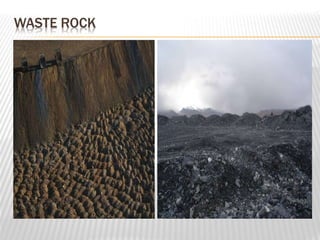
 Waste rock 
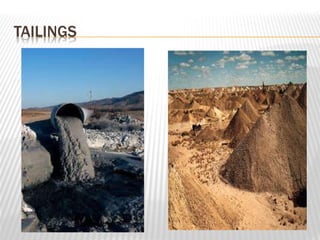
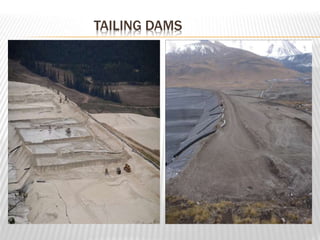
 Tailings 
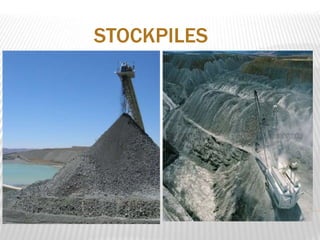
 Temporary stock piles 
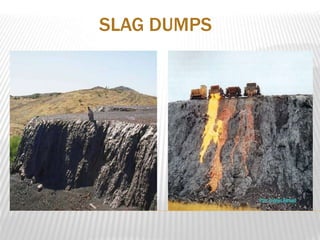
 Slags
WASTE ROCK
TAILINGS
STOCKPILES
SLAG DUMPS
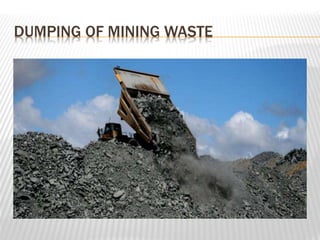
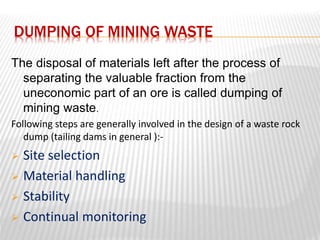
DUMPING OF MINING WASTE 
The disposal of materials left after the process of 
separating the valuable fraction from the 
uneconomic part of an ore is called dumping of 
mining waste. 
Following steps are generally involved in the design of a waste rock 
dump (tailing dams in general ):- 
 Site selection 
 Material handling 
 Stability 
 Continual monitoring
TAILING DAMS
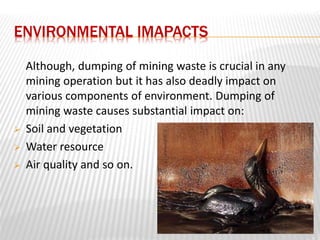
ENVIRONMENTAL IMAPACTS 
Although, dumping of mining waste is crucial in any 
mining operation but it has also deadly impact on 
various components of environment. Dumping of 
mining waste causes substantial impact on: 
 Soil and vegetation 
 Water resource 
 Air quality and so on.
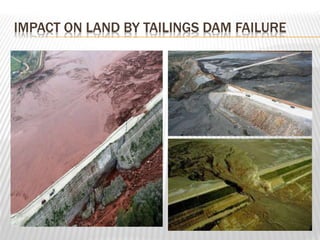
IMPACT ON LAND BY TAILINGS DAM FAILURE
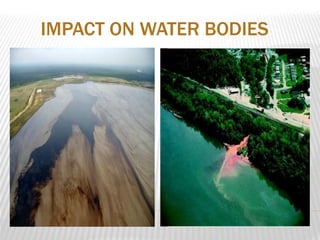
IMPACT ON WATER BODIES
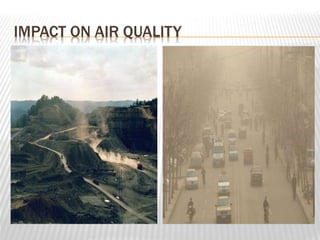
IMPACT ON AIR QUALITY
MANAGEMENT OF DUMPING WASTE 
In recent years, the mining industry has placed increasing 
emphasis on finding solutions to mine waste management 
issues that are both environmentally sound and cost 
effective. 
 Safe disposal of mining waste. 
 Long term security and environmental protection. 
 Safety and stability of dams 
 Recycling : Coarse mining waste and especially barren 
rock is sometimes considered as materials for roads, 
building foundations or cement factories, depending on 
its geotechnical and geochemical characteristics.
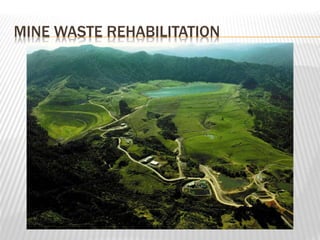
MINE WASTE REHABILITATION
LEGISLATION 
 Mining activity has subjected it to a body of national 
legislation known as the Mining Code. 
 International law, including the Stockholm Declaration 
and the Rio Declaration, recognizes that nations have a 
right to exploit their own natural resources following 
their own particular environmental policies. 
 No nation may undertake activities within its borders 
that will cause significant injury to another nation,
AWARENESS 
 The industry and government have responded with 
a number of initiatives and regulations to protect 
and manage the environmental effects of mining 
activities. 
 Public participation can also forge lines of 
communication among communities, the project 
proponent, and the government, that will continue 
through to project implementation or other future 
projects. 
 Recycle , Reuse and Rehabilitation of Mine wastes.
CONCLUSION 
 Safe disposal of mine waste 
 . Humans must focus on understanding the 
character, stability, impact, remediation and reuse 
of the mine waste. 
 Currently, extensive planning for and caring out 
environmentally conscious mining activities of site 
cleanup and rehabilitation of mine waste are of 
primary concern.
Dumping of mining waste (2)

Dumping of mining waste (2)

  • 1.
    Presented By: PranjitSharmah BSc. Part III (Geology) J. B. College, Jorhat, 2013
  • 2.
  • 3.
    INTRODUCTION Mining Waste: Mining operation brings out all sorts of unwanted materials, which is known as mining waste. Mining waste can be defined as a part of the materials that result from exploration, mining and processing of substance governed by legislation on mines and quarries. Mining operation also produce diverse kind of potentially hazardous waste.
  • 4.
    WASTE GENERATED BYTHE DIFFERENT MINING STEPS Each of the ore mining and processing steps can generate mining waste. This waste generally has different physical and chemical properties. The chemical composition of the waste varies considerably according to the substance mined and nature of geological formation containing deposit. The main types of mining waste in addition to top soil and overburden can be classified as:-  Waste rock  Tailings  Temporary stock piles  Slags
  • 5.
  • 6.
  • 7.
  • 8.
  • 9.
    DUMPING OF MININGWASTE The disposal of materials left after the process of separating the valuable fraction from the uneconomic part of an ore is called dumping of mining waste. Following steps are generally involved in the design of a waste rock dump (tailing dams in general ):-  Site selection  Material handling  Stability  Continual monitoring
  • 10.
  • 11.
    ENVIRONMENTAL IMAPACTS Although,dumping of mining waste is crucial in any mining operation but it has also deadly impact on various components of environment. Dumping of mining waste causes substantial impact on:  Soil and vegetation  Water resource  Air quality and so on.
  • 12.
    IMPACT ON LANDBY TAILINGS DAM FAILURE
  • 13.
  • 14.
  • 15.
    MANAGEMENT OF DUMPINGWASTE In recent years, the mining industry has placed increasing emphasis on finding solutions to mine waste management issues that are both environmentally sound and cost effective.  Safe disposal of mining waste.  Long term security and environmental protection.  Safety and stability of dams  Recycling : Coarse mining waste and especially barren rock is sometimes considered as materials for roads, building foundations or cement factories, depending on its geotechnical and geochemical characteristics.
  • 16.
  • 17.
    LEGISLATION  Miningactivity has subjected it to a body of national legislation known as the Mining Code.  International law, including the Stockholm Declaration and the Rio Declaration, recognizes that nations have a right to exploit their own natural resources following their own particular environmental policies.  No nation may undertake activities within its borders that will cause significant injury to another nation,
  • 18.
    AWARENESS  Theindustry and government have responded with a number of initiatives and regulations to protect and manage the environmental effects of mining activities.  Public participation can also forge lines of communication among communities, the project proponent, and the government, that will continue through to project implementation or other future projects.  Recycle , Reuse and Rehabilitation of Mine wastes.
  • 19.
    CONCLUSION  Safedisposal of mine waste  . Humans must focus on understanding the character, stability, impact, remediation and reuse of the mine waste.  Currently, extensive planning for and caring out environmentally conscious mining activities of site cleanup and rehabilitation of mine waste are of primary concern.