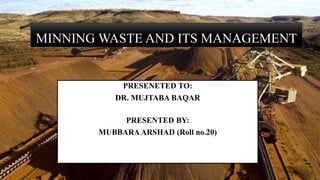
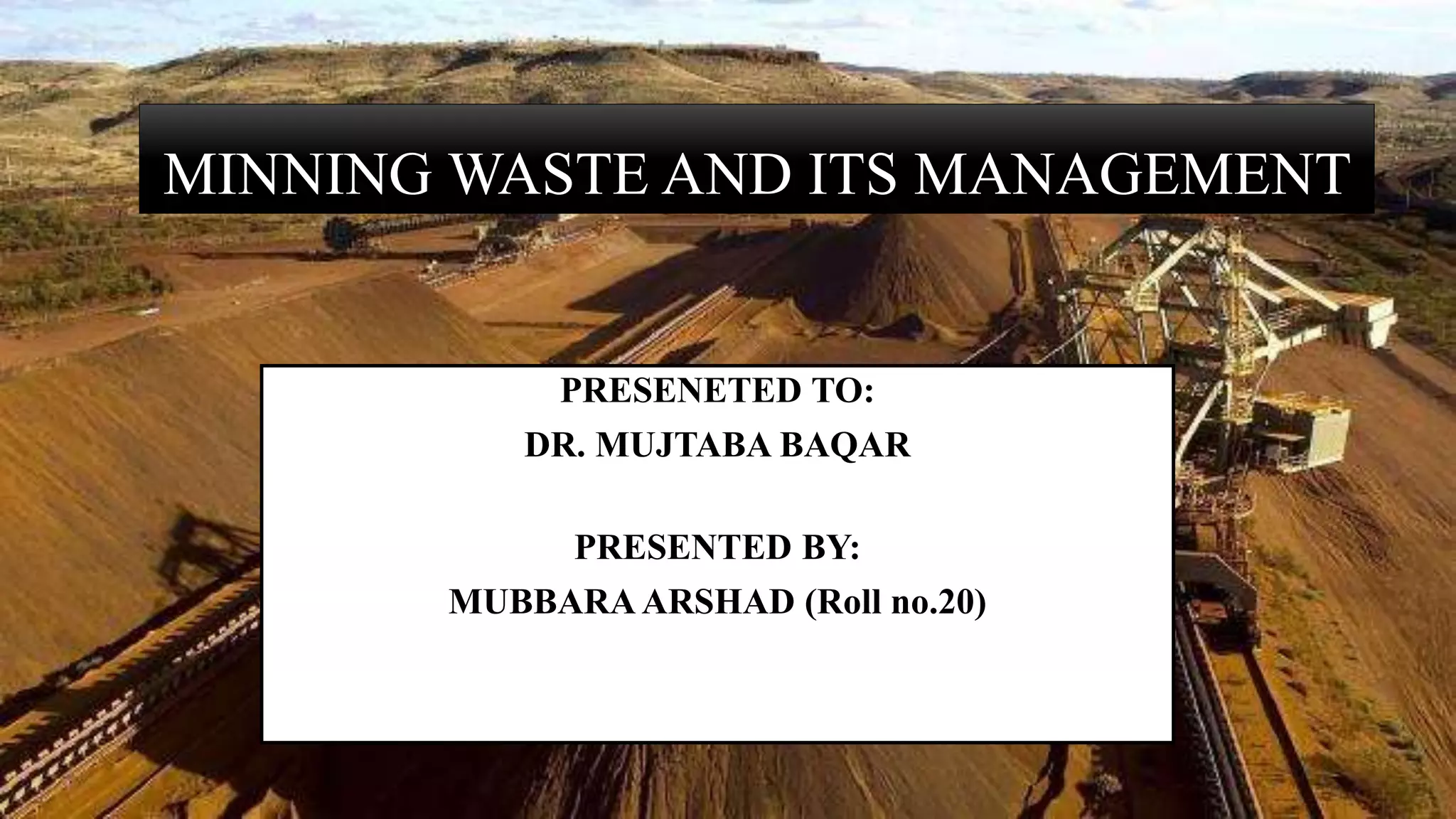
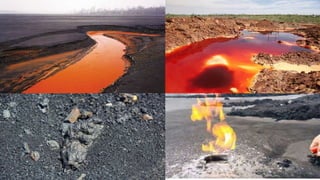
MINNING WASTE AND ITS MANAGEMENT
PRESENETED TO:
DR. MUJTABA BAQAR
PRESENTED BY:
MUBBARA ARSHAD (Roll no.20)
OVERVIEW
• Mining
• Types Of Mining
• Mining Methods
• Importance Of Mining
• Determination Of The Potential
Polluting Capacities
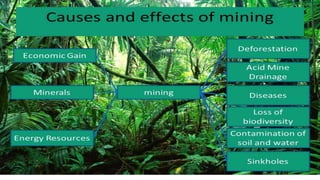
• Causes And Effects Of Mining
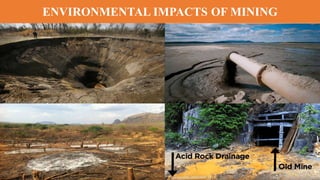
• Environmental Impacts Of
Mining
• Waste Types Produced By
Mining Activity
• Mining Waste Management
• Sector-specific Wastes Generated
During Mining
• Management Practices
• Major Concerns
• Commercial Use Of Waste Product
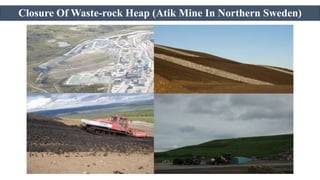
• Closure Of Waste-rock Heap (Atik
Mine In Northern Sweden
• Conclusion
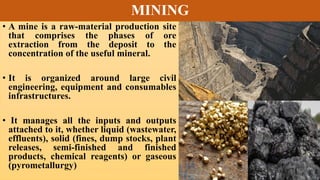
MINING
• A mine is a raw-material production site
that comprises the phases of ore
extraction from the deposit to the
concentration of the useful mineral.
• It is organized around large civil
engineering, equipment and consumables
infrastructures.
• It manages all the inputs and outputs
attached to it, whether liquid (wastewater,
effluents), solid (fines, dump stocks, plant
releases, semi-finished and finished
products, chemical reagents) or gaseous
(pyrometallurgy)
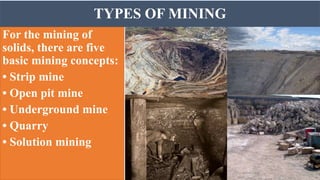
TYPES OF MINING
For the mining of
solids, there are five
basic mining concepts:
• Strip mine
• Open pit mine
• Underground mine
• Quarry
• Solution mining
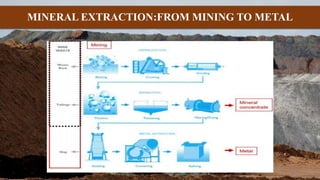
MINERAL EXTRACTION:FROM MINING TO METAL
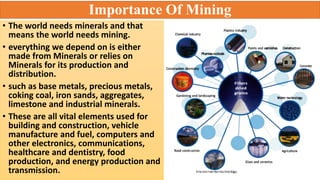
Importance Of Mining
• The world needs minerals and that
means the world needs mining.
• everything we depend on is either
made from Minerals or relies on
Minerals for its production and
distribution.
• such as base metals, precious metals,
coking coal, iron sands, aggregates,
limestone and industrial minerals.
• These are all vital elements used for
building and construction, vehicle
manufacture and fuel, computers and
other electronics, communications,
healthcare and dentistry, food
production, and energy production and
transmission.
Determination of the Potential Polluting Capacities
The quantities of the various types of mining waste and their potential
polluting capacities are determined by:
• The substance, which may undergo processing (i.e. its mineralogical
context and its association with other elements)
• The characteristics of the layer (depth, nature, size)
• The environment in which the waste is disposed and the regulatory
regime in place at the time.
• The time of the mining activity (economic context, treatment used, age
of the waste.
ENVIRONMENTAL IMPACTS OF MINING
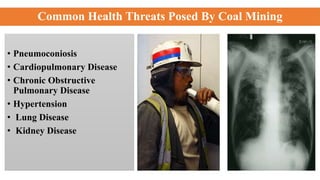
Common Health Threats Posed By Coal Mining
• Pneumoconiosis
• Cardiopulmonary Disease
• Chronic Obstructive
Pulmonary Disease
• Hypertension
• Lung Disease
• Kidney Disease
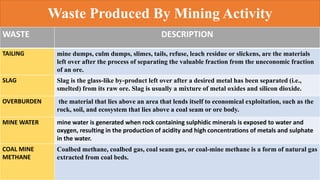
Waste Produced By Mining Activity
WASTE DESCRIPTION
TAILING mine dumps, culm dumps, slimes, tails, refuse, leach residue or slickens, are the materials
left over after the process of separating the valuable fraction from the uneconomic fraction
of an ore.
SLAG Slag is the glass-like by-product left over after a desired metal has been separated (i.e.,
smelted) from its raw ore. Slag is usually a mixture of metal oxides and silicon dioxide.
OVERBURDEN the material that lies above an area that lends itself to economical exploitation, such as the
rock, soil, and ecosystem that lies above a coal seam or ore body.
MINE WATER mine water is generated when rock containing sulphidic minerals is exposed to water and
oxygen, resulting in the production of acidity and high concentrations of metals and sulphate
in the water.
COAL MINE
METHANE
Coalbed methane, coalbed gas, coal seam gas, or coal-mine methane is a form of natural gas
extracted from coal beds.
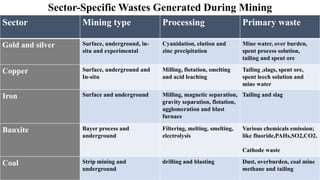
Sector-Specific Wastes Generated During Mining
Sector Mining type Processing Primary waste
Gold and silver Surface, underground, in-
situ and experimental
Cyanidation, elution and
zinc precipitation
Mine water, over burden,
spent process solution,
tailing and spent ore
Copper Surface, underground and
In-situ
Milling, flotation, smelting
and acid leaching
Tailing ,slags, spent ore,
spent leech solution and
mine water
Iron Surface and underground Milling, magnetic separation,
gravity separation, flotation,
agglomeration and blast
furnace
Tailing and slag
Bauxite Bayer process and
underground
Filtering, melting, smelting,
electrolysis
Various chemicals emission;
like fluoride,PAHs,SO2,CO2.
Cathode waste
Coal Strip mining and
underground
drilling and blasting Dust, overburden, coal mine
methane and tailing
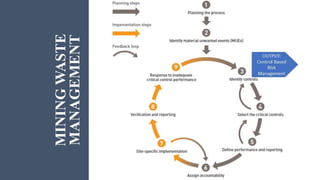
MININGWASTE
MANAGEMENT
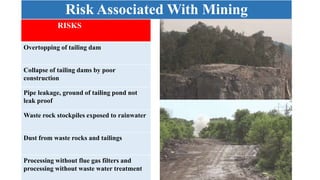
Risk Associated With Mining
RISKS
Overtopping of tailing dam
Collapse of tailing dams by poor
construction
Pipe leakage, ground of tailing pond not
leak proof
Waste rock stockpiles exposed to rainwater
Dust from waste rocks and tailings
Processing without flue gas filters and
processing without waste water treatment
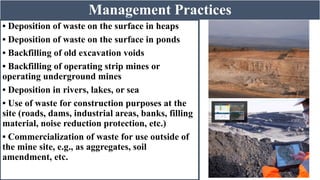
Management Practices
• Deposition of waste on the surface in heaps
• Deposition of waste on the surface in ponds
• Backfilling of old excavation voids
• Backfilling of operating strip mines or
operating underground mines
• Deposition in rivers, lakes, or sea
• Use of waste for construction purposes at the
site (roads, dams, industrial areas, banks, filling
material, noise reduction protection, etc.)
• Commercialization of waste for use outside of
the mine site, e.g., as aggregates, soil
amendment, etc.
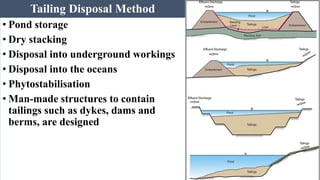
Tailing Disposal Method
• Pond storage
• Dry stacking
• Disposal into underground workings
• Disposal into the oceans
• Phytostabilisation
• Man-made structures to contain
tailings such as dykes, dams and
berms, are designed
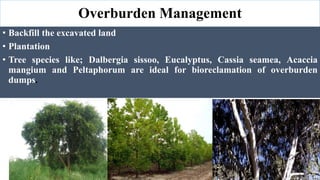
Overburden Management
• Backfill the excavated land
• Plantation
• Tree species like; Dalbergia sissoo, Eucalyptus, Cassia seamea, Acaccia
mangium and Peltaphorum are ideal for bioreclamation of overburden
dumps.
Management PracticesMajor concerns Management practices on the site (Solutions )
Public Health
And Safety
• Restricting emanating areas to a minimum size and number and keeping tailings moist can
reduce total emissions.
• Using barren cover for keeping the dusting areas damp and implementing controls on dust
discharging process areas.
• Monitoring of dust exposure includes use of active air sampling, passive dust collectors or
more novel approaches such as sticky paper collectors or moss collectors.
Water Bodies
(ground
water ,
surface
water)
• Intercepting groundwater around mines and waste management areas with dewatering
wells up-gradient of the mine;
• Diverting clean surface water around or away from mining operations;
• lining mine shafts with concrete or grout or constructing a freeze wall to minimize
groundwater inflows;
• reusing treated wastewater for mill process water or producing reagents
Leaching • Water balance modelling
• Rigorous monitoring programme
• Monitoring wells installation in the strategic locations
W
a
s
t
e
R
o
c
k
s
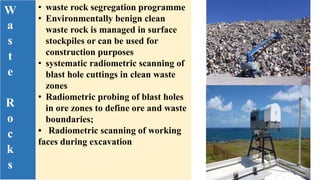
• waste rock segregation programme
• Environmentally benign clean
waste rock is managed in surface
stockpiles or can be used for
construction purposes
• systematic radiometric scanning of
blast hole cuttings in clean waste
zones
• Radiometric probing of blast holes
in ore zones to define ore and waste
boundaries;
• Radiometric scanning of working
faces during excavation
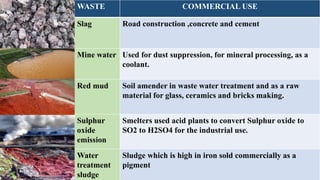
WASTE COMMERCIAL USE
Slag Road construction ,concrete and cement
Mine water Used for dust suppression, for mineral processing, as a
coolant.
Red mud Soil amender in waste water treatment and as a raw
material for glass, ceramics and bricks making.
Sulphur
oxide
emission
Smelters used acid plants to convert Sulphur oxide to
SO2 to H2SO4 for the industrial use.
Water
treatment
sludge
Sludge which is high in iron sold commercially as a
pigment
Atik Mine In Northern Sweden
• The mining started in 1968 and was planned to last at least until 2029.
• Largest copper mine in Europe
• in 2014, more than 67,000 t of copper, almost 55 t of silver and 1.8 t of gold were
produced.
• climate at the Atik area is sub-arctic with an average temperature of just +0.6 °C. 5
km long, 500 m wide and sheared in a north-south direction.
• host rock of the Atik deposit contains metamorphosed paleoproterozoic volcanic
muscovite schists, biotite gneisses, and amphibole-biotite gneisses and was formed
around 1.89 Ga ago.
• Only around 10 kg of concentrate is produced from one tonne of ore, and as a result,
99% of the ore ends up as waste.
• Tailings pond with a size of around 13 km2 is the largest single component on the site .
• Most important objectives of the closure and remediation work in the Aitik has been
to find a qualified waste rock cover solution. Boliden has developed a plan aiming to
successful reclamation of the waste rock areas. According to the plan, the reclamation
work will progress approximately 20 hectares every year after the final areas have
been filled out
Atik Mine In Northern Sweden; Results
• Atik mine site to find suitable technological solutions for the
reclamation of waste areas after the mine closure.
• The enormous size of the mine and the Northern climatic
conditions bring special characteristics to the closure
planning.
• the current requirements on minimization of waste, use of
resources and reduced environmental impacts.
Closure Of Waste-rock Heap (Atik Mine In Northern Sweden)
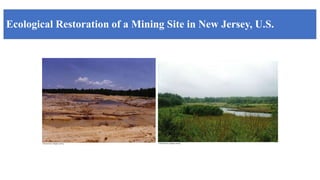
Ecological Restoration of a Mining Site in New Jersey, U.S.
CONCLUSION
• Not only does it play a vital role in the economies of
many developing countries, it also generates metals
and minerals that are components of everyday life.
• Mining activities may also cause distinct changes in
topography, hydrology and stability of a landscape.
• Proper legal framework, monitoring and on time
strict management and proper reuse activities.
QUESTIONS? ? ?

Minning waste management

  • 1.
    MINNING WASTE ANDITS MANAGEMENT PRESENETED TO: DR. MUJTABA BAQAR PRESENTED BY: MUBBARA ARSHAD (Roll no.20)
  • 2.
    OVERVIEW • Mining • TypesOf Mining • Mining Methods • Importance Of Mining • Determination Of The Potential Polluting Capacities • Causes And Effects Of Mining • Environmental Impacts Of Mining • Waste Types Produced By Mining Activity • Mining Waste Management • Sector-specific Wastes Generated During Mining • Management Practices • Major Concerns • Commercial Use Of Waste Product • Closure Of Waste-rock Heap (Atik Mine In Northern Sweden • Conclusion
  • 3.
    MINING • A mineis a raw-material production site that comprises the phases of ore extraction from the deposit to the concentration of the useful mineral. • It is organized around large civil engineering, equipment and consumables infrastructures. • It manages all the inputs and outputs attached to it, whether liquid (wastewater, effluents), solid (fines, dump stocks, plant releases, semi-finished and finished products, chemical reagents) or gaseous (pyrometallurgy)
  • 4.
    TYPES OF MINING Forthe mining of solids, there are five basic mining concepts: • Strip mine • Open pit mine • Underground mine • Quarry • Solution mining
  • 5.
  • 6.
    Importance Of Mining •The world needs minerals and that means the world needs mining. • everything we depend on is either made from Minerals or relies on Minerals for its production and distribution. • such as base metals, precious metals, coking coal, iron sands, aggregates, limestone and industrial minerals. • These are all vital elements used for building and construction, vehicle manufacture and fuel, computers and other electronics, communications, healthcare and dentistry, food production, and energy production and transmission.
  • 7.
    Determination of thePotential Polluting Capacities The quantities of the various types of mining waste and their potential polluting capacities are determined by: • The substance, which may undergo processing (i.e. its mineralogical context and its association with other elements) • The characteristics of the layer (depth, nature, size) • The environment in which the waste is disposed and the regulatory regime in place at the time. • The time of the mining activity (economic context, treatment used, age of the waste.
  • 9.
  • 10.
    Common Health ThreatsPosed By Coal Mining • Pneumoconiosis • Cardiopulmonary Disease • Chronic Obstructive Pulmonary Disease • Hypertension • Lung Disease • Kidney Disease
  • 11.
    Waste Produced ByMining Activity WASTE DESCRIPTION TAILING mine dumps, culm dumps, slimes, tails, refuse, leach residue or slickens, are the materials left over after the process of separating the valuable fraction from the uneconomic fraction of an ore. SLAG Slag is the glass-like by-product left over after a desired metal has been separated (i.e., smelted) from its raw ore. Slag is usually a mixture of metal oxides and silicon dioxide. OVERBURDEN the material that lies above an area that lends itself to economical exploitation, such as the rock, soil, and ecosystem that lies above a coal seam or ore body. MINE WATER mine water is generated when rock containing sulphidic minerals is exposed to water and oxygen, resulting in the production of acidity and high concentrations of metals and sulphate in the water. COAL MINE METHANE Coalbed methane, coalbed gas, coal seam gas, or coal-mine methane is a form of natural gas extracted from coal beds.
  • 13.
    Sector-Specific Wastes GeneratedDuring Mining Sector Mining type Processing Primary waste Gold and silver Surface, underground, in- situ and experimental Cyanidation, elution and zinc precipitation Mine water, over burden, spent process solution, tailing and spent ore Copper Surface, underground and In-situ Milling, flotation, smelting and acid leaching Tailing ,slags, spent ore, spent leech solution and mine water Iron Surface and underground Milling, magnetic separation, gravity separation, flotation, agglomeration and blast furnace Tailing and slag Bauxite Bayer process and underground Filtering, melting, smelting, electrolysis Various chemicals emission; like fluoride,PAHs,SO2,CO2. Cathode waste Coal Strip mining and underground drilling and blasting Dust, overburden, coal mine methane and tailing
  • 14.
  • 15.
    Risk Associated WithMining RISKS Overtopping of tailing dam Collapse of tailing dams by poor construction Pipe leakage, ground of tailing pond not leak proof Waste rock stockpiles exposed to rainwater Dust from waste rocks and tailings Processing without flue gas filters and processing without waste water treatment
  • 16.
    Management Practices • Depositionof waste on the surface in heaps • Deposition of waste on the surface in ponds • Backfilling of old excavation voids • Backfilling of operating strip mines or operating underground mines • Deposition in rivers, lakes, or sea • Use of waste for construction purposes at the site (roads, dams, industrial areas, banks, filling material, noise reduction protection, etc.) • Commercialization of waste for use outside of the mine site, e.g., as aggregates, soil amendment, etc.
  • 17.
    Tailing Disposal Method •Pond storage • Dry stacking • Disposal into underground workings • Disposal into the oceans • Phytostabilisation • Man-made structures to contain tailings such as dykes, dams and berms, are designed
  • 18.
    Overburden Management • Backfillthe excavated land • Plantation • Tree species like; Dalbergia sissoo, Eucalyptus, Cassia seamea, Acaccia mangium and Peltaphorum are ideal for bioreclamation of overburden dumps.
  • 19.
    Management PracticesMajor concernsManagement practices on the site (Solutions ) Public Health And Safety • Restricting emanating areas to a minimum size and number and keeping tailings moist can reduce total emissions. • Using barren cover for keeping the dusting areas damp and implementing controls on dust discharging process areas. • Monitoring of dust exposure includes use of active air sampling, passive dust collectors or more novel approaches such as sticky paper collectors or moss collectors. Water Bodies (ground water , surface water) • Intercepting groundwater around mines and waste management areas with dewatering wells up-gradient of the mine; • Diverting clean surface water around or away from mining operations; • lining mine shafts with concrete or grout or constructing a freeze wall to minimize groundwater inflows; • reusing treated wastewater for mill process water or producing reagents Leaching • Water balance modelling • Rigorous monitoring programme • Monitoring wells installation in the strategic locations
  • 20.
    W a s t e R o c k s • waste rocksegregation programme • Environmentally benign clean waste rock is managed in surface stockpiles or can be used for construction purposes • systematic radiometric scanning of blast hole cuttings in clean waste zones • Radiometric probing of blast holes in ore zones to define ore and waste boundaries; • Radiometric scanning of working faces during excavation
  • 21.
    WASTE COMMERCIAL USE SlagRoad construction ,concrete and cement Mine water Used for dust suppression, for mineral processing, as a coolant. Red mud Soil amender in waste water treatment and as a raw material for glass, ceramics and bricks making. Sulphur oxide emission Smelters used acid plants to convert Sulphur oxide to SO2 to H2SO4 for the industrial use. Water treatment sludge Sludge which is high in iron sold commercially as a pigment
  • 22.
    Atik Mine InNorthern Sweden • The mining started in 1968 and was planned to last at least until 2029. • Largest copper mine in Europe • in 2014, more than 67,000 t of copper, almost 55 t of silver and 1.8 t of gold were produced. • climate at the Atik area is sub-arctic with an average temperature of just +0.6 °C. 5 km long, 500 m wide and sheared in a north-south direction. • host rock of the Atik deposit contains metamorphosed paleoproterozoic volcanic muscovite schists, biotite gneisses, and amphibole-biotite gneisses and was formed around 1.89 Ga ago. • Only around 10 kg of concentrate is produced from one tonne of ore, and as a result, 99% of the ore ends up as waste. • Tailings pond with a size of around 13 km2 is the largest single component on the site . • Most important objectives of the closure and remediation work in the Aitik has been to find a qualified waste rock cover solution. Boliden has developed a plan aiming to successful reclamation of the waste rock areas. According to the plan, the reclamation work will progress approximately 20 hectares every year after the final areas have been filled out
  • 23.
    Atik Mine InNorthern Sweden; Results • Atik mine site to find suitable technological solutions for the reclamation of waste areas after the mine closure. • The enormous size of the mine and the Northern climatic conditions bring special characteristics to the closure planning. • the current requirements on minimization of waste, use of resources and reduced environmental impacts.
  • 24.
    Closure Of Waste-rockHeap (Atik Mine In Northern Sweden)
  • 25.
    Ecological Restoration ofa Mining Site in New Jersey, U.S.
  • 26.
    CONCLUSION • Not onlydoes it play a vital role in the economies of many developing countries, it also generates metals and minerals that are components of everyday life. • Mining activities may also cause distinct changes in topography, hydrology and stability of a landscape. • Proper legal framework, monitoring and on time strict management and proper reuse activities.
  • 27.