Introduction
Special Facts About Magnesium:
 Joseph Black recognized magnesium as an element in 1755
 Magnesium, light metal has a density of 1783 kg/m3, (high-strength-to weight
ratios) which is two thirds of aluminum and one sixth of steel
 Due to magnesium ion's high solubility in water, it is the third most-abundant element dissolved in seawater.
 Alloys of magnesium have good corrosion resistance, good machinability, good dimensional stability and
damping capacity
 ORE:
Dolomite (CaMg(CO3)2) Magnesite (MgCO3) Carnallite(KMgCl3.6H2O)
 In the iron and steel industry, magnesium is added for producing SG iron by transforming graphite into
spherical nodules, thereby improving the strength and malleability of the iron.
 Used in production of titanium from titanium tetrachloride
 Magnesium blended with lime or other fillers is injected into liquid blast-furnace iron, where it improves
mechanical properties of steel by combining with sulfur and oxygen.
Applications
Magnesium side panels Aerospace applications Alloyed wheel
Car parts Mobile phone bodies Camera bodies
Pyrometallurgy deals with the methods of extraction of metals from their ores and their refining
and is based on physical and chemical changes occurring at high temperatures, i.e. 500-2000°C.
Pyro-metallurgical extraction
• Lower capital costs
• High production rates
• Physical separation of product metal from the gangue easy
Advantages
• Cannot be developed to commercial operation in small scale
• Lean grade ore not suitable
• High temp is required for reduction
Dis-Advantage
 Pyro metallurgical route for magnesium extraction is silico-thermic process which are
1.Pidgeon process 2. Bolzano Process 3. Magnetherm Process
Pidgeon Process
Reducing molten magnesium oxide slag by ferrosilicon under low gas pressure at a
temperature of about 1400C
STEPS INVOLVED:
 Ratio of Calcine dolomite : ferrosilicon as briquettes = 6:1
 A pressure of 0.1 mm Hg is maintained inside the reactor
 Gas or electricity is used as the source of heat
 Magnesium vapor condenses in the cooler regions of the retort
 Reaction cycle time is about 8 hours
 At the end the retort is opened and the solid magnesium is recovered
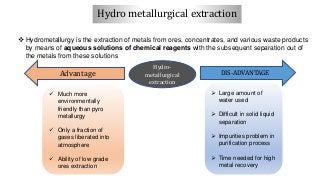
Hydro metallurgical extraction
 Hydrometallurgy is the extraction of metals from ores, concentrates, and various waste products
by means of aqueous solutions of chemical reagents with the subsequent separation out of
the metals from these solutions
DIS-ADVANTAGEAdvantage
Hydro-
metallurgical
extraction
 Large amount of
water used
 Difficult in solid liquid
separation
 Impurities problem in
purification process
 Time needed for high
metal recovery
 Much more
environmentally
friendly than pyro
metallurgy
 Only a fraction of
gases liberated into
atmosphere
 Ability of low grade
ores extraction
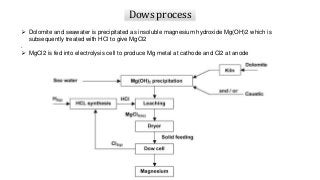
Dows process
 Dolomite and seawater is precipitated as insoluble magnesium hydroxide Mg(OH)2 which is
subsequently treated with HCl to give MgCl2
.
 MgCl2 is fed into electrolysis cell to produce Mg metal at cathode and Cl2 at anode
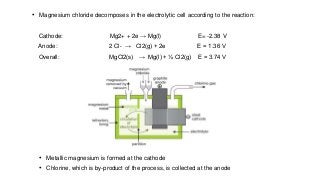
• Magnesium chloride decomposes in the electrolytic cell according to the reaction:
Cathode: Mg2+ + 2e → Mg(l) E= -2.38 V
Anode: 2 Cl- → Cl2(g) + 2e E = 1.36 V
Overall: MgCl2(s) → Mg(l) + ½ Cl2(g) E = 3.74 V
• Metallic magnesium is formed at the cathode
• Chlorine, which is by-product of the process, is collected at the anode
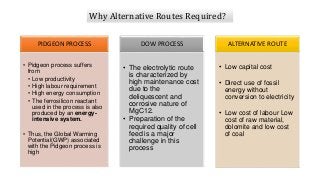
Why Alternative Routes Required?
PIDGEON PROCESS
• Pidgeon process suffers
from
• Low productivity
• High labour requirement
• High energy consumption
• The ferrosilicon reactant
used in the process is also
produced by an energy-
intensive system.
• Thus, the Global Warming
Potential(GWP) associated
with the Pidgeon process is
high
DOW PROCESS
• The electrolytic route
is characterized by
high maintenance cost
due to the
deliquescent and
corrosive nature of
MgC12.
• Preparation of the
required quality of cell
feed is a major
challenge in this
process
ALTERNATIVE ROUTE
• Low capital cost
• Direct use of fossil
energy without
conversion to electricity
• Low cost of labour Low
cost of raw material,
dolomite and low cost
of coal
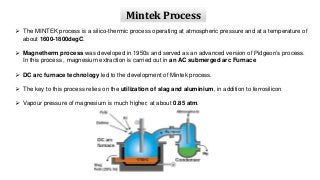
 The MINTEK process is a silico-thermic process operating at atmospheric pressure and at a temperature of
about 1600-1800degC.
 Magnetherm process was developed in 1950s and served as an advanced version of Pidgeon’s process.
In this process , magnesium extraction is carried out in an AC submerged arc Furnace
 DC arc furnace technology led to the development of Mintek process.
 The key to this process relies on the utilization of slag and aluminium, in addition to ferrosilicon
 Vapour pressure of magnesium is much higher, at about 0.85 atm.
Mintek Process
The Solid Oxide Membrane (SOM) process
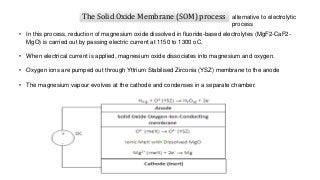
• In this process, reduction of magnesium oxide dissolved in fluoride-based electrolytes (MgF2-CaF2-
MgO) is carried out by passing electric current at 1150 to 1300 oC.
• When electrical current is applied, magnesium oxide dissociates into magnesium and oxygen.
• Oxygen ions are pumped out through Yttrium Stabilised Zirconia (YSZ) membrane to the anode
• The magnesium vapour evolves at the cathode and condenses in a separate chamber.
alternative to electrolytic
process
Carbothermic routes
• Alternative to both silicothermic and electrolytic process.
• The process involves carbon to reduce magnesium oxide which produces magnesium vapour
and carbon monoxide gas above 1500 oC.
The overall reaction can be written as:
MgO(s) + C(s) = Mg(s) + CO(g)
Problem:
• The shortcomings come from the reverse reaction of magnesium vapour and carbon monoxide
gas as the mixture is cooled down. This result in fine magnesium powder contaminated with
magnesium oxide
Solution:
• To overcome the reversion issue on two process routes: The “quench” route and the “solvent
route”.
• In the “quench” route, magnesium and CO are generated are rapidly quenched and recovered.
• In the ‘solvent’ route agglomerated feed is fed into the reduction phase containing a molten
metal solvent in which magnesium formed from reduction dissolved in the molten metal while the
CO gas librates.
 The process is currently very theoretical and requires significant work
before it can be developed
 The light weighting of transportation and alloy development will continue be the
driving force of the increasing demand of magnesium metal
 Magnesium production consumes greater energy than other metal production
routes due to its oxide chemical stability.
 In particular, the Pidgeon process as the dominant production route in the world
has high energy consumption which leads to high a Global Warming Potential.
CONCLUSIONS
 Thus, technology improvement is essential to achieve lower energy
usage and a sustainable future
 New processes such as Carbothermic and the Mintek process are
high productivity alternatives to the existing technologies that still
require further development.

extraction of magnesium

  • 1.
    Introduction Special Facts AboutMagnesium:  Joseph Black recognized magnesium as an element in 1755  Magnesium, light metal has a density of 1783 kg/m3, (high-strength-to weight ratios) which is two thirds of aluminum and one sixth of steel  Due to magnesium ion's high solubility in water, it is the third most-abundant element dissolved in seawater.  Alloys of magnesium have good corrosion resistance, good machinability, good dimensional stability and damping capacity  ORE: Dolomite (CaMg(CO3)2) Magnesite (MgCO3) Carnallite(KMgCl3.6H2O)
  • 2.
     In theiron and steel industry, magnesium is added for producing SG iron by transforming graphite into spherical nodules, thereby improving the strength and malleability of the iron.  Used in production of titanium from titanium tetrachloride  Magnesium blended with lime or other fillers is injected into liquid blast-furnace iron, where it improves mechanical properties of steel by combining with sulfur and oxygen. Applications Magnesium side panels Aerospace applications Alloyed wheel Car parts Mobile phone bodies Camera bodies
  • 3.
    Pyrometallurgy deals withthe methods of extraction of metals from their ores and their refining and is based on physical and chemical changes occurring at high temperatures, i.e. 500-2000°C. Pyro-metallurgical extraction • Lower capital costs • High production rates • Physical separation of product metal from the gangue easy Advantages • Cannot be developed to commercial operation in small scale • Lean grade ore not suitable • High temp is required for reduction Dis-Advantage  Pyro metallurgical route for magnesium extraction is silico-thermic process which are 1.Pidgeon process 2. Bolzano Process 3. Magnetherm Process
  • 4.
    Pidgeon Process Reducing moltenmagnesium oxide slag by ferrosilicon under low gas pressure at a temperature of about 1400C STEPS INVOLVED:  Ratio of Calcine dolomite : ferrosilicon as briquettes = 6:1  A pressure of 0.1 mm Hg is maintained inside the reactor  Gas or electricity is used as the source of heat  Magnesium vapor condenses in the cooler regions of the retort  Reaction cycle time is about 8 hours  At the end the retort is opened and the solid magnesium is recovered
  • 5.
    Hydro metallurgical extraction Hydrometallurgy is the extraction of metals from ores, concentrates, and various waste products by means of aqueous solutions of chemical reagents with the subsequent separation out of the metals from these solutions DIS-ADVANTAGEAdvantage Hydro- metallurgical extraction  Large amount of water used  Difficult in solid liquid separation  Impurities problem in purification process  Time needed for high metal recovery  Much more environmentally friendly than pyro metallurgy  Only a fraction of gases liberated into atmosphere  Ability of low grade ores extraction
  • 6.
    Dows process  Dolomiteand seawater is precipitated as insoluble magnesium hydroxide Mg(OH)2 which is subsequently treated with HCl to give MgCl2 .  MgCl2 is fed into electrolysis cell to produce Mg metal at cathode and Cl2 at anode
  • 7.
    • Magnesium chloridedecomposes in the electrolytic cell according to the reaction: Cathode: Mg2+ + 2e → Mg(l) E= -2.38 V Anode: 2 Cl- → Cl2(g) + 2e E = 1.36 V Overall: MgCl2(s) → Mg(l) + ½ Cl2(g) E = 3.74 V • Metallic magnesium is formed at the cathode • Chlorine, which is by-product of the process, is collected at the anode
  • 8.
    Why Alternative RoutesRequired? PIDGEON PROCESS • Pidgeon process suffers from • Low productivity • High labour requirement • High energy consumption • The ferrosilicon reactant used in the process is also produced by an energy- intensive system. • Thus, the Global Warming Potential(GWP) associated with the Pidgeon process is high DOW PROCESS • The electrolytic route is characterized by high maintenance cost due to the deliquescent and corrosive nature of MgC12. • Preparation of the required quality of cell feed is a major challenge in this process ALTERNATIVE ROUTE • Low capital cost • Direct use of fossil energy without conversion to electricity • Low cost of labour Low cost of raw material, dolomite and low cost of coal
  • 9.
     The MINTEKprocess is a silico-thermic process operating at atmospheric pressure and at a temperature of about 1600-1800degC.  Magnetherm process was developed in 1950s and served as an advanced version of Pidgeon’s process. In this process , magnesium extraction is carried out in an AC submerged arc Furnace  DC arc furnace technology led to the development of Mintek process.  The key to this process relies on the utilization of slag and aluminium, in addition to ferrosilicon  Vapour pressure of magnesium is much higher, at about 0.85 atm. Mintek Process
  • 10.
    The Solid OxideMembrane (SOM) process • In this process, reduction of magnesium oxide dissolved in fluoride-based electrolytes (MgF2-CaF2- MgO) is carried out by passing electric current at 1150 to 1300 oC. • When electrical current is applied, magnesium oxide dissociates into magnesium and oxygen. • Oxygen ions are pumped out through Yttrium Stabilised Zirconia (YSZ) membrane to the anode • The magnesium vapour evolves at the cathode and condenses in a separate chamber. alternative to electrolytic process
  • 11.
    Carbothermic routes • Alternativeto both silicothermic and electrolytic process. • The process involves carbon to reduce magnesium oxide which produces magnesium vapour and carbon monoxide gas above 1500 oC. The overall reaction can be written as: MgO(s) + C(s) = Mg(s) + CO(g) Problem: • The shortcomings come from the reverse reaction of magnesium vapour and carbon monoxide gas as the mixture is cooled down. This result in fine magnesium powder contaminated with magnesium oxide Solution: • To overcome the reversion issue on two process routes: The “quench” route and the “solvent route”. • In the “quench” route, magnesium and CO are generated are rapidly quenched and recovered. • In the ‘solvent’ route agglomerated feed is fed into the reduction phase containing a molten metal solvent in which magnesium formed from reduction dissolved in the molten metal while the CO gas librates.  The process is currently very theoretical and requires significant work before it can be developed
  • 12.
     The lightweighting of transportation and alloy development will continue be the driving force of the increasing demand of magnesium metal  Magnesium production consumes greater energy than other metal production routes due to its oxide chemical stability.  In particular, the Pidgeon process as the dominant production route in the world has high energy consumption which leads to high a Global Warming Potential. CONCLUSIONS  Thus, technology improvement is essential to achieve lower energy usage and a sustainable future  New processes such as Carbothermic and the Mintek process are high productivity alternatives to the existing technologies that still require further development.