Made by
Simrat
 Firstly completely American Psychology
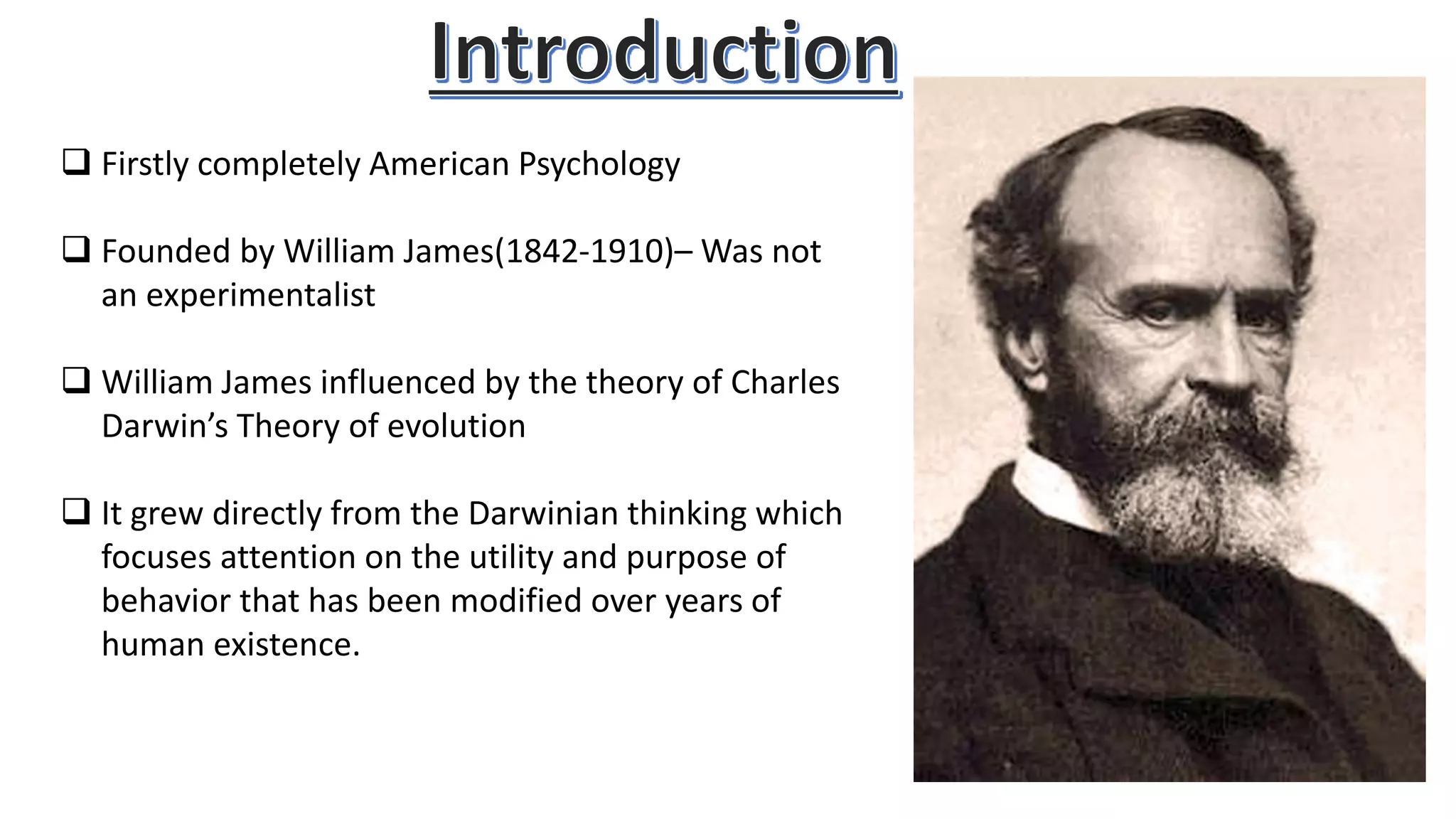
 Founded by William James(1842-1910)– Was not
an experimentalist
 William James influenced by the theory of Charles
Darwin’s Theory of evolution
 It grew directly from the Darwinian thinking which
focuses attention on the utility and purpose of
behavior that has been modified over years of
human existence.
 Functionalism began as a rebellion against the structural approach for being
• Narrow
• Artificial
• Pointless
 They protested against the restrictions and limitations of Wundt’s version of
psychology and of Titchener’s structuralism, but they did not want to replace these
with another formal “-ism”.
 Rejected the idea that the conscious mind had a permanent structure or blue-print of
the mind.
 No aim to start another school of thought or system.
 It incorporated many of the characteristics of a school of thought, but that was the goal
of the leaders.
 Scholars associated with the founding of functionalism had no ambition to
start a new school of thought.
 Many functional psychologists coexisted at one time- each differed in
someway or the other. Although each of them interested in studying the
function of consciousness.
 No single Functional psychology , whereas only one structural psychology.
 Main interest in potential application of psychology.
 Not associated with a single dominant theorist.
 Lack of a central leader or formalized set of ideas.
 Major Premise:-- Mental Processes help/cause human beings
to adapt to their everyday environment
 Primary Interest in this approach:-- Function of mental
processes
 Functionalism conceived of a fundamental set of values and
procedures emphasizing adaptive acts and empirically
demonstrated functional relationships has remained a strong
influence in psychology and even today represents much of the
main stream of American Psychology.
 Stream of Consciousness– Conscious Experience was like a river that was
always changing and flowing.
 The conscious mind enabled people to make rational choices which in
turn helped them to survive generation after generation
 Functionalists more concerned with the function of mental processes
play in our life than on breaking consciousness into smaller elements.
 To William James, how the mind allows people to function in the real
world – how people play, work and adapt to their surroundings, is what
he called functionalism.
Functionalists:
 Oppose the search for the elements of consciousness as futile.
 Believe that the mind has the function of helping us adapt to the environment. They want to
understand the function of the mind, the ways it helps us adapt.
 Want psychology to be practical, not pure science.
 Want psychology to be broadened to include research on animals, children, and atypical
humans.
 Believed the needs and motivations of the organism should be understood if one wanted to
understand behavior.
 They are more interested in what makes people different from each other than in what makes
them similar.
 They are willing to use a wide variety of methods of study.
Three groups of psychologists who contributed towards forming
Functionalism
1st --- Pioneers --- Laid the ground work, gave the starting and mentioned the
initial postulates --- William James
2nd --- Founders --- Gave the major contribution to make Functionalism as a
system --- John Dewey and James Angell
3rd --- Developers --- Responsible for Maturation and further elaboration of
the system --- Harvey Carr and Robert S. Woodworth
 Considered important in the development of psychology.
 Broadened the scope of psychological research and application.
 The Subject area for psychology undertaken by functionalists is very wide in nature
(not stuck to immediate experiences but also included applied fields).
 It also introduced a wide variety of research techniques that were beyond the
boundaries of structural psychology, like physiological measures, mental tests and
Questionnaires.
Some of the Primary Concepts with functionalism are as following:--
• Collective Conscience
• Value Consensus
• Social Order
• Education
• Family
• Crime and deviance
• Media
A history of Modern Psychology by Duane P. Schultz and Sydney
Ellen Schultz
System and Theories in Psychology by Melvin H. Marx and William A.
Hillix
Internet Sources
https://plato.stanford.edu/entries/functionalism/
https://www.iep.utm.edu/functism/

Functionalism in Psychology

  • 1.
  • 2.
     Firstly completelyAmerican Psychology  Founded by William James(1842-1910)– Was not an experimentalist  William James influenced by the theory of Charles Darwin’s Theory of evolution  It grew directly from the Darwinian thinking which focuses attention on the utility and purpose of behavior that has been modified over years of human existence.
  • 3.
     Functionalism beganas a rebellion against the structural approach for being • Narrow • Artificial • Pointless  They protested against the restrictions and limitations of Wundt’s version of psychology and of Titchener’s structuralism, but they did not want to replace these with another formal “-ism”.  Rejected the idea that the conscious mind had a permanent structure or blue-print of the mind.  No aim to start another school of thought or system.  It incorporated many of the characteristics of a school of thought, but that was the goal of the leaders.
  • 4.
     Scholars associatedwith the founding of functionalism had no ambition to start a new school of thought.  Many functional psychologists coexisted at one time- each differed in someway or the other. Although each of them interested in studying the function of consciousness.  No single Functional psychology , whereas only one structural psychology.  Main interest in potential application of psychology.  Not associated with a single dominant theorist.  Lack of a central leader or formalized set of ideas.
  • 5.
     Major Premise:--Mental Processes help/cause human beings to adapt to their everyday environment  Primary Interest in this approach:-- Function of mental processes  Functionalism conceived of a fundamental set of values and procedures emphasizing adaptive acts and empirically demonstrated functional relationships has remained a strong influence in psychology and even today represents much of the main stream of American Psychology.
  • 6.
     Stream ofConsciousness– Conscious Experience was like a river that was always changing and flowing.  The conscious mind enabled people to make rational choices which in turn helped them to survive generation after generation  Functionalists more concerned with the function of mental processes play in our life than on breaking consciousness into smaller elements.  To William James, how the mind allows people to function in the real world – how people play, work and adapt to their surroundings, is what he called functionalism.
  • 7.
    Functionalists:  Oppose thesearch for the elements of consciousness as futile.  Believe that the mind has the function of helping us adapt to the environment. They want to understand the function of the mind, the ways it helps us adapt.  Want psychology to be practical, not pure science.  Want psychology to be broadened to include research on animals, children, and atypical humans.  Believed the needs and motivations of the organism should be understood if one wanted to understand behavior.  They are more interested in what makes people different from each other than in what makes them similar.  They are willing to use a wide variety of methods of study.
  • 8.
    Three groups ofpsychologists who contributed towards forming Functionalism 1st --- Pioneers --- Laid the ground work, gave the starting and mentioned the initial postulates --- William James 2nd --- Founders --- Gave the major contribution to make Functionalism as a system --- John Dewey and James Angell 3rd --- Developers --- Responsible for Maturation and further elaboration of the system --- Harvey Carr and Robert S. Woodworth
  • 9.
     Considered importantin the development of psychology.  Broadened the scope of psychological research and application.  The Subject area for psychology undertaken by functionalists is very wide in nature (not stuck to immediate experiences but also included applied fields).  It also introduced a wide variety of research techniques that were beyond the boundaries of structural psychology, like physiological measures, mental tests and Questionnaires.
  • 10.
    Some of thePrimary Concepts with functionalism are as following:-- • Collective Conscience • Value Consensus • Social Order • Education • Family • Crime and deviance • Media
  • 11.
    A history ofModern Psychology by Duane P. Schultz and Sydney Ellen Schultz System and Theories in Psychology by Melvin H. Marx and William A. Hillix Internet Sources https://plato.stanford.edu/entries/functionalism/ https://www.iep.utm.edu/functism/