FIRE SAFETYDepartment of architecture, South east university.
50,51 Tajgaon industrial area, Dhaka.
Means of escape:
1. Exit access
2. Exit
3. Exit discharge
Lift & Escalator will not be part of means of escape.
Exit should be always Free, so that man can go through.
General need:
• Exit & exit access corridor should not used as supply work.
• If Floor difference is more than 300 mm , ramp should be used.
• The exit access which is not used by disable & old people,
considerable step will be 200 mm.
• If there are more exit access,
exit sign will be used everywhere.
Placement of fire exit:
• Exit should not open in that place which will close or used for
dangerous work.
• Exit should not be locked.
• In national building, entry area will ½ of user no.
User number:
• In assembly & intuitional building, user number depends on
fixed seat.
• In case of without arm seat, 500 mm width will be provided for
1 user.
• 1 user requires min 0.3 sq.m.
• If roof is used, exit access will provided according to user no.
Size of exit:
Pg-3066,BNBC, 2008
Corridor :
• One sided closed corridor length maximum 10 m.
• Corridor width-
• More than 50 user- 1.1 m
• Less than 50 user- 0.9 m
• Health care building- 2.4 m
• Institution (more than 150 user)- 1.8 m
• Clear height of corridor
should be min 2.4 m.
• Exit access corridor’s fire
rating should be min 1 hr.
• Exit door’s fire rating
should be min ½ hr.
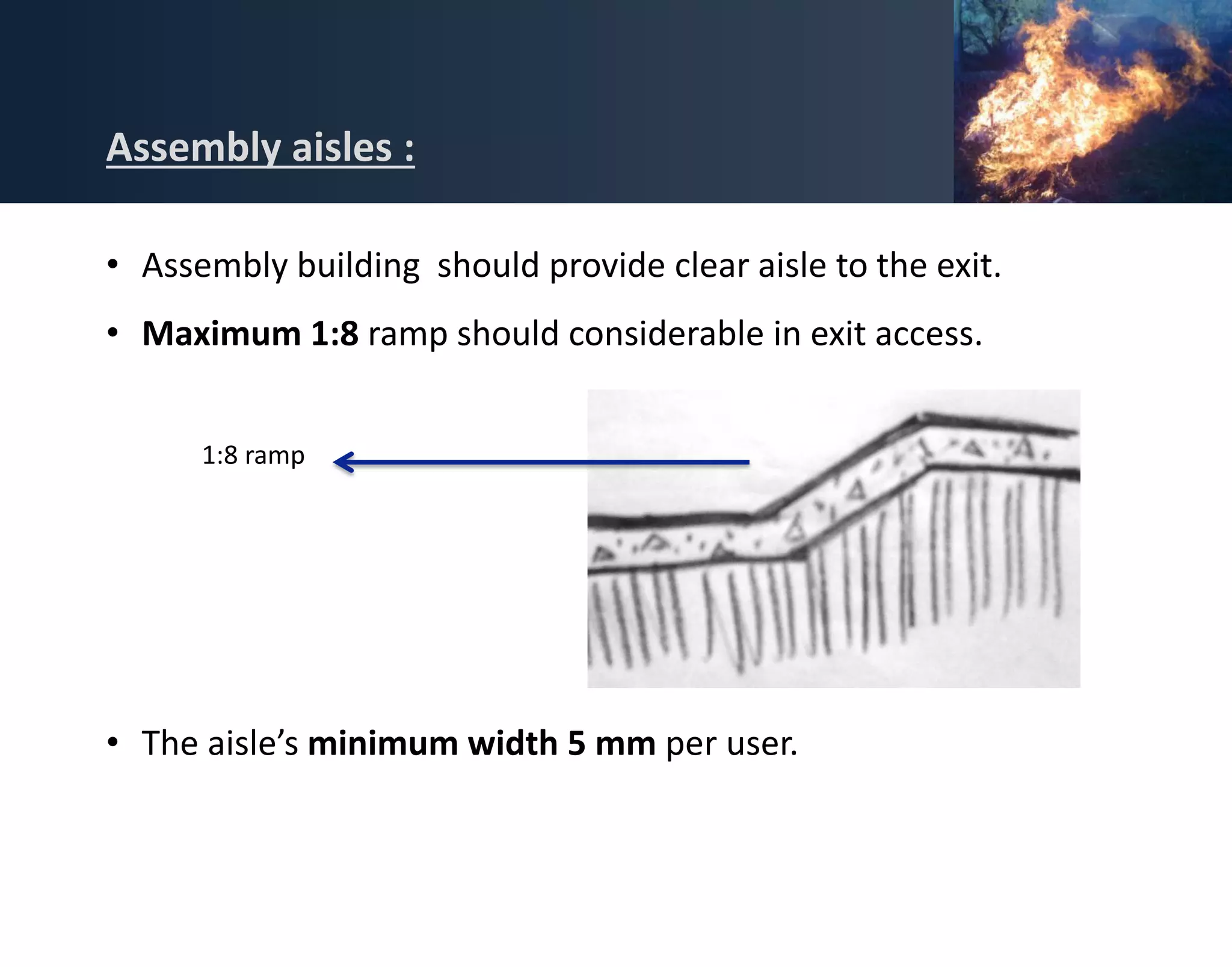
Assembly aisles :
• Assembly building should provide clear aisle to the exit.
• Maximum 1:8 ramp should considerable in exit access.
• The aisle’s minimum width 5 mm per user.
1:8 ramp
• If it will step, then
• tread 275mm
• Riser 100-200 mm
• Aisle width
• For both side seat- 1m
• For single seat- 0.9 m
Doors:
• Following chart will be used for 1 door.
Pg-3067,BNBC, 2008
• Exit door min Width 1 m
Height 2 m
• Sliding or hanging door should not used as fire exit.
• The clear area from door to stair should be min 0.9m
• In assembly & institutional building where more than 200 user,
revolving door should not be used.
Stair :
i. Exit stair’s landing width will not less
than stair width.
ii. In circular & spiral stair,
• stair width 650 mm
• Tread width 200-300 mm.
Fig: i
Fig: ii
• In fire stair, if Clear width is 1 m
1 sided hand rail should be provided
• If clear width is more than 1m,
both sided hand rail needed.
• If clear width is more than 2.2 m,
Hand rail is needed in middle.
• Every Exit stair should be made of fire
resistant material.
• If lift shaft is made of fire resistant
material, then its surrounding stair can
consider as fire stair.
• Outer stair can be used as fire stair if it
ensure opening direct to ground.
Ramp:
i. Slope of exit ramp should not more than 1:12
ii. Ramp surface should be made of non slippery material.
iii. If ramp slope is more than 1:15 , handrail should be provided
both side.
Horizontal exit:
• Exit door should closed itself from the fire hazardous area.
• Exit width is not less than 1m.
• Minimum floor area without stair, lift shaft -
• In refugee camp, 0.28 sq.m. is needed per head.
• In hospital, 2.8 sq.m is needed per bed.
Number of exit:
• Stair number will be derived from chart 5 .
Pg-3071,BNBC, 2008
• Without chart 5, stair number should be decided according to
user number.
User number up to 500 – min exit 2 nos
User number 501-1000 – min exit 3 nos
More than 1000 – min exit 4 nos
• If building(other than residence) cross 10 story & 500 sq.m floor
area , then it requires minimum 2 fire exit.
Travel path :
• Exit should be designed in a certain distance so that occupant can
Easily get stair in travelling time.
• Maximum travel distance is given below:-
Pg-3072,BNBC, 2008
Store room type:
• If user no is more than 10 & floor area is more than 1400sq.m
,then minimum 2 fire exit is a must.
• Workers should be able to open the lock easily in case of
emergancy.
Fire alarm system:
• All buildings with a height of more than 20 m should provide
I. manually operated electrical fire alarm system
II. automatic fire alarm system.
Fire lift:
• Fire lift should be used in buildings
more than 20 m in height.
• Fire lift should have a load carrying
capacity of 8 persons.
• Power supply of the fire lift should be seperated from the main
source supplying the building.
• Must have an intercommunication with the fire command station.
• During fire, only fire man can operate such lifts.
• Lift speed shall be such as to reach the top floor
from ground level in 1 minute.
• On landing doors at each floor, the sign ‘ FIRE LIFT ‘ shall be
painted in such sizes as to be easily noticeable.
• A smoke detector senses smoke and give indication of fire.
• It is a part of fire alarm system.
Smoke detector
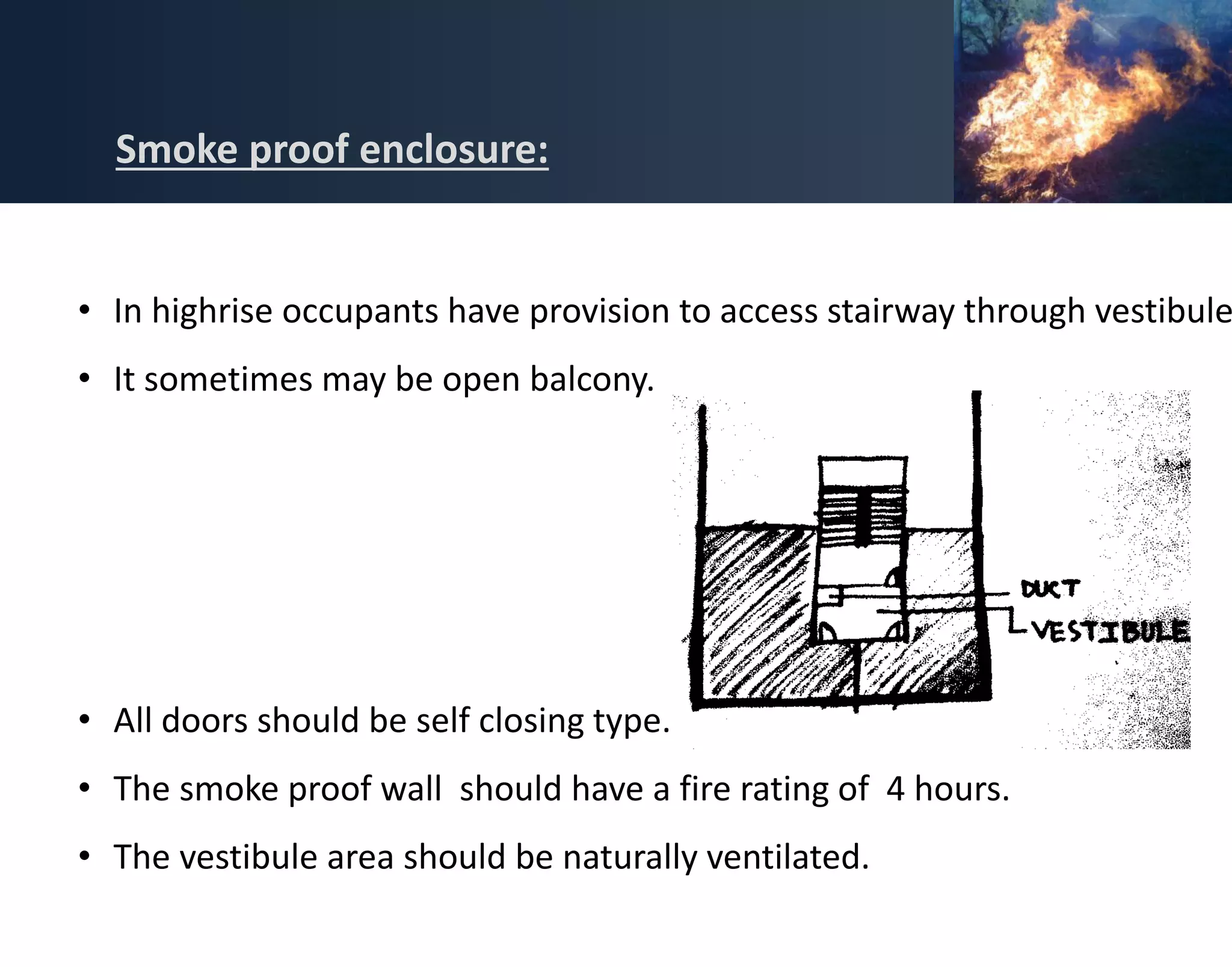
Smoke proof enclosure:
• In highrise occupants have provision to access stairway through vestibule
• It sometimes may be open balcony.
• All doors should be self closing type.
• The smoke proof wall should have a fire rating of 4 hours.
• The vestibule area should be naturally ventilated.
Command station:
• All building above 26 m height shall have a command station on
the entrance lobby with suitable public address system having
communication to all floors as well as facilities to receive
messages from all doors.
• Command Station shall be fitted and maintained.
Refuse area:
Refuge Area shall not be less than 15 sq.m at the heights
mentioned below :
a) Floors between 20 and 26 m One refuge area on the floor
immediately above 20 m.
b) Floors above 26 m One refuge area on the floor
immediately above 26 m and then one
refuge area five floor above 26 m.
Fire command room
Refuge area
For undergraduate professional practice presentation:
Akramul hoque masum
Biplob Hossain
Mahiza Hossain
Tania akter sunny
Ref: Emarot Nirmam Bidimala @ Bangldesh national building code(BNBC)
Department of architecture, South east university.
50,51 Tajgaon industrial area, Dhaka.

Fire safety system of Building.

  • 1.
    FIRE SAFETYDepartment ofarchitecture, South east university. 50,51 Tajgaon industrial area, Dhaka.
  • 2.
    Means of escape: 1.Exit access 2. Exit 3. Exit discharge Lift & Escalator will not be part of means of escape. Exit should be always Free, so that man can go through.
  • 3.
    General need: • Exit& exit access corridor should not used as supply work. • If Floor difference is more than 300 mm , ramp should be used.
  • 4.
    • The exitaccess which is not used by disable & old people, considerable step will be 200 mm. • If there are more exit access, exit sign will be used everywhere.
  • 5.
    Placement of fireexit: • Exit should not open in that place which will close or used for dangerous work. • Exit should not be locked. • In national building, entry area will ½ of user no.
  • 6.
    User number: • Inassembly & intuitional building, user number depends on fixed seat. • In case of without arm seat, 500 mm width will be provided for 1 user. • 1 user requires min 0.3 sq.m. • If roof is used, exit access will provided according to user no.
  • 7.
  • 8.
    Corridor : • Onesided closed corridor length maximum 10 m. • Corridor width- • More than 50 user- 1.1 m • Less than 50 user- 0.9 m • Health care building- 2.4 m • Institution (more than 150 user)- 1.8 m
  • 9.
    • Clear heightof corridor should be min 2.4 m. • Exit access corridor’s fire rating should be min 1 hr. • Exit door’s fire rating should be min ½ hr.
  • 10.
    Assembly aisles : •Assembly building should provide clear aisle to the exit. • Maximum 1:8 ramp should considerable in exit access. • The aisle’s minimum width 5 mm per user. 1:8 ramp
  • 11.
    • If itwill step, then • tread 275mm • Riser 100-200 mm
  • 12.
    • Aisle width •For both side seat- 1m • For single seat- 0.9 m
  • 13.
    Doors: • Following chartwill be used for 1 door. Pg-3067,BNBC, 2008
  • 14.
    • Exit doormin Width 1 m Height 2 m • Sliding or hanging door should not used as fire exit. • The clear area from door to stair should be min 0.9m • In assembly & institutional building where more than 200 user, revolving door should not be used.
  • 15.
    Stair : i. Exitstair’s landing width will not less than stair width. ii. In circular & spiral stair, • stair width 650 mm • Tread width 200-300 mm. Fig: i Fig: ii
  • 16.
    • In firestair, if Clear width is 1 m 1 sided hand rail should be provided • If clear width is more than 1m, both sided hand rail needed. • If clear width is more than 2.2 m, Hand rail is needed in middle.
  • 17.
    • Every Exitstair should be made of fire resistant material. • If lift shaft is made of fire resistant material, then its surrounding stair can consider as fire stair. • Outer stair can be used as fire stair if it ensure opening direct to ground.
  • 18.
    Ramp: i. Slope ofexit ramp should not more than 1:12 ii. Ramp surface should be made of non slippery material. iii. If ramp slope is more than 1:15 , handrail should be provided both side.
  • 19.
    Horizontal exit: • Exitdoor should closed itself from the fire hazardous area. • Exit width is not less than 1m. • Minimum floor area without stair, lift shaft - • In refugee camp, 0.28 sq.m. is needed per head. • In hospital, 2.8 sq.m is needed per bed.
  • 20.
    Number of exit: •Stair number will be derived from chart 5 . Pg-3071,BNBC, 2008
  • 21.
    • Without chart5, stair number should be decided according to user number. User number up to 500 – min exit 2 nos User number 501-1000 – min exit 3 nos More than 1000 – min exit 4 nos • If building(other than residence) cross 10 story & 500 sq.m floor area , then it requires minimum 2 fire exit.
  • 22.
    Travel path : •Exit should be designed in a certain distance so that occupant can Easily get stair in travelling time. • Maximum travel distance is given below:- Pg-3072,BNBC, 2008
  • 23.
    Store room type: •If user no is more than 10 & floor area is more than 1400sq.m ,then minimum 2 fire exit is a must. • Workers should be able to open the lock easily in case of emergancy.
  • 24.
    Fire alarm system: •All buildings with a height of more than 20 m should provide I. manually operated electrical fire alarm system II. automatic fire alarm system.
  • 25.
    Fire lift: • Firelift should be used in buildings more than 20 m in height. • Fire lift should have a load carrying capacity of 8 persons. • Power supply of the fire lift should be seperated from the main source supplying the building. • Must have an intercommunication with the fire command station.
  • 26.
    • During fire,only fire man can operate such lifts. • Lift speed shall be such as to reach the top floor from ground level in 1 minute. • On landing doors at each floor, the sign ‘ FIRE LIFT ‘ shall be painted in such sizes as to be easily noticeable.
  • 27.
    • A smokedetector senses smoke and give indication of fire. • It is a part of fire alarm system. Smoke detector
  • 28.
    Smoke proof enclosure: •In highrise occupants have provision to access stairway through vestibule • It sometimes may be open balcony. • All doors should be self closing type. • The smoke proof wall should have a fire rating of 4 hours. • The vestibule area should be naturally ventilated.
  • 29.
    Command station: • Allbuilding above 26 m height shall have a command station on the entrance lobby with suitable public address system having communication to all floors as well as facilities to receive messages from all doors. • Command Station shall be fitted and maintained.
  • 30.
    Refuse area: Refuge Areashall not be less than 15 sq.m at the heights mentioned below : a) Floors between 20 and 26 m One refuge area on the floor immediately above 20 m. b) Floors above 26 m One refuge area on the floor immediately above 26 m and then one refuge area five floor above 26 m.
  • 31.
  • 32.
    For undergraduate professionalpractice presentation: Akramul hoque masum Biplob Hossain Mahiza Hossain Tania akter sunny Ref: Emarot Nirmam Bidimala @ Bangldesh national building code(BNBC) Department of architecture, South east university. 50,51 Tajgaon industrial area, Dhaka.