Fire safety in Building
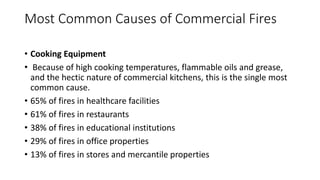
Most Common Causes of Commercial Fires
• Cooking Equipment
• Because of high cooking temperatures, flammable oils and grease,
and the hectic nature of commercial kitchens, this is the single most
common cause.
• 65% of fires in healthcare facilities
• 61% of fires in restaurants
• 38% of fires in educational institutions
• 29% of fires in office properties
• 13% of fires in stores and mercantile properties
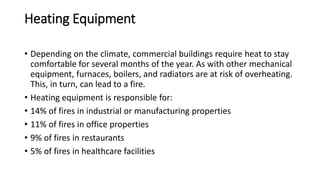
Heating Equipment
• Depending on the climate, commercial buildings require heat to stay
comfortable for several months of the year. As with other mechanical
equipment, furnaces, boilers, and radiators are at risk of overheating.
This, in turn, can lead to a fire.
• Heating equipment is responsible for:
• 14% of fires in industrial or manufacturing properties
• 11% of fires in office properties
• 9% of fires in restaurants
• 5% of fires in healthcare facilities
Electrical & Lighting Equipment
• All modern buildings feature electrical wiring behind the wall for light
and power. Unfortunately, electricity carries an inherent fire risk. Old
or defective wiring, overloaded circuits, loose connections, faulty
fuses, imbalanced electrical loads, and many other problems can
develop that lead to overheating or sparks that ignite a fire.
• Electrical problems are responsible for:
• 12% of fires in office properties
• 10% of fires in stores and mercantile properties
• 9% of fires in restaurants
• 5% of fires in healthcare facilities
Smoking Materials
• Lighted cigars, cigarettes, and other smoking materials can start fires
if disposed of improperly. Fortunately, the rate of fires caused by
smoking materials has decreased in recent years as a result of
declining popularity and the introduction of “fire safe” cigarettes with
reduced ignition strength. Still, smoking materials remain one of the
top five most common causes of commercial fires. They are
responsible for:
• 9% of fires in office properties
• 7% of fires in restaurants
• 5% of fires in healthcare facilities
Intentional
• An intentional fire is one that occurs as the result of the deliberate
misuse of a heat source. Arson fits into this category, though to be
considered arson, the fire starter must have malicious, criminal
intent.
• 36% of fires in educational institutions
• 10% of fires in office properties
• 6% of fires in healthcare facilities
• 4% of fires in restaurants
NBC (2005) regulation for non-combusting
materials
• The combustible/flammable material shall not be used for partitioning,
wall paneling, false ceiling etc.
• Any material giving out toxic gases/smoke if involved in the fire shall not be
used for partitioning of a floor or wall paneling or a false ceiling etc.
• The use of LPG shall not be permitted in the high-rise building except
residential/hotel/hostel/kitchen/pantry (if any) and shall be located at the
periphery of the building on the ground level.
• The framework of the entire false ceiling would be provided with metallic
sections and no wooden framework shall be allowed for paneling/false
ceiling.
• lining material shall conform to class-I of the standard specification
STAIRCASES
As per section 12.18 of part III
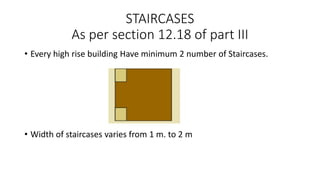
• Every high rise building Have minimum 2 number of Staircases.
• Width of staircases varies from 1 m. to 2 m
STAIRCASES
As per section 12.18 of part III
• For residential building width of staircases should be 1 mtr.
• Out of 2 staircases, 1 can be used as a fire escape staircase.
• Width of fire escape should be minimum 0.75 meter.
• Number of staircases shall be given as per the travel distances
• Staircase shall not be extended to basement to prevent smoke , heat
& gases. From the basement smoke, heat gases can be travel to upper
floors.
• Access to the basement from the ground should be through a
separate staircase, which is not connected to main staircase (i.e. It
should be remote to each other.)
STAIRCASES
As per section 12.18 of part III
• Staircase shall be of enclosed type to prevent entry of smoke & fire to
the staircase & vice versa.
• Spiral staircase shall be provided up to 9 mtr height.
• External staircase normally shall not be allowed.
Stairs
• Internal stairs shall be constructed of non-combustible materials
throughout.
• . A staircase shall not be arranged round a lift shaft.
• No gas piping, or electrical panels shall be allowed in the stairway.
Ducting in the stairway may be permitted if it is of 1hr. fire resistance
rating.
• The minimum width of tread without nosing shall be 250 mm for
internal staircase of residential buildings. This shall be 300 mm for
assembly, hotels, educational, institutional, business and other
buildings. The treads shall be constructed and maintained in a
manner to prevent slipping
Stairs
• The maximum height of riser shall be 190mm for residential buildings,
and 150mm for other buildings, and the number shall be limited to 15
per flight.
• Handrails shall be provided at a height of 1000 mm to be measured
from the base of the middle of the treads to the top of the handrails
• The minimum headroom in a passage under the landing of a staircase
and the staircase shall be 2.2m.
• No electrical shafts /AC ducts or gas pipes, etc, shall pass through or
open in the staircases.
• Lifts shall not open in staircase.
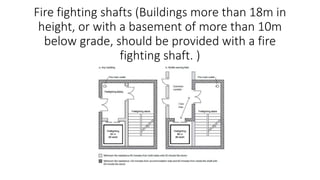
Fire fighting shafts (Buildings more than 18m in
height, or with a basement of more than 10m
below grade, should be provided with a fire
fighting shaft. )
Lift Enclosure/lift
• Provision of the lifts shall be made for all multi-storeyed building
having a height of 15.0 m. and above.
• All the floors shall be accessible for 24 hrs. by the lift. The lift
provided in the buildings shall not be considered as a means of
escape in case of emergency.
• Grounding switch at ground floor level to enable the fire service to
ground the lift car in case of emergency shall also be provided.
• The lift machine room shall be separate and no other machinery be
installed in it.
Lift Enclosure/lift
• Walls of lift enclosures shall have a fire rating of two hours. Lift shafts
shall have a vent at the top of area not less than 0.2 sq m.
• Lift motor room shall be located preferably on top of the shaft and
separated from the shaft by the floor of the room.
• Landing doors in lift enclosures shall have fire resistance of not less
than 1h
• The number of lifts in one row for a lift bank shall not exceed 4 and
the total number of lifts in the bank shall not exceed 8.
• Lift car door shall have a fire resistance rating of 1 hour
Lift Enclosure/lift
• Collapsible gates shall not be permitted for lifts and solid doors with
fire resistance of at least one hour shall be provided.
• If the lift shaft and lobby is in the core of the building, a positive
pressure between 25 and 30 Pa shall be maintained in the lobby, and
a positive pressure of 50 Pa shall be maintained in the shaft.
• Exit from the lift lobby, if located in the core of the building , shall be
through a self-closing smoke stop door of half an hour fire resistance;
• Lifts shall not normally communicate with the basement; if, however,
lifts are in communication, the lift lobby of the basements shall be
pressurised as in (g), with self closing door as in (h);
Lift Enclosure/lift
• Telephone or other communication facilities shall be provided in lift
cars for buildings of 30m in height and above. Communication system
for lifts shall be connected to fire control room for the building;
• Suitable arrangements such as providing slope in the floor of lift
lobby, shall be made to prevent water used during fire fighting etc,
from entering the lift shafts.
• A sign shall be posted and maintained on every floor at or near the lift
indicating that in case of fire, occupants shall use the stairs unless
instructed otherwise
Fire Lifts
• Where applicable, fire lifts shall be provided with a minimum capacity
for 8 passengers and fully automated with emergency switch on
ground.
• In case of fire, only firemen or any member of fire service shall
operate the fire lift. In normal course, lifts may be used by other
persons.
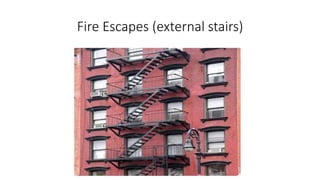
Fire Escapes (external stairs)
• External stairs shall always be kept in sound operable conditions.
• All external stairs shall be directly connected to the ground.
• Entrance to the external stairs shall be separate and remote from the
internal staircase.
• Care shall be taken to ensure that no wall opening or window opens
on to or close to an external stairs.
• No external staircase, used as a fire escape, shall be inclined at an
angle greater than 45 degrees from the horizontal

Fire safety in building

  • 1.
  • 2.
    Most Common Causesof Commercial Fires • Cooking Equipment • Because of high cooking temperatures, flammable oils and grease, and the hectic nature of commercial kitchens, this is the single most common cause. • 65% of fires in healthcare facilities • 61% of fires in restaurants • 38% of fires in educational institutions • 29% of fires in office properties • 13% of fires in stores and mercantile properties
  • 3.
    Heating Equipment • Dependingon the climate, commercial buildings require heat to stay comfortable for several months of the year. As with other mechanical equipment, furnaces, boilers, and radiators are at risk of overheating. This, in turn, can lead to a fire. • Heating equipment is responsible for: • 14% of fires in industrial or manufacturing properties • 11% of fires in office properties • 9% of fires in restaurants • 5% of fires in healthcare facilities
  • 4.
    Electrical & LightingEquipment • All modern buildings feature electrical wiring behind the wall for light and power. Unfortunately, electricity carries an inherent fire risk. Old or defective wiring, overloaded circuits, loose connections, faulty fuses, imbalanced electrical loads, and many other problems can develop that lead to overheating or sparks that ignite a fire. • Electrical problems are responsible for: • 12% of fires in office properties • 10% of fires in stores and mercantile properties • 9% of fires in restaurants • 5% of fires in healthcare facilities
  • 5.
    Smoking Materials • Lightedcigars, cigarettes, and other smoking materials can start fires if disposed of improperly. Fortunately, the rate of fires caused by smoking materials has decreased in recent years as a result of declining popularity and the introduction of “fire safe” cigarettes with reduced ignition strength. Still, smoking materials remain one of the top five most common causes of commercial fires. They are responsible for: • 9% of fires in office properties • 7% of fires in restaurants • 5% of fires in healthcare facilities
  • 6.
    Intentional • An intentionalfire is one that occurs as the result of the deliberate misuse of a heat source. Arson fits into this category, though to be considered arson, the fire starter must have malicious, criminal intent. • 36% of fires in educational institutions • 10% of fires in office properties • 6% of fires in healthcare facilities • 4% of fires in restaurants
  • 7.
    NBC (2005) regulationfor non-combusting materials • The combustible/flammable material shall not be used for partitioning, wall paneling, false ceiling etc. • Any material giving out toxic gases/smoke if involved in the fire shall not be used for partitioning of a floor or wall paneling or a false ceiling etc. • The use of LPG shall not be permitted in the high-rise building except residential/hotel/hostel/kitchen/pantry (if any) and shall be located at the periphery of the building on the ground level. • The framework of the entire false ceiling would be provided with metallic sections and no wooden framework shall be allowed for paneling/false ceiling. • lining material shall conform to class-I of the standard specification
  • 8.
    STAIRCASES As per section12.18 of part III • Every high rise building Have minimum 2 number of Staircases. • Width of staircases varies from 1 m. to 2 m
  • 9.
    STAIRCASES As per section12.18 of part III • For residential building width of staircases should be 1 mtr. • Out of 2 staircases, 1 can be used as a fire escape staircase. • Width of fire escape should be minimum 0.75 meter. • Number of staircases shall be given as per the travel distances • Staircase shall not be extended to basement to prevent smoke , heat & gases. From the basement smoke, heat gases can be travel to upper floors. • Access to the basement from the ground should be through a separate staircase, which is not connected to main staircase (i.e. It should be remote to each other.)
  • 10.
    STAIRCASES As per section12.18 of part III • Staircase shall be of enclosed type to prevent entry of smoke & fire to the staircase & vice versa. • Spiral staircase shall be provided up to 9 mtr height. • External staircase normally shall not be allowed.
  • 11.
    Stairs • Internal stairsshall be constructed of non-combustible materials throughout. • . A staircase shall not be arranged round a lift shaft. • No gas piping, or electrical panels shall be allowed in the stairway. Ducting in the stairway may be permitted if it is of 1hr. fire resistance rating. • The minimum width of tread without nosing shall be 250 mm for internal staircase of residential buildings. This shall be 300 mm for assembly, hotels, educational, institutional, business and other buildings. The treads shall be constructed and maintained in a manner to prevent slipping
  • 12.
    Stairs • The maximumheight of riser shall be 190mm for residential buildings, and 150mm for other buildings, and the number shall be limited to 15 per flight. • Handrails shall be provided at a height of 1000 mm to be measured from the base of the middle of the treads to the top of the handrails • The minimum headroom in a passage under the landing of a staircase and the staircase shall be 2.2m. • No electrical shafts /AC ducts or gas pipes, etc, shall pass through or open in the staircases. • Lifts shall not open in staircase.
  • 13.
    Fire fighting shafts(Buildings more than 18m in height, or with a basement of more than 10m below grade, should be provided with a fire fighting shaft. )
  • 14.
    Lift Enclosure/lift • Provisionof the lifts shall be made for all multi-storeyed building having a height of 15.0 m. and above. • All the floors shall be accessible for 24 hrs. by the lift. The lift provided in the buildings shall not be considered as a means of escape in case of emergency. • Grounding switch at ground floor level to enable the fire service to ground the lift car in case of emergency shall also be provided. • The lift machine room shall be separate and no other machinery be installed in it.
  • 15.
    Lift Enclosure/lift • Wallsof lift enclosures shall have a fire rating of two hours. Lift shafts shall have a vent at the top of area not less than 0.2 sq m. • Lift motor room shall be located preferably on top of the shaft and separated from the shaft by the floor of the room. • Landing doors in lift enclosures shall have fire resistance of not less than 1h • The number of lifts in one row for a lift bank shall not exceed 4 and the total number of lifts in the bank shall not exceed 8. • Lift car door shall have a fire resistance rating of 1 hour
  • 16.
    Lift Enclosure/lift • Collapsiblegates shall not be permitted for lifts and solid doors with fire resistance of at least one hour shall be provided. • If the lift shaft and lobby is in the core of the building, a positive pressure between 25 and 30 Pa shall be maintained in the lobby, and a positive pressure of 50 Pa shall be maintained in the shaft. • Exit from the lift lobby, if located in the core of the building , shall be through a self-closing smoke stop door of half an hour fire resistance; • Lifts shall not normally communicate with the basement; if, however, lifts are in communication, the lift lobby of the basements shall be pressurised as in (g), with self closing door as in (h);
  • 17.
    Lift Enclosure/lift • Telephoneor other communication facilities shall be provided in lift cars for buildings of 30m in height and above. Communication system for lifts shall be connected to fire control room for the building; • Suitable arrangements such as providing slope in the floor of lift lobby, shall be made to prevent water used during fire fighting etc, from entering the lift shafts. • A sign shall be posted and maintained on every floor at or near the lift indicating that in case of fire, occupants shall use the stairs unless instructed otherwise
  • 18.
    Fire Lifts • Whereapplicable, fire lifts shall be provided with a minimum capacity for 8 passengers and fully automated with emergency switch on ground. • In case of fire, only firemen or any member of fire service shall operate the fire lift. In normal course, lifts may be used by other persons.
  • 19.
  • 20.
    Fire Escapes (externalstairs) • External stairs shall always be kept in sound operable conditions. • All external stairs shall be directly connected to the ground. • Entrance to the external stairs shall be separate and remote from the internal staircase. • Care shall be taken to ensure that no wall opening or window opens on to or close to an external stairs. • No external staircase, used as a fire escape, shall be inclined at an angle greater than 45 degrees from the horizontal