LOOP ANTENNA
Presentation on Electric
field of small loop antenna
and directivity of circular
loop antenna with uniform
current
SUBMITTED TO: SUBMITTED BY:
Mr.Sudhir Mishra Priya Hada
Amity Institute of Engineering and Technology
Priya Hada Title 1/19
LOOP ANTENNA
LOOP ANTENNA
• A loop antenna is a radio antenna consisting of a loop of
wire with its ends connected to a balanced transmission
line
• It is a single turn coil carrying RF current through it.
• The dimensions of coil are smaller than the wavelength
hence current flowing through the coil has same phase.
• Small loops have a poor efficiency and are mainly used as
receiving antennas at low frequencies. Except for car
radios, almost every AM broadcast receiver sold has such
an antenna built inside of it or directly attached to it.
Priya Hada Title 2/19
LOOP ANTENNA
LOOP ANTENNA
• A technically small loop, also known as a magnetic loop,
should have a circumference of one tenth of a wavelength
or less. This is necessary to ensure a constant current
distribution round the loop.
• As the frequency or the size are increased, a standing
wave starts to develop in the current, and the antenna
starts to have some of the characteristics of a folded dipole
antenna or a self-resonant loop.
• Self-resonant loop antennas are larger. They are typically
used at higher frequencies, especially VHF and UHF,
where their size is manageable. They can be viewed as a
form of folded dipole and have somewhat similar
characteristics. The radiation efficiency is also high and
similar to that of a dipole.
Priya Hada Title 3/19
LOOP ANTENNA
LOOP ANTENNA
• Loop antennas come in a variety of shapes (circular,
rectangular, elliptical, etc.)but the fundamental
characteristics of the loop antenna radiation pattern(far
field) are largely independent of the loop shape.
• Just as the electrical length of the dipoles and monopoles
effect the efficiency of these antennas, the electrical size of
the loop (circumference) determines the efficiency of the
loop antenna.
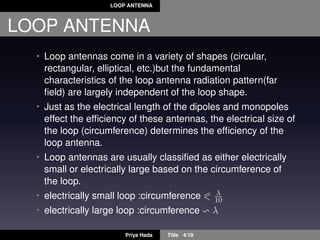
• Loop antennas are usually classified as either electrically
small or electrically large based on the circumference of
the loop.
• electrically small loop :circumference λ
10
• electrically large loop :circumference λ
Priya Hada Title 4/19
LOOP ANTENNA
SMALL CIRCULAR LOOP
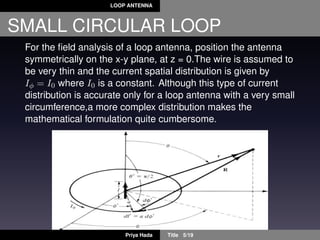
For the field analysis of a loop antenna, position the antenna
symmetrically on the x-y plane, at z = 0.The wire is assumed to
be very thin and the current spatial distribution is given by
Iφ = I0 where I0 is a constant. Although this type of current
distribution is accurate only for a loop antenna with a very small
circumference,a more complex distribution makes the
mathematical formulation quite cumbersome.
Priya Hada Title 5/19
LOOP ANTENNA
RADIATED FIELDS
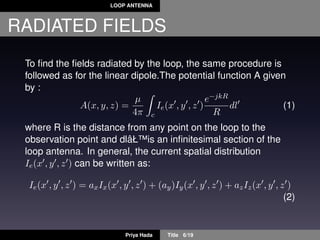
To find the fields radiated by the loop, the same procedure is
followed as for the linear dipole.The potential function A given
by :
A(x, y, z) =
µ
4π c
Ie(x , y , z )
e−jkR
R
dl (1)
where R is the distance from any point on the loop to the
observation point and dl⣙is an infinitesimal section of the
loop antenna. In general, the current spatial distribution
Ie(x , y , z ) can be written as:
Ie(x , y , z ) = axIx(x , y , z ) + (ay)Iy(x , y , z ) + azIz(x , y , z )
(2)
Priya Hada Title 6/19
LOOP ANTENNA
RADIATED FIELDS
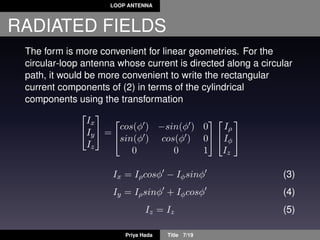
The form is more convenient for linear geometries. For the
circular-loop antenna whose current is directed along a circular
path, it would be more convenient to write the rectangular
current components of (2) in terms of the cylindrical
components using the transformation


Ix
Iy
Iz

 =


cos(φ ) −sin(φ ) 0
sin(φ ) cos(φ ) 0
0 0 1




Iρ
Iφ
Iz


Ix = Iρcosφ − Iφsinφ (3)
Iy = Iρsinφ + Iφcosφ (4)
Iz = Iz (5)
Priya Hada Title 7/19
LOOP ANTENNA
RADIATED FIELDS
Since the radiated fields are usually determined in spherical
components, the rectangular unit vectors of (2) are transformed
to spherical unit vectors.
ax = arsinθcosφ + aθcosθcosφ + aφsinφ (6)
ay = arsinθsinφ + aθcosθsinφ + aφcosφ (7)
az = arcosθ − aθsinφ (8)
Substituting (3,4,5,6,7,8) in (2) reduces it to:
Ie = ar[Iρsinθcos(φ − φ ) + Iφsinθsin(φ − φ ) + Izcosθ] +
aθ[Iρcosθcos(φ − φ ) + Iφcosθsin(φ − φ ) − Izsinθ] +
aφ[−Iρsin(φ − φ ) + Iφcos(φ − φ )]
Priya Hada Title 8/19
LOOP ANTENNA
RADIATED FIELDS
For the circular loop, the current is flowing in the φ direction (Iφ)
so that above equation reduces to:
Ie = ar[Iφsinθsin(φ−φ )]+aθ[Iφcosθsin(φ−φ )]+aφ[Iφcos(φ−φ )]
(9)
The distance R, from any point on the loop to the observation
point, can be written as:
R = (x − x )2 + (y − y )2 + (z − z )2 (10)
x = rsinθcosφ
y = rsinθsinφ
z = rcosθ
x2
+ y2
+ z2
= r (11)
x = acosφ
Priya Hada Title 9/19
LOOP ANTENNA
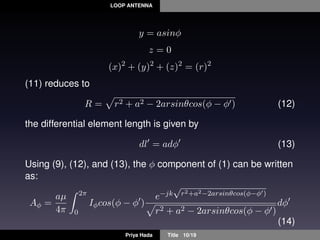
y = asinφ
z = 0
(x)2
+ (y)2
+ (z)2
= (r)2
(11) reduces to
R = r2 + a2 − 2arsinθcos(φ − φ ) (12)
the differential element length is given by
dl = adφ (13)
Using (9), (12), and (13), the φ component of (1) can be written
as:
Aφ =
aµ
4π
2π
0
Iφcos(φ − φ )
e−jk
√
r2+a2−2arsinθcos(φ−φ )
r2 + a2 − 2arsinθcos(φ − φ )
dφ
(14)
Priya Hada Title 10/19
LOOP ANTENNA
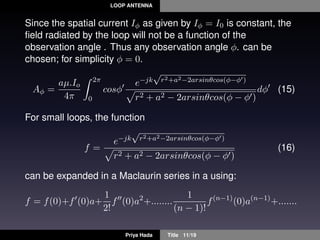
Since the spatial current Iφ as given by Iφ = I0 is constant, the
field radiated by the loop will not be a function of the
observation angle . Thus any observation angle φ. can be
chosen; for simplicity φ = 0.
Aφ =
aµ.Io
4π
2π
0
cosφ
e−jk
√
r2+a2−2arsinθcos(φ−φ )
r2 + a2 − 2arsinθcos(φ − φ )
dφ (15)
For small loops, the function
f =
e−jk
√
r2+a2−2arsinθcos(φ−φ )
r2 + a2 − 2arsinθcos(φ − φ )
(16)
can be expanded in a Maclaurin series in a using:
f = f(0)+f (0)a+
1
2!
f (0)a2
+........
1
(n − 1)!
f(n−1)
(0)a(n−1)
+.......
Priya Hada Title 11/19
LOOP ANTENNA
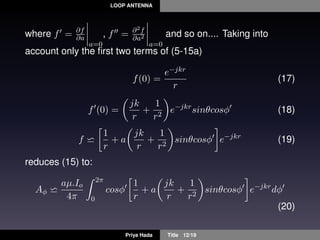
where f = ∂f
∂a
a=0
, f = ∂2f
∂a2
a=0
and so on.... Taking into
account only the first two terms of (5-15a)
f(0) =
e−jkr
r
(17)
f (0) =
jk
r
+
1
r2
e−jkr
sinθcosφ (18)
f
1
r
+ a
jk
r
+
1
r2
sinθcosφ e−jkr
(19)
reduces (15) to:
Aφ
aµ.Io
4π
2π
0
cosφ
1
r
+ a
jk
r
+
1
r2
sinθcosφ e−jkr
dφ
(20)
Priya Hada Title 12/19
LOOP ANTENNA
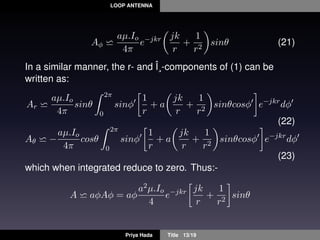
Aφ
aµ.Io
4π
e−jkr jk
r
+
1
r2
sinθ (21)
In a similar manner, the r- and θ-components of (1) can be
written as:
Ar
aµ.Io
4π
sinθ
2π
0
sinφ
1
r
+ a
jk
r
+
1
r2
sinθcosφ e−jkr
dφ
(22)
Aθ −
aµ.Io
4π
cosθ
2π
0
sinφ
1
r
+ a
jk
r
+
1
r2
sinθcosφ e−jkr
dφ
(23)
which when integrated reduce to zero. Thus:-
A aφAφ = aφ
a2µ.Io
4
e−jkr jk
r
+
1
r2
sinθ
Priya Hada Title 13/19
LOOP ANTENNA
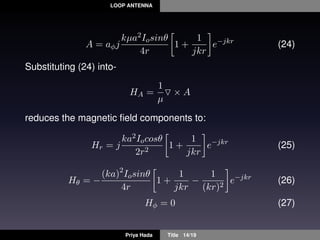
A = aφj
kµa2Iosinθ
4r
1 +
1
jkr
e−jkr
(24)
Substituting (24) into-
HA =
1
µ
× A
reduces the magnetic field components to:
Hr = j
ka2Iocosθ
2r2
1 +
1
jkr
e−jkr
(25)
Hθ = −
(ka)2
Iosinθ
4r
1 +
1
jkr
−
1
(kr)2
e−jkr
(26)
Hφ = 0 (27)
Priya Hada Title 14/19
LOOP ANTENNA
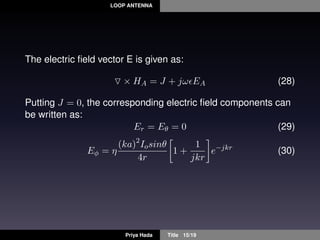
The electric field vector E is given as:
× HA = J + jω EA (28)
Putting J = 0, the corresponding electric field components can
be written as:
Er = Eθ = 0 (29)
Eφ = η
(ka)2
Iosinθ
4r
1 +
1
jkr
e−jkr
(30)
Priya Hada Title 15/19
LOOP ANTENNA
Power Density and Radiation
Resistance
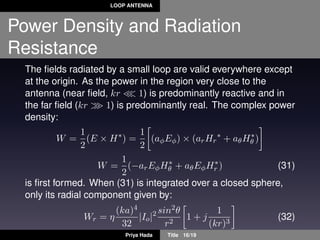
The fields radiated by a small loop are valid everywhere except
at the origin. As the power in the region very close to the
antenna (near field, kr 1) is predominantly reactive and in
the far field (kr 1) is predominantly real. The complex power
density:
W =
1
2
(E × H∗
) =
1
2
(aφEφ) × (arHr
∗
+ aθH∗
θ )
W =
1
2
(−arEφH∗
θ + aθEφH∗
r ) (31)
is first formed. When (31) is integrated over a closed sphere,
only its radial component given by:
Wr = η
(ka)4
32
|Io|2 sin2θ
r2
1 + j
1
(kr)3
(32)
Priya Hada Title 16/19
LOOP ANTENNA
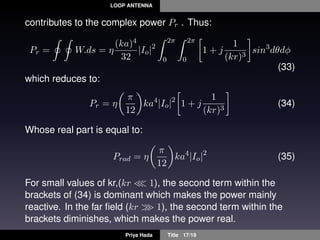
contributes to the complex power Pr . Thus:
Pr = W.ds = η
(ka)4
32
|Io|2
2π
0
2π
0
1 + j
1
(kr)3
sin3
dθdφ
(33)
which reduces to:
Pr = η
π
12
ka4
|Io|2
1 + j
1
(kr)3
(34)
Whose real part is equal to:
Prad = η
π
12
ka4
|Io|2
(35)
For small values of kr,(kr 1), the second term within the
brackets of (34) is dominant which makes the power mainly
reactive. In the far field (kr 1), the second term within the
brackets diminishes, which makes the power real.
Priya Hada Title 17/19
LOOP ANTENNA
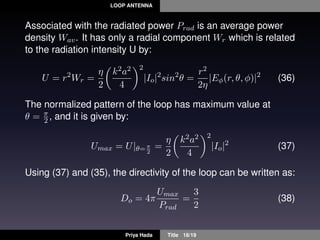
Associated with the radiated power Prad is an average power
density Wav. It has only a radial component Wr which is related
to the radiation intensity U by:
U = r2
Wr =
η
2
k2a2
4
2
|Io|2
sin2
θ =
r2
2η
|Eφ(r, θ, φ)|2
(36)
The normalized pattern of the loop has maximum value at
θ = π
2 , and it is given by:
Umax = U|θ=π
2
=
η
2
k2a2
4
2
|Io|2
(37)
Using (37) and (35), the directivity of the loop can be written as:
Do = 4π
Umax
Prad
=
3
2
(38)
Priya Hada Title 18/19
LOOP ANTENNA
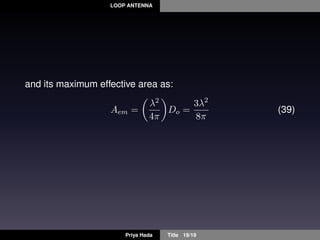
and its maximum effective area as:
Aem =
λ2
4π
Do =
3λ2
8π
(39)
Priya Hada Title 19/19

Presentation small loop_antennas_electric_field_and_directivity_calculations_section_b

  • 1.
    LOOP ANTENNA Presentation onElectric field of small loop antenna and directivity of circular loop antenna with uniform current SUBMITTED TO: SUBMITTED BY: Mr.Sudhir Mishra Priya Hada Amity Institute of Engineering and Technology Priya Hada Title 1/19
  • 2.
    LOOP ANTENNA LOOP ANTENNA •A loop antenna is a radio antenna consisting of a loop of wire with its ends connected to a balanced transmission line • It is a single turn coil carrying RF current through it. • The dimensions of coil are smaller than the wavelength hence current flowing through the coil has same phase. • Small loops have a poor efficiency and are mainly used as receiving antennas at low frequencies. Except for car radios, almost every AM broadcast receiver sold has such an antenna built inside of it or directly attached to it. Priya Hada Title 2/19
  • 3.
    LOOP ANTENNA LOOP ANTENNA •A technically small loop, also known as a magnetic loop, should have a circumference of one tenth of a wavelength or less. This is necessary to ensure a constant current distribution round the loop. • As the frequency or the size are increased, a standing wave starts to develop in the current, and the antenna starts to have some of the characteristics of a folded dipole antenna or a self-resonant loop. • Self-resonant loop antennas are larger. They are typically used at higher frequencies, especially VHF and UHF, where their size is manageable. They can be viewed as a form of folded dipole and have somewhat similar characteristics. The radiation efficiency is also high and similar to that of a dipole. Priya Hada Title 3/19
  • 4.
    LOOP ANTENNA LOOP ANTENNA •Loop antennas come in a variety of shapes (circular, rectangular, elliptical, etc.)but the fundamental characteristics of the loop antenna radiation pattern(far field) are largely independent of the loop shape. • Just as the electrical length of the dipoles and monopoles effect the efficiency of these antennas, the electrical size of the loop (circumference) determines the efficiency of the loop antenna. • Loop antennas are usually classified as either electrically small or electrically large based on the circumference of the loop. • electrically small loop :circumference λ 10 • electrically large loop :circumference λ Priya Hada Title 4/19
  • 5.
    LOOP ANTENNA SMALL CIRCULARLOOP For the field analysis of a loop antenna, position the antenna symmetrically on the x-y plane, at z = 0.The wire is assumed to be very thin and the current spatial distribution is given by Iφ = I0 where I0 is a constant. Although this type of current distribution is accurate only for a loop antenna with a very small circumference,a more complex distribution makes the mathematical formulation quite cumbersome. Priya Hada Title 5/19
  • 6.
    LOOP ANTENNA RADIATED FIELDS Tofind the fields radiated by the loop, the same procedure is followed as for the linear dipole.The potential function A given by : A(x, y, z) = µ 4π c Ie(x , y , z ) e−jkR R dl (1) where R is the distance from any point on the loop to the observation point and dl⣙is an infinitesimal section of the loop antenna. In general, the current spatial distribution Ie(x , y , z ) can be written as: Ie(x , y , z ) = axIx(x , y , z ) + (ay)Iy(x , y , z ) + azIz(x , y , z ) (2) Priya Hada Title 6/19
  • 7.
    LOOP ANTENNA RADIATED FIELDS Theform is more convenient for linear geometries. For the circular-loop antenna whose current is directed along a circular path, it would be more convenient to write the rectangular current components of (2) in terms of the cylindrical components using the transformation   Ix Iy Iz   =   cos(φ ) −sin(φ ) 0 sin(φ ) cos(φ ) 0 0 0 1     Iρ Iφ Iz   Ix = Iρcosφ − Iφsinφ (3) Iy = Iρsinφ + Iφcosφ (4) Iz = Iz (5) Priya Hada Title 7/19
  • 8.
    LOOP ANTENNA RADIATED FIELDS Sincethe radiated fields are usually determined in spherical components, the rectangular unit vectors of (2) are transformed to spherical unit vectors. ax = arsinθcosφ + aθcosθcosφ + aφsinφ (6) ay = arsinθsinφ + aθcosθsinφ + aφcosφ (7) az = arcosθ − aθsinφ (8) Substituting (3,4,5,6,7,8) in (2) reduces it to: Ie = ar[Iρsinθcos(φ − φ ) + Iφsinθsin(φ − φ ) + Izcosθ] + aθ[Iρcosθcos(φ − φ ) + Iφcosθsin(φ − φ ) − Izsinθ] + aφ[−Iρsin(φ − φ ) + Iφcos(φ − φ )] Priya Hada Title 8/19
  • 9.
    LOOP ANTENNA RADIATED FIELDS Forthe circular loop, the current is flowing in the φ direction (Iφ) so that above equation reduces to: Ie = ar[Iφsinθsin(φ−φ )]+aθ[Iφcosθsin(φ−φ )]+aφ[Iφcos(φ−φ )] (9) The distance R, from any point on the loop to the observation point, can be written as: R = (x − x )2 + (y − y )2 + (z − z )2 (10) x = rsinθcosφ y = rsinθsinφ z = rcosθ x2 + y2 + z2 = r (11) x = acosφ Priya Hada Title 9/19
  • 10.
    LOOP ANTENNA y =asinφ z = 0 (x)2 + (y)2 + (z)2 = (r)2 (11) reduces to R = r2 + a2 − 2arsinθcos(φ − φ ) (12) the differential element length is given by dl = adφ (13) Using (9), (12), and (13), the φ component of (1) can be written as: Aφ = aµ 4π 2π 0 Iφcos(φ − φ ) e−jk √ r2+a2−2arsinθcos(φ−φ ) r2 + a2 − 2arsinθcos(φ − φ ) dφ (14) Priya Hada Title 10/19
  • 11.
    LOOP ANTENNA Since thespatial current Iφ as given by Iφ = I0 is constant, the field radiated by the loop will not be a function of the observation angle . Thus any observation angle φ. can be chosen; for simplicity φ = 0. Aφ = aµ.Io 4π 2π 0 cosφ e−jk √ r2+a2−2arsinθcos(φ−φ ) r2 + a2 − 2arsinθcos(φ − φ ) dφ (15) For small loops, the function f = e−jk √ r2+a2−2arsinθcos(φ−φ ) r2 + a2 − 2arsinθcos(φ − φ ) (16) can be expanded in a Maclaurin series in a using: f = f(0)+f (0)a+ 1 2! f (0)a2 +........ 1 (n − 1)! f(n−1) (0)a(n−1) +....... Priya Hada Title 11/19
  • 12.
    LOOP ANTENNA where f= ∂f ∂a a=0 , f = ∂2f ∂a2 a=0 and so on.... Taking into account only the first two terms of (5-15a) f(0) = e−jkr r (17) f (0) = jk r + 1 r2 e−jkr sinθcosφ (18) f 1 r + a jk r + 1 r2 sinθcosφ e−jkr (19) reduces (15) to: Aφ aµ.Io 4π 2π 0 cosφ 1 r + a jk r + 1 r2 sinθcosφ e−jkr dφ (20) Priya Hada Title 12/19
  • 13.
    LOOP ANTENNA Aφ aµ.Io 4π e−jkr jk r + 1 r2 sinθ(21) In a similar manner, the r- and θ-components of (1) can be written as: Ar aµ.Io 4π sinθ 2π 0 sinφ 1 r + a jk r + 1 r2 sinθcosφ e−jkr dφ (22) Aθ − aµ.Io 4π cosθ 2π 0 sinφ 1 r + a jk r + 1 r2 sinθcosφ e−jkr dφ (23) which when integrated reduce to zero. Thus:- A aφAφ = aφ a2µ.Io 4 e−jkr jk r + 1 r2 sinθ Priya Hada Title 13/19
  • 14.
    LOOP ANTENNA A =aφj kµa2Iosinθ 4r 1 + 1 jkr e−jkr (24) Substituting (24) into- HA = 1 µ × A reduces the magnetic field components to: Hr = j ka2Iocosθ 2r2 1 + 1 jkr e−jkr (25) Hθ = − (ka)2 Iosinθ 4r 1 + 1 jkr − 1 (kr)2 e−jkr (26) Hφ = 0 (27) Priya Hada Title 14/19
  • 15.
    LOOP ANTENNA The electricfield vector E is given as: × HA = J + jω EA (28) Putting J = 0, the corresponding electric field components can be written as: Er = Eθ = 0 (29) Eφ = η (ka)2 Iosinθ 4r 1 + 1 jkr e−jkr (30) Priya Hada Title 15/19
  • 16.
    LOOP ANTENNA Power Densityand Radiation Resistance The fields radiated by a small loop are valid everywhere except at the origin. As the power in the region very close to the antenna (near field, kr 1) is predominantly reactive and in the far field (kr 1) is predominantly real. The complex power density: W = 1 2 (E × H∗ ) = 1 2 (aφEφ) × (arHr ∗ + aθH∗ θ ) W = 1 2 (−arEφH∗ θ + aθEφH∗ r ) (31) is first formed. When (31) is integrated over a closed sphere, only its radial component given by: Wr = η (ka)4 32 |Io|2 sin2θ r2 1 + j 1 (kr)3 (32) Priya Hada Title 16/19
  • 17.
    LOOP ANTENNA contributes tothe complex power Pr . Thus: Pr = W.ds = η (ka)4 32 |Io|2 2π 0 2π 0 1 + j 1 (kr)3 sin3 dθdφ (33) which reduces to: Pr = η π 12 ka4 |Io|2 1 + j 1 (kr)3 (34) Whose real part is equal to: Prad = η π 12 ka4 |Io|2 (35) For small values of kr,(kr 1), the second term within the brackets of (34) is dominant which makes the power mainly reactive. In the far field (kr 1), the second term within the brackets diminishes, which makes the power real. Priya Hada Title 17/19
  • 18.
    LOOP ANTENNA Associated withthe radiated power Prad is an average power density Wav. It has only a radial component Wr which is related to the radiation intensity U by: U = r2 Wr = η 2 k2a2 4 2 |Io|2 sin2 θ = r2 2η |Eφ(r, θ, φ)|2 (36) The normalized pattern of the loop has maximum value at θ = π 2 , and it is given by: Umax = U|θ=π 2 = η 2 k2a2 4 2 |Io|2 (37) Using (37) and (35), the directivity of the loop can be written as: Do = 4π Umax Prad = 3 2 (38) Priya Hada Title 18/19
  • 19.
    LOOP ANTENNA and itsmaximum effective area as: Aem = λ2 4π Do = 3λ2 8π (39) Priya Hada Title 19/19