Writing Intended Learning Outcomes
Stuart Palmer
1
Session learning outcomes
After completing this session, participants should be able to:
• Explain the purpose of learning outcomes in Australian higher
education;
• Identify the essential components of a learning outcome
statement for a university course/subject/class;
• Critique the usefulness of learning outcome statements;
• Produce class-level learning outcome statements for subjects
offered by the Melbourne Dental School.
2
Learning outcomes - principles
TEQSA require of programs: “the expected learning outcomes,
their sequence of attainment and assessment”
3
Learning outcomes - principles
TEQSA require of programs: “the expected learning outcomes,
their sequence of attainment and assessment”
• Statements that explain to students what they are expected to
know or be able to do after completing the subject
• Helpful in providing transparency for students
• Must be observable and measurable – assessable
• Good starting point for the design of activities and assessments
4From: Elliot, K. (2019) Designing a Curriculum EDUC90516
Aims, learning objectives and learning
outcomes
Aims or goals in teaching and learning reflect general intentions and
desired outcomes of an institution, program or course
Example: Curriculum and teaching practices aim to link students’
learning experiences to the world graduates will confront.
Learning objectives refer to teachers’ intentions for learners, such as
what students will be taught during the course or program
Example: Students will be taught the conceptual and theoretical tools
used in reasoning and problem solving, such as statistics, probability,
logic, and decision theory.
5From: Popenici, S. & Millar, M. (2015) Writing Learning Outcomes
Learning outcomes are statements of what a student will be able
to do or demonstrate at the completion of a certain sequence of
learning (course, program).
Example: At the end of the course students will be able to
demonstrate the ability to use mathematical and statistical
techniques relevant to the business subjects taught.
6
Aims, learning objectives and learning
outcomes
From: Popenici, S. & Millar, M. (2015) Writing Learning Outcomes
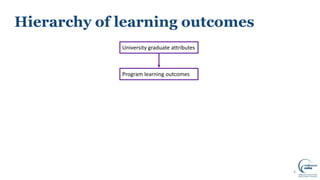
Hierarchy of learning outcomes
7
University graduate attributes
Hierarchy of learning outcomes
8
University graduate attributes
Program learning outcomes
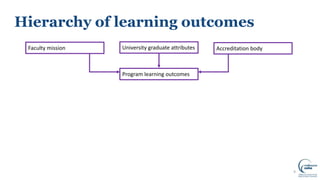
Hierarchy of learning outcomes
9
University graduate attributes
Program learning outcomes
Faculty mission Accreditation body
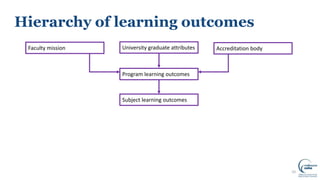
Hierarchy of learning outcomes
10
University graduate attributes
Program learning outcomes
Subject learning outcomes
Faculty mission Accreditation body
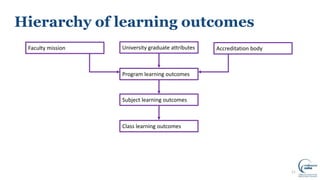
Hierarchy of learning outcomes
11
University graduate attributes
Program learning outcomes
Subject learning outcomes
Class learning outcomes
Faculty mission Accreditation body
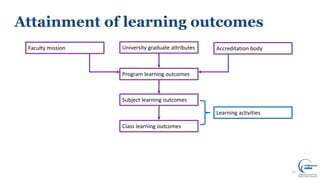
Attainment of learning outcomes
12
University graduate attributes
Program learning outcomes
Subject learning outcomes
Class learning outcomes
Faculty mission Accreditation body
Learning activities
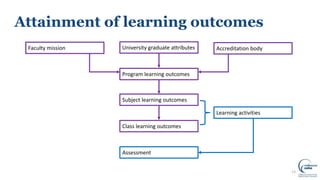
Attainment of learning outcomes
13
University graduate attributes
Program learning outcomes
Subject learning outcomes
Class learning outcomes
Assessment
Faculty mission Accreditation body
Learning activities
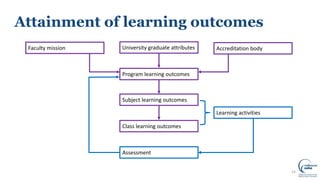
Attainment of learning outcomes
14
University graduate attributes
Program learning outcomes
Subject learning outcomes
Class learning outcomes
Assessment
Faculty mission Accreditation body
Learning activities
15From: Elliot, K. (2019) Designing a Curriculum EDUC90516
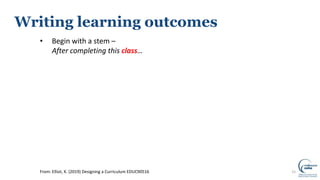
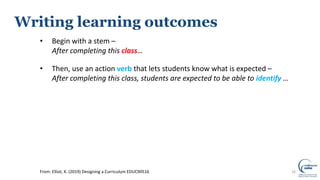
Writing learning outcomes
• Begin with a stem –
After completing this class…
16From: Elliot, K. (2019) Designing a Curriculum EDUC90516
Writing learning outcomes
• Begin with a stem –
After completing this class…
• Then, use an action verb that lets students know what is expected –
After completing this class, students are expected to be able to identify …
17From: Elliot, K. (2019) Designing a Curriculum EDUC90516
Writing learning outcomes
• Begin with a stem –
After completing this class…
• Then, use an action verb that lets students know what is expected –
After completing this class, students are expected to be able to identify …
• Then, add the content and context –
After completing this class, students are expected to be able to identify
characteristic style features of early seventeenth-century opera.
By the end of this ________________________ , students are
[class, subject, programme of study]
expected to be able to ______ ________ ________.
[verb] [content] [context]
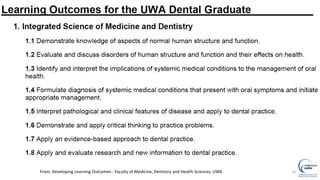
18From: Developing Learning Outcomes - Faculty of Medicine, Dentistry and Health Sciences, UWA
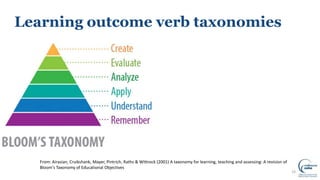
Learning outcome verb taxonomies
19
From: Airasian, Cruikshank, Mayer, Pintrich, Raths & Wittrock (2001) A taxonomy for learning, teaching and assessing: A revision of
Bloom's Taxonomy of Educational Objectives
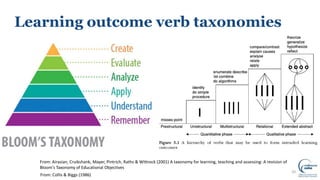
Learning outcome verb taxonomies
20
From: Airasian, Cruikshank, Mayer, Pintrich, Raths & Wittrock (2001) A taxonomy for learning, teaching and assessing: A revision of
Bloom's Taxonomy of Educational Objectives
From: Collis & Biggs (1986)
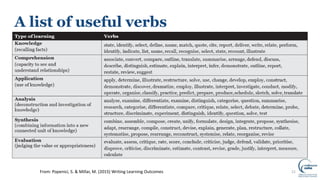
A list of useful verbs
21From: Popenici, S. & Millar, M. (2015) Writing Learning Outcomes
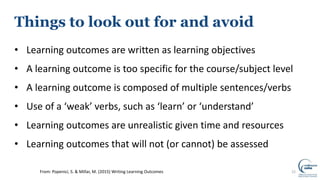
Things to look out for and avoid
• Learning outcomes are written as learning objectives
• A learning outcome is too specific for the course/subject level
• A learning outcome is composed of multiple sentences/verbs
• Use of a ‘weak’ verbs, such as ‘learn’ or ‘understand’
• Learning outcomes are unrealistic given time and resources
• Learning outcomes that will not (or cannot) be assessed
22From: Popenici, S. & Millar, M. (2015) Writing Learning Outcomes
Thank you for your time
Useful references
Writing Learning Outcomes, CSHE
http://go.unimelb.edu.au/4xmx
Developing Learning Outcomes - Faculty of Medicine, Dentistry
and Health Sciences, UWA
http://go.unimelb.edu.au/8xmx
23

Sp190305ss

  • 1.
    Writing Intended LearningOutcomes Stuart Palmer 1
  • 2.
    Session learning outcomes Aftercompleting this session, participants should be able to: • Explain the purpose of learning outcomes in Australian higher education; • Identify the essential components of a learning outcome statement for a university course/subject/class; • Critique the usefulness of learning outcome statements; • Produce class-level learning outcome statements for subjects offered by the Melbourne Dental School. 2
  • 3.
    Learning outcomes -principles TEQSA require of programs: “the expected learning outcomes, their sequence of attainment and assessment” 3
  • 4.
    Learning outcomes -principles TEQSA require of programs: “the expected learning outcomes, their sequence of attainment and assessment” • Statements that explain to students what they are expected to know or be able to do after completing the subject • Helpful in providing transparency for students • Must be observable and measurable – assessable • Good starting point for the design of activities and assessments 4From: Elliot, K. (2019) Designing a Curriculum EDUC90516
  • 5.
    Aims, learning objectivesand learning outcomes Aims or goals in teaching and learning reflect general intentions and desired outcomes of an institution, program or course Example: Curriculum and teaching practices aim to link students’ learning experiences to the world graduates will confront. Learning objectives refer to teachers’ intentions for learners, such as what students will be taught during the course or program Example: Students will be taught the conceptual and theoretical tools used in reasoning and problem solving, such as statistics, probability, logic, and decision theory. 5From: Popenici, S. & Millar, M. (2015) Writing Learning Outcomes
  • 6.
    Learning outcomes arestatements of what a student will be able to do or demonstrate at the completion of a certain sequence of learning (course, program). Example: At the end of the course students will be able to demonstrate the ability to use mathematical and statistical techniques relevant to the business subjects taught. 6 Aims, learning objectives and learning outcomes From: Popenici, S. & Millar, M. (2015) Writing Learning Outcomes
  • 7.
    Hierarchy of learningoutcomes 7 University graduate attributes
  • 8.
    Hierarchy of learningoutcomes 8 University graduate attributes Program learning outcomes
  • 9.
    Hierarchy of learningoutcomes 9 University graduate attributes Program learning outcomes Faculty mission Accreditation body
  • 10.
    Hierarchy of learningoutcomes 10 University graduate attributes Program learning outcomes Subject learning outcomes Faculty mission Accreditation body
  • 11.
    Hierarchy of learningoutcomes 11 University graduate attributes Program learning outcomes Subject learning outcomes Class learning outcomes Faculty mission Accreditation body
  • 12.
    Attainment of learningoutcomes 12 University graduate attributes Program learning outcomes Subject learning outcomes Class learning outcomes Faculty mission Accreditation body Learning activities
  • 13.
    Attainment of learningoutcomes 13 University graduate attributes Program learning outcomes Subject learning outcomes Class learning outcomes Assessment Faculty mission Accreditation body Learning activities
  • 14.
    Attainment of learningoutcomes 14 University graduate attributes Program learning outcomes Subject learning outcomes Class learning outcomes Assessment Faculty mission Accreditation body Learning activities
  • 15.
    15From: Elliot, K.(2019) Designing a Curriculum EDUC90516 Writing learning outcomes • Begin with a stem – After completing this class…
  • 16.
    16From: Elliot, K.(2019) Designing a Curriculum EDUC90516 Writing learning outcomes • Begin with a stem – After completing this class… • Then, use an action verb that lets students know what is expected – After completing this class, students are expected to be able to identify …
  • 17.
    17From: Elliot, K.(2019) Designing a Curriculum EDUC90516 Writing learning outcomes • Begin with a stem – After completing this class… • Then, use an action verb that lets students know what is expected – After completing this class, students are expected to be able to identify … • Then, add the content and context – After completing this class, students are expected to be able to identify characteristic style features of early seventeenth-century opera. By the end of this ________________________ , students are [class, subject, programme of study] expected to be able to ______ ________ ________. [verb] [content] [context]
  • 18.
    18From: Developing LearningOutcomes - Faculty of Medicine, Dentistry and Health Sciences, UWA
  • 19.
    Learning outcome verbtaxonomies 19 From: Airasian, Cruikshank, Mayer, Pintrich, Raths & Wittrock (2001) A taxonomy for learning, teaching and assessing: A revision of Bloom's Taxonomy of Educational Objectives
  • 20.
    Learning outcome verbtaxonomies 20 From: Airasian, Cruikshank, Mayer, Pintrich, Raths & Wittrock (2001) A taxonomy for learning, teaching and assessing: A revision of Bloom's Taxonomy of Educational Objectives From: Collis & Biggs (1986)
  • 21.
    A list ofuseful verbs 21From: Popenici, S. & Millar, M. (2015) Writing Learning Outcomes
  • 22.
    Things to lookout for and avoid • Learning outcomes are written as learning objectives • A learning outcome is too specific for the course/subject level • A learning outcome is composed of multiple sentences/verbs • Use of a ‘weak’ verbs, such as ‘learn’ or ‘understand’ • Learning outcomes are unrealistic given time and resources • Learning outcomes that will not (or cannot) be assessed 22From: Popenici, S. & Millar, M. (2015) Writing Learning Outcomes
  • 23.
    Thank you foryour time Useful references Writing Learning Outcomes, CSHE http://go.unimelb.edu.au/4xmx Developing Learning Outcomes - Faculty of Medicine, Dentistry and Health Sciences, UWA http://go.unimelb.edu.au/8xmx 23