Teaching and learning
in large classes
Contributed by: Ms Anne Olsen
(Adapted from the 2015 SoTLC Topic 7)
CTLM
(Centre for Teaching, Learning & Media)
Define
How large is a large class?
Large classes…
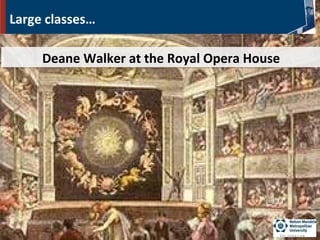
Deane Walker at the Royal Opera HouseDeane Walker at the Royal Opera House
Large classes…
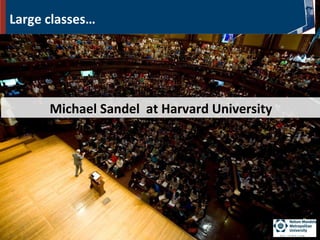
Michael Sandel at Harvard UniversityMichael Sandel at Harvard University
Large classes…
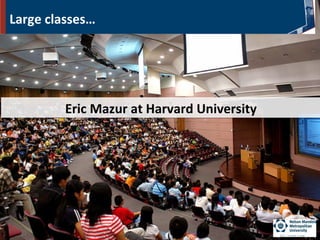
Eric Mazur at Harvard UniversityEric Mazur at Harvard University
Large classes…
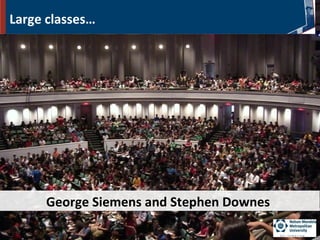
George Siemens and Stephen DownesGeorge Siemens and Stephen Downes
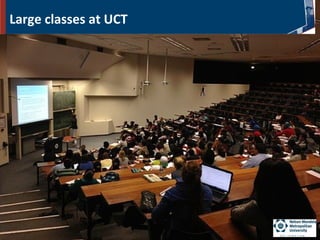
Large classes at UCT
Large classes at NMMU
Define
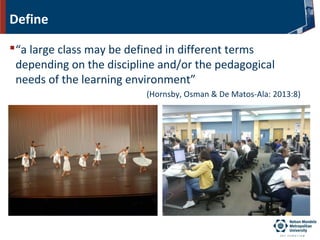
“a large class may be defined in different terms
depending on the discipline and/or the pedagogical
needs of the learning environment”
(Hornsby, Osman & De Matos-Ala: 2013:8)
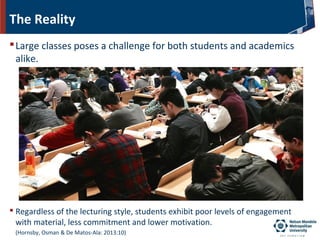
The Reality
Large classes poses a challenge for both students and academics
alike.
 Regardless of the lecturing style, students exhibit poor levels of engagement
with material, less commitment and lower motivation.
(Hornsby, Osman & De Matos-Ala: 2013:10)
Seven principles for good practice in
undergraduate education…
1. encourages contact between students and
faculty,
2. develops reciprocity and cooperation among
students,
3. encourages active learning,
4. gives prompt feedback,
5. emphasizes time on task,
6. communicates high expectations, and
7. respects diverse talents and ways of learning.
Chickering &
Gamson, 1987
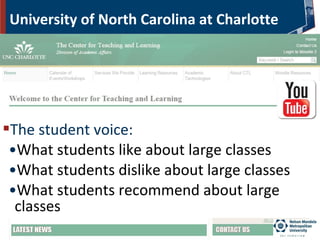
The student voice:
•What students like about large classes
•What students dislike about large classes
•What students recommend about large
classes
University of North Carolina at Charlotte
“huh”
And what else?
What the students said
https://www.youtube.com/watch?v=mfdEFaeqzoM
What the students said: Recommendations
Keep students accountable
Provide an online platform for engagement in addition to
consultation time
Reinforce the relationship to enable communication
Caring about the students and the academic project
Enable peer collaborative learning opportunities
Interaction and engagement
Learn the students’ names
Group work
Visual aids
Take attendance
The challenge
“Challenge the perception that large-class learning environments
are void of pedagogical value”
(Hornsby, Osman & De Matos-Ala: 2013:8)
Any questions?
Resources
 Chickering, Arthur W., and Zelda F. Gamson. "Seven principles for good practice in
undergraduate education." AAHE bulletin 3 (1987): 7
 Gibbs, G. (1999). Using Assessment Strategically to Change the Way Students
Learn. In: Assessment Matters in Higher Education edited by Brown, S. and
Glesner, A. Buckingham: SRHE and Open University Press.
 Hornsby, David J, Osman, Ruksana, De Matos-Ala, Jaqueline. (2013), Large-Class
Pedagogy: Interdisciplinary perspectves for qualtiy highe education. Sun Media:
Stellenbosch
 UNCC CTL YouTube channel: https://www.youtube.com/user/unccCTL/videos
 Teacher to Teacher: http://www.utexas.edu/academic/ctl/largeclasses/#
 Innovative Teaching Methods for Large Classes Bates Wolfe UKZN (2011)
http://www.slideshare.net/EdPER_talks/ukzn-workshop-bates-wolfe?qid=be6b1ea3-9f72

2015 Education Faculty: Large classes presentation

  • 1.
    Teaching and learning inlarge classes Contributed by: Ms Anne Olsen (Adapted from the 2015 SoTLC Topic 7) CTLM (Centre for Teaching, Learning & Media)
  • 2.
    Define How large isa large class?
  • 3.
    Large classes… Deane Walkerat the Royal Opera HouseDeane Walker at the Royal Opera House
  • 4.
    Large classes… Michael Sandelat Harvard UniversityMichael Sandel at Harvard University
  • 5.
    Large classes… Eric Mazurat Harvard UniversityEric Mazur at Harvard University
  • 6.
    Large classes… George Siemensand Stephen DownesGeorge Siemens and Stephen Downes
  • 7.
  • 8.
  • 9.
    Define “a large classmay be defined in different terms depending on the discipline and/or the pedagogical needs of the learning environment” (Hornsby, Osman & De Matos-Ala: 2013:8)
  • 10.
    The Reality Large classesposes a challenge for both students and academics alike.  Regardless of the lecturing style, students exhibit poor levels of engagement with material, less commitment and lower motivation. (Hornsby, Osman & De Matos-Ala: 2013:10)
  • 11.
    Seven principles forgood practice in undergraduate education… 1. encourages contact between students and faculty, 2. develops reciprocity and cooperation among students, 3. encourages active learning, 4. gives prompt feedback, 5. emphasizes time on task, 6. communicates high expectations, and 7. respects diverse talents and ways of learning. Chickering & Gamson, 1987
  • 12.
    The student voice: •Whatstudents like about large classes •What students dislike about large classes •What students recommend about large classes University of North Carolina at Charlotte
  • 13.
    “huh” And what else? Whatthe students said https://www.youtube.com/watch?v=mfdEFaeqzoM
  • 14.
    What the studentssaid: Recommendations Keep students accountable Provide an online platform for engagement in addition to consultation time Reinforce the relationship to enable communication Caring about the students and the academic project Enable peer collaborative learning opportunities Interaction and engagement Learn the students’ names Group work Visual aids Take attendance
  • 15.
    The challenge “Challenge theperception that large-class learning environments are void of pedagogical value” (Hornsby, Osman & De Matos-Ala: 2013:8) Any questions?
  • 16.
    Resources  Chickering, ArthurW., and Zelda F. Gamson. "Seven principles for good practice in undergraduate education." AAHE bulletin 3 (1987): 7  Gibbs, G. (1999). Using Assessment Strategically to Change the Way Students Learn. In: Assessment Matters in Higher Education edited by Brown, S. and Glesner, A. Buckingham: SRHE and Open University Press.  Hornsby, David J, Osman, Ruksana, De Matos-Ala, Jaqueline. (2013), Large-Class Pedagogy: Interdisciplinary perspectves for qualtiy highe education. Sun Media: Stellenbosch  UNCC CTL YouTube channel: https://www.youtube.com/user/unccCTL/videos  Teacher to Teacher: http://www.utexas.edu/academic/ctl/largeclasses/#  Innovative Teaching Methods for Large Classes Bates Wolfe UKZN (2011) http://www.slideshare.net/EdPER_talks/ukzn-workshop-bates-wolfe?qid=be6b1ea3-9f72

Editor's Notes

  • #3 1 min brainstorm session
  • #4 Lecturing Astronomy in 1817 using the magic lantern Note the use of technology
  • #5 Michael J. Sandel (/sænˈdɛl/; born March 5, 1953) is an American political philosopher and a professor at Harvard University. He is best known for the Harvard course "Justice", which is available to view online, and for his critique of John Rawls' A Theory of Justice in his first book, Liberalism and the Limits of Justice (1982). He was elected a Fellow of the American Academy of Arts and Sciences in 2002. (http://en.wikipedia.org/wiki/Michael_J._Sandel)
  • #6 Eric Mazur is the Balkanski Professor of Physics and Applied Physics at Harvard University and Area Dean of Applied Physics. An internationally recognized scientist and researcher, he leads a vigorous research program in optical physics and supervises one of the largest research groups in the Physics Department at Harvard University. Mazur founded several companies and plays an active role in industry. He has served the OSA previously as Director-at-large. Dr. Mazur came to Harvard University in 1982 after obtaining his Ph.D. at the University of Leiden in the Netherlands. In 1984 he joined the faculty and obtained tenure six years later. Dr. Mazur has made important contributions to spectroscopy, light scattering, the interaction of ultrashort laser pulses with materials, and nanophotonics. Dr. Mazur received an Honorary Doctorate from the Ecole Polytechnique and the University of Montreal (2008) and holds Honorary Professorships from Beijing University of Technology, Beijing Normal University, and the Institute of Semiconductor Physics of the Chinese Academy of Sciences. Eric Mazur has received numerous awards, including the Esther Hoffman Beller award from the Optical Society of America and the Millikan Medal from the American Association of Physics Teachers. In 2014 Mazur became the inaugural recipient of the Minerva Prize for Advancements in Higher Education. He is Fellow of the Optical Society of America and Fellow of the American Physical Society. He is a Member of the Royal Academy of Sciences of the Netherlands and a Member of the Royal Holland Society of Sciences and Humanities. He has held appointments as Visiting Professor or Distinguished Lecturer at Princeton University, Vanderbilt University, the University of Leuven in Belgium, National Taiwan University in Taiwan, Carnegie Mellon University, and Hong Kong University. Dr. Mazur has served on numerous committees and councils, including advisory and visiting committees for the National Science Foundation, and has chaired and organized national and international scientific conferences. He serves as consultant to industry in the electronics and telecommunications industry. In 2006 he founded SiOnyx, a company that is commercializing black silicon, a new form of silicon developed in Mazur's laboratory. Mazur is currently Chairman of the Scientific Advisory Board for SiOnyx. In 2011 he founded Learning Catalytics, a company that uses data analytics to improve learning in the classroom. In 2013 the company was acquired by Pearson. Mazur is Chief Academic Advisor for Turning Technologies and serves on the Scientific Advisory Panel for Allied Minds, a pre-seed investment company creating partnerships with key universities to fund corporate spin-outs in early stage technology companies. In addition to his work in optical physics, Mazur has been very active in education. In 1990 he began developing Peer Instruction, a method for teaching large lecture classes interactively. He is the author of Peer Instruction: A User's Manual (Prentice Hall, 1997), a book that explains how to teach large lecture classes interactively. In 2006 he helped produce the award-winning DVD Interactive Teaching. Dr. Mazur's teaching method has developed a large following, both nationally and internationally, and has been adopted across many disciplines. Dr. Mazur is author or co-author of 284 scientific publications, 36 patents, and several books, including thePrinciples and Practice of Physics (Pearson, 2014), a book that presents a groundbreaking new approach to teaching introductory calculus-based physics. Mazur is a sought-after speaker on optics and on education.
  • #7 So George Siemens and Stephen Downes are leading a course entitled "Connectivism & Connective Knowledge." The course has an insane number of students (something like over 2,000) - probably speaking to both the interest in the topic and the reputation of the two leaders. (http://blogoehlert.typepad.com/eclippings/2008/09/cck08-valdis-kr.html)
  • #9 2 min
  • #10 A large class may be defined differently depending on the discipline I.e. theatre students = 15 is large / Biology = 100 is a large number for students
  • #12 Gibbs also refers to it.