Developing learning outcomes Assessment and Improvement  Professional Development Workshop August 27, 2010
Description Understand the process of developing a learning outcome statement requires some time and effort. Understand how outcomes are linked to improving student learning, and ultimately teaching becomes a natural extension of the classroom experience.  Working with a small group we will construct learning outcome statements.  Using the learning outcome statements we will determine a variety of assessment methods and strategies.  Finally, we will discuss how the data gathered is used to revise or improve student learning.
Objectives During this workshop, participants will: Create or construct measurable learning outcome statements Identify possible methods to assess or evaluate student accomplishment Develop strategies to use outcomes for improvement
CREATE OR CONSTRUCT MEASURABLE LEARNING OUTCOME STATEMENTS
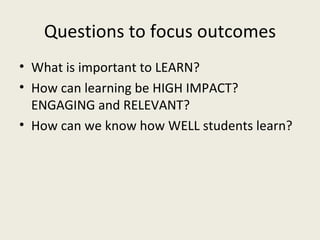
Questions to focus outcomes What is important to LEARN? How can learning be HIGH IMPACT? ENGAGING and RELEVANT? How can we know how WELL students learn?
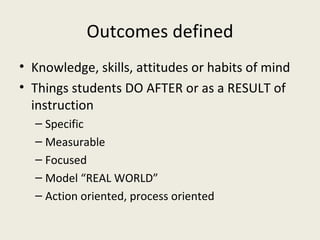
Outcomes defined Knowledge, skills, attitudes or habits of mind Things students DO AFTER or as a RESULT of instruction Specific Measurable Focused Model “REAL WORLD” Action oriented, process oriented
IDENTIFY POSSIBLE METHODS TO ASSESS OR EVALUATE STUDENT ACCOMPLISHMENT
Identify possible methods to assess or evaluate student accomplishment Types of assessment Direct or Indirect Embedded or Add-on Objective or Subjective Timing of assessment Formative or Summative Outcomes enhance accomplishment Accurate determination of learning
DEVELOP STRATEGIES TO USE OUTCOMES FOR IMPROVEMENT
Develop strategies to use outcomes for improvement Identify learning strengths Identify teaching strengths Identify technological needs
Review Objectives During this workshop, participants: Create or construct measurable learning outcome statements Identify possible methods to assess or evaluate student accomplishment Develop strategies to use outcomes for improvement
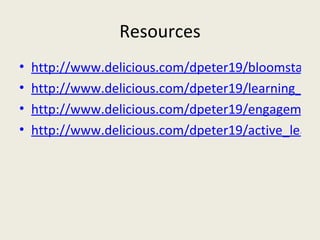
Resources http://www.delicious.com/dpeter19/bloomstaxonomy http://www.delicious.com/dpeter19/learning_outcomes http://www.delicious.com/dpeter19/engagement http://www.delicious.com/dpeter19/active_learning
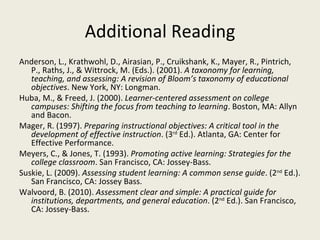
Additional Reading Anderson, L., Krathwohl, D., Airasian, P., Cruikshank, K., Mayer, R., Pintrich, P., Raths, J., & Wittrock, M. (Eds.). (2001).  A taxonomy for learning, teaching, and assessing: A revision of Bloom’s taxonomy of educational objectives . New York, NY: Longman. Huba, M., & Freed, J. (2000).  Learner-centered assessment on college campuses: Shifting the focus from teaching to learning . Boston, MA: Allyn and Bacon. Mager, R. (1997).  Preparing instructional objectives: A critical tool in the development of effective instruction . (3 rd  Ed.). Atlanta, GA: Center for Effective Performance. Meyers, C., & Jones, T. (1993).  Promoting active learning: Strategies for the college classroom . San Francisco, CA: Jossey-Bass. Suskie, L. (2009).  Assessing student learning: A common sense guide . (2 nd  Ed.). San Francisco, CA: Jossey Bass. Walvoord, B. (2010).  Assessment clear and simple: A practical guide for institutions, departments, and general education . (2 nd  Ed.). San Francisco, CA: Jossey-Bass.

01 developing learning outcomes

  • 1.
    Developing learning outcomesAssessment and Improvement Professional Development Workshop August 27, 2010
  • 2.
    Description Understand theprocess of developing a learning outcome statement requires some time and effort. Understand how outcomes are linked to improving student learning, and ultimately teaching becomes a natural extension of the classroom experience. Working with a small group we will construct learning outcome statements. Using the learning outcome statements we will determine a variety of assessment methods and strategies. Finally, we will discuss how the data gathered is used to revise or improve student learning.
  • 3.
    Objectives During thisworkshop, participants will: Create or construct measurable learning outcome statements Identify possible methods to assess or evaluate student accomplishment Develop strategies to use outcomes for improvement
  • 4.
    CREATE OR CONSTRUCTMEASURABLE LEARNING OUTCOME STATEMENTS
  • 5.
    Questions to focusoutcomes What is important to LEARN? How can learning be HIGH IMPACT? ENGAGING and RELEVANT? How can we know how WELL students learn?
  • 6.
    Outcomes defined Knowledge,skills, attitudes or habits of mind Things students DO AFTER or as a RESULT of instruction Specific Measurable Focused Model “REAL WORLD” Action oriented, process oriented
  • 7.
    IDENTIFY POSSIBLE METHODSTO ASSESS OR EVALUATE STUDENT ACCOMPLISHMENT
  • 8.
    Identify possible methodsto assess or evaluate student accomplishment Types of assessment Direct or Indirect Embedded or Add-on Objective or Subjective Timing of assessment Formative or Summative Outcomes enhance accomplishment Accurate determination of learning
  • 9.
    DEVELOP STRATEGIES TOUSE OUTCOMES FOR IMPROVEMENT
  • 10.
    Develop strategies touse outcomes for improvement Identify learning strengths Identify teaching strengths Identify technological needs
  • 11.
    Review Objectives Duringthis workshop, participants: Create or construct measurable learning outcome statements Identify possible methods to assess or evaluate student accomplishment Develop strategies to use outcomes for improvement
  • 12.
    Resources http://www.delicious.com/dpeter19/bloomstaxonomy http://www.delicious.com/dpeter19/learning_outcomeshttp://www.delicious.com/dpeter19/engagement http://www.delicious.com/dpeter19/active_learning
  • 13.
    Additional Reading Anderson,L., Krathwohl, D., Airasian, P., Cruikshank, K., Mayer, R., Pintrich, P., Raths, J., & Wittrock, M. (Eds.). (2001). A taxonomy for learning, teaching, and assessing: A revision of Bloom’s taxonomy of educational objectives . New York, NY: Longman. Huba, M., & Freed, J. (2000). Learner-centered assessment on college campuses: Shifting the focus from teaching to learning . Boston, MA: Allyn and Bacon. Mager, R. (1997). Preparing instructional objectives: A critical tool in the development of effective instruction . (3 rd Ed.). Atlanta, GA: Center for Effective Performance. Meyers, C., & Jones, T. (1993). Promoting active learning: Strategies for the college classroom . San Francisco, CA: Jossey-Bass. Suskie, L. (2009). Assessing student learning: A common sense guide . (2 nd Ed.). San Francisco, CA: Jossey Bass. Walvoord, B. (2010). Assessment clear and simple: A practical guide for institutions, departments, and general education . (2 nd Ed.). San Francisco, CA: Jossey-Bass.