

Transformative Curriculum
Development
Presented by Anne-Mart Olsen
CTLM
Anne-Mart.Olsen2@NMMU.ac.za
https://i.ytimg.com/vi/MyBsRn2vIlE/maxresdefault.jpg
INTRODUCTION
What is the purpose of Higher Education?
http://archive.freeenterprise.com/sites/default/files/styles/large/public/media/00_ED_iStock_000017899207Medium_Credit_659px.jpg
Transformative curricula
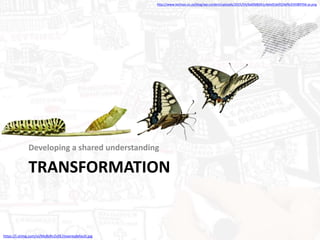
• Developing a shared understanding
– Curriculum Development
– Transformation
• Curriculum Responsiveness & Transformation
• Transformative curricula
• Constructive alignment
• Challenges
http://www.techsys.co.za/blog/wp-content/uploads/2015/04/6a00d8341c4ebd53ef019affe25938970d-pi.png
Developing a shared understanding
• Divide into 2 groups
• Introduce key questions
– Curriculum Development
– Transformation
• Move around to each question
• Discuss question
• Note answers down
• Move to the next question
• Repeat process with the other group’s questions
– Look at the previous groups answers & discuss
– Add to previous answers
• Provide feedback
http://www.livingsafetogether.gov.au/newsandblog/PublishingImages/news_jigsawhands_bcr.jpg
Developing a shared understanding
Curriculum
• How would you define
curriculum?
• What role do you think
curriculum plays in higher
education?
• What are the dominant
ideas that shape curriculum
development practices at
NMMU?
Transformation
• How would you define
transformation?
• What role do you think
transformation plays in
higher education?
• What ideas relevant to
transformation are evident
at NMMU?
http://www.livingsafetogether.gov.au/newsandblog/PublishingImages/news_jigsawhands_bcr.jpg
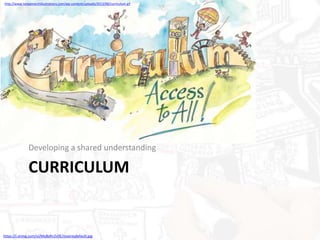
CURRICULUM
Developing a shared understanding
https://i.ytimg.com/vi/MyBsRn2vIlE/maxresdefault.jpg
http://www.tanyamarchillustrations.com/wp-content/uploads/2013/06/curriculum.gif
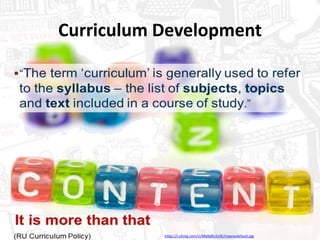
Curriculum Development
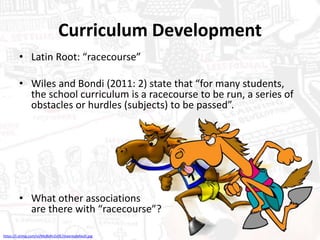
• Latin Root: “racecourse”
• Wiles and Bondi (2011: 2) state that “for many students,
the school curriculum is a racecourse to be run, a series of
obstacles or hurdles (subjects) to be passed”.
• What other associations
are there with “racecourse”?
https://i.ytimg.com/vi/MyBsRn2vIlE/maxresdefault.jpg
Curriculum Development
https://i.ytimg.com/vi/MyBsRn2vIlE/maxresdefault.jpg
Curriculum Development
https://i.ytimg.com/vi/MyBsRn2vIlE/maxresdefault.jpg
Curriculum Development
https://i.ytimg.com/vi/MyBsRn2vIlE/maxresdefault.jpg
Curriculum Development @ NMMU
https://i.ytimg.com/vi/MyBsRn2vIlE/maxresdefault.jpg
TRANSFORMATION
Developing a shared understanding
https://i.ytimg.com/vi/MyBsRn2vIlE/maxresdefault.jpg
http://www.techsys.co.za/blog/wp-content/uploads/2015/04/6a00d8341c4ebd53ef019affe25938970d-pi.png
Transformation
• … process of profound and radical change
• … implies change of character and little or no
resemblance to the previous structure
Transformation reflects deep change and
restructuring enabling HE institutions to
address challenging needs and demands posed
by a changing environment.
(Hay & Marias, 2011: 230)
http://www.techsys.co.za/blog/wp-content/uploads/2015/04/6a00d8341c4ebd53ef019affe25938970d-pi.png
Transformation
• In the South African context HE is often driven by
an institutional understanding and interpretation
of transformation concepts, how and what
institutions perceive for example as social justice,
discrimination, social cohesion and the burning
societal and research imperatives
(Hay & Marias, 2011: 233)
• Address historical imbalances
– E.g. Black graduates in Health Sciences
– E.g. Indigenous knowledge in the curriculum
http://www.techsys.co.za/blog/wp-content/uploads/2015/04/6a00d8341c4ebd53ef019affe25938970d-pi.png
Transformation @ NMMU
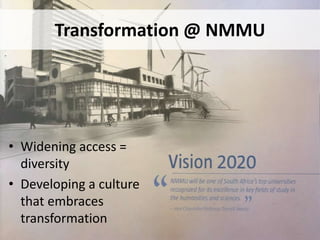
• Widening access =
diversity
• Developing a culture
that embraces
transformation
Developing a shared understanding
How does curriculum development and
transformation relate? https://i.ytimg.com/vi/MyBsRn2vIlE/maxresdefault.jpg
http://b-i.forbesimg.com/joefolkman/files/2013/12/feedback-heads1.png
https://www.youtube.com/watch?v=MyBsRn2vIlE
CURRICULUM RESPONSIVENESS
Ian Moll: 2004
http://www.joblo.com/newsimages1/A-Bug-s-Life-a-bugs-life-626989_1024_768xxx.jpg
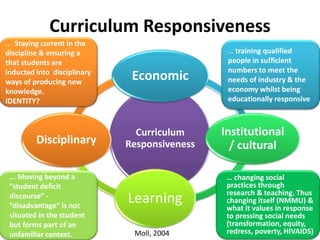
Curriculum Responsiveness
Curriculum
Responsiveness
Economic
Institutional
/ cultural
Learning
Disciplinary
… training qualified
people in sufficient
numbers to meet the
needs of industry & the
economy whilst being
educationally responsive
… changing social
practices through
research & teaching. Thus
changing itself (NMMU) &
what it values in response
to pressing social needs
(transformation, equity,
redress, poverty, HIVAIDS)
... Moving beyond a
“student deficit
discourse” -
“disadvantage” is not
situated in the student
but forms part of an
unfamiliar context.
… Staying current in the
discipline & ensuring a
that students are
inducted into disciplinary
ways of producing new
knowledge.
IDENTITY?
Moll, 2004
How responsive/transformative?
• Articulation
– Multiple exits
• Africanisation
• Nation Health Plan
• Relevance as a profession
• Student support and development
• …
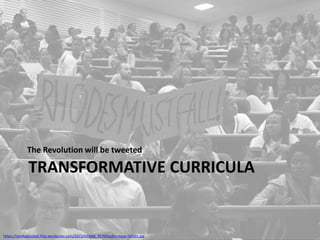
TRANSFORMATIVE CURRICULA
The Revolution will be tweeted
https://tamikadoubell.files.wordpress.com/2015/04/img_4570rhodes-must-fall001.jpg
Transformative curricula
Curriculum development cannot be detached from
societal and cultural transformation, or from
evolving trends that drive global and national
change…
(Hay & Marias, 2011: 229)
• … transformation is strategically linked to
curricula reflecting the
– academic content
– learning activities
– extra curricular knowledge & competencies
Hay & Marias, 2011: 232
Transformative curricula
• Formal access vs Epistemological access
(Morrow, 1993)
• Social and political redress has mandated
curricular redress, specifically in terms of
participation rates and access to higher
education
• Enable students to adapt to the HE
environment
(Hay & Marias, 2011: 234)
Transformative curricula
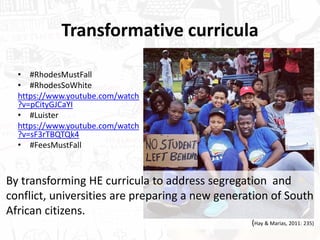
• #RhodesMustFall
• #RhodesSoWhite
https://www.youtube.com/watch
?v=pCityGJCaYI
• #Luister
https://www.youtube.com/watch
?v=sF3rTBQTQk4
• #FeesMustFall
By transforming HE curricula to address segregation and
conflict, universities are preparing a new generation of South
African citizens.
(Hay & Marias, 2011: 235)
Transformative curricula
Brainstorm:
• How can the Psychology curriculum be
transformative?
Content
Teaching strategies
Assessment
Technology
Student Development / Support
Peer collaborative learning
https://blog.optimizely.com/wp-content/uploads/2014/02/brainstorm1.jpg
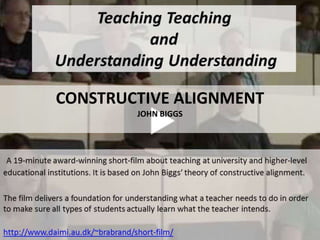
CONSTRUCTIVE ALIGNMENT
JOHN BIGGS
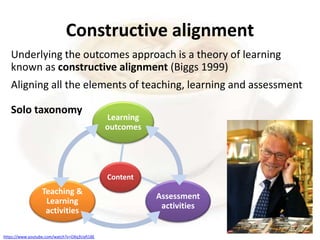
Underlying the outcomes approach is a theory of learning
known as constructive alignment (Biggs 1999)
Aligning all the elements of teaching, learning and assessment
Solo taxonomy
Constructive alignment
Content
Learning
outcomes
Teaching &
Learning
activities
Assessment
activities
https://www.youtube.com/watch?v=OXq3Uyfi18E
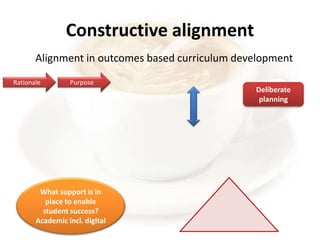
Alignment in outcomes based curriculum development
Constructive alignment
Rationale Purpose
What support is in
place to enable
student success?
Academic incl. digital
Deliberate
planning
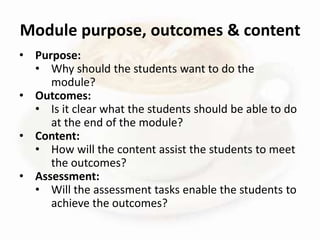
• Purpose:
• Why should the students want to do the
module?
• Outcomes:
• Is it clear what the students should be able to do
at the end of the module?
• Content:
• How will the content assist the students to meet
the outcomes?
• Assessment:
• Will the assessment tasks enable the students to
achieve the outcomes?
Module purpose, outcomes & content
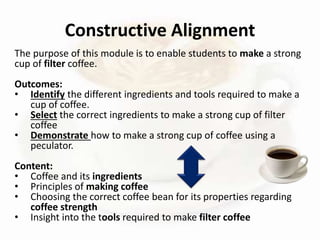
The purpose of this module is to enable students to make a strong
cup of filter coffee.
Outcomes:
• Identify the different ingredients and tools required to make a
cup of coffee.
• Select the correct ingredients to make a strong cup of filter
coffee
• Demonstrate how to make a strong cup of coffee using a
peculator.
Content:
• Coffee and its ingredients
• Principles of making coffee
• Choosing the correct coffee bean for its properties regarding
coffee strength
• Insight into the tools required to make filter coffee
Constructive Alignment
Identify the different ingredients and tools required to make a
cup of coffee.
Aligning the teaching strategy to the learning outcome
• A 35min lecture on the theory associated with the
ingredients of coffee and the tools required to make a cup
of coffee.
Or
• Watch a video of someone making a cup of coffee whilst
taking notes on a hand out of what ingredients and tools
the person in the video used. Compare and discuss your
answers with a peer and adapt your worksheet accordingly.
Constructive Alignment
Identify the different ingredients and tools required to make a cup of
coffee.
Watch a video of someone making a cup of coffee whilst taking
notes on a hand out of what ingredients and tools the person in the
video used. Compare and discuss your answers with a peer and
adapt your worksheet accordingly.
Assessment:
Identify and label the different ingredients and tools required for
making coffee in the picture supplied
Or
Write a 500 essay discussing the characteristics of the tools required
to make a cup of coffee?
Integrated feedback and support
Constructive Alignment
Just for Fun
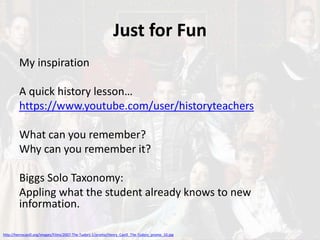
My inspiration
A quick history lesson…
https://www.youtube.com/user/historyteachers
What can you remember?
Why can you remember it?
Biggs Solo Taxonomy:
Appling what the student already knows to new
information.
http://henrycavill.org/images/Films/2007-The-Tudors-1/promo/Henry_Cavill_The-Tudors_promo_10.jpg
CHALLENGES
And possible solutions
http://robertsontrainingsystems.com/wp-content/uploads/2011/08/challenges.png
Challenges
• Large classes
– Teaching strategies
– Marking
• Various faculties
– Admission criteria
– Relevance
– Assessment practices
• Developing a student identify
Questions and Discussion
https://www.inmar.com/PublishingImages/Question%20People.jpg

Transformative curriculum workshop

  • 1.
    Transformative Curriculum Development Presented byAnne-Mart Olsen CTLM Anne-Mart.Olsen2@NMMU.ac.za https://i.ytimg.com/vi/MyBsRn2vIlE/maxresdefault.jpg
  • 2.
    INTRODUCTION What is thepurpose of Higher Education? http://archive.freeenterprise.com/sites/default/files/styles/large/public/media/00_ED_iStock_000017899207Medium_Credit_659px.jpg
  • 3.
    Transformative curricula • Developinga shared understanding – Curriculum Development – Transformation • Curriculum Responsiveness & Transformation • Transformative curricula • Constructive alignment • Challenges http://www.techsys.co.za/blog/wp-content/uploads/2015/04/6a00d8341c4ebd53ef019affe25938970d-pi.png
  • 4.
    Developing a sharedunderstanding • Divide into 2 groups • Introduce key questions – Curriculum Development – Transformation • Move around to each question • Discuss question • Note answers down • Move to the next question • Repeat process with the other group’s questions – Look at the previous groups answers & discuss – Add to previous answers • Provide feedback http://www.livingsafetogether.gov.au/newsandblog/PublishingImages/news_jigsawhands_bcr.jpg
  • 5.
    Developing a sharedunderstanding Curriculum • How would you define curriculum? • What role do you think curriculum plays in higher education? • What are the dominant ideas that shape curriculum development practices at NMMU? Transformation • How would you define transformation? • What role do you think transformation plays in higher education? • What ideas relevant to transformation are evident at NMMU? http://www.livingsafetogether.gov.au/newsandblog/PublishingImages/news_jigsawhands_bcr.jpg
  • 6.
    CURRICULUM Developing a sharedunderstanding https://i.ytimg.com/vi/MyBsRn2vIlE/maxresdefault.jpg http://www.tanyamarchillustrations.com/wp-content/uploads/2013/06/curriculum.gif
  • 7.
    Curriculum Development • LatinRoot: “racecourse” • Wiles and Bondi (2011: 2) state that “for many students, the school curriculum is a racecourse to be run, a series of obstacles or hurdles (subjects) to be passed”. • What other associations are there with “racecourse”? https://i.ytimg.com/vi/MyBsRn2vIlE/maxresdefault.jpg
  • 8.
  • 9.
  • 10.
  • 11.
    Curriculum Development @NMMU https://i.ytimg.com/vi/MyBsRn2vIlE/maxresdefault.jpg
  • 12.
    TRANSFORMATION Developing a sharedunderstanding https://i.ytimg.com/vi/MyBsRn2vIlE/maxresdefault.jpg http://www.techsys.co.za/blog/wp-content/uploads/2015/04/6a00d8341c4ebd53ef019affe25938970d-pi.png
  • 13.
    Transformation • … processof profound and radical change • … implies change of character and little or no resemblance to the previous structure Transformation reflects deep change and restructuring enabling HE institutions to address challenging needs and demands posed by a changing environment. (Hay & Marias, 2011: 230) http://www.techsys.co.za/blog/wp-content/uploads/2015/04/6a00d8341c4ebd53ef019affe25938970d-pi.png
  • 14.
    Transformation • In theSouth African context HE is often driven by an institutional understanding and interpretation of transformation concepts, how and what institutions perceive for example as social justice, discrimination, social cohesion and the burning societal and research imperatives (Hay & Marias, 2011: 233) • Address historical imbalances – E.g. Black graduates in Health Sciences – E.g. Indigenous knowledge in the curriculum http://www.techsys.co.za/blog/wp-content/uploads/2015/04/6a00d8341c4ebd53ef019affe25938970d-pi.png
  • 15.
    Transformation @ NMMU •Widening access = diversity • Developing a culture that embraces transformation
  • 16.
    Developing a sharedunderstanding How does curriculum development and transformation relate? https://i.ytimg.com/vi/MyBsRn2vIlE/maxresdefault.jpg http://b-i.forbesimg.com/joefolkman/files/2013/12/feedback-heads1.png https://www.youtube.com/watch?v=MyBsRn2vIlE
  • 17.
    CURRICULUM RESPONSIVENESS Ian Moll:2004 http://www.joblo.com/newsimages1/A-Bug-s-Life-a-bugs-life-626989_1024_768xxx.jpg
  • 18.
    Curriculum Responsiveness Curriculum Responsiveness Economic Institutional / cultural Learning Disciplinary …training qualified people in sufficient numbers to meet the needs of industry & the economy whilst being educationally responsive … changing social practices through research & teaching. Thus changing itself (NMMU) & what it values in response to pressing social needs (transformation, equity, redress, poverty, HIVAIDS) ... Moving beyond a “student deficit discourse” - “disadvantage” is not situated in the student but forms part of an unfamiliar context. … Staying current in the discipline & ensuring a that students are inducted into disciplinary ways of producing new knowledge. IDENTITY? Moll, 2004
  • 19.
    How responsive/transformative? • Articulation –Multiple exits • Africanisation • Nation Health Plan • Relevance as a profession • Student support and development • …
  • 20.
    TRANSFORMATIVE CURRICULA The Revolutionwill be tweeted https://tamikadoubell.files.wordpress.com/2015/04/img_4570rhodes-must-fall001.jpg
  • 21.
    Transformative curricula Curriculum developmentcannot be detached from societal and cultural transformation, or from evolving trends that drive global and national change… (Hay & Marias, 2011: 229) • … transformation is strategically linked to curricula reflecting the – academic content – learning activities – extra curricular knowledge & competencies Hay & Marias, 2011: 232
  • 22.
    Transformative curricula • Formalaccess vs Epistemological access (Morrow, 1993) • Social and political redress has mandated curricular redress, specifically in terms of participation rates and access to higher education • Enable students to adapt to the HE environment (Hay & Marias, 2011: 234)
  • 23.
    Transformative curricula • #RhodesMustFall •#RhodesSoWhite https://www.youtube.com/watch ?v=pCityGJCaYI • #Luister https://www.youtube.com/watch ?v=sF3rTBQTQk4 • #FeesMustFall By transforming HE curricula to address segregation and conflict, universities are preparing a new generation of South African citizens. (Hay & Marias, 2011: 235)
  • 24.
    Transformative curricula Brainstorm: • Howcan the Psychology curriculum be transformative? Content Teaching strategies Assessment Technology Student Development / Support Peer collaborative learning https://blog.optimizely.com/wp-content/uploads/2014/02/brainstorm1.jpg
  • 25.
  • 26.
    Underlying the outcomesapproach is a theory of learning known as constructive alignment (Biggs 1999) Aligning all the elements of teaching, learning and assessment Solo taxonomy Constructive alignment Content Learning outcomes Teaching & Learning activities Assessment activities https://www.youtube.com/watch?v=OXq3Uyfi18E
  • 27.
    Alignment in outcomesbased curriculum development Constructive alignment Rationale Purpose What support is in place to enable student success? Academic incl. digital Deliberate planning
  • 28.
    • Purpose: • Whyshould the students want to do the module? • Outcomes: • Is it clear what the students should be able to do at the end of the module? • Content: • How will the content assist the students to meet the outcomes? • Assessment: • Will the assessment tasks enable the students to achieve the outcomes? Module purpose, outcomes & content
  • 29.
    The purpose ofthis module is to enable students to make a strong cup of filter coffee. Outcomes: • Identify the different ingredients and tools required to make a cup of coffee. • Select the correct ingredients to make a strong cup of filter coffee • Demonstrate how to make a strong cup of coffee using a peculator. Content: • Coffee and its ingredients • Principles of making coffee • Choosing the correct coffee bean for its properties regarding coffee strength • Insight into the tools required to make filter coffee Constructive Alignment
  • 30.
    Identify the differentingredients and tools required to make a cup of coffee. Aligning the teaching strategy to the learning outcome • A 35min lecture on the theory associated with the ingredients of coffee and the tools required to make a cup of coffee. Or • Watch a video of someone making a cup of coffee whilst taking notes on a hand out of what ingredients and tools the person in the video used. Compare and discuss your answers with a peer and adapt your worksheet accordingly. Constructive Alignment
  • 31.
    Identify the differentingredients and tools required to make a cup of coffee. Watch a video of someone making a cup of coffee whilst taking notes on a hand out of what ingredients and tools the person in the video used. Compare and discuss your answers with a peer and adapt your worksheet accordingly. Assessment: Identify and label the different ingredients and tools required for making coffee in the picture supplied Or Write a 500 essay discussing the characteristics of the tools required to make a cup of coffee? Integrated feedback and support Constructive Alignment
  • 32.
    Just for Fun Myinspiration A quick history lesson… https://www.youtube.com/user/historyteachers What can you remember? Why can you remember it? Biggs Solo Taxonomy: Appling what the student already knows to new information. http://henrycavill.org/images/Films/2007-The-Tudors-1/promo/Henry_Cavill_The-Tudors_promo_10.jpg
  • 33.
  • 34.
    Challenges • Large classes –Teaching strategies – Marking • Various faculties – Admission criteria – Relevance – Assessment practices • Developing a student identify
  • 35.

Editor's Notes

  • #2 Ice breaker: Fold piece of paper in 3s write name on the front and draw of picture of your approach to teaching in the classroom.
  • #3 knowledge (and truth) production democracy self – identity critique emancipation
  • #17 This short film produced by the North Alliance explains the background to the Curriculum for Excellence and how it links to Community Learning and Development principles. The film is narrated by Keir Bloomer, a member of the original Curriculum Review Group https://www.youtube.com/watch?v=MyBsRn2vIlE
  • #19 Learning: For Slonimsky “disadvantage” is not inherent in the individual, but is a result of “a relation between a familiar cultural context, which (the learner) has internalised, and the unfamiliar cultural and institutional context (of the university) which she has not yet internalised.” Cultural Capital – My story Moll suggests that economic responsiveness (which seems to dominate policy documents) can only be achieved if the other elements of responsiveness are achieved.
  • #20 Africanisatin – personalogy only module when I was studying National health plan – mental health
  • #22 Access / redress / transformation Therefore curriculum facilitates the development of extra-curricular knowledge, as it prepares graduates not only to fulfil their responsibilities in the labour market but also to become responsible citizens, contributing to overall human capital endeavours. It also addresses social, economic, educational and political issues of the day.
  • #23 Access / redress / transformation Therefore curriculum facilitates the development of extra-curricular knowledge, as it prepares graduates not only to fulfil their responsibilities in the labour market but also to become responsible citizens, contributing to overall human capital endeavours. It also addresses social, economic, educational and political issues of the day. NMMU’s co-curricular record
  • #24 #RhodesSoWhite explores systematic white privilege within Rhodes University in Grahamstown, South Africa. Students talk through the current controversies and share their ideas of transformation in this 24 min documentary. Luister is a documentary about the lives of students of colour who attend Stellenbosch University, a South African institution of higher learning. In a series of interviews, students recount instances of racial prejudice that they continue to experience in the town of Stellenbosch, and the enormous challenges that they face due to the use of Afrikaans as a language of teaching at the university. Luister is a film about Afrikaans as a language and a culture. It is a film about the continuing racism that exists within a divided society. It is a film about a group of students whose stories have been ignored.
  • #27 The process of aligning all the content, teaching, learning and assessment activities to learning outcomes is known as Bigg’s constructive alignment. Workshop on it’s own
  • #28 As demonstrated by the slide every aspect on the curriculum development process is aligned – from the rationale to the assessment tasks provided to students. This alignment also includes what support structures are included in the curriculum in order to enable student success. The module outcomes can be considered building blocks to achieving the more holistic exit level outcomes at programme level, which is why the alignment is crucial. The module purpose, outcomes, content and teaching, learning and assessment methods need to be aligned in order to holistically develop students that will meet the exit level outcomes. CTLM is able to assist with the writing of the purpose and outcomes and then to align the teaching, learning and assessment methods the outcomes. Furthermore we are able to suggest potential support initiatives, such as academic literacies that can be embedded into the curriculum in order to assist with enabling student success. As demonstrated by the slide, the alignment of the module purpose, outcomes and teaching, learning and assessment methods should assist with identifying the necessary assessment criteria, marking tools, such as rubrics and how to provide students with feedback.
  • #29 Mention outcomes… specific, measurable, written for the students
  • #30 How does it all fit together? Based on the last page for Form 2 Note how the purpose, outcomes and content is aligned. Assists with prioritising the selection and sequencing of the content For example, in the content I don’t have a section on the history of coffee or slavery or even how to grow a coffee bean. That is interesting information, potentially something we would like to teach or our students to know, however, there is no outcomes that is aligned to the content. Ideally we should choose our outcomes first and then align the content to the outcome. However, if you strongly believe that there is content that should be there that is not covered by the outcomes, an outcome should be added to accommodate the content, otherwise it is unclear to the students and the lecturer how that content will be assessed. Also, it should be clear how the content is then aligned to the purpose of the module. I have also assisted with aligning outcomes and content with the purpose of the module.
  • #31 Once we have an outcome we need to identify the best strategies to teach the outcome. This is also a section of the document we have been commenting on. An example would include looking at how the proposed teaching strategy will or will not meet the outcomes associated with the module. If the teaching and learning strategy does not meet the outcome we could discuss alterative teaching and learning strategies to enable constructive alignment.
  • #32 NMMU Moderation policy The same is true for assessment, as the outcome and teaching strategy indicate how the module (or content) will be assessed. Biggs argues that if these (outcome, teaching strategy and assessment is aligned) students will be more motivated to engage with teaching and learning and potentially realise the benefit of attending class. Once again this is an aspect of the process where we are able to assist.
  • #35 Flip chart… How can these be solved? BLENDED LEARNING