Supply Chain Management
By: Er. Vaibhav Agarwal
Asst. prof.
BBD University, Lucknow
Supply Chain Management
 Definition:
Supply Chain Management is primarily concerned with the efficient
integration of suppliers, factories, warehouses and stores so that
merchandise is produced and distributed in the right quantities, to the
right locations and at the right time, and so as to minimize total
system cost subject to satisfying customer service requirements.
 Notice:
 Who is involved
 Cost and Service Level
 It is all about integration
What Is Supply Chain
Management?
 Supply chain management is a set of approaches utilized to efficiently
integrate suppliers, manufacturers, warehouses, and stores, so that
merchandise is produced and distributed at the right quantities, to the
right locations, and at the right time, in order to minimize system wide
costs while satisfying service level requirements.
What Is a Supply Chain?
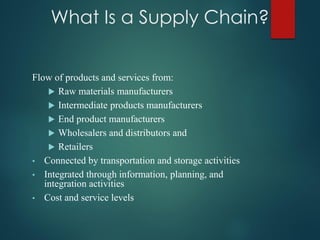
Flow of products and services from:
 Raw materials manufacturers
 Intermediate products manufacturers
 End product manufacturers
 Wholesalers and distributors and
 Retailers
• Connected by transportation and storage activities
• Integrated through information, planning, and
integration activities
• Cost and service levels
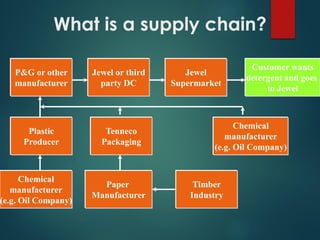
What is a supply chain?
Customer wants
detergent and goes
to Jewel
Jewel
Supermarket
Jewel or third
party DC
P&G or other
manufacturer
Plastic
Producer
Chemical
manufacturer
(e.g. Oil Company)
Tenneco
Packaging
Paper
Manufacturer
Timber
Industry
Chemical
manufacturer
(e.g. Oil Company)
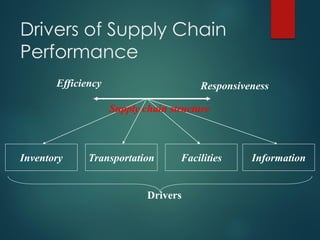
Drivers of Supply Chain
Performance
Efficiency Responsiveness
Inventory Transportation Facilities Information
Supply chain structure
Drivers
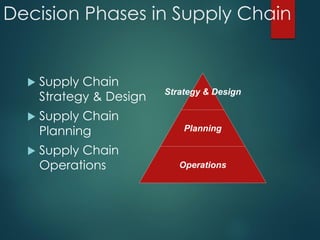
Decision Phases in Supply Chain
 Supply Chain
Strategy & Design
 Supply Chain
Planning
 Supply Chain
Operations
Strategy & Design
Planning
Operations
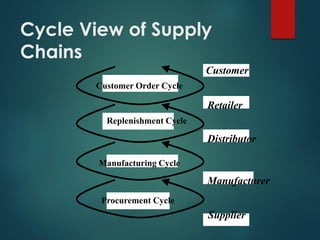
Cycle View of Supply
Chains
Customer Order Cycle
Replenishment Cycle
Manufacturing Cycle
Procurement Cycle
Customer
Retailer
Distributor
Manufacturer
Supplier
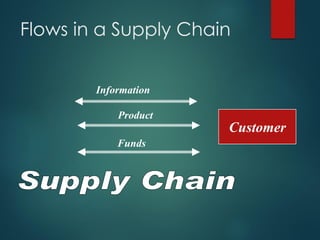
Flows in a Supply Chain
Customer
Information
Product
Funds
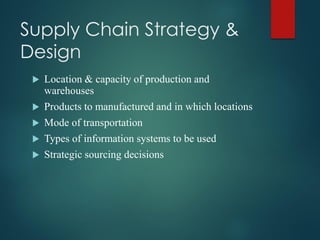
Supply Chain Strategy &
Design
 Location & capacity of production and
warehouses
 Products to manufactured and in which locations
 Mode of transportation
 Types of information systems to be used
 Strategic sourcing decisions
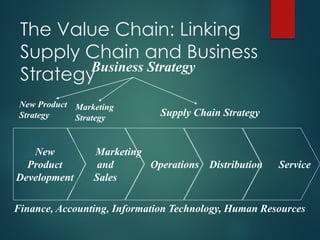
The Value Chain: Linking
Supply Chain and Business
Strategy
New
Product
Development
Marketing
and
Sales
Operations Distribution Service
Finance, Accounting, Information Technology, Human Resources
Business Strategy
New Product
Strategy
Marketing
Strategy
Supply Chain Strategy
Supply Chain Planning
 Markets to be supplied & from which location
 Planned build-up of inventory
 Subcontracting of manufacturing
 Timing and size of market promotion
 Handling uncertainty in demand, foreign exchange
fluctuations
 Establishing production plan under fixed strategic
parameters
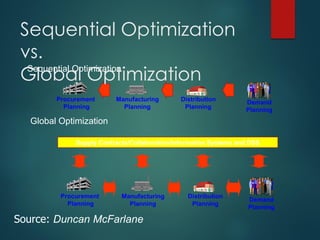
Procurement
Planning
Manufacturing
Planning
Distribution
Planning
Demand
Planning
Sequential Optimization
Supply Contracts/Collaboration/Information Systems and DSS
Procurement
Planning
Manufacturing
Planning
Distribution
Planning
Demand
Planning
Global Optimization
Sequential Optimization
vs.
Global Optimization
Source: Duncan McFarlane
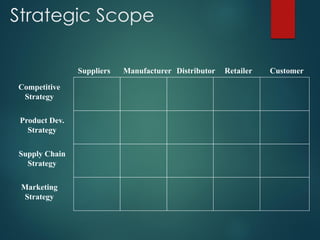
Strategic Scope
Suppliers Manufacturer Distributor Retailer Customer
Competitive
Strategy
Product Dev.
Strategy
Supply Chain
Strategy
Marketing
Strategy
Strategic Scope
 Intracompany Intraoperation Scope
 Minimize local cost view
 Intracompany Intrafunctional Scope
 Minimize functional cost view
 Intracompany Interfunctional Scope
 Minimize company profit view
 Intercompany Interfunctional Scope
 Maximize supply chain surplus view
Supply Chain Challenges
 Achieving Global Optimization
 Conflicting Objectives
 Complex network of facilities
 System Variations over time
Key Issues in Supply Chain
Management
 Distribution Network Configuration
 Inventory Control
 Supply contract
 Distribution Strategies
 Supply Chain Integration & Strategic Partnering
 Outsourcing & Procurement Strategies
Key Issues of SCM (cont)
 Product Design
 Information Technology & Decision Support
System
 Customer Value
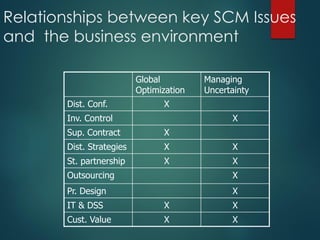
Relationships between key SCM Issues
and the business environment
Global
Optimization
Managing
Uncertainty
Dist. Conf. X
Inv. Control X
Sup. Contract X
Dist. Strategies X X
St. partnership X X
Outsourcing X
Pr. Design X
IT & DSS X X
Cust. Value X X
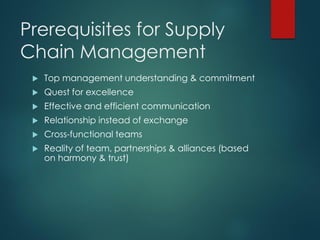
Prerequisites for Supply
Chain Management
 Top management understanding & commitment
 Quest for excellence
 Effective and efficient communication
 Relationship instead of exchange
 Cross-functional teams
 Reality of team, partnerships & alliances (based
on harmony & trust)
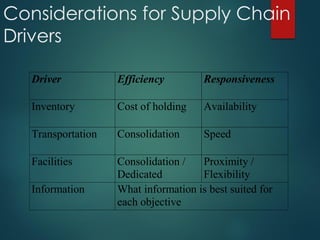
Considerations for Supply Chain
Drivers
Driver Efficiency Responsiveness
Inventory Cost of holding Availability
Transportation Consolidation Speed
Facilities Consolidation /
Dedicated
Proximity /
Flexibility
Information What information is best suited for
each objective

Supply chain management

  • 1.
    Supply Chain Management By:Er. Vaibhav Agarwal Asst. prof. BBD University, Lucknow
  • 2.
    Supply Chain Management Definition: Supply Chain Management is primarily concerned with the efficient integration of suppliers, factories, warehouses and stores so that merchandise is produced and distributed in the right quantities, to the right locations and at the right time, and so as to minimize total system cost subject to satisfying customer service requirements.  Notice:  Who is involved  Cost and Service Level  It is all about integration
  • 3.
    What Is SupplyChain Management?  Supply chain management is a set of approaches utilized to efficiently integrate suppliers, manufacturers, warehouses, and stores, so that merchandise is produced and distributed at the right quantities, to the right locations, and at the right time, in order to minimize system wide costs while satisfying service level requirements.
  • 4.
    What Is aSupply Chain? Flow of products and services from:  Raw materials manufacturers  Intermediate products manufacturers  End product manufacturers  Wholesalers and distributors and  Retailers • Connected by transportation and storage activities • Integrated through information, planning, and integration activities • Cost and service levels
  • 5.
    What is asupply chain? Customer wants detergent and goes to Jewel Jewel Supermarket Jewel or third party DC P&G or other manufacturer Plastic Producer Chemical manufacturer (e.g. Oil Company) Tenneco Packaging Paper Manufacturer Timber Industry Chemical manufacturer (e.g. Oil Company)
  • 6.
    Drivers of SupplyChain Performance Efficiency Responsiveness Inventory Transportation Facilities Information Supply chain structure Drivers
  • 7.
    Decision Phases inSupply Chain  Supply Chain Strategy & Design  Supply Chain Planning  Supply Chain Operations Strategy & Design Planning Operations
  • 8.
    Cycle View ofSupply Chains Customer Order Cycle Replenishment Cycle Manufacturing Cycle Procurement Cycle Customer Retailer Distributor Manufacturer Supplier
  • 9.
    Flows in aSupply Chain Customer Information Product Funds
  • 10.
    Supply Chain Strategy& Design  Location & capacity of production and warehouses  Products to manufactured and in which locations  Mode of transportation  Types of information systems to be used  Strategic sourcing decisions
  • 11.
    The Value Chain:Linking Supply Chain and Business Strategy New Product Development Marketing and Sales Operations Distribution Service Finance, Accounting, Information Technology, Human Resources Business Strategy New Product Strategy Marketing Strategy Supply Chain Strategy
  • 12.
    Supply Chain Planning Markets to be supplied & from which location  Planned build-up of inventory  Subcontracting of manufacturing  Timing and size of market promotion  Handling uncertainty in demand, foreign exchange fluctuations  Establishing production plan under fixed strategic parameters
  • 13.
    Procurement Planning Manufacturing Planning Distribution Planning Demand Planning Sequential Optimization Supply Contracts/Collaboration/InformationSystems and DSS Procurement Planning Manufacturing Planning Distribution Planning Demand Planning Global Optimization Sequential Optimization vs. Global Optimization Source: Duncan McFarlane
  • 14.
    Strategic Scope Suppliers ManufacturerDistributor Retailer Customer Competitive Strategy Product Dev. Strategy Supply Chain Strategy Marketing Strategy
  • 15.
    Strategic Scope  IntracompanyIntraoperation Scope  Minimize local cost view  Intracompany Intrafunctional Scope  Minimize functional cost view  Intracompany Interfunctional Scope  Minimize company profit view  Intercompany Interfunctional Scope  Maximize supply chain surplus view
  • 16.
    Supply Chain Challenges Achieving Global Optimization  Conflicting Objectives  Complex network of facilities  System Variations over time
  • 17.
    Key Issues inSupply Chain Management  Distribution Network Configuration  Inventory Control  Supply contract  Distribution Strategies  Supply Chain Integration & Strategic Partnering  Outsourcing & Procurement Strategies
  • 18.
    Key Issues ofSCM (cont)  Product Design  Information Technology & Decision Support System  Customer Value
  • 19.
    Relationships between keySCM Issues and the business environment Global Optimization Managing Uncertainty Dist. Conf. X Inv. Control X Sup. Contract X Dist. Strategies X X St. partnership X X Outsourcing X Pr. Design X IT & DSS X X Cust. Value X X
  • 20.
    Prerequisites for Supply ChainManagement  Top management understanding & commitment  Quest for excellence  Effective and efficient communication  Relationship instead of exchange  Cross-functional teams  Reality of team, partnerships & alliances (based on harmony & trust)
  • 21.
    Considerations for SupplyChain Drivers Driver Efficiency Responsiveness Inventory Cost of holding Availability Transportation Consolidation Speed Facilities Consolidation / Dedicated Proximity / Flexibility Information What information is best suited for each objective