SUPPLY CHAIN
ANALYTICS
“Supply Chain Analytics”
T. A. S. Vijayaraghavan
Copyright @ 2021 Wiley India Pvt. Ltd. All rights reserved.
“Supply Chain Analytics”
T. A. S. Vijayaraghavan
Copyright @ 2021 Wiley India Pvt. Ltd. All rights reserved.
SECTION I
Overview of Logistics and Supply Chain
Management
CHAPTER 1
Overview of Logistics and Supply
Chain Management
Introduction
• Supply chain management has gained prominence over the past three decades.
• Keith Oliver is believed to have coined the term by first using it in an interview
with the Financial Times on 4 June 1982.
• Customers demand quality products, better innovations, and variety and expect
them to be consistently delivered on time and with no damage.
• This necessitates closer coordination with suppliers and distributors, which has
increased performance-based competition, combined with changing
technology and economic conditions contributing to marketplace uncertainty.
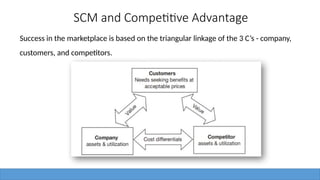
SCM and Competitive Advantage
Success in the marketplace is based on the triangular linkage of the 3 C’s - company,
customers, and competitors.
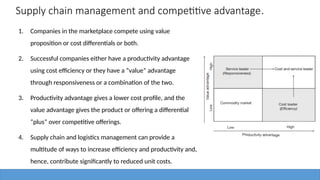
Supply chain management and competitive advantage.
1. Companies in the marketplace compete using value
proposition or cost differentials or both.
2. Successful companies either have a productivity advantage
using cost efficiency or they have a “value” advantage
through responsiveness or a combination of the two.
3. Productivity advantage gives a lower cost profile, and the
value advantage gives the product or offering a differential
“plus” over competitive offerings.
4. Supply chain and logistics management can provide a
multitude of ways to increase efficiency and productivity and,
hence, contribute significantly to reduced unit costs.
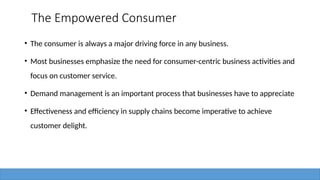
Driving Forces in Business and SCM
Driving forces always influence any business, and any supply chain design should
recognize these forces and reckon with them. They are as follows:
1. The empowered consumer
2. Power shift in the supply chain
3. Liberalization
4. Globalization
5. Technology
The Empowered Consumer
• The consumer is always a major driving force in any business.
• Most businesses emphasize the need for consumer-centric business activities and
focus on customer service.
• Demand management is an important process that businesses have to appreciate
• Effectiveness and efficiency in supply chains become imperative to achieve
customer delight.
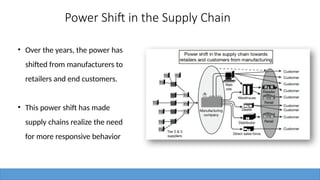
Power Shift in the Supply Chain
• Over the years, the power has
shifted from manufacturers to
retailers and end customers.
• This power shift has made
supply chains realize the need
for more responsive behavior
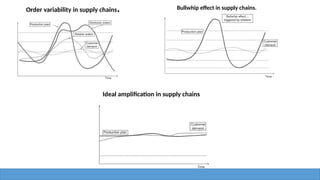
Order variability in supply chains. Bullwhip effect in supply chains.
Ideal amplification in supply chains
Liberalization
• It is one of the major driving forces that influences any business as this is
caused by economic policies of governments and political changes.
• Such policy changes have been witnessed in India since 1995 when
economic liberalization of the Indian economy started with many
decontrol measures.
• The economy was opened up for many changes, and opportunities such as
changing economic controls empowered creativity and competition
among companies and industries.
Globalization
• Globalization trends:
 growing interdependence of the world’s economies.
 cultures.
 populations.
• It is brought about by cross-border trade in goods and services, technology, and flows of
investment, people, and information.
• This has made countries build economic partnerships to facilitate movements across the
globe.
• It has resulted in a global marketplace concept with global network sourcing, manufacturing,
marketing, and distribution.
Technology
• Due to increased globalization, product complexity and customer demands have
made companies scale up advanced technologies to transform their supply chains
from pure operations into focusing on business innovation.
• A few important technologies that have helped achieve such efficiencies:
machine learning .
artificial intelligence.
advanced analytics.
Overview of Logistics Management
• Logistics management is historically a branch of military science.
• One practical definition is the layperson’s description of logistics as the seven R’s, which means
ensuring the availability of
1. Right product, in the
2. Right quantity and the
3. Right condition, at the
4. Right place, at the
5. Right time, for the
6. Right customer, at the
7. Right cost .
Definitions
“Logistics is the physical movement of goods from supply points to final sale to customers and the
associated transfer and holding of such goods at various intermediate storage points, accomplished
in such manner as to contribute to the explicit goals of the organization.
The definition of CSCMP is more comprehensive and addresses all the facets of logistics that are:
1. It is part of SCM as one of the processes,
2. It is a management function,
3. It addresses the efficiency and effectiveness of the forward and reverse flow and storage of
goods,
4. It addresses the intangible side of logistics as a service,
5. It covers the entire flow from raw material point till final consumption,
6. It should be served from a customer’s point of view and not internally but externally
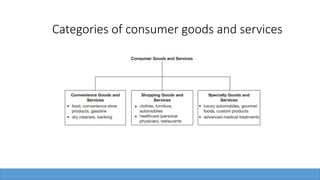
Categories of consumer goods and services
Activities in Logistics
The logistics function of a company focuses on the following activities
1. Customer service
2. Demand forecasting/planning
3. Inventory management
4. Logistics communications
5. Material handling
6. Order processing
7. Packaging
8. Parts and service support
9. Plant and warehouse site selection
10. Procurement
11. Return goods handling
12. Reverse logistics
13. Traffic and transportation
14. Warehousing and storage
Approaches in Logistics
Designing logistics systems, the following approaches and perspectives separately or
in combination can help in understanding the complexities and help planning
strategies in logistics:
• Materials Management versus Physical Distribution.
• Cost Centers.
• Nodes versus Links (Network Perspective).
• Logistics Channel (Channel Perspective).
Cost Considerations in Logistics
While implementing a logistics plan, it is important to understand the major factors
that affect the cost of logistics and its importance. They are categorized as follows:
1. Competitive relationships
2. Product relationships
3. Spatial relationships
Interfaces of Logistics with Other Functions
• Logistics with the Manufacturing and Production Function
1. Length of production runs balances economies of long production runs against
increased costs of high inventories.
2. Seasonal demand accepts a seasonal inventory to balance lead production times.
3. Supply-side interfaces maintain stocks and adequate supplies to ensure uninterrupted
production.
4. Protective packaging is done to protect the product from damage.
5. Foreign and third-party alternatives are evaluated for outsourcing
• Logistics with the Marketing Function
The major customer-contact activities in an organization are sales and logistics. The major
interface with marketing is with the four P’s of marketing: price, product, place, and promotion.
They are briefly explained as follows:
1. Carrier pricing
2. Matching schedules
3. Volume relationships
5. Push versus pull
6. Channel competition
7. Wholesalers
8. Retailers
Key Actors in Logistics
The key actors that create the place and time utility of products and foster the
economic growth of a country:
1. The shipper (user of logistics)
2. The carrier (rail, road, air, water, pipeline, etc.)
3. Warehousing corporations
4. Freight forwarders
5. Terminal operators (ports, stevedores, etc.)
6. Government (regulator of logistics)
Overview of Supply Chain Management
• The term SCM started appearing in 1982 and still has many semantic
definitions that have since appeared in many research journals.
• The initial usage of the term SCM emphasized a reduction in inventory both
within and across firms, but that initial perspective has been broadening.
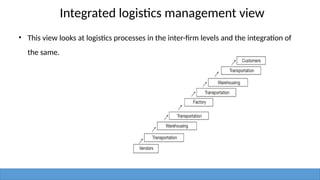
Integrated logistics management view
• This view looks at logistics processes in the inter-firm levels and the integration of
the same.
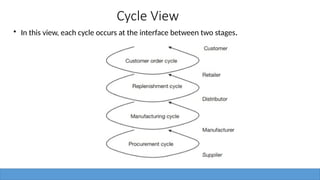
Cycle View
• In this view, each cycle occurs at the interface between two stages.
Push and Pull View
• This view is an important view and looks at SCM from the manufacturing point of view.
• The view identifies the push/pull boundaries that take place in a supply chain and looks
at the manufacturing strategy to handle the boundaries.
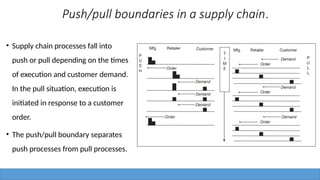
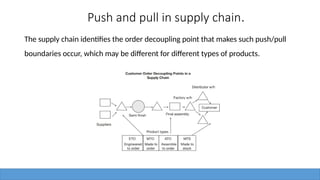
Push/pull boundaries in a supply chain.
• Supply chain processes fall into
push or pull depending on the times
of execution and customer demand.
In the pull situation, execution is
initiated in response to a customer
order.
• The push/pull boundary separates
push processes from pull processes.
Push and pull in supply chain.
The supply chain identifies the order decoupling point that makes such push/pull
boundaries occur, which may be different for different types of products.
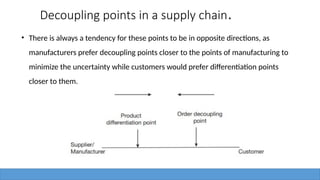
Decoupling points in a supply chain.
• There is always a tendency for these points to be in opposite directions, as
manufacturers prefer decoupling points closer to the points of manufacturing to
minimize the uncertainty while customers would prefer differentiation points
closer to them.
Process View of Supply Chain
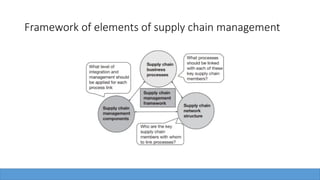
The conceptual framework of this approach is based on the following three
elements that are major and closely related:1. Business processes, which are
activities that produce a specific output of value to the customer.
2. Management components by which business processes are structured and
managed.
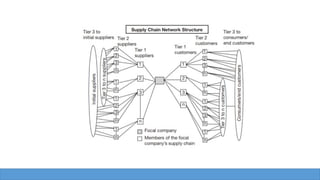
3.Supply chain network structure, which is the configuration of companies within a
supply chain.
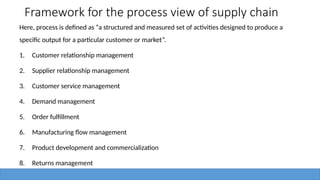
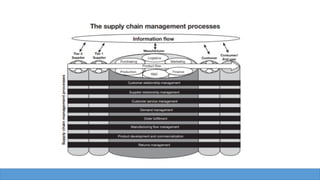
Framework for the process view of supply chain
Here, process is defined as “a structured and measured set of activities designed to produce a
specific output for a particular customer or market”.
1. Customer relationship management
2. Supplier relationship management
3. Customer service management
4. Demand management
5. Order fulfillment
6. Manufacturing flow management
7. Product development and commercialization
8. Returns management
Supply chain management processes
• Successful SCM involves the coordination of activities within the firm and
between members of the supply chain.
• Although the focus does not reduce the importance of functional expertise, SCM
requires transition from a functional organization to one focused on business
processes first inside the firm and then across firms in the supply chain.
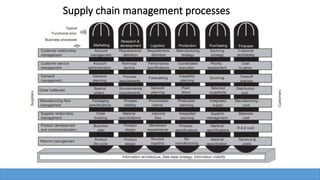
Supply chain management processes
Framework of elements of supply chain management
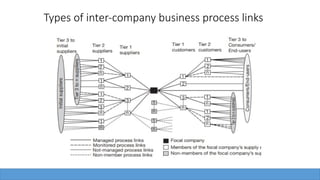
Types of inter-company business process links
Drivers of Supply Chain Performance
1. Facilities- places where inventory is stored, assembled, or fabricated production
sites and storage sites.
2. Inventory- covering raw materials, WIP, finished goods within supply chain
inventory policies.
3. Transportation- moving inventory from point to point in a supply chain and
combinations of transportation modes and routes.
4. Information- data and analysis regarding inventory, transportation, facilities
throughout the supply chain and potentially the biggest driver of supply chain
performance.
Supply Chain Analytics
• The full impact of Big Data in supply chain is restrained by two major challenges.
First, there is a lack of capabilities. Supply chain managers—even those with a
high degree of technical skills— have little or no experience with the data analysis
techniques used by data scientists.
Second, most companies lack a structured process to explore, evaluate, and
capture Big Data opportunities in their supply chains.
• Supply chain analytics uses data and quantitative methods to improve decision
making for all activities across the supply chain. Particularly, it does two new
things.
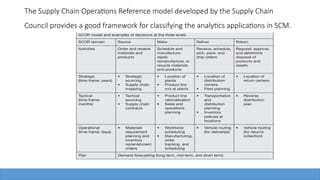
The Supply Chain Operations Reference model developed by the Supply Chain
Council provides a good framework for classifying the analytics applications in SCM.
SCOR model and decisions at different levels.
• Descriptive Analytics
• Predictive Analytics
• Prescriptive Analytics
• Cognitive Analytics

Thank you

Supply chain analytics Supply chain analytics ch1.pptx

  • 1.
    SUPPLY CHAIN ANALYTICS “Supply ChainAnalytics” T. A. S. Vijayaraghavan Copyright @ 2021 Wiley India Pvt. Ltd. All rights reserved. “Supply Chain Analytics” T. A. S. Vijayaraghavan Copyright @ 2021 Wiley India Pvt. Ltd. All rights reserved.
  • 2.
    SECTION I Overview ofLogistics and Supply Chain Management
  • 3.
    CHAPTER 1 Overview ofLogistics and Supply Chain Management
  • 4.
    Introduction • Supply chainmanagement has gained prominence over the past three decades. • Keith Oliver is believed to have coined the term by first using it in an interview with the Financial Times on 4 June 1982. • Customers demand quality products, better innovations, and variety and expect them to be consistently delivered on time and with no damage. • This necessitates closer coordination with suppliers and distributors, which has increased performance-based competition, combined with changing technology and economic conditions contributing to marketplace uncertainty.
  • 5.
    SCM and CompetitiveAdvantage Success in the marketplace is based on the triangular linkage of the 3 C’s - company, customers, and competitors.
  • 6.
    Supply chain managementand competitive advantage. 1. Companies in the marketplace compete using value proposition or cost differentials or both. 2. Successful companies either have a productivity advantage using cost efficiency or they have a “value” advantage through responsiveness or a combination of the two. 3. Productivity advantage gives a lower cost profile, and the value advantage gives the product or offering a differential “plus” over competitive offerings. 4. Supply chain and logistics management can provide a multitude of ways to increase efficiency and productivity and, hence, contribute significantly to reduced unit costs.
  • 7.
    Driving Forces inBusiness and SCM Driving forces always influence any business, and any supply chain design should recognize these forces and reckon with them. They are as follows: 1. The empowered consumer 2. Power shift in the supply chain 3. Liberalization 4. Globalization 5. Technology
  • 8.
    The Empowered Consumer •The consumer is always a major driving force in any business. • Most businesses emphasize the need for consumer-centric business activities and focus on customer service. • Demand management is an important process that businesses have to appreciate • Effectiveness and efficiency in supply chains become imperative to achieve customer delight.
  • 9.
    Power Shift inthe Supply Chain • Over the years, the power has shifted from manufacturers to retailers and end customers. • This power shift has made supply chains realize the need for more responsive behavior
  • 10.
    Order variability insupply chains. Bullwhip effect in supply chains. Ideal amplification in supply chains
  • 11.
    Liberalization • It isone of the major driving forces that influences any business as this is caused by economic policies of governments and political changes. • Such policy changes have been witnessed in India since 1995 when economic liberalization of the Indian economy started with many decontrol measures. • The economy was opened up for many changes, and opportunities such as changing economic controls empowered creativity and competition among companies and industries.
  • 12.
    Globalization • Globalization trends: growing interdependence of the world’s economies.  cultures.  populations. • It is brought about by cross-border trade in goods and services, technology, and flows of investment, people, and information. • This has made countries build economic partnerships to facilitate movements across the globe. • It has resulted in a global marketplace concept with global network sourcing, manufacturing, marketing, and distribution.
  • 13.
    Technology • Due toincreased globalization, product complexity and customer demands have made companies scale up advanced technologies to transform their supply chains from pure operations into focusing on business innovation. • A few important technologies that have helped achieve such efficiencies: machine learning . artificial intelligence. advanced analytics.
  • 14.
    Overview of LogisticsManagement • Logistics management is historically a branch of military science. • One practical definition is the layperson’s description of logistics as the seven R’s, which means ensuring the availability of 1. Right product, in the 2. Right quantity and the 3. Right condition, at the 4. Right place, at the 5. Right time, for the 6. Right customer, at the 7. Right cost .
  • 15.
    Definitions “Logistics is thephysical movement of goods from supply points to final sale to customers and the associated transfer and holding of such goods at various intermediate storage points, accomplished in such manner as to contribute to the explicit goals of the organization. The definition of CSCMP is more comprehensive and addresses all the facets of logistics that are: 1. It is part of SCM as one of the processes, 2. It is a management function, 3. It addresses the efficiency and effectiveness of the forward and reverse flow and storage of goods, 4. It addresses the intangible side of logistics as a service, 5. It covers the entire flow from raw material point till final consumption, 6. It should be served from a customer’s point of view and not internally but externally
  • 16.
    Categories of consumergoods and services
  • 17.
    Activities in Logistics Thelogistics function of a company focuses on the following activities 1. Customer service 2. Demand forecasting/planning 3. Inventory management 4. Logistics communications 5. Material handling 6. Order processing 7. Packaging 8. Parts and service support 9. Plant and warehouse site selection 10. Procurement 11. Return goods handling 12. Reverse logistics 13. Traffic and transportation 14. Warehousing and storage
  • 18.
    Approaches in Logistics Designinglogistics systems, the following approaches and perspectives separately or in combination can help in understanding the complexities and help planning strategies in logistics: • Materials Management versus Physical Distribution. • Cost Centers. • Nodes versus Links (Network Perspective). • Logistics Channel (Channel Perspective).
  • 19.
    Cost Considerations inLogistics While implementing a logistics plan, it is important to understand the major factors that affect the cost of logistics and its importance. They are categorized as follows: 1. Competitive relationships 2. Product relationships 3. Spatial relationships
  • 20.
    Interfaces of Logisticswith Other Functions • Logistics with the Manufacturing and Production Function 1. Length of production runs balances economies of long production runs against increased costs of high inventories. 2. Seasonal demand accepts a seasonal inventory to balance lead production times. 3. Supply-side interfaces maintain stocks and adequate supplies to ensure uninterrupted production. 4. Protective packaging is done to protect the product from damage. 5. Foreign and third-party alternatives are evaluated for outsourcing
  • 21.
    • Logistics withthe Marketing Function The major customer-contact activities in an organization are sales and logistics. The major interface with marketing is with the four P’s of marketing: price, product, place, and promotion. They are briefly explained as follows: 1. Carrier pricing 2. Matching schedules 3. Volume relationships 5. Push versus pull 6. Channel competition 7. Wholesalers 8. Retailers
  • 22.
    Key Actors inLogistics The key actors that create the place and time utility of products and foster the economic growth of a country: 1. The shipper (user of logistics) 2. The carrier (rail, road, air, water, pipeline, etc.) 3. Warehousing corporations 4. Freight forwarders 5. Terminal operators (ports, stevedores, etc.) 6. Government (regulator of logistics)
  • 23.
    Overview of SupplyChain Management • The term SCM started appearing in 1982 and still has many semantic definitions that have since appeared in many research journals. • The initial usage of the term SCM emphasized a reduction in inventory both within and across firms, but that initial perspective has been broadening.
  • 24.
    Integrated logistics managementview • This view looks at logistics processes in the inter-firm levels and the integration of the same.
  • 25.
    Cycle View • Inthis view, each cycle occurs at the interface between two stages.
  • 26.
    Push and PullView • This view is an important view and looks at SCM from the manufacturing point of view. • The view identifies the push/pull boundaries that take place in a supply chain and looks at the manufacturing strategy to handle the boundaries.
  • 27.
    Push/pull boundaries ina supply chain. • Supply chain processes fall into push or pull depending on the times of execution and customer demand. In the pull situation, execution is initiated in response to a customer order. • The push/pull boundary separates push processes from pull processes.
  • 28.
    Push and pullin supply chain. The supply chain identifies the order decoupling point that makes such push/pull boundaries occur, which may be different for different types of products.
  • 29.
    Decoupling points ina supply chain. • There is always a tendency for these points to be in opposite directions, as manufacturers prefer decoupling points closer to the points of manufacturing to minimize the uncertainty while customers would prefer differentiation points closer to them.
  • 30.
    Process View ofSupply Chain The conceptual framework of this approach is based on the following three elements that are major and closely related:1. Business processes, which are activities that produce a specific output of value to the customer. 2. Management components by which business processes are structured and managed. 3.Supply chain network structure, which is the configuration of companies within a supply chain.
  • 32.
    Framework for theprocess view of supply chain Here, process is defined as “a structured and measured set of activities designed to produce a specific output for a particular customer or market”. 1. Customer relationship management 2. Supplier relationship management 3. Customer service management 4. Demand management 5. Order fulfillment 6. Manufacturing flow management 7. Product development and commercialization 8. Returns management
  • 34.
    Supply chain managementprocesses • Successful SCM involves the coordination of activities within the firm and between members of the supply chain. • Although the focus does not reduce the importance of functional expertise, SCM requires transition from a functional organization to one focused on business processes first inside the firm and then across firms in the supply chain.
  • 35.
  • 36.
    Framework of elementsof supply chain management
  • 37.
    Types of inter-companybusiness process links
  • 38.
    Drivers of SupplyChain Performance 1. Facilities- places where inventory is stored, assembled, or fabricated production sites and storage sites. 2. Inventory- covering raw materials, WIP, finished goods within supply chain inventory policies. 3. Transportation- moving inventory from point to point in a supply chain and combinations of transportation modes and routes. 4. Information- data and analysis regarding inventory, transportation, facilities throughout the supply chain and potentially the biggest driver of supply chain performance.
  • 39.
    Supply Chain Analytics •The full impact of Big Data in supply chain is restrained by two major challenges. First, there is a lack of capabilities. Supply chain managers—even those with a high degree of technical skills— have little or no experience with the data analysis techniques used by data scientists. Second, most companies lack a structured process to explore, evaluate, and capture Big Data opportunities in their supply chains. • Supply chain analytics uses data and quantitative methods to improve decision making for all activities across the supply chain. Particularly, it does two new things.
  • 40.
    The Supply ChainOperations Reference model developed by the Supply Chain Council provides a good framework for classifying the analytics applications in SCM.
  • 41.
    SCOR model anddecisions at different levels. • Descriptive Analytics • Predictive Analytics • Prescriptive Analytics • Cognitive Analytics
  • 42.