1
Introduction to
Supply Chain Management (SCM)
Presentation by:
Seyed Hamid Hashemi Petrudi
PhD student of POM at University of Tehran
hhashemip@yahoo.com - s.hamidhashemi@ut.ac.ir
Contents
2
What is a supply chain?
House of supply chain management?
SCM strategies
Supply chain performance measurement
New trends in supply chain management
What is a supply chain?
3
Information Flow
Raw Materials
RETAILERFACTORY DC RDCSUPPLIER
Finished Goods
RETAILERFACTORY DCSUPPLIER
Cash flow3 key flows
What is a supply chain?
4
the supply chain of Natural Gas in Iran
What is a supply chain?
A supply chain consists of all parties involved, directly or indirectly, in
fulfilling a customer request. The supply chain includes not only the
manufacturer and suppliers, but also transporters, warehouses,
retailers, and even customers themselves (Chopra and Meindl, 2007).
5
Categorization of SCM definitions
Ahi and Searcy (2013) reviewed supply chain definitions by focusing on
different concepts as follows:
 Flow
 Coordination
 Stakeholders
 Relationship
 Value
 Efficiency
 Performance
6
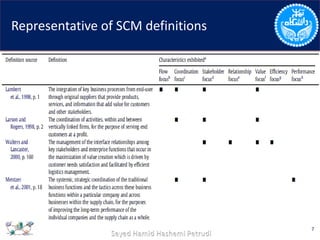
Representative of SCM definitions
7
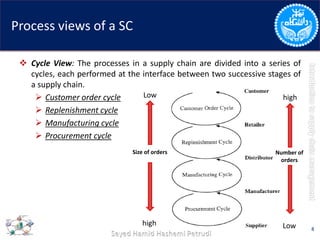
Process views of a SC
 Cycle View: The processes in a supply chain are divided into a series of
cycles, each performed at the interface between two successive stages of
a supply chain.
 Customer order cycle
 Replenishment cycle
 Manufacturing cycle
 Procurement cycle
8
Number of
orders
high
Lowhigh
Low
Size of orders
Process views of a SC (cont.)
 Push/Pull View: The processes in a supply chain are divided into two
categories depending on whether they are executed in response to a
customer order or in anticipation of customer orders.
 Pull processes: response to the customers’ order
 Push processes: response to the anticipation of demands
9
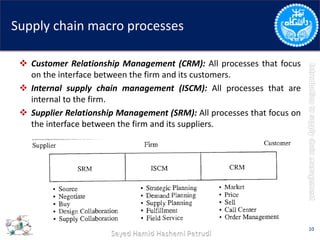
Supply chain macro processes
 Customer Relationship Management (CRM): All processes that focus
on the interface between the firm and its customers.
 Internal supply chain management (ISCM): All processes that are
internal to the firm.
 Supplier Relationship Management (SRM): All processes that focus on
the interface between the firm and its suppliers.
10
Contents
11
What is a supply chain?
House of supply chain management?
SCM strategies
Supply chain performance measurement
New trends in supply chain management
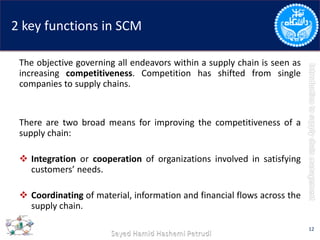
2 key functions in SCM
The objective governing all endeavors within a supply chain is seen as
increasing competitiveness. Competition has shifted from single
companies to supply chains.
There are two broad means for improving the competitiveness of a
supply chain:
 Integration or cooperation of organizations involved in satisfying
customers’ needs.
 Coordinating of material, information and financial flows across the
supply chain.
12
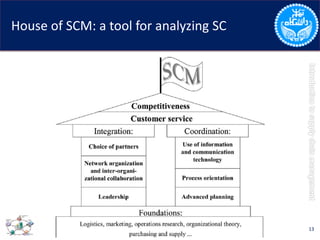
House of SCM: a tool for analyzing SC
13
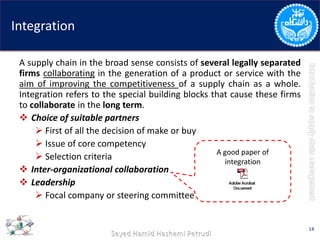
Integration
A supply chain in the broad sense consists of several legally separated
firms collaborating in the generation of a product or service with the
aim of improving the competitiveness of a supply chain as a whole.
Integration refers to the special building blocks that cause these firms
to collaborate in the long term.
 Choice of suitable partners
 First of all the decision of make or buy
 Issue of core competency
 Selection criteria
 Inter-organizational collaboration
 Leadership
 Focal company or steering committee
14
A good paper of
integration
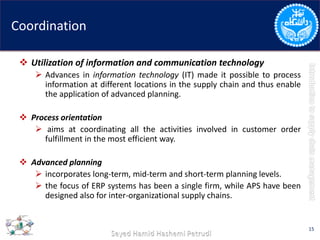
Coordination
 Utilization of information and communication technology
 Advances in information technology (IT) made it possible to process
information at different locations in the supply chain and thus enable
the application of advanced planning.
 Process orientation
 aims at coordinating all the activities involved in customer order
fulfillment in the most efficient way.
 Advanced planning
 incorporates long-term, mid-term and short-term planning levels.
 the focus of ERP systems has been a single firm, while APS have been
designed also for inter-organizational supply chains.
15
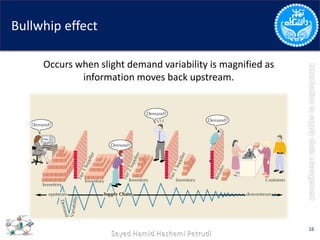
Bullwhip effect
Occurs when slight demand variability is magnified as
information moves back upstream.
16
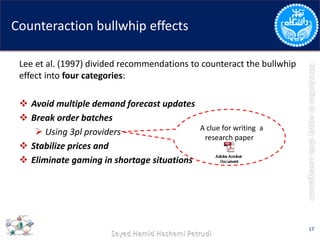
Counteraction bullwhip effects
Lee et al. (1997) divided recommendations to counteract the bullwhip
effect into four categories:
 Avoid multiple demand forecast updates
 Break order batches
 Using 3pl providers
 Stabilize prices and
 Eliminate gaming in shortage situations
17
AA clue for writing a
research paper
Contents
18
What is a supply chain?
House of supply chain management?
SCM strategies
Supply chain performance measurement
New trends in supply chain management
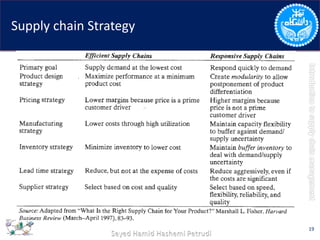
Supply chain Strategy
19
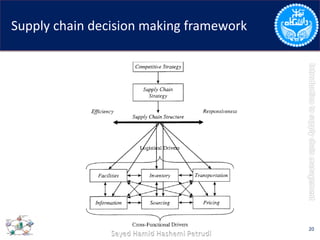
Supply chain decision making framework
20
Decision phases in a SC
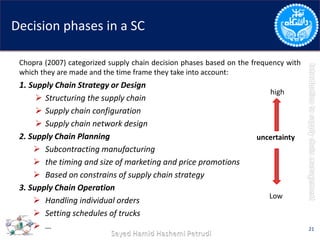
Chopra (2007) categorized supply chain decision phases based on the frequency with
which they are made and the time frame they take into account:
1. Supply Chain Strategy or Design
 Structuring the supply chain
 Supply chain configuration
 Supply chain network design
2. Supply Chain Planning
 Subcontracting manufacturing
 the timing and size of marketing and price promotions
 Based on constrains of supply chain strategy
3. Supply Chain Operation
 Handling individual orders
 Setting schedules of trucks
 … 21
uncertainty
high
Low
Supply chain planning matrix (SCP matrix)
22
Contents
23
What is a supply chain?
House of supply chain management?
SCM strategies
Supply chain performance measurement
New trends in supply chain management
Supply chain performance measurement
The Supply Chain Operations Reference (SCOR) model:
is a tool for representing, analyzing and configuring supply chains.
The SCOR-model is a reference model. It does not provide any optimization
methods, but aims at providing a standardized terminology for the
description of supply chains. This standardization allows benchmarking of
processes and the extraction of best practices for certain processes.
The standard processes are divided into four hierarchical levels:
 process types
 process categories
 process elements
 Implementation (not included in SCOR model)
24
Level 1 – Process Types
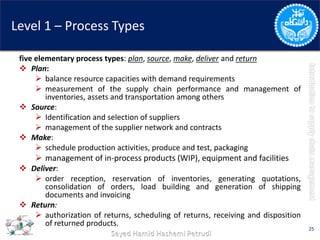
five elementary process types: plan, source, make, deliver and return
 Plan:
 balance resource capacities with demand requirements
 measurement of the supply chain performance and management of
inventories, assets and transportation among others
 Source:
 Identification and selection of suppliers
 management of the supplier network and contracts
 Make:
 schedule production activities, produce and test, packaging
 management of in-process products (WIP), equipment and facilities
 Deliver:
 order reception, reservation of inventories, generating quotations,
consolidation of orders, load building and generation of shipping
documents and invoicing
 Return:
 authorization of returns, scheduling of returns, receiving and disposition
of returned products.
25
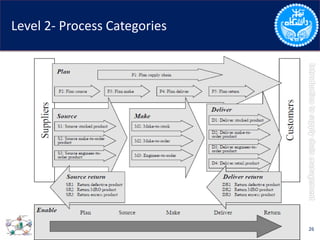
Level 2- Process Categories
26
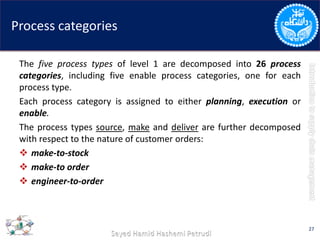
Process categories
The five process types of level 1 are decomposed into 26 process
categories, including five enable process categories, one for each
process type.
Each process category is assigned to either planning, execution or
enable.
The process types source, make and deliver are further decomposed
with respect to the nature of customer orders:
 make-to-stock
 make-to order
 engineer-to-order
27
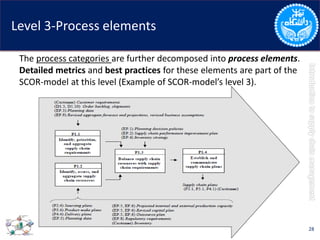
Level 3-Process elements
The process categories are further decomposed into process elements.
Detailed metrics and best practices for these elements are part of the
SCOR-model at this level (Example of SCOR-model’s level 3).
28
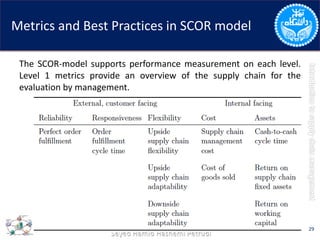
Metrics and Best Practices in SCOR model
The SCOR-model supports performance measurement on each level.
Level 1 metrics provide an overview of the supply chain for the
evaluation by management.
29
A good subject for your dissertation:
sustainable balance scorecard (SBSC) application in SCM.
How we can establish SCOR model for a specific supply chain?
Please use a case study
Your practice
Deadline: December, 5th, 2013
30
Contents
31
What is a supply chain?
House of supply chain management?
SCM strategies
Supply chain performance measurement
New trends in supply chain management
New trend in SCM
 New concerns:
 Service SCM
 Green SCM
 Sustainable SCM
 Humanitarian SCM
 New focused areas:
 Health care
 Air line
 Hotels
 Agriculture
 Renewable energies
 Projects supply chain
32
Service supply chain
Baltacioglu et al. (2007) define the service supply chain as the network of
suppliers, service providers, consumers and other supporting units that
performs the functions of transaction of resources required to produce
services, transformation of these resources into supporting and core
services, and the delivery of these services to customers.
 The customer perceives all services s/he receives as one and as aiming to
provide her/him the ultimate benefit.
SSCs Like Hospitals, Hotels, Universities, MTN Irancell, assurance
agencies, etc.
33
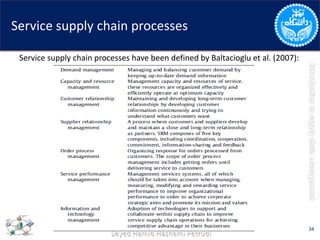
Service supply chain processes
Service supply chain processes have been defined by Baltacioglu et al. (2007):
34
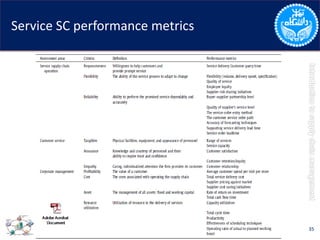
Service SC performance metrics
35
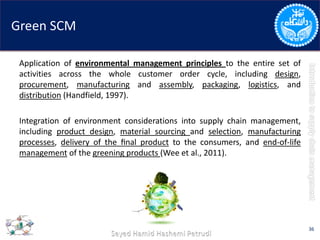
Green SCM
Application of environmental management principles to the entire set of
activities across the whole customer order cycle, including design,
procurement, manufacturing and assembly, packaging, logistics, and
distribution (Handfield, 1997).
Integration of environment considerations into supply chain management,
including product design, material sourcing and selection, manufacturing
processes, delivery of the final product to the consumers, and end-of-life
management of the greening products (Wee et al., 2011).
36
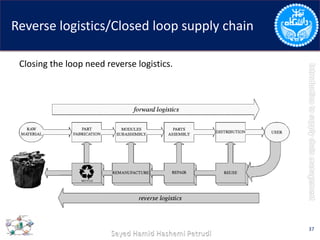
Reverse logistics/Closed loop supply chain
Closing the loop need reverse logistics.
37
Sustainable SCM
The management of material, information and capital flows as well as
cooperation among companies along the supply chain while taking goals from
all three dimensions of sustainable development, i.e., economic,
environmental and social, into account which are derived from customer and
stakeholder requirements (Seuring, 2008).
An extension to the traditional concept of Supply Chain Management by
adding environmental and social/ethical aspects (Wittstruck &Teuteberg,
2011).
38
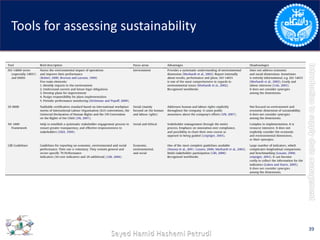
Tools for assessing sustainability
39
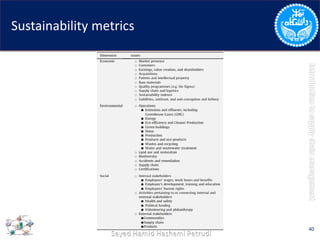
Sustainability metrics
40
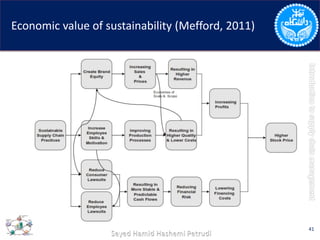
Economic value of sustainability (Mefford, 2011)
41
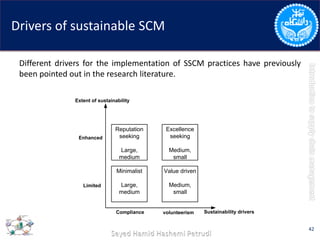
Drivers of sustainable SCM
Different drivers for the implementation of SSCM practices have previously
been pointed out in the research literature.
42
Extent of sustainability
Sustainability driversvolunteerismCompliance
Limited
Enhanced
Minimalist
Large,
medium
Value driven
Medium,
small
Reputation
seeking
Large,
medium
Excellence
seeking
Medium,
small
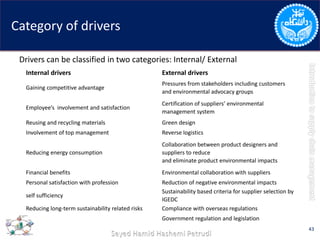
Category of drivers
Drivers can be classified in two categories: Internal/ External
43
Internal drivers External drivers
Gaining competitive advantage
Pressures from stakeholders including customers
and environmental advocacy groups
Employee’s involvement and satisfaction
Certification of suppliers’ environmental
management system
Reusing and recycling materials Green design
Involvement of top management Reverse logistics
Reducing energy consumption
Collaboration between product designers and
suppliers to reduce
and eliminate product environmental impacts
Financial benefits Environmental collaboration with suppliers
Personal satisfaction with profession Reduction of negative environmental impacts
self sufficiency
Sustainability based criteria for supplier selection by
IGEDC
Reducing long-term sustainability related risks Compliance with overseas regulations
Government regulation and legislation
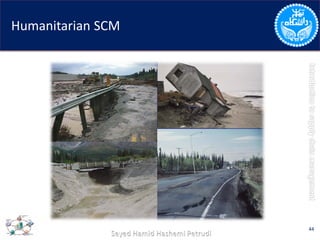
Humanitarian SCM
44
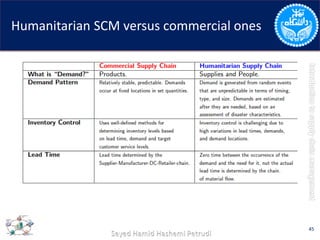
Humanitarian SCM versus commercial ones
45
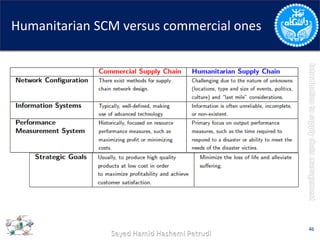
Humanitarian SCM versus commercial ones
46
Humanitarian efforts
Humanitarian efforts are organized along two broad lines:
 Disaster relief
 Continuous aid work
disaster relief deals with calamities, destructive actions, and plagues (Long
1997). Continuous aid work is mainly required in the case of plagues and
crises.
Logistics is the most important element in any disaster relief effort, and it is
the one that makes the difference between a successful and a failed
operation.
47
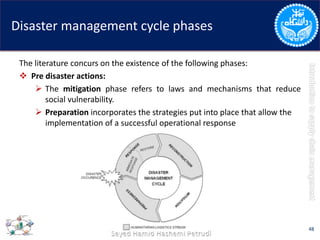
Disaster management cycle phases
The literature concurs on the existence of the following phases:
 Pre disaster actions:
 The mitigation phase refers to laws and mechanisms that reduce
social vulnerability.
 Preparation incorporates the strategies put into place that allow the
implementation of a successful operational response
48
Disaster management cycle phases (cont.)
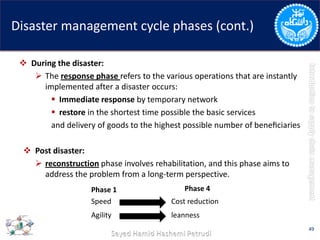
 During the disaster:
 The response phase refers to the various operations that are instantly
implemented after a disaster occurs:
 Immediate response by temporary network
 restore in the shortest time possible the basic services
and delivery of goods to the highest possible number of beneficiaries
 Post disaster:
 reconstruction phase involves rehabilitation, and this phase aims to
address the problem from a long-term perspective.
49
Speed Cost reduction
Phase 1 Phase 4
Agility leanness
Role of companies in HSCM
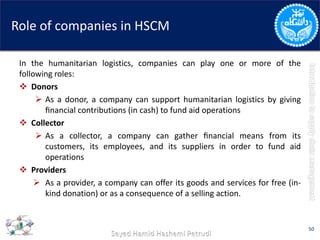
In the humanitarian logistics, companies can play one or more of the
following roles:
 Donors
 As a donor, a company can support humanitarian logistics by giving
financial contributions (in cash) to fund aid operations
 Collector
 As a collector, a company can gather financial means from its
customers, its employees, and its suppliers in order to fund aid
operations
 Providers
 As a provider, a company can offer its goods and services for free (in-
kind donation) or as a consequence of a selling action.
50
New subjects for thesis
em
51
Any question?
With the best wishes for you.
52
Humility is the product of knowledge
Imam Ali

Supply Chain Management & new trends

  • 1.
    1 Introduction to Supply ChainManagement (SCM) Presentation by: Seyed Hamid Hashemi Petrudi PhD student of POM at University of Tehran hhashemip@yahoo.com - s.hamidhashemi@ut.ac.ir
  • 2.
    Contents 2 What is asupply chain? House of supply chain management? SCM strategies Supply chain performance measurement New trends in supply chain management
  • 3.
    What is asupply chain? 3 Information Flow Raw Materials RETAILERFACTORY DC RDCSUPPLIER Finished Goods RETAILERFACTORY DCSUPPLIER Cash flow3 key flows
  • 4.
    What is asupply chain? 4 the supply chain of Natural Gas in Iran
  • 5.
    What is asupply chain? A supply chain consists of all parties involved, directly or indirectly, in fulfilling a customer request. The supply chain includes not only the manufacturer and suppliers, but also transporters, warehouses, retailers, and even customers themselves (Chopra and Meindl, 2007). 5
  • 6.
    Categorization of SCMdefinitions Ahi and Searcy (2013) reviewed supply chain definitions by focusing on different concepts as follows:  Flow  Coordination  Stakeholders  Relationship  Value  Efficiency  Performance 6
  • 7.
    Representative of SCMdefinitions 7
  • 8.
    Process views ofa SC  Cycle View: The processes in a supply chain are divided into a series of cycles, each performed at the interface between two successive stages of a supply chain.  Customer order cycle  Replenishment cycle  Manufacturing cycle  Procurement cycle 8 Number of orders high Lowhigh Low Size of orders
  • 9.
    Process views ofa SC (cont.)  Push/Pull View: The processes in a supply chain are divided into two categories depending on whether they are executed in response to a customer order or in anticipation of customer orders.  Pull processes: response to the customers’ order  Push processes: response to the anticipation of demands 9
  • 10.
    Supply chain macroprocesses  Customer Relationship Management (CRM): All processes that focus on the interface between the firm and its customers.  Internal supply chain management (ISCM): All processes that are internal to the firm.  Supplier Relationship Management (SRM): All processes that focus on the interface between the firm and its suppliers. 10
  • 11.
    Contents 11 What is asupply chain? House of supply chain management? SCM strategies Supply chain performance measurement New trends in supply chain management
  • 12.
    2 key functionsin SCM The objective governing all endeavors within a supply chain is seen as increasing competitiveness. Competition has shifted from single companies to supply chains. There are two broad means for improving the competitiveness of a supply chain:  Integration or cooperation of organizations involved in satisfying customers’ needs.  Coordinating of material, information and financial flows across the supply chain. 12
  • 13.
    House of SCM:a tool for analyzing SC 13
  • 14.
    Integration A supply chainin the broad sense consists of several legally separated firms collaborating in the generation of a product or service with the aim of improving the competitiveness of a supply chain as a whole. Integration refers to the special building blocks that cause these firms to collaborate in the long term.  Choice of suitable partners  First of all the decision of make or buy  Issue of core competency  Selection criteria  Inter-organizational collaboration  Leadership  Focal company or steering committee 14 A good paper of integration
  • 15.
    Coordination  Utilization ofinformation and communication technology  Advances in information technology (IT) made it possible to process information at different locations in the supply chain and thus enable the application of advanced planning.  Process orientation  aims at coordinating all the activities involved in customer order fulfillment in the most efficient way.  Advanced planning  incorporates long-term, mid-term and short-term planning levels.  the focus of ERP systems has been a single firm, while APS have been designed also for inter-organizational supply chains. 15
  • 16.
    Bullwhip effect Occurs whenslight demand variability is magnified as information moves back upstream. 16
  • 17.
    Counteraction bullwhip effects Leeet al. (1997) divided recommendations to counteract the bullwhip effect into four categories:  Avoid multiple demand forecast updates  Break order batches  Using 3pl providers  Stabilize prices and  Eliminate gaming in shortage situations 17 AA clue for writing a research paper
  • 18.
    Contents 18 What is asupply chain? House of supply chain management? SCM strategies Supply chain performance measurement New trends in supply chain management
  • 19.
  • 20.
    Supply chain decisionmaking framework 20
  • 21.
    Decision phases ina SC Chopra (2007) categorized supply chain decision phases based on the frequency with which they are made and the time frame they take into account: 1. Supply Chain Strategy or Design  Structuring the supply chain  Supply chain configuration  Supply chain network design 2. Supply Chain Planning  Subcontracting manufacturing  the timing and size of marketing and price promotions  Based on constrains of supply chain strategy 3. Supply Chain Operation  Handling individual orders  Setting schedules of trucks  … 21 uncertainty high Low
  • 22.
    Supply chain planningmatrix (SCP matrix) 22
  • 23.
    Contents 23 What is asupply chain? House of supply chain management? SCM strategies Supply chain performance measurement New trends in supply chain management
  • 24.
    Supply chain performancemeasurement The Supply Chain Operations Reference (SCOR) model: is a tool for representing, analyzing and configuring supply chains. The SCOR-model is a reference model. It does not provide any optimization methods, but aims at providing a standardized terminology for the description of supply chains. This standardization allows benchmarking of processes and the extraction of best practices for certain processes. The standard processes are divided into four hierarchical levels:  process types  process categories  process elements  Implementation (not included in SCOR model) 24
  • 25.
    Level 1 –Process Types five elementary process types: plan, source, make, deliver and return  Plan:  balance resource capacities with demand requirements  measurement of the supply chain performance and management of inventories, assets and transportation among others  Source:  Identification and selection of suppliers  management of the supplier network and contracts  Make:  schedule production activities, produce and test, packaging  management of in-process products (WIP), equipment and facilities  Deliver:  order reception, reservation of inventories, generating quotations, consolidation of orders, load building and generation of shipping documents and invoicing  Return:  authorization of returns, scheduling of returns, receiving and disposition of returned products. 25
  • 26.
    Level 2- ProcessCategories 26
  • 27.
    Process categories The fiveprocess types of level 1 are decomposed into 26 process categories, including five enable process categories, one for each process type. Each process category is assigned to either planning, execution or enable. The process types source, make and deliver are further decomposed with respect to the nature of customer orders:  make-to-stock  make-to order  engineer-to-order 27
  • 28.
    Level 3-Process elements Theprocess categories are further decomposed into process elements. Detailed metrics and best practices for these elements are part of the SCOR-model at this level (Example of SCOR-model’s level 3). 28
  • 29.
    Metrics and BestPractices in SCOR model The SCOR-model supports performance measurement on each level. Level 1 metrics provide an overview of the supply chain for the evaluation by management. 29
  • 30.
    A good subjectfor your dissertation: sustainable balance scorecard (SBSC) application in SCM. How we can establish SCOR model for a specific supply chain? Please use a case study Your practice Deadline: December, 5th, 2013 30
  • 31.
    Contents 31 What is asupply chain? House of supply chain management? SCM strategies Supply chain performance measurement New trends in supply chain management
  • 32.
    New trend inSCM  New concerns:  Service SCM  Green SCM  Sustainable SCM  Humanitarian SCM  New focused areas:  Health care  Air line  Hotels  Agriculture  Renewable energies  Projects supply chain 32
  • 33.
    Service supply chain Baltaciogluet al. (2007) define the service supply chain as the network of suppliers, service providers, consumers and other supporting units that performs the functions of transaction of resources required to produce services, transformation of these resources into supporting and core services, and the delivery of these services to customers.  The customer perceives all services s/he receives as one and as aiming to provide her/him the ultimate benefit. SSCs Like Hospitals, Hotels, Universities, MTN Irancell, assurance agencies, etc. 33
  • 34.
    Service supply chainprocesses Service supply chain processes have been defined by Baltacioglu et al. (2007): 34
  • 35.
  • 36.
    Green SCM Application ofenvironmental management principles to the entire set of activities across the whole customer order cycle, including design, procurement, manufacturing and assembly, packaging, logistics, and distribution (Handfield, 1997). Integration of environment considerations into supply chain management, including product design, material sourcing and selection, manufacturing processes, delivery of the final product to the consumers, and end-of-life management of the greening products (Wee et al., 2011). 36
  • 37.
    Reverse logistics/Closed loopsupply chain Closing the loop need reverse logistics. 37
  • 38.
    Sustainable SCM The managementof material, information and capital flows as well as cooperation among companies along the supply chain while taking goals from all three dimensions of sustainable development, i.e., economic, environmental and social, into account which are derived from customer and stakeholder requirements (Seuring, 2008). An extension to the traditional concept of Supply Chain Management by adding environmental and social/ethical aspects (Wittstruck &Teuteberg, 2011). 38
  • 39.
    Tools for assessingsustainability 39
  • 40.
  • 41.
    Economic value ofsustainability (Mefford, 2011) 41
  • 42.
    Drivers of sustainableSCM Different drivers for the implementation of SSCM practices have previously been pointed out in the research literature. 42 Extent of sustainability Sustainability driversvolunteerismCompliance Limited Enhanced Minimalist Large, medium Value driven Medium, small Reputation seeking Large, medium Excellence seeking Medium, small
  • 43.
    Category of drivers Driverscan be classified in two categories: Internal/ External 43 Internal drivers External drivers Gaining competitive advantage Pressures from stakeholders including customers and environmental advocacy groups Employee’s involvement and satisfaction Certification of suppliers’ environmental management system Reusing and recycling materials Green design Involvement of top management Reverse logistics Reducing energy consumption Collaboration between product designers and suppliers to reduce and eliminate product environmental impacts Financial benefits Environmental collaboration with suppliers Personal satisfaction with profession Reduction of negative environmental impacts self sufficiency Sustainability based criteria for supplier selection by IGEDC Reducing long-term sustainability related risks Compliance with overseas regulations Government regulation and legislation
  • 44.
  • 45.
    Humanitarian SCM versuscommercial ones 45
  • 46.
    Humanitarian SCM versuscommercial ones 46
  • 47.
    Humanitarian efforts Humanitarian effortsare organized along two broad lines:  Disaster relief  Continuous aid work disaster relief deals with calamities, destructive actions, and plagues (Long 1997). Continuous aid work is mainly required in the case of plagues and crises. Logistics is the most important element in any disaster relief effort, and it is the one that makes the difference between a successful and a failed operation. 47
  • 48.
    Disaster management cyclephases The literature concurs on the existence of the following phases:  Pre disaster actions:  The mitigation phase refers to laws and mechanisms that reduce social vulnerability.  Preparation incorporates the strategies put into place that allow the implementation of a successful operational response 48
  • 49.
    Disaster management cyclephases (cont.)  During the disaster:  The response phase refers to the various operations that are instantly implemented after a disaster occurs:  Immediate response by temporary network  restore in the shortest time possible the basic services and delivery of goods to the highest possible number of beneficiaries  Post disaster:  reconstruction phase involves rehabilitation, and this phase aims to address the problem from a long-term perspective. 49 Speed Cost reduction Phase 1 Phase 4 Agility leanness
  • 50.
    Role of companiesin HSCM In the humanitarian logistics, companies can play one or more of the following roles:  Donors  As a donor, a company can support humanitarian logistics by giving financial contributions (in cash) to fund aid operations  Collector  As a collector, a company can gather financial means from its customers, its employees, and its suppliers in order to fund aid operations  Providers  As a provider, a company can offer its goods and services for free (in- kind donation) or as a consequence of a selling action. 50
  • 51.
    New subjects forthesis em 51
  • 52.
    Any question? With thebest wishes for you. 52 Humility is the product of knowledge Imam Ali